AQA · A-Level · History
Course version: 7042 · Version from Sept 2017
The USSR and the Soviet Empire, 1953–2000 (A-level only) – Soviet…
Full specification wording
2T The Crisis of Communism: The USSR and the Soviet Empire, 1953–2000 (A-level only) – Soviet Satellites, 1953–1968: The political and economic condition of the satellite states of central Europe: Poland and the leadership of Gomulka; Czechoslovakia and the leadership of Novotny; Hungary and the leadership of Nagy; Rakosi, Gero and Kadar; East Germany and the leadership of Ulbricht; the political organisation and influence of the Communist Party; economic organisation, state of collectivisation and the centrally planned economy; political and economic strengths and weaknesses of states
Central European satellite states faced distinct political and economic conditions under Soviet hegemony.
Checked against the AQA 7042 specification (opens in a new tab) on .
- Point 1 of 4
- 4 key terms
Study notes
From the checked teaching notes for this specification point.
The idea
Central European satellite states faced distinct political and economic conditions under Soviet hegemony. In Poland, Gomulka navigated a 'Polish road to socialism', halting collectivisation. Czechoslovakia under Novotny maintained rigid central planning, leading to economic stagnation. Hungary experienced turmoil: Rakosi and Gero's hardline rule sparked the 1956 uprising led by Nagy, before Kadar restored order with 'Goulash Communism'. East Germany under Ulbricht strictly followed Soviet models, building the Berlin Wall to stem emigration. Across these states, the Communist Party held absolute political influence. Economically, centrally planned economies and varying states of collectivisation created weaknesses like consumer shortages, despite strengths in heavy industrial output.
What earns the marks
- Compare the different leadership styles and their impact on national stability, such as Gomulka's initial reforms versus Ulbricht's hardline approach.
- Assess the role and pervasive influence of the Communist Party apparatus in maintaining political control across the satellite states.
- Evaluate the economic consequences of centrally planned economies, focusing on the imbalance between heavy industry and consumer goods.
- Analyse the varying degrees of success in agricultural collectivisation, contrasting Poland's abandonment of the policy with East Germany's completion of it.
- Examine the political and economic weaknesses that made these regimes vulnerable to popular unrest, such as in Hungary in 1956.
Common mistakes and how to put them right
Treating all satellite states as identical Soviet clones.
Put it right: Highlight the specific national variations, such as Kadar's 'Goulash Communism' in Hungary or Gomulka's agricultural concessions in Poland.
Confusing the chronological order of Hungarian leaders.
Put it right: Ensure the sequence is clear: Rakosi's Stalinist rule, Gero's brief tenure, Nagy's reformist leadership during the 1956 uprising, and Kadar's subsequent consolidation of power.
Assuming centrally planned economies had no strengths.
Put it right: Acknowledge that while flawed, these economies initially succeeded in rapid industrialisation and providing basic employment and housing.
Exam tips
- When discussing economic weaknesses, use specific examples like the failure of the New Economic Model in Czechoslovakia under Novotny to illustrate systemic flaws.
- Contrast the political organisation of the states to show how leaders like Ulbricht relied heavily on secret police (Stasi) compared to Kadar's later, more relaxed social contract.
- Link the state of collectivisation directly to the political stability of the regime, noting how forced collectivisation often triggered rural resistance.
Try the lesson
The start of the 2T The Crisis of Communism: The USSR and the Soviet Empire, 1953–2000 (A-level only) – Soviet Satellites, 1953–1968: The political and economic condition of the satellite states of central Europe: Poland and the leadership of Gomulka; Czechoslovakia and the leadership of Novotny; Hungary and the leadership of Nagy; Rakosi, Gero and Kadar; East Germany and the leadership of Ulbricht; the political organisation and influence of the Communist Party; economic organisation, state of collectivisation and the centrally planned economy; political and economic strengths and weaknesses of states lesson, made from checked teaching notes for this specification point.
Have a go first
Which leader was appointed as Prime Minister of Hungary during the 1956 uprising and subsequently executed after the Soviet intervention?
Listen
Central European satellite states faced distinct political and economic conditions under Soviet hegemony. In Poland, Gomulka navigated a 'Polish road to socialism', halting collectivisation. Czechoslovakia under Novotny maintained rigid central planning, leading to economic stagnation. Hungary experienced turmoil: Rakosi and Gero's hardline rule sparked the 1956 uprising led by Nagy, before Kadar restored order with 'Goulash Communism'. East Germany under Ulbricht strictly followed Soviet models, building the Berlin Wall to stem emigration. Across these states, the Communist Party held absolute political influence. Economically, centrally planned economies and varying states of collectivisation created weaknesses like consumer shortages, despite strengths in heavy industrial output. A strong answer earns marks for these points. Compare the different leadership styles and their impact on national stability, such as Gomulka's initial reforms versus Ulbricht's hardline approach. Assess the role and pervasive influence of the Communist Party apparatus in maintaining political control across the satellite states. Evaluate the economic consequences of centrally planned economies, focusing on the imbalance between heavy industry and consumer goods. Analyse the varying degrees of success in agricultural collectivisation, contrasting Poland's abandonment of the policy with East Germany's completion of it. A common slip: Treating all satellite states as identical Soviet clones. Instead, Highlight the specific national variations, such as Kadar's 'Goulash Communism' in Hungary or Gomulka's agricultural concessions in Poland. Exam tip: When discussing economic weaknesses, use specific examples like the failure of the New Economic Model in Czechoslovakia under Novotny to illustrate systemic flaws.
See it
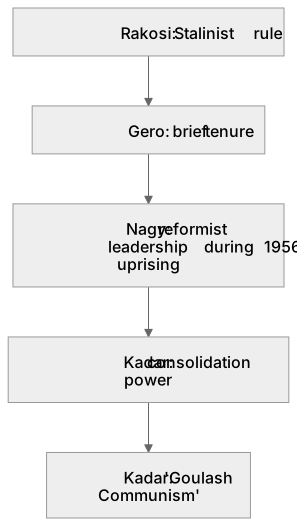
Put it in order
Put these steps in the order they happen.
- 1. Gero: brief tenure
- 2. Nagy: reformist leadership during 1956 uprising
- 3. Rakosi: Stalinist rule
- 4. Kadar: 'Goulash Communism'
- 5. Kadar: consolidation of power
Key words
Say what each word means before you turn the card.
Soviet hegemony and national sovereignty
Try answering aloud or in your head before turning the card.
Economic centralisation versus reform
Try answering aloud or in your head before turning the card.
Political repression and dissent
Try answering aloud or in your head before turning the card.
Variations in communist leadership
Try answering aloud or in your head before turning the card.
See every definition
- Soviet hegemony and national sovereignty
- Central European satellite states faced distinct political and economic conditions under Soviet hegemony, with national variations such as Gomulka's 'Polish road to socialism'.
- Economic centralisation versus reform
- Czechoslovakia under Novotny maintained rigid central planning, leading to economic stagnation, while Gomulka halted collectivisation in Poland.
- Political repression and dissent
- Rakosi and Gero's hardline rule sparked the 1956 uprising led by Nagy, before Kadar restored order with 'Goulash Communism'.
- Variations in communist leadership
- Gomulka navigated a 'Polish road to socialism', Novotny maintained rigid central planning, and Ulbricht strictly followed Soviet models.
Label the diagram
Some boxes have lost their names. Pick the right name for each number.
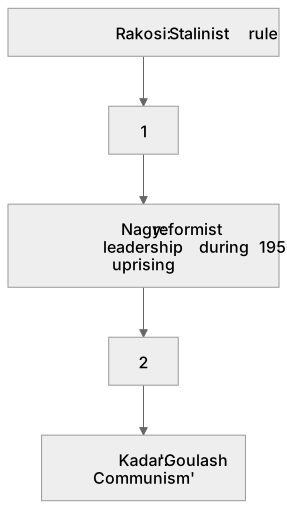
1Box 1
2Box 2
There is more to this lesson
The full lesson goes on to check your understanding and help you earn the marks. Create a free account to carry on, with your progress saved.
A week of Premium from your first lesson · Then the free plan continues · No card, no charge
Test your understanding of 2T The Crisis of Communism: The USSR and the Soviet Empire, 1953–2000 (A-level only) – Soviet Satellites, 1953–1968: The political and economic condition of the satellite states of central Europe: Poland and the leadership of Gomulka; Czechoslovakia and the leadership of Novotny; Hungary and the leadership of Nagy; Rakosi, Gero and Kadar; East Germany and the leadership of Ulbricht; the political organisation and influence of the Communist Party; economic organisation, state of collectivisation and the centrally planned economy; political and economic strengths and weaknesses of states
Active recall beats re-reading. Take an instant quiz now to test what you’ve learned and lock it into long-term memory.
A week of Premium from your first lesson · Then the free plan continues · No card, no charge