AQA · A-Level · History
Course version: 7042 · Version from Sept 2017
The USSR and the Soviet Empire, 1953–2000 (A-level only) – The Gorbachev…
Full specification wording
2T The Crisis of Communism: The USSR and the Soviet Empire, 1953–2000 (A-level only) – The Gorbachev Revolution, 1985–2000: Gorbachev as leader: personality, aims and power base; reasons for perestroika, glasnost and demokratizatsiya; withdrawal from Afghanistan and readiness to end the Cold War; summit meetings leading to the Malta Agreement
Mikhail Gorbachev’s dynamic personality and reformist aims contrasted sharply with his predecessors.
Checked against the AQA 7042 specification (opens in a new tab) on .
- Point 1 of 4
- 4 key terms
Study notes
From the checked teaching notes for this specification point.
The idea
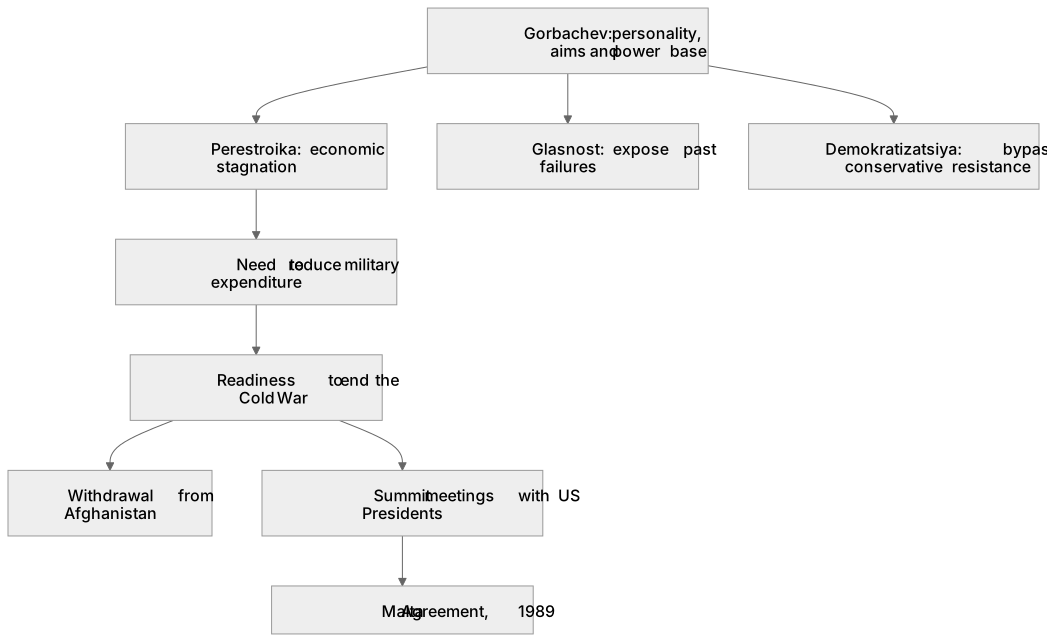
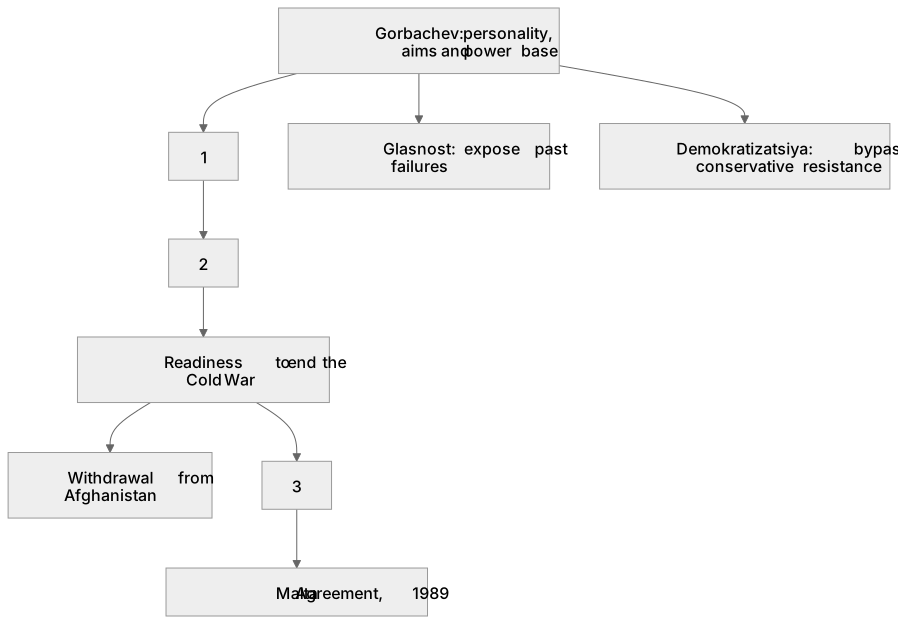
Mikhail Gorbachev’s dynamic personality and reformist aims contrasted sharply with his predecessors. Leveraging his Politburo power base, he introduced radical policies to save the Soviet system. He initiated 'perestroika' to combat economic stagnation, 'glasnost' to expose past failures, and 'demokratizatsiya' to bypass conservative resistance by engaging the public. Recognising that domestic reform required reducing military expenditure, Gorbachev showed a readiness to end the Cold War. This pragmatism drove the withdrawal of Soviet troops from Afghanistan. He also engaged in pivotal summit meetings with US Presidents, culminating in the decisive 1989 Malta Agreement, which effectively declared an end to the Cold War.
What earns the marks
- Evaluate how Gorbachev's personality and aims differed from previous leaders, enabling him to consolidate a reformist power base.
- Analyse the distinct reasons for introducing perestroika (economic efficiency), glasnost (transparency), and demokratizatsiya (political participation).
- Assess the economic and political motivations behind the Soviet withdrawal from Afghanistan.
- Explain how Gorbachev's readiness to end the Cold War was intrinsically linked to his domestic reform agenda.
- Trace the progression of US-Soviet summit meetings, evaluating their cumulative impact leading up to the Malta Agreement.
Common mistakes and how to put them right
Treating perestroika, glasnost, and demokratizatsiya as a single, undifferentiated reform policy.
Put it right: Clearly distinguish the specific aims of each policy: economic restructuring, social/political openness, and political democratisation, respectively.
Claiming Gorbachev aimed to dismantle communism and dissolve the Soviet Union from the start.
Put it right: Emphasise that his initial aim was to reform and save the communist system, not destroy it.
Attributing the end of the Cold War solely to US pressure.
Put it right: Highlight Gorbachev's proactive readiness to end the conflict and his initiation of summit diplomacy to reduce the Soviet military burden.
Exam tips
- When evaluating Gorbachev's foreign policy, explicitly link his diplomatic initiatives, such as the summit meetings, to his need to fund domestic perestroika.
- Use the withdrawal from Afghanistan as a key example of Gorbachev breaking with the Brezhnev Doctrine and prioritising internal reform over external empire.
- Be prepared to discuss how glasnost inadvertently undermined Gorbachev's power base by allowing public criticism of the Soviet system's foundational myths.
Try the lesson
The start of the 2T The Crisis of Communism: The USSR and the Soviet Empire, 1953–2000 (A-level only) – The Gorbachev Revolution, 1985–2000: Gorbachev as leader: personality, aims and power base; reasons for perestroika, glasnost and demokratizatsiya; withdrawal from Afghanistan and readiness to end the Cold War; summit meetings leading to the Malta Agreement lesson, made from checked teaching notes for this specification point.
Have a go first
Which of Mikhail Gorbachev's key policies was specifically aimed at introducing 'openness' and reducing state censorship in the Soviet Union?
Listen
Mikhail Gorbachev’s dynamic personality and reformist aims contrasted sharply with his predecessors. Leveraging his Politburo power base, he introduced radical policies to save the Soviet system. He initiated 'perestroika' to combat economic stagnation, 'glasnost' to expose past failures, and 'demokratizatsiya' to bypass conservative resistance by engaging the public. Recognising that domestic reform required reducing military expenditure, Gorbachev showed a readiness to end the Cold War. This pragmatism drove the withdrawal of Soviet troops from Afghanistan. He also engaged in pivotal summit meetings with US Presidents, culminating in the decisive 1989 Malta Agreement, which effectively declared an end to the Cold War. A strong answer earns marks for these points. Evaluate how Gorbachev's personality and aims differed from previous leaders, enabling him to consolidate a reformist power base. Analyse the distinct reasons for introducing perestroika (economic efficiency), glasnost (transparency), and demokratizatsiya (political participation). Assess the economic and political motivations behind the Soviet withdrawal from Afghanistan. Explain how Gorbachev's readiness to end the Cold War was intrinsically linked to his domestic reform agenda. A common slip: Treating perestroika, glasnost, and demokratizatsiya as a single, undifferentiated reform policy. Instead, Clearly distinguish the specific aims of each policy: economic restructuring, social/political openness, and political democratisation, respectively. Exam tip: When evaluating Gorbachev's foreign policy, explicitly link his diplomatic initiatives, such as the summit meetings, to his need to fund domestic perestroika.
See it
Key words
Say what each word means before you turn the card.
perestroika
Try answering aloud or in your head before turning the card.
glasnost
Try answering aloud or in your head before turning the card.
demokratizatsiya
Try answering aloud or in your head before turning the card.
Malta Agreement
Try answering aloud or in your head before turning the card.
See every definition
- perestroika
- A radical policy initiated to combat economic stagnation and save the Soviet system.
- glasnost
- A radical policy introduced to expose past failures and provide transparency.
- demokratizatsiya
- A radical policy intended to bypass conservative resistance by engaging the public and encouraging political participation.
- Malta Agreement
- The decisive 1989 summit agreement which effectively declared an end to the Cold War.
Label the diagram
Some boxes have lost their names. Pick the right name for each number.
1Box 1
2Box 2
3Box 3
There is more to this lesson
The full lesson goes on to check your understanding and help you earn the marks. Create a free account to carry on, with your progress saved.
A week of Premium from your first lesson · Then the free plan continues · No card, no charge
Test your understanding of 2T The Crisis of Communism: The USSR and the Soviet Empire, 1953–2000 (A-level only) – The Gorbachev Revolution, 1985–2000: Gorbachev as leader: personality, aims and power base; reasons for perestroika, glasnost and demokratizatsiya; withdrawal from Afghanistan and readiness to end the Cold War; summit meetings leading to the Malta Agreement
Active recall beats re-reading. Take an instant quiz now to test what you’ve learned and lock it into long-term memory.
A week of Premium from your first lesson · Then the free plan continues · No card, no charge