AQA · A-Level · History
Course version: 7042 · Version from Sept 2017
The USSR and the Soviet Empire, 1953–2000 (A-level only) – The Gorbachev…
Full specification wording
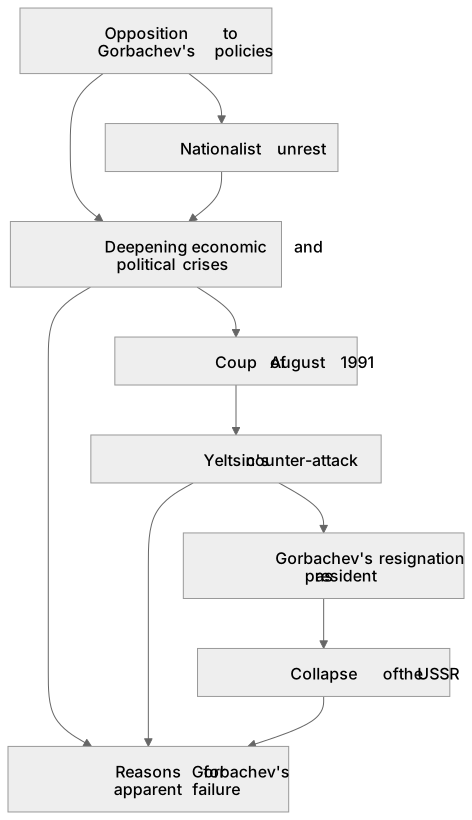
2T The Crisis of Communism: The USSR and the Soviet Empire, 1953–2000 (A-level only) – The Gorbachev Revolution, 1985–2000: Revolution and counter-revolution in the USSR: opposition to Gorbachev's policies; nationalist unrest; deepening economic and political crises; the coup of August 1991 and Yeltsin's counter-attack; Gorbachev's resignation as president; the collapse of the USSR; reasons for Gorbachev's apparent failure
The late Gorbachev era saw revolution and counter-revolution as reforms triggered deepening economic and political crises.
Checked against the AQA 7042 specification (opens in a new tab) on .
- Point 3 of 4
- 4 key terms
Study notes
From the checked teaching notes for this specification point.
The idea
The late Gorbachev era saw revolution and counter-revolution as reforms triggered deepening economic and political crises. Opposition to Gorbachev's policies grew among hardline conservatives and radical reformers alike. Simultaneously, nationalist unrest exploded in the Baltics and Caucasus, fracturing Soviet unity. This culminated in the August 1991 coup by hardliners seeking to halt the new Union Treaty. Boris Yeltsin’s decisive counter-attack defeated the coup, fatally weakening the centre. Consequently, Gorbachev's resignation as president in December 1991 marked the formal collapse of the USSR. Reasons for Gorbachev's apparent failure include his inability to balance competing factions, the disastrous economic outcomes of Perestroika, and his fatal underestimation of nationalism.
What earns the marks
- Analyse the dual nature of opposition to Gorbachev, contrasting the conservative desire for stability with the radical demand for faster reform.
- Evaluate the role of nationalist unrest in the Baltic states and the Caucasus in accelerating the political crisis and dismantling the Soviet empire.
- Assess the significance of the August 1991 coup and Yeltsin's counter-attack in shifting power from the Soviet centre to the Russian Republic.
- Synthesise the long-term and short-term reasons for Gorbachev's failure, including economic mismanagement, political miscalculations, and the resurgence of nationalism.
Common mistakes and how to put them right
Claiming the August 1991 coup was led by Yeltsin.
Put it right: The coup was orchestrated by conservative hardliners (the Gang of Eight), while Yeltsin led the counter-attack against them.
Stating that Gorbachev resigned as President of Russia.
Put it right: He resigned as President of the Soviet Union, a position that ceased to exist upon the collapse of the USSR.
Attributing the collapse of the USSR solely to economic failure, ignoring the crucial catalyst of nationalist unrest and the political paralysis caused by the 1991 coup.
Exam tips
- When discussing the collapse of the USSR, explicitly link the deepening economic crisis to the rise of nationalist unrest, as economic failure undermined the legitimacy of the central government.
- Use the August 1991 coup as a critical turning point to explain why Gorbachev's authority evaporated and Yeltsin emerged as the dominant political figure.
- Structure essays on Gorbachev's failure by categorising his mistakes into economic, political, and social (nationalist) misjudgements to ensure a comprehensive analysis.
Try the lesson
The start of the 2T The Crisis of Communism: The USSR and the Soviet Empire, 1953–2000 (A-level only) – The Gorbachev Revolution, 1985–2000: Revolution and counter-revolution in the USSR: opposition to Gorbachev's policies; nationalist unrest; deepening economic and political crises; the coup of August 1991 and Yeltsin's counter-attack; Gorbachev's resignation as president; the collapse of the USSR; reasons for Gorbachev's apparent failure lesson, made from checked teaching notes for this specification point.
Have a go first
Who led the prominent public counter-attack against the hardline communist plotters during the August 1991 coup attempt?
Listen
The late Gorbachev era saw revolution and counter-revolution as reforms triggered deepening economic and political crises. Opposition to Gorbachev's policies grew among hardline conservatives and radical reformers alike. Simultaneously, nationalist unrest exploded in the Baltics and Caucasus, fracturing Soviet unity. This culminated in the August 1991 coup by hardliners seeking to halt the new Union Treaty. Boris Yeltsin’s decisive counter-attack defeated the coup, fatally weakening the centre. Consequently, Gorbachev's resignation as president in December 1991 marked the formal collapse of the USSR. Reasons for Gorbachev's apparent failure include his inability to balance competing factions, the disastrous economic outcomes of Perestroika, and his fatal underestimation of nationalism. A strong answer earns marks for these points. Analyse the dual nature of opposition to Gorbachev, contrasting the conservative desire for stability with the radical demand for faster reform. Evaluate the role of nationalist unrest in the Baltic states and the Caucasus in accelerating the political crisis and dismantling the Soviet empire. Assess the significance of the August 1991 coup and Yeltsin's counter-attack in shifting power from the Soviet centre to the Russian Republic. Synthesise the long-term and short-term reasons for Gorbachev's failure, including economic mismanagement, political miscalculations, and the resurgence of nationalism. Exam tip: When discussing the collapse of the USSR, explicitly link the deepening economic crisis to the rise of nationalist unrest, as economic failure undermined the legitimacy of the central government.
See it
Key words
Say what each word means before you turn the card.
Nationalism and separatism
Try answering aloud or in your head before turning the card.
Political opposition and factionalism
Try answering aloud or in your head before turning the card.
Crisis and collapse
Try answering aloud or in your head before turning the card.
Leadership and political miscalculation
Try answering aloud or in your head before turning the card.
See every definition
- Nationalism and separatism
- Unrest that exploded in the Baltics and Caucasus, fracturing Soviet unity and accelerating the political crisis and dismantling of the Soviet empire.
- Political opposition and factionalism
- Opposition to Gorbachev's policies that grew among hardline conservatives and radical reformers alike, leaving him unable to balance competing factions.
- Crisis and collapse
- Deepening economic and political crises, culminating in the August 1991 coup and Gorbachev's resignation as president in December 1991, which marked the formal collapse of the USSR.
- Leadership and political miscalculation
- Reasons for Gorbachev's apparent failure include his inability to balance competing factions, disastrous economic outcomes of Perestroika, and fatal underestimation of nationalism.
Label the diagram
Some boxes have lost their names. Pick the right name for each number.
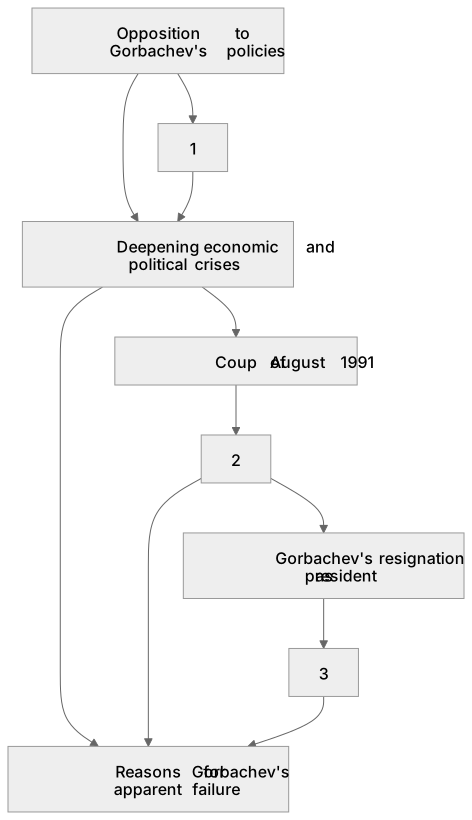
1Box 1
2Box 2
3Box 3
There is more to this lesson
The full lesson goes on to check your understanding and help you earn the marks. Create a free account to carry on, with your progress saved.
A week of Premium from your first lesson · Then the free plan continues · No card, no charge
Test your understanding of 2T The Crisis of Communism: The USSR and the Soviet Empire, 1953–2000 (A-level only) – The Gorbachev Revolution, 1985–2000: Revolution and counter-revolution in the USSR: opposition to Gorbachev's policies; nationalist unrest; deepening economic and political crises; the coup of August 1991 and Yeltsin's counter-attack; Gorbachev's resignation as president; the collapse of the USSR; reasons for Gorbachev's apparent failure
Active recall beats re-reading. Take an instant quiz now to test what you’ve learned and lock it into long-term memory.
A week of Premium from your first lesson · Then the free plan continues · No card, no charge