AQA · A-Level · History
Course version: 7042 · Version from Sept 2017
The USSR and the Soviet Empire, 1953–2000 (A-level only) – Years of…
Full specification wording
2T The Crisis of Communism: The USSR and the Soviet Empire, 1953–2000 (A-level only) – Years of Stagnation, 1964–1985: Pressures for change and the reaction of the regime: political dissidents and protest, including Andrei Sakharov and Alexander Solzhenitsyn; the effect of the Helsinki accords; nationalist unrest; new leaders and political developments: Andropov; limited political and economic reform; Chernenko as leader and stagnation; the reformers and position of Gorbachev
The Soviet regime faced mounting pressures from dissidents like Andrei Sakharov, advocating human rights, and Alexander Solzhenitsyn, exposing the Gulag.
Checked against the AQA 7042 specification (opens in a new tab) on .
- Point 4 of 4
- 3 key terms
Study notes
From the checked teaching notes for this specification point.
The idea
The Soviet regime faced mounting pressures from dissidents like Andrei Sakharov, advocating human rights, and Alexander Solzhenitsyn, exposing the Gulag. The 1975 Helsinki Accords inadvertently fuelled protest by committing the USSR to human rights, emboldening monitoring groups. Simultaneously, nationalist unrest simmered in republics like Ukraine. Following Brezhnev, Yuri Andropov initiated limited political and economic reforms, targeting corruption and labour discipline. His brief tenure gave way to Konstantin Chernenko, whose leadership epitomised political stagnation. This inertia strengthened the position of younger reformers within the Politburo, notably Mikhail Gorbachev, who recognised the urgent need for systemic revitalisation.
What earns the marks
- Assess the impact of the Helsinki Accords in providing a legal framework for Soviet dissidents to demand human rights.
- Evaluate the methods used by the KGB under Andropov to suppress political dissidents like Sakharov and Solzhenitsyn.
- Analyse the nature of Andropov's limited economic reforms, focusing on his anti-corruption campaigns and efforts to improve labour discipline.
- Explain how Chernenko's leadership represented a return to Brezhnev-era stagnation and resistance to structural reform.
- Identify the growing influence of the reformist faction within the Communist Party, highlighting Gorbachev's rise as a response to gerontocracy.
Common mistakes and how to put them right
Claiming the Helsinki Accords were purely a foreign policy victory for the USSR.
Put it right: Acknowledge that while they secured Western recognition of Soviet borders, the human rights clauses created significant internal pressure from dissident monitoring groups.
Confusing the leadership styles and policies of Andropov and Chernenko.
Put it right: Distinguish Andropov as a disciplinarian who attempted limited reforms, whereas Chernenko represented a complete halt to reform and a return to stagnation.
Stating that nationalist unrest was a major, regime-threatening crisis before 1985.
Put it right: Describe nationalist unrest during this period as simmering and persistent, but largely contained by the KGB, rather than an immediate existential threat.
Exam tips
- When discussing dissidents, explicitly link their activities to the international context, such as the Helsinki Accords, to demonstrate a synoptic understanding of internal and external pressures.
- Use the contrast between Andropov's disciplinary reforms and Chernenko's stagnation to explain why the Politburo eventually selected a radical reformer like Gorbachev.
- Avoid treating the 'Years of Stagnation' as entirely uneventful; highlight the underlying social and political tensions that were building up beneath the surface of regime control.
Try the lesson
The start of the 2T The Crisis of Communism: The USSR and the Soviet Empire, 1953–2000 (A-level only) – Years of Stagnation, 1964–1985: Pressures for change and the reaction of the regime: political dissidents and protest, including Andrei Sakharov and Alexander Solzhenitsyn; the effect of the Helsinki accords; nationalist unrest; new leaders and political developments: Andropov; limited political and economic reform; Chernenko as leader and stagnation; the reformers and position of Gorbachev lesson, made from checked teaching notes for this specification point.
Have a go first
Which of the following Soviet leaders succeeded Leonid Brezhnev in 1982 and attempted to introduce limited economic reforms and an anti-corruption campaign?
Listen
The Soviet regime faced mounting pressures from dissidents like Andrei Sakharov, advocating human rights, and Alexander Solzhenitsyn, exposing the Gulag. The 1975 Helsinki Accords inadvertently fuelled protest by committing the USSR to human rights, emboldening monitoring groups. Simultaneously, nationalist unrest simmered in republics like Ukraine. Following Brezhnev, Yuri Andropov initiated limited political and economic reforms, targeting corruption and labour discipline. His brief tenure gave way to Konstantin Chernenko, whose leadership epitomised political stagnation. This inertia strengthened the position of younger reformers within the Politburo, notably Mikhail Gorbachev, who recognised the urgent need for systemic revitalisation. A strong answer earns marks for these points. Assess the impact of the Helsinki Accords in providing a legal framework for Soviet dissidents to demand human rights. Evaluate the methods used by the KGB under Andropov to suppress political dissidents like Sakharov and Solzhenitsyn. Analyse the nature of Andropov's limited economic reforms, focusing on his anti-corruption campaigns and efforts to improve labour discipline. Explain how Chernenko's leadership represented a return to Brezhnev-era stagnation and resistance to structural reform. A common slip: Claiming the Helsinki Accords were purely a foreign policy victory for the USSR. Instead, Acknowledge that while they secured Western recognition of Soviet borders, the human rights clauses created significant internal pressure from dissident monitoring groups. Exam tip: When discussing dissidents, explicitly link their activities to the international context, such as the Helsinki Accords, to demonstrate a synoptic understanding of internal and external pressures.
See it
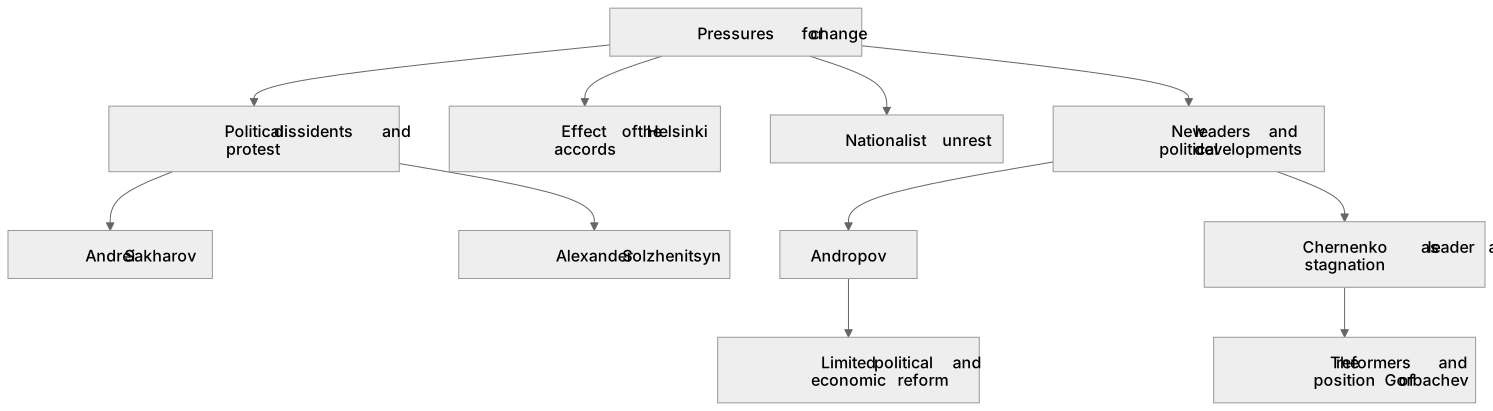
Key words
Say what each word means before you turn the card.
Political dissent and state repression
Try answering aloud or in your head before turning the card.
The impact of international agreements on domestic politics
Try answering aloud or in your head before turning the card.
Generational shifts within the Soviet leadership
Try answering aloud or in your head before turning the card.
See every definition
- Political dissent and state repression
- Pressures for change from political dissidents and protest, including Andrei Sakharov and Alexander Solzhenitsyn, and the reaction of the regime.
- The impact of international agreements on domestic politics
- The 1975 Helsinki Accords inadvertently fuelled protest by committing the USSR to human rights, emboldening monitoring groups.
- Generational shifts within the Soviet leadership
- Inertia strengthened the position of younger reformers within the Politburo, notably Mikhail Gorbachev, who recognised the urgent need for systemic revitalisation.
Label the diagram
Some boxes have lost their names. Pick the right name for each number.
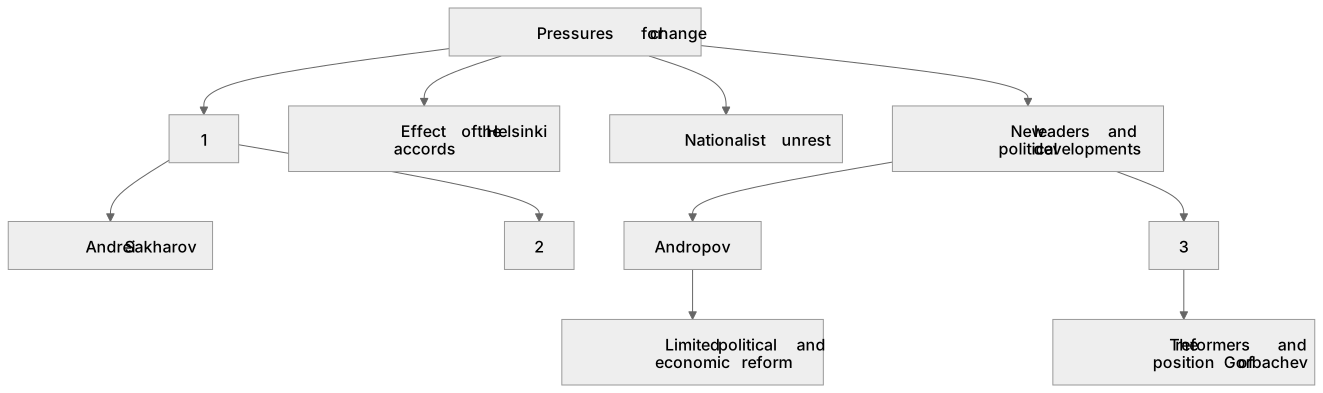
1Box 1
2Box 2
3Box 3
There is more to this lesson
The full lesson goes on to check your understanding and help you earn the marks. Create a free account to carry on, with your progress saved.
A week of Premium from your first lesson · Then the free plan continues · No card, no charge
Test your understanding of 2T The Crisis of Communism: The USSR and the Soviet Empire, 1953–2000 (A-level only) – Years of Stagnation, 1964–1985: Pressures for change and the reaction of the regime: political dissidents and protest, including Andrei Sakharov and Alexander Solzhenitsyn; the effect of the Helsinki accords; nationalist unrest; new leaders and political developments: Andropov; limited political and economic reform; Chernenko as leader and stagnation; the reformers and position of Gorbachev
Active recall beats re-reading. Take an instant quiz now to test what you’ve learned and lock it into long-term memory.
A week of Premium from your first lesson · Then the free plan continues · No card, no charge