Pearson Edexcel · A-Level · History
Anglo-Saxon England and the Anglo-Norman Kingdom, c1053–1106
Master the dramatic end of Anglo-Saxon England and the seismic shock of the Norman Conquest. This guide covers the complex power struggles of the Godwins, the succession crisis of 1066, and the bloody campaigns that reshaped English history forever.
- 8 min read
- 3 worked examples
- 5 practice questions
- 6 key terms
Study Notes
Overview
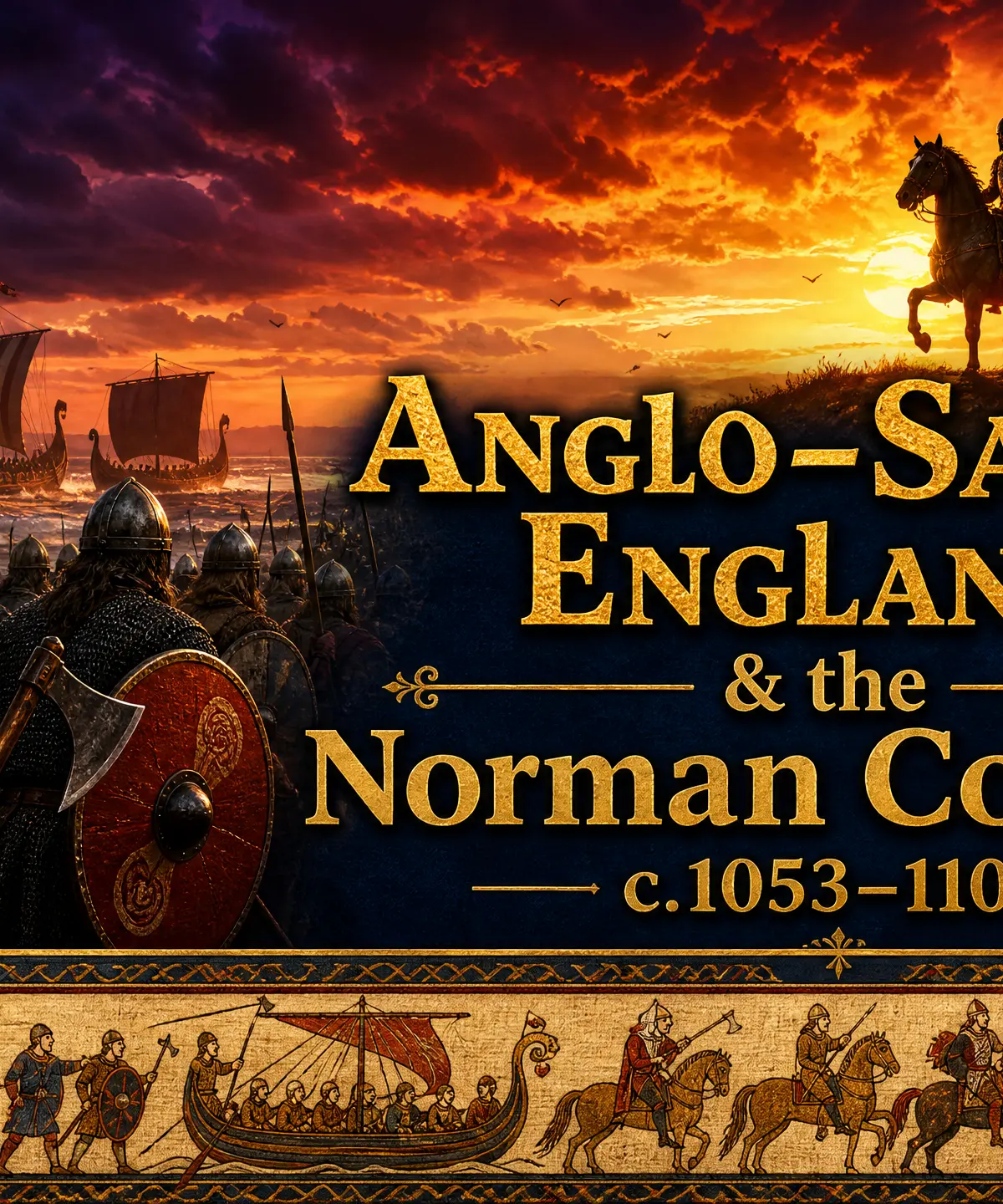
This study covers one of the most transformative periods in English history: the twilight of the Anglo-Saxon kingdom and the dramatic Norman Conquest. From the death of Earl Godwin in 1053 to the decisive Battle of Tinchebray in 1106, this era saw the total restructuring of English society, government, and land ownership. Examiners expect candidates to move beyond simple narrative storytelling; you must analyse the power dynamics of late Anglo-Saxon England, evaluate the legitimacy of the rival claimants in 1066, and explain the profound consequences of the Norman victory. A sophisticated Anglo-Saxon state, characterised by its complex legal system and the dominance of the Godwin family, was replaced by a brutal but highly effective Norman feudal system.
Key Events & Developments
The Power of the Godwin Family
Date(s): 1053–1066
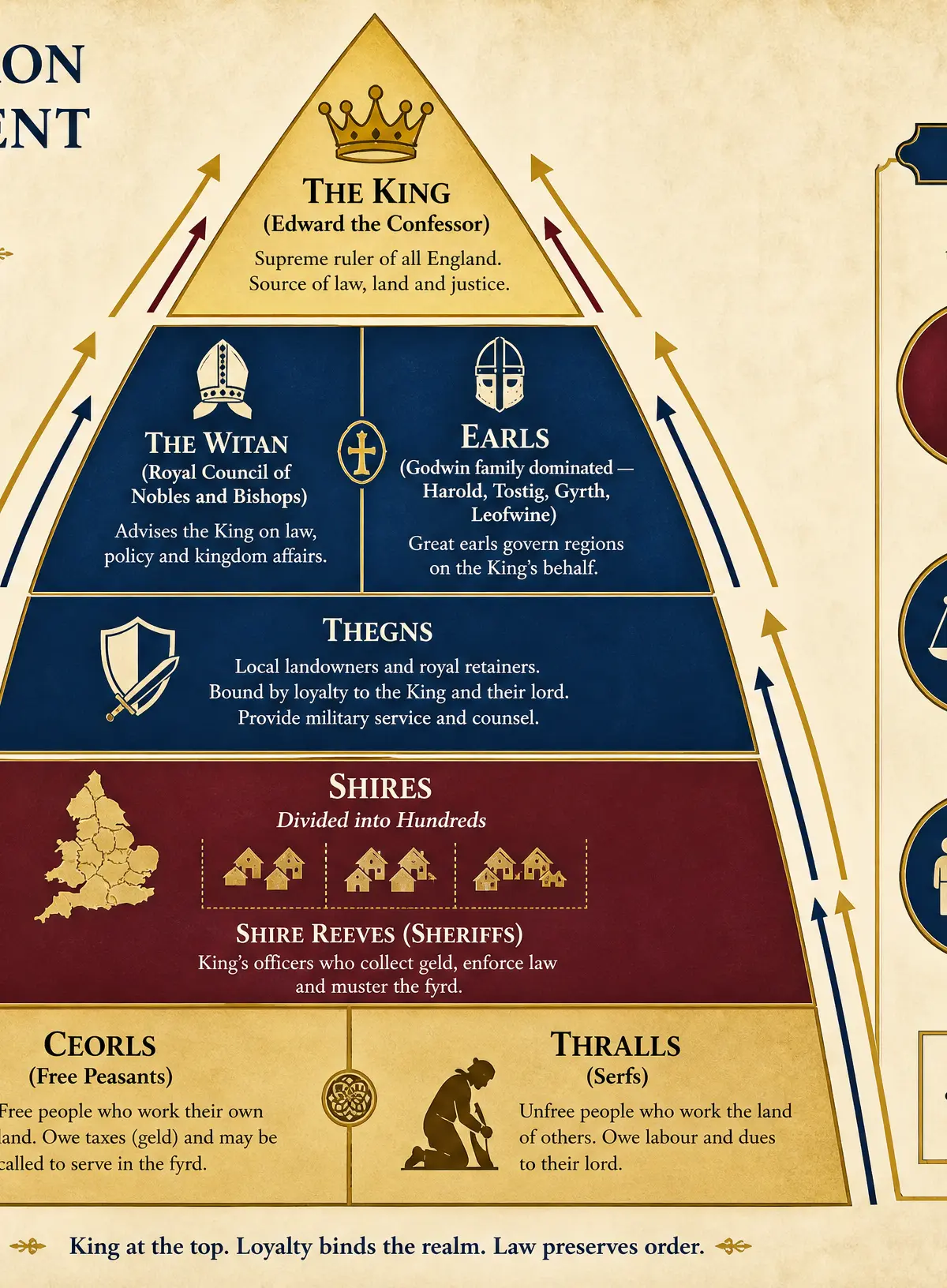
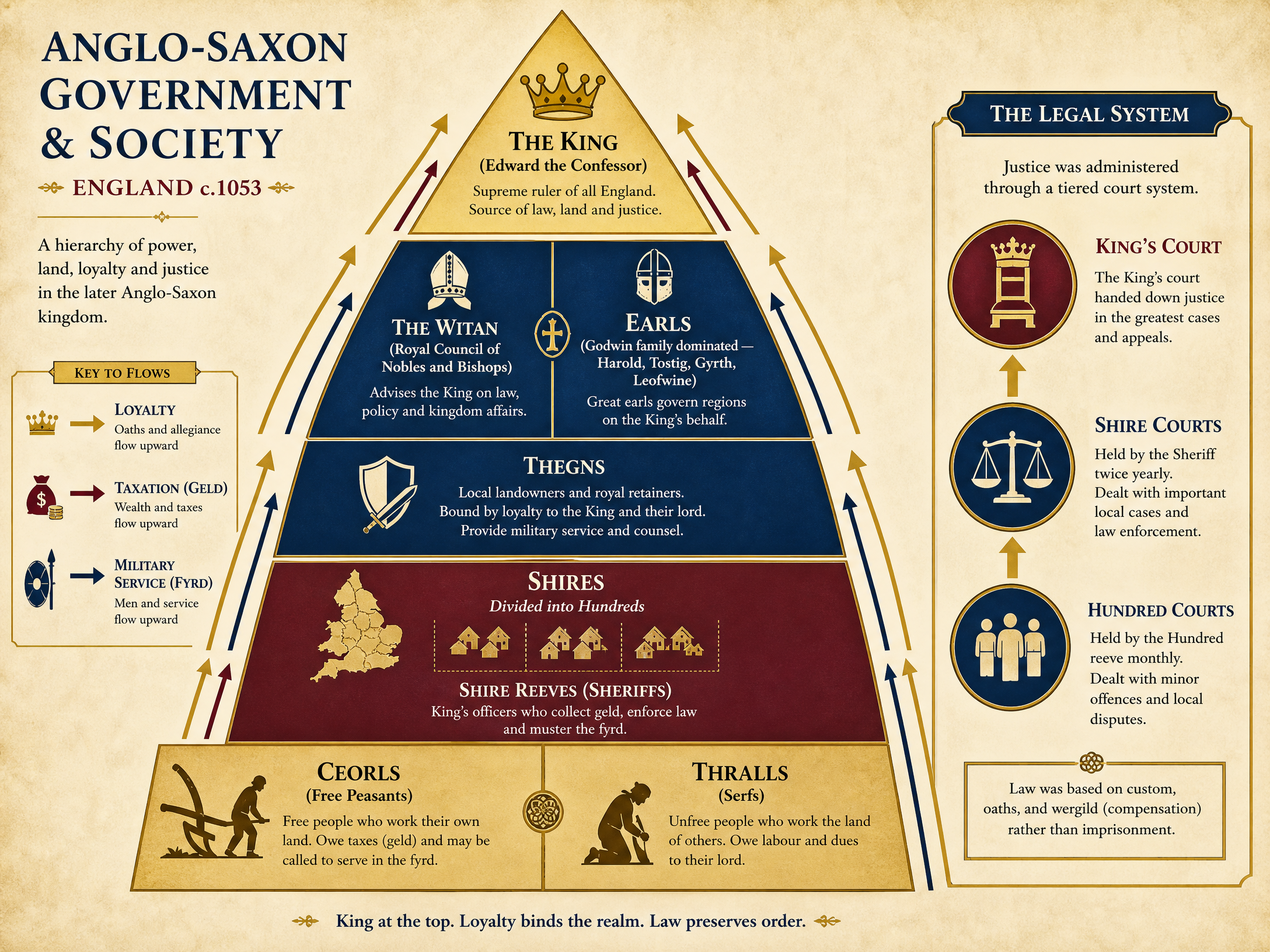
What happened: Following the death of Earl Godwin in 1053, his sons consolidated immense power. Harold Godwinson became Earl of Wessex, while his brothers Tostig, Gyrth, and Leofwine secured earldoms in Northumbria, East Anglia, and the south-east respectively. By the 1060s, the Godwins controlled almost all of England under King Edward the Confessor.
Why it matters: This dominance explains why Harold was the natural choice for king in 1066, but it also bred resentment among rival families (like the Mercian earls Edwin and Morcar), leading to fatal divisions during the succession crisis.
Specific Knowledge: Earl Godwin died in 1053; Harold Godwinson; Tostig (Northumbria); Gyrth (East Anglia); Leofwine.
Harold's Embassy to Normandy
Date(s): c. 1064–1065
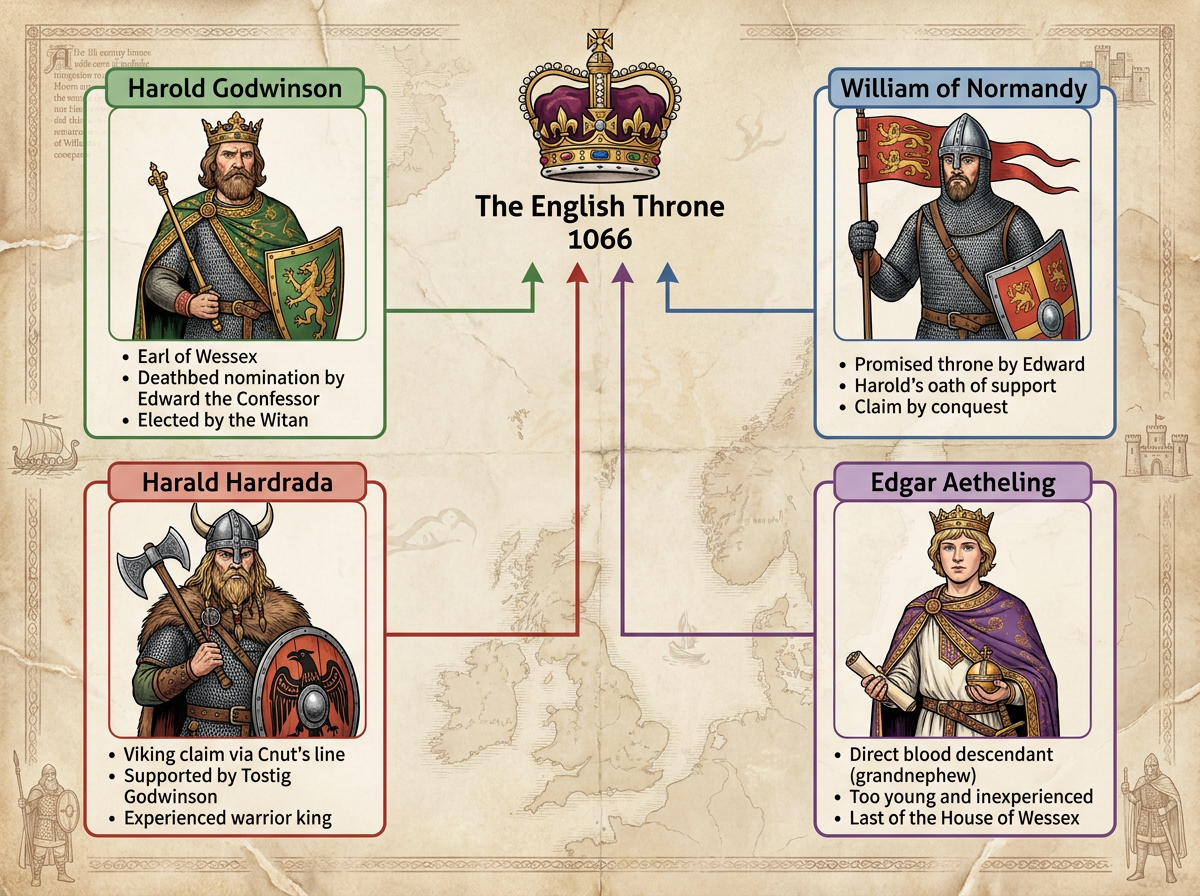
What happened: Harold Godwinson travelled to Normandy. According to Norman sources (like the Bayeux Tapestry), he swore an oath on holy relics to support William of Normandy's claim to the English throne upon Edward's death.
Why it matters: This is the crux of William's claim to legitimacy. When Harold took the throne, William framed his invasion not as a conquest, but as a holy crusade to punish a perjurer, securing vital Papal backing.
Specific Knowledge: Bayeux Tapestry; Papal banner; oath sworn on holy relics.
The Rising Against Tostig
Date(s): Autumn 1065
What happened: Northumbrian thegns rebelled against the harsh rule and heavy taxation of their earl, Tostig Godwinson. They invited Morcar to replace him. Harold Godwinson, prioritizing national stability over family loyalty, agreed to the rebels' demands and forced Tostig into exile.
Why it matters: This shattered the unity of the Godwin family. Tostig sought revenge by allying with Harald Hardrada, directly causing the Viking invasion of September 1066, which fatally weakened Harold's forces before Hastings.
Specific Knowledge: Tostig Godwinson; Morcar; Northumbrian thegns.
The Succession Crisis
Date(s): 5-6 January 1066
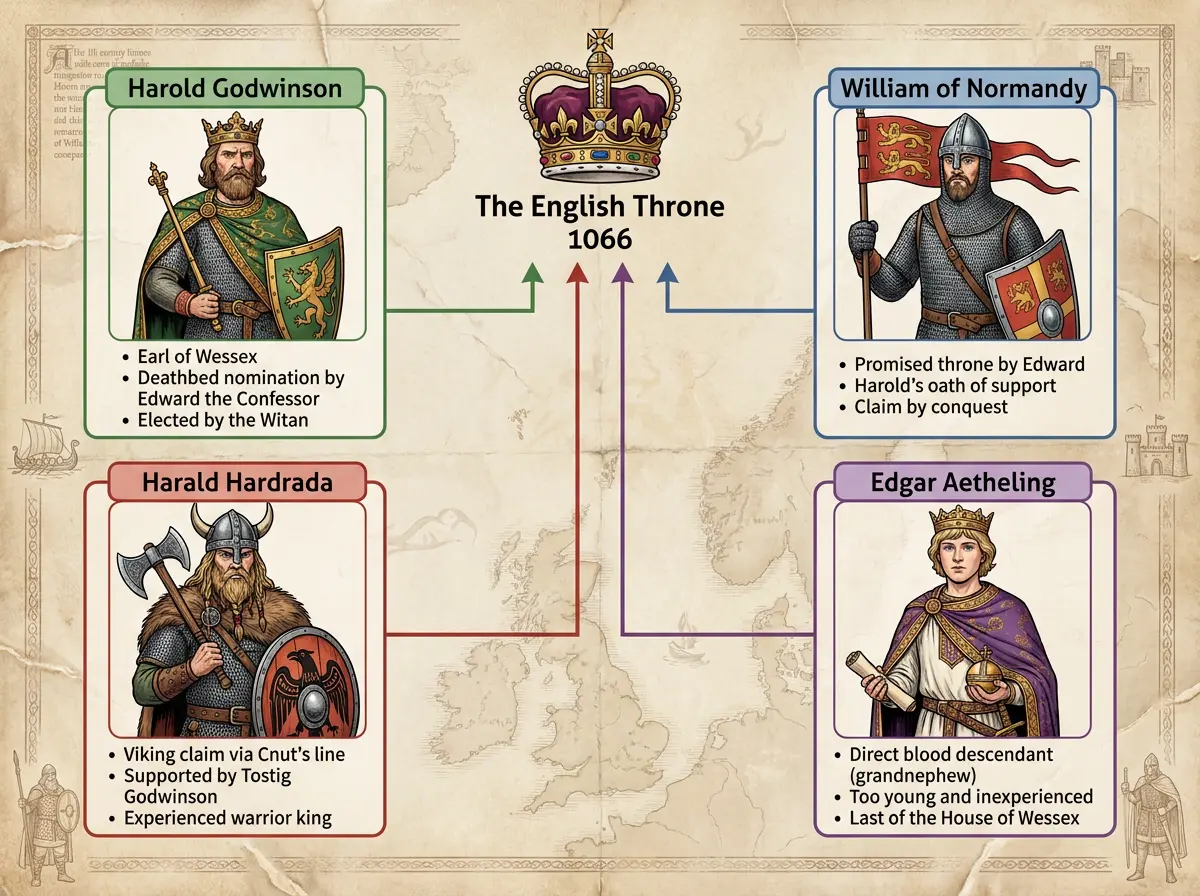
What happened: Edward the Confessor died childless on 5 January. On his deathbed, he reportedly nominated Harold Godwinson. The Witan immediately elected Harold, and he was crowned the very next day.
Why it matters: The speed of the coronation highlighted the vulnerability of Harold's position. It immediately triggered mobilisation by rival claimants who felt they had been cheated.
Specific Knowledge: Edward the Confessor; Witan; 5 January (death); 6 January (coronation).
The Invasions of 1066
Date(s): September–October 1066
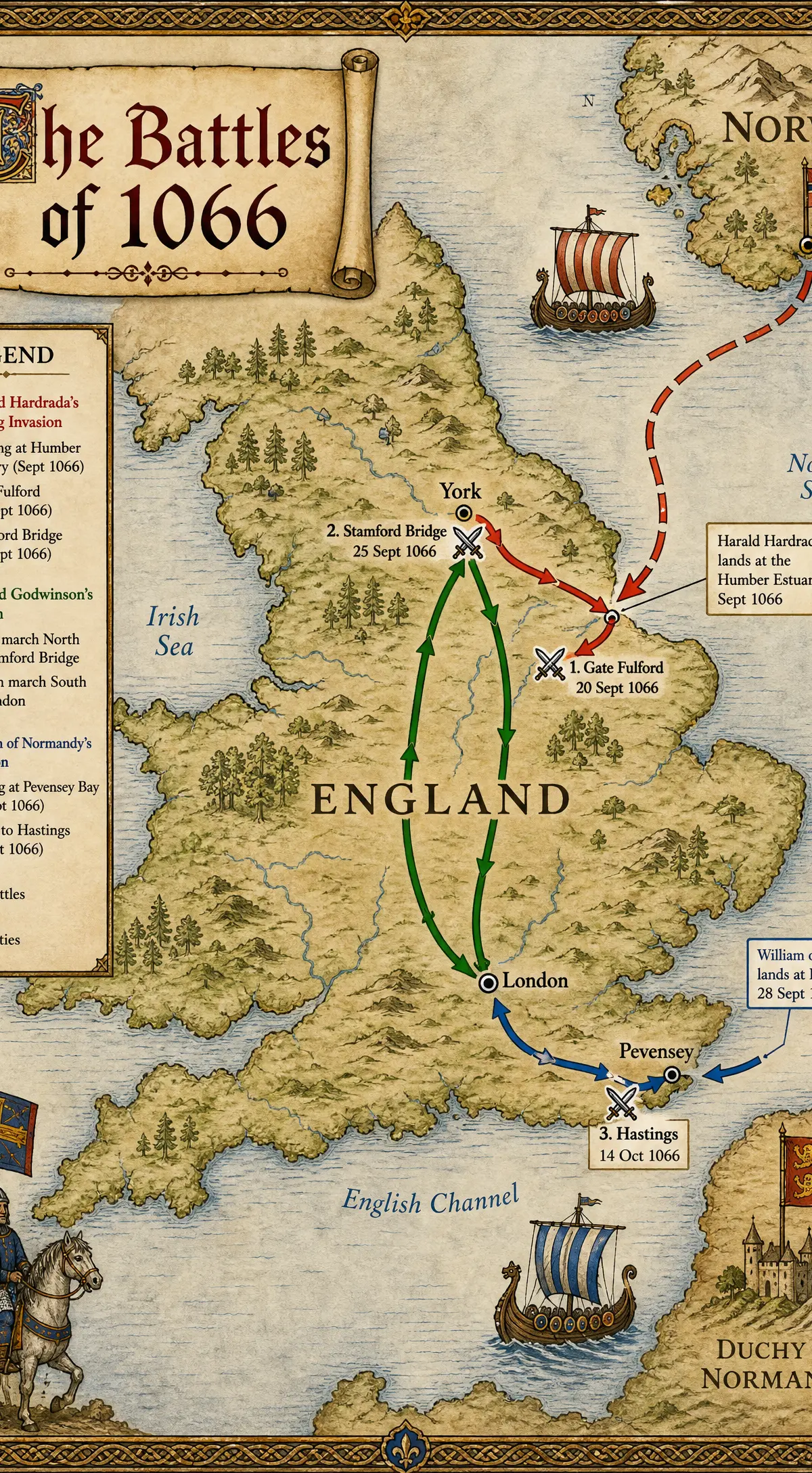
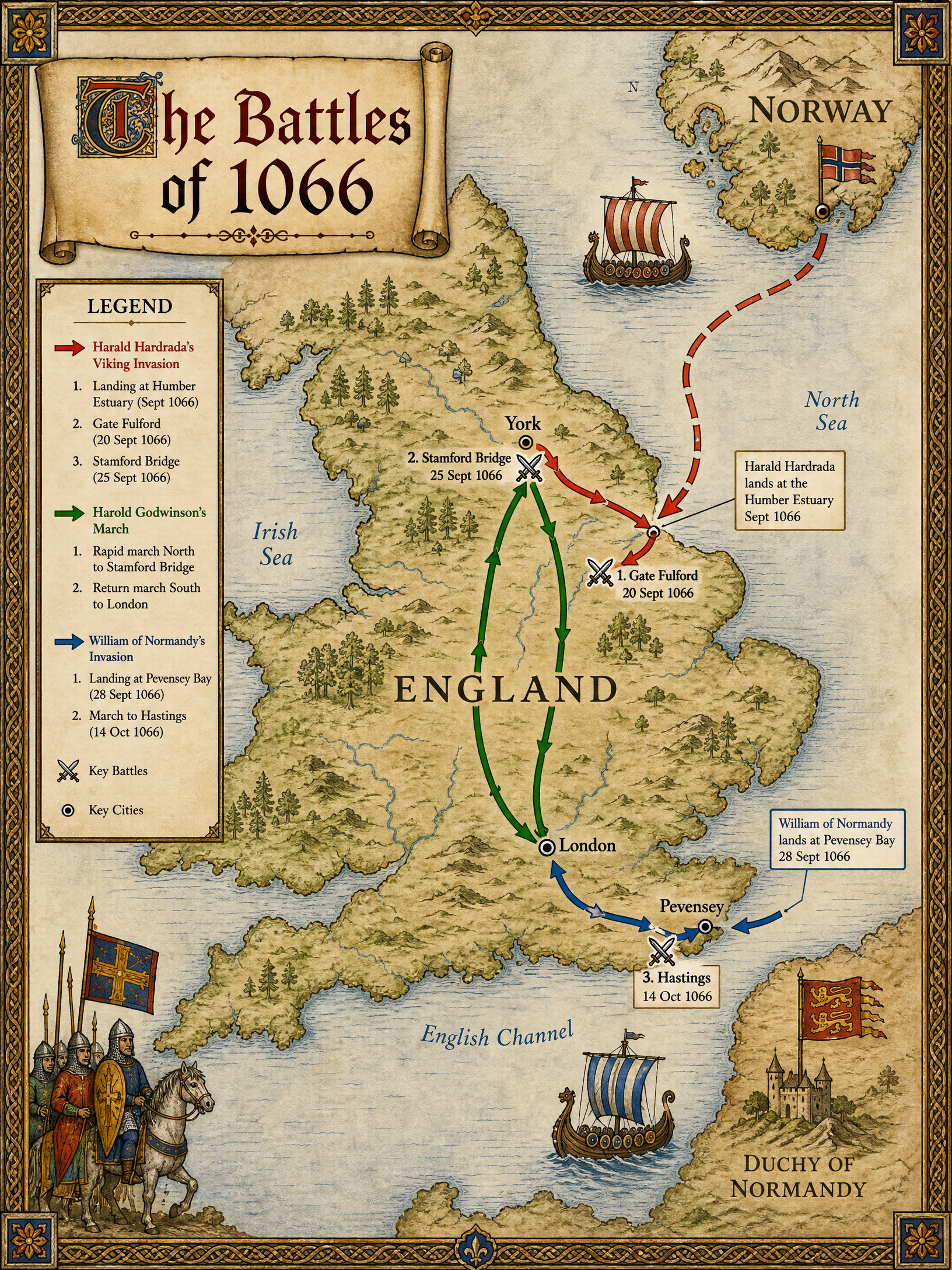
What happened: Harald Hardrada and Tostig invaded the north, defeating the English at Gate Fulford (20 Sept). Harold marched rapidly north, destroying the Viking army at Stamford Bridge (25 Sept). Just three days later, William landed at Pevensey (28 Sept), forcing Harold to march his exhausted army back south to face the Normans at Hastings (14 Oct).
Why it matters: The sequence of events is critical for causation. Harold's victory in the north was tactically brilliant but strategically disastrous, leaving his army depleted and exhausted for the decisive clash with William.
Specific Knowledge: Gate Fulford (20 Sept); Stamford Bridge (25 Sept); Pevensey landing (28 Sept); Hastings (14 Oct).
Key Individuals
Edward the Confessor
Role: King of England (1042–1066)
Key Actions: Restored the House of Wessex, oversaw a sophisticated administration, but failed to produce an heir. He allegedly made conflicting promises regarding the succession to both William of Normandy and Harold Godwinson.
Impact: His death without a clear heir directly caused the succession crisis of 1066.
Harold Godwinson
Role: Earl of Wessex, then King of England (1066)
Key Actions: Consolidated Godwin power, defeated the Welsh, crushed the Viking invasion at Stamford Bridge, but fell at Hastings.
Impact: He was the last crowned Anglo-Saxon king of England; his death marked the end of an era.
William of Normandy
Role: Duke of Normandy, then King of England
Key Actions: Claimed the English throne, launched a meticulously planned invasion, won at Hastings, and ruthlessly subjugated England through castles and the harrying of the north.
Impact: Completely transformed English society, replacing the Anglo-Saxon elite with Norman lords and introducing feudalism.
Harald Hardrada
Role: King of Norway
Key Actions: Claimed the English throne based on old Viking treaties; allied with Tostig Godwinson; invaded northern England but was killed at Stamford Bridge.
Impact: His invasion fatally distracted and weakened Harold Godwinson's forces just before the Norman landing.
Second-Order Concepts
Causation
The Norman Conquest was not caused by a single event, but by a chain of interconnected factors. Long-term causes include Edward the Confessor's lack of an heir and his conflicting promises. Short-term causes include the rising against Tostig, which fractured English unity. The trigger was Edward's death in January 1066. Candidates must link these factors: e.g., because Tostig was exiled, he allied with Hardrada, which caused the northern invasion, which in turn weakened Harold for Hastings.
Consequence
The consequences of 1066 were profound and long-lasting. Immediately, it resulted in the death of the Anglo-Saxon elite. In the longer term, it led to a complete restructuring of land ownership (recorded in the Domesday Book), the introduction of the feudal system, the building of castles to enforce control, and a shift in England's cultural and political orientation from Scandinavia towards France and continental Europe.
Change & Continuity
Change: The ruling elite was almost entirely replaced by Normans. Language at the top of society shifted to Norman French. Architecture changed dramatically with the introduction of motte-and-bailey castles and Romanesque cathedrals.
Continuity: William retained many effective Anglo-Saxon administrative systems, such as the division of the country into shires and hundreds, the role of the shire reeve (sheriff), and the sophisticated taxation system (geld), which he used to his own advantage.
Significance
The events of 1066 are arguably the most significant in English history. They permanently altered the trajectory of the nation, ending centuries of Anglo-Saxon rule and integrating England tightly into the politics of continental Europe, setting the stage for centuries of cross-channel conflict.
Source Skills
For this topic, you will frequently encounter chronicles (e.g., the Anglo-Saxon Chronicle, William of Poitiers) and visual sources like the Bayeux Tapestry.
Always evaluate the provenance:
- Norman sources (Bayeux Tapestry, William of Poitiers) seek to justify the conquest, portray Harold as an oath-breaker, and present William as the rightful, divinely-sanctioned heir.
- English sources (Anglo-Saxon Chronicle) often reflect the trauma of conquest and may portray Harold more sympathetically, though they are also influenced by hindsight and the need to survive under Norman rule.
When assessing usefulness, consider both what the source tells you (Content) and why it was created (Provenance), while acknowledging its Limitations (what it omits or distorts).
Worked Examples
3 worked examples — open one to explore the question and available guidance.
Practice Questions
Test your understanding — click to reveal model answers
Explain why there was a succession crisis in 1066. (12 marks)
Hint: Consider Edward the Confessor's actions, the power of the Godwins, and the rival claims from overseas.
Describe two features of the Godwin family's power in Anglo-Saxon England. (4 marks)
Hint: Think about land/earldoms and their relationship with the King.
How far do you agree that William's leadership was the main reason for the Norman victory at Hastings? (16 marks)
Hint: Balance William's tactics against Harold's mistakes and prior exhaustion.
Explain why there was a rebellion against Tostig in 1065. (12 marks)
Hint: Consider taxation, his background, and his methods of rule.
Describe two features of the Anglo-Saxon economy. (4 marks)
Hint: Think about money and trade.
Test your understanding of Anglo-Saxon England and the Anglo-Norman Kingdom, c1053–1106
Active recall beats re-reading. Take an instant quiz now to test what you’ve learned and lock it into long-term memory.
7 days Premium · Then free forever · No card, no charge