Pearson Edexcel · A-Level · History
Britain, c1785–c1870: democracy, protest and reform
This study explores the crucial development of British trade unionism and cooperative movements between 1785 and 1870. It is historically significant as it traces the working class's struggle from illegal secret societies to the legal recognition and national organisation of the Trades Union Congress, laying the foundation for modern workers' rights.
- 8 min read
- 3 worked examples
- 5 practice questions
- 6 key terms
Study Notes
Overview
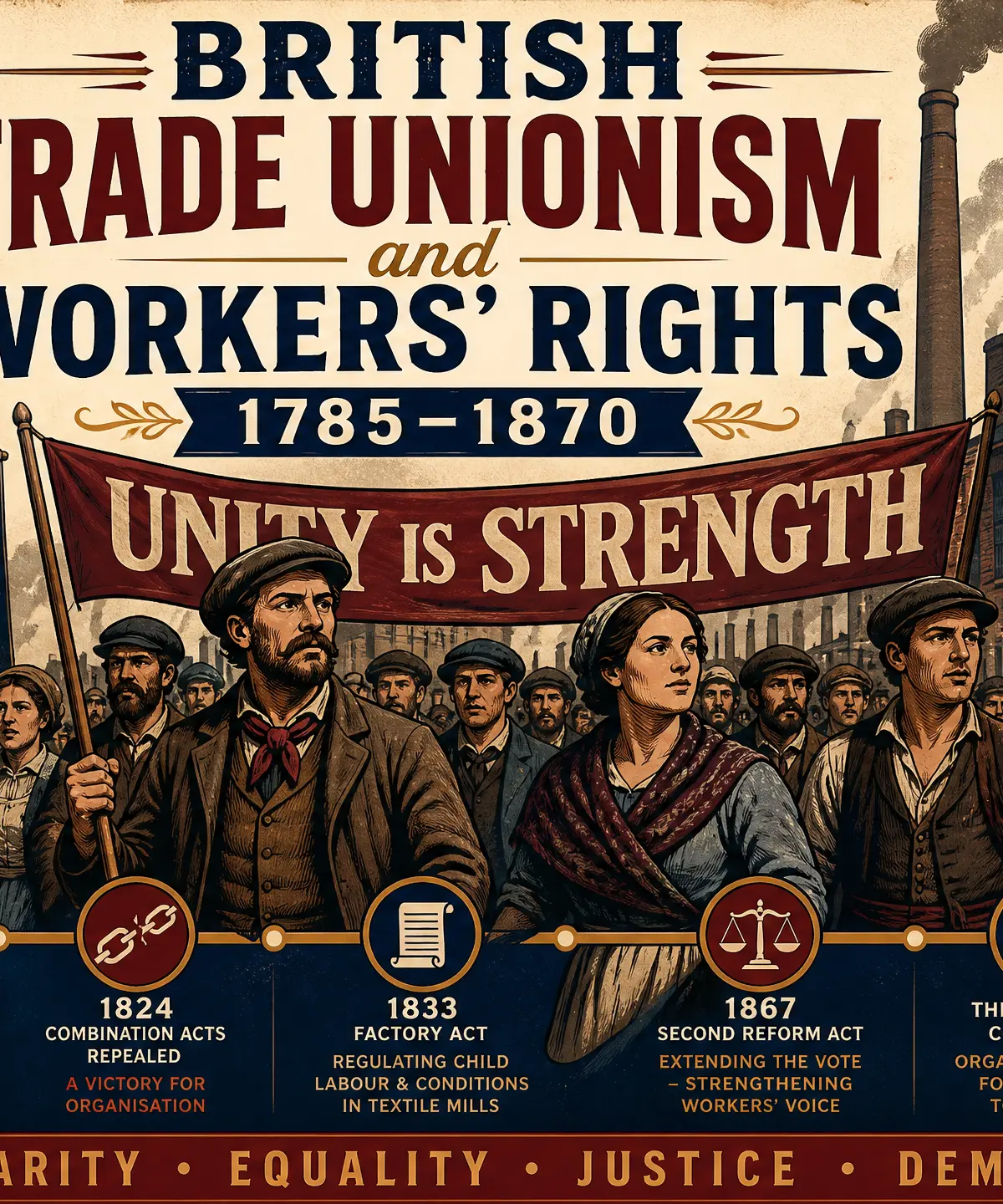
This study guide covers the development of trade unionism in Britain from c1785 to 1870. During this period of intense industrialisation, workers faced long hours, low pay, and dangerous conditions. The government, fearful of revolution, initially attempted to crush working-class organisation through repressive legislation like the Combination Acts. However, through perseverance, early failures like the GNCTU, and the strategic shift towards 'New Model Unionism', workers gradually secured the right to organise and strike. Examiners expect candidates to understand the causes and consequences of these shifts, the differences between early and later unions, and the parallel growth of the cooperative movement. You must be able to deploy specific knowledge—dates, names, and statistics—to support your arguments.
Audio Revision
Listen to our comprehensive 10-minute podcast covering the entire topic:
Key Events & Developments
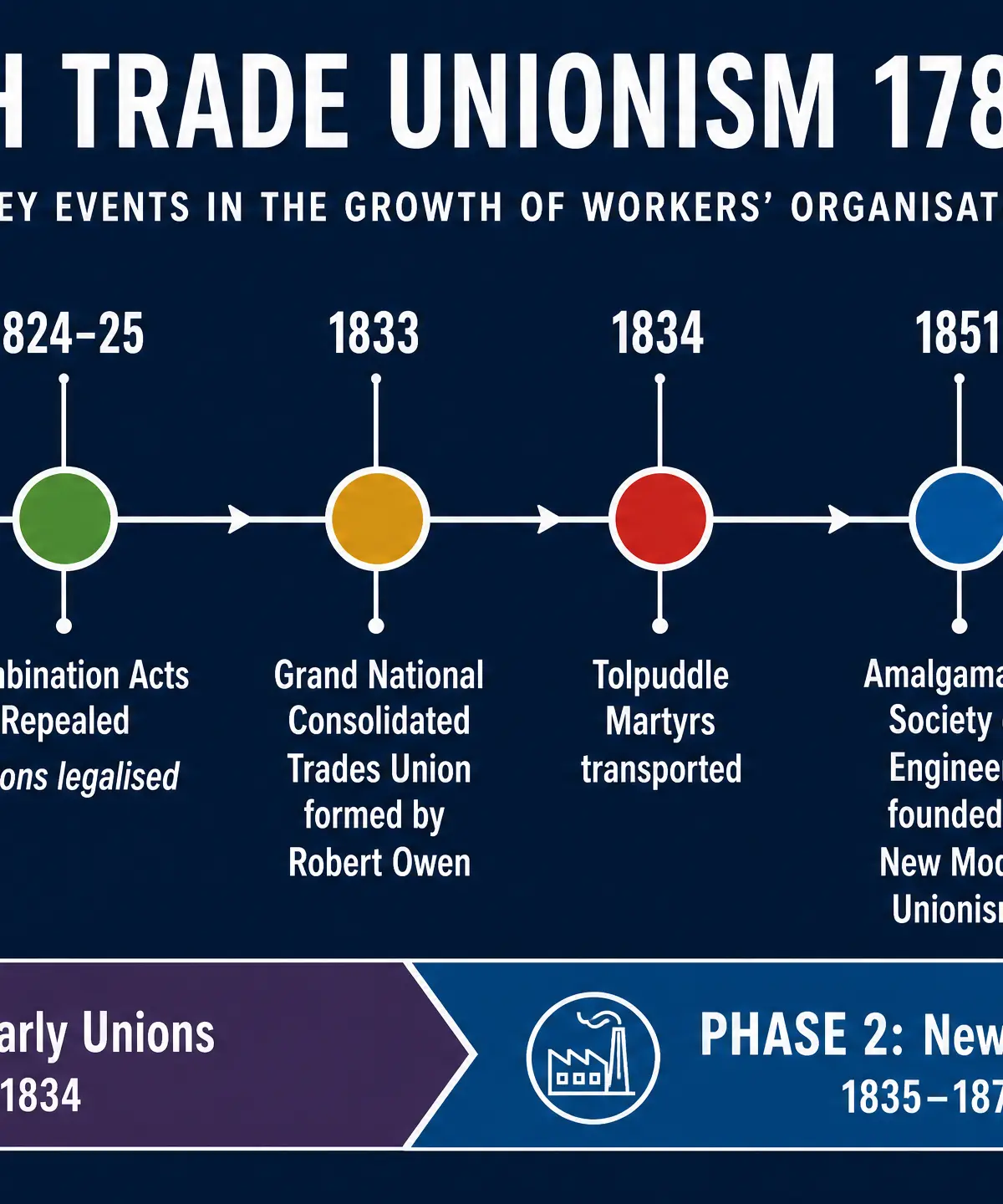
The Combination Acts
Date(s): 1799 and 1800
What happened: Parliament passed laws making it illegal for workers to 'combine' (organise together) to demand better wages or shorter hours. Offenders could be sentenced to three months in prison.
Why it matters: This demonstrates the government's profound fear of working-class organisation following the French Revolution (1789). It forced unions underground into secret societies but failed to stop workers from organising entirely.
Specific Knowledge: Passed in 1799/1800; maximum penalty of 3 months imprisonment; driven by fear of Jacobinism.
Repeal of the Combination Acts
Date(s): 1824 and 1825
What happened: The 1824 Act legalised trade unions, leading to a wave of strikes. The government panicked and passed the 1825 Act, which kept unions legal but severely restricted their ability to strike or picket.
Why it matters: This was a major victory for workers, marking the first time they could legally exist as organised bodies, though their power remained heavily curtailed.
Specific Knowledge: Campaigned for by Francis Place and Joseph Hume MP; 1825 Act limited the right to strike.
The Grand National Consolidated Trades Union (GNCTU)
Date(s): 1833-1834
What happened: Founded by Robert Owen, the GNCTU attempted to unite all workers across all trades into a single, massive union to demand better conditions and an eight-hour day.
Why it matters: It represents the ambition of early unionism but also its fundamental weakness. It collapsed within months due to a lack of funds, internal divisions, and fierce opposition from employers who used 'the Document' to break the union.
Specific Knowledge: Claimed 500,000 members at its peak; employers used 'the Document' (a pledge not to join a union); collapsed in 1834.
The Tolpuddle Martyrs
Date(s): 1834
What happened: Six agricultural labourers from Tolpuddle, Dorset, formed a friendly society and swore a secret oath of loyalty. They were arrested under an obscure 1797 law against illegal oaths and sentenced to seven years' transportation to Australia.
Why it matters: It highlights the severe repression the government was willing to use against organised labour. The massive public outcry (800,000 petition signatures) eventually secured their pardon, showing the growing power of public opinion.
Specific Knowledge: 6 labourers; sentenced to 7 years transportation; 800,000 signed the petition for their release; pardoned in 1836.
The Rise of New Model Unionism
Date(s): 1851 onwards
What happened: Following the failure of the GNCTU, unions changed tactics. They formed smaller, exclusive unions for skilled workers only. They charged high subscription fees to build up large welfare funds and preferred peaceful negotiation over strikes.
Why it matters: This marked a shift from radical, confrontational unionism to moderate, respectable unionism. It proved highly successful in winning concessions from employers and gaining political respectability.
Specific Knowledge: Amalgamated Society of Engineers (ASE) founded in 1851; led by William Allan; charged 1 shilling a week subscription.
The Founding of the Trades Union Congress (TUC)
Date(s): 1868
What happened: The first meeting of the TUC was held in Manchester, bringing together delegates from various unions across the country to coordinate policy and lobby Parliament.
Why it matters: It marked the beginning of a unified, national labour movement with political influence, moving beyond isolated, local trade disputes.
Specific Knowledge: Founded in Manchester, 1868; first meeting attended by 34 delegates representing 118,000 members.
The Cooperative Movement
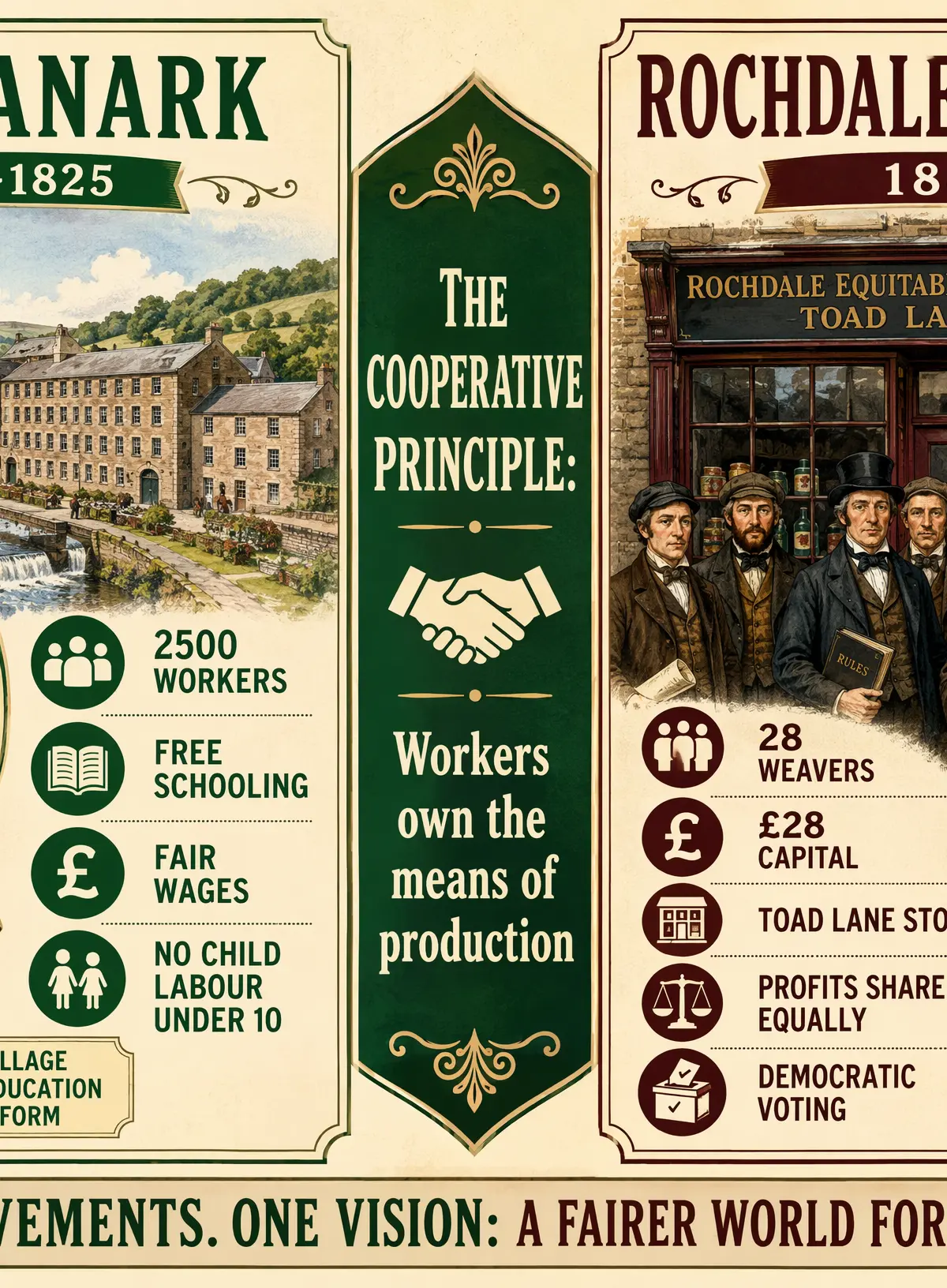
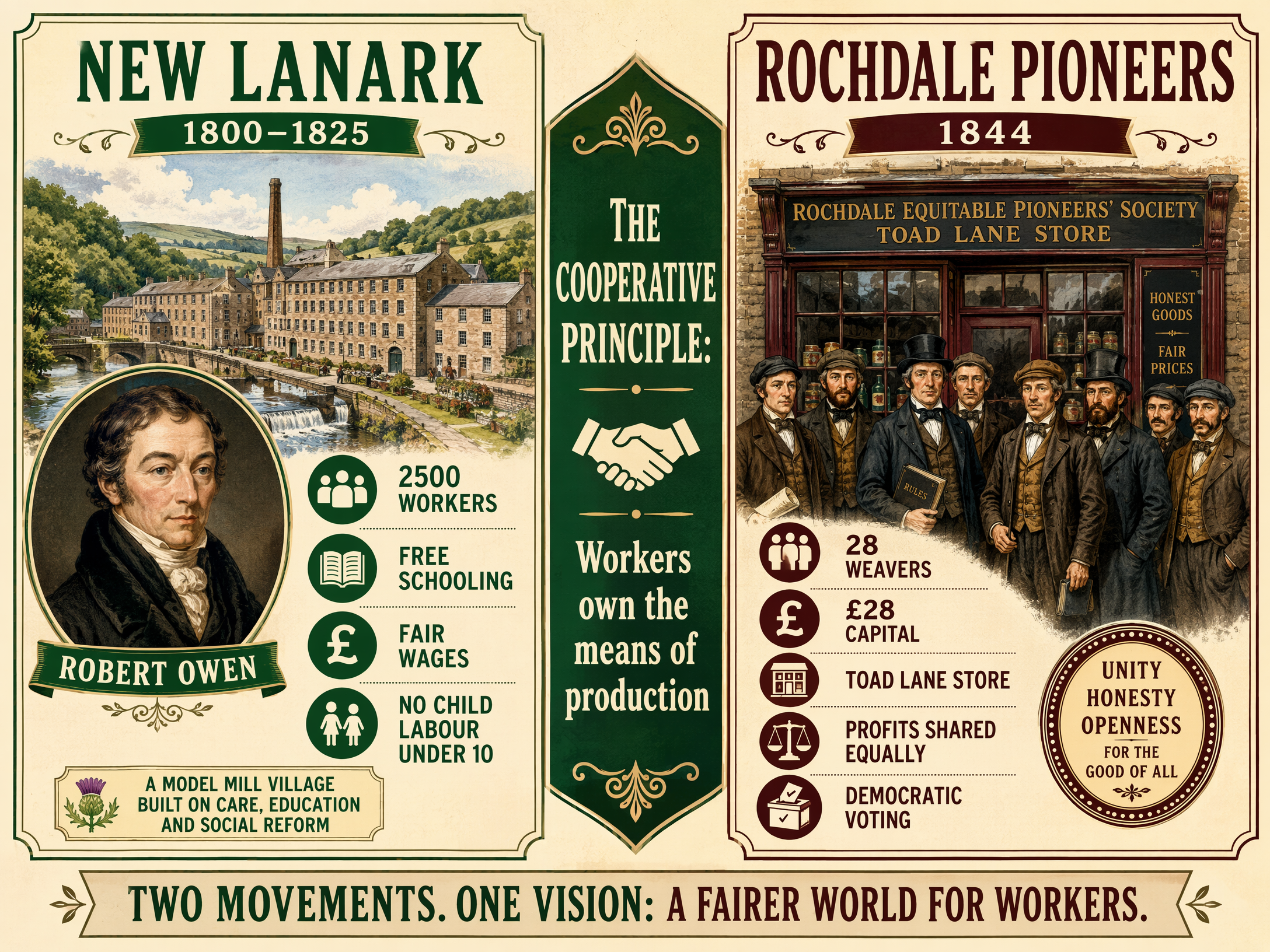
While trade unions fought employers for better wages, the cooperative movement sought an alternative economic model where workers owned the businesses.
New Lanark
Date(s): 1800-1825
Robert Owen transformed his Scottish cotton mills into a model village. He provided decent housing, free schooling, and fair wages, proving that treating workers well could still be profitable. It housed 2,500 workers and banned child labour under 10.
The Rochdale Pioneers
Date(s): 1844
Twenty-eight weavers pooled £28 to open a cooperative shop on Toad Lane, Rochdale. They sold unadulterated food at fair prices and shared the profits among members based on their purchases (the 'divi'). By 1851, they had over 600 members, establishing the modern cooperative movement.
Key Individuals
Robert Owen
Role: Factory owner, social reformer, and founder of the GNCTU.
Key Actions: Created the model community at New Lanark; championed cooperative economics; founded the ambitious but short-lived GNCTU in 1833.
Impact: He was a visionary who proved that industrial capitalism did not require the brutal exploitation of workers, though his grander schemes like the GNCTU failed.
Francis Place
Role: Radical reformer and tailor.
Key Actions: Campaigned tirelessly and strategically for the repeal of the Combination Acts, working with sympathetic MPs like Joseph Hume.
Impact: His behind-the-scenes lobbying was crucial in securing the legal right for unions to exist in 1824.
William Allan
Role: General Secretary of the Amalgamated Society of Engineers (ASE).
Key Actions: Led the ASE with a focus on moderation, high subscriptions, and welfare benefits rather than strikes.
Impact: He was the architect of 'New Model Unionism', proving that respectable, well-funded unions could succeed where radical movements had failed.
Second-Order Concepts
Causation
The growth of unionism was caused fundamentally by the harsh conditions of the Industrial Revolution (long-term cause). The repeal of the Combination Acts in 1824 acted as a trigger for open organisation, while the failure of the GNCTU caused the strategic shift towards New Model Unionism.
Consequence
The immediate consequence of early union activity was severe government repression (Combination Acts, Tolpuddle Martyrs). The long-term consequence of New Model Unionism was the establishment of a permanent, legally recognised, and politically influential labour movement (the TUC).
Change & Continuity
Change: The period saw a massive shift from illegal, secret societies to large, legal, national organisations like the ASE and TUC. The tactics changed from radical confrontation to moderate negotiation.
Continuity: Throughout the period, employers consistently resisted union power (using 'the Document' in the 1830s and lockouts in the 1850s), and the government remained suspicious of working-class power.
Significance
This topic is highly significant because it traces the origins of modern workers' rights and the welfare state. The cooperative movement and friendly societies demonstrate how the working class actively sought to improve their own lives rather than relying on government charity.
Source Skills
When evaluating sources on unionism, provenance is crucial. A source written by a factory owner in 1834 will likely emphasize the 'tyranny' and violence of unions to justify breaking them. A source from a union leader like William Allan in 1860 will emphasize the respectability and moderation of the union to win public support. Always consider the author's motive and the specific year the source was produced.
Visual Resources
2 diagrams and illustrations
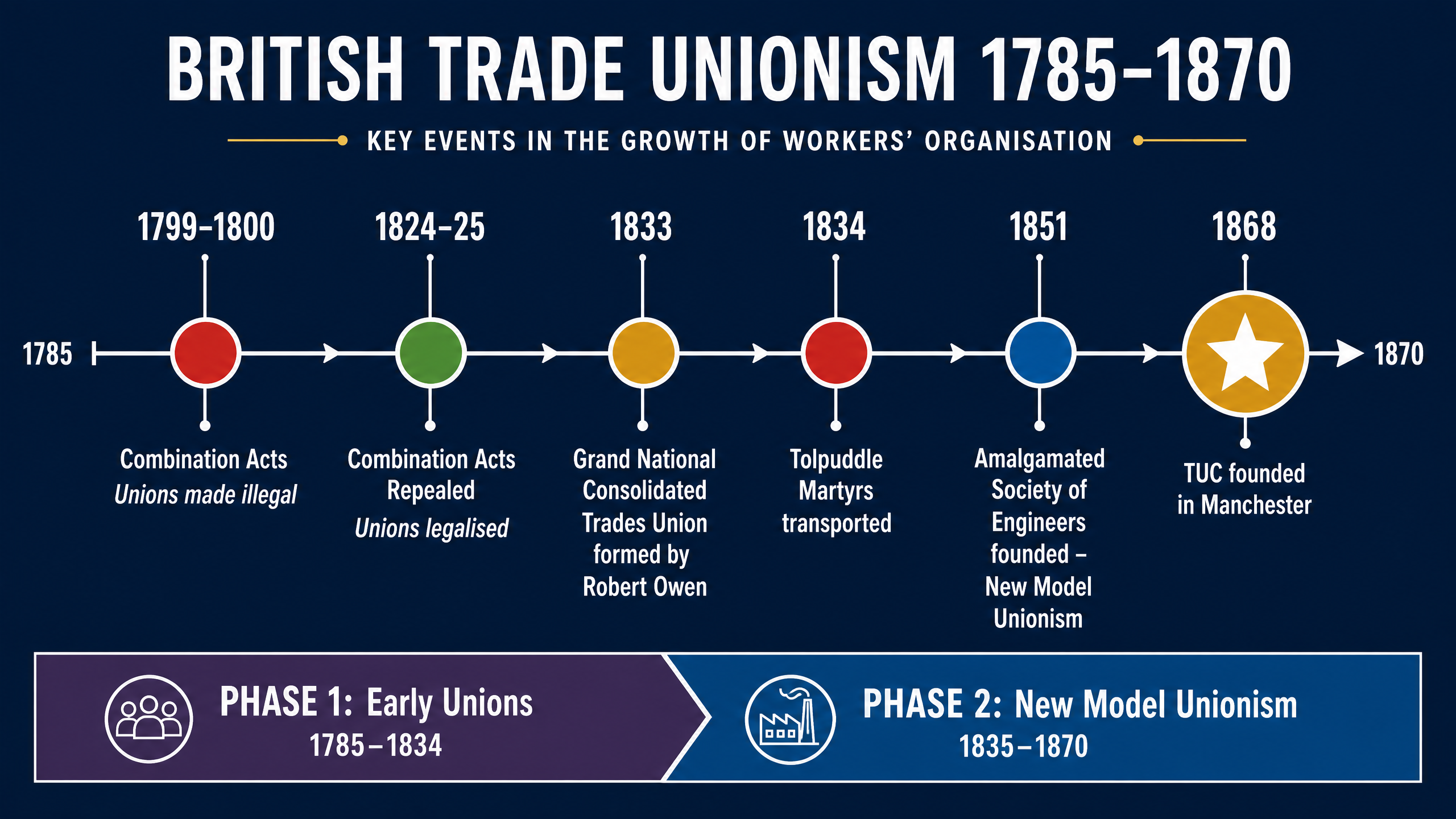
Interactive Diagrams
1 interactive diagram to visualise key concepts
Conceptual Flow Outline
Flowchart showing the causes and consequences of union development
Worked Examples
3 worked examples — open one to explore the question and available guidance.
Practice Questions
Test your understanding — click to reveal model answers
Explain the significance of the Amalgamated Society of Engineers (ASE) to the development of trade unionism. (8 marks)
Hint: Focus on how the ASE changed the tactics and reputation of unions compared to the earlier GNCTU.
How far do you agree that government repression was the main reason for the failure of early trade unions between 1800 and 1834? (16 marks)
Hint: Balance government actions (Combination Acts, Tolpuddle) against employer actions (the Document) and internal union weaknesses.
Describe two features of the Rochdale Pioneers. (4 marks)
Hint: Think about how they shared profits and how they ran the business.
Explain why the Combination Acts were passed in 1799 and 1800. (12 marks)
Hint: Consider the context of the French Revolution and the fear of working-class political power.
Explain the significance of the Trades Union Congress (TUC) founded in 1868. (8 marks)
Hint: Focus on the shift from local/trade-specific action to national political lobbying.
Test your understanding of Britain, c1785–c1870: democracy, protest and reform
Active recall beats re-reading. Take an instant quiz now to test what you’ve learned and lock it into long-term memory.
7 days Premium · Then free forever · No card, no charge