Pearson Edexcel · A-Level · History
Britain: losing and gaining an empire, 1763–1914
This study guide covers the crucial period of British involvement in India from 1829 to 1858, tracking the shift from East India Company trade to direct Crown rule. It explores the complex mix of social reforms, aggressive annexations, and religious tensions that ultimately triggered the explosive 1857 Indian Rebellion.
- 10 min read
- 3 worked examples
- 5 practice questions
- 6 key terms
Study Notes
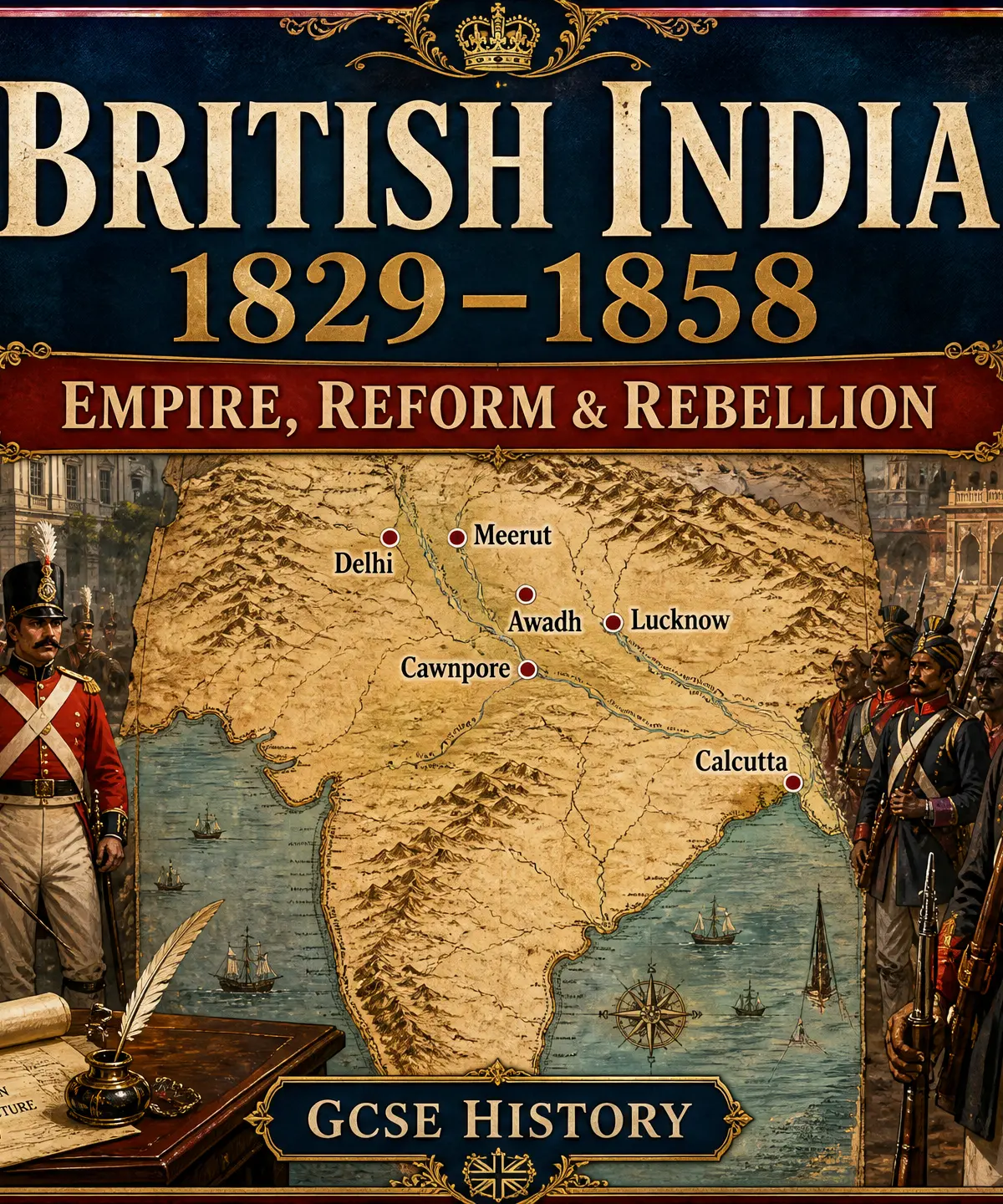
Overview
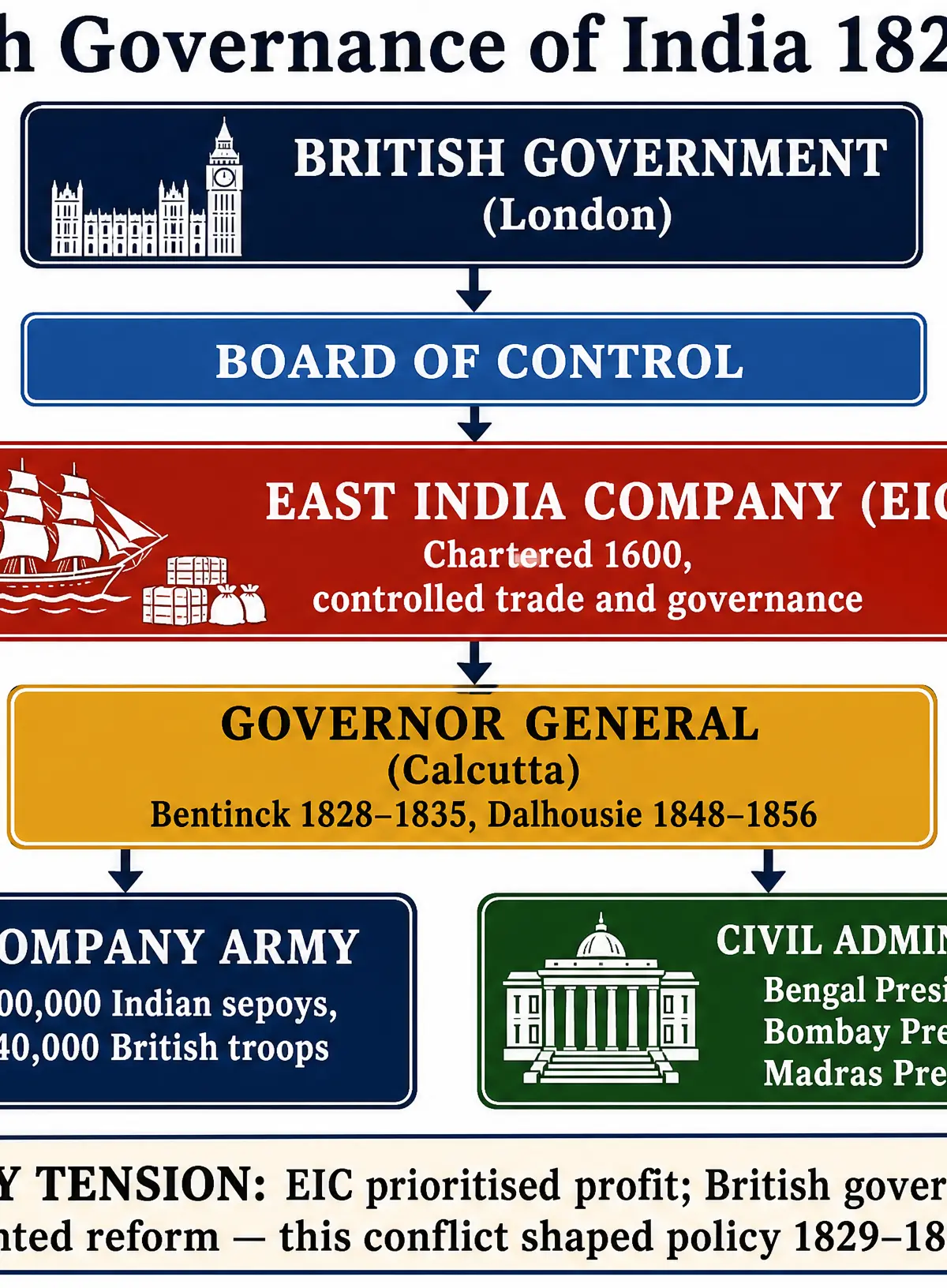
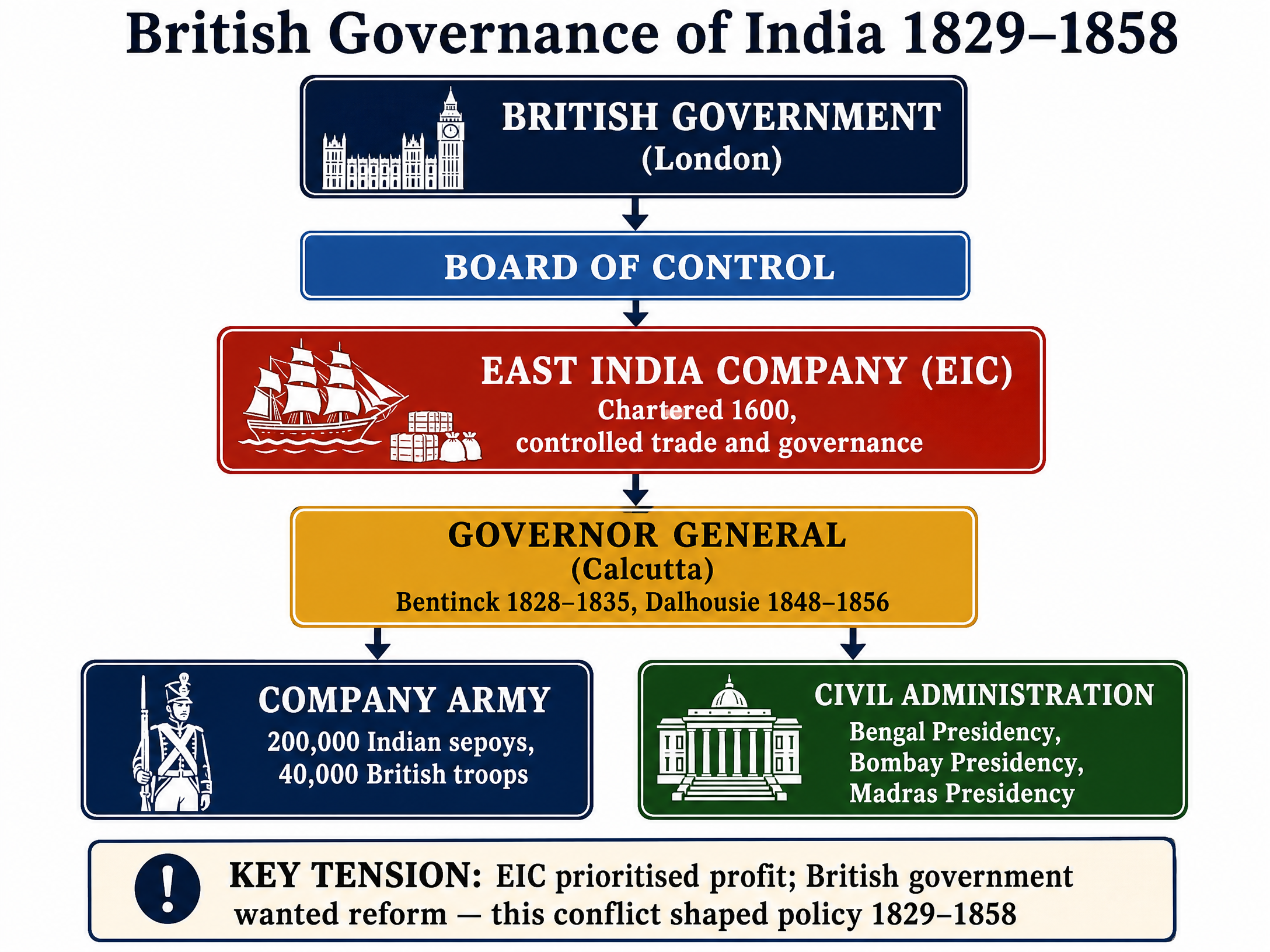
This unit examines a pivotal turning point in imperial history: how the British governed India between 1829 and 1858, and why that system collapsed so violently in 1857. Examiners expect candidates to understand the unique nature of the East India Company (EIC) — a private trading corporation that functioned as a government, complete with its own vast army of Indian sepoys.
You will need to analyse the long-term causes of the 1857 Indian Rebellion, particularly the impact of Westernising social reforms (such as the banning of Sati) and Lord Dalhousie's aggressive territorial annexations under the Doctrine of Lapse. The examiner will test your ability to link these underlying tensions to the immediate trigger of the greased cartridges. Finally, you must be able to evaluate the profound consequences of the rebellion: the abolition of the EIC and the establishment of direct British Crown rule. Precision is key — use specific names, dates, and locations to elevate your answers from Level 2 to Level 3 and 4.
Key Events & Developments
The Banning of Sati
Date(s): 1829
What happened: Governor General Lord William Bentinck outlawed the Hindu practice of Sati (where a widow sacrificed herself on her husband's funeral pyre), declaring it culpable homicide.
Why it matters: This demonstrates the British shift towards actively reforming Indian society based on Western, Christian values. While a humanitarian reform, it generated significant resentment among conservative Hindus who viewed it as an attack on their religion, contributing to long-term tensions.
Specific Knowledge: Lord William Bentinck; Bengal Sati Regulation, 1829.
The Campaign Against Thagi
Date(s): 1830s onwards
What happened: William Sleeman led a systematic campaign to eradicate the 'Thugs' — groups of robbers and murderers who operated across India, often associated with the worship of the goddess Kali.
Why it matters: The British used the successful suppression of Thagi to justify their rule, presenting themselves as bringers of law and order and civilisation. However, it further embedded the idea that the British were interfering with Indian religious practices.
Specific Knowledge: William Sleeman; Thuggee and Dacoity Department created in 1835; over 3,000 Thugs arrested by 1837.
The Doctrine of Lapse and Annexations
Date(s): 1848–1856
What happened: Lord Dalhousie implemented a policy stating that if an Indian ruler died without a natural male heir, their territory would 'lapse' to the East India Company, rather than passing to an adopted heir as was Hindu custom.
Why it matters: This was a major long-term cause of the 1857 Rebellion. It alienated the Indian aristocracy, stripping them of power and pensions, and created a powerful class of disgruntled former rulers (like Nana Sahib) who would later lead rebel forces.
Specific Knowledge: Lord Dalhousie; key annexations included Satara (1848), Jhansi (1854), and Awadh (1856).
The Annexation of Awadh (Oudh)
Date(s): February 1856
What happened: Dalhousie annexed the wealthy kingdom of Awadh, not under the Doctrine of Lapse, but by accusing its ruler, Nawab Wajid Ali Shah, of 'misgovernment'.
Why it matters: Awadh was the primary recruiting ground for the EIC's Bengal Army. The annexation deeply offended the sepoys, who felt their homeland had been stolen and their privileges lost. This directly linked political annexation with military grievance.
Specific Knowledge: Nawab Wajid Ali Shah; Awadh (Oudh); Bengal Army sepoys.
The Outbreak of the 1857 Rebellion
Date(s): 10 May 1857
What happened: Following the court-martial of 85 sepoys who refused to use the new Enfield rifle cartridges (rumoured to be greased with cow and pig fat), the garrison at Meerut mutinied. They killed their British officers and marched to Delhi.
Why it matters: This was the immediate trigger that ignited years of underlying tension. The march to Delhi and the proclamation of the Mughal Emperor as their leader transformed a military mutiny into a widespread political rebellion.
Specific Knowledge: Meerut; Enfield rifle; greased cartridges (cow/pig fat); Bahadur Shah Zafar (Mughal Emperor).
The Siege and Massacre at Cawnpore
Date(s): June–July 1857
What happened: British forces and civilians besieged in Cawnpore surrendered to the rebel leader Nana Sahib. During their evacuation at the Satichaura Ghat (27 June), they were fired upon. The surviving women and children were later killed at the Bibighar (15 July).
Why it matters: The massacres at Cawnpore hardened British attitudes, leading to a desire for brutal revenge. It became a defining propaganda event in Victorian Britain, used to justify severe reprisals against the Indian population.
Specific Knowledge: Cawnpore (Kanpur); Nana Sahib; Satichaura Ghat; Bibighar massacre.
The Siege and Relief of Lucknow
Date(s): June–November 1857
What happened: The British Residency at Lucknow was besieged by rebel forces. It held out for months under severe conditions until finally relieved by forces under Sir Colin Campbell in November.
Why it matters: Lucknow became the ultimate symbol of British imperial endurance and heroism. The successful defence boosted British morale and demonstrated the military superiority that eventually crushed the rebellion.
Specific Knowledge: Sir Henry Lawrence (died during siege); General Havelock (first relief); Sir Colin Campbell (final relief).
The Government of India Act
Date(s): August 1858
What happened: In the aftermath of the rebellion, the British Parliament passed an Act abolishing the East India Company. Control of India was transferred directly to the British Crown.
Why it matters: This is the most significant consequence of the period. It marks the end of Company rule and the beginning of the British Raj. British policy shifted away from aggressive social reform towards a more cautious approach that respected Indian traditions.
Specific Knowledge: Government of India Act 1858; Queen Victoria; shift from Company rule to Crown rule.
Key Individuals
Lord William Bentinck
Role: Governor General of India (1828–1835)
Key Actions: Banned Sati (1829); supported the suppression of Thagi; promoted Western education (following Macaulay's Minute in 1835).
Impact: Initiated the era of British social reform in India, believing in the superiority of Western civilisation, which inadvertently sowed seeds of cultural resentment.
Lord Dalhousie
Role: Governor General of India (1848–1856)
Key Actions: Introduced the Doctrine of Lapse; oversaw the annexation of Awadh, Punjab, and other states; introduced the telegraph and railways.
Impact: His aggressive expansionist policies and disregard for Indian aristocratic traditions are widely considered the primary long-term political cause of the 1857 Rebellion.
William Sleeman
Role: British soldier and administrator
Key Actions: Led the campaign to suppress the Thuggee cult in the 1830s.
Impact: His success was used to justify British rule as a civilising force, though it also represented interference in Indian religious practices.
Bahadur Shah Zafar
Role: The last Mughal Emperor
Key Actions: Was proclaimed the leader of the rebellion by the mutinying sepoys who marched from Meerut to Delhi in May 1857.
Impact: Provided a symbolic figurehead for the rebellion, uniting various rebel factions under the idea of restoring the old pre-British political order.
Nana Sahib
Role: Adopted son of the exiled Maratha Peshwa
Key Actions: Denied his father's pension by Dalhousie under the Doctrine of Lapse; led the rebel forces at Cawnpore.
Impact: Exemplifies how Dalhousie's policies turned the Indian aristocracy against the British; his association with the Cawnpore massacres made him a notorious figure in Britain.
Second-Order Concepts
Causation
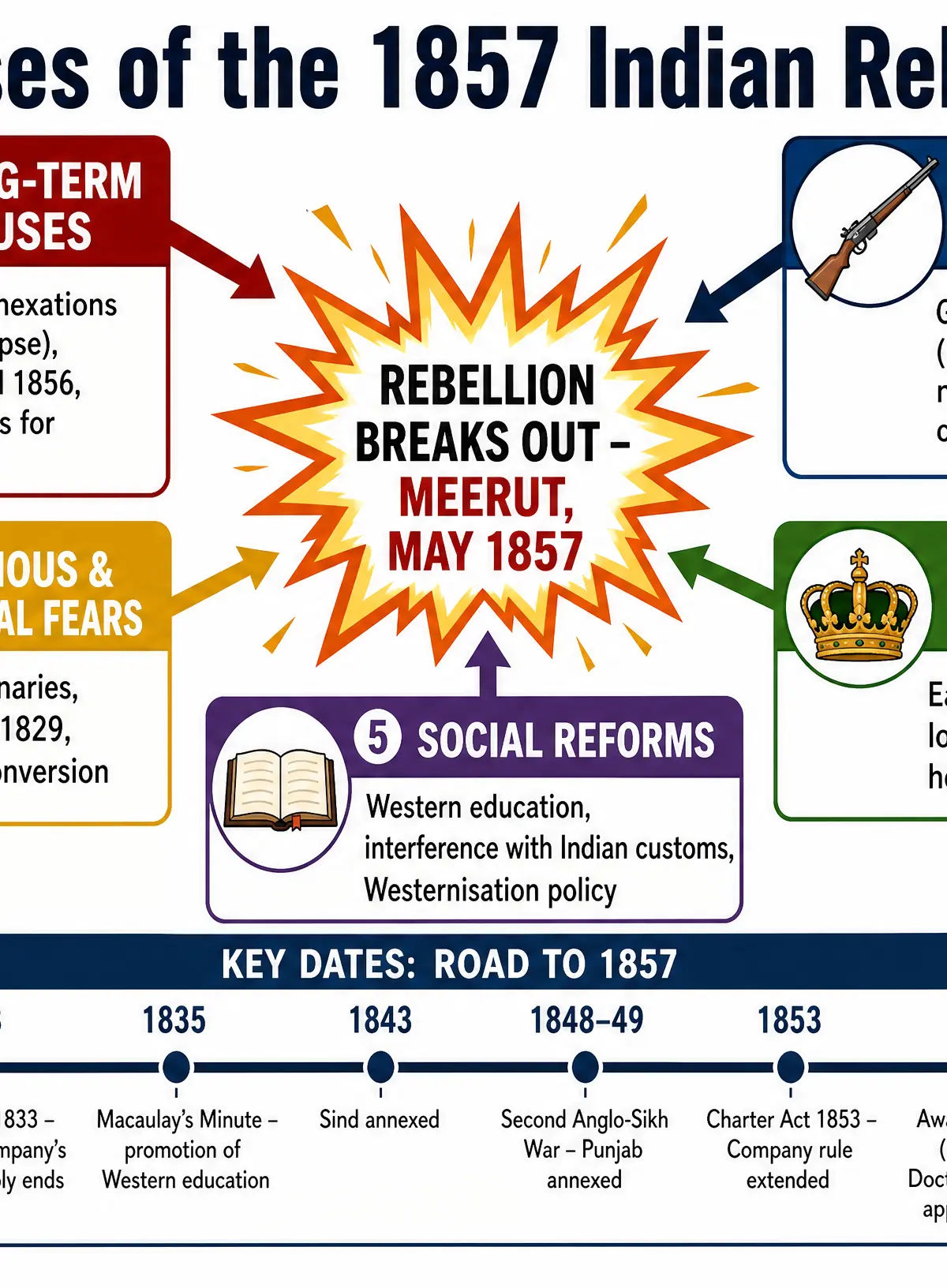
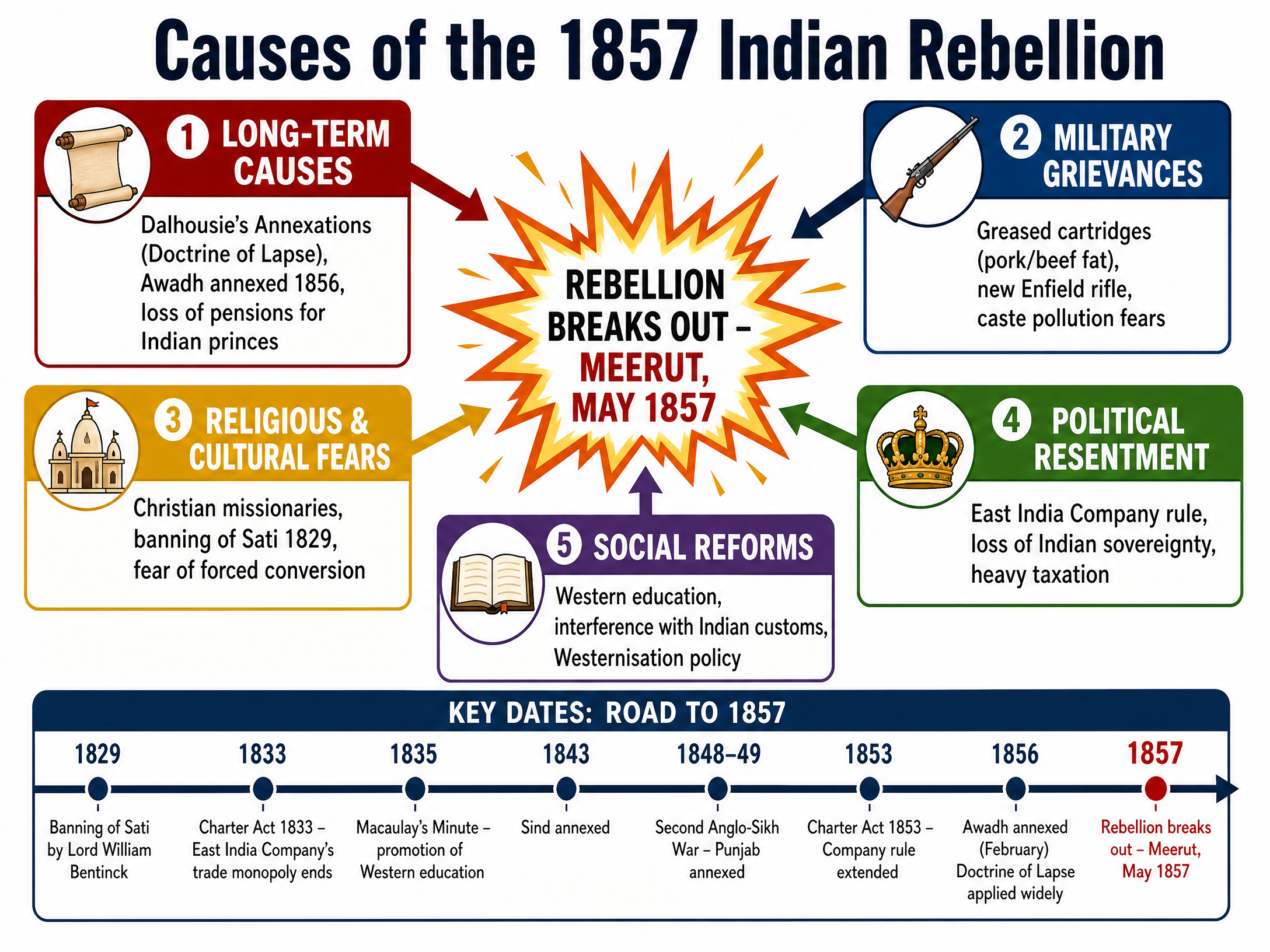
The 1857 Rebellion was not caused by a single event, but by a combination of factors. Long-term causes included Dalhousie's Doctrine of Lapse and the annexation of Awadh (political), the banning of Sati and the rise of Christian missionaries (religious/social), and heavy taxation (economic). The immediate trigger was the introduction of the Enfield rifle and the greased cartridges, which provided the spark that ignited these underlying tensions into open mutiny.
Consequence
The most significant consequence of the 1857 Rebellion was the fundamental change in governance. The East India Company was abolished, and direct Crown rule was established via the Government of India Act 1858. A secondary consequence was a shift in British attitudes: the British became more racially separate from Indians, abandoned aggressive social reform, and actively cultivated the support of loyal Indian princes.
Change & Continuity
Between 1829 and 1857, there was rapid change as the British shifted from merely trading to actively trying to 'Westernise' India through education and social reform. Following the rebellion in 1858, there was a continuity of British economic exploitation, but a significant change in policy, as the British abandoned social reform in favour of preserving the status quo to maintain stability.
Significance
This period is highly significant because it marks the zenith and the collapse of the East India Company — the most powerful corporation in history. The 1857 Rebellion itself is significant as the largest anti-colonial uprising of the 19th century, fundamentally altering the trajectory of the British Empire and laying the earliest foundations for Indian nationalism.
Source Skills
When evaluating sources for this period, provenance is crucial.
- British official sources (e.g., Dalhousie's letters) often justify actions as 'civilising' or necessary for order, downplaying Indian resentment.
- British popular press/diaries (e.g., accounts of Cawnpore) from 1857 are highly emotive, focusing on British victimhood and Indian 'savagery', often used to justify brutal reprisals.
- Indian perspectives are rarer in the written record but can be found in rebel proclamations, which focus on the defence of religion (Deen/Dharma) against Christian interference and the restoration of traditional rulers.
Worked Examples
3 worked examples — open one to explore the question and available guidance.
Practice Questions
Test your understanding — click to reveal model answers
Describe two features of the Doctrine of Lapse. (4 marks)
Hint: Identify a feature, then add a specific factual detail to develop it.
Explain the significance of the Government of India Act 1858. (8 marks)
Hint: Significance means 'what changed' or 'why it mattered long-term'. Focus on the shift in power.
Explain why the British faced a rebellion in India in 1857. (12 marks)
Hint: Use the B.A.D. C.A.R.S. mnemonic. Group your causes into Political, Religious/Social, and Military paragraphs.
How useful are Sources B and C for an enquiry into the causes of the 1857 Rebellion? (8 marks)
Hint: Analyse content, provenance, and limitations for BOTH sources, then compare them to reach a judgement.
‘The introduction of the greased cartridges was the main reason for the Indian Rebellion in 1857.’ How far do you agree? (16 marks)
Hint: Argue for the cartridges as the immediate spark, but argue against the statement by explaining the long-term political and religious resentment that made the spark catch fire.
Test your understanding of Britain: losing and gaining an empire, 1763–1914
Active recall beats re-reading. Take an instant quiz now to test what you’ve learned and lock it into long-term memory.
7 days Premium · Then free forever · No card, no charge