Pearson Edexcel · A-Level · History
Civil rights and race relations in the USA, 1850–2009
This study explores how Southern states and the Supreme Court systematically dismantled Black Americans' rights after Reconstruction. It's crucial for understanding how the legal framework of segregation—Jim Crow—was built, forming the foundation of racial inequality that lasted until the Civil Rights Movement of the 1950s and 60s.
- 6 min read
- 3 worked examples
- 5 practice questions
- 6 key terms
Study Notes
Overview
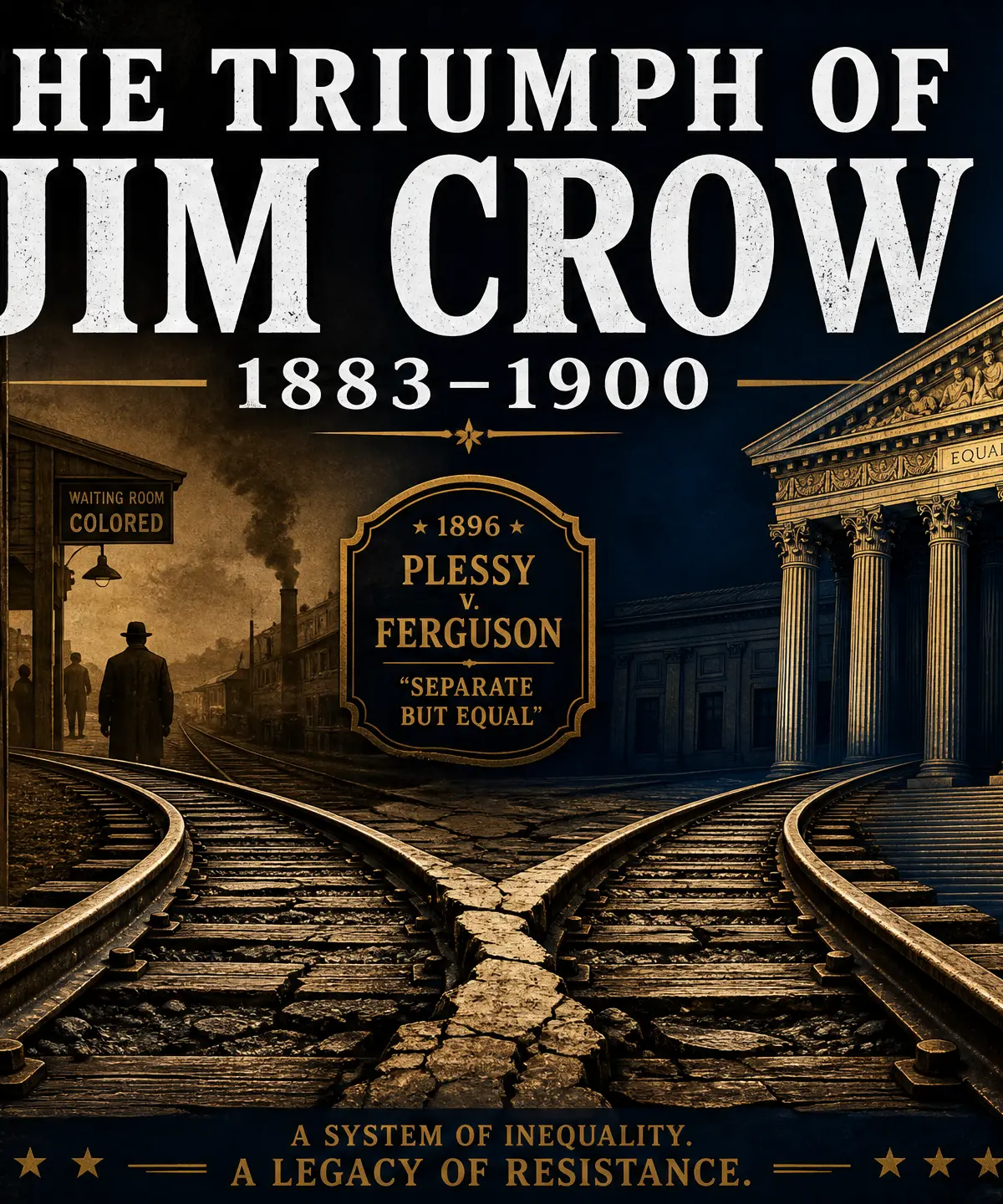
The period from 1883 to 1900 marks a devastating turning point in American history. Following the Civil War (1861-1865) and the era of Reconstruction (1865-1877), Black Americans had briefly secured constitutional rights, including the right to vote under the Fifteenth Amendment. However, this study covers how those gains were systematically dismantled. Examiners expect you to understand the specific methods used by Southern states to enforce segregation (Jim Crow laws) and disenfranchise Black voters, and crucially, how the US Supreme Court provided the legal justification for this oppression. You must be able to link specific court cases to their social and political consequences.
Key Events & Developments
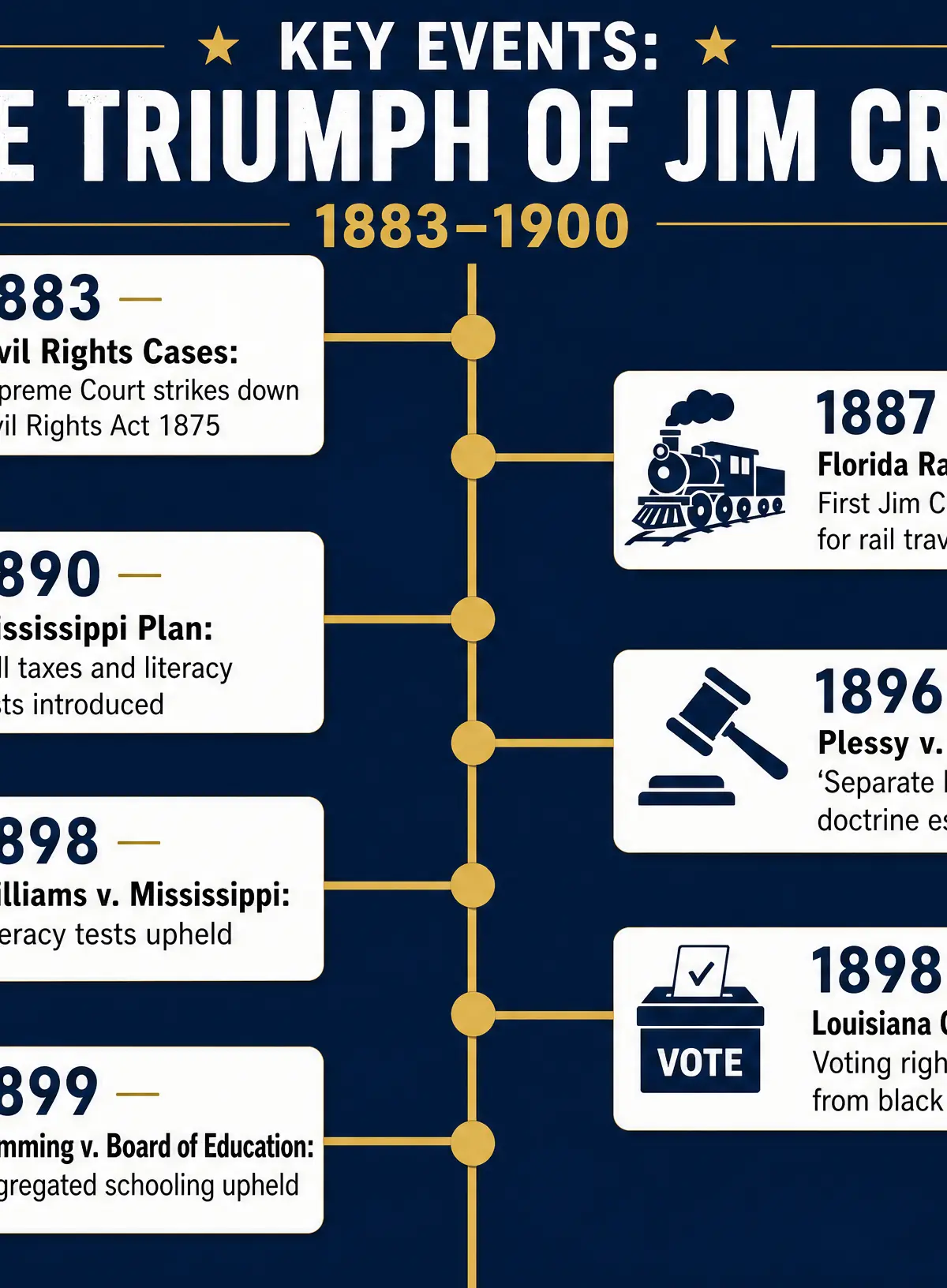
The Civil Rights Cases
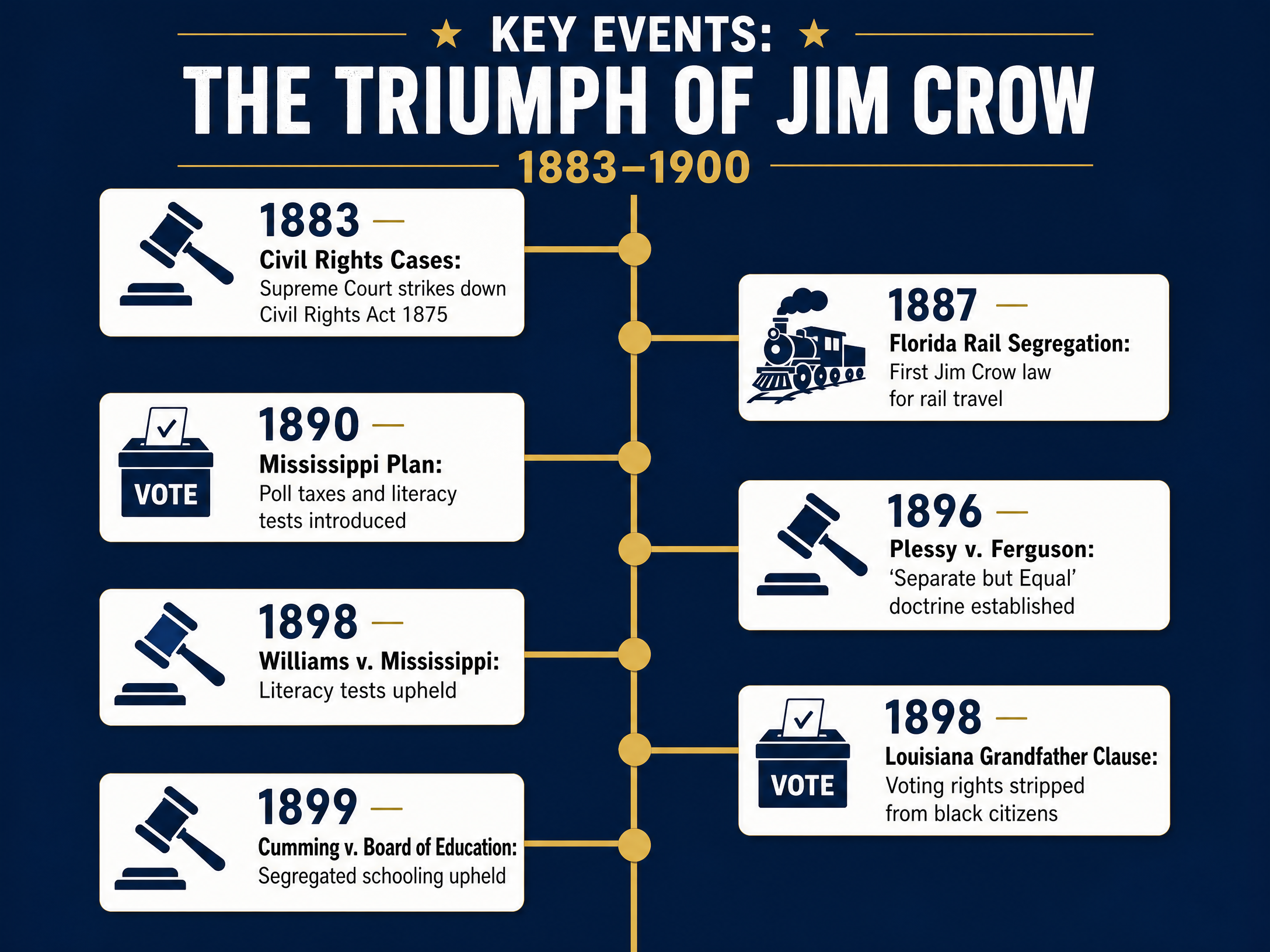
Date(s): 1883
What happened: The Supreme Court struck down the Civil Rights Act of 1875, which had banned racial discrimination in public accommodations (like hotels and railways). The Court ruled 8-1 that the Fourteenth Amendment only prevented discrimination by state governments, not by private individuals or businesses.
Why it matters: This was the trigger for the Jim Crow era. By removing federal protection, it gave Southern states a green light to pass their own segregation laws without fear of federal intervention.
Specific Knowledge: 8-1 decision; Justice John Marshall Harlan was the lone dissenter; nullified the 1875 Civil Rights Act.
The Spread of Jim Crow Laws
Date(s): 1887 onwards
What happened: Southern states rapidly passed laws mandating racial segregation in public facilities. Florida was the first to introduce segregated railway carriages in 1887. This soon extended to schools, hospitals, parks, and cemeteries.
Why it matters: It physically separated the races and entrenched social inequality, as facilities for Black Americans were consistently underfunded and inferior.
Specific Knowledge: Florida 1887 (railways); facilities were 'separate but unequal'.
Disenfranchisement: The Mississippi Plan
Date(s): 1890
What happened: Mississippi held a constitutional convention to strip Black men of their voting rights without explicitly violating the Fifteenth Amendment. They introduced poll taxes (a fee to vote) and literacy tests (requiring voters to interpret the constitution to a white registrar's satisfaction).
Why it matters: It successfully removed Black political power in the South. In Mississippi, Black voter registration plummeted from roughly 190,000 in 1890 to just 8,600 by 1892.
Specific Knowledge: Poll taxes; literacy tests; 95% drop in Black voter registration in Mississippi.
Plessy v. Ferguson
Date(s): 1896
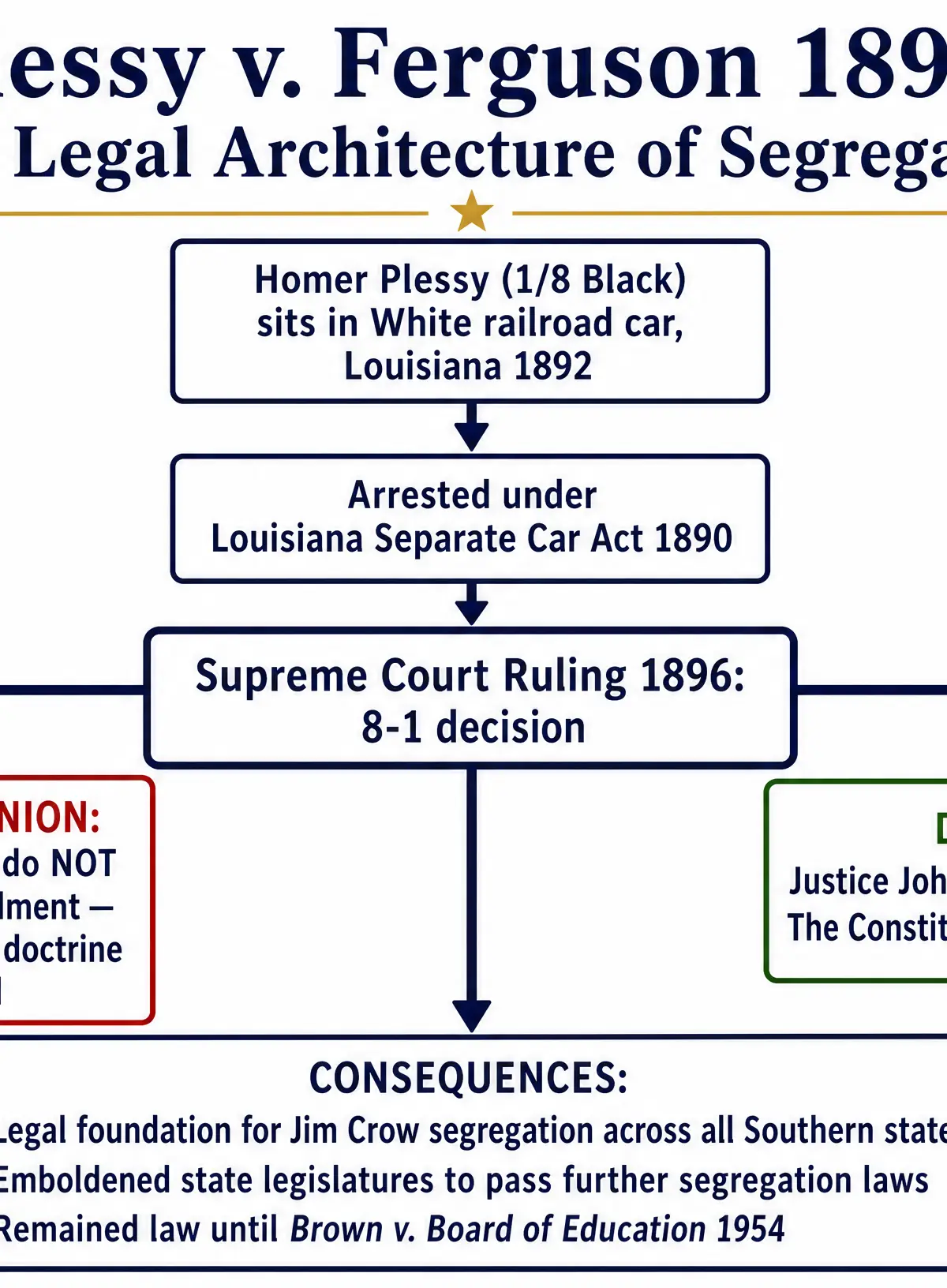
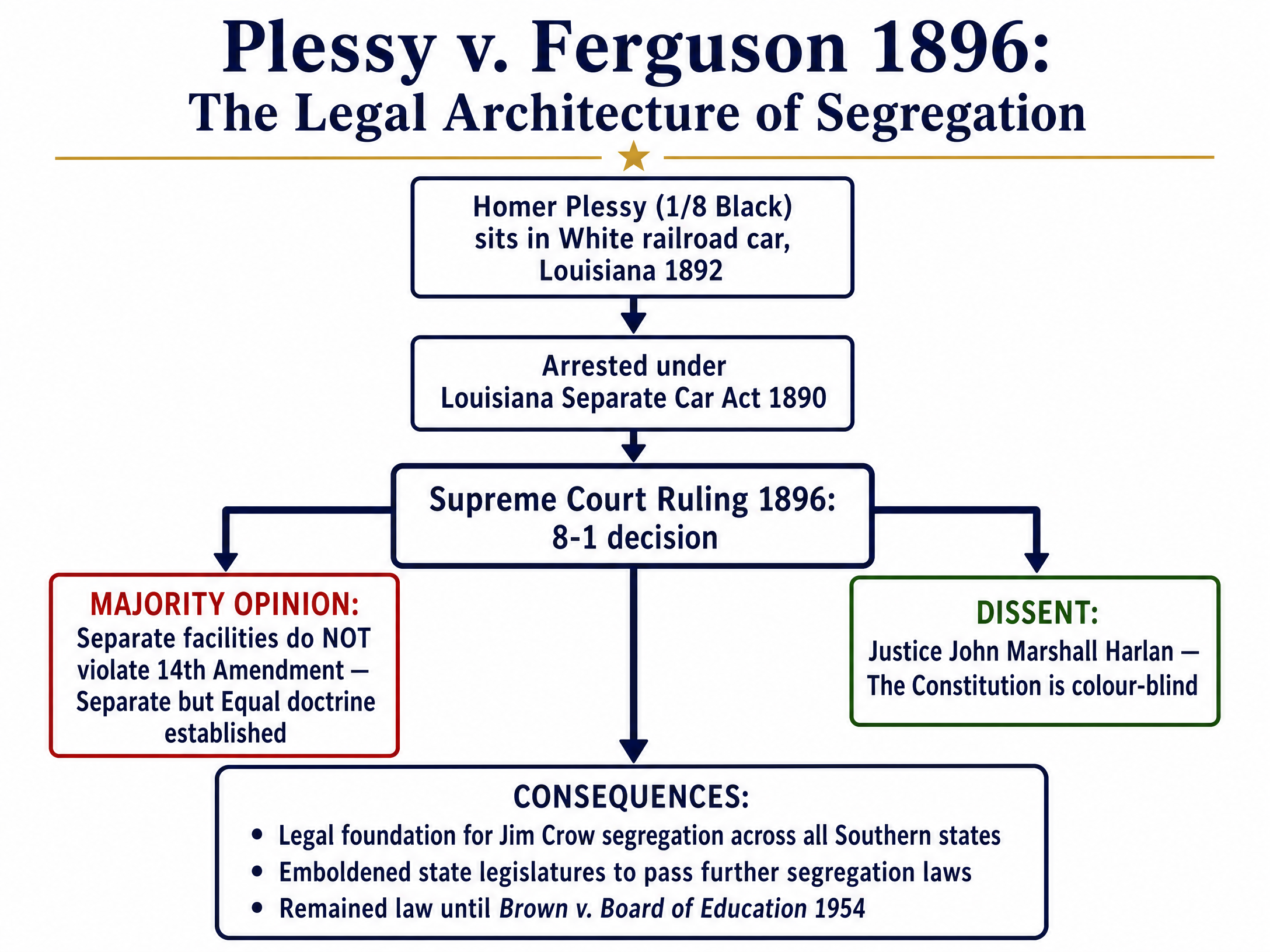
What happened: Homer Plessy (who was 1/8 Black) deliberately violated Louisiana's Separate Car Act of 1890. The Supreme Court ruled 8-1 against him, establishing the 'Separate but Equal' doctrine.
Why it matters: This is the most significant legal case of the period. It provided constitutional legitimacy for Jim Crow segregation across all Southern states, remaining the law until 1954.
Specific Knowledge: 8-1 decision; 'Separate but Equal' doctrine; Louisiana Separate Car Act 1890.
Disenfranchisement: The Grandfather Clause
Date(s): 1898
What happened: Louisiana introduced a clause stating that men could only vote if their grandfathers had the right to vote before 1867.
Why it matters: Since enslaved people could not vote before 1867, this excluded almost all Black citizens while allowing poor, illiterate white men to vote, bypassing the literacy tests.
Specific Knowledge: Louisiana 1898; 1867 cutoff date.
Further Supreme Court Endorsements
Date(s): 1898 and 1899
What happened: In Williams v. Mississippi (1898), the Court upheld literacy tests and poll taxes. In Cumming v. Board of Education (1899), the Court allowed a Georgia county to close its Black high school while keeping the white high school open.
Why it matters: These rulings cemented the system. Williams legalized political disenfranchisement, and Cumming legalized unequal educational provision.
Specific Knowledge: Williams v. Mississippi 1898; Cumming v. Board of Education 1899.
Key Individuals
Justice John Marshall Harlan
Role: Supreme Court Justice
Key Actions: He was the sole dissenting voice in both the Civil Rights Cases (1883) and Plessy v. Ferguson (1896).
Impact: He famously wrote that "Our Constitution is color-blind." His dissents highlight that the Court's decisions were not inevitable and that contemporaries recognized their discriminatory nature.
Homer Plessy
Role: Civil Rights Activist
Key Actions: Agreed to be the test case for the Citizens' Committee to challenge Louisiana's segregation laws in 1892.
Impact: His arrest led to the landmark Plessy v. Ferguson ruling, inadvertently resulting in the legal entrenchment of segregation.
Second-Order Concepts
Causation
The triumph of Jim Crow was caused by a combination of the withdrawal of federal troops after Reconstruction (1877), deep-seated white supremacist attitudes in the South, and crucially, the Supreme Court's willingness to interpret the 14th and 15th Amendments narrowly to allow state-level discrimination.
Consequence
The immediate consequence was the total segregation of Southern society and the near-complete disenfranchisement of Black voters. The long-term consequence was decades of systemic poverty, lack of education, and political powerlessness for Black Americans, which necessitated the Civil Rights Movement of the mid-20th century.
Change & Continuity
While the abolition of slavery (1865) represented a massive change, the period 1883-1900 represents a continuity of white supremacy, adapting from the economic system of slavery to a legal and social system of segregation (Jim Crow).
Significance
This period is highly significant because it demonstrates how the law can be used as an instrument of oppression. The Supreme Court rulings gave a veneer of constitutional respectability to a deeply racist system.
Source Skills
When evaluating sources for this topic, consider provenance carefully. A speech by a Southern Democratic politician in 1890 advocating for poll taxes will have the purpose of maintaining white political control. A newspaper illustration depicting Black Americans using racist caricatures demonstrates the social attitudes that justified Jim Crow laws. Always ask: Who created this? What was their vested interest in the racial hierarchy of the South?
Worked Examples
3 worked examples — open one to explore the question and available guidance.
Practice Questions
Test your understanding — click to reveal model answers
Describe two ways in which Southern states restricted Black voting rights in the 1890s. (4 marks)
Hint: Think of the Mississippi Plan and the Louisiana clause. Name the method and briefly explain how it worked.
Explain the significance of the 1883 Civil Rights Cases. (8 marks)
Hint: What did it strike down? What did it allow states to do?
Explain why Plessy v. Ferguson was a turning point in US race relations. (8 marks)
Hint: Focus on the phrase 'Separate but Equal' and what it allowed states to do legally.
How useful are Sources B and C for an enquiry into the nature of segregated education? (8 marks)
Hint: Remember to analyse Content, Provenance, and Limitations for both, then compare.
‘State governments were more responsible than the federal government for the triumph of Jim Crow.’ How far do you agree? (16 marks)
Hint: State governments passed the laws (Mississippi Plan, Florida rail). The federal government (Supreme Court) allowed them to do it (1883 Cases, Plessy). Weigh them up.
Test your understanding of Civil rights and race relations in the USA, 1850–2009
Active recall beats re-reading. Take an instant quiz now to test what you’ve learned and lock it into long-term memory.
7 days Premium · Then free forever · No card, no charge