Pearson Edexcel · A-Level · History
England, 1509–1603: authority, nation and religion
This study focuses on the final years of Elizabeth I's reign (1589–1603), exploring whether England faced a genuine 'crisis of government'. It is crucial for the exam because it requires you to weigh up evidence of severe challenges (war, rebellion, famine, faction) against the resilience of Tudor government.
- 6 min read
- 3 worked examples
- 2 practice questions
- 6 key terms
Study Notes
Overview
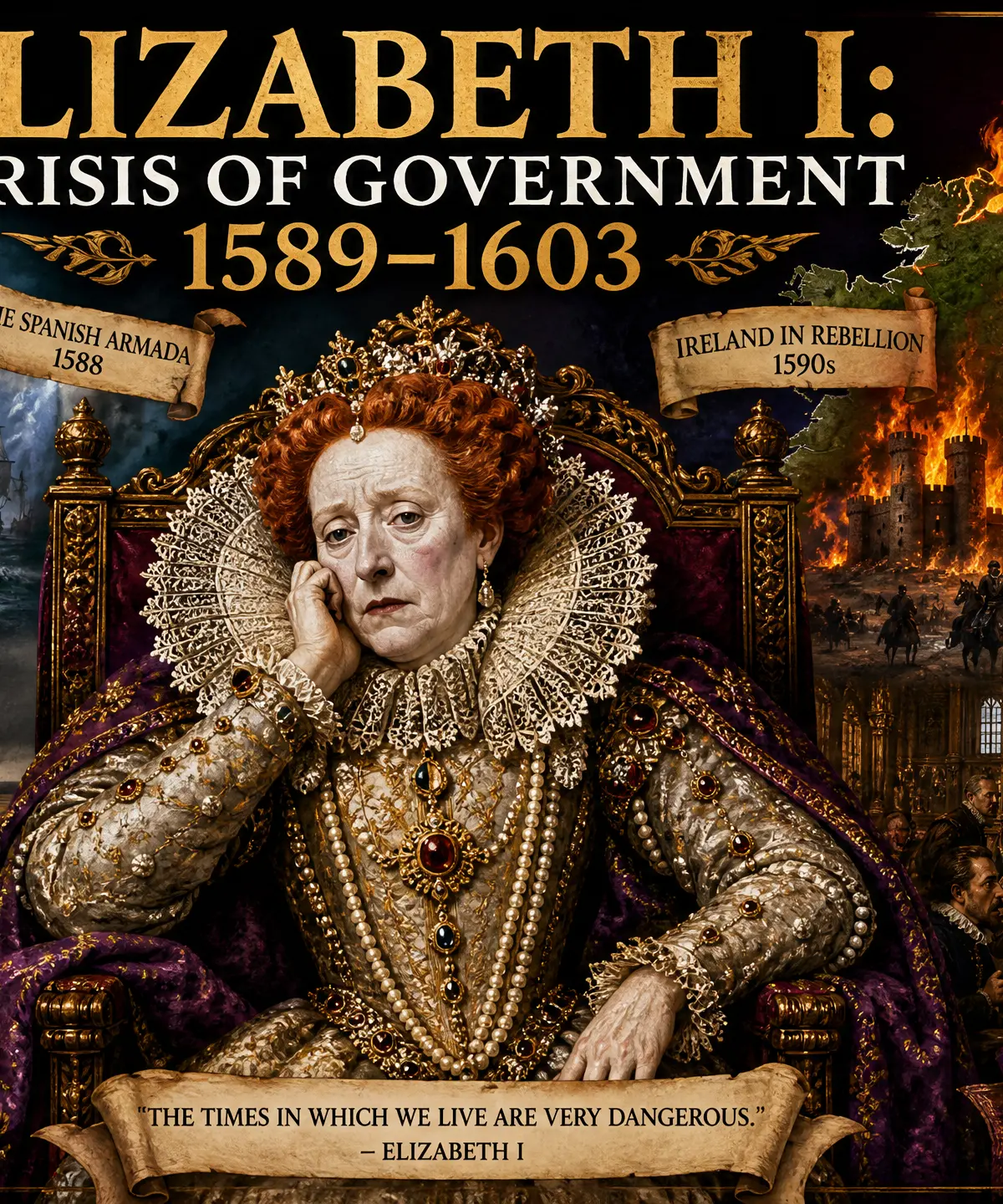
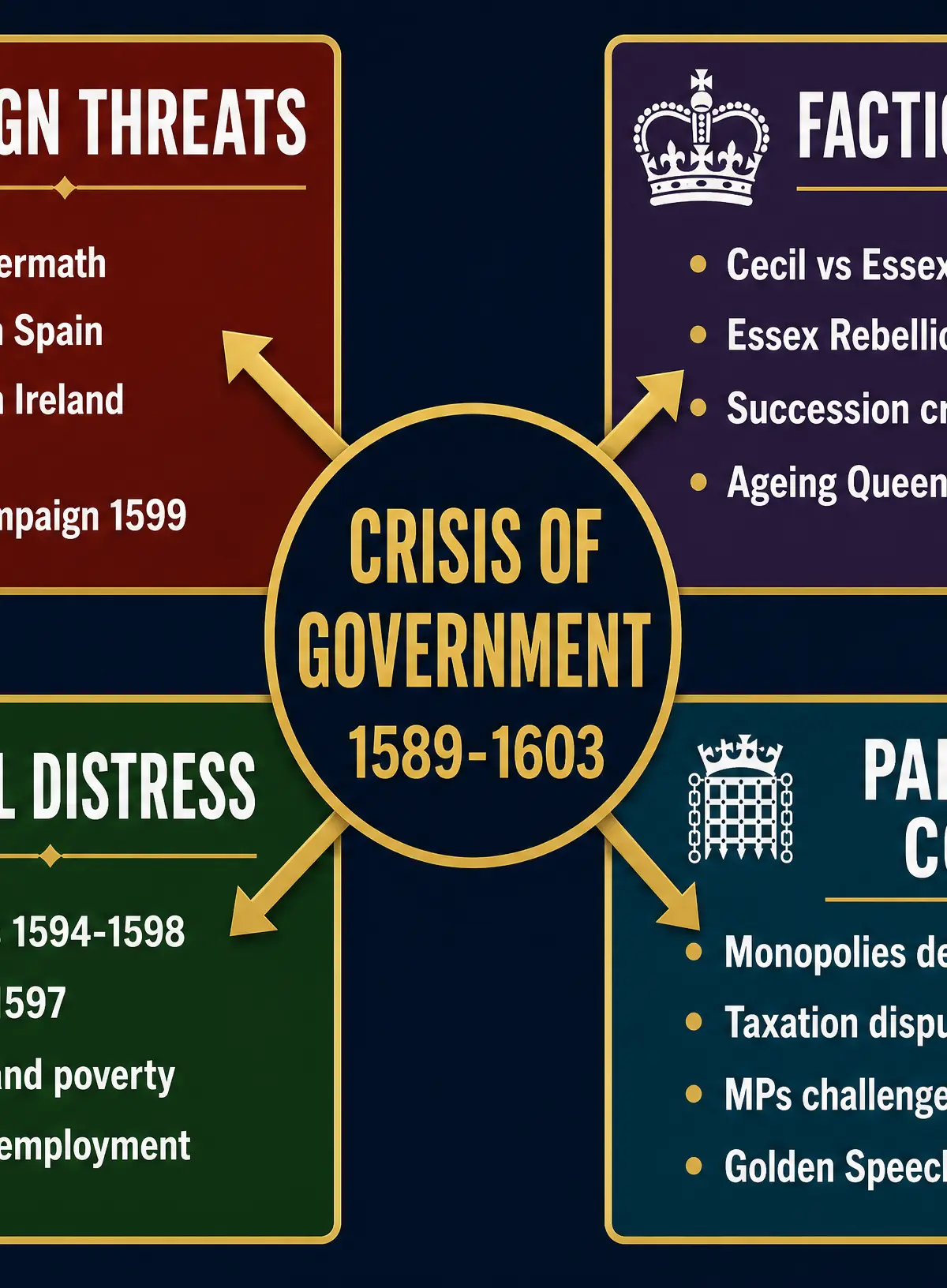
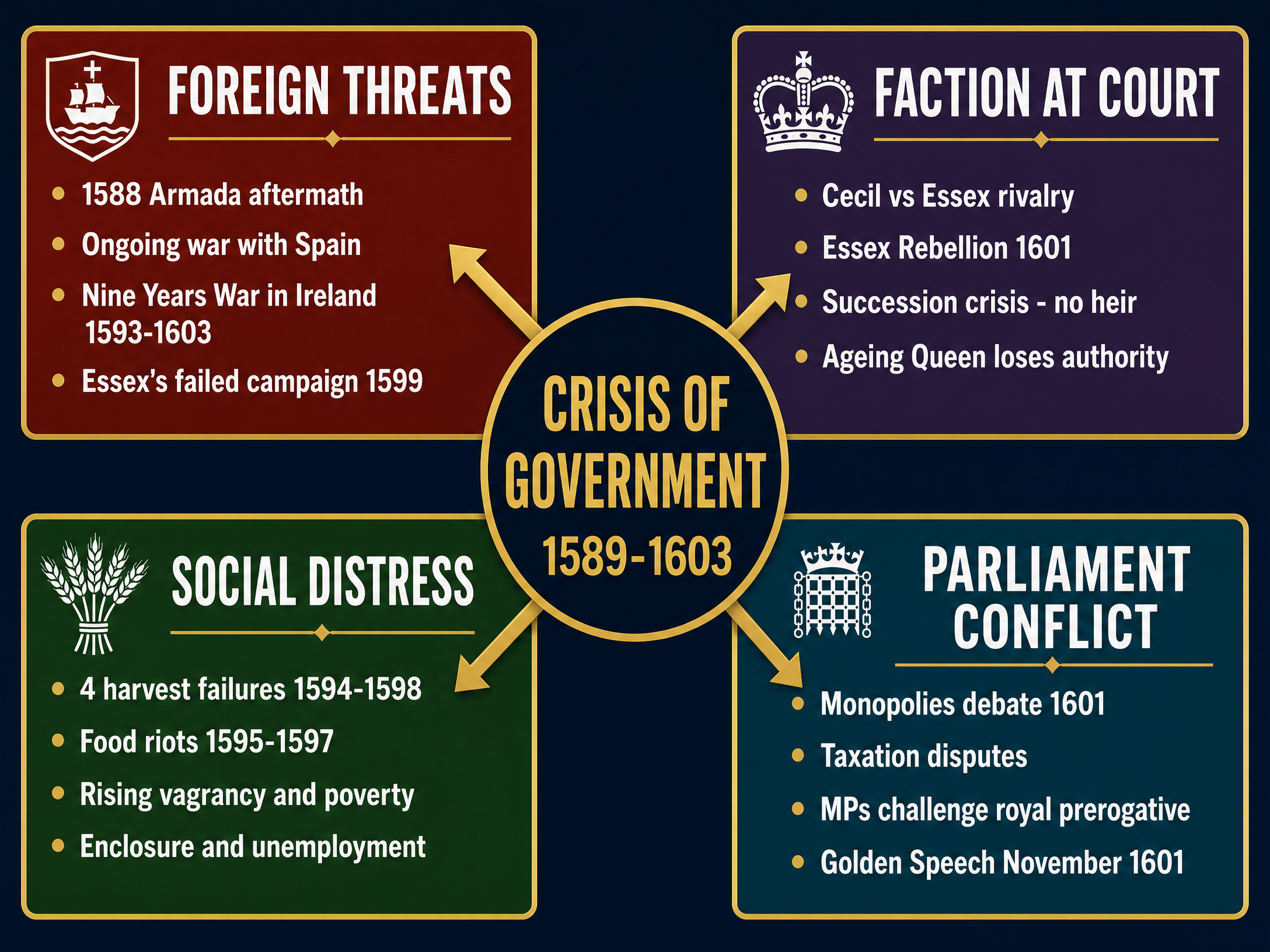
The period from 1589 to 1603 is often described by historians as Elizabeth I's 'second reign'. While her earlier years are remembered for the 'cult of Gloriana' and the defeat of the Spanish Armada, these final 14 years were characterised by intense pressure. England was engaged in a costly, ongoing war with Spain, faced a massive rebellion in Ireland, suffered consecutive harvest failures, and witnessed bitter factional rivalry at court as the Queen aged without an heir. For the exam, candidates must be able to analyse these four key factors and evaluate whether they constituted a genuine 'crisis of government', or whether the fact that the regime survived proves its underlying strength.
Listen to the revision podcast below for a full overview of the topic:
Key Events & Developments
The Nine Years War in Ireland
Date(s): 1593–1603
What happened: A major rebellion against English rule led by Hugh O'Neill, Earl of Tyrone. Tyrone built a sophisticated army, secured Spanish support, and inflicted severe defeats on English forces, notably at the Battle of Yellow Ford.
Why it matters: This was the most serious military threat to Elizabeth's authority. It drained England's finances, required the largest army of her reign (16,000 men under Essex), and highlighted the vulnerability of England's control over Ireland.
Specific Knowledge: Battle of Yellow Ford (1598) - 4,000 English troops defeated. Essex's failed campaign (1599). Lord Mountjoy eventually defeated the rebellion, securing Tyrone's surrender in 1603, days after Elizabeth's death.
The Harvest Failures of the 1590s
Date(s): 1594–1597
What happened: Four consecutive years of terrible harvests caused by cold, wet summers. This led to a dramatic rise in food prices, starvation in some areas, and an increase in vagrancy and poverty.
Why it matters: Economic distress led to social instability, including food riots (e.g., London in 1595, Oxfordshire in 1596). It forced the government to act, resulting in the Poor Laws, demonstrating both the scale of the crisis and the government's ability to respond.
Specific Knowledge: Grain prices more than doubled. The Poor Laws of 1598 and 1601 established a national system of poor relief, requiring parishes to appoint Overseers of the Poor.
The Parliament of 1601 and the Monopolies Crisis
Date(s): November 1601
What happened: MPs fiercely attacked the Queen's granting of monopolies (exclusive rights to sell goods), which were driving up prices for ordinary people. The debate was unprecedentedly hostile.
Why it matters: It showed the growing assertiveness of Parliament and the tension caused by the financial strain of war. However, Elizabeth's masterful handling of the situation demonstrated her continued political skill.
Specific Knowledge: Elizabeth revoked the most unpopular monopolies and delivered the 'Golden Speech', famously declaring: 'Though God hath raised me high, yet this I count the glory of my Crown, that I have reigned with your loves.'
The Essex Rebellion
Date(s): February 1601
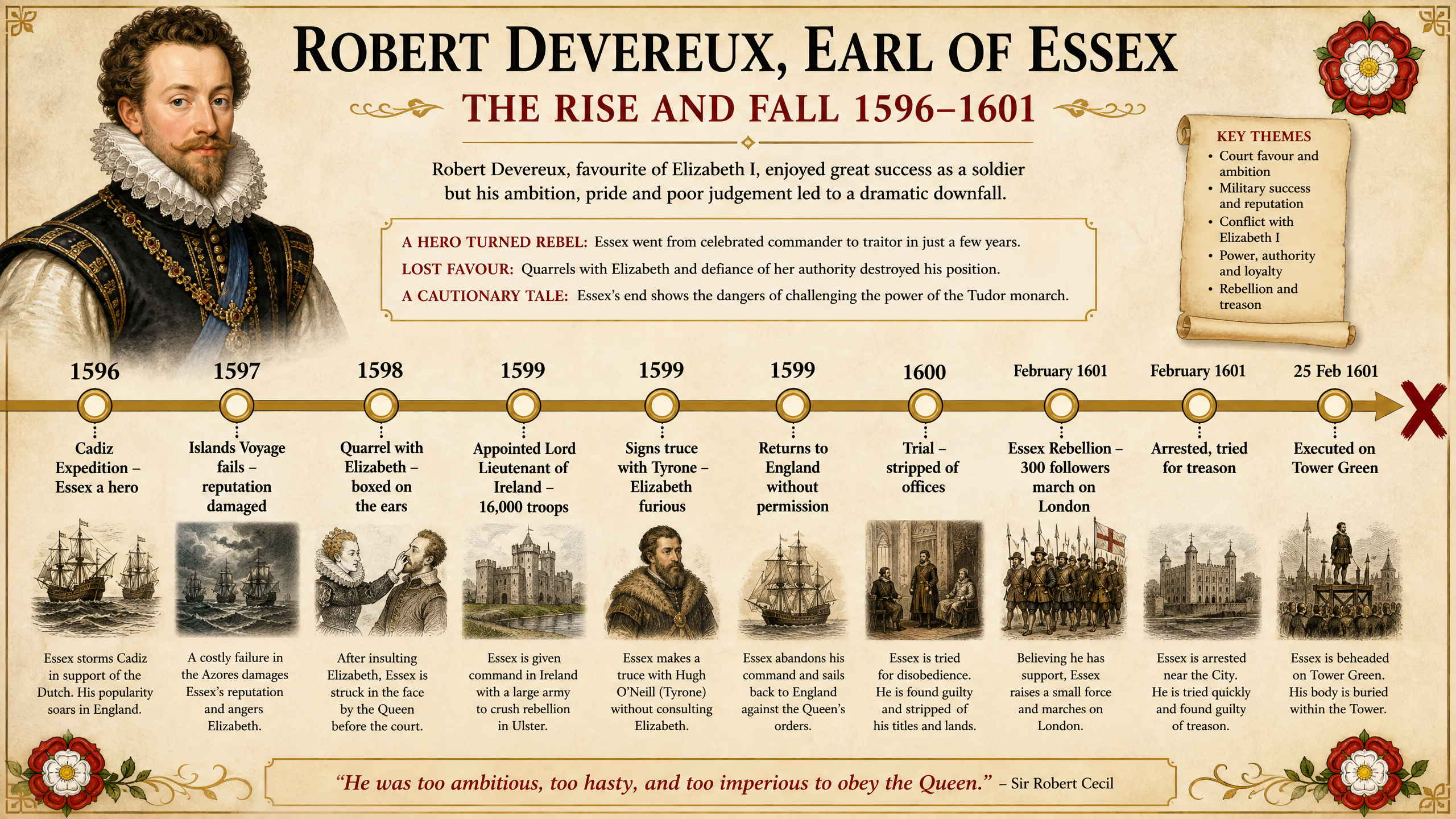
What happened: Following his disastrous campaign in Ireland and loss of royal favour, the Earl of Essex attempted to lead an armed uprising in London to force the Queen to dismiss his rival, Robert Cecil.
Why it matters: It is the clearest example of factional rivalry escalating into treason. However, its complete failure (he gathered only about 300 supporters) proves that the Crown's authority remained secure.
Specific Knowledge: Essex burst into the Queen's bedchamber at Nonsuch Palace in 1599. He was executed on Tower Green on 25 February 1601.
Key Individuals
Robert Devereux, Earl of Essex
Role: Royal favourite, military commander, and faction leader.
Key Actions: Led the successful Cadiz raid (1596), failed disastrously in Ireland (1599), and led an abortive rebellion in London (1601).
Impact: His ambition and rivalry with Cecil destabilised the court. His rebellion highlights the dangers of faction in the 1590s.
Robert Cecil
Role: Secretary of State, leading minister in the 1590s.
Key Actions: Took over the administrative burden from his father (Lord Burghley). Managed the government's response to the Essex Rebellion and secretly negotiated the peaceful succession of James VI of Scotland.
Impact: Provided crucial stability and continuity in government during a volatile period, ensuring the regime did not collapse.
Second-Order Concepts
Causation
Why did the crisis emerge in the 1590s? The trigger was the ongoing war with Spain, which drained finances. This long-term pressure was exacerbated by short-term shocks: the sudden harvest failures of 1594-97 and the unexpected scale of Tyrone's rebellion in Ireland. The structural weakness of an ageing, childless Queen allowed factional rivalry to spiral out of control.
Consequence
The immediate consequences were severe social distress, heavy taxation, and political instability (the Essex Rebellion). The long-term consequences included the establishment of a national system of poor relief (the 1601 Poor Law) which lasted until 1834, and the peaceful transition of power to the Stuart dynasty, engineered by Robert Cecil.
Significance
The significance of this period lies in the historical debate it generates. Does the evidence of war, rebellion, and famine prove that Elizabeth's government was failing? Or does the fact that she defeated Essex, managed Parliament, pacified Ireland, and passed the Poor Laws prove that her government was highly effective under extreme pressure? Examiners reward candidates who can argue both sides.
Source Skills
When evaluating sources for this topic, consider provenance carefully. Official government proclamations or speeches by Elizabeth (like the Golden Speech) are highly useful for showing how the government wanted to be perceived (maintaining authority, showing love for the people), but they are limited as evidence of the actual level of social distress or opposition. Conversely, reports from local magistrates about vagrancy or food riots are useful for showing the reality of the crisis on the ground, but may exaggerate the threat of rebellion due to the magistrates' fear of disorder.
Worked Examples
3 worked examples — open one to explore the question and available guidance.
Practice Questions
Test your understanding — click to reveal model answers
Explain the significance of the harvest failures in the 1590s. (8 marks)
Hint: Don't just describe the bad weather. Explain what the bad harvests LED TO (starvation, riots) and how the government RESPONDED (Poor Laws).
How far was the Earl of Essex responsible for his own downfall? (16 marks)
Hint: Balance Essex's personal flaws (arrogance, failure in Ireland) against structural factors (Elizabeth's ageing, Cecil's scheming).
Test your understanding of England, 1509–1603: authority, nation and religion
Active recall beats re-reading. Take an instant quiz now to test what you’ve learned and lock it into long-term memory.
7 days Premium · Then free forever · No card, no charge