Pearson Edexcel · A-Level · History
England and the Angevin Empire in the reign of Henry II, 1154–89
This study explores the dramatic clash between royal authority and the Church during the reign of Henry II, culminating in the murder of Thomas Becket. It is historically significant as a defining constitutional struggle over legal jurisdiction and power, making it a crucial topic for understanding medieval governance and answering causation and consequence questions.
- 8 min read
- 3 worked examples
- 5 practice questions
- 6 key terms
Study Notes
Overview
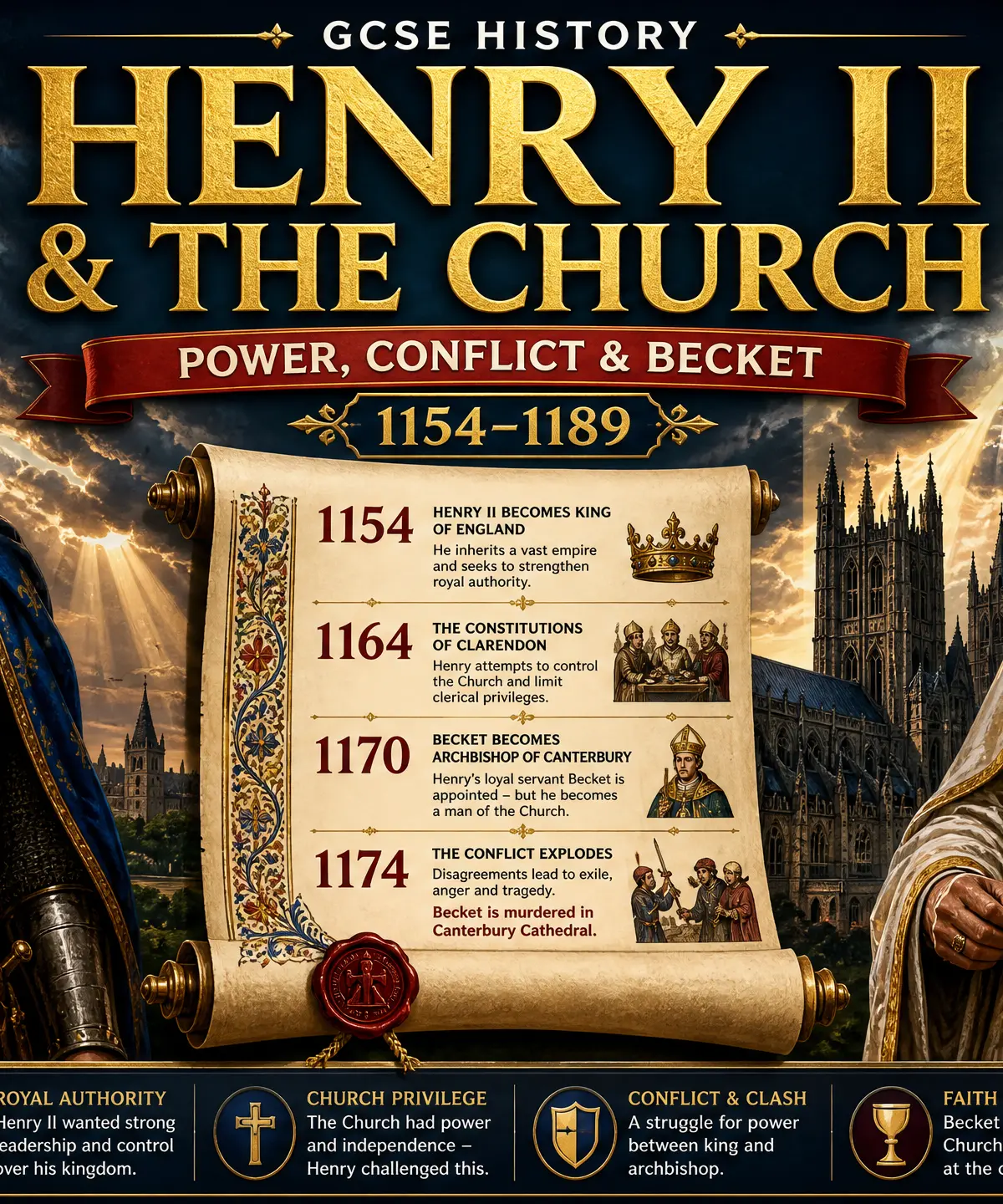
The conflict between Henry II and the Church (1154–1189) is one of the most famous power struggles in English history. When Henry II inherited the throne in 1154, he ruled the vast Angevin Empire and sought to restore strong royal authority after the chaos of King Stephen's reign. However, the Church in England had grown powerful, operating its own courts and appealing directly to the Pope in Rome. Henry's attempt to bring the Church under royal control led to a bitter, decade-long dispute with his former friend and Chancellor, Thomas Becket, whom he had appointed Archbishop of Canterbury. For examiners, this topic is not just a dramatic story of murder in a cathedral; it is a complex constitutional crisis. Candidates must understand the specific structural causes of the conflict, the details of the Constitutions of Clarendon (1164), and be able to evaluate the extent of Henry's success in his final settlements with the Church in 1172 and 1174.
Key Events & Developments
The Appointment of Thomas Becket
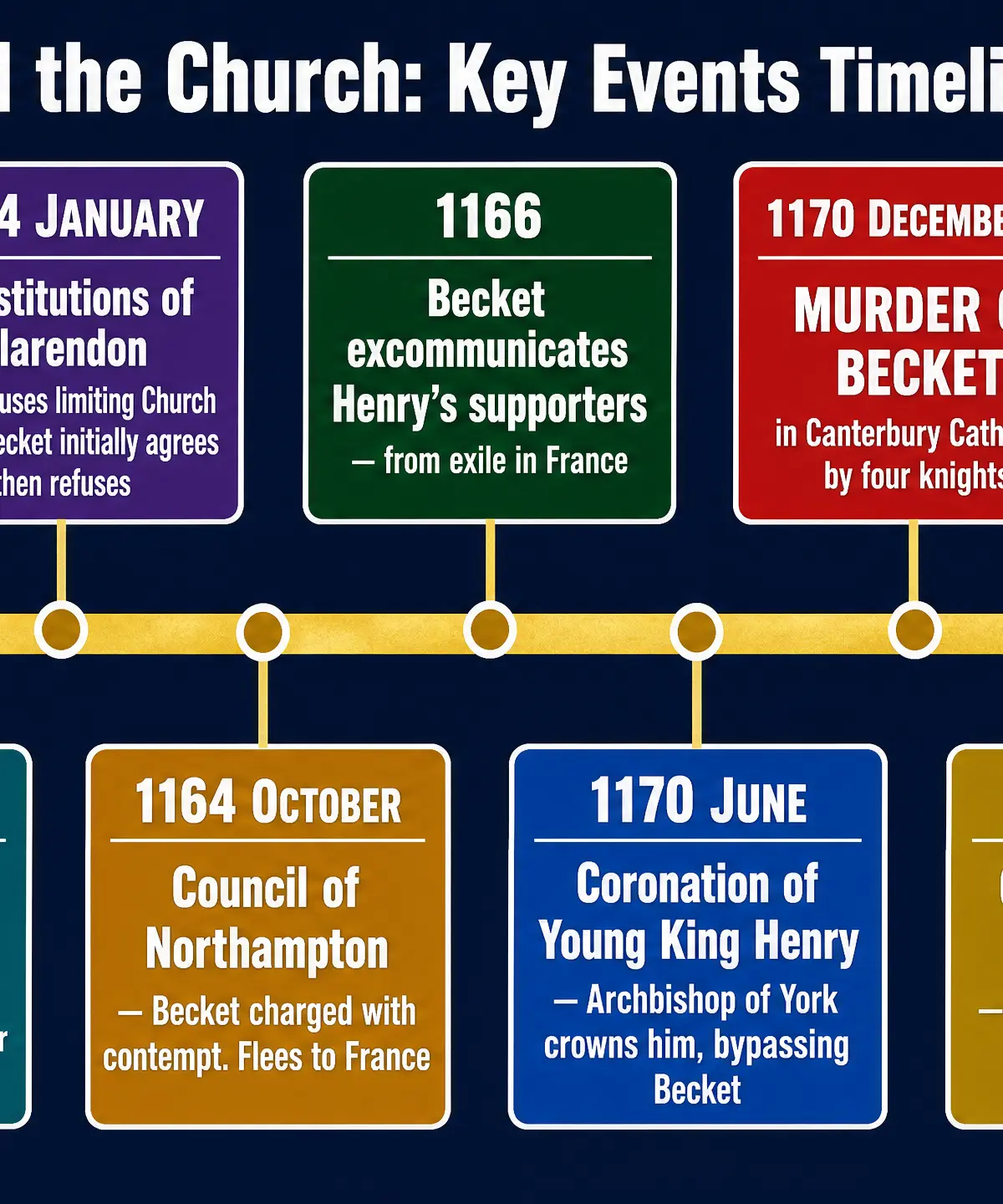
Date(s): 1162
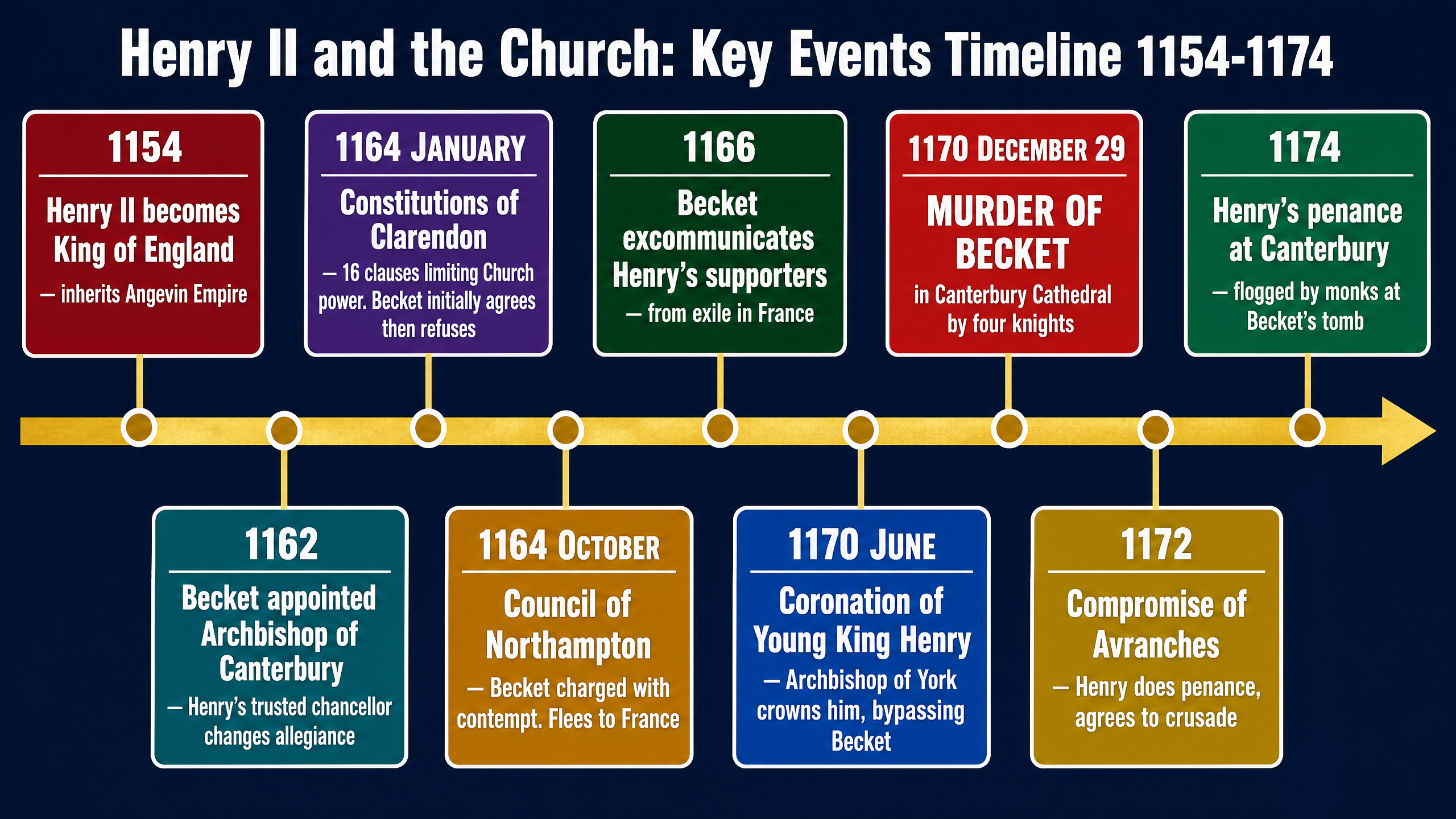
What happened: Henry II appointed his close friend and loyal Chancellor, Thomas Becket, as Archbishop of Canterbury. Henry expected Becket to help him control the Church. Instead, Becket resigned as Chancellor and became a staunch defender of Church privileges.
Why it matters: This was the trigger for the personal and political conflict. It shows how Henry's attempt to assert control backfired, leading to a clash between royal authority and ecclesiastical independence.
Specific Knowledge: Becket was appointed in 1162. He had previously served as Chancellor since 1155.
The Constitutions of Clarendon
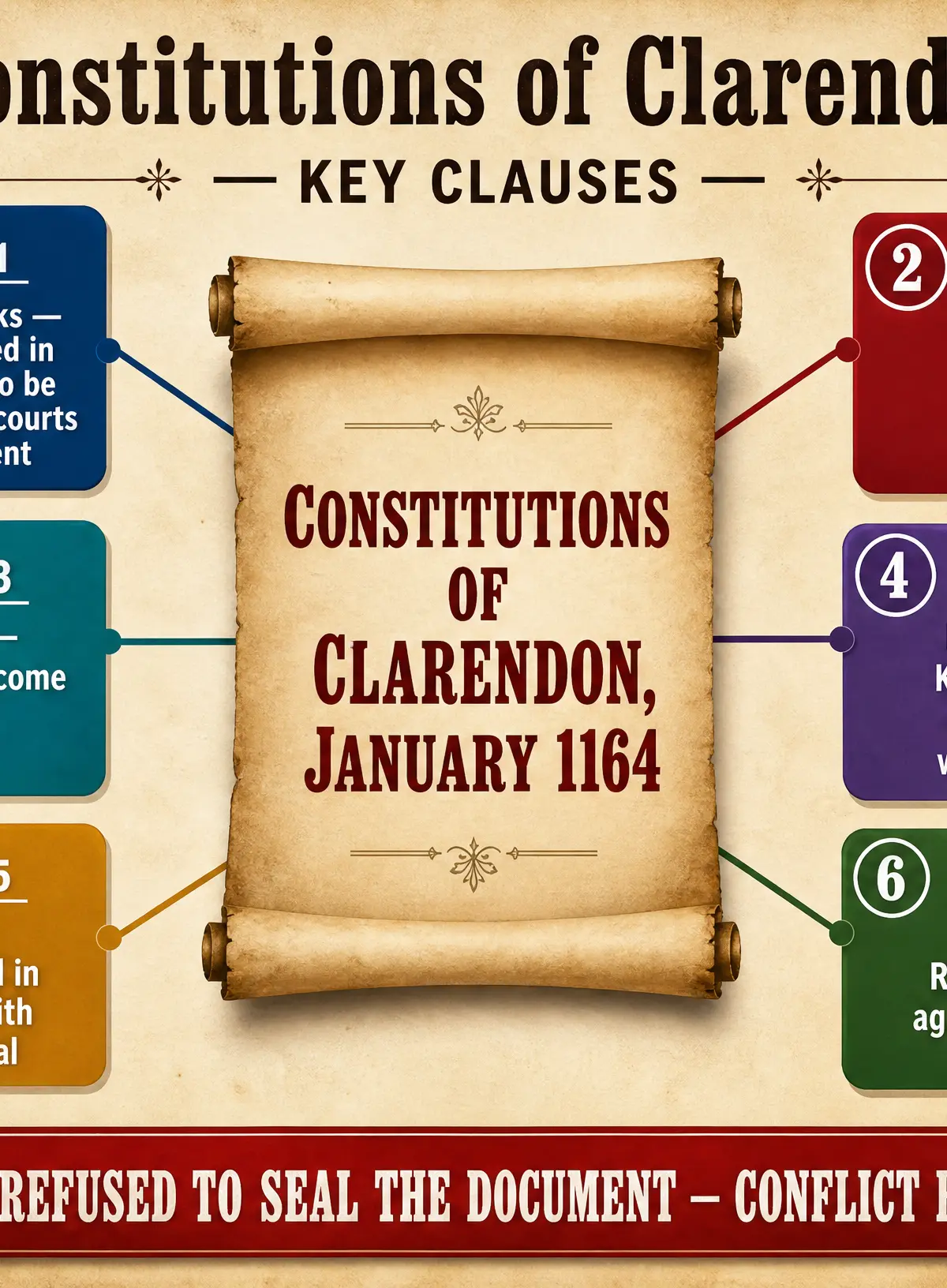
Date(s): January 1164
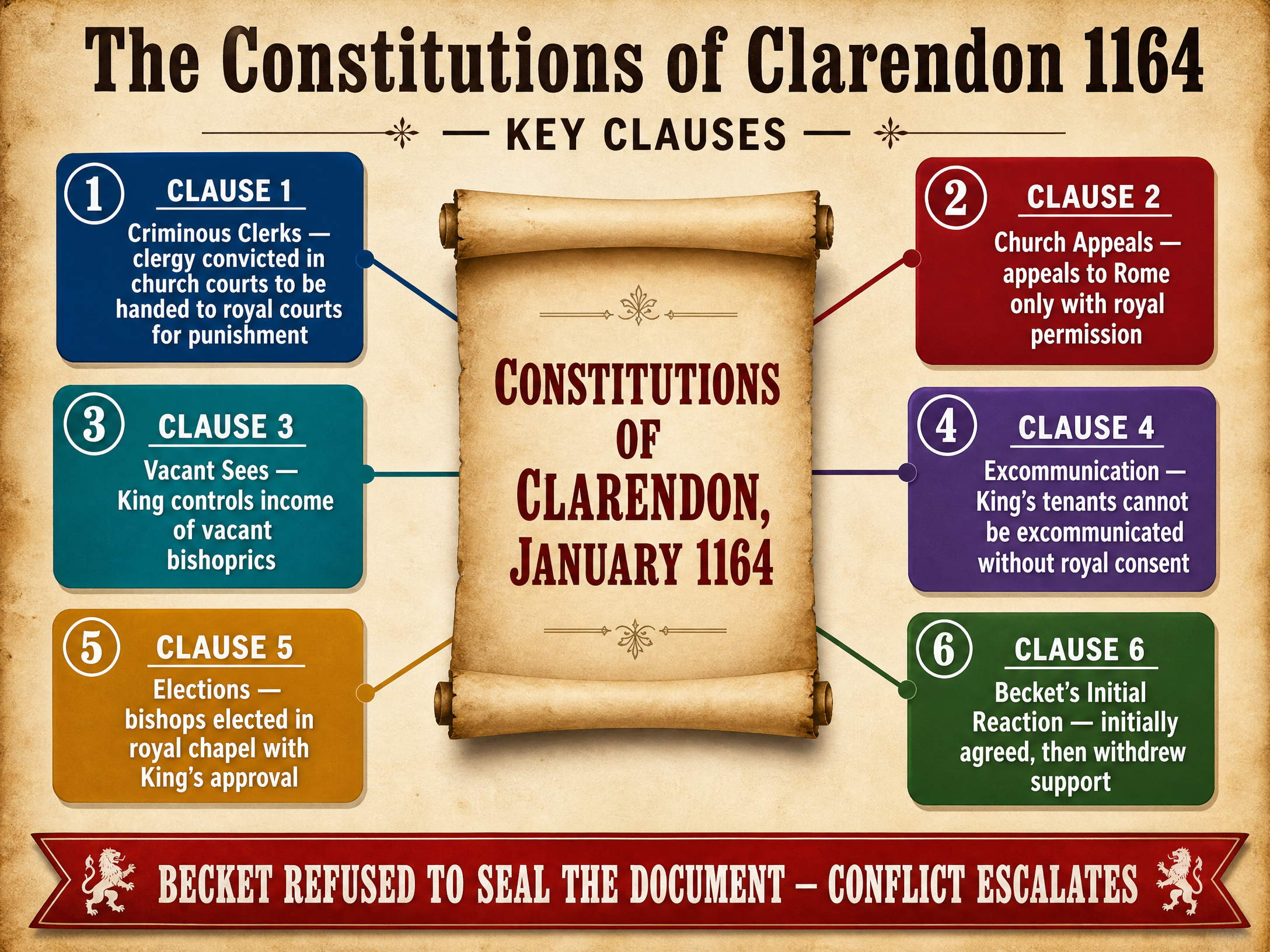
What happened: Henry issued 16 written clauses aiming to define and restrict Church power. Key clauses included: criminous clerks must be punished by royal courts after being found guilty in church courts; appeals to Rome required royal permission; and bishops must be elected with the king's approval.
Why it matters: This is the central constitutional document of the conflict. It represents Henry's attempt to codify unwritten customs into law. Becket's initial agreement, followed by his refusal to seal the document, escalated the crisis.
Specific Knowledge: 16 clauses; issued in January 1164; addressed 'benefit of clergy' and 'criminous clerks'.
The Council of Northampton and Becket's Exile
Date(s): October 1164 – 1170
What happened: Henry summoned Becket to face charges of contempt and financial embezzlement from his time as Chancellor. Realising Henry intended to ruin him, Becket fled to France, spending six years in exile under the protection of King Louis VII.
Why it matters: The exile internationalised the conflict, bringing in the Pope (Alexander III) and the King of France. It showed the breakdown of compromise and led to a war of words and excommunications.
Specific Knowledge: October 1164; exiled in France; Pope Alexander III attempted to mediate.
The Coronation of the Young King
Date(s): June 1170
What happened: Henry II had his eldest son crowned co-king by the Archbishop of York. This violated the traditional right of the Archbishop of Canterbury to crown English monarchs and defied a papal prohibition.
Why it matters: This was the catalyst for the final crisis. It infuriated Becket, leading him to excommunicate the bishops involved, which in turn provoked Henry's fatal outburst.
Specific Knowledge: June 1170; Archbishop of York performed the ceremony.
The Murder of Thomas Becket
Date(s): 29 December 1170
What happened: Following Henry's angry outburst ("Will no one rid me of this turbulent priest?"), four knights travelled to Canterbury and murdered Becket at the altar of the cathedral.
Why it matters: It was a PR disaster for Henry, shocking Christendom. Becket became a martyr, forcing Henry to back down on several key issues and perform public penance.
Specific Knowledge: 29 December 1170; Four knights (Reginald FitzUrse, Hugh de Morville, William de Tracy, Richard le Breton); Becket canonised in 1173.
The Settlements: Avranches and Canterbury
Date(s): 1172 and 1174
What happened: At the Compromise of Avranches (1172), Henry agreed to abolish 'evil customs' and allow appeals to Rome. In 1174, he performed public penance at Canterbury, being flogged by monks at Becket's tomb.
Why it matters: These events are crucial for evaluating Henry's success. While publicly humiliating, Henry retained practical control over church appointments and much of his royal authority.
Specific Knowledge: Compromise of Avranches 1172; Public penance at Canterbury 1174.
Key Individuals
Henry II
Role: King of England (1154-1189) and ruler of the Angevin Empire.
Key Actions: Issued the Constitutions of Clarendon, appointed Becket, inadvertently caused Becket's murder, and negotiated the Compromise of Avranches.
Impact: His drive to centralise royal justice and limit Church independence was the fundamental cause of the conflict.
Thomas Becket
Role: Chancellor (1155-1162) and Archbishop of Canterbury (1162-1170).
Key Actions: Refused to seal the Constitutions of Clarendon, fled into exile, excommunicated royal supporters, and was martyred in 1170.
Impact: His uncompromising stance transformed a political dispute into a crisis of faith and principle, ultimately limiting Henry's ambitions.
Pope Alexander III
Role: The Head of the Catholic Church.
Key Actions: Attempted to mediate the dispute, canonised Becket in 1173, and negotiated the Compromise of Avranches.
Impact: His authority over the English Church was a key issue, and his diplomatic pressure forced Henry to make concessions after 1170.
Second-Order Concepts
Causation
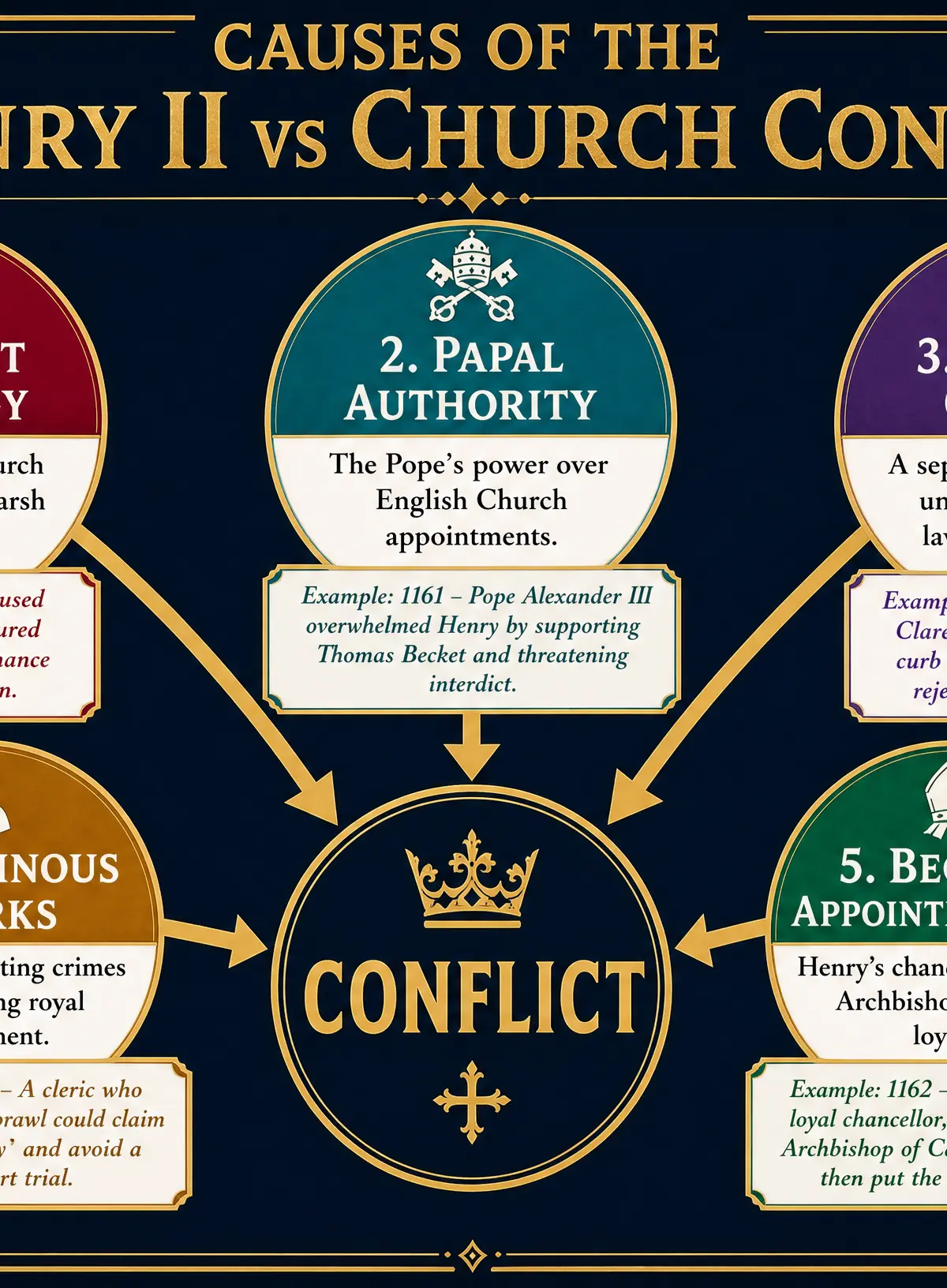
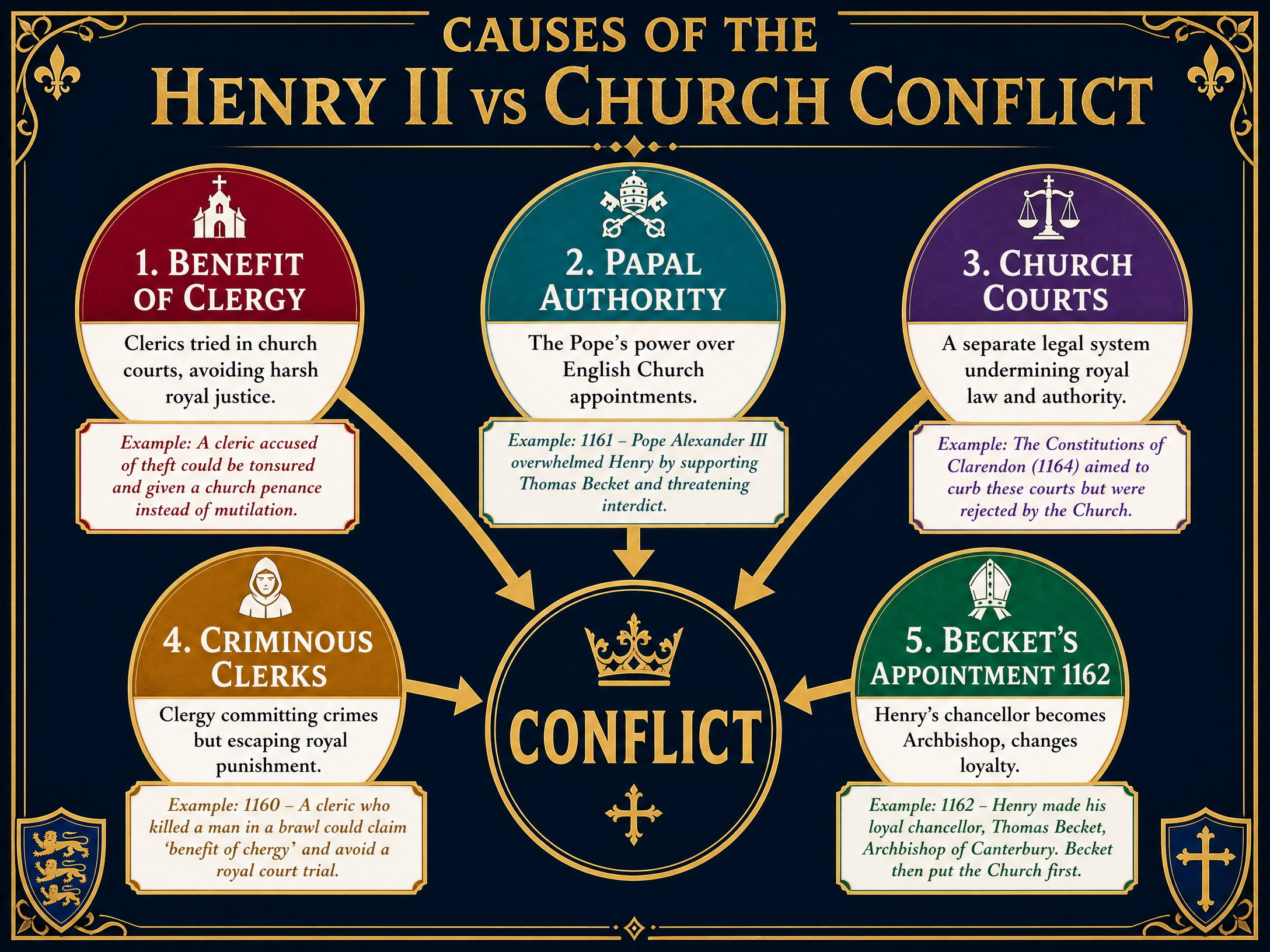
The conflict was driven by long-term structural issues: the separate system of Church courts, the issue of 'criminous clerks' escaping royal justice (benefit of clergy), and the increasing influence of the Papacy over English affairs. The short-term trigger was Henry's appointment of Becket in 1162, expecting compliance, and Becket's subsequent transformation into a staunch defender of Church rights. The Constitutions of Clarendon (1164) acted as the catalyst for open hostility.
Consequence
The immediate consequence of the conflict was the shocking murder of Becket in 1170, which severely damaged Henry's reputation across Europe. Long-term consequences included the Compromise of Avranches (1172), which forced Henry to formally concede the right of appeal to Rome and abandon his attempts to try criminous clerks in royal courts, though he retained significant practical control over the Church.
Change & Continuity
Change: The conflict resulted in a formal recognition of papal authority in appeals and the establishment of Becket's cult, making Canterbury a major pilgrimage site. Continuity: Despite the dramatic events, Henry II maintained practical control over the appointment of bishops and continued to exert strong influence over the English Church for the rest of his reign.
Significance
This conflict is highly significant as a defining clash between Church and State in medieval Europe. It highlights the limits of royal authority when faced with the spiritual power of the Church and the moral force of martyrdom. It also established legal precedents regarding the separation of secular and ecclesiastical jurisdiction that lasted for centuries.
Source Skills
When evaluating sources for this topic, consider the intense bias likely present. Monastic chroniclers (like William Fitzstephen or John of Salisbury) were often sympathetic to Becket, portraying him as a saintly martyr and Henry as a tyrant. Royal records or letters from Henry's supporters will emphasise Becket's stubbornness and the necessity of royal law. Always assess the provenance: was the author a cleric? Were they writing before or after Becket's martyrdom (which heavily influenced later accounts)? Use your specific knowledge of events like the Constitutions of Clarendon to test the claims made in the sources.
Podcast Revision
Listen to this 10-minute audio guide covering the core concepts, narrative, and exam tips for this topic:
Worked Examples
3 worked examples — open one to explore the question and available guidance.
Practice Questions
Test your understanding — click to reveal model answers
Describe two features of the Constitutions of Clarendon (1164). (4 marks)
Hint: Think about what Henry wanted to do with criminous clerks and appeals to Rome.
Explain why Thomas Becket went into exile in 1164. (12 marks)
Hint: Link his refusal of the Constitutions of Clarendon to the Council of Northampton.
‘The main reason for the conflict between Henry II and the Church was the issue of criminous clerks.’ How far do you agree? (16 marks)
Hint: Compare the legal issue of criminous clerks with the personal issue of Becket's betrayal and the broader issue of papal power.
Explain the consequences of the murder of Thomas Becket. (8 marks)
Hint: Think about the short-term shock and the long-term legal settlements.
How useful are sources about Becket written by monks? (General source evaluation practice)
Hint: Consider the worldview of a monk and the impact of Becket's martyrdom.
Test your understanding of England and the Angevin Empire in the reign of Henry II, 1154–89
Active recall beats re-reading. Take an instant quiz now to test what you’ve learned and lock it into long-term memory.
7 days Premium · Then free forever · No card, no charge