Pearson Edexcel · A-Level · History
France in revolution, 1774–99
Dive into the dramatic final phase of the French Revolution, where the Directory struggled to control a fractured nation. Discover how political instability, economic ruin, and war paved the way for Napoleon Bonaparte's rise to power in 1799.
- 8 min read
- 3 worked examples
- 2 practice questions
- 6 key terms
Study Notes
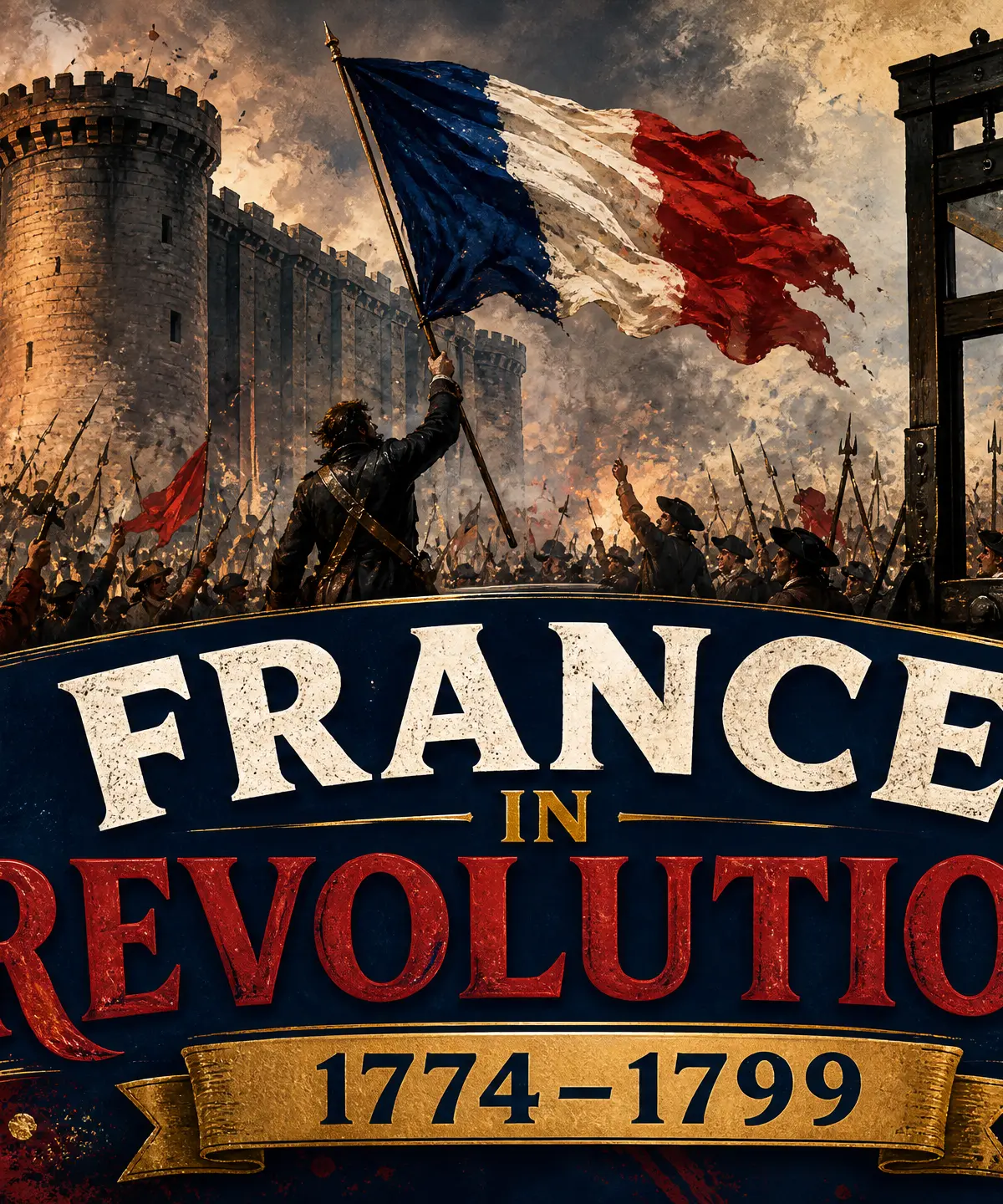
Overview
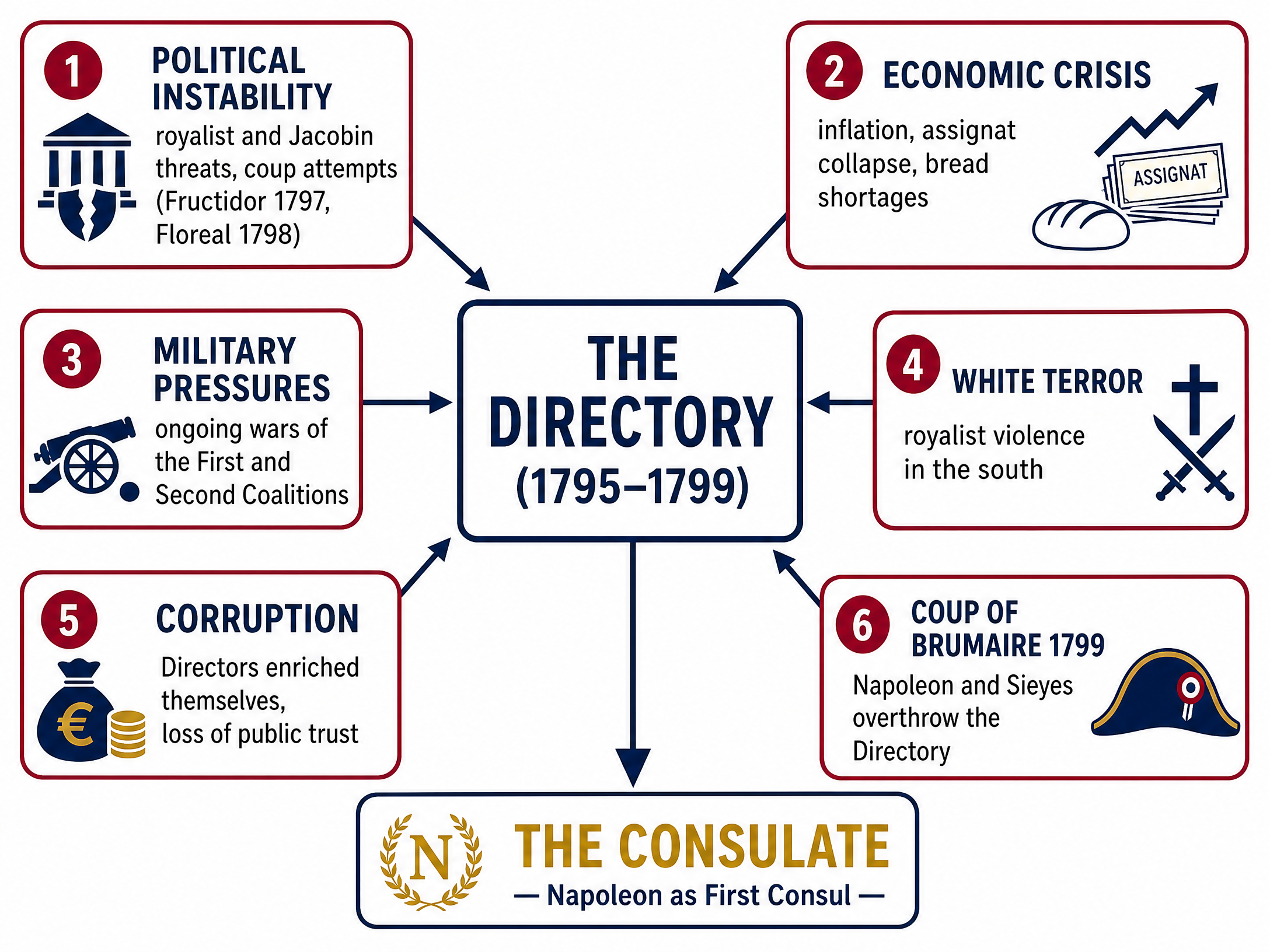
This study guide covers the final, turbulent phase of the French Revolution from 1795 to 1799. Following the fall of Robespierre and the Reign of Terror, France desperately sought stability. The solution was the Directory, a new government established by the Constitution of Year III. However, the Directory proved to be weak, corrupt, and incapable of solving France's deep-rooted political and economic crises. Caught between royalist uprisings and radical Jacobin plots, the government relied increasingly on the army to survive. This reliance on military force ultimately proved fatal. In November 1799, the brilliant general Napoleon Bonaparte, aided by political architect Emmanuel-Joseph Sieyès, overthrew the Directory in the Coup of Brumaire. Examiners expect you to understand the interconnected nature of the Directory's failures—how economic collapse, political factionalism, and the pressures of the Revolutionary Wars all combined to make Napoleon's seizure of power possible.
Key Events & Developments
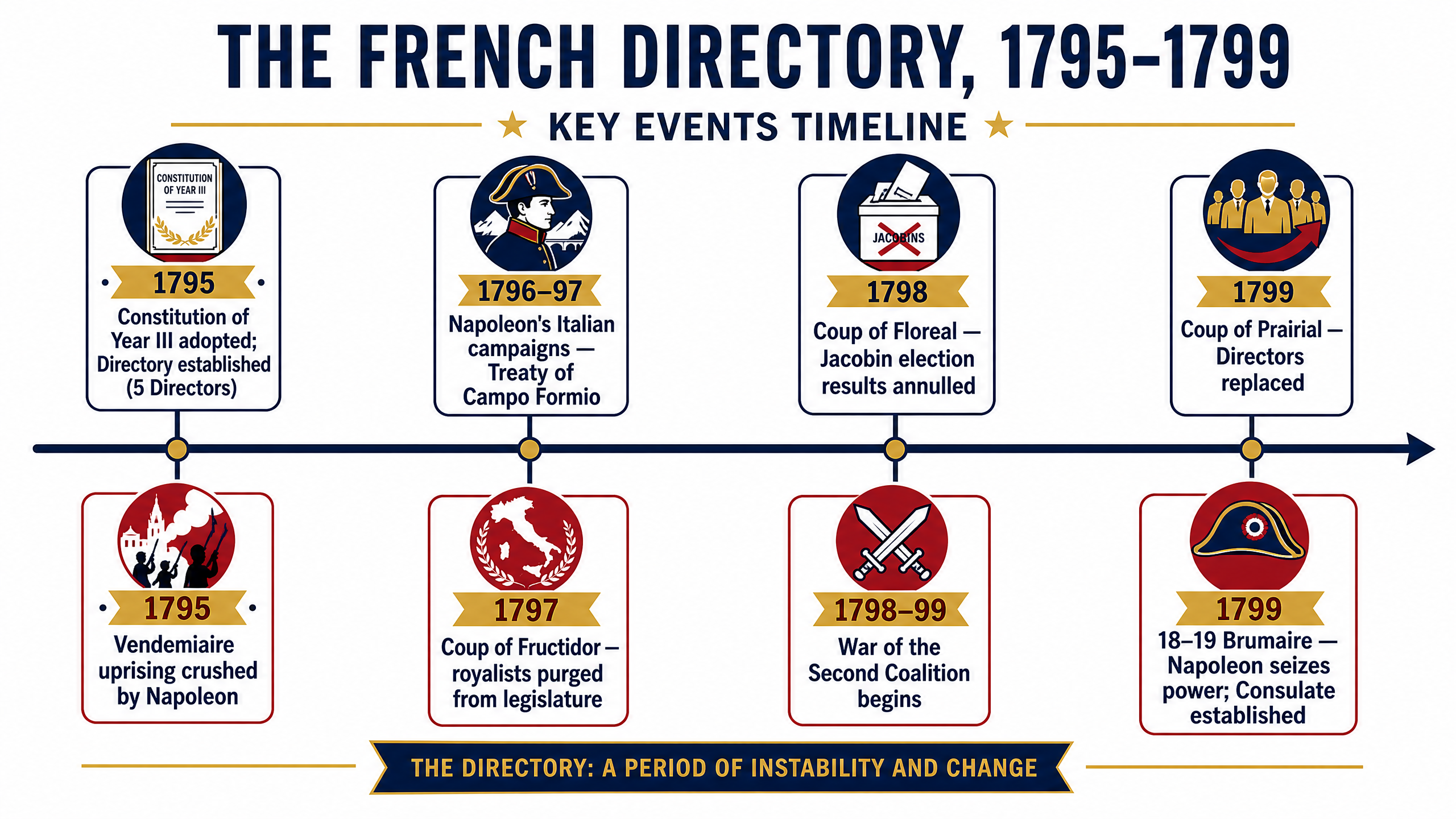
The Constitution of Year III and the Directory
Date(s): August 1795
What happened: Following the Thermidorian Reaction, a new constitution was drafted to prevent the rise of another dictator like Robespierre. It created a bicameral legislature (the Council of Five Hundred and the Council of Ancients) and a five-man executive called the Directory.
Why it matters: The constitution was fundamentally flawed. The 'Two-Thirds Law' (requiring two-thirds of the new deputies to be chosen from the old Convention) sparked outrage and undermined the Directory's democratic legitimacy from day one. It lacked a mechanism to resolve disputes between the executive and the legislature, leading to political gridlock.
Specific Knowledge: Council of Five Hundred (proposed laws), Council of Ancients (250 men, approved/rejected laws), Five Directors (executive).
The Vendémiaire Uprising
Date(s): 5 October 1795 (13 Vendémiaire)
What happened: An armed royalist uprising in Paris protesting the Two-Thirds Law. The government called upon a young artillery officer, Napoleon Bonaparte, to defend the National Convention. Napoleon dispersed the crowd with a "whiff of grapeshot", killing around 300 rebels.
Why it matters: It demonstrated that the new government relied on the army for its survival. It also catapulted Napoleon to national prominence, earning him the command of the Army of Italy.
Specific Knowledge: 25,000 royalist rebels vs 5,000 government troops; Napoleon's use of artillery in urban combat.
The Italian Campaigns and the Treaty of Campo Formio
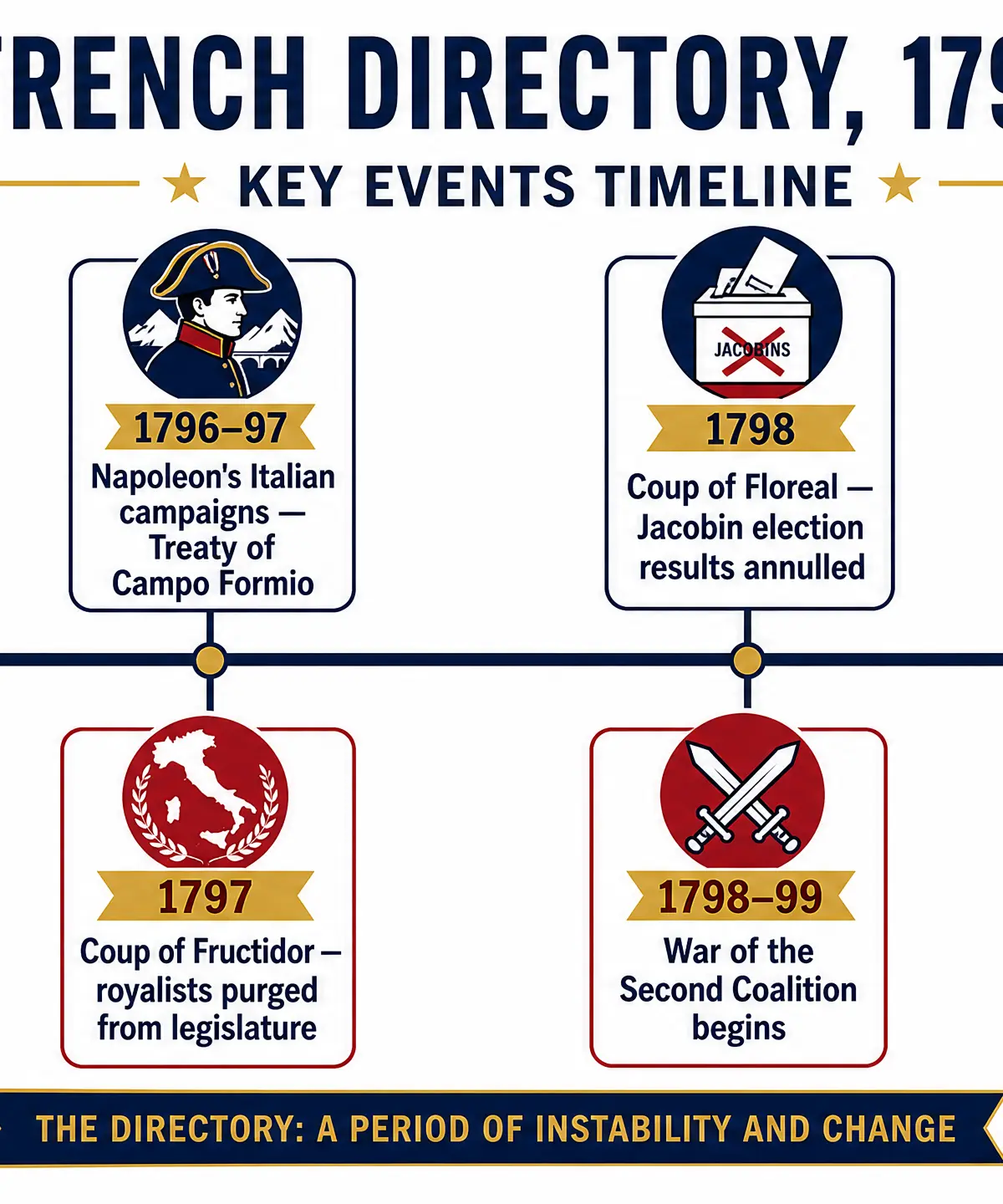
Date(s): 1796–1797
What happened: Napoleon led a brilliant, rapid campaign against Austrian and Piedmontese forces in Northern Italy. He negotiated the Treaty of Campo Formio independently of the Directory in Paris.
Why it matters: The campaign enriched France (Napoleon sent millions of francs in loot back to Paris, keeping the bankrupt Directory afloat) but also made Napoleon a national hero and an independent political force. It ended the War of the First Coalition.
Specific Knowledge: Battles of Lodi, Arcole, and Rivoli; Treaty of Campo Formio (October 1797).
The Coup of Fructidor
Date(s): 4 September 1797 (18 Fructidor)
What happened: Elections in 1797 returned a royalist majority to the councils. Fearing a restoration of the monarchy, three of the Directors (including Barras), supported by the army, purged the royalist deputies and annulled the election results.
Why it matters: This destroyed the constitutional legitimacy of the Directory. It proved that the regime would only respect democracy when it suited them, and it further entrenched the army as the ultimate arbiter of French politics.
Specific Knowledge: 177 royalist deputies purged; censorship of the press reintroduced.
The Economic Crisis
Date(s): 1795–1799
What happened: The paper currency (assignats) became entirely worthless. The Directory tried to replace them with mandats territoriaux, which also failed. By 1797, the government declared bankruptcy, writing off two-thirds of its state debt.
Why it matters: Economic misery alienated the population. The working classes (sans-culottes) suffered from inflation and poor harvests, while the middle classes lost their investments due to the state bankruptcy. This widespread dissatisfaction meant nobody was willing to defend the Directory in 1799.
Specific Knowledge: Assignats fell to less than 1% of their face value; the "Bankruptcy of the Two-Thirds" (September 1797).
The Coup of Brumaire
Date(s): 9–10 November 1799 (18–19 Brumaire)
What happened: Emmanuel-Joseph Sieyès conspired with Napoleon to overthrow the Directory. The legislature was moved to Saint-Cloud under the pretext of a Jacobin plot. When the Council of Five Hundred resisted, Napoleon's brother Lucien called in the troops to clear the chamber. The Directory was abolished and replaced by the Consulate.
Why it matters: This marks the end of the French Revolution. It established a military dictatorship disguised as a republic, setting the stage for the Napoleonic Empire.
Specific Knowledge: Sieyès (the political architect), Napoleon (the "sword"), Lucien Bonaparte (President of the Five Hundred); the establishment of the three Consuls.
Key Individuals
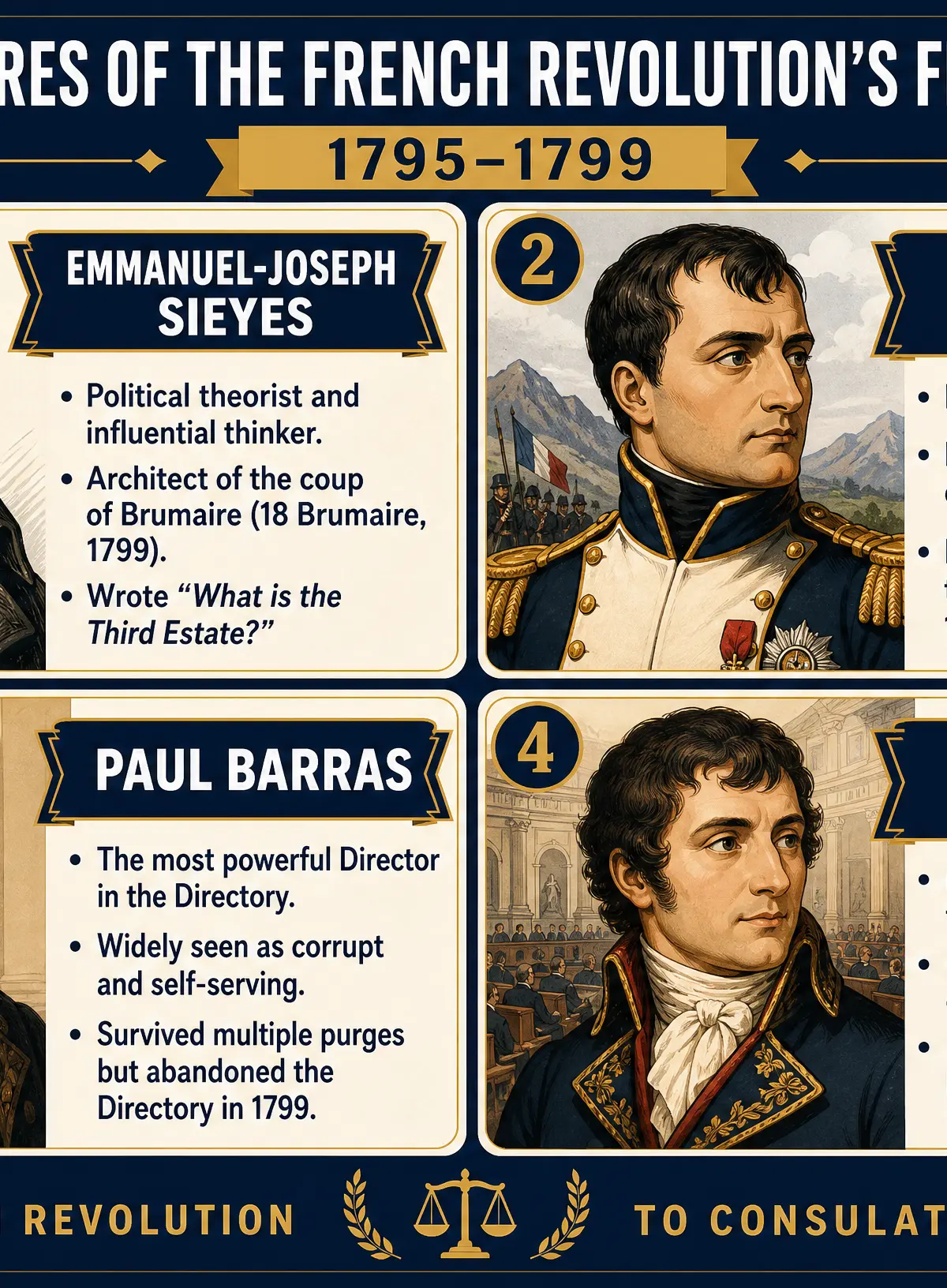
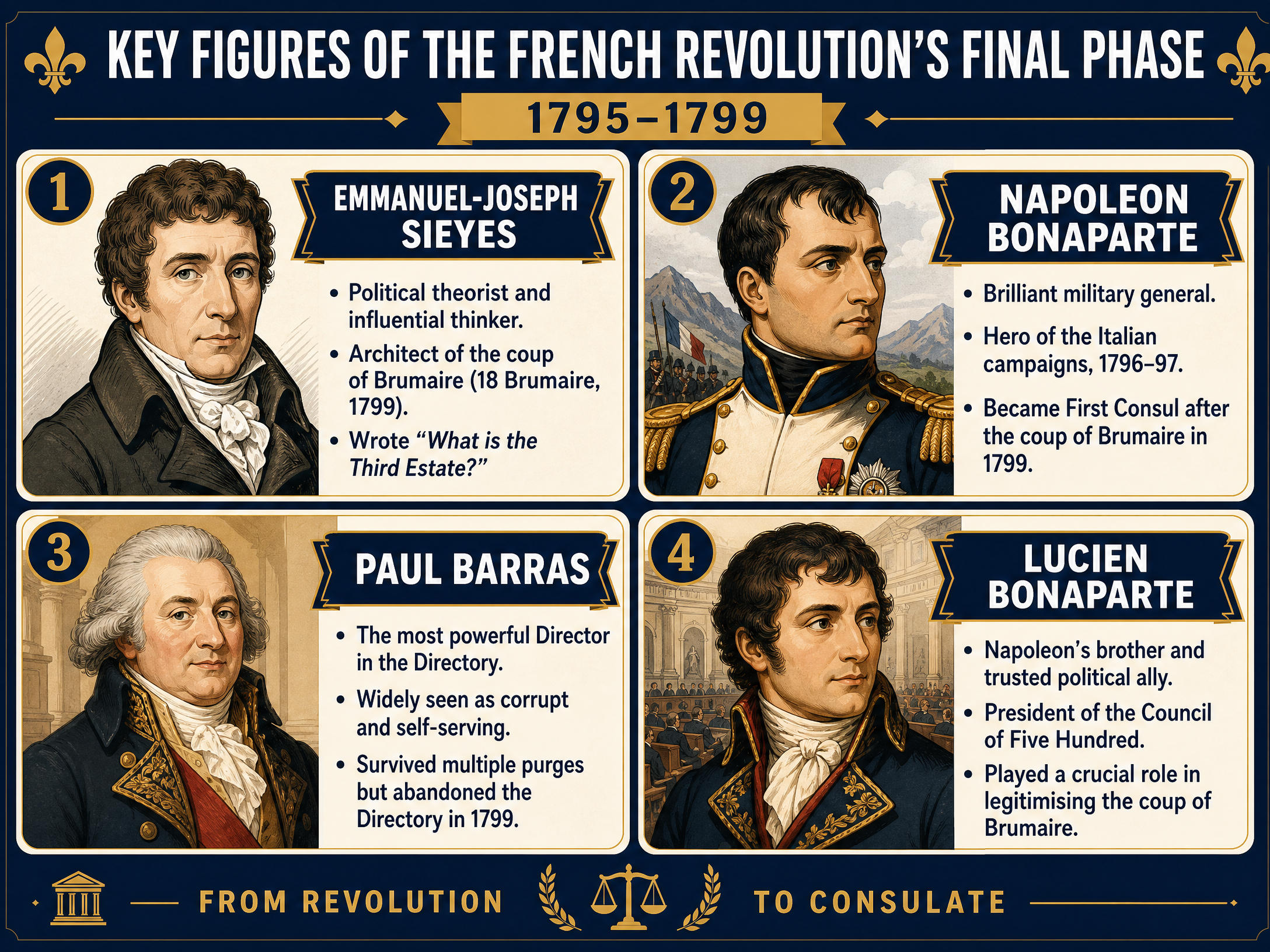
Emmanuel-Joseph Sieyès
Role: Director and political theorist.
Key Actions: Realising the Directory was failing, he orchestrated the Coup of Brumaire, intending to use Napoleon merely as military muscle.
Impact: He provided the political framework for the coup but was ultimately outmanoeuvred by Napoleon, who seized primary power as First Consul.
Napoleon Bonaparte
Role: General and First Consul.
Key Actions: Saved the Convention in 1795, won the Italian campaigns, returned from Egypt in 1799 to act as the "sword" in the Coup of Brumaire.
Impact: His military success provided the only positive news for the Directory, yet his popularity and ambition ultimately destroyed it.
Paul Barras
Role: The longest-serving Director.
Key Actions: A corrupt survivor who participated in the Thermidorian Reaction and the Coup of Fructidor. He promoted Napoleon's early career.
Impact: His notorious corruption symbolised everything wrong with the Directory. He stepped aside during Brumaire without a fight.
Lucien Bonaparte
Role: President of the Council of Five Hundred.
Key Actions: During the Coup of Brumaire, when deputies threatened Napoleon, Lucien convinced the palace guards that Napoleon's life was in danger, ordering them to clear the chamber.
Impact: Without Lucien's quick thinking and political position, the coup likely would have failed and Napoleon might have been outlawed.
Second-Order Concepts
Causation
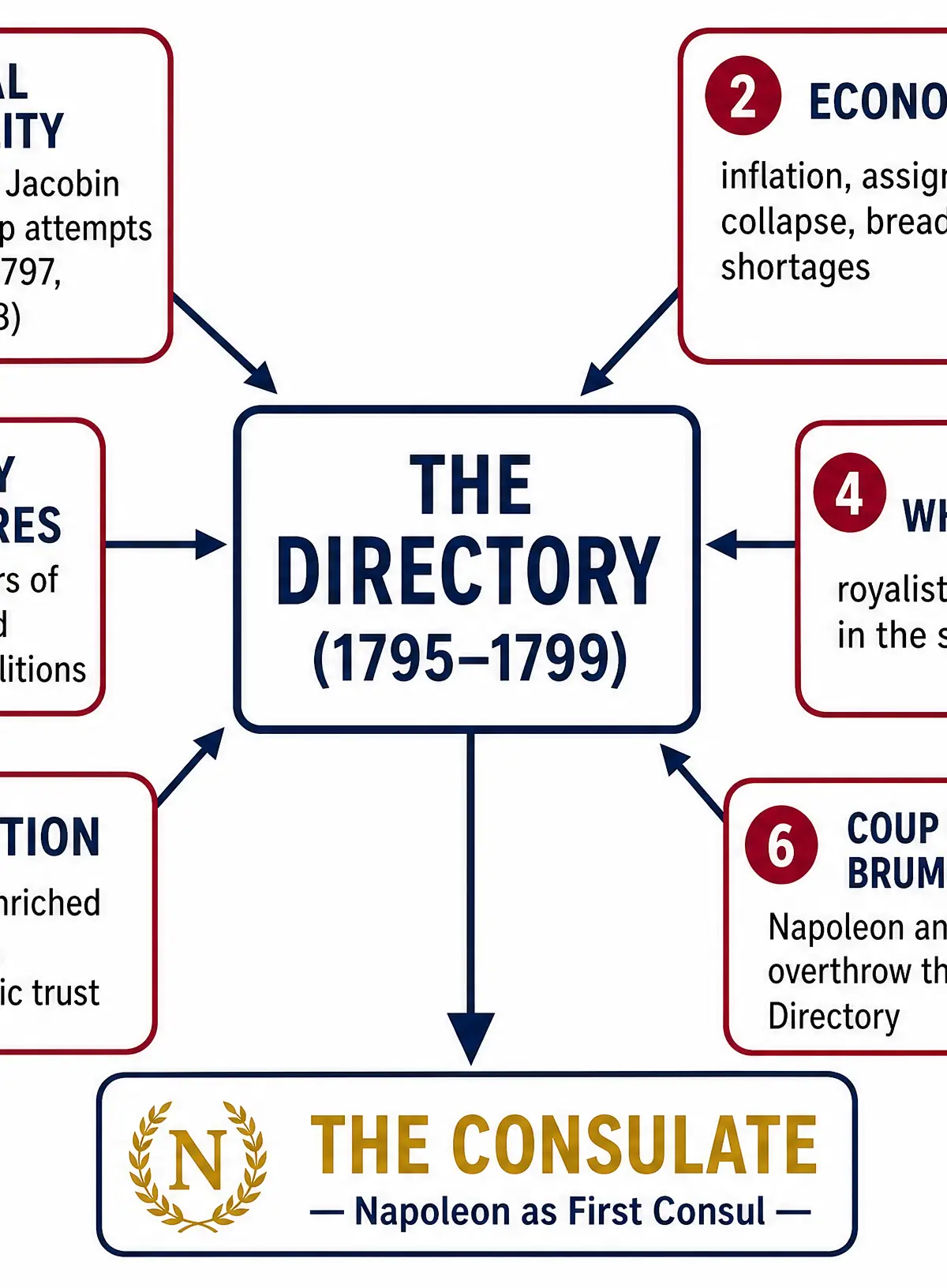
Why did the Directory fall? It was a combination of long-term structural flaws (the unworkable Constitution of Year III), medium-term economic failures (inflation, state bankruptcy), and short-term triggers (military defeats in 1799 during the War of the Second Coalition). The catalyst was the ambition of Sieyès and Napoleon.
Consequence
The immediate consequence of the Directory's fall was the establishment of the Consulate, concentrating power in the hands of the executive (Napoleon). The long-term consequence was the end of the democratic experiment of the Revolution and the eventual creation of the First French Empire in 1804.
Change & Continuity
Change: The shift from a collective, elected executive (the Directory) to an authoritarian, military-backed dictatorship (the Consulate).
Continuity: The reliance on the army to maintain order, which began under the Directory (Vendémiaire, Fructidor), continued and intensified under Napoleon.
Significance
The period from 1795 to 1799 is highly significant because it demonstrates the difficulty of establishing a stable democracy in the wake of radical revolution. It shows how political polarization and economic ruin can pave the way for a military strongman.
Source Skills
When evaluating sources on the Directory, pay close attention to provenance:
- Royalist sources: Will emphasize the corruption, the White Terror, and the illegitimacy of the republican government.
- Jacobin/Radical sources: Will criticize the Directory as a bourgeois betrayal of the 1793 revolution, focusing on the suffering of the poor.
- Bonapartist sources (written after 1799): Will deliberately exaggerate the chaos, corruption, and weakness of the Directory to justify Napoleon's illegal seizure of power. Always question the motive of sources praising Napoleon's intervention.
Visual Resources
3 diagrams and illustrations
Interactive Diagrams
1 interactive diagram to visualise key concepts
Conceptual Flow Outline
Flowchart showing how constitutional flaws led to military intervention.
Worked Examples
3 worked examples — open one to explore the question and available guidance.
Practice Questions
Test your understanding — click to reveal model answers
Describe two features of the Coup of Fructidor (1797).
Hint: Think about who was targeted and who the Directory used to carry it out.
Explain why the French economy was so weak under the Directory. (12 marks)
Hint: Discuss paper money, the cost of war, and government bankruptcy.
Test your understanding of France in revolution, 1774–99
Active recall beats re-reading. Take an instant quiz now to test what you’ve learned and lock it into long-term memory.
7 days Premium · Then free forever · No card, no charge