Pearson Edexcel · A-Level · History
India, c1914–48: the road to independence
Master the complex journey from British colonial rule to the brink of independence in India. This guide unpacks the critical negotiations, the rise of mass nationalism, and the deep political divisions that ultimately shaped the subcontinent, earning you crucial marks on causation and consequence.
- 8 min read
- 2 worked examples
- 1 practice question
- 6 key terms
Study Notes
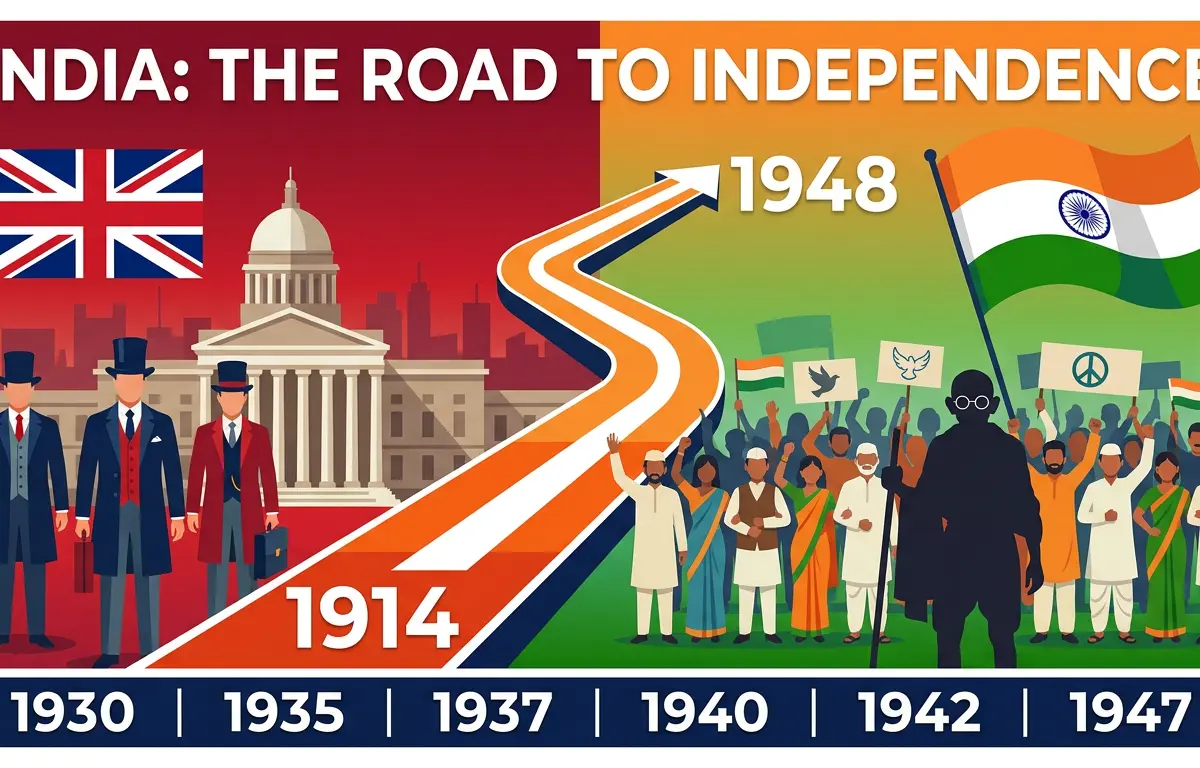
Overview
This study guide covers the pivotal years in India's struggle for self-government, focusing on the constitutional negotiations between the British and Indian leaders, and the rising tensions between the Indian National Congress and the Muslim League. Examiners expect candidates to understand not just the timeline of events, but the causes of failed negotiations (like the Round Table Conferences) and the consequences of key turning points (like the 1937 elections and the outbreak of WWII). You will need precise knowledge of dates, key figures, and the changing attitudes towards the British Raj to succeed in explanation and source-based questions.
Key Events & Developments
The Round Table Conferences
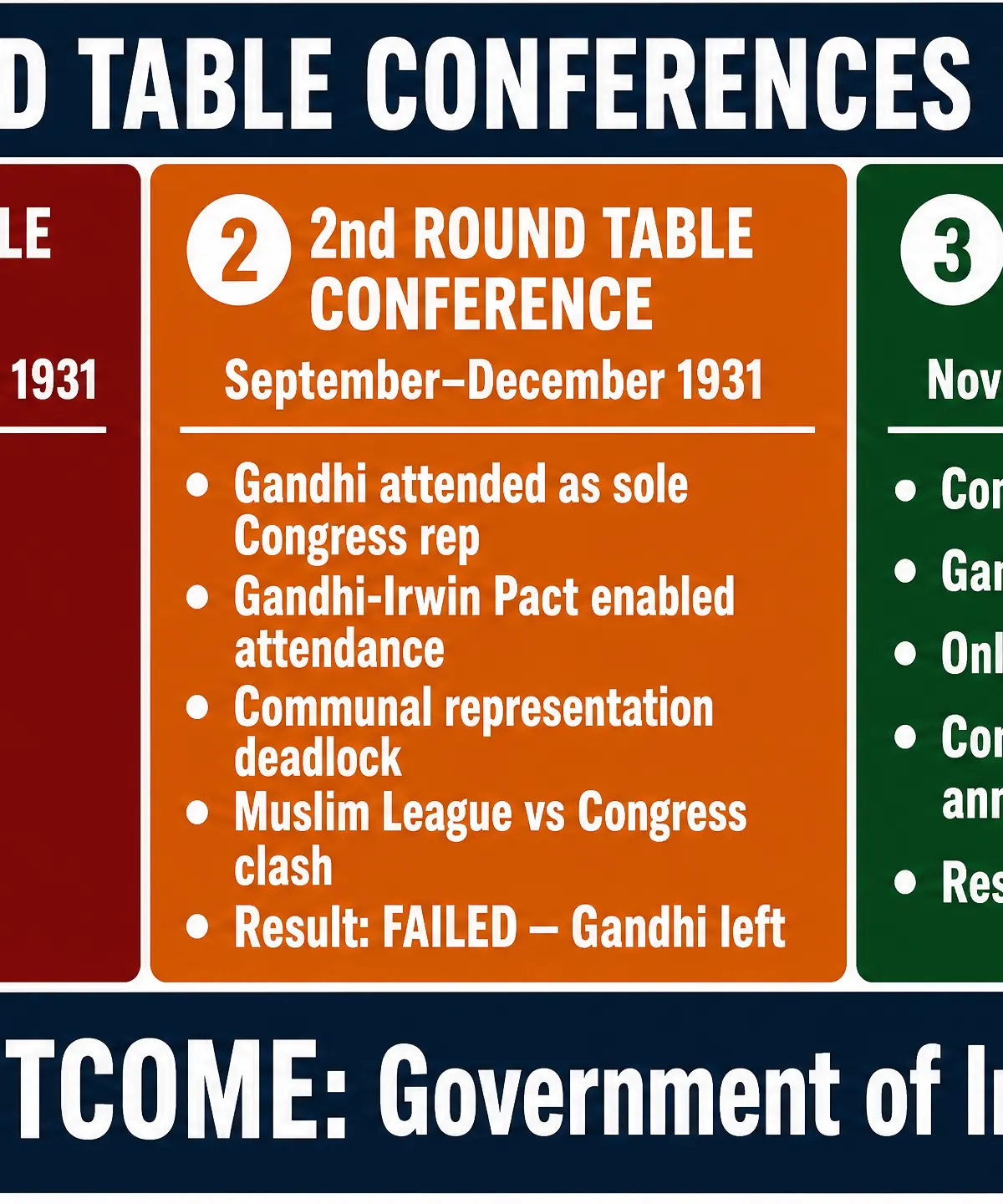
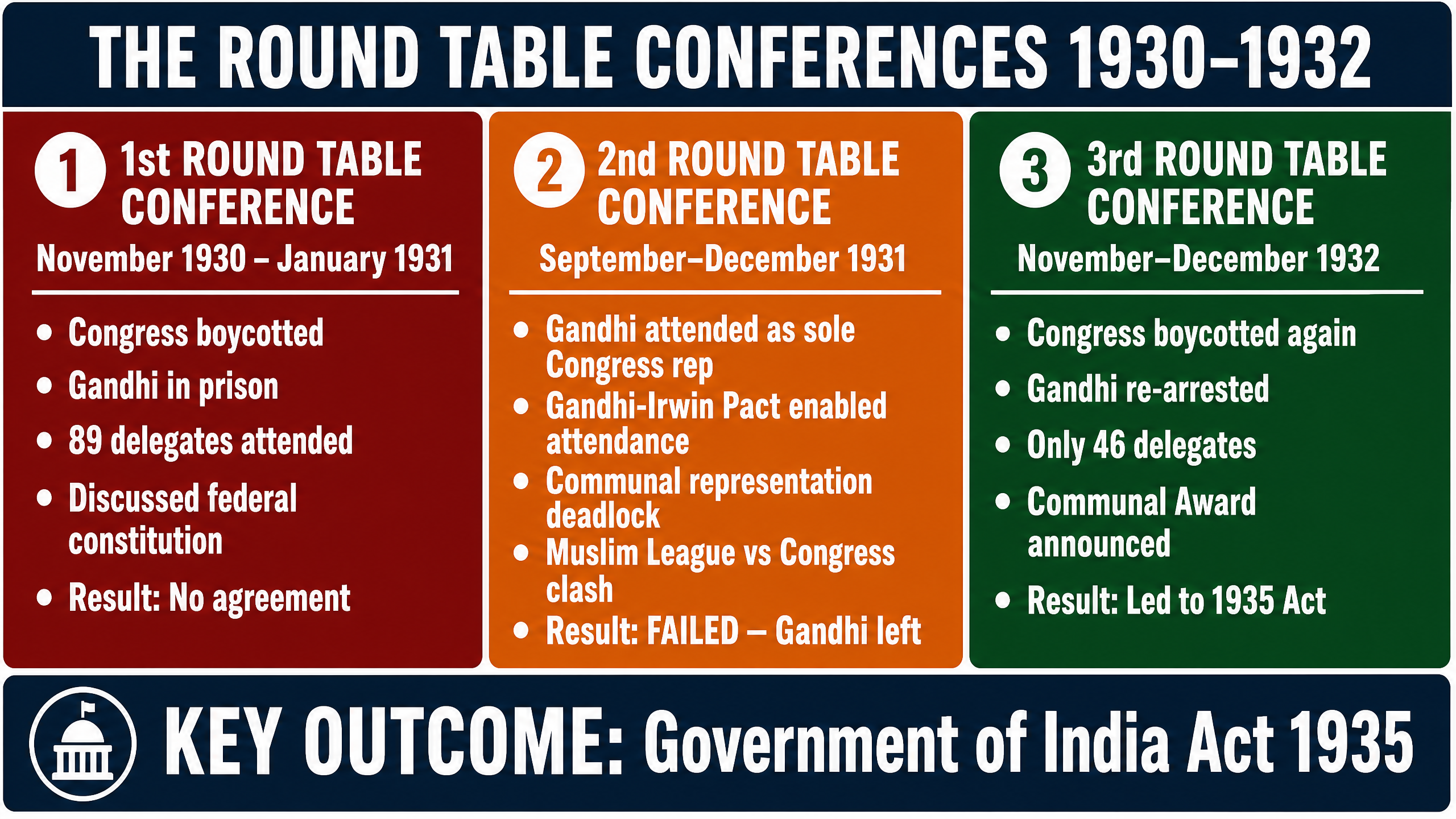
Date(s): November 1930 – December 1932
What happened: A series of three conferences held in London to discuss constitutional reforms in India. The first was boycotted by Congress. Gandhi attended the second (following the Gandhi-Irwin Pact of March 1931) as the sole Congress representative, but it collapsed over the issue of separate electorates for minority communities. The third was poorly attended and largely insignificant.
Why it matters: The failure of these conferences demonstrated the deep divisions within Indian politics, particularly between Hindus and Muslims over representation. The conferences ultimately laid the groundwork for the Government of India Act 1935, despite failing to reach a consensus.
Specific Knowledge: 1st RTC (Nov 1930-Jan 1931, 89 delegates); Gandhi-Irwin Pact (March 1931); 2nd RTC (Sept-Dec 1931); Deadlock over communal representation.
The Communal Award and Yeravda Pact
Date(s): August – September 1932
What happened: The British announced the Communal Award, granting separate electorates to various minorities, including the Depressed Classes. Gandhi, imprisoned in Yeravda, began a fast unto death in protest, fearing this would permanently divide Hindu society. This forced B.R. Ambedkar, leader of the Depressed Classes, to negotiate the Yeravda Pact, which abandoned separate electorates in exchange for more reserved seats in provincial assemblies.
Why it matters: It highlights Gandhi's immense political leverage (using fasting as a weapon) and the complex social dynamics within India that the British were attempting to manage (or exploit).
Specific Knowledge: Communal Award (Aug 1932); Gandhi's fast in Yeravda Prison; B.R. Ambedkar; Yeravda Pact (Sept 1932).
The Government of India Act 1935
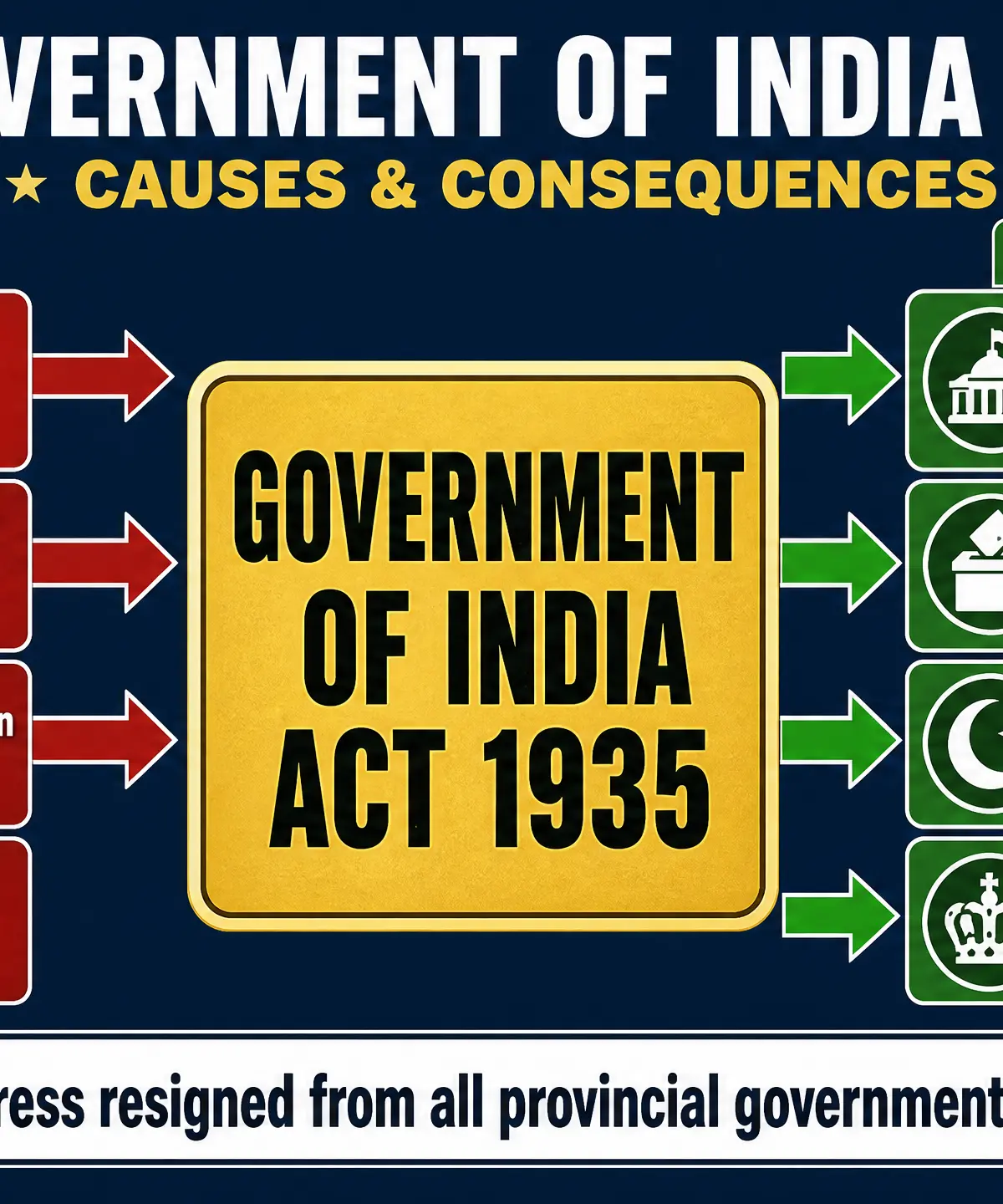
Date(s): August 1935
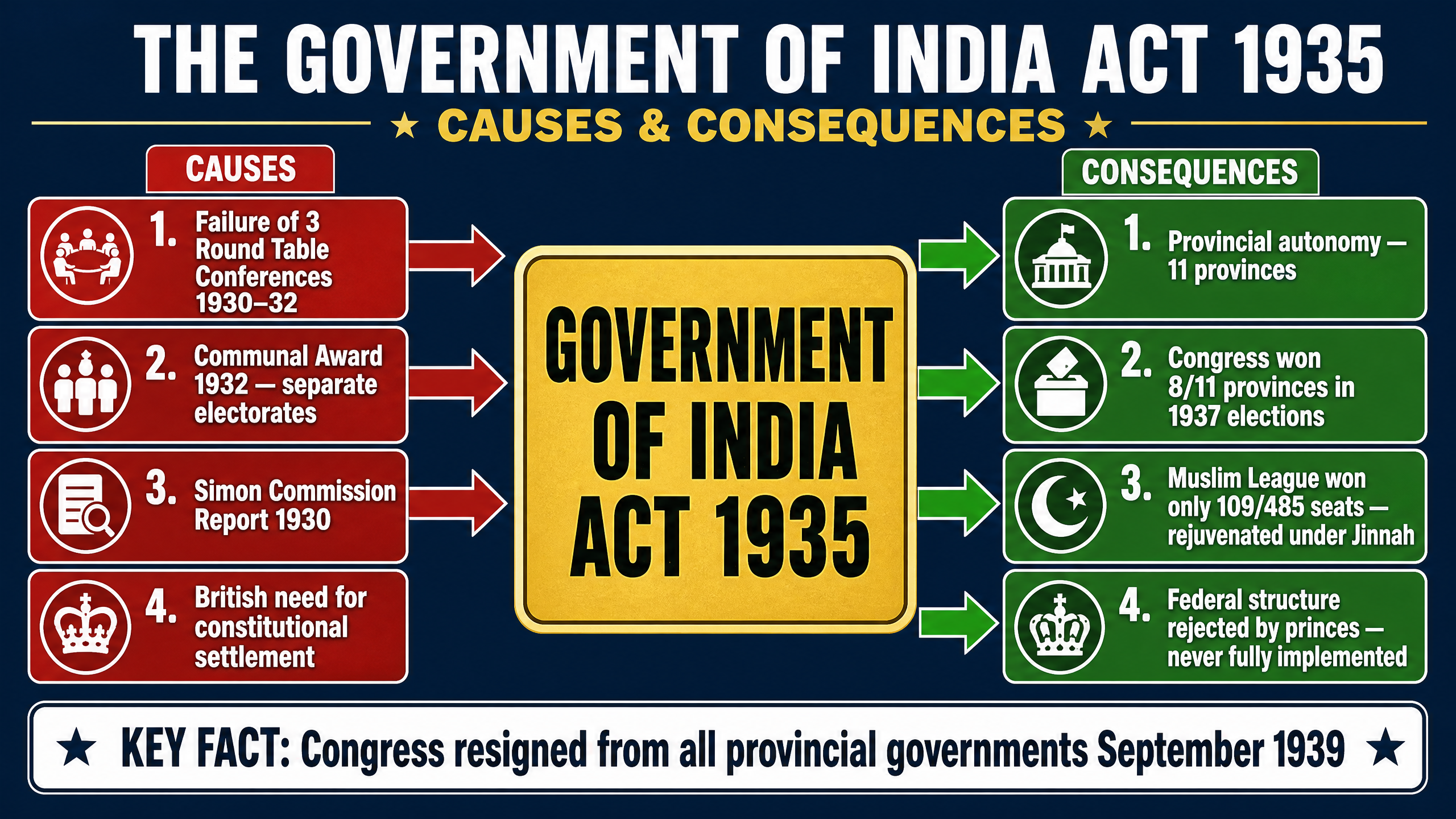
What happened: The longest act passed by the British Parliament at the time. It proposed a federal structure for India (which never materialized due to opposition from princely states) and granted provincial autonomy, meaning Indian ministers would control provincial governments.
Why it matters: It was a significant step towards self-government, but its limitations frustrated nationalists. The ensuing 1937 elections under this Act dramatically altered the political landscape.
Specific Knowledge: Provincial autonomy in 11 provinces; failure of the federal structure.
The 1937 Elections and Muslim League Rejuvenation
Date(s): 1937
What happened: Elections held under the 1935 Act resulted in a massive victory for Congress, forming governments in 8 of 11 provinces. The Muslim League performed poorly (winning only 109 of 485 reserved seats). However, Congress rule alienated many Muslims, allowing Muhammad Ali Jinnah to rebuild the Muslim League into a mass movement by claiming Congress could not be trusted to protect Muslim interests.
Why it matters: This is a crucial turning point. Congress's success paradoxically fuelled the rise of Muslim separatism, setting the stage for the demand for Pakistan.
Specific Knowledge: Congress won 8/11 provinces; Muslim League won 109/485 reserved seats; Jinnah's leadership.
Outbreak of WWII and the Lahore Resolution
Date(s): September 1939 – August 1940
What happened: Viceroy Lord Linlithgow declared India at war with Germany in 1939 without consulting Indian leaders. In protest, Congress provincial ministries resigned. In March 1940, the Muslim League passed the Lahore Resolution, formally demanding independent states for Muslim-majority areas. The British responded with the August Offer (1940), promising dominion status after the war, which Congress rejected.
Why it matters: The war severed the working relationship between Congress and the British. The Lahore Resolution marked the formal adoption of the Two-Nation Theory by the Muslim League, making partition increasingly likely.
Specific Knowledge: Linlithgow's declaration (Sept 1939); Congress resignations (Oct/Nov 1939); Lahore Resolution (March 1940); August Offer (1940).
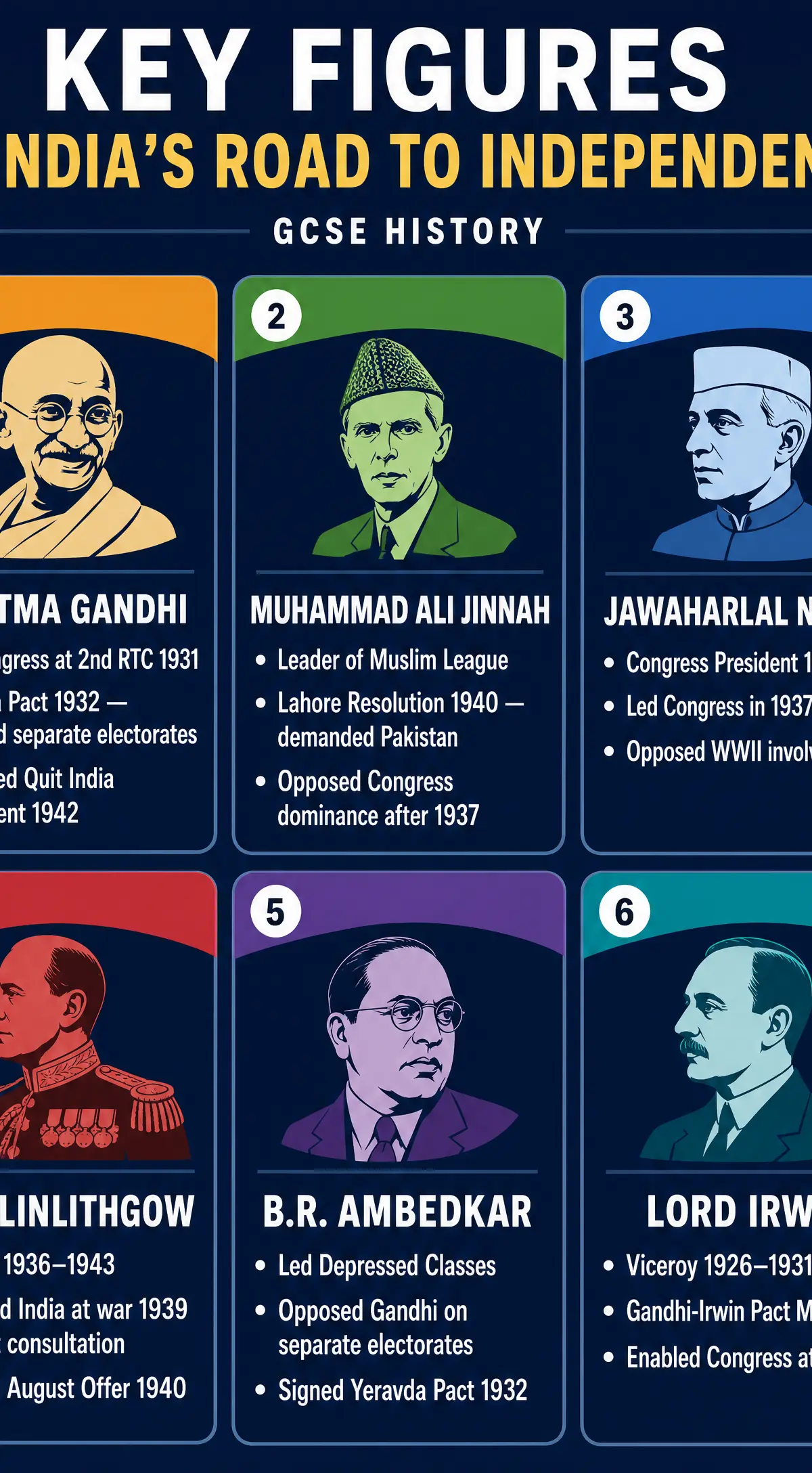
Key Individuals
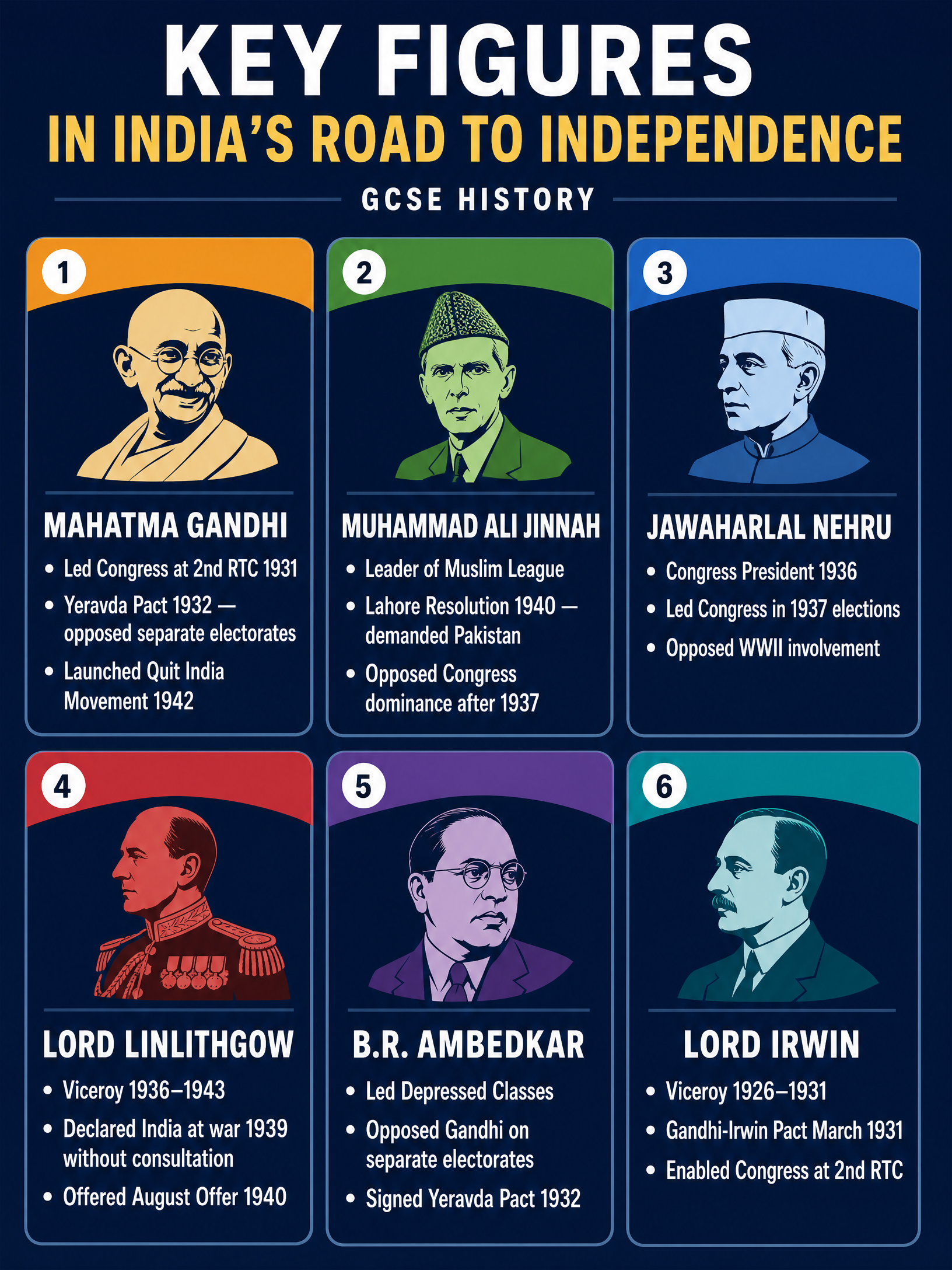
Mahatma Gandhi
Role: Pre-eminent leader of the Indian National Congress.
Key Actions: Led the Salt March (1930), signed the Gandhi-Irwin Pact (1931), attended the 2nd Round Table Conference, undertook the fast against the Communal Award leading to the Yeravda Pact (1932).
Impact: Transformed Congress into a mass movement; his insistence on a united India clashed with rising Muslim nationalism and British policies of separate electorates.
Muhammad Ali Jinnah
Role: Leader of the All-India Muslim League.
Key Actions: Attended Round Table Conferences; rejuvenated the Muslim League after the disastrous 1937 elections; championed the Two-Nation Theory and the Lahore Resolution (1940).
Impact: He is the pivotal figure in the creation of Pakistan, transforming the League from a weak political body into a powerful force demanding a separate nation.
Lord Linlithgow
Role: Viceroy of India (1936–1943).
Key Actions: Oversaw the implementation of the 1935 Act; unilaterally declared India at war in 1939; issued the August Offer in 1940.
Impact: His failure to consult Indian leaders in 1939 caused a major constitutional crisis, leading to the resignation of Congress ministries and widening the rift between the Raj and Indian nationalists.
B.R. Ambedkar
Role: Leader and representative of the Depressed Classes (Dalits).
Key Actions: Advocated for separate electorates for the Depressed Classes at the Round Table Conferences; signed the Yeravda Pact with Gandhi under immense pressure.
Impact: Highlighted the deep social divisions within India; his clash with Gandhi demonstrated that the nationalist movement was not a monolithic bloc.
Second-Order Concepts
Causation
Examiners often ask why events occurred. For example, the failure of the Round Table Conferences was caused by short-term factors (Gandhi's initial boycott, clashes over communal representation) and long-term factors (deep-seated mistrust between Congress and the Muslim League, British reluctance to cede central control).
Consequence
The 1935 Government of India Act had profound consequences. While intended as a compromise, it led to the 1937 elections. The consequence of Congress's massive victory was the alienation of the Muslim League, which Jinnah used to build a mass movement demanding a separate state.
Change & Continuity
While the 1935 Act brought change in the form of provincial autonomy, there was significant continuity in British control at the centre. The Viceroy retained ultimate authority, as demonstrated by Linlithgow's unilateral declaration of war in 1939.
Significance
The Lahore Resolution of 1940 is highly significant because it marks the point of no return for the Two-Nation Theory. It shifted the political debate from 'how to share power in a united India' to 'how to divide the subcontinent'.
Source Skills
When evaluating sources for this topic, consider:
- Provenance: Is it a British official document (likely justifying British policy or emphasizing Indian divisions)? Is it a Congress speech (likely emphasizing unity and demanding immediate independence)? Is it a Muslim League publication (likely highlighting Hindu domination)?
- Content: What specific claims does it make? Use your contextual knowledge (dates, names) to verify or challenge these claims.
- Limitations: What does the source deliberately omit? A British source from 1932 might praise the Communal Award as fair, omitting Gandhi's fierce opposition to it.
Visual Resources
3 diagrams and illustrations
Interactive Diagrams
1 interactive diagram to visualise key concepts
Diagram could not be rendered
Timeline of key events 1930-1940
Worked Examples
2 worked examples — open one to explore the question and available guidance.
Practice Questions
Test your understanding — click to reveal model answers
Explain the consequences of the 1937 provincial elections in India. (8 marks)
Hint: Think about the impact on BOTH the Indian National Congress and the Muslim League.
Test your understanding of India, c1914–48: the road to independence
Active recall beats re-reading. Take an instant quiz now to test what you’ve learned and lock it into long-term memory.
7 days Premium · Then free forever · No card, no charge