Pearson Edexcel · A-Level · History
Industrialisation and social change in Britain, 1759–1928: forging a new society
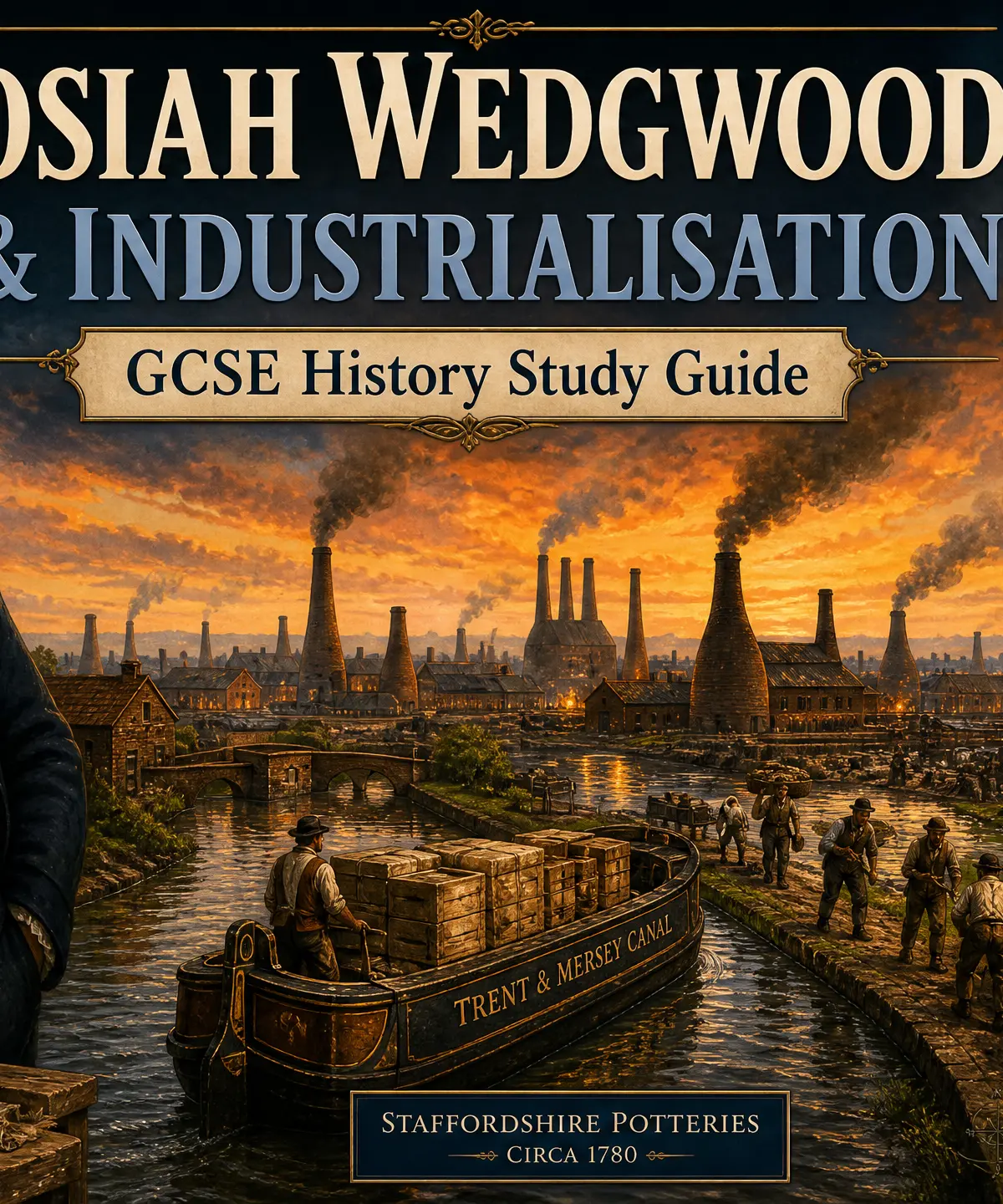
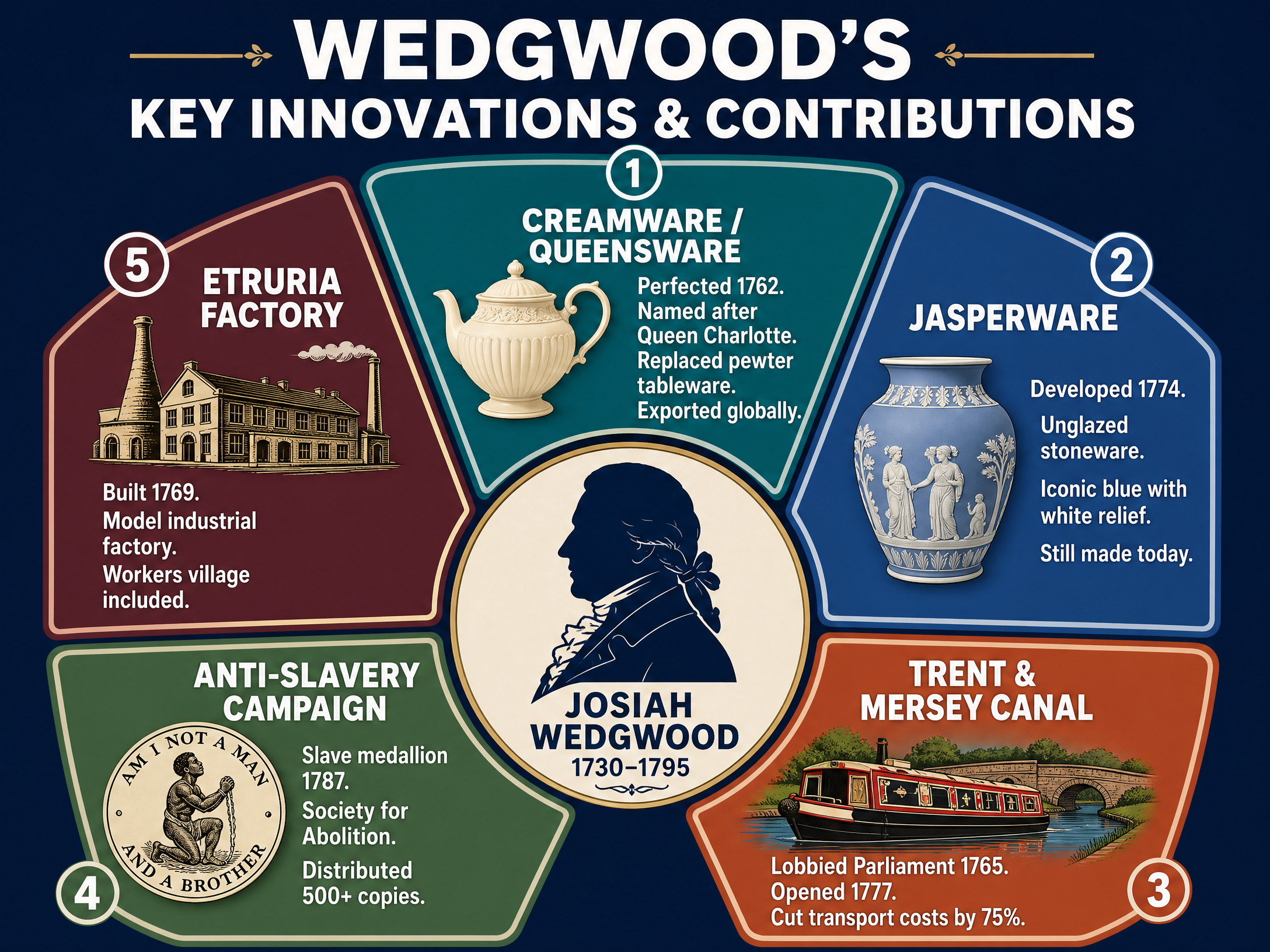
Josiah Wedgwood was far more than just a master potter; he was a pioneer of the Industrial Revolution whose innovations in manufacturing, transport, and marketing transformed Britain. From perfecting Creamware and Jasperware to lobbying for the Trent and Mersey Canal and designing the iconic anti-slavery medallion, his work perfectly illustrates the interconnected nature of industrialisation and social change.
- 9 min read
- 3 worked examples
- 5 practice questions
- 6 key terms
Study Notes
Overview
This study focuses on the industrial and commercial activities of Josiah Wedgwood between 1759 and 1787. While he is most famous for his pottery, examiners expect candidates to understand his broader significance as a catalyst for the Industrial Revolution in Britain. His story demonstrates how scientific experimentation, aristocratic patronage, infrastructure development, and social conscience were deeply intertwined during this period. You must be able to link his specific innovations—such as Creamware and Jasperware—to wider themes like the expansion of the canal network and the growth of the abolitionist movement.
Key Events & Developments
Opening of Ivy House Works
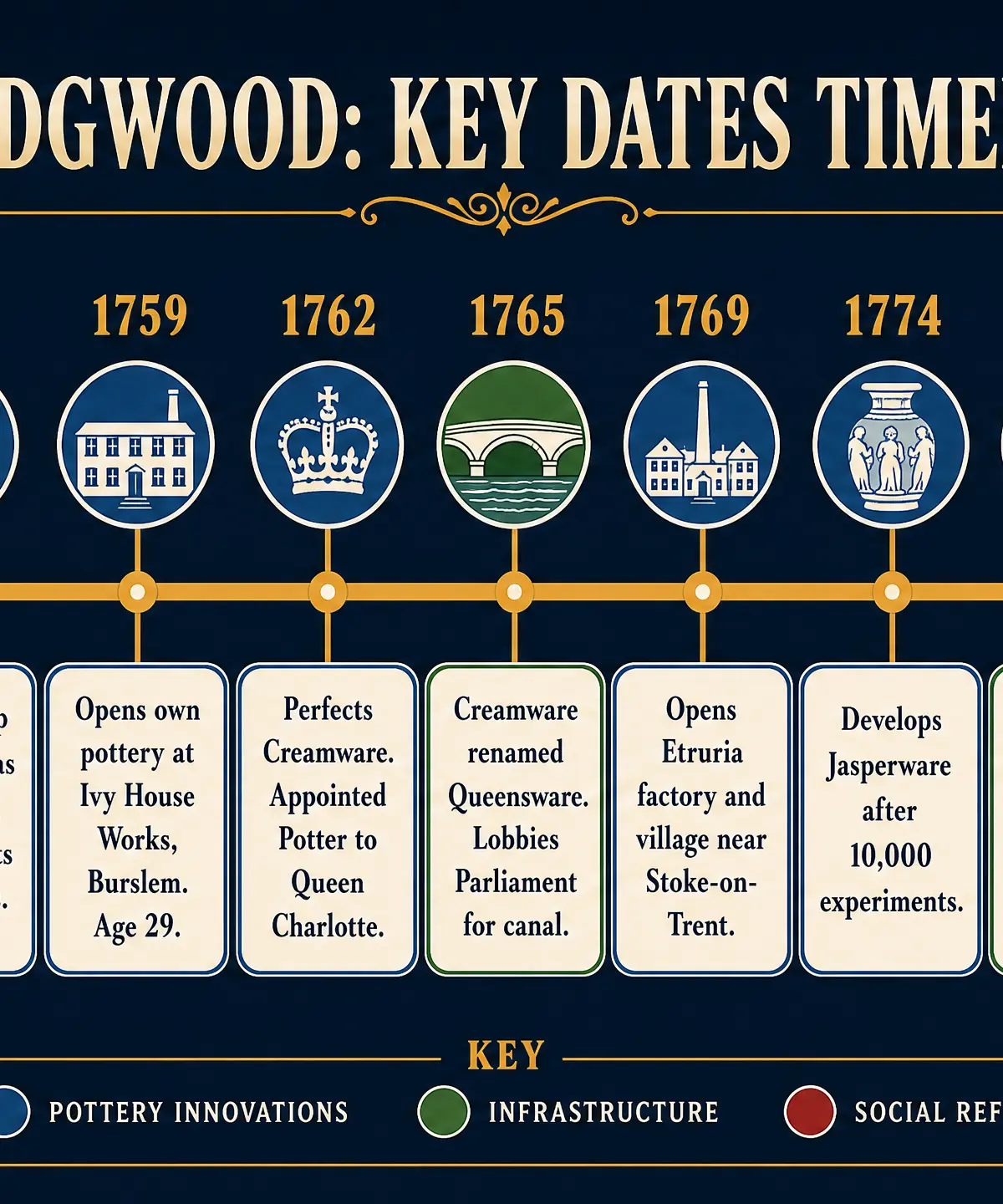
Date(s): 1759
What happened: After an apprenticeship and a partnership with Thomas Whieldon, Josiah Wedgwood opened his own independent pottery business in Burslem, Staffordshire.
Why it matters: This marks the beginning of Wedgwood's independent experimentation and his application of scientific methods to pottery production, shifting it from a traditional craft to an industrial process.
Specific Knowledge: Located in Burslem; marks the start of systematic, recorded experiments with clay and glazes.
Perfection of Creamware (Queensware)
Date(s): 1762 (Perfected), 1765 (Renamed Queensware)
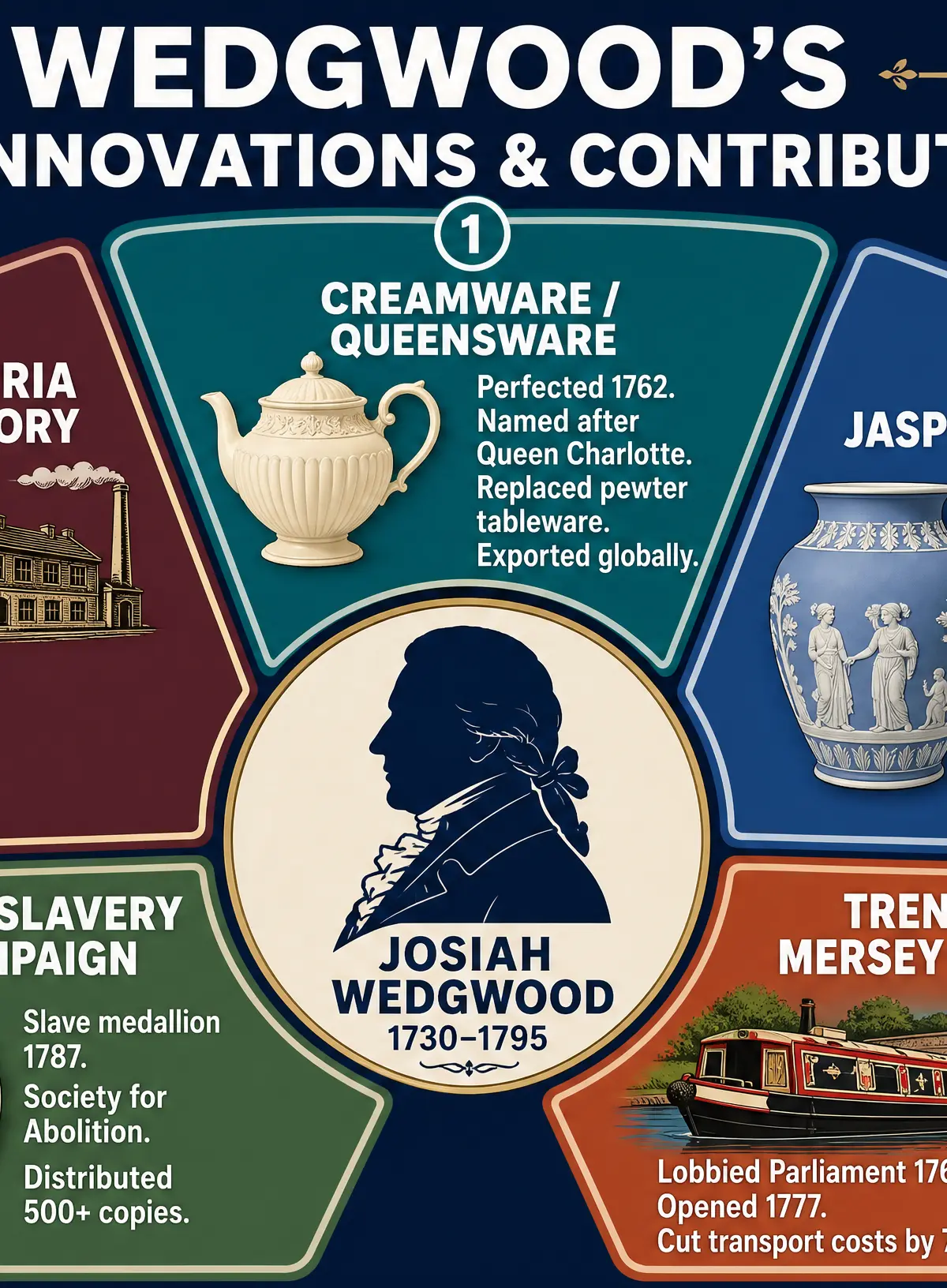
What happened: Wedgwood perfected a high-quality, durable, cream-coloured earthenware. In 1765, he presented a tea set to Queen Charlotte, who appointed him "Potter to Her Majesty".
Why it matters: This demonstrates the power of aristocratic patronage and brilliant marketing. By securing royal approval, Wedgwood created a massive middle-class demand for his products, illustrating the growth of consumerism in industrialising Britain.
Specific Knowledge: Queen Charlotte (wife of George III); Creamware replaced pewter tableware; exported globally.
Construction of the Trent and Mersey Canal
Date(s): 1765 (Lobbied Parliament), 1777 (Opened)
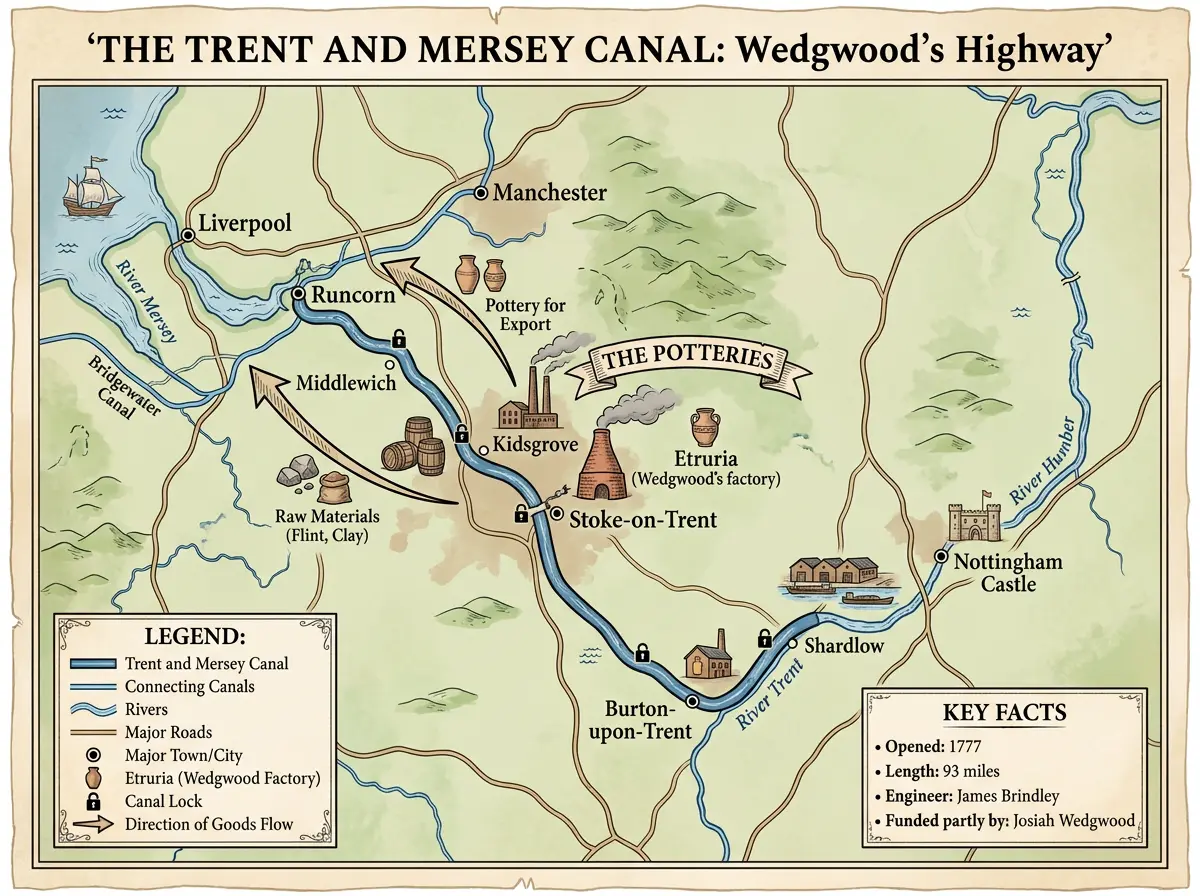
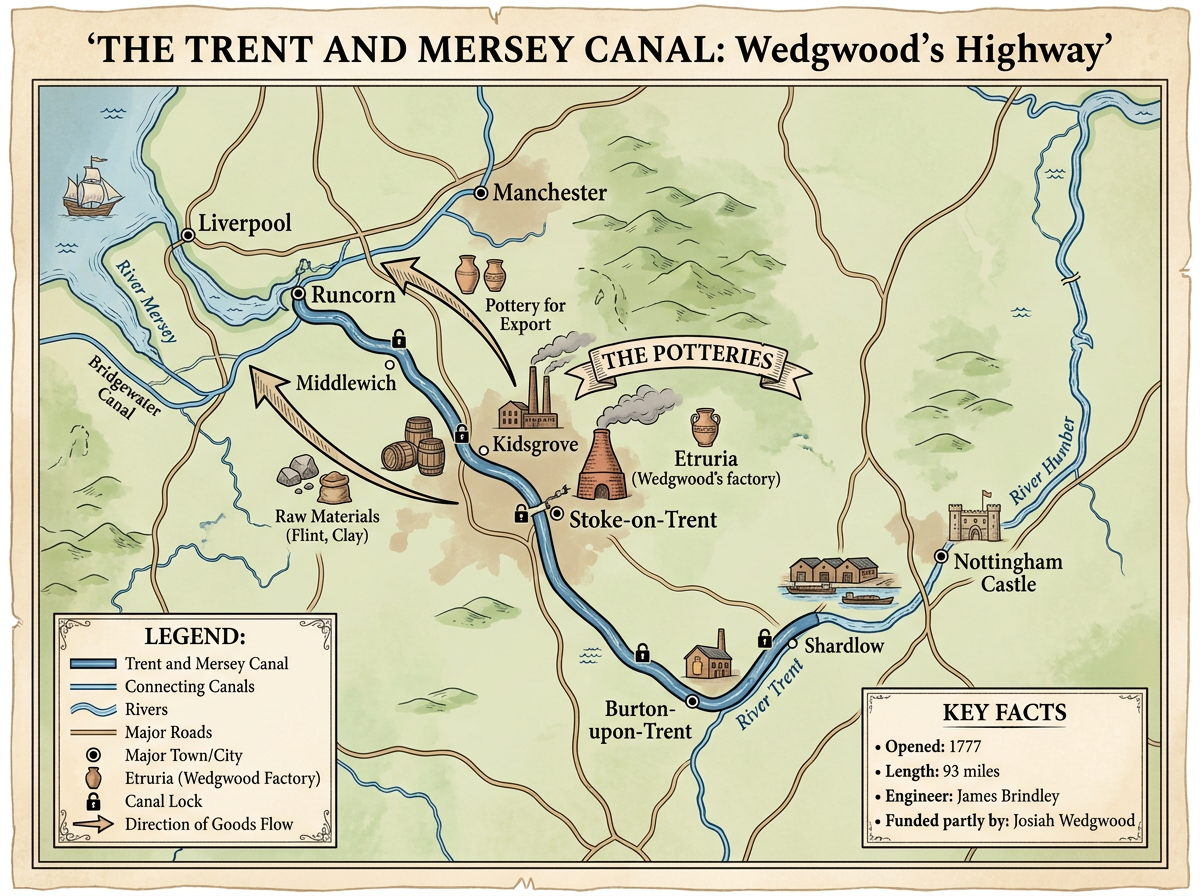
What happened: Wedgwood successfully campaigned for a canal connecting the River Mersey to the River Trent, providing a smooth water route for transporting fragile pottery and heavy raw materials.
Why it matters: The canal reduced transport costs by approximately 75% and drastically reduced breakages. It exemplifies how industrialists drove infrastructure improvements to solve logistical problems, sparking a wider "canal mania".
Specific Knowledge: 93 miles long; engineered by James Brindley; supported by the Duke of Bridgewater; reduced costs by ~75%.
Opening of Etruria Factory
Date(s): 1769
What happened: Wedgwood opened a purpose-built, state-of-the-art factory named Etruria, located directly alongside the route of the new Trent and Mersey Canal.
Why it matters: Etruria was a model of early industrial organisation, featuring a division of labour, steam power (later introduced), and an adjacent purpose-built village for workers. It represents the shift from domestic industry to the factory system.
Specific Knowledge: Built alongside the Trent and Mersey Canal; included a workers' village; demonstrated division of labour.
Development of Jasperware
Date(s): 1774
What happened: After approximately 10,000 recorded experiments, Wedgwood perfected Jasperware, an unglazed vitreous stoneware best known in its pale blue form with white classical relief decorations.
Why it matters: Jasperware cemented Wedgwood's international reputation and capitalized on the Neo-classical movement. It shows his relentless commitment to scientific experimentation and product development.
Specific Knowledge: Required ~10,000 experiments; iconic blue and white Neo-classical designs.
Creation of the Anti-Slavery Medallion
Date(s): 1787
What happened: Wedgwood, a prominent member of the Society for the Abolition of the Slave Trade, designed a Jasperware cameo depicting an enslaved man in chains with the motto: "Am I Not a Man and a Brother?"
Why it matters: This became one of the most effective pieces of political propaganda in history. It highlights how industrialists could use their wealth, manufacturing capabilities, and social networks to drive major social reform.
Specific Knowledge: Society for the Abolition of the Slave Trade; motto "Am I Not a Man and a Brother?"; distributed hundreds of copies.
Key Individuals
Josiah Wedgwood
Role: Master potter, industrialist, and social reformer.
Key Actions: Perfected Creamware and Jasperware; lobbied for the Trent and Mersey Canal; produced the anti-slavery medallion.
Impact: Transformed pottery into a major British industry; drove transport infrastructure improvements; advanced the abolitionist cause.
Sarah Wedgwood
Role: Josiah's wife and crucial business partner.
Key Actions: Managed the domestic and social spheres; helped cultivate relationships with aristocratic and wealthy clients.
Impact: Her social networking was essential in securing the elite patronage (like Queen Charlotte's) that drove the brand's prestige and middle-class sales.
Queen Charlotte
Role: Queen Consort to King George III.
Key Actions: Accepted a gift of Creamware in 1765 and appointed Wedgwood "Potter to Her Majesty".
Impact: Her endorsement allowed Wedgwood to rebrand Creamware as "Queensware", sparking massive consumer demand and establishing the power of celebrity endorsement.
Duke of Bridgewater
Role: Aristocrat and early canal pioneer.
Key Actions: Built the Bridgewater Canal and subsequently supported Wedgwood's campaign for the Trent and Mersey Canal.
Impact: Provided the political influence and precedent needed to get the Trent and Mersey Canal Act through Parliament.
James Brindley
Role: Pioneering civil engineer.
Key Actions: Surveyed and engineered the Trent and Mersey Canal.
Impact: His technical expertise made Wedgwood's vision of a national canal network a physical reality.
Second-Order Concepts
Causation
Why did Wedgwood's business expand so rapidly? The causes are multifaceted: Technological (scientific experimentation leading to superior products like Jasperware), Logistical (the Trent and Mersey Canal solving the problem of breakages and high transport costs), and Commercial (brilliant marketing, such as securing royal patronage from Queen Charlotte to drive middle-class demand). Additionally, the broader context of trade with the East created a pre-existing appetite for fine ceramics that Wedgwood was able to satisfy with domestic production.
Consequence
The consequences of Wedgwood's work extended far beyond the Potteries. Economically, he helped establish Britain as a global manufacturing powerhouse. Infrastructurally, his lobbying for the Trent and Mersey Canal helped spark a national "canal mania" that provided the transport network necessary for the wider Industrial Revolution. Socially, his mass production of the anti-slavery medallion provided the abolitionist movement with its most powerful and widely recognized visual symbol.
Change & Continuity
Wedgwood represents a profound period of change in British manufacturing. He shifted pottery from a localized, small-scale craft into a scientifically driven, factory-based, mass-export industry. However, there was continuity in the reliance on elite patronage (royalty and aristocracy) to set consumer trends, a dynamic that Wedgwood exploited rather than overturned.
Significance
Wedgwood is historically significant because he embodies the multi-dimensional nature of the Industrial Revolution. He was not just an inventor; he was a marketer, a lobbyist, an infrastructure developer, and a social reformer. His career proves that industrialisation was not just about steam engines and cotton mills; it was about consumer goods, transport networks, and the mobilization of wealth for political causes.
Source Skills
When evaluating sources for this topic, examiners expect you to go beyond surface-level description.
For physical sources (e.g., the anti-slavery medallion or a piece of Queensware):
- Content: What does the design show? (e.g., the kneeling figure and the specific motto).
- Provenance: Who made it, when, and why? (e.g., produced by a wealthy industrialist in 1787 to mass-market a political message).
- Utility: How useful is this for understanding the methods of the abolitionist movement or the power of early industrial manufacturing?
For written sources (e.g., letters between Wedgwood and his partners, or parliamentary petitions for the canal):
- Content: What arguments are being made? (e.g., the economic necessity of the canal).
- Provenance: Consider the audience. A petition to Parliament is designed to persuade politicians, so it may exaggerate economic benefits.
(Listen to the accompanying podcast for a deep dive into these topics, including a quick-fire revision quiz!)
Visual Resources
3 diagrams and illustrations
Interactive Diagrams
1 interactive diagram to visualise key concepts
Diagram could not be rendered
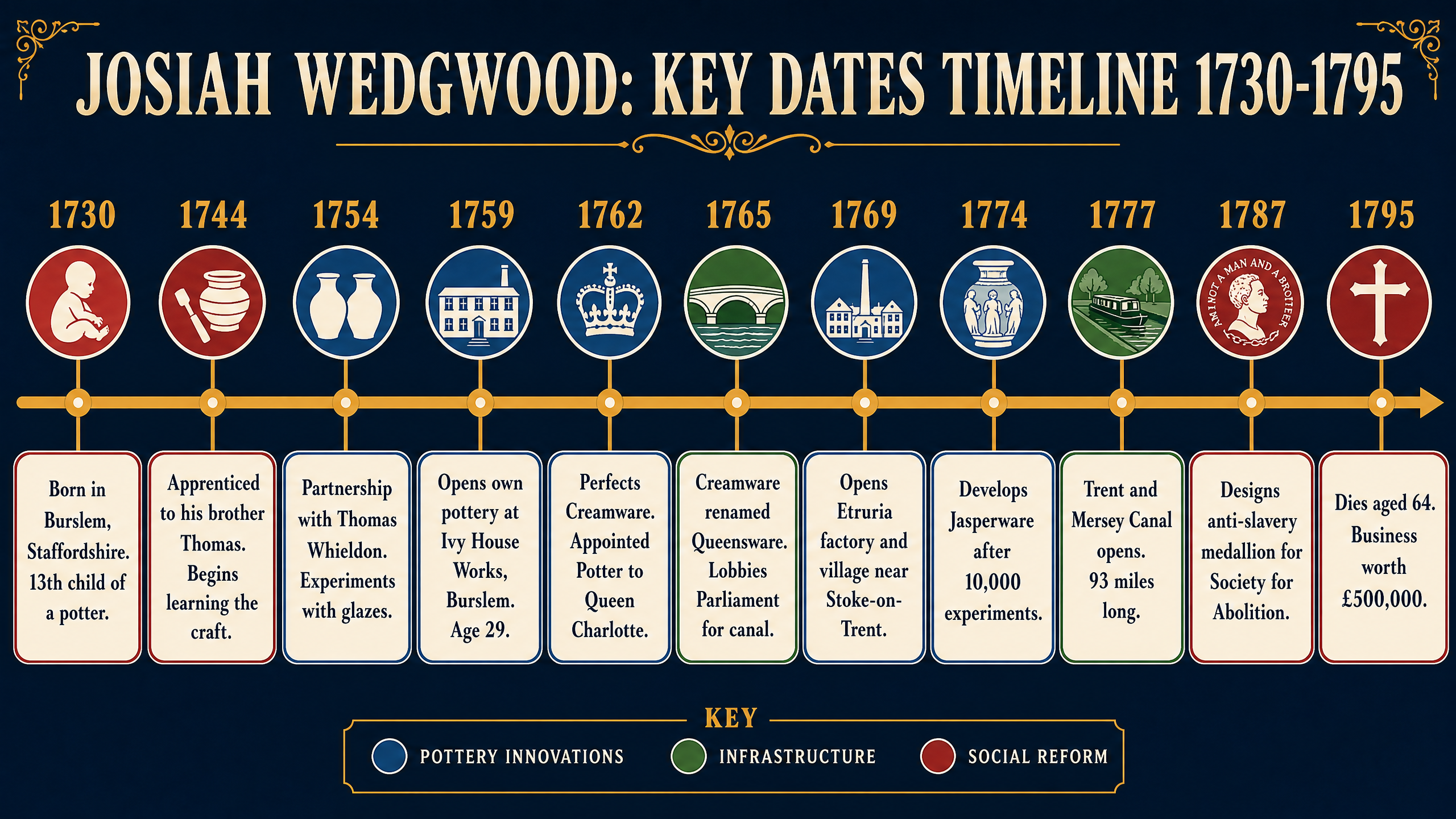
Timeline of Josiah Wedgwood's Key Contributions
Worked Examples
3 worked examples — open one to explore the question and available guidance.
Practice Questions
Test your understanding — click to reveal model answers
Describe two features of the Etruria factory built by Josiah Wedgwood.
Hint: Think about its location and how it was organised for the workers.
Explain the significance of the Trent and Mersey Canal for the industrialisation of Britain. (8 marks)
Hint: Discuss the impact on transport costs, the pottery industry, and the wider 'canal mania'.
Explain why there was a growing demand for Wedgwood's pottery in the late 18th century. (12 marks)
Hint: Think about product quality, royal patronage, and the influence of Eastern trade.
How useful is a letter from Josiah Wedgwood to his business partner Thomas Bentley, written in 1765, complaining about the terrible state of the roads in Staffordshire, for an enquiry into the reasons for building the Trent and Mersey Canal? (8 marks)
Hint: Consider the private nature of the letter (provenance) and what it reveals about the economic pressures on industrialists.
‘Josiah Wedgwood’s most significant achievement was his campaign against the slave trade.’ How far do you agree? (16 marks)
Hint: You must evaluate his social reform against his industrial and infrastructural achievements.
Test your understanding of Industrialisation and social change in Britain, 1759–1928: forging a new society
Active recall beats re-reading. Take an instant quiz now to test what you’ve learned and lock it into long-term memory.
7 days Premium · Then free forever · No card, no charge