Pearson Edexcel · A-Level · History
Luther and the German Reformation, c1515–55
This study covers the explosive period from 1515 to 1555 when a single German monk challenged the Catholic Church and permanently divided Western Christianity. It matters historically because the Reformation fundamentally transformed European politics, society, and religious life, setting the stage for the modern world.
- 9 min read
- 3 worked examples
- 5 practice questions
- 6 key terms
Study Notes
Overview
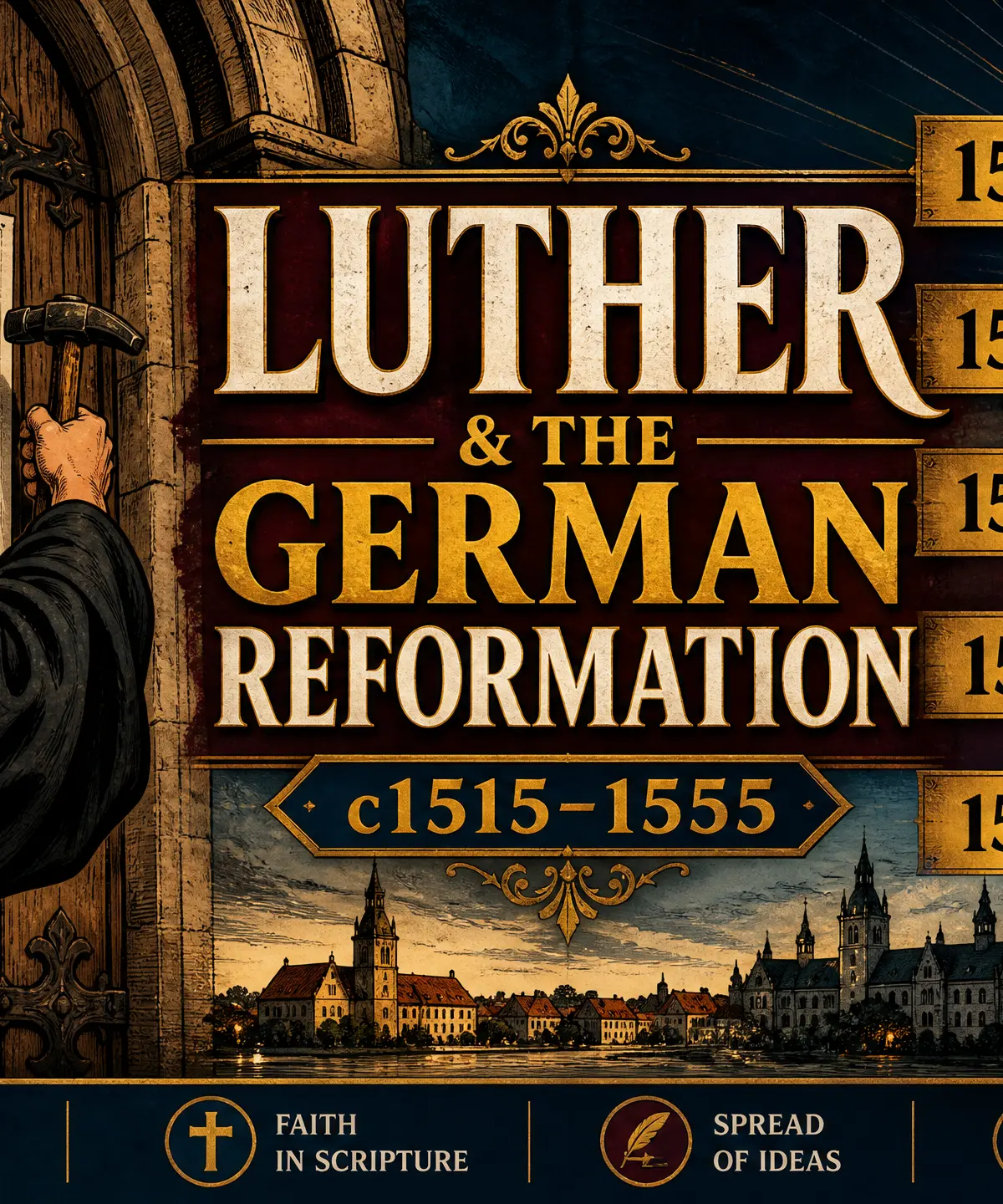
This period study explores the dramatic evolution of Lutheranism between 1515 and 1555. It covers Martin Luther's initial theological challenge to the Catholic Church, the rapid spread of his ideas via the printing press, and the establishment of a separate Lutheran Church within the German states. Crucially, examiners expect you to understand not just the religious theology, but the political dimension: how the German princes used Lutheranism to assert independence, and how the Holy Roman Emperor (Charles V) and the papacy responded to this unprecedented challenge. You must be able to link theological ideas to political and social consequences, such as the Peasants' War of 1525 and the Schmalkaldic League.
Listen to the Podcast
Key Events & Developments
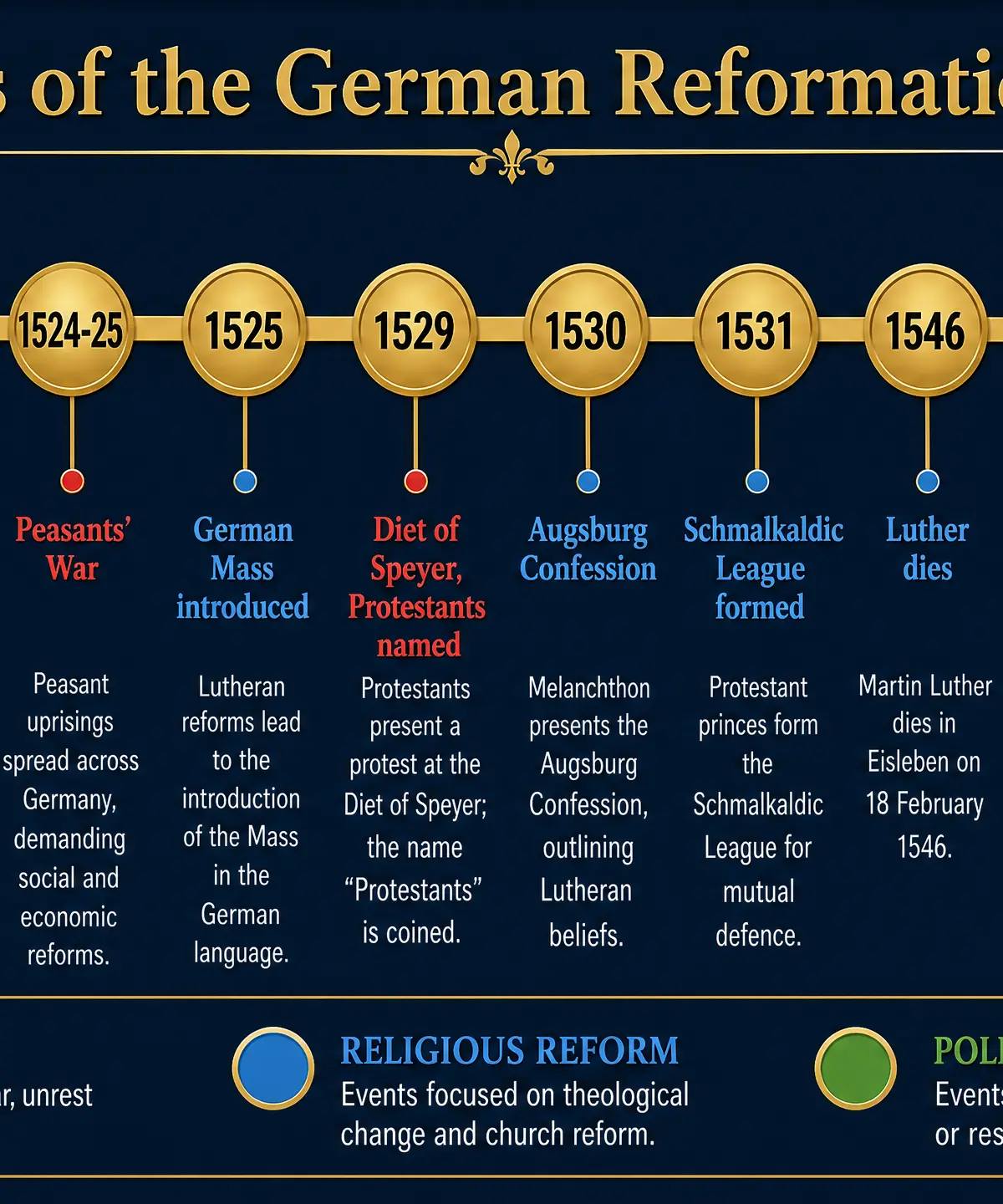
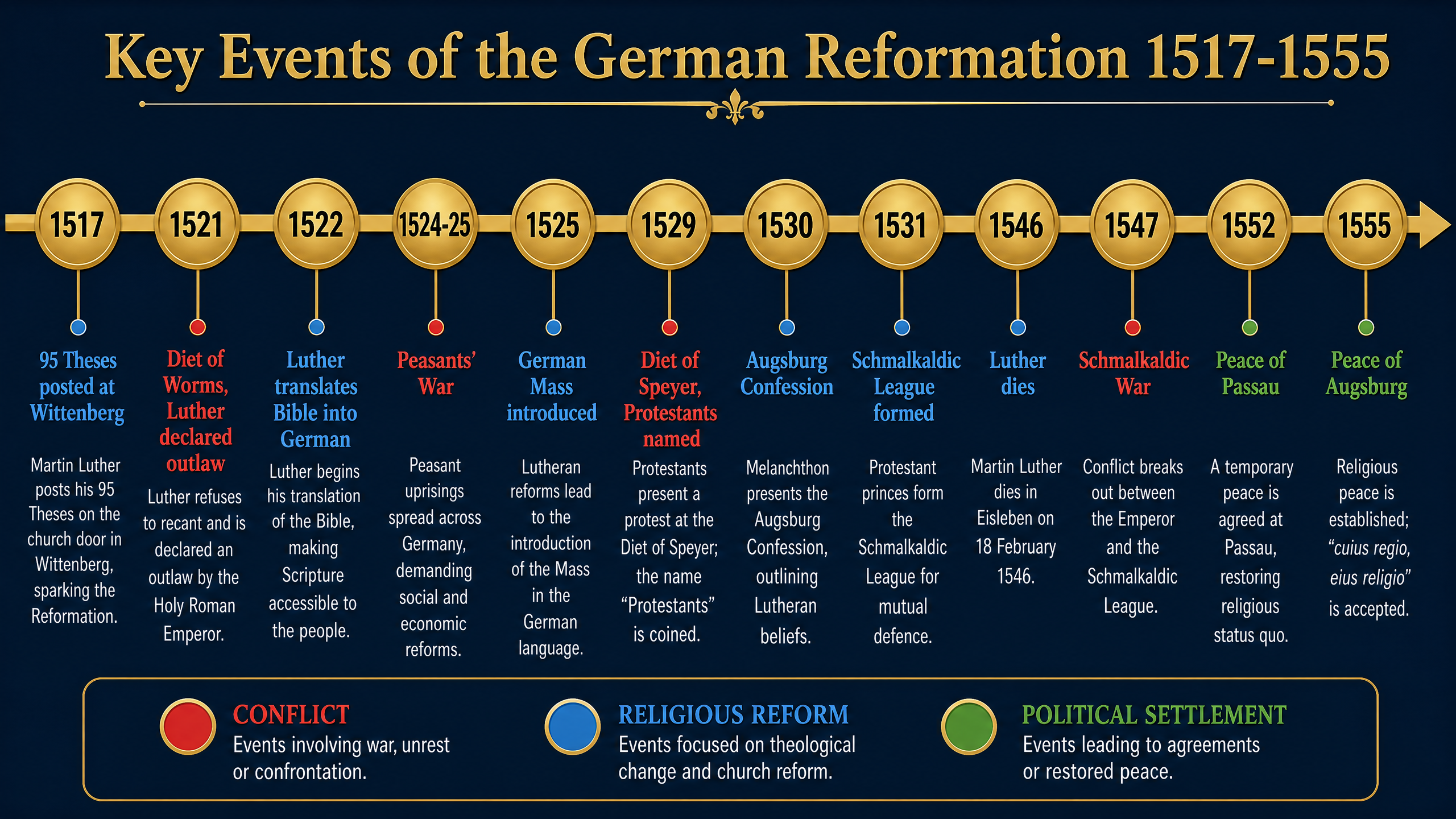
The 95 Theses and the Indulgence Controversy
Date(s): 31 October 1517
What happened: Martin Luther, an Augustinian monk and theology professor, posted his 95 Theses on the door of the Castle Church in Wittenberg. These were academic arguments condemning the sale of indulgences (certificates reducing time in purgatory) by the Dominican friar Johann Tetzel.
Why it matters: This was the spark that ignited the Reformation (Causation). It challenged papal authority over salvation. Thanks to the printing press, the Theses were translated from Latin into German and spread rapidly, transforming an academic debate into a mass public movement.
Specific Knowledge: Johann Tetzel, Archbishop Albert of Mainz, Pope Leo X, Wittenberg, 1517.
The Diet of Worms
Date(s): April 1521
What happened: Luther was summoned before the Holy Roman Emperor, Charles V, at the imperial assembly (Diet) in Worms. Asked to recant his writings, Luther famously refused, stating "Here I stand, I can do no other." Charles V issued the Edict of Worms, declaring Luther a heretic and an outlaw ("put to the ban").
Why it matters: This was the point of no return (Significance). It formalized the break with the Catholic Church and the Empire. Luther's survival, engineered by Frederick the Wise who hid him at Wartburg Castle, demonstrated the limits of imperial power in Germany.
Specific Knowledge: Charles V, Edict of Worms, Frederick the Wise, Wartburg Castle, Junker Jörg.
Translation of the Bible
Date(s): 1521-1522
What happened: While in hiding at Wartburg Castle, Luther translated the New Testament from Greek into German. It was published in September 1522 (the "September Testament").
Why it matters: This practically applied the doctrine of sola scriptura (scripture alone) (Consequence). It allowed ordinary literate Germans to read the word of God without priestly interpretation, undermining the Catholic Church's monopoly on religious truth.
Specific Knowledge: September Testament 1522, sola scriptura, Wartburg Castle.
The Peasants' War
Date(s): 1524-1525
What happened: A massive popular uprising of around 300,000 peasants across Germany, demanding an end to serfdom and citing Lutheran ideas of Christian freedom. Luther vehemently opposed the violence, writing Against the Murderous, Thieving Hordes of Peasants (1525), urging princes to crush the revolt.
Why it matters: A major turning point (Change & Continuity). Around 100,000 peasants were killed. Luther lost popular support among the lower classes but secured the vital backing of the German princes, cementing Lutheranism as a conservative, magisterial movement rather than a radical social revolution.
Specific Knowledge: Thomas Müntzer, Twelve Articles of Memmingen, 100,000 deaths, 1525.
The Schmalkaldic League
Date(s): 1531
What happened: A defensive military alliance formed by Protestant princes and imperial cities, led by Philip of Hesse and John Frederick of Saxony, to defend themselves against Emperor Charles V's attempts to enforce Catholicism.
Why it matters: This militarized and politicized the religious division (Significance). It showed that Lutheranism now had institutional state backing and could defend itself militarily, making a quick Catholic victory impossible.
Specific Knowledge: Philip of Hesse, John Frederick of Saxony, 1531.
The Peace of Augsburg
Date(s): September 1555
What happened: A legal and political treaty between Charles V (represented by his brother Ferdinand) and the Schmalkaldic League. It established the principle of cuius regio, eius religio ("whose realm, his religion"), allowing princes to choose between Catholicism and Lutheranism for their territories.
Why it matters: It legally recognized the permanent division of Western Christianity (Consequence). It marked the failure of Charles V's lifelong goal to restore religious unity to the Empire.
Specific Knowledge: Cuius regio, eius religio, Ferdinand I, 1555.
Key Individuals
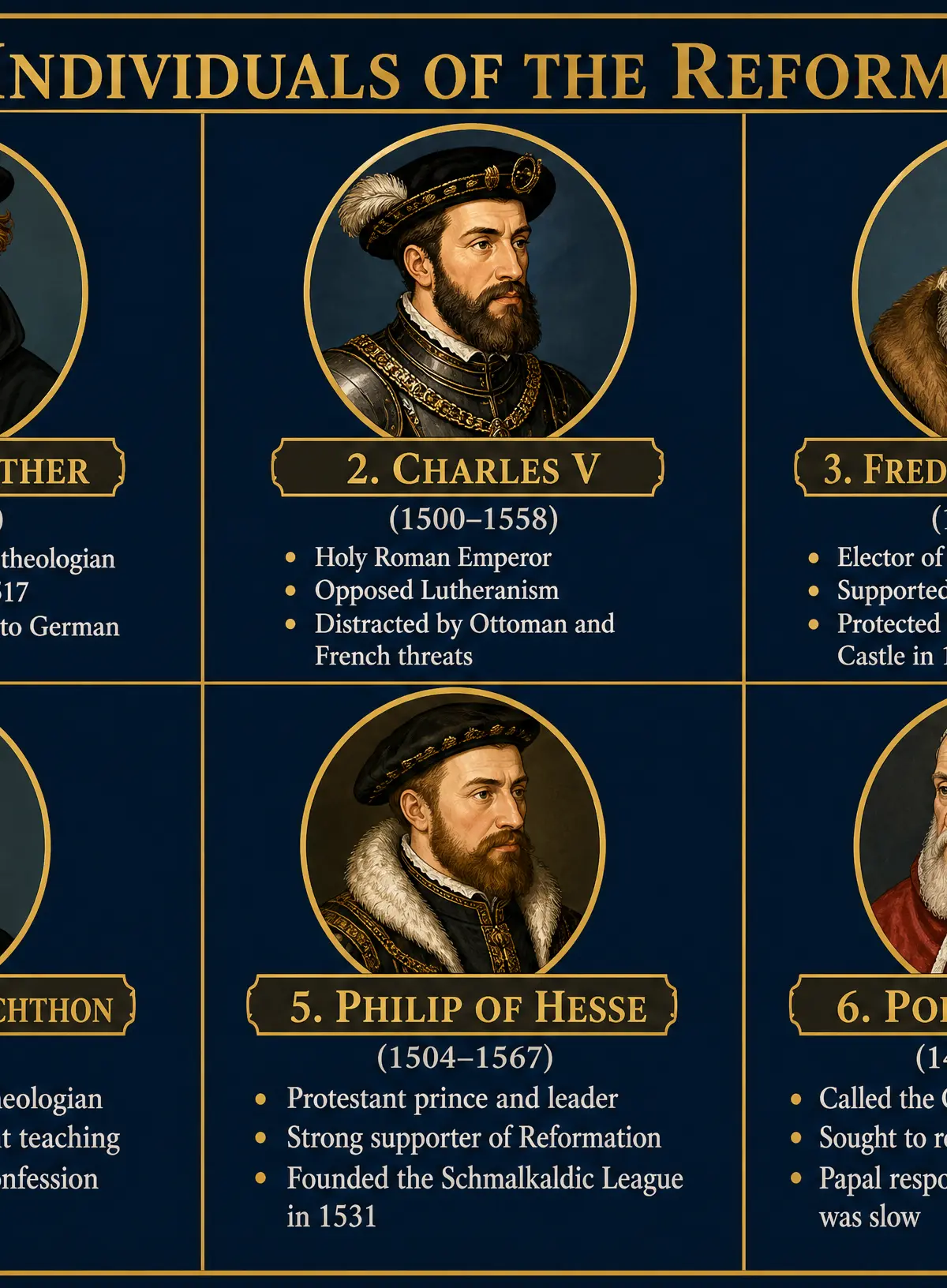
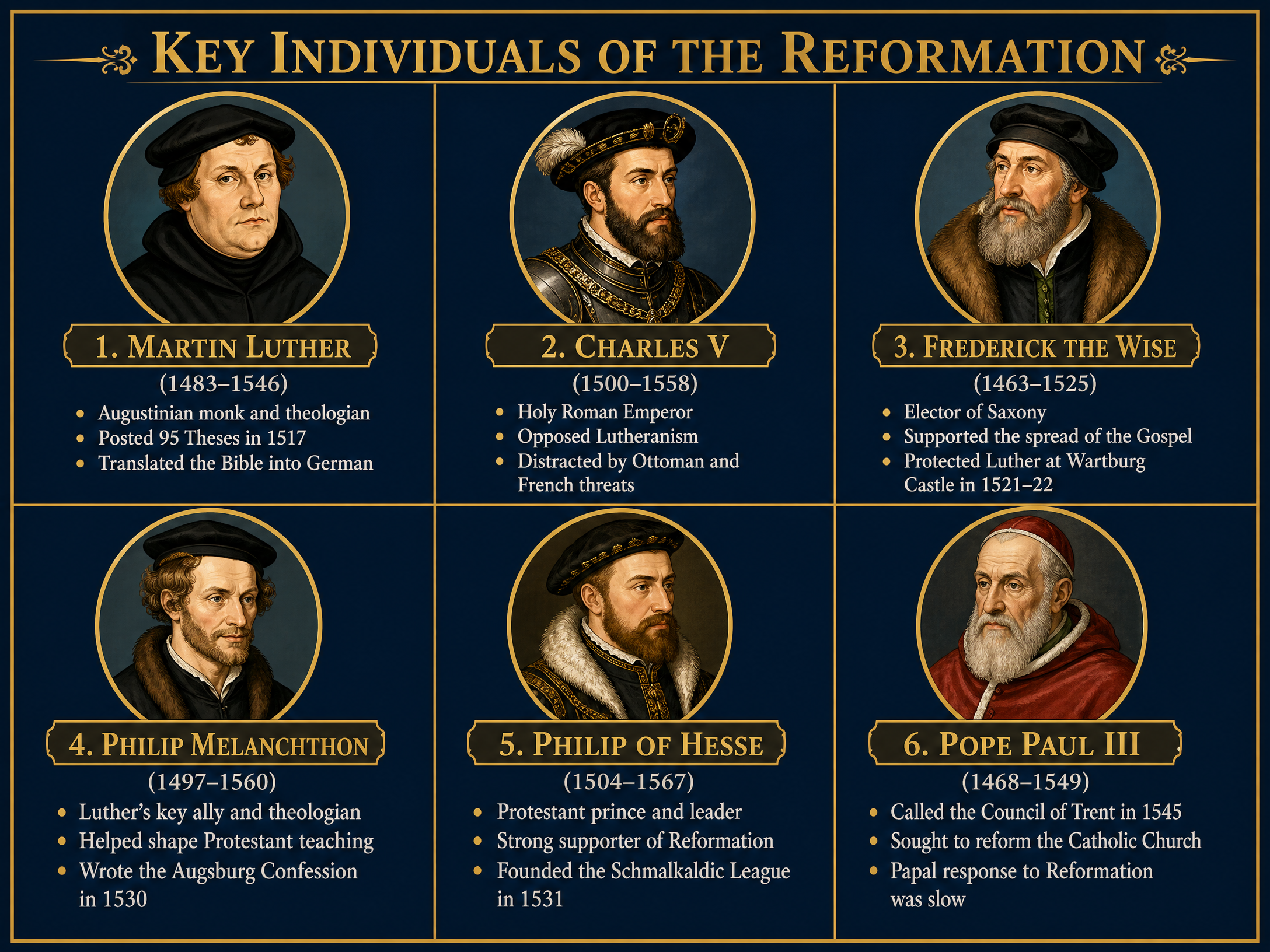
Martin Luther (1483-1546)
Role: Augustinian monk, theology professor at Wittenberg, and catalyst of the Reformation.
Key Actions: Posted 95 Theses (1517); refused to recant at Worms (1521); translated the Bible into German (1522); condemned the Peasants' War (1525).
Impact: His theological breakthrough (sola fide) dismantled the Catholic penitential system. His refusal to submit to papal or imperial authority fractured Western Christianity.
Emperor Charles V (1500-1558)
Role: Holy Roman Emperor and King of Spain; the most powerful monarch in Europe.
Key Actions: Issued Edict of Worms (1521); defeated Schmalkaldic League at Mühlberg (1547); ultimately forced to accept Peace of Augsburg (1555).
Impact: His attempts to crush Lutheranism failed because he was constantly distracted by wars against France (Francis I) and the Ottoman Empire (Suleiman the Magnificent).
Frederick the Wise (1463-1525)
Role: Elector of Saxony, Luther's prince and protector.
Key Actions: Refused to send Luther to Rome; secured Luther a hearing at Worms; arranged Luther's protective "kidnapping" to Wartburg Castle.
Impact: Without his political protection, Luther would almost certainly have been executed as a heretic early in the controversy.
Philip Melanchthon (1497-1560)
Role: Brilliant humanist scholar and Luther's closest theological ally.
Key Actions: Systematized Lutheran theology; authored the Augsburg Confession (1530).
Impact: He provided the intellectual and diplomatic framework for the new church, making Lutheranism a coherent, defensible theology rather than just a protest movement.
Pope Paul III (1468-1549)
Role: Pope from 1534 to 1549.
Key Actions: Finally recognized the severity of the Protestant threat; convened the Council of Trent in 1545 to reform the Catholic Church.
Impact: Initiated the Catholic Counter-Reformation, but his actions came decades too late to heal the schism in Germany.
Second-Order Concepts
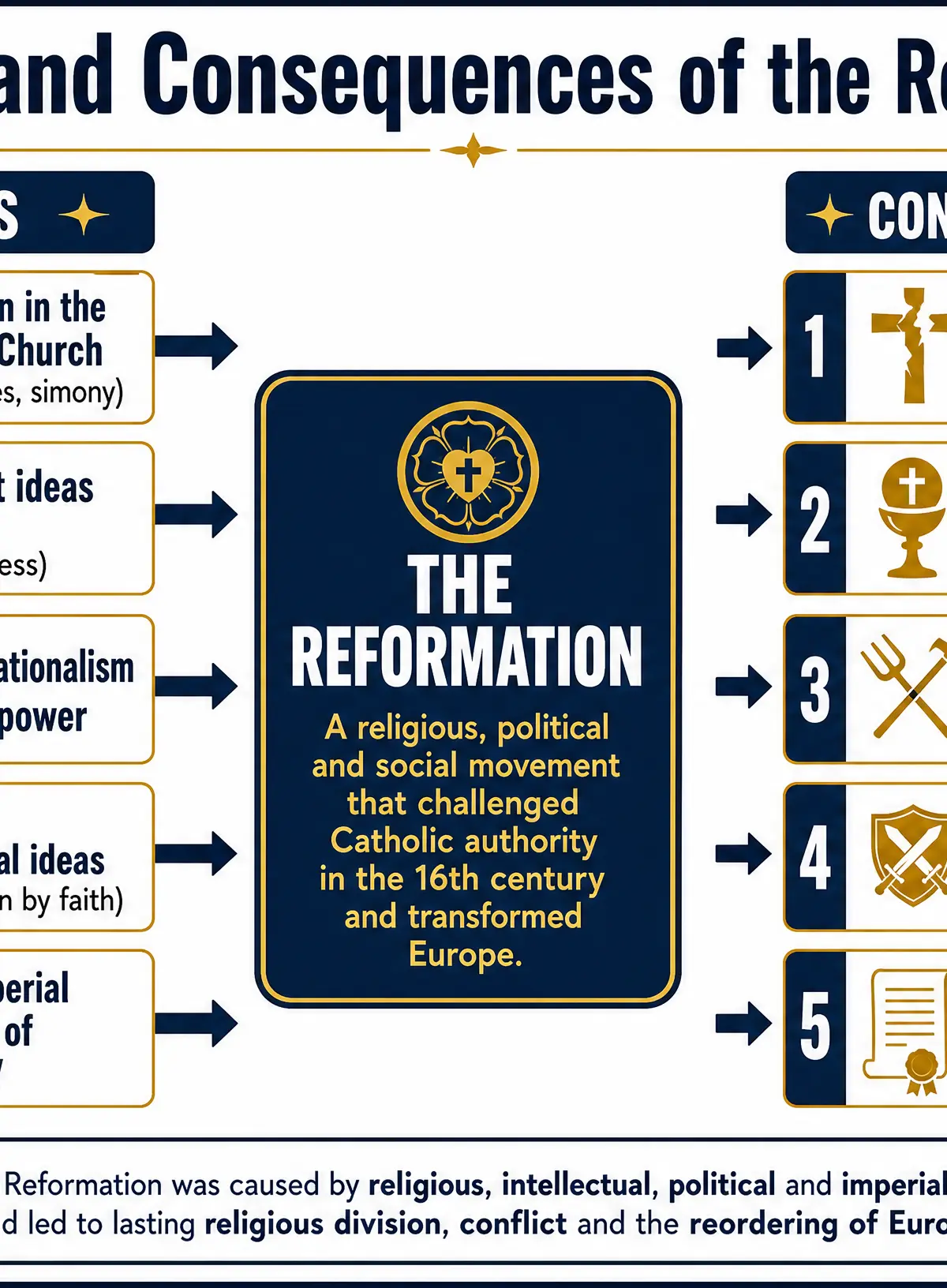
Causation
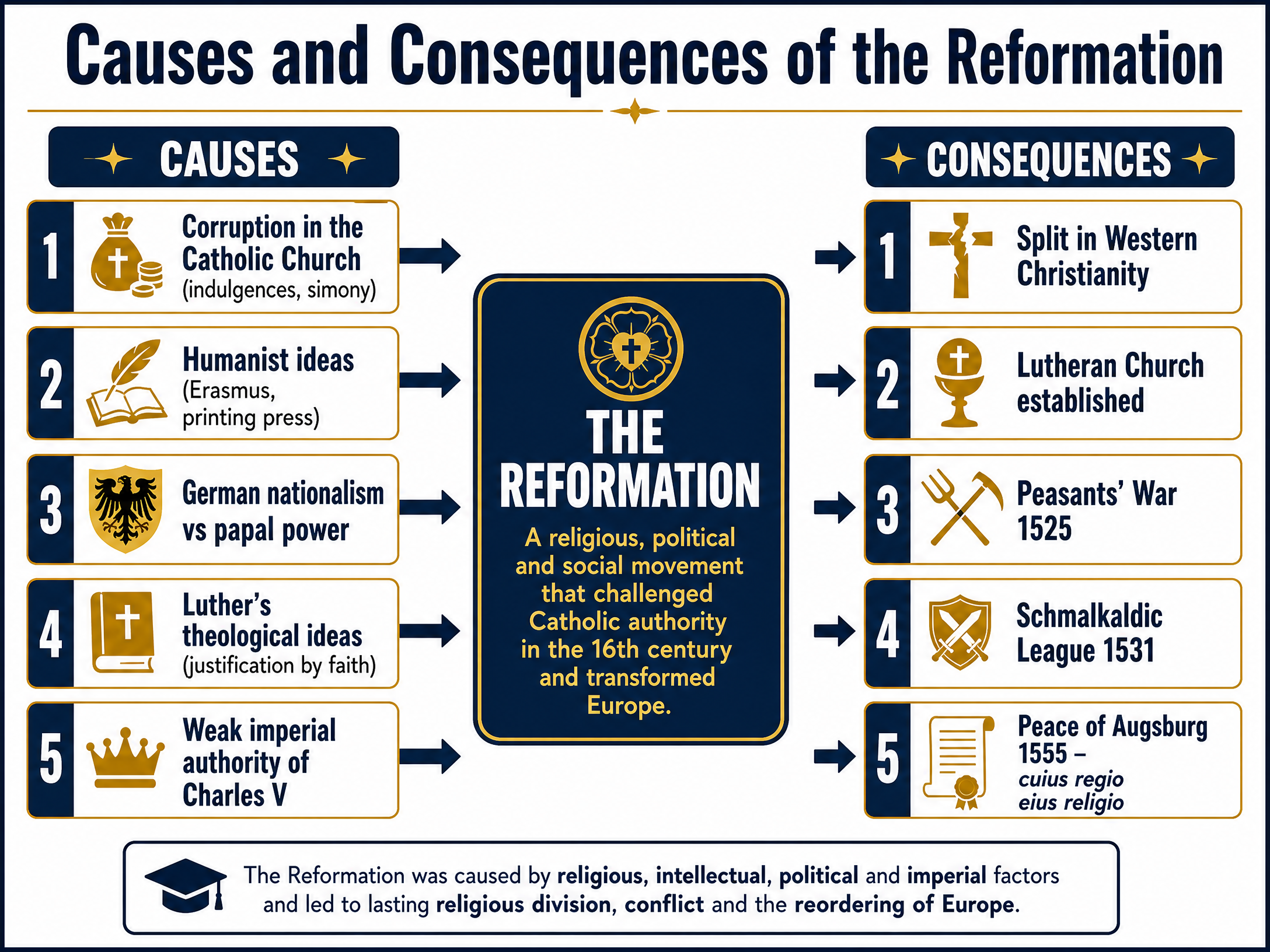
Short-term triggers: Johann Tetzel's aggressive sale of indulgences in Germany in 1517 directly provoked Luther's 95 Theses.
Long-term causes: Deep-seated anti-clericalism in Germany; resentment of Italian papal taxation; the influence of Renaissance Humanism (e.g., Erasmus) which emphasized returning to original biblical texts; and the political fragmentation of the Holy Roman Empire.
Consequence
Immediate effects: The rapid spread of Luther's ideas via print; the polarization of German society; radical uprisings like the Zwickau Prophets and the Peasants' War (1525).
Long-term effects: The permanent division of Western Christianity; the strengthening of princely state power in Germany at the expense of the Emperor and Pope; the Catholic Counter-Reformation.
Change & Continuity
Change: The Catholic monopoly on salvation was broken. The Mass was translated into German. Clerical marriage was permitted (Luther married Katharina von Bora in 1525). Princes gained control over territorial churches.
Continuity: Luther remained socially conservative, maintaining strict social hierarchies (as seen in his reaction to the Peasants' War). He also retained many traditional liturgical practices and the belief in the Real Presence in the Eucharist.
Significance
Luther's challenge is historically significant because it was the first successful defiance of papal authority in centuries. It shifted the locus of religious authority from the institutional Church to the individual conscience and the biblical text (sola scriptura).
Source Skills
When evaluating sources for this period, consider:
Catholic Sources (e.g., Papal Bulls, Charles V's edicts): Often characterize Luther as a dangerous heretic, a "wild boar in the vineyard," emphasizing the threat he posed to social order and tradition.
Lutheran Sources (e.g., Luther's pamphlets, woodcuts by Lucas Cranach): Highly polemical. Cranach's woodcuts often juxtapose the piety of Christ with the corruption of the Pope (e.g., the Pope as the Antichrist). Remember that these were designed as mass propaganda.
Provenance: A source from 1517 (early debate) will have a very different tone and purpose to a source from 1547 (Schmalkaldic War). Always check the date to place the source in the correct phase of the Reformation.
Worked Examples
3 worked examples — open one to explore the question and available guidance.
Practice Questions
Test your understanding — click to reveal model answers
Describe two features of the Diet of Worms (1521).
Hint: Identify a feature, then add a specific detail to support it.
Explain why the Peasants' War broke out in 1524.
Hint: Think about long-term economic grievances and how Luther's new religious ideas acted as a spark.
‘The Catholic Church’s response to Luther was completely ineffective in the years 1517–1555.’ How far do you agree?
Hint: Look at early failures (Leo X) vs later attempts (Council of Trent), and distinguish between the Papacy and the Emperor.
Explain the significance of the Peace of Augsburg (1555).
Hint: Significance means 'why does this matter?' Look at the short-term and long-term impacts.
How useful are Sources B and C for an enquiry into Luther's challenge to the Catholic Church? (8 marks)
Hint: Compare the two sources. One is likely a Catholic attack, the other a Protestant defense.
Test your understanding of Luther and the German Reformation, c1515–55
Active recall beats re-reading. Take an instant quiz now to test what you’ve learned and lock it into long-term memory.
7 days Premium · Then free forever · No card, no charge