Pearson Edexcel · A-Level · History
Rebellion and disorder under the Tudors, 1485–1603
Master the complexities of Tudor rule, from pretenders to the throne to popular uprisings against religious change and taxation. This study guide explores how the Tudor monarchs (1485–1603) not only faced significant rebellions but also developed sophisticated methods of local control to secure their authority.
- 10 min read
- 3 worked examples
- 5 practice questions
- 6 key terms
Study Notes
Overview
This study guide covers the turbulent period of Tudor rule from 1485 to 1603, focusing on the various rebellions that challenged the crown and the methods the monarchs used to maintain order in the localities. For GCSE History, examiners expect candidates to understand that rebellions were driven by a complex mix of causes: taxation, religion, politics, and succession. Equally important is understanding how the Tudor state evolved to prevent disorder, moving away from medieval reliance on over-mighty nobles towards a more integrated system of local governance involving Justices of the Peace (JPs), regional councils, and Lord Lieutenants. To achieve top marks, you must be able to deploy specific knowledge (dates, names, statistics) and explain how causes connect, rather than just narrating events.
Audio Revision
Listen to our comprehensive revision podcast covering the key events, causes, and exam tips for this topic:
Key Events & Developments
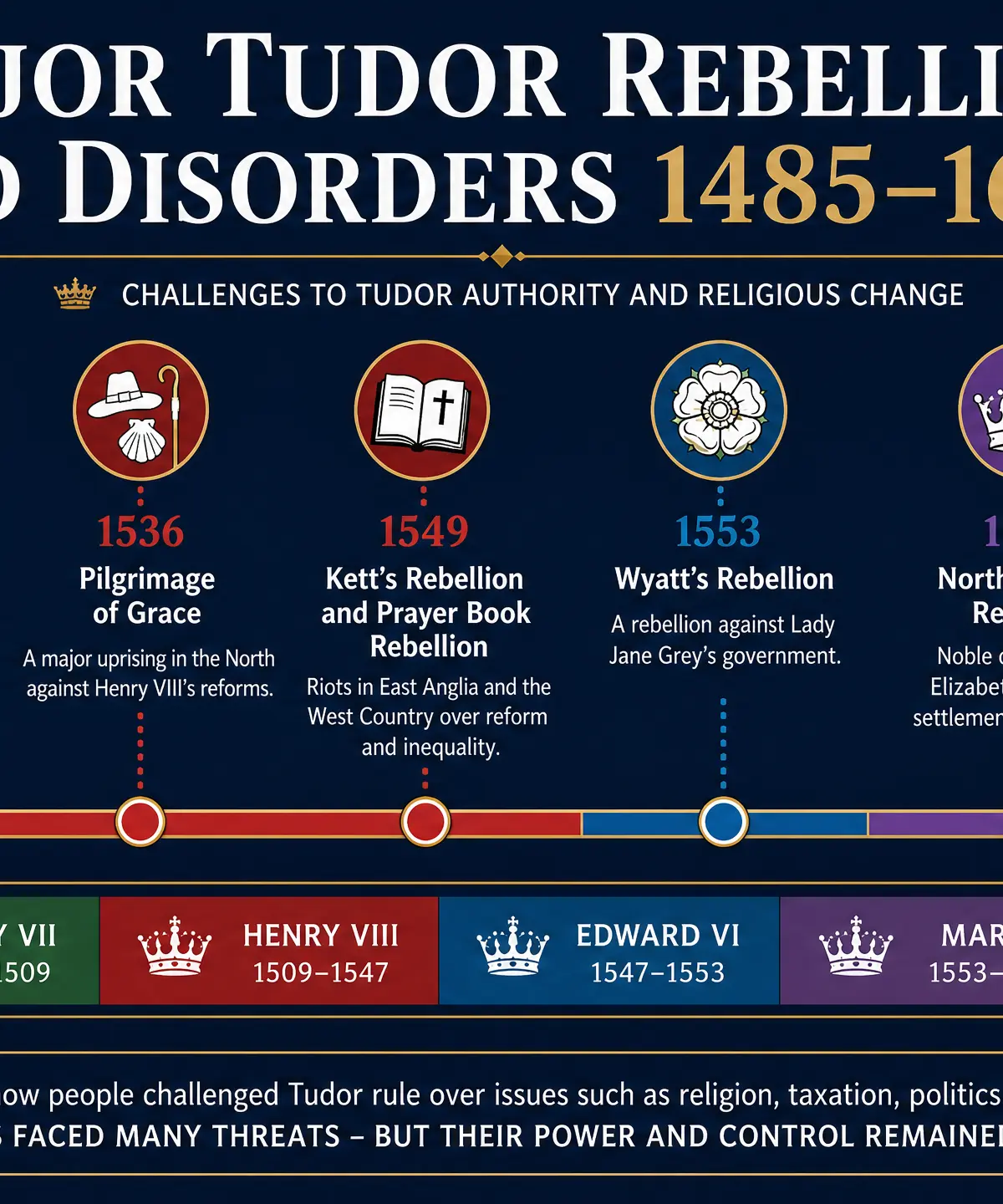
Lambert Simnel Rebellion
Date(s): 1487
What happened: A young boy, Lambert Simnel, was trained by a priest to impersonate the Earl of Warwick (a Yorkist claimant). He was crowned King Edward VI in Dublin and invaded England with an army of Irish and German mercenaries. He was defeated by Henry VII at the Battle of Stoke Field.
Why it matters: This was a significant early challenge to Henry VII's new dynasty, demonstrating that Yorkist support remained dangerous. Henry's decision to pardon Simnel (giving him a job in the royal kitchens) showed political intelligence and a desire to appear secure rather than vindictive.
Specific Knowledge: Lambert Simnel, Richard Symonds, Earl of Warwick, Battle of Stoke Field (June 1487).
Perkin Warbeck's Challenge
Date(s): 1491–1499
What happened: Perkin Warbeck claimed to be Richard, Duke of York (one of the Princes in the Tower). He gained backing from foreign powers including France, Burgundy, and Scotland, attempting several invasions of England before finally being captured and executed.
Why it matters: Warbeck posed a prolonged threat because of his international support. Henry VII's response demonstrated the use of diplomacy (negotiating treaties to remove foreign backing) alongside military readiness to secure the realm.
Specific Knowledge: Richard Duke of York, Margaret of Burgundy, executed 1499.
The Cornish Rebellion
Date(s): 1497
What happened: A popular uprising triggered by Henry VII's demand for taxes to fund a war against Scotland. The Cornish felt the Scottish threat did not concern them. They marched on London but were defeated at the Battle of Deptford Bridge.
Why it matters: This highlights the limits of Tudor authority when imposing national taxation on distant localities. It showed that ordinary people, not just nobles, would rebel over economic grievances.
Specific Knowledge: Taxation for Scottish war, Battle of Deptford Bridge.
The Pilgrimage of Grace
Date(s): 1536
What happened: A massive uprising in the North of England (Yorkshire and Lincolnshire) led by lawyer Robert Aske. It was primarily triggered by Henry VIII's dissolution of the monasteries, though there were also economic and political grievances.
Why it matters: This was the most significant threat of the entire Tudor period, involving around 40,000 rebels. Henry VIII could not defeat them militarily, so he used negotiation and false promises of pardons to disperse them, before ruthlessly executing the leaders later.
Specific Knowledge: Robert Aske, 40,000 rebels, dissolution of the monasteries, Thomas Cromwell.
The 1549 Rebellions
Date(s): 1549
What happened: Two major uprisings during Edward VI's reign. The Prayer Book Rebellion in the West Country was a Catholic reaction against the new English Protestant Prayer Book. Kett's Rebellion in East Anglia, led by Robert Kett, was driven by socio-economic grievances, specifically the enclosure of common land.
Why it matters: These simultaneous rebellions revealed the intense pressure the Tudor state faced during the mid-Tudor crisis, struggling with both religious upheaval and severe economic inequality.
Specific Knowledge: Prayer Book Rebellion (Western Rising), Kett's Rebellion, enclosure, Robert Kett, 16,000 rebels in Norwich.
Wyatt's Rebellion
Date(s): 1553–1554
What happened: Thomas Wyatt led a rebellion in Kent against Mary I. The stated aim was to prevent her marriage to Philip of Spain, though many rebels were motivated by Protestantism. The rebellion failed to take London.
Why it matters: It demonstrated the xenophobia and religious tension of the period. The aftermath led to the execution of Lady Jane Grey, removing her as a potential Protestant figurehead.
Specific Knowledge: Thomas Wyatt, Mary I, Philip of Spain, Lady Jane Grey.
The Northern Earls Rebellion
Date(s): 1569
What happened: A Catholic uprising led by the Earls of Northumberland and Westmorland, aiming to depose Elizabeth I and replace her with Mary, Queen of Scots. The rebellion failed, and Elizabeth executed over 450 rebels.
Why it matters: This was a significant political and religious threat from the traditional nobility. Elizabeth's harsh response demonstrated her determination to crush Catholic opposition and assert royal authority in the North.
Specific Knowledge: Earls of Northumberland and Westmorland, Mary Queen of Scots, 450 executions.
The Essex Rebellion
Date(s): 1601
What happened: Robert Devereux, Earl of Essex, a former favourite of Elizabeth I, attempted a coup in London after falling out of favour and losing his monopolies. The rebellion was poorly planned and quickly collapsed.
Why it matters: It illustrates the dangers inherent in the Tudor patronage system; when a powerful noble was excluded from royal favour and financial rewards, rebellion could become a desperate last resort.
Specific Knowledge: Robert Devereux (Earl of Essex), monopolies, patronage.
Methods of Controlling the Localities
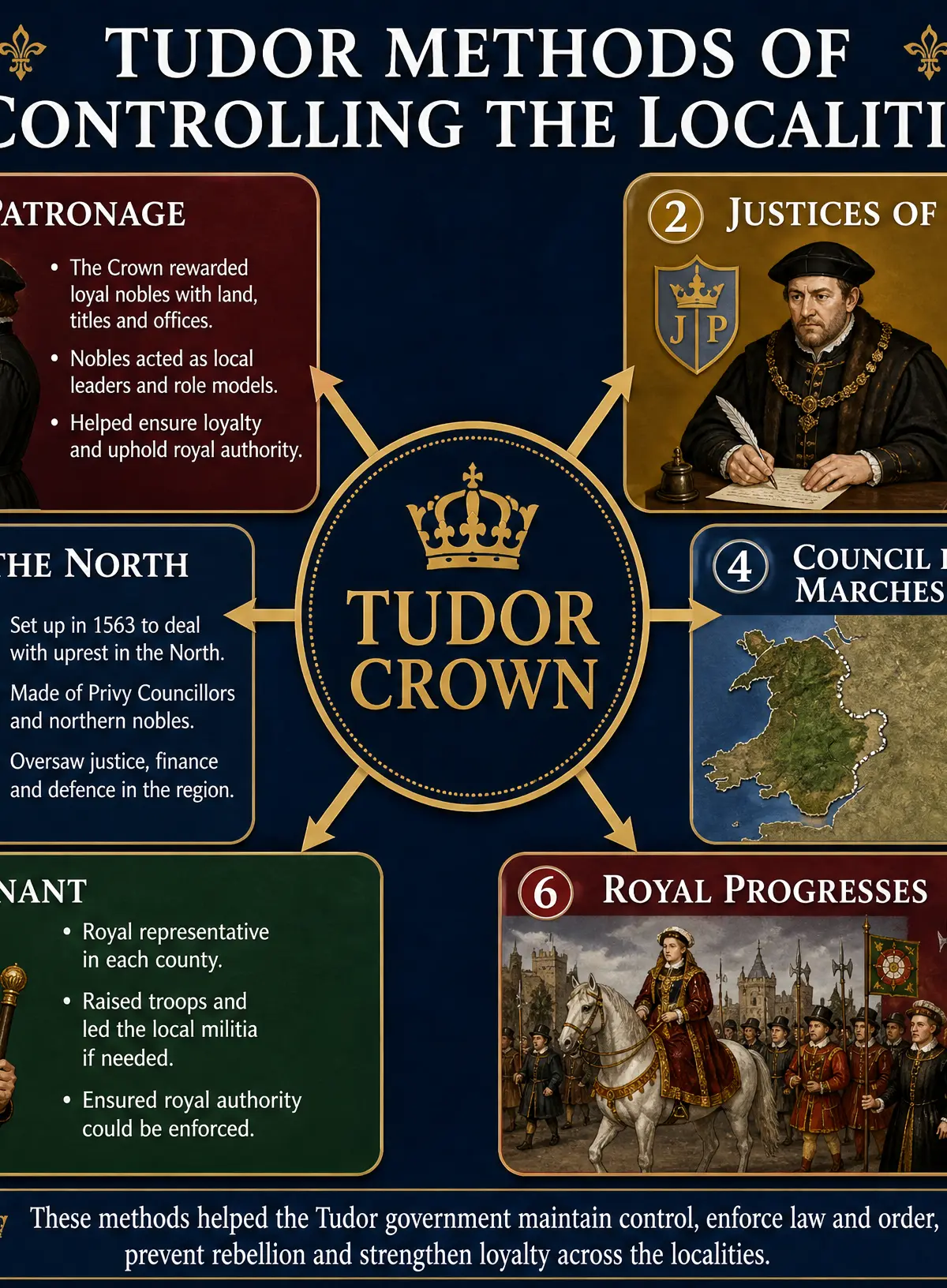
The Tudors did not just react to disorder; they actively developed systems to integrate the localities and maintain control.
1. Patronage: The Crown rewarded loyal nobles with land, titles, and offices. This bound local elites to the monarch through financial self-interest.
2. Regional Councils: The Council of the North and the Council in the Marches of Wales extended royal justice and administration into areas far from London.
3. Justices of the Peace (JPs): Unpaid local gentlemen appointed by the Crown. Their role expanded significantly to include poor relief, wage regulation, and enforcing religious laws, providing cheap and effective local governance.
4. Law in Wales Acts (1535 & 1542): Integrated Wales into the English legal system, creating Welsh counties and parliamentary representation.
5. Lord Lieutenants: Developed under Elizabeth I, these were royal representatives in each county responsible for raising the local militia.
6. Royal Progresses: The monarch (especially Elizabeth I) travelled the country, staying with nobles, which built personal loyalty and demonstrated royal presence.
Key Individuals
Henry VII
Role: First Tudor monarch (1485–1509).
Key Actions: Defeated Richard III at Bosworth. Dealt with pretenders Simnel and Warbeck. Used financial bonds and recognisances to control the nobility.
Impact: Secured the dynasty and established a firm financial and political foundation for Tudor rule.
Robert Aske
Role: Leader of the Pilgrimage of Grace (1536).
Key Actions: Led 40,000 rebels in a peaceful protest against religious changes. Negotiated with the King's representatives.
Impact: Demonstrated the scale of popular opposition to the Reformation. His execution showed Henry VIII's ruthlessness.
Thomas Cromwell
Role: Chief Minister to Henry VIII.
Key Actions: Architect of the break with Rome and the dissolution of the monasteries. Pushed through the Law in Wales Acts.
Impact: Centralised government power and provoked the Pilgrimage of Grace, fundamentally altering the relationship between the Crown and the localities.
Elizabeth I
Role: Last Tudor monarch (1558–1603).
Key Actions: Established the Religious Settlement. Defeated the Northern Earls and Essex rebellions. Expanded the role of JPs and Lord Lieutenants. Used royal progresses extensively.
Impact: Maintained stability during a period of intense religious and political tension, solidifying the structures of local government.
Second-Order Concepts
Causation
Rebellions rarely had a single cause. Short-term triggers (like a new tax or the closure of a local abbey) often ignited long-term grievances (like inflation, enclosure, or religious alienation). Examiners expect you to identify the primary cause while acknowledging contributing factors.
Consequence
The immediate consequence of most rebellions was failure and execution for the leaders. However, the long-term consequence was often a strengthening of the Tudor state, as monarchs responded by improving local administration (e.g., expanding the role of JPs) to prevent future uprisings.
Change & Continuity
While the threat of rebellion was a continuity throughout the period, the methods of control changed. Henry VII relied on financial threats to control powerful nobles. By Elizabeth's reign, the system had evolved to rely more on a broad network of local gentry (JPs) and structural institutions (Lord Lieutenants).
Significance
This topic is significant because it shows the transition of England from a medieval state, where power was held by semi-independent regional lords, to a more modern, centralised nation-state where the Crown's authority reached into every locality.
Source Skills
When evaluating sources for this topic, always consider provenance. A source written by a royal official (like a report from a JP) will emphasize the danger of the rebels and the justice of the Crown's response. A petition from the rebels (like the demands of the Pilgrimage of Grace) will frame their actions as a loyal attempt to advise the King against 'evil councillors'. Use the formula: Content (what it says) + Provenance (who/when/why) + Limitations (what it omits) + Judgement (overall usefulness).
Visual Resources
2 diagrams and illustrations
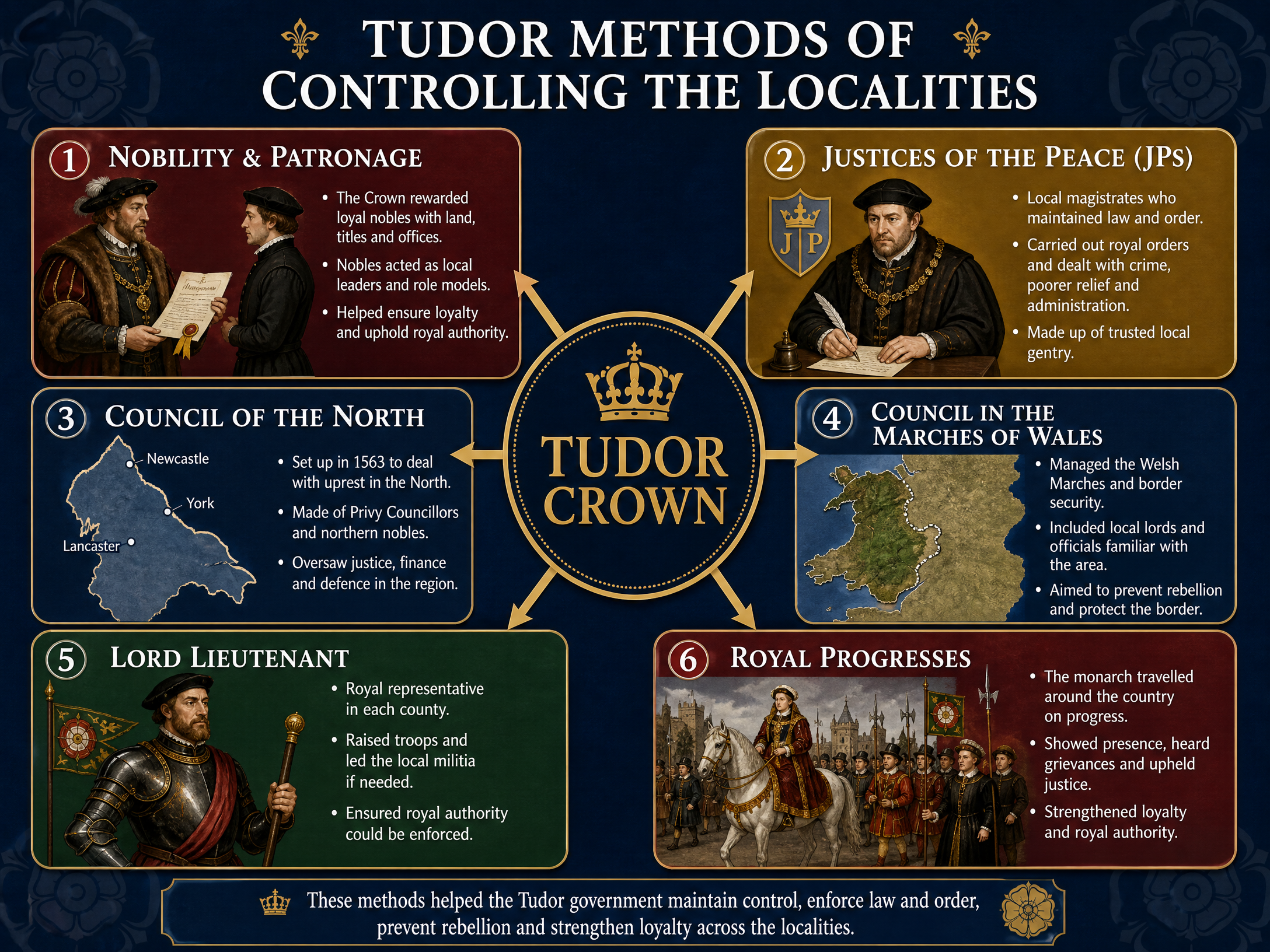
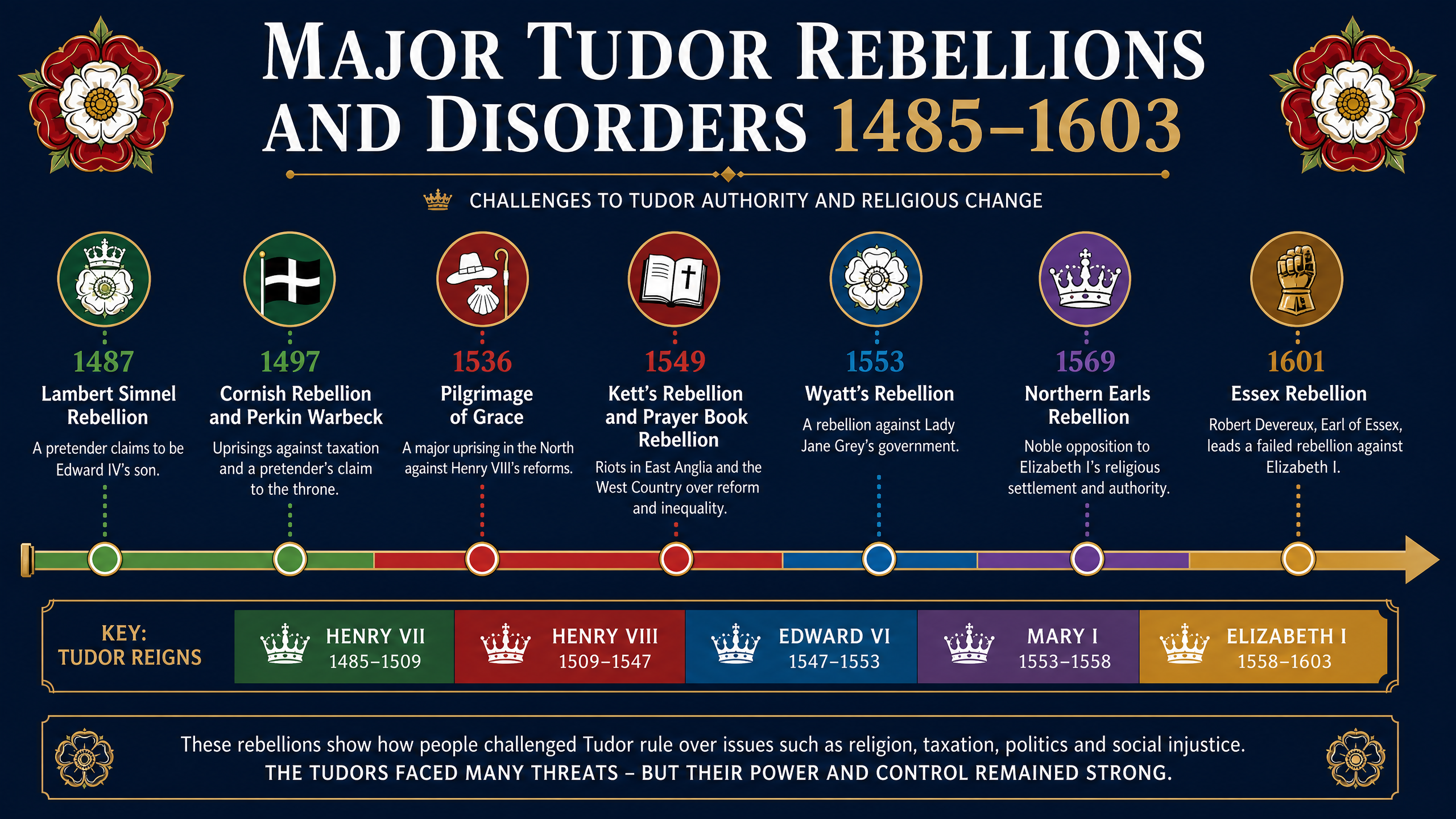
Interactive Diagrams
1 interactive diagram to visualise key concepts
Conceptual Flow Outline
How Tudor methods of control contributed to stability in the localities.
Worked Examples
3 worked examples — open one to explore the question and available guidance.
Practice Questions
Test your understanding — click to reveal model answers
Describe two features of the role of Justices of the Peace (JPs) in Tudor England. (4 marks)
Hint: Identify a duty they performed, and add a specific detail about how they did it or who they were.
Explain why Henry VII faced challenges to his rule in the years 1485–1499. (12 marks)
Hint: Focus on his weak claim to the throne, the survival of Yorkist rivals, and taxation.
‘The development of regional councils was the most effective method the Tudors used to control the localities.’ How far do you agree? (16 marks)
Hint: Compare regional councils (North/Wales) with other methods like JPs, patronage, and Lord Lieutenants.
Explain why the rebellions of 1549 failed. (12 marks)
Hint: Consider the lack of noble support, the strength of the government mercenary forces, and the geographical isolation of the rebels.
Describe two features of the Northern Earls Rebellion (1569). (4 marks)
Hint: Think about the religious motivation and the leaders involved.
Test your understanding of Rebellion and disorder under the Tudors, 1485–1603
Active recall beats re-reading. Take an instant quiz now to test what you’ve learned and lock it into long-term memory.
7 days Premium · Then free forever · No card, no charge