Pearson Edexcel · A-Level · History
Russia in revolution, 1894–1924
This study guide covers the dramatic transformation of Russia from a Tsarist autocracy to the world's first communist state between 1894 and 1924. It is essential for understanding how the Bolsheviks seized and consolidated power, surviving civil war, economic collapse, and foreign intervention to establish a one-party state.
- 6 min read
- 3 worked examples
- 5 practice questions
- 6 key terms
Study Notes
Overview
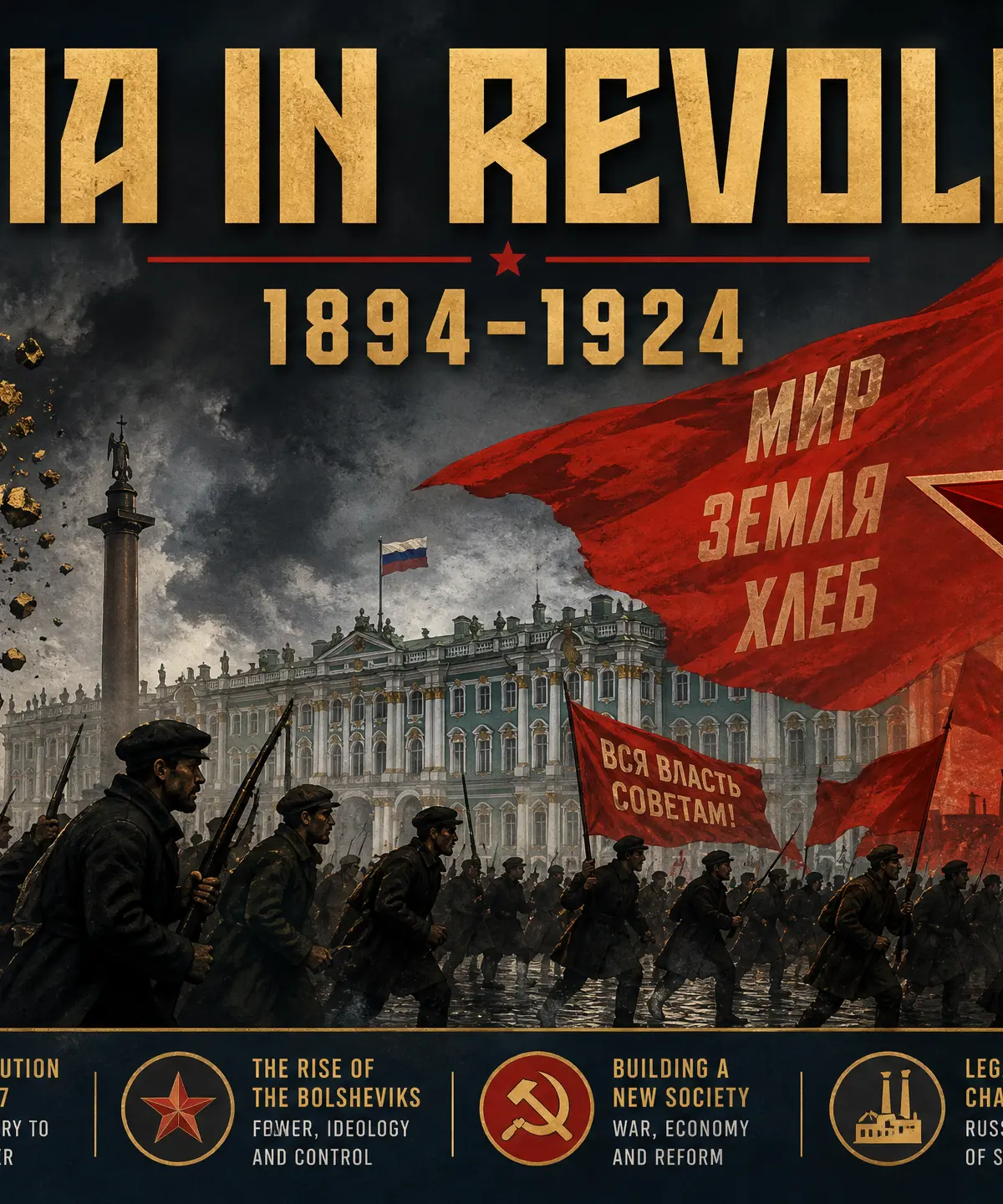
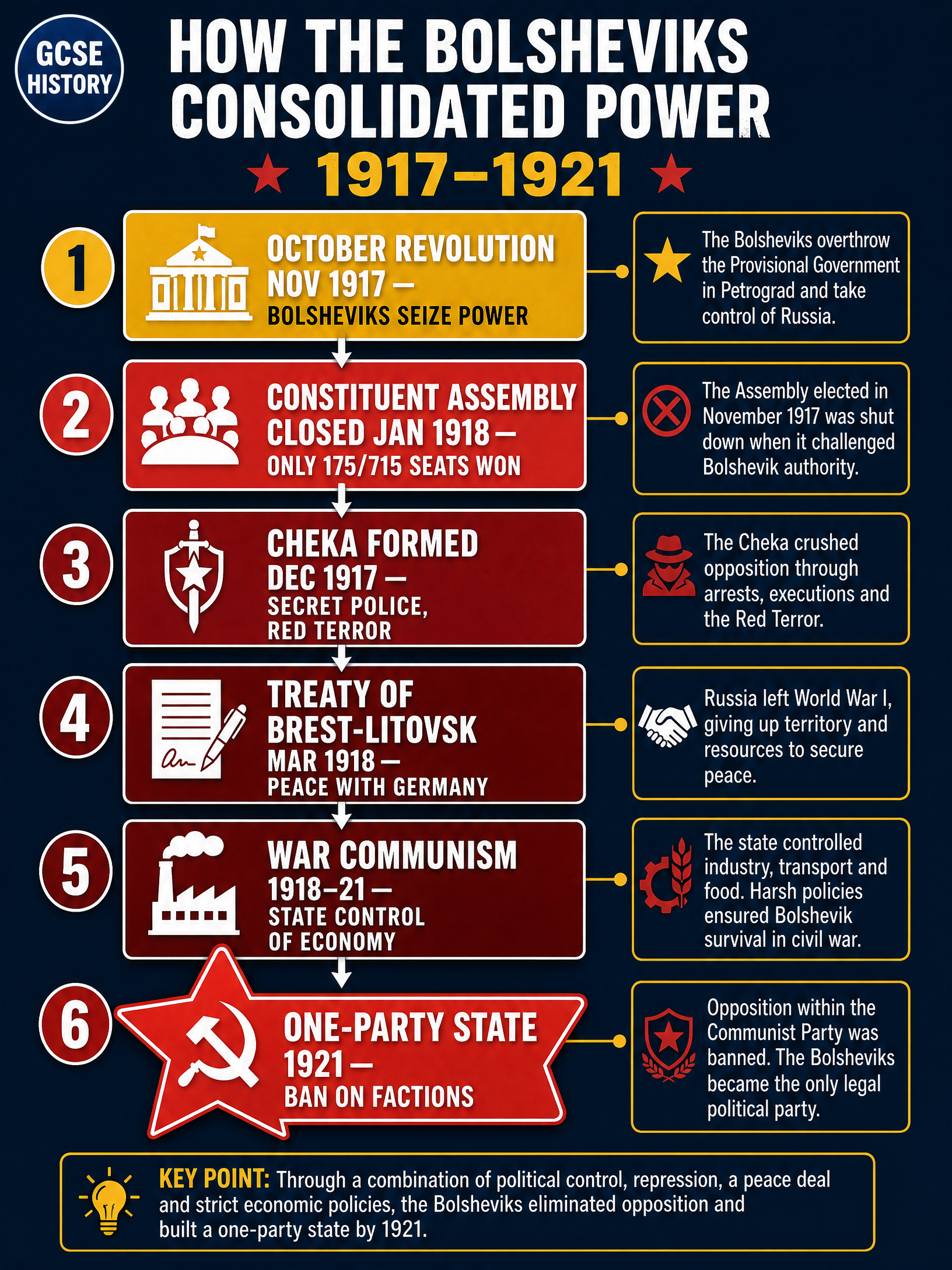
This study guide covers the crucial period of 1894 to 1924, focusing on how the Bolsheviks consolidated power after the October Revolution of 1917. Examiners expect candidates to understand not just what happened, but why the Bolsheviks were successful in holding onto power despite facing overwhelming odds. You need to be able to explain the political ruthlessness of Lenin (closing the Constituent Assembly, forming the Cheka), the pragmatic compromises made (the Treaty of Brest-Litovsk, the New Economic Policy), and the military victory in the Civil War orchestrated by Trotsky. Specific knowledge—such as dates, names, and statistics—is heavily rewarded in exams.
Key Events & Developments
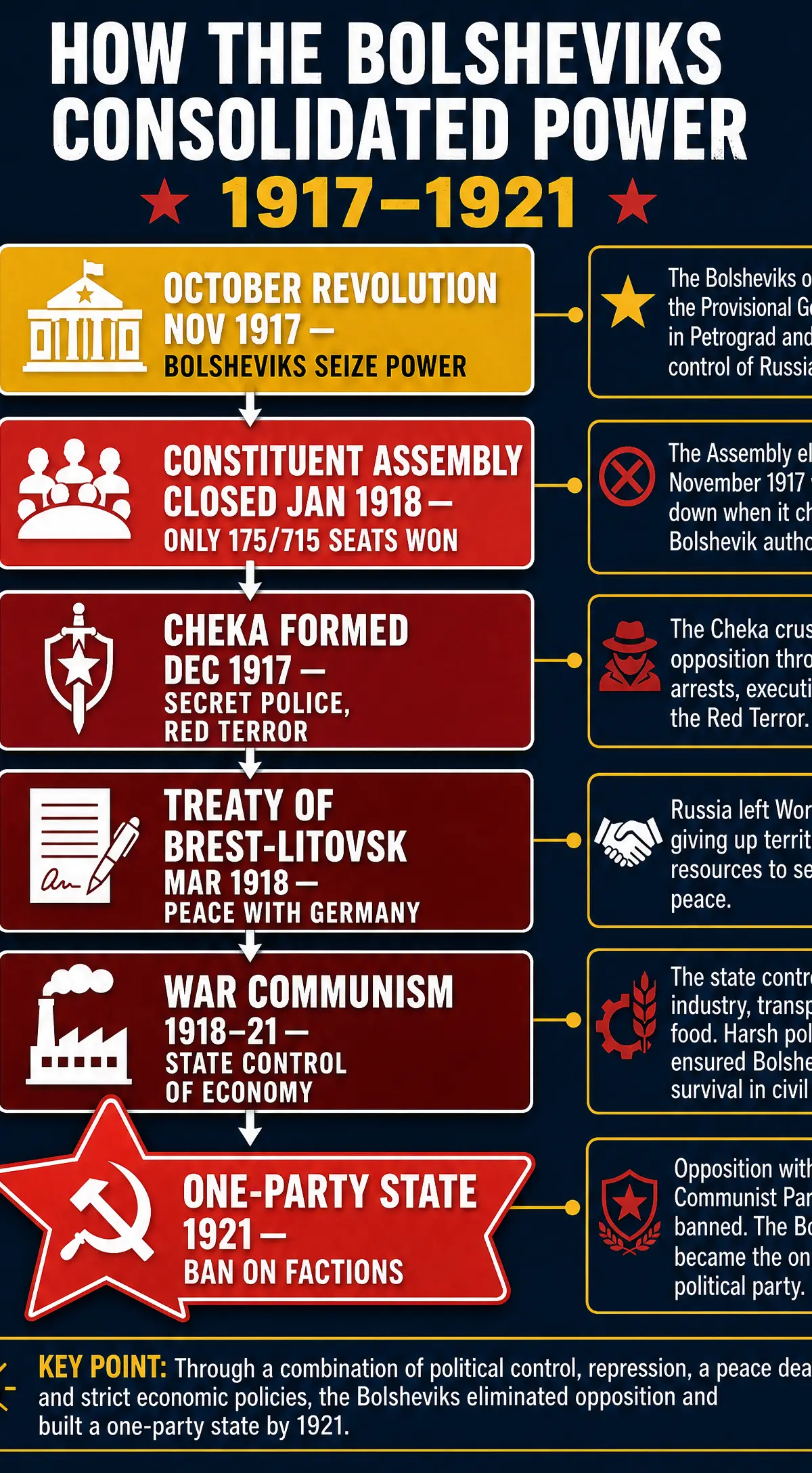
The Closing of the Constituent Assembly
Date(s): January 1918
What happened: The Constituent Assembly, Russia's first democratically elected parliament, met for the first time. The Bolsheviks had won only 175 out of 715 seats, while the Socialist Revolutionaries won a majority. After one day, Lenin ordered the Red Guards to close it down by force.
Why it matters: This was a clear signal that the Bolsheviks had no intention of sharing power or ruling democratically. It helped trigger the Civil War, as opponents realised they could not remove the Bolsheviks through the ballot box.
Specific Knowledge: Bolsheviks won 175/715 seats; closed after 1 day.
The Treaty of Brest-Litovsk
Date(s): March 1918
What happened: Lenin signed a harsh peace treaty with Germany to end Russia's involvement in the First World War. Russia lost vast amounts of territory, population, and resources.
Why it matters: It secured the survival of the Bolshevik government by providing a "breathing space" from foreign war, allowing them to focus on internal enemies. However, the humiliating terms angered many Russians and fueled opposition.
Specific Knowledge: Russia lost 34% of its population, 54% of its industrial capacity, and 89% of its coal mines.
The Russian Civil War
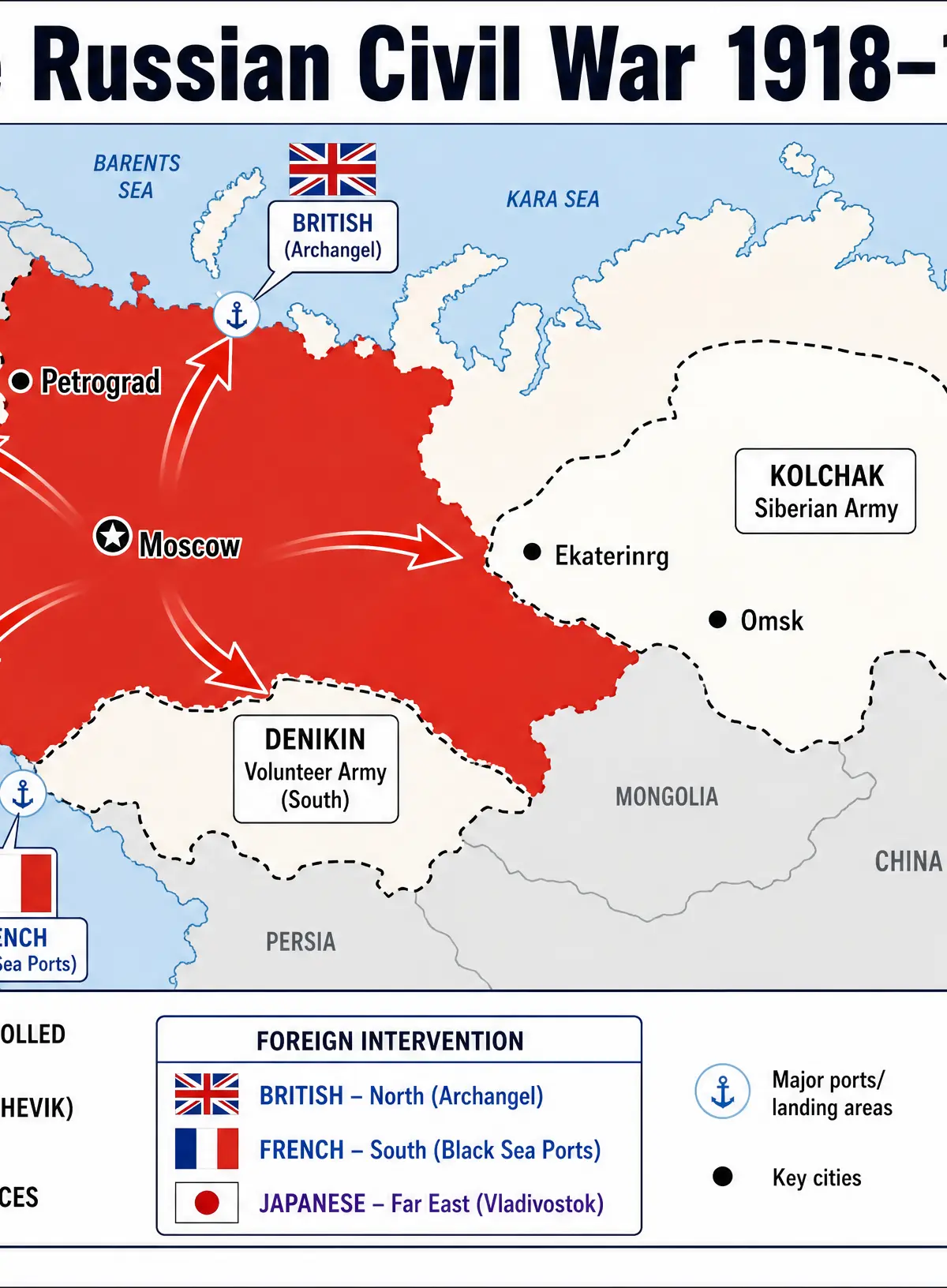
Date(s): 1918–1921
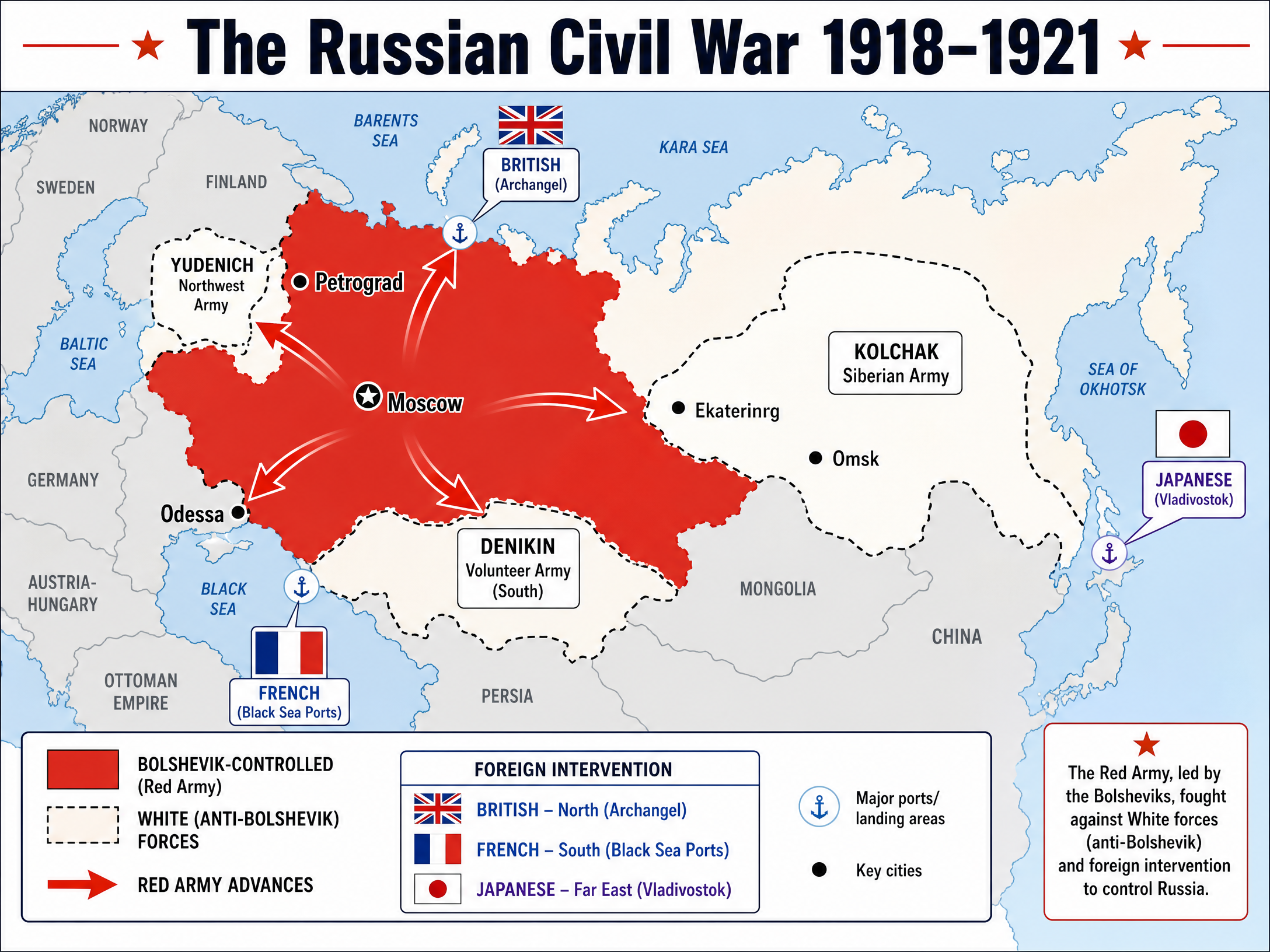
What happened: A brutal conflict between the Bolsheviks (Reds) and a loose coalition of opponents (Whites), complicated by foreign intervention (Britain, France, USA, Japan). The Reds emerged victorious.
Why it matters: The victory secured Bolshevik rule. It also militarised the Communist Party and normalised the use of terror and authoritarian control.
Specific Knowledge: White commanders: Admiral Kolchak (Siberia), General Denikin (South), General Yudenich (Northwest). Trotsky built the Red Army to 5 million men by 1920.
War Communism and the NEP
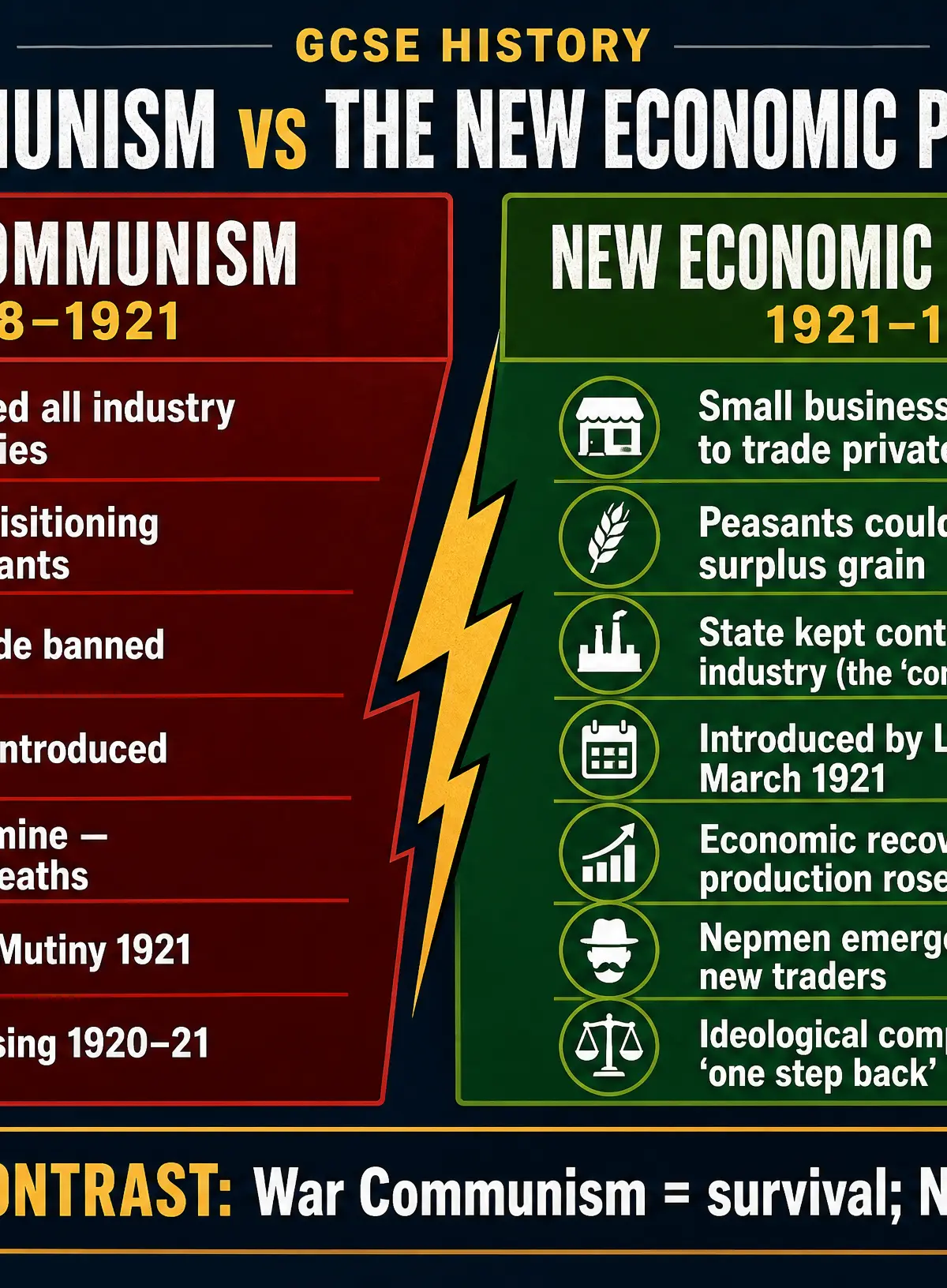
Date(s): War Communism (1918–1921), NEP (1921 onwards)
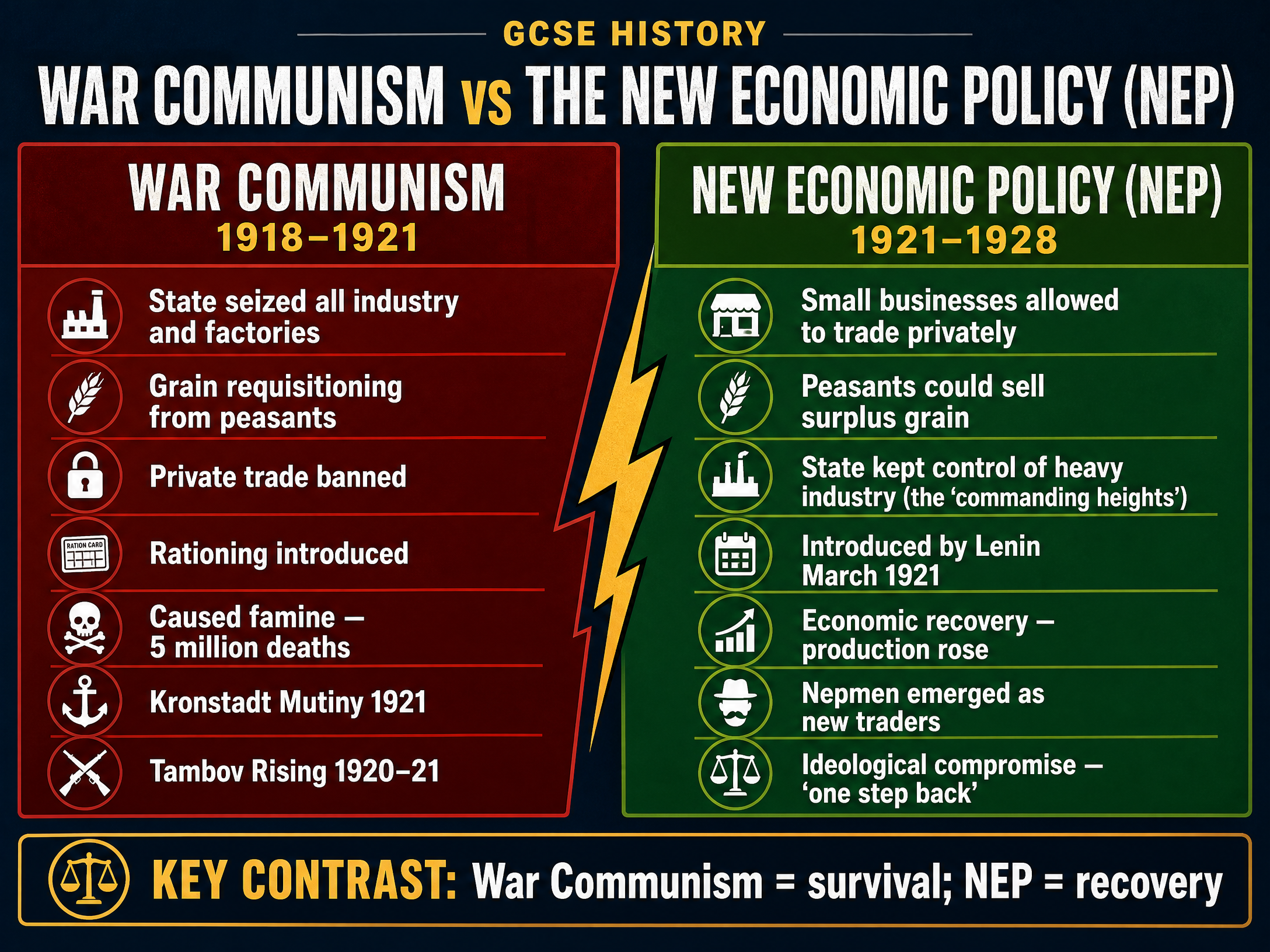
What happened: War Communism involved state control of industry and forced grain requisitioning to feed the Red Army. It caused a famine (5 million deaths) and uprisings (Kronstadt Mutiny, Tambov Rising). Lenin replaced it with the New Economic Policy (NEP) in March 1921, allowing some private trade and profit to recover the economy.
Why it matters: Shows Lenin's pragmatism. War Communism ensured military survival but caused economic collapse; the NEP saved the economy but compromised communist ideology.
Specific Knowledge: Kronstadt Mutiny (March 1921); Famine killed approx 5 million.
Key Individuals
Vladimir Lenin
Role: Leader of the Bolshevik Party and Head of Government.
Key Actions: Drove the October Revolution, closed the Constituent Assembly, pushed through the Treaty of Brest-Litovsk, introduced War Communism and the NEP, banned factions in 1921.
Impact: The indispensable architect of the Bolshevik state. His pragmatic leadership ensured Bolshevik survival.
Leon Trotsky
Role: Commissar for War.
Key Actions: Organised the October Revolution, but his most crucial role was creating and leading the Red Army during the Civil War. Used an armoured train to visit the front lines, introduced conscription, and employed former Tsarist officers.
Impact: Without Trotsky's military organisation and leadership, the Reds would likely have lost the Civil War.
Felix Dzerzhinsky
Role: Head of the Cheka (Secret Police).
Key Actions: Orchestrated the Red Terror from 1918, ruthlessly hunting down and executing political opponents, striking workers, and deserting soldiers.
Impact: Ensured Bolshevik control through fear and repression, eliminating domestic threats.
Second-Order Concepts
Causation
Examiners often ask why the Reds won the Civil War. This requires linking multiple causes: geographical advantages (controlling the central hub of Moscow/Petrograd and railway networks), superior leadership (Trotsky's organisation), ideological unity (compared to the divided Whites), and the use of terror (Cheka) to enforce discipline.
Consequence
The consequence of War Communism was not just economic ruin, but a political crisis that threatened the regime itself (Kronstadt Mutiny), which in turn caused the introduction of the NEP.
Change & Continuity
A key theme is how much actually changed. The Bolsheviks overthrew an autocratic Tsar who used a secret police (Okhrana), only to establish a one-party dictatorship that used an even more brutal secret police (Cheka).
Significance
The period 1917–1924 is highly significant because it laid the foundations for the Soviet state. The authoritarian methods, centralization of power, and use of terror established by Lenin paved the way for Stalin's later totalitarian dictatorship.
Source Skills
When evaluating sources on this topic, provenance is critical.
- Bolshevik Propaganda: Often exaggerates the support of the workers and the threat of foreign intervention. Useful for showing how the Bolsheviks tried to win support.
- White/Emigré Sources: Often highly critical of Bolshevik brutality, but may downplay their own disorganisation or atrocities (the 'White Terror').
- Foreign Accounts: British or French sources from 1918-1920 often reflect a deep fear of communism spreading, explaining their intervention.
Visual Resources
3 diagrams and illustrations
Interactive Diagrams
1 interactive diagram to visualise key concepts
Diagram could not be rendered
Timeline of Bolshevik Consolidation 1917-1924
Worked Examples
3 worked examples — open one to explore the question and available guidance.
Practice Questions
Test your understanding — click to reveal model answers
Describe two features of the Red Terror. (4 marks)
Hint: Identify a feature, then add a specific detail to develop it.
Explain why Lenin introduced the New Economic Policy (NEP) in 1921. (12 marks)
Hint: Think about the failures of War Communism, the economic crisis, and the political rebellions.
Explain the significance of the Treaty of Brest-Litovsk for the Bolshevik regime. (8 marks)
Hint: Significance means looking at the impact. What did it save them from? What new problems did it cause?
How useful is a photograph of Trotsky addressing Red Army troops in 1919 for an enquiry into the reasons for Red victory in the Civil War? (8 marks)
Hint: Think about what a photo shows (morale, leadership) and what it doesn't show (geography, White weakness).
‘The weakness of the Whites was the main reason the Bolsheviks won the Civil War.’ How far do you agree? (16 marks)
Hint: Compare White weaknesses with Red strengths (geography, Trotsky).
Test your understanding of Russia in revolution, 1894–1924
Active recall beats re-reading. Take an instant quiz now to test what you’ve learned and lock it into long-term memory.
7 days Premium · Then free forever · No card, no charge