Pearson Edexcel · A-Level · History
Spain, 1930–78: republicanism, Francoism and the re-establishment of democracy
Dive into the ideological battleground of Spain from 1930 to 1978. This crucial topic covers the collapse of the Second Republic, the brutal Spanish Civil War, and the establishment of Franco's dictatorship, testing your understanding of political extremism, foreign intervention, and the nature of authoritarian rule.
- 6 min read
- 3 worked examples
- 5 practice questions
- 6 key terms
Study Notes
Overview
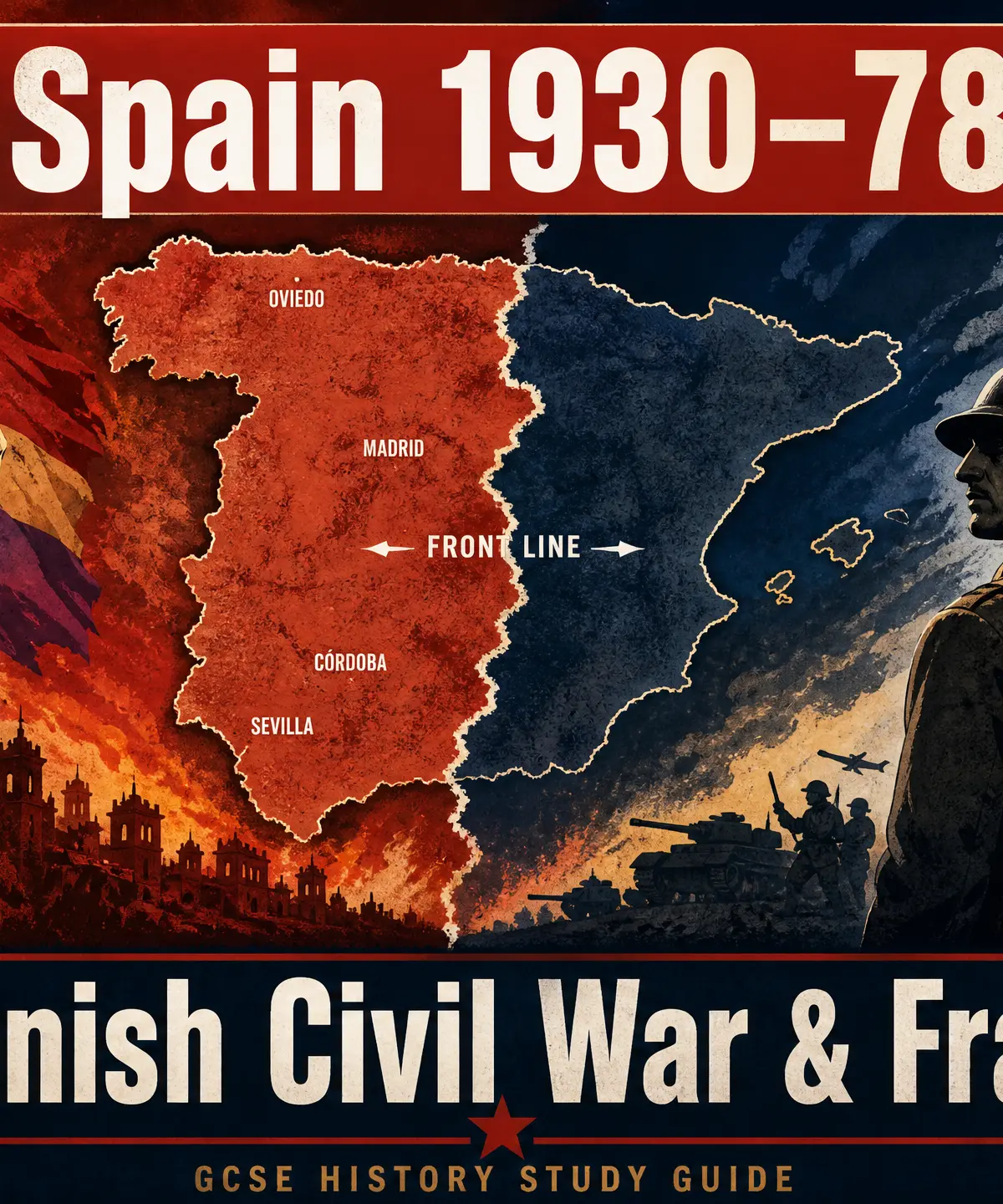
This study guide covers the turbulent history of Spain from 1930 to 1978, focusing primarily on the causes, course, and consequences of the Spanish Civil War (1936–1939). For examiners, this topic is a classic test of your ability to analyse causation (why the war broke out) and consequence (how Franco's victory shaped Spain). You will need to demonstrate precise knowledge of the deeply polarised political landscape of the Second Republic, the critical role of foreign intervention (such as the German Condor Legion), and the stark differences in life under Republican and Nationalist control. The period concludes with Franco's nearly 40-year dictatorship and Spain's subsequent transition to democracy.
Listen to our revision podcast for an in-depth audio guide:
Key Events & Developments
The Second Republic
Date(s): April 1931 – July 1936
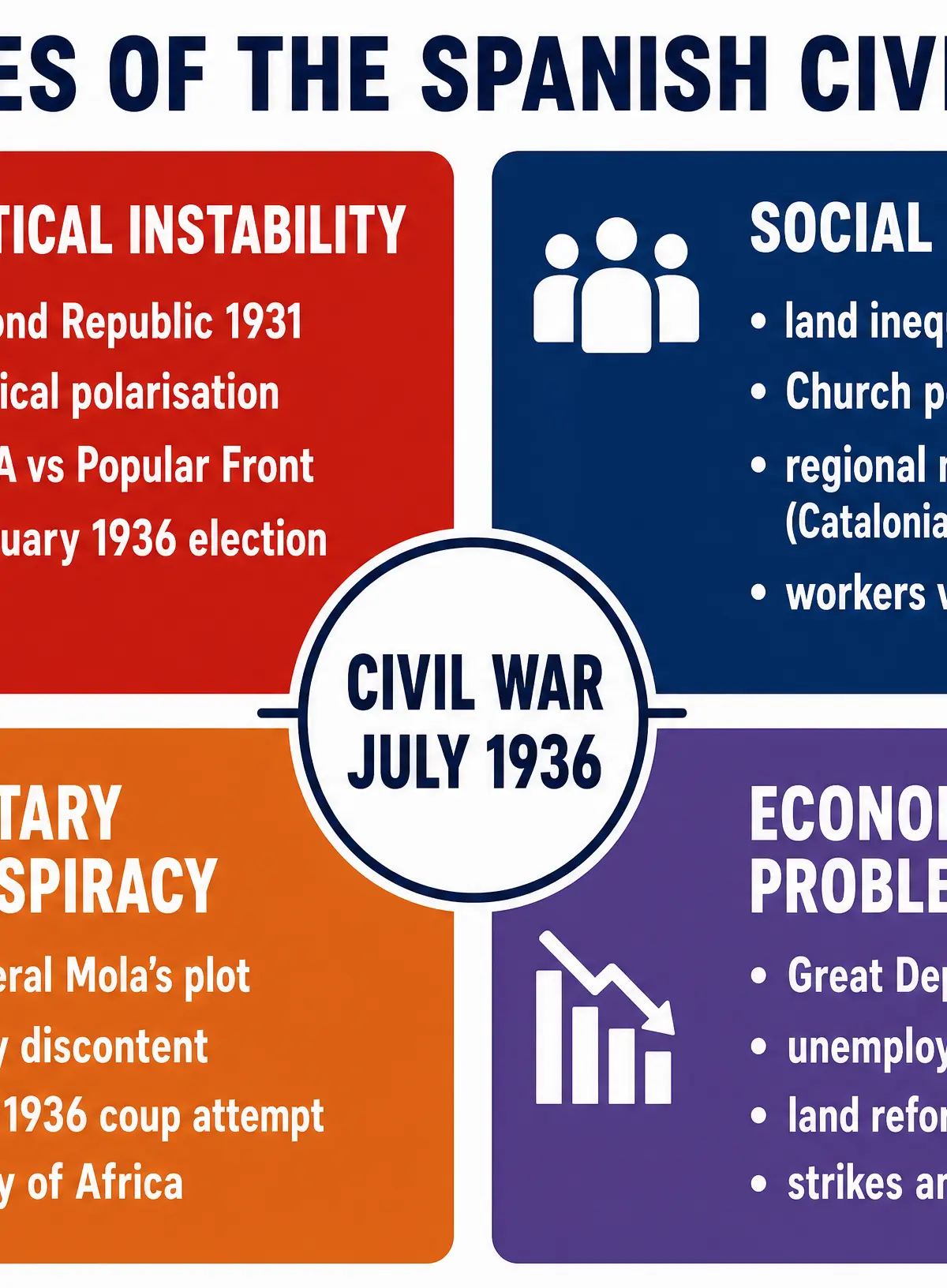
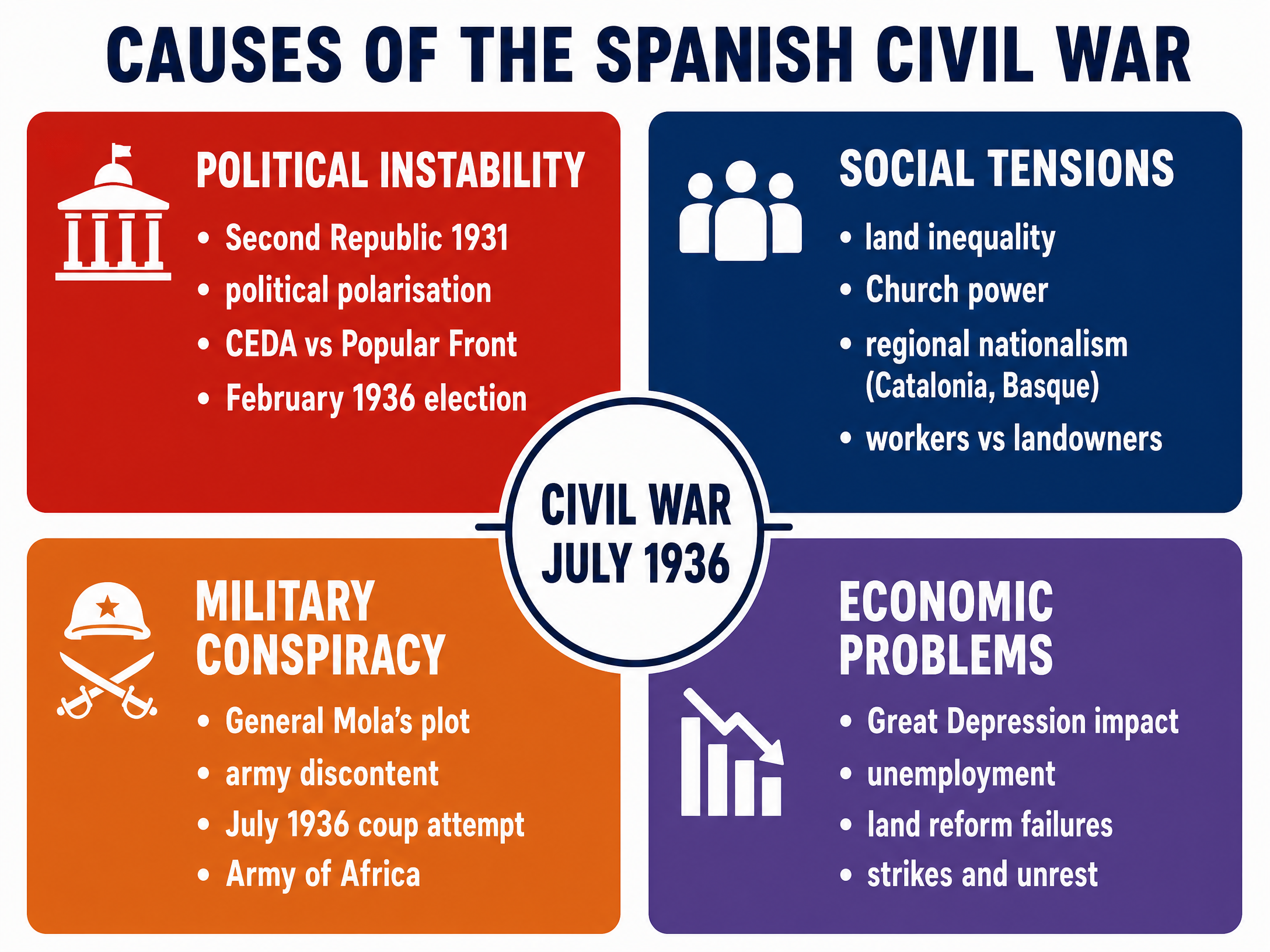
What happened: King Alfonso XIII abdicated, and a new democratic republic was established. The government attempted sweeping reforms, including land redistribution, reducing the power of the Catholic Church, and granting autonomy to Catalonia.
Why it matters: These reforms alienated conservative elites (landowners, the military, and the Church) while failing to satisfy the radical demands of the working class and anarchists, creating the intense political polarisation that caused the Civil War.
Specific Knowledge: The Popular Front (left-wing coalition) won the February 1936 election; CEDA (right-wing Catholic party) opposed them.
The Military Coup and Outbreak of War
Date(s): 17–18 July 1936
What happened: Nationalist generals, planned by General Emilio Mola, launched a military uprising against the Republican government. The coup failed to take major cities like Madrid and Barcelona, dividing the country in two.
Why it matters: The failure of the swift coup plunged Spain into a protracted, three-year civil war.
Specific Knowledge: General Francisco Franco commanded the elite Army of Africa in Spanish Morocco.
Foreign Intervention
Date(s): 1936–1939
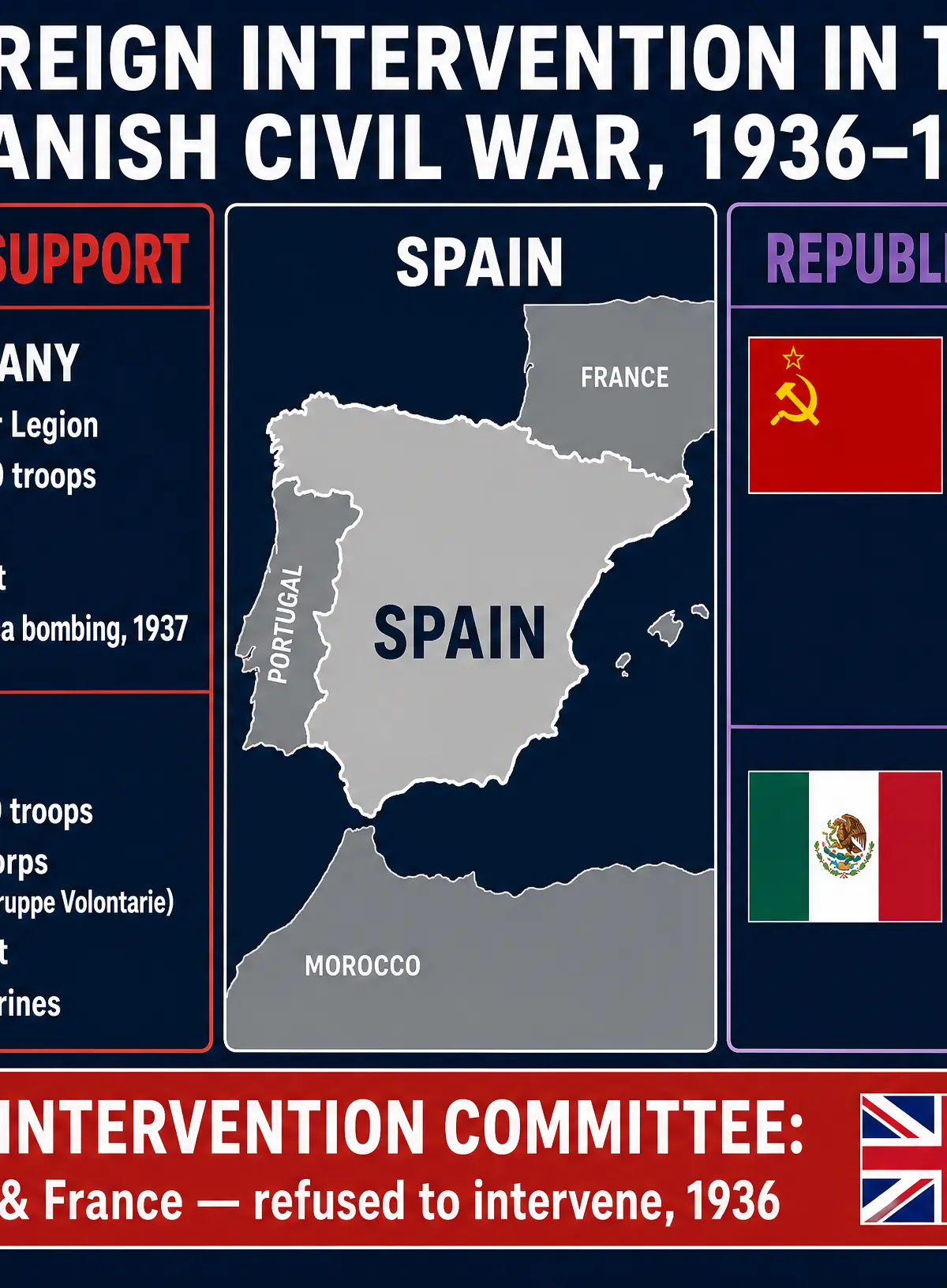
What happened: Foreign powers intervened decisively. Germany and Italy backed the Nationalists; the USSR backed the Republic. Britain and France formed the ineffective Non-Intervention Committee.
Why it matters: Foreign aid, particularly German air power and Italian troops, was the most significant factor in the Nationalist victory. The Non-Intervention policy starved the Republic of legitimate arms.
Specific Knowledge: German Condor Legion (approx. 10,000 men); bombing of Guernica (26 April 1937); Italian CTV (75,000 troops); Soviet NKVD influence; International Brigades (approx. 35,000 volunteers).
The May Days in Barcelona
Date(s): 3–8 May 1937
What happened: Street fighting broke out in Barcelona between rival Republican factions—anarchists (CNT/FAI) and anti-Stalinist Marxists (POUM) fought against the Soviet-backed communists (PCE) and the Republican government.
Why it matters: This internal civil war within a civil war crippled the Republican war effort and demonstrated their fatal lack of unity compared to the Nationalists.
Specific Knowledge: George Orwell witnessed and fought in this conflict, later writing Homage to Catalonia.
Key Individuals
General Francisco Franco
Role: Leader of the Nationalist forces and subsequent dictator of Spain.
Key Actions: Took command of the Army of Africa, secured German/Italian airlift support, unified the right-wing factions into a single party (FET y de las JONS) in April 1937, and led the Nationalists to victory.
Impact: His cautious but effective military leadership and astute political maneuvering secured the Nationalist win and established a conservative, Catholic dictatorship lasting until 1975.
General Emilio Mola
Role: The primary planner of the July 1936 military coup.
Key Actions: Organised the conspiracy against the Popular Front government. Coined the term "Fifth Column" to describe Nationalist sympathisers within Republican Madrid.
Impact: His initial planning started the war, but his death in a plane crash in June 1937 cleared the path for Franco's undisputed leadership.
Dolores Ibárruri (La Pasionaria)
Role: Communist leader and Republican orator.
Key Actions: Coined the famous Republican slogan "¡No Pasarán!" (They shall not pass) during the defence of Madrid.
Impact: She was a crucial figure for Republican morale and propaganda, symbolising the anti-fascist resistance.
Second-Order Concepts
Causation
Long-term causes included deep-seated inequalities in land ownership and the entrenched power of the Catholic Church. Short-term causes involved the political polarisation of the Second Republic (1931-1936). The immediate trigger was the assassination of right-wing politician José Calvo Sotelo in July 1936, which sparked the military coup.
Consequence
The immediate consequence was a devastating three-year war resulting in roughly 500,000 deaths. The long-term consequence was the destruction of Spanish democracy and the establishment of Franco's authoritarian regime, which isolated Spain internationally for decades.
Change & Continuity
While the Second Republic attempted radical change (secularisation, land reform, women's rights), Franco's victory represented a violent return to continuity—restoring the traditional power of the Church, the military, and the landowning elites, and rolling back social progress for women.
Significance
The Spanish Civil War is historically significant as a proxy war or "dress rehearsal" for the Second World War, testing new military tactics (like terror bombing at Guernica) and solidifying the ideological battle lines between fascism, communism, and democracy.
Source Skills
When evaluating sources on the Spanish Civil War, provenance is critical. Nationalist sources (often heavily censored or propagandistic) will emphasize the Republic's anti-clerical violence (the "Red Terror") and frame the coup as a crusade to save Catholic Spain. Republican sources (or those from the International Brigades) will emphasize the fight against fascism and the atrocities of the "White Terror." Always consider the author's political affiliation (e.g., anarchist vs. communist) as the Republic was highly fractured.
Worked Examples
3 worked examples — open one to explore the question and available guidance.
Practice Questions
Test your understanding — click to reveal model answers
Explain why the Second Republic faced opposition between 1931 and 1936. (12 marks)
Hint: Consider opposition from the right (Church, landowners, military) regarding reforms, and opposition from the extreme left (anarchists) who felt reforms didn't go far enough.
Describe two features of foreign intervention in the Spanish Civil War. (4 marks)
Hint: Pick two different countries and state exactly what they provided.
'Foreign intervention was the main reason for the defeat of the Republic in 1939.' How far do you agree? (16 marks + 4 SPaG)
Hint: Evaluate foreign intervention against other factors like Republican divisions and Franco's leadership.
Explain why the Non-Intervention Committee was established in 1936. (12 marks)
Hint: Think about British and French fears of a wider European war and domestic politics.
Describe two features of the Barcelona May Days (1937). (4 marks)
Hint: Who was fighting who? What was the result?
Test your understanding of Spain, 1930–78: republicanism, Francoism and the re-establishment of democracy
Active recall beats re-reading. Take an instant quiz now to test what you’ve learned and lock it into long-term memory.
7 days Premium · Then free forever · No card, no charge