Pearson Edexcel · A-Level · History
The changing nature of warfare, 1859–1991: perception and reality
This topic explores the dramatic transformation of warfare from the static, attritional trenches of 1914–1918 to the lightning-fast, mobile Blitzkrieg of 1940. It matters historically because the nations that understood and adapted to new technologies—specifically the internal combustion engine and radio—gained a devastating advantage that reshaped the map of Europe in just six weeks.
- 8 min read
- 3 worked examples
- 5 practice questions
- 6 key terms
Study Notes
Overview
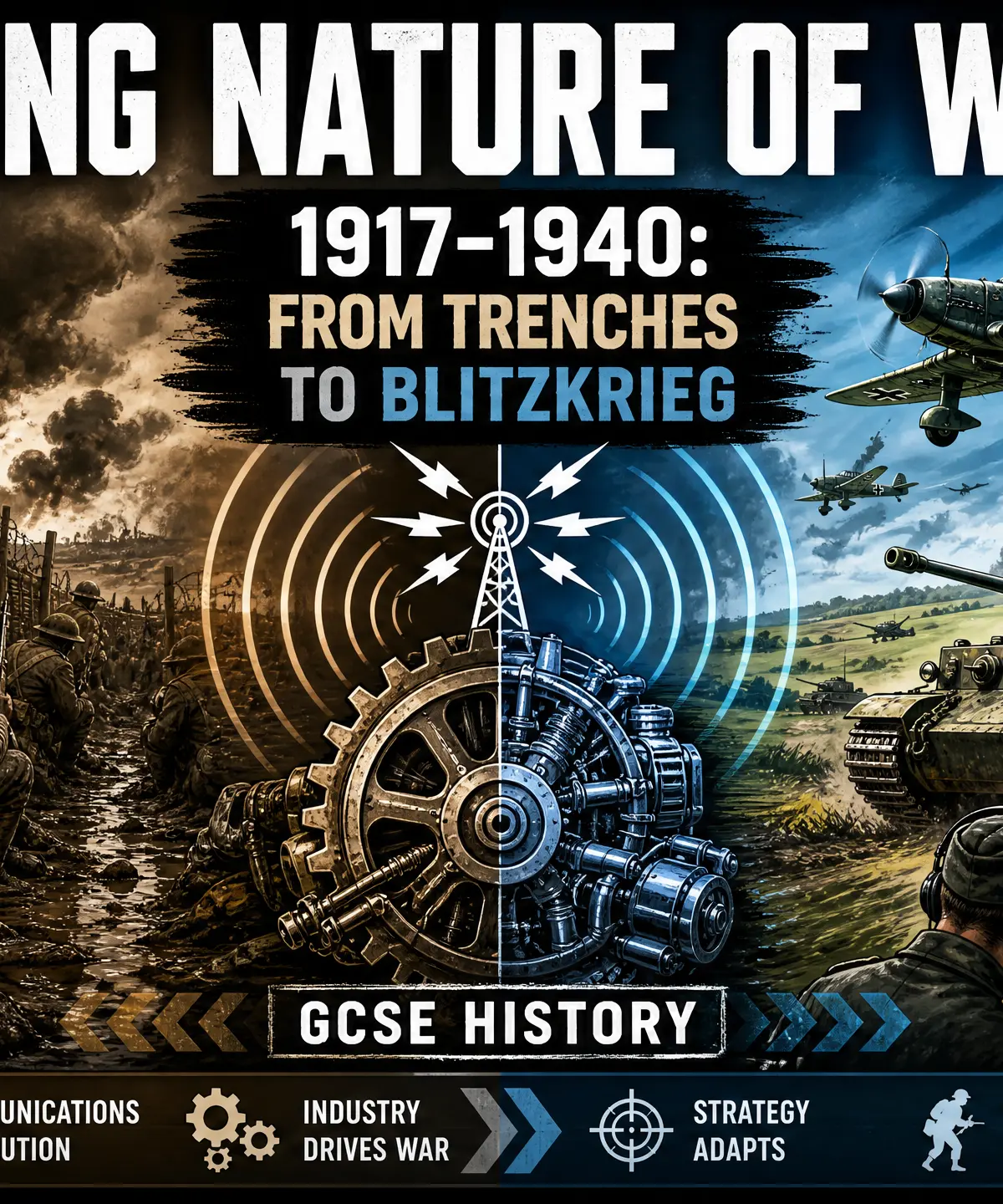
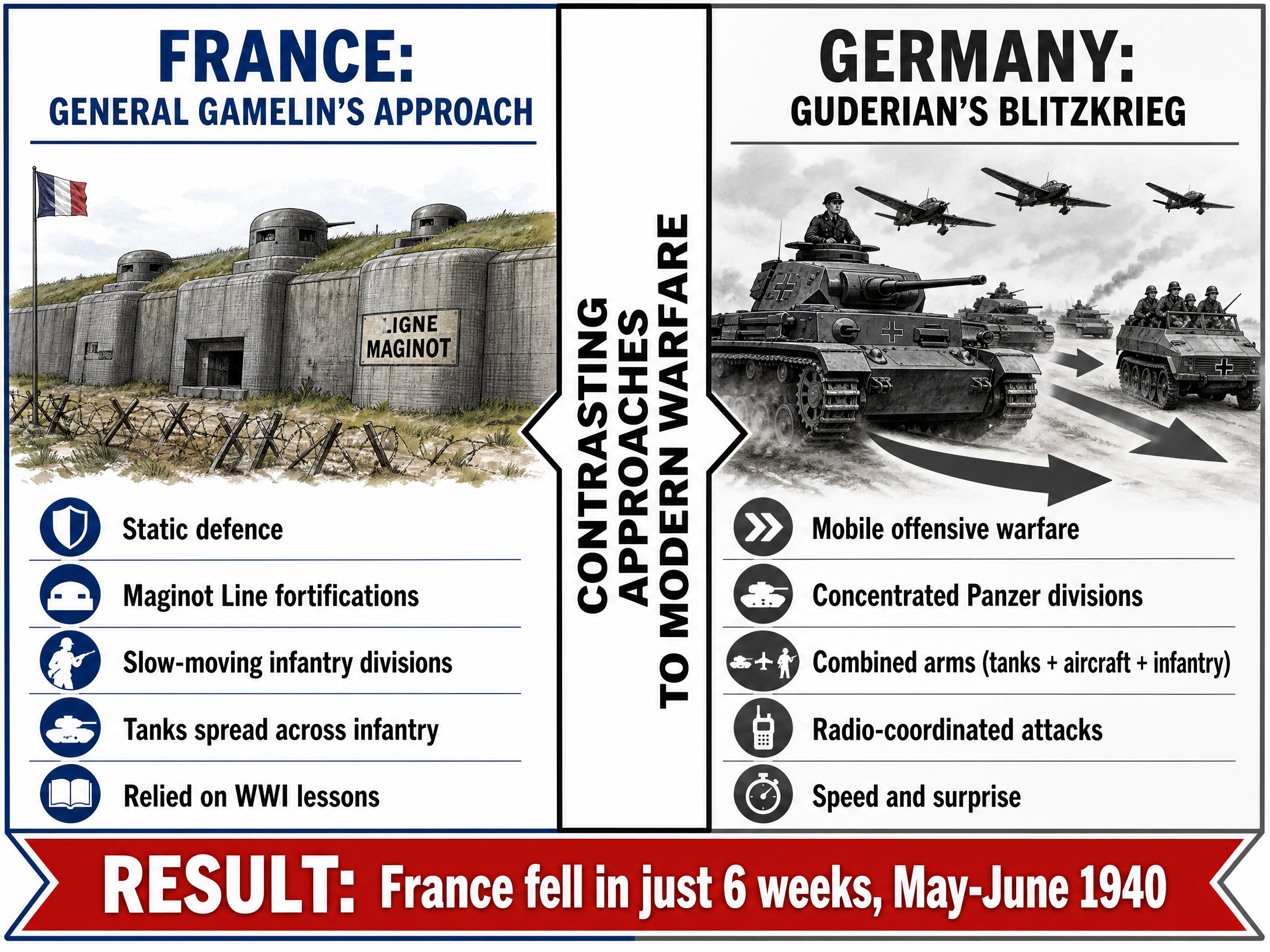
This study covers the critical interwar period (1917–1940), focusing on how two key technologies—the internal combustion engine and the radio—fundamentally altered the nature of warfare. Examiners expect candidates to understand not just the technologies themselves, but how they changed military tactics, moving from the static trench warfare of the First World War to the highly mobile 'Blitzkrieg' of the Second World War. You must be able to contrast the defensive mindset of the French military under General Gamelin with the aggressive, concentrated, and coordinated approach developed by German theorists like Heinz Guderian. The ultimate proof of these contrasting approaches was the Fall of France in May–June 1940, which demonstrated the devastating effectiveness of combined arms and rapid manoeuvre.
Key Events & Developments
The Battle of Cambrai
Date(s): November 1917
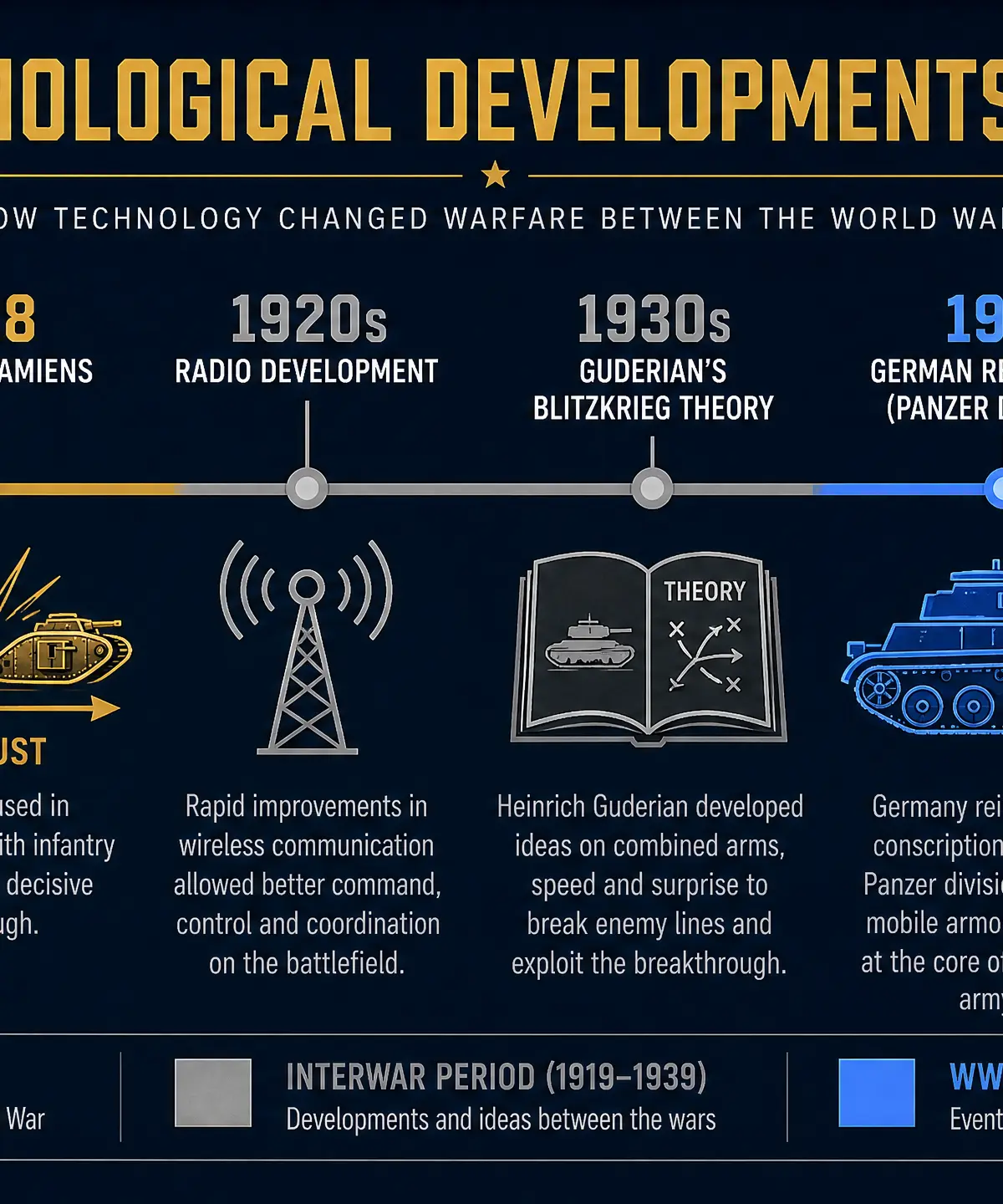
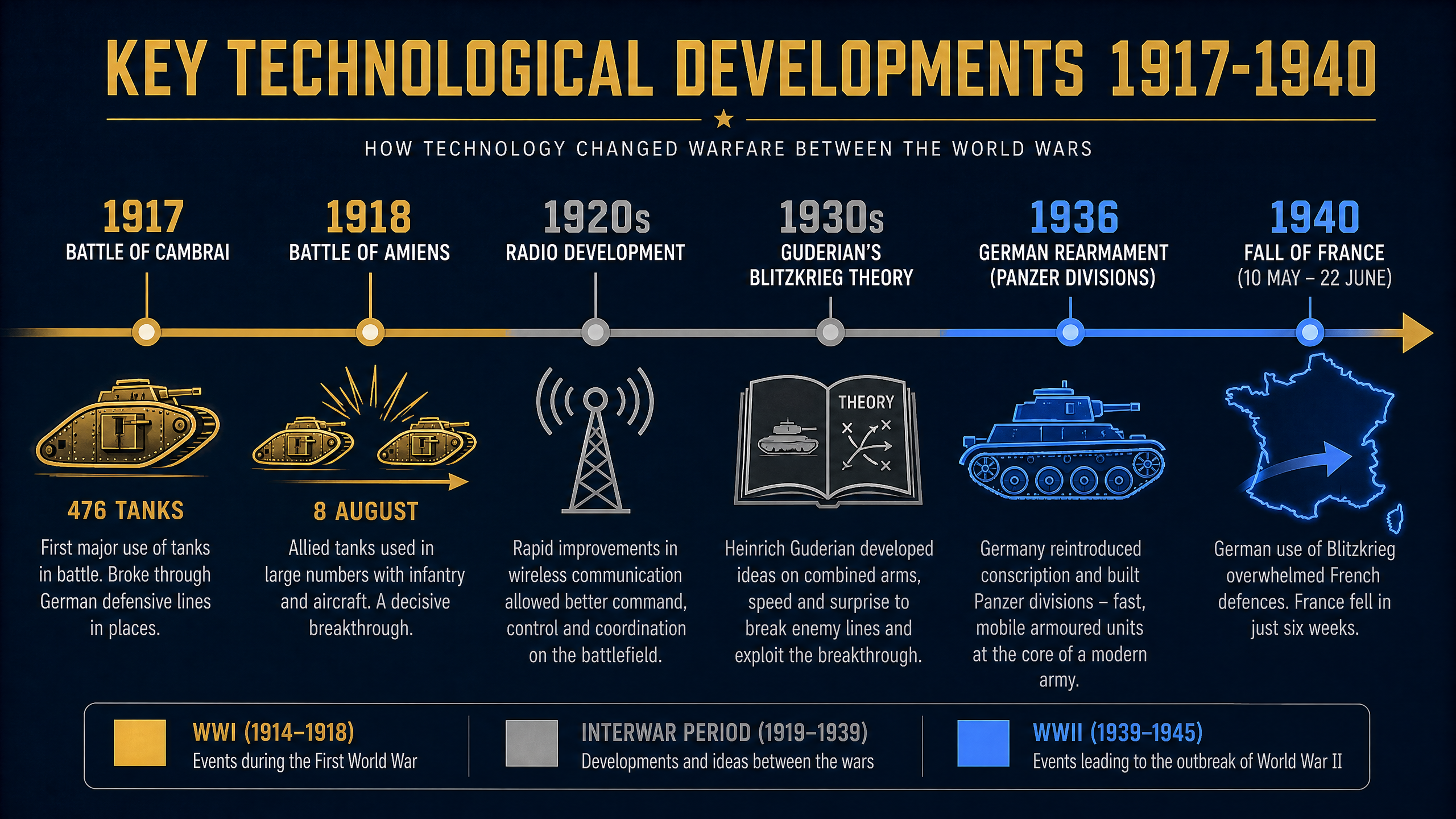
What happened: The British launched the first large-scale, concentrated tank offensive, deploying 476 tanks. They broke through the heavily fortified German Hindenburg Line, advancing further in hours than previous offensives had in months.
Why it matters: This was the first proof of concept for armoured warfare. It demonstrated that the internal combustion engine, powering tracked vehicles, could overcome the static defences (trenches, barbed wire, machine guns) that had caused the stalemate of 1914–1917. However, mechanical failures and lack of radio coordination meant the breakthrough could not be fully exploited.
Specific Knowledge: 476 British tanks; Hindenburg Line; lack of radio communication stalled the advance.
The Battle of Amiens
Date(s): 8 August 1918
What happened: Allied forces launched a massive, coordinated assault using infantry, artillery, aircraft, and over 500 tanks. They advanced eight miles on the first day.
Why it matters: German commander Erich Ludendorff called it the "black day of the German Army." It was the blueprint for modern combined-arms warfare, showing how the internal combustion engine (powering tanks, trucks, and aircraft) could restore mobility to the battlefield.
Specific Knowledge: 8 August 1918; "Black day of the German Army" (Ludendorff); combined arms approach.
Development of Radio Technology
Date(s): 1920s–1930s
What happened: Radios evolved from the heavy, fragile, and static sets of WWI to smaller, more robust two-way radios that could be fitted into moving vehicles, including tanks and aircraft.
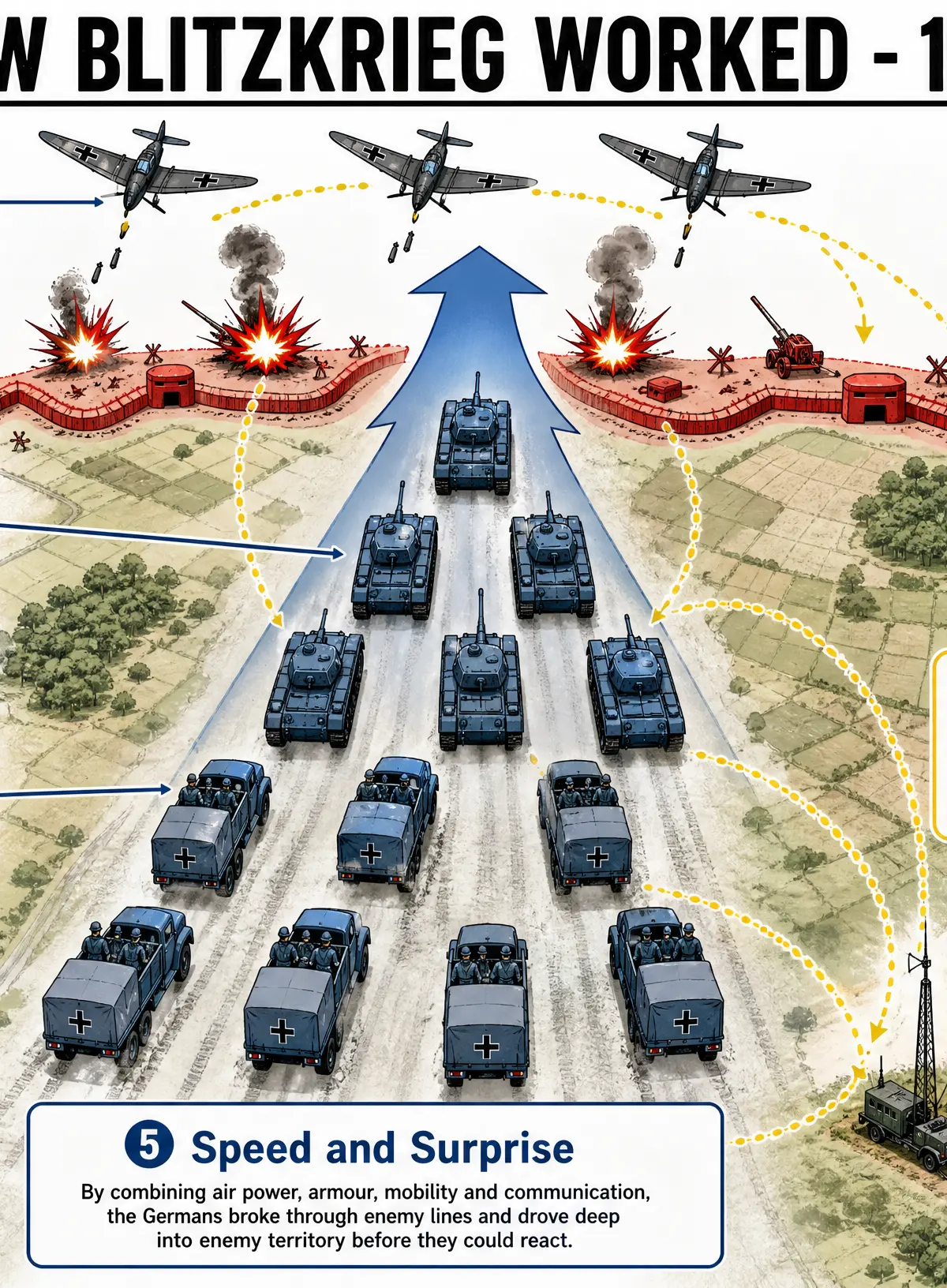
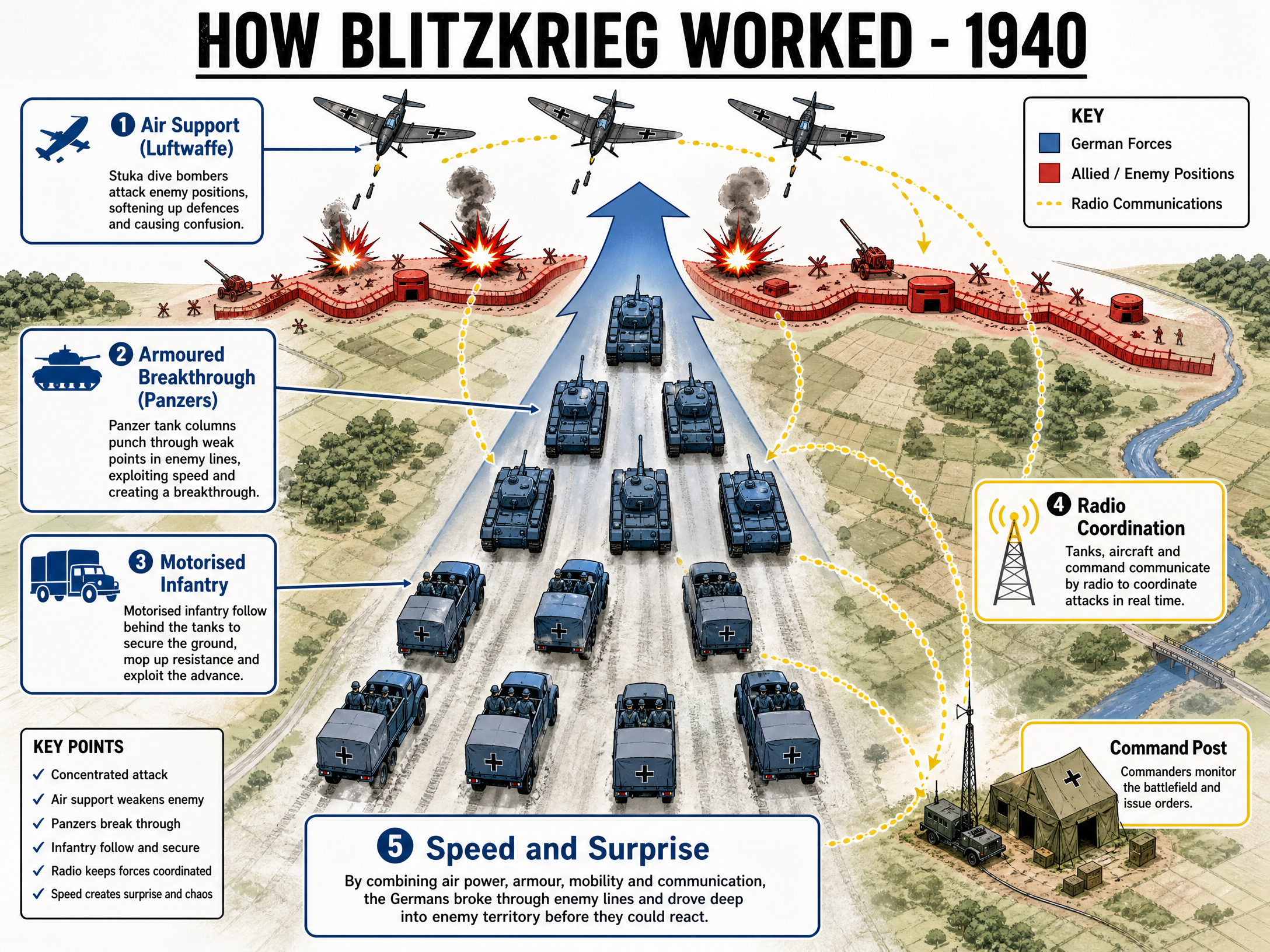
Why it matters: Radio was the "nervous system" of Blitzkrieg. It solved the WWI problem of commanders losing touch with advancing troops. Real-time communication allowed for the rapid coordination of tanks, motorised infantry, and close air support (Stukas), enabling forces to exploit gaps in enemy lines instantly.
Specific Knowledge: Two-way vehicle radios; real-time coordination; replacement of runners/pigeons/flags.
The Fall of France
Date(s): 10 May – 22 June 1940
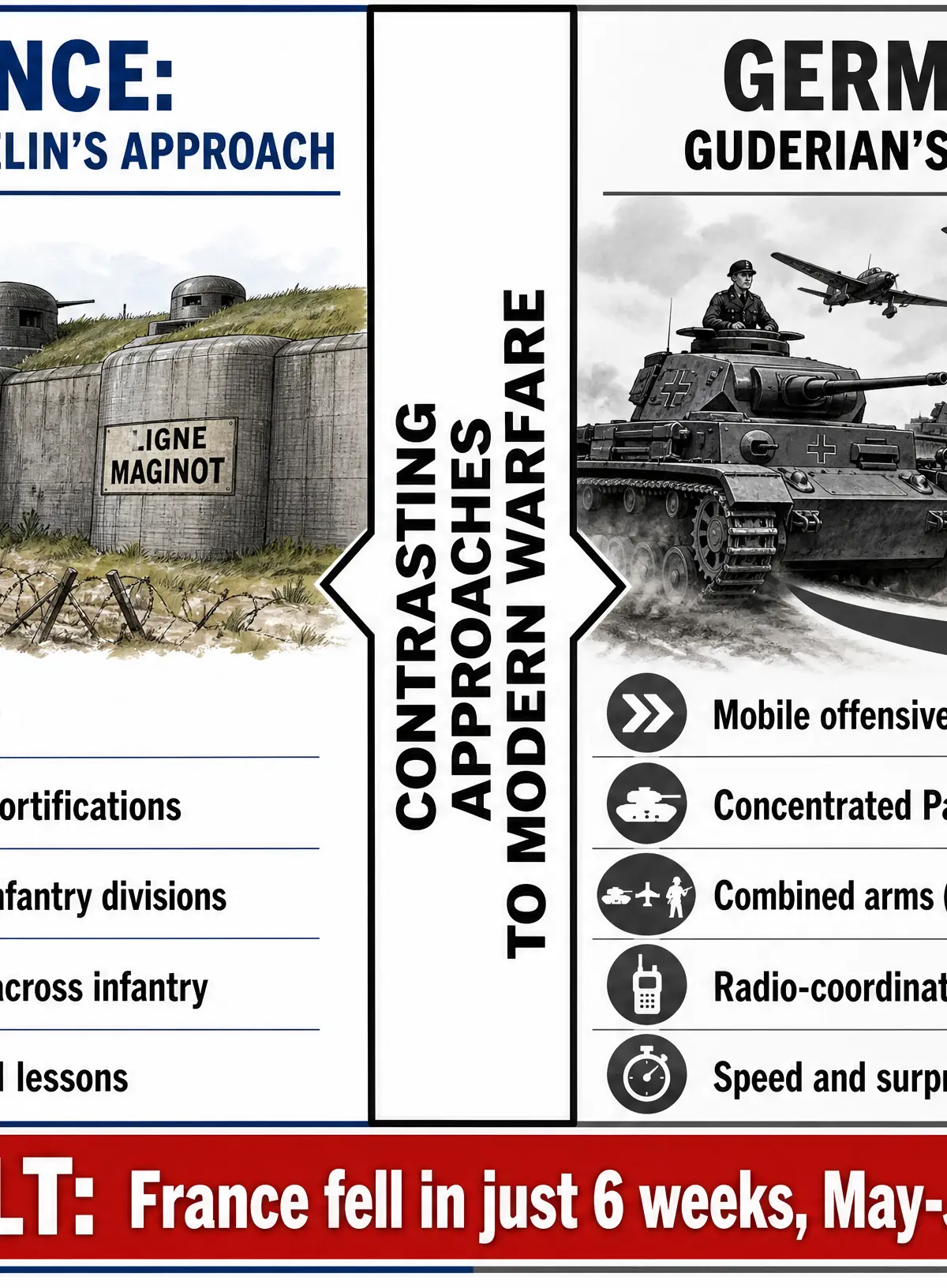
What happened: Germany invaded France and the Low Countries. Bypassing the Maginot Line by attacking through the Ardennes forest, German Panzer divisions raced to the English Channel, cutting off Allied forces. France surrendered in just six weeks.
Why it matters: This was the ultimate vindication of Blitzkrieg tactics and the devastating consequence of French defensive planning. It proved that concentrated armour, speed, and radio coordination could defeat a numerically equal or superior force that relied on static defence and dispersed tanks.
Specific Knowledge: Ardennes forest; River Meuse crossed at Sedan (13 May); 6 weeks to defeat France.
Key Individuals
Heinz Guderian
Role: German military theorist and tank commander.
Key Actions: Wrote the influential book Achtung Panzer! (1937), which laid out the theory of Blitzkrieg. He argued for concentrated Panzer divisions supported by motorised infantry and aircraft, coordinated by radio. He successfully led the XIX Panzer Corps through the Ardennes in 1940.
Impact: He was the primary architect of Germany's mobile warfare doctrine, transforming the German army into a fast-moving, coordinated force that dominated the early years of WWII.
General Maurice Gamelin
Role: Commander-in-Chief of the French Armed Forces in 1940.
Key Actions: Adopted a defensive strategy based on the lessons of WWI. He relied on the Maginot Line fortifications and dispersed French tanks among infantry divisions rather than concentrating them. He failed to equip French tanks with adequate radios.
Impact: His defensive, slow-moving approach left the French army unable to react to the speed and concentration of the German Blitzkrieg, leading directly to the rapid fall of France.
Erwin Rommel
Role: Commander of the German 7th Panzer Division in 1940.
Key Actions: Led his division with such unprecedented speed and surprise during the invasion of France that even the German High Command often didn't know his exact location.
Impact: His division earned the nickname the "Ghost Division," perfectly exemplifying the speed, shock, and dislocation that Blitzkrieg tactics relied upon.
Second-Order Concepts
Causation
Why did warfare become mobile again by 1940? The long-term cause was the maturation of the internal combustion engine, which provided the physical means for mobility (tanks, trucks, aircraft). The short-term catalyst was the development of robust, vehicle-mounted two-way radios, which provided the command and control necessary to coordinate fast-moving forces. The intellectual cause was the development of Blitzkrieg theory by figures like Guderian, who recognised how to combine these technologies.
Consequence
The immediate consequence of these technological and tactical shifts was the rapid defeat of France in 1940—a shock to the world given France's four-year resistance in WWI. The long-term consequence was a permanent shift in military doctrine worldwide towards combined arms, air superiority, and armoured concentration.
Change & Continuity
Change: The speed of advance (yards per month in WWI vs miles per day in WWII); the role of the tank (infantry support in WWI vs independent spearhead in WWII); communication (runners/wire in WWI vs real-time radio in WWII).
Continuity: The fundamental goal of warfare remained breaking the enemy's will to fight; artillery remained a major killer, though it became more mobile; infantry was still required to hold ground taken by tanks.
Significance
The period 1917–1940 is highly significant because it represents one of the most rapid and profound revolutions in military affairs in history. The failure of the French to adapt to this revolution serves as a stark historical lesson in the dangers of preparing to fight the last war rather than the next one.
Source Skills
When approaching sources for this topic, you will likely encounter:
- Memoirs/Diaries (e.g., Guderian's Panzer Leader): Useful for understanding tactical thinking, but beware of post-war justification and exaggeration of their own brilliance.
- Military Plans/Memos: Highly useful for showing the actual intent of commanders like Gamelin before the battle, revealing their defensive mindset.
- Photographs: Useful for showing the physical reality of the technology (e.g., the size of early radios vs 1940 radios), but limited in showing the coordination of forces.
Always consider the provenance: A French source from June 1940 will likely reflect shock, confusion, and a desire to blame others for the rapid collapse. A German source from the same time will reflect triumph and vindication of their new tactics.
Podcast Revision
Listen to this 10-minute podcast episode to consolidate your knowledge on the changing nature of warfare:
Visual Resources
3 diagrams and illustrations
Interactive Diagrams
1 interactive diagram to visualise key concepts
Conceptual Flow Outline
How technology fed into Blitzkrieg tactics
Worked Examples
3 worked examples — open one to explore the question and available guidance.
Practice Questions
Test your understanding — click to reveal model answers
Describe two features of the German Blitzkrieg tactics used in 1940. (4 marks)
Hint: Think about the TRIPS mnemonic. Give a feature, then add a specific detail to develop it.
Explain why the Battle of Cambrai (1917) was significant in the development of warfare. (8 marks)
Hint: Explain what it proved was possible, but also explain its limitations that highlighted what technology was still missing.
How far do you agree that the French were defeated in 1940 because of their reliance on the Maginot Line? (16 marks)
Hint: The Maginot Line is one factor (defensive mindset). You must contrast this with German offensive tactics, and mention French misuse of tanks and lack of radios.
Study Source C. How useful is this source to a historian studying the impact of the internal combustion engine on warfare? (8 marks)
Source C: A British newspaper report from November 1917 describing the Battle of Cambrai.
Hint: Assess what a newspaper report from the time would show (public reaction, initial success) versus what it wouldn't show (the mechanical breakdowns, the long-term impact).
Explain why the German military adopted Blitzkrieg tactics in the 1930s. (8 marks)
Hint: Think about both the technological opportunities (radios/engines) and the strategic necessity (avoiding another long, static war).
Test your understanding of The changing nature of warfare, 1859–1991: perception and reality
Active recall beats re-reading. Take an instant quiz now to test what you’ve learned and lock it into long-term memory.
7 days Premium · Then free forever · No card, no charge