Pearson Edexcel · A-Level · History
The crusades, c1095–1204
This study guide covers the dramatic events of the Crusades from 1095 to 1204, a defining era of holy war, political ambition, and cultural clash between the Christian and Islamic worlds. Understanding the complex motivations behind these campaigns, the rise of key figures like Saladin and Richard the Lionheart, and the fragile existence of the Crusader States is essential for achieving top marks in your GCSE History exam.
- 8 min read
- 3 worked examples
- 5 practice questions
- 6 key terms
Study Notes
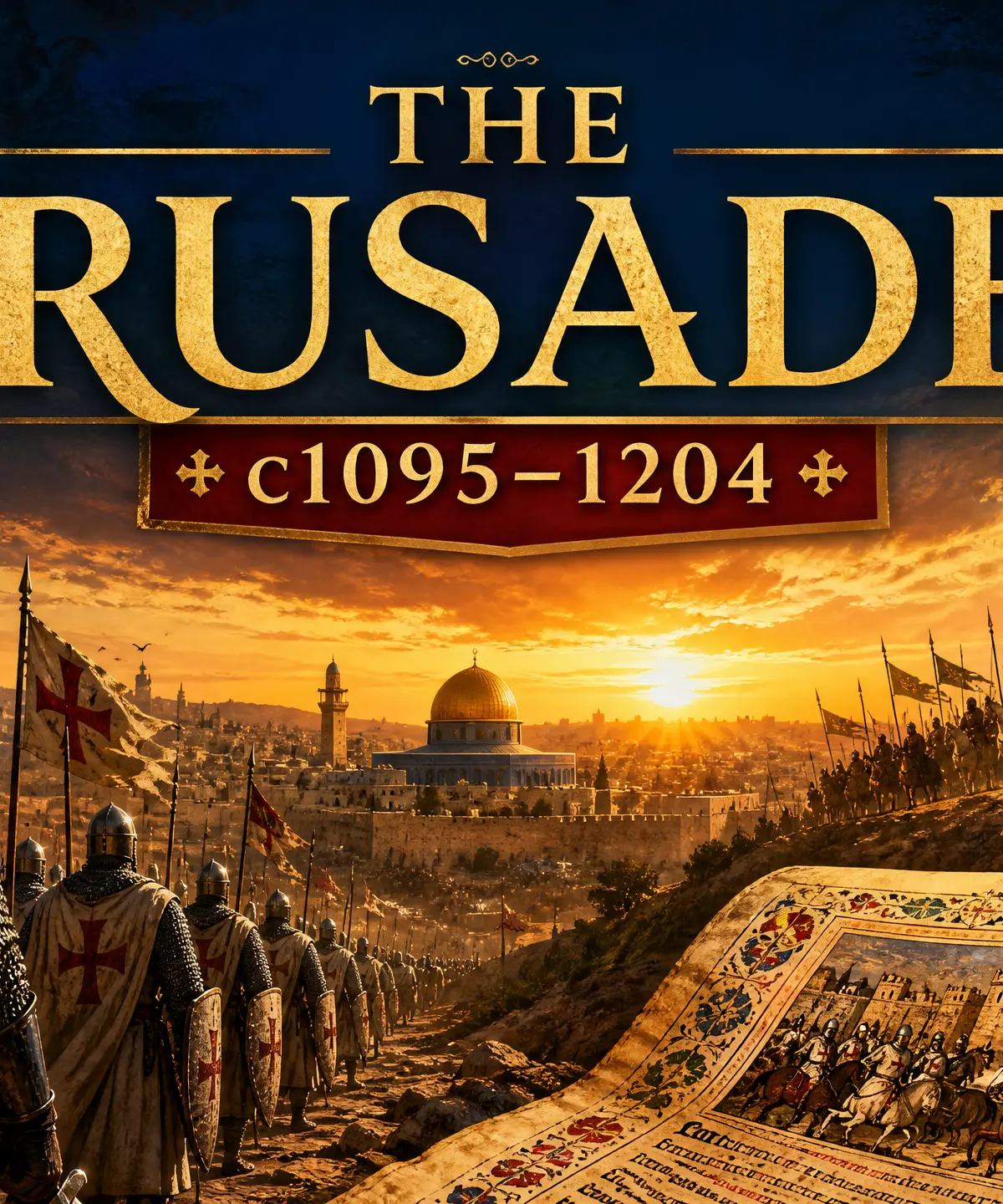
Overview
The Crusades (c.1095–1204) represent one of the most fascinating and bloody periods in medieval history. Initiated by Pope Urban II's call to arms in 1095, these campaigns were driven by a complex mix of religious fervour, political calculation, and social ambition. For GCSE History candidates, this topic requires a nuanced understanding of causation—specifically, how the concept of 'just war' and the promise of plenary indulgences combined with the political threats facing the Byzantine Empire and the Pope's own ambitions in Europe. Examiners expect you to move beyond a simple narrative of 'Christians vs Muslims' and instead analyse the internal divisions within both the Crusader States and the Islamic world, the impact of charismatic leadership, and the shifting balance of power across the First, Second, and Third Crusades.
Key Events & Developments
The Council of Clermont
Date(s): November 1095
What happened: Pope Urban II preached the First Crusade, calling on Western Christians to aid the Byzantine Empire against the Seljuk Turks and to liberate Jerusalem. He offered a plenary indulgence (remission of all sins) to those who took the cross.
Why it matters: This is the fundamental trigger event (causation) for the entire crusading movement. It demonstrates the power of the papacy and the immense appeal of religious salvation combined with military action.
Specific Knowledge: Pope Urban II, plenary indulgence, remission of sins, 'Deus vult' (God wills it).
The First Crusade & Fall of Jerusalem
Date(s): 1096–1099 (Jerusalem fell 15 July 1099)
What happened: Four main crusader armies marched to the East. Despite immense hardships, including the brutal Siege of Antioch (1097-98), they successfully captured Jerusalem in 1099, resulting in a notorious massacre of its inhabitants.
Why it matters: It was the only truly successful crusade in terms of achieving its primary objective. Its success was largely due to the deep political and religious divisions within the Muslim world (Sunni Seljuks vs Shi'ah Fatimids) at the time.
Specific Knowledge: Siege of Antioch, Holy Lance, Godfrey of Bouillon, Kerbogha, Sunni/Shi'ah divide.
Establishment of the Crusader States (Outremer)
Date(s): 1098 onwards
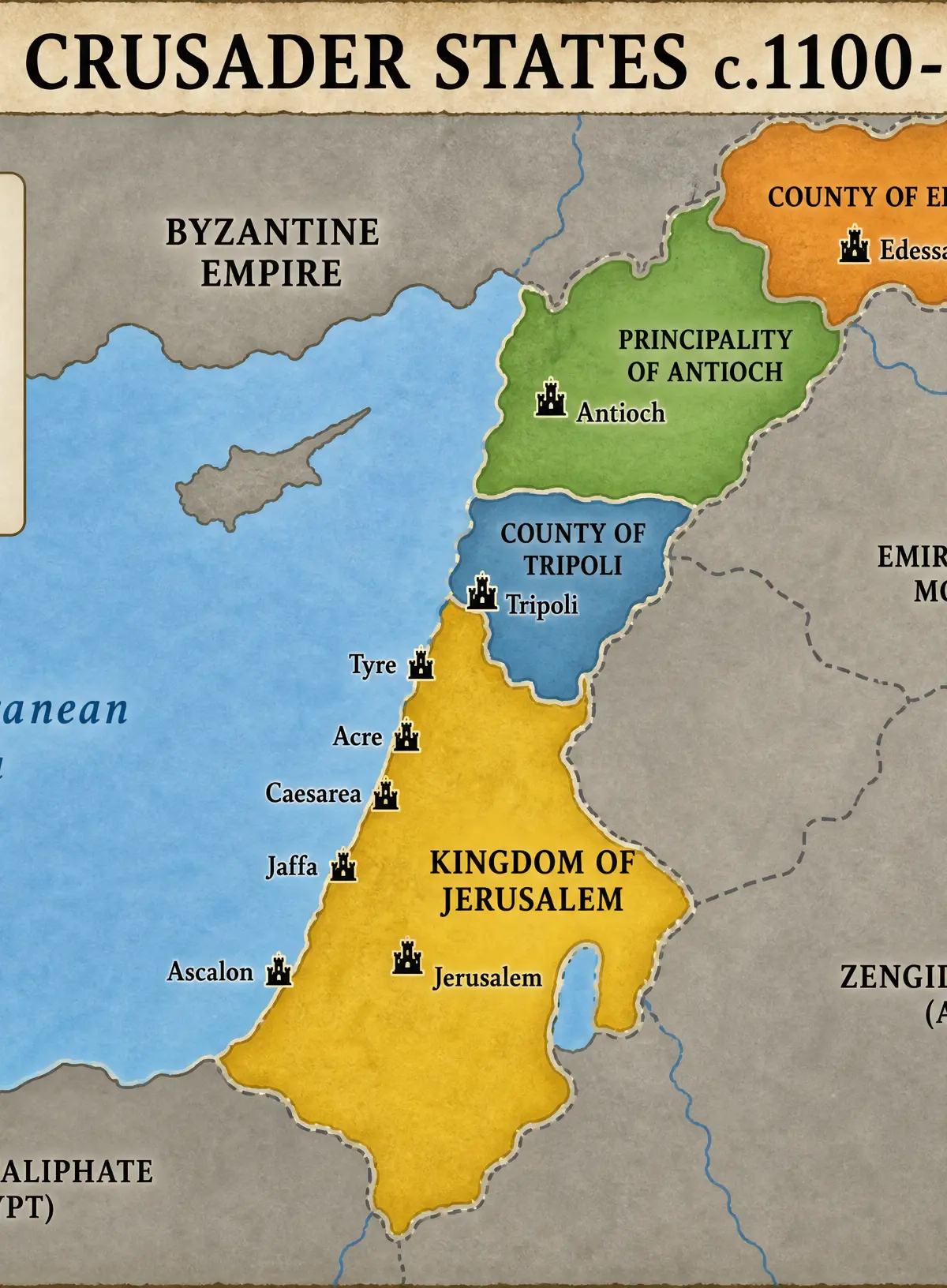
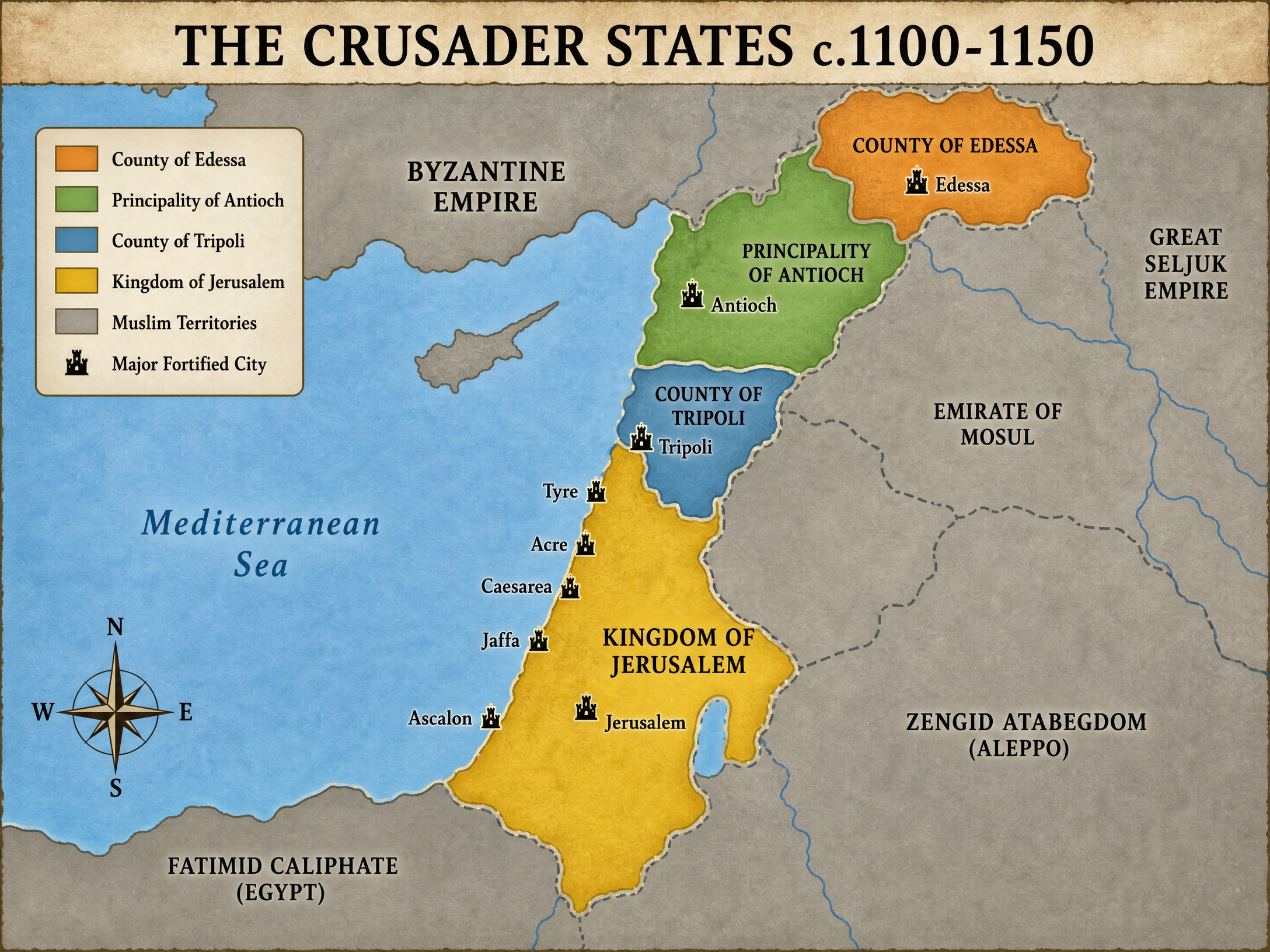
What happened: Following their victories, the crusaders established four states: the County of Edessa, the Principality of Antioch, the County of Tripoli, and the Kingdom of Jerusalem.
Why it matters: These states required constant defence and supply from Europe, leading to the creation of military orders and reliance on Italian maritime republics. Their geography (a thin coastal strip) made them inherently vulnerable.
Specific Knowledge: Outremer, King Baldwin I, Knights Templar (founded 1119), Knights Hospitaller, importance of seaports (Acre, Tyre).
The Rise of Saladin & The Battle of Hattin
Date(s): 1174–1187 (Battle of Hattin: 4 July 1187)
What happened: Saladin successfully united the Muslim territories of Egypt and Syria. In 1187, he lured the Crusader army into a trap at the Horns of Hattin, decisively defeating them and subsequently capturing Jerusalem in October 1187.
Why it matters: This marks the turning point of the Crusades. The loss of Jerusalem shocked Europe and directly caused the Third Crusade. It highlights the consequence of a united Muslim front versus a divided Crusader leadership (the 1185 succession crisis).
Specific Knowledge: Saladin (Salah ad-Din), unification of Egypt and Syria, King Guy of Jerusalem, succession crisis 1185.
The Third Crusade
Date(s): 1189–1192
What happened: Led by Richard I of England, Philip II of France, and Frederick Barbarossa (who died en route). Richard won key victories at Acre and Arsuf but failed to retake Jerusalem, culminating in the Treaty of Jaffa.
Why it matters: It demonstrates the limits of crusader military power even under brilliant leadership. The Treaty of Jaffa was a pragmatic compromise that allowed the Crusader States to survive for another century, though without their holy city.
Specific Knowledge: Richard I (Lionheart), Philip II, Siege of Acre, Battle of Arsuf (Sept 1191), Treaty of Jaffa (Sept 1192).
Key Individuals
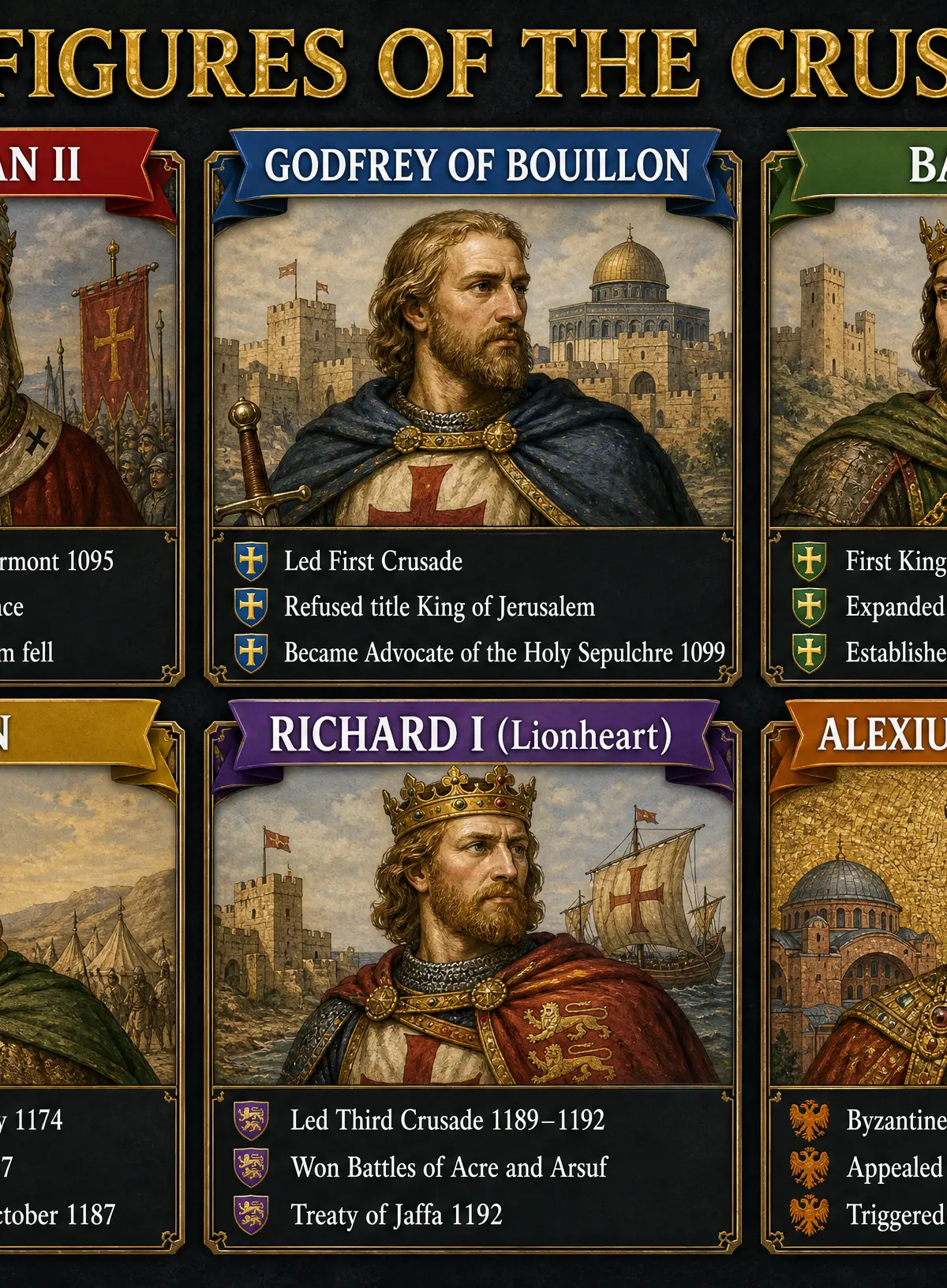
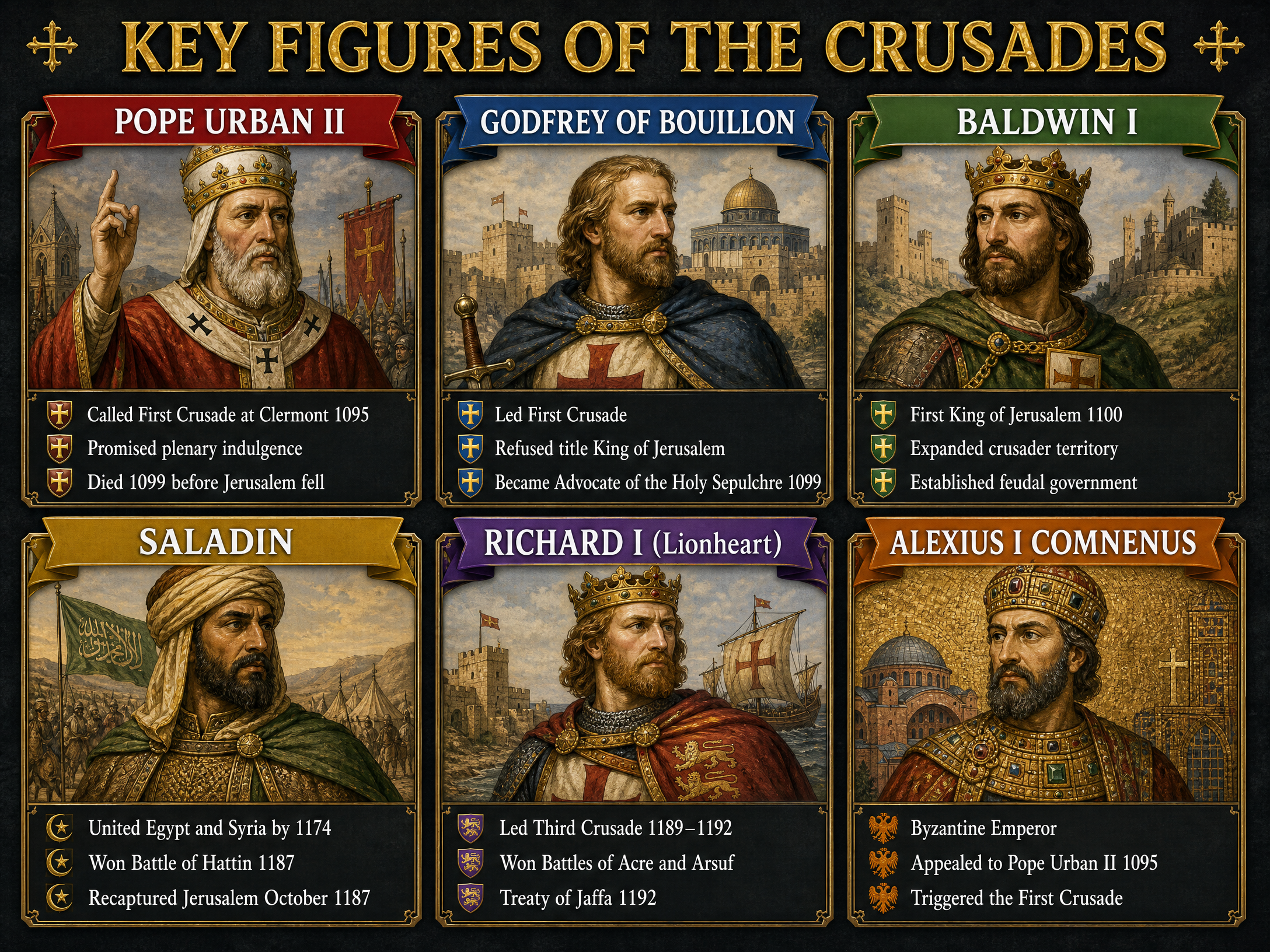
Pope Urban II
Role: Pope from 1088 to 1099.
Key Actions: Preached the First Crusade at the Council of Clermont in 1095, offering spiritual rewards for military service.
Impact: His ability to fuse the concepts of pilgrimage and holy war ignited the crusading movement and temporarily asserted papal supremacy over secular rulers in Europe.
Baldwin I of Jerusalem
Role: First King of Jerusalem (1100–1118).
Key Actions: Expanded the Kingdom of Jerusalem, capturing vital coastal cities and establishing a functioning feudal administration.
Impact: He transformed the fragile conquests of the First Crusade into a viable, structured state capable of defending itself.
Saladin (Salah ad-Din)
Role: Sultan of Egypt and Syria.
Key Actions: United the fractured Muslim territories, defeated the Crusader army at Hattin (1187), and recaptured Jerusalem.
Impact: He is the most significant Muslim leader of the era, successfully employing the concept of jihad to rally forces and dismantle the Kingdom of Jerusalem.
Richard I (The Lionheart)
Role: King of England (1189–1199) and leader of the Third Crusade.
Key Actions: Won the Siege of Acre and the Battle of Arsuf; negotiated the Treaty of Jaffa with Saladin.
Impact: His tactical brilliance saved the coastal Crusader States from annihilation, though his failure to retake Jerusalem meant the primary goal of the Third Crusade was unfulfilled.
Second-Order Concepts
Causation
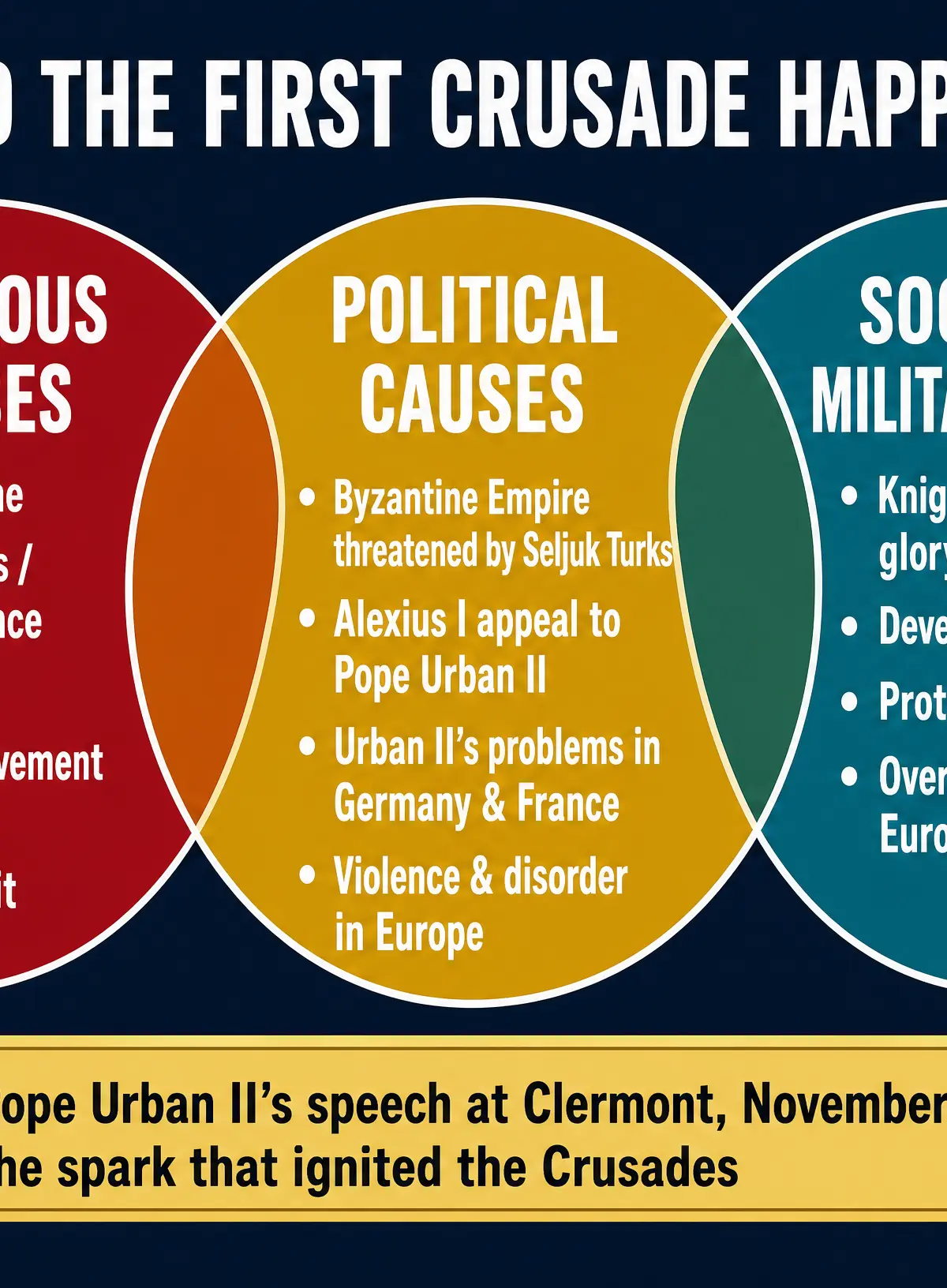
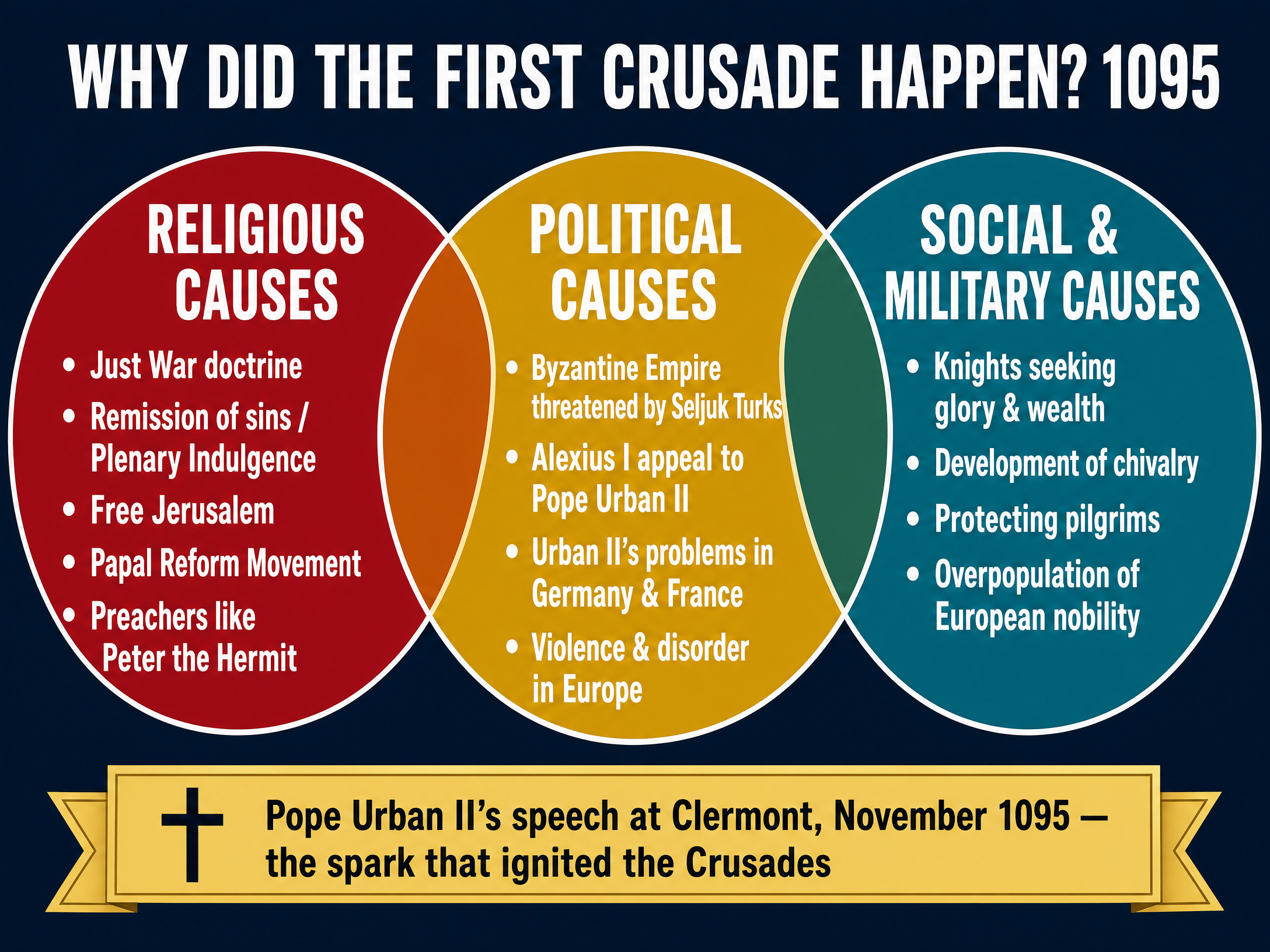
The First Crusade was caused by a convergence of factors. Long-term causes included the growing Papal Reform Movement and the development of chivalric culture in Europe. Short-term causes involved the immediate threat to the Byzantine Empire following the Battle of Manzikert (1071). The trigger was Pope Urban II's speech at Clermont in 1095. Crucially, examiners want to see you link these: the religious desire to free Jerusalem provided the ideological cover for the political ambition to extend papal power and the social need to redirect the violence of European knights.
Consequence
The immediate consequence of the First Crusade was the brutal establishment of the Crusader States and the deepening of religious animosity. A long-term consequence was the eventual unification of the Muslim world under leaders like Zingi, Nur ad-Din, and Saladin, who utilized the ideology of jihad to counter the crusader threat, ultimately leading to the fall of Jerusalem in 1187.
Change & Continuity
Change: The nature of warfare and religious expression changed significantly, with the creation of Military Orders (Templars, Hospitallers) representing a new fusion of monasticism and knighthood. Continuity: Throughout the period, the Crusader States remained heavily dependent on Western Europe for manpower and naval support from Italian city-states (Venice, Genoa) for trade and survival.
Significance
The Crusades are historically significant because they represent a major clash of civilizations that reshaped the geopolitics of the Mediterranean. They enhanced the power of the papacy, stimulated trade and cultural exchange between East and West, and created enduring historical narratives regarding holy war and religious conflict.
Source Skills
When approaching sources for the Crusades, provenance is critical.
- Christian Chronicles (e.g., Fulcher of Chartres, William of Tyre): Often written by clerics to glorify the crusaders or justify God's will. They may exaggerate enemy numbers or emphasize miracles (like the Holy Lance) to explain victories.
- Muslim Chronicles (e.g., Ibn al-Athir, Imad ad-Din): Often written by scholars attached to the courts of leaders like Zingi or Saladin. Their purpose is frequently to praise their patron as a champion of jihad and to emphasize the barbarity of the 'Franks'.
Always ask: Who wrote this? Who was their patron? What were they trying to justify? A source's bias does not make it useless; it tells you about the attitudes and propaganda of the time.
Worked Examples
3 worked examples — open one to explore the question and available guidance.
Practice Questions
Test your understanding — click to reveal model answers
Describe two features of the Knights Templar. (4 marks)
Hint: Think about their dual role as monks and soldiers, and why they were created.
Explain why Saladin was able to recapture Jerusalem in 1187. (12 marks)
Hint: Combine Saladin's strengths (unification, tactics) with Crusader weaknesses (succession crisis, mistakes at Hattin).
‘The main reason for the calling of the First Crusade was Pope Urban II’s desire to increase his own power.’ How far do you agree? (16 marks)
Hint: Evaluate the political motive (papal power/Investiture Controversy) against the religious motive (freeing Jerusalem/indulgences) and the Byzantine appeal.
Describe two consequences of the Battle of Hattin (1187). (4 marks)
Hint: Think about what happened to the Crusader army and what happened to Jerusalem shortly after.
Explain the importance of the Muslim response to the Crusades between 1099 and 1187. (8 marks)
Hint: Focus on the shift from division (which helped Crusaders) to unity under Zingi, Nur ad-Din, and Saladin (which destroyed them).
Test your understanding of The crusades, c1095–1204
Active recall beats re-reading. Take an instant quiz now to test what you’ve learned and lock it into long-term memory.
7 days Premium · Then free forever · No card, no charge