Pearson Edexcel · A-Level · History
The Dutch Revolt, c1563–1609
The Dutch Revolt (c1563–1609) was a defining struggle for independence, pitting the Protestant northern provinces against the mighty Catholic Spanish Empire. This topic matters historically because it demonstrates how brutal repression and economic taxation united a divided people, ultimately leading to the birth of the Dutch Republic.
- 7 min read
- 3 worked examples
- 5 practice questions
- 6 key terms
Study Notes
Overview
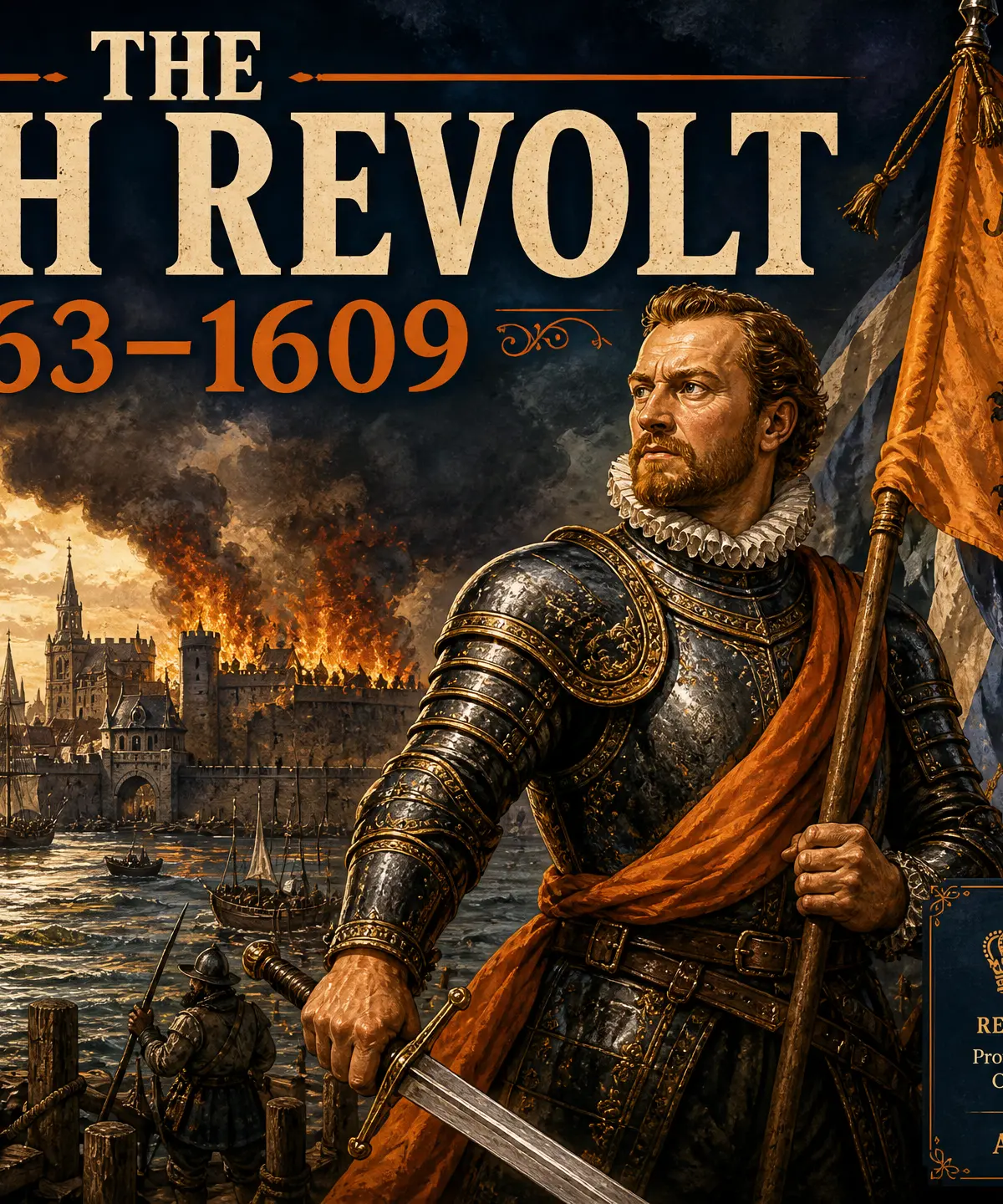
This study covers the crucial period from 1567 to 1573, focusing on the arrival and harsh rule of the Duke of Alva in the Netherlands, the early failures of the Dutch Revolt, and the pivotal turning point in 1572 led by the Sea Beggars and William of Orange. Historically, this period is significant because it marks the transition from scattered religious discontent into a unified, national war of independence against Spanish authority. Examiners expect candidates to demonstrate specific knowledge of Alva's policies (such as the Council of Troubles and the Tenth Penny Tax) and to explain how these policies inadvertently united opposition. You must also be able to explain the transition from William of Orange's initial military failures in 1568 to his successful establishment of control over Holland and Zeeland by 1572.
Key Events & Developments
The Arrival of the Duke of Alva and the Council of Troubles
Date(s): 1567
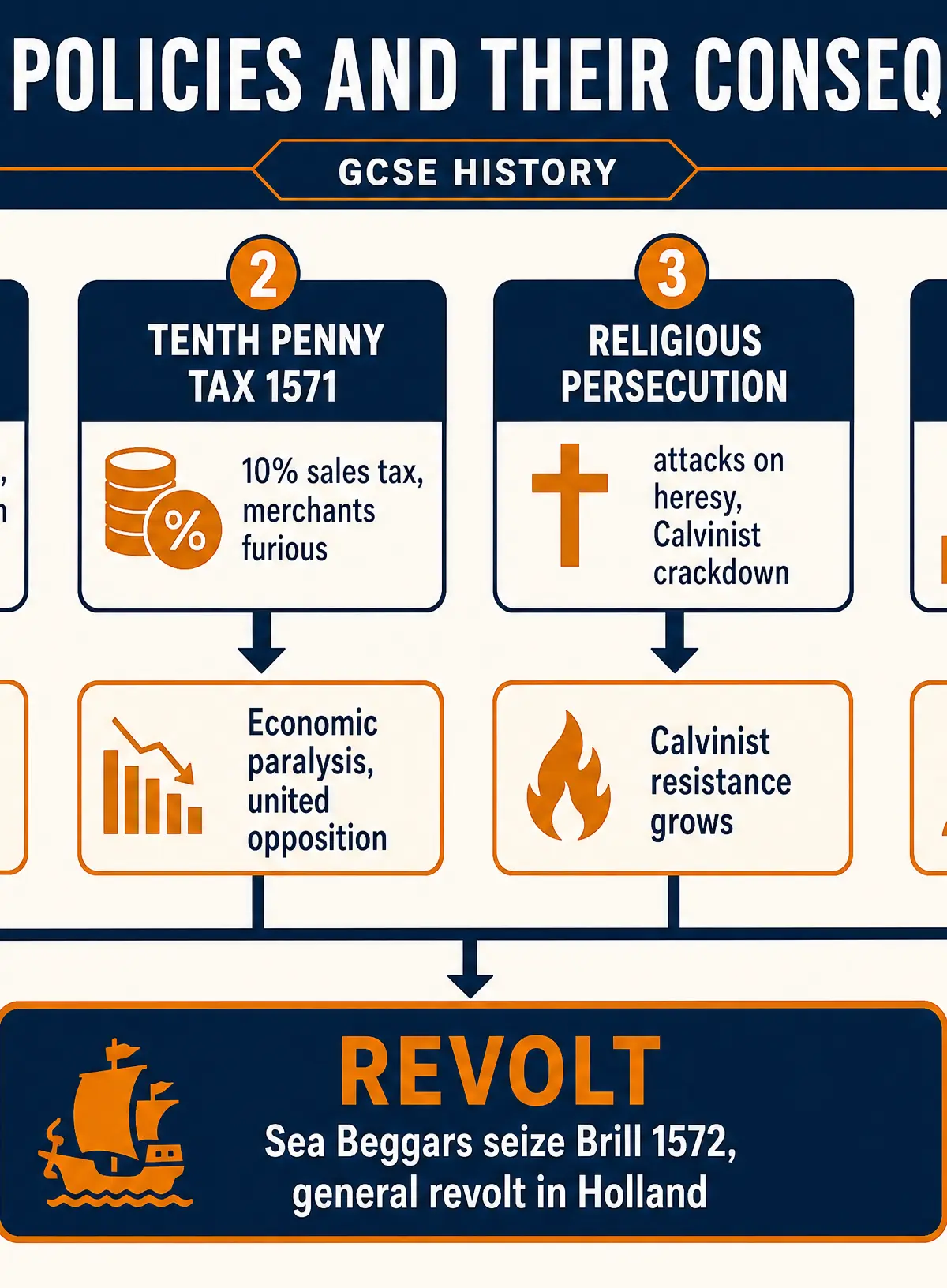
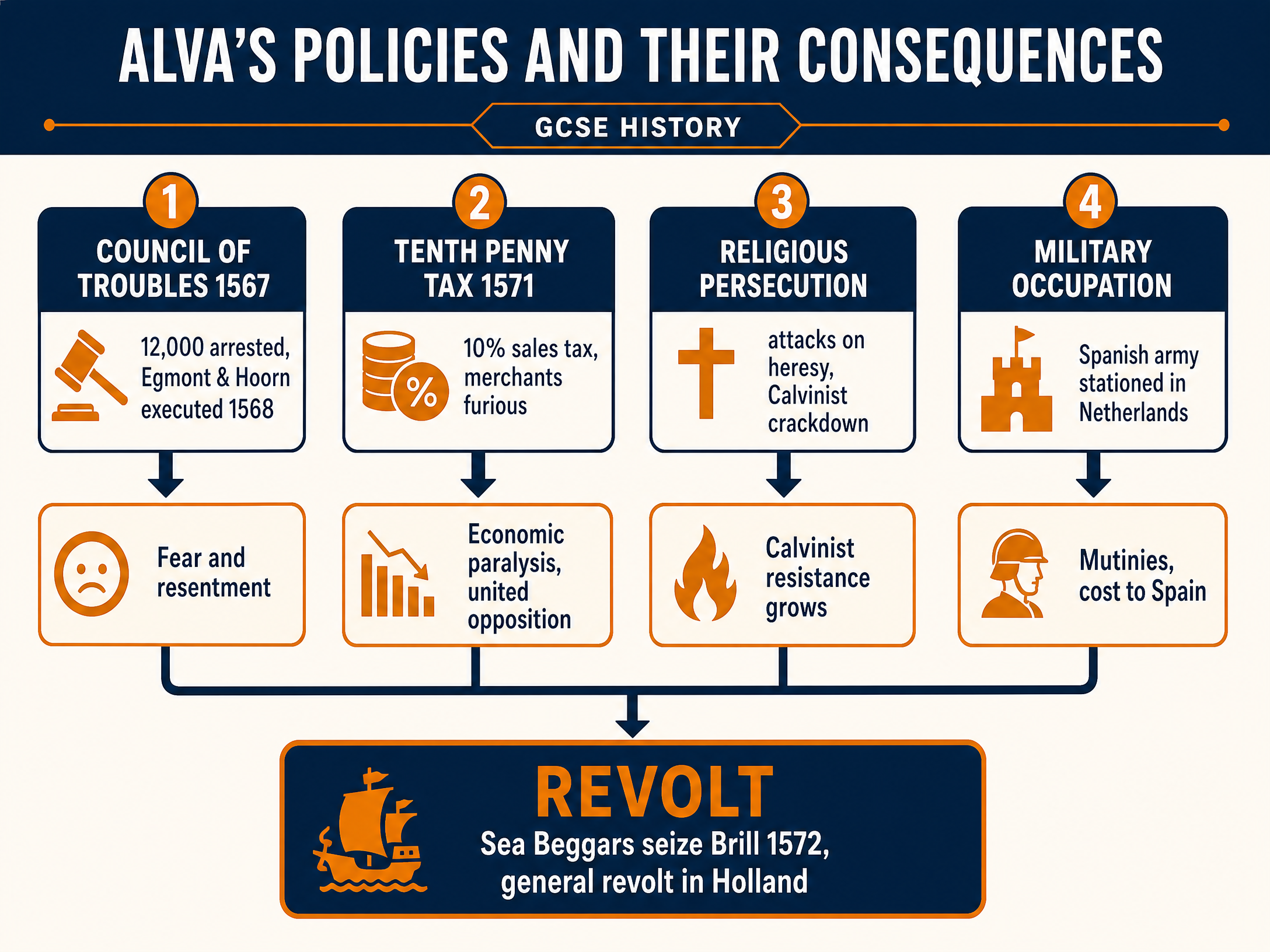
What happened: Following the Iconoclast Fury of 1566, Philip II of Spain sent the Duke of Alva to replace Margaret of Parma as Governor-General. Alva immediately established the Council of Troubles (known locally as the Council of Blood) to punish suspected rebels and heretics. Over 12,000 people were arrested, and prominent nobles, including the Counts of Egmont and Hoorn, were executed in June 1568.
Why it matters: This is a crucial example of causation. Alva's brutal repression removed moderate voices and demonstrated that no one was safe, replacing political negotiation with terror. This radicalised the opposition and laid the groundwork for armed revolt.
Specific Knowledge: 12,000 arrested; execution of Egmont and Hoorn (June 1568); Margaret of Parma replaced.
The Tenth Penny Tax
Date(s): Proposed 1569, Implemented 1571
What happened: Alva introduced a 10% sales tax on all commercial transactions to fund his occupying Spanish army. In a region whose wealth depended entirely on trade, this caused economic paralysis.
Why it matters: This is perhaps the most significant cause of the general revolt. It united Catholics and Protestants, nobles and merchants, against Spanish rule. It transformed a religious dispute into a broad-based economic and political rebellion.
Specific Knowledge: 10% sales tax; implemented 1571; united economic opposition.
Orange's Early Invasions and Failure
Date(s): 1568
What happened: William of Orange, having fled to Germany, launched military invasions into the Netherlands. Despite a victory by his brother Louis of Nassau at Heiligerlee (May 1568), the campaign failed due to lack of funds, disintegrating mercenary forces, and the superiority of Alva's professional army.
Why it matters: Demonstrates that early resistance lacked the broad popular support, secure bases, and financial backing needed to defeat Spain. It sets up the contrast with the successful revolt of 1572.
Specific Knowledge: Battle of Heiligerlee (May 1568); Louis of Nassau; lack of funds for mercenaries.
The Sea Beggars and the Seizure of Brill
Date(s): April 1572
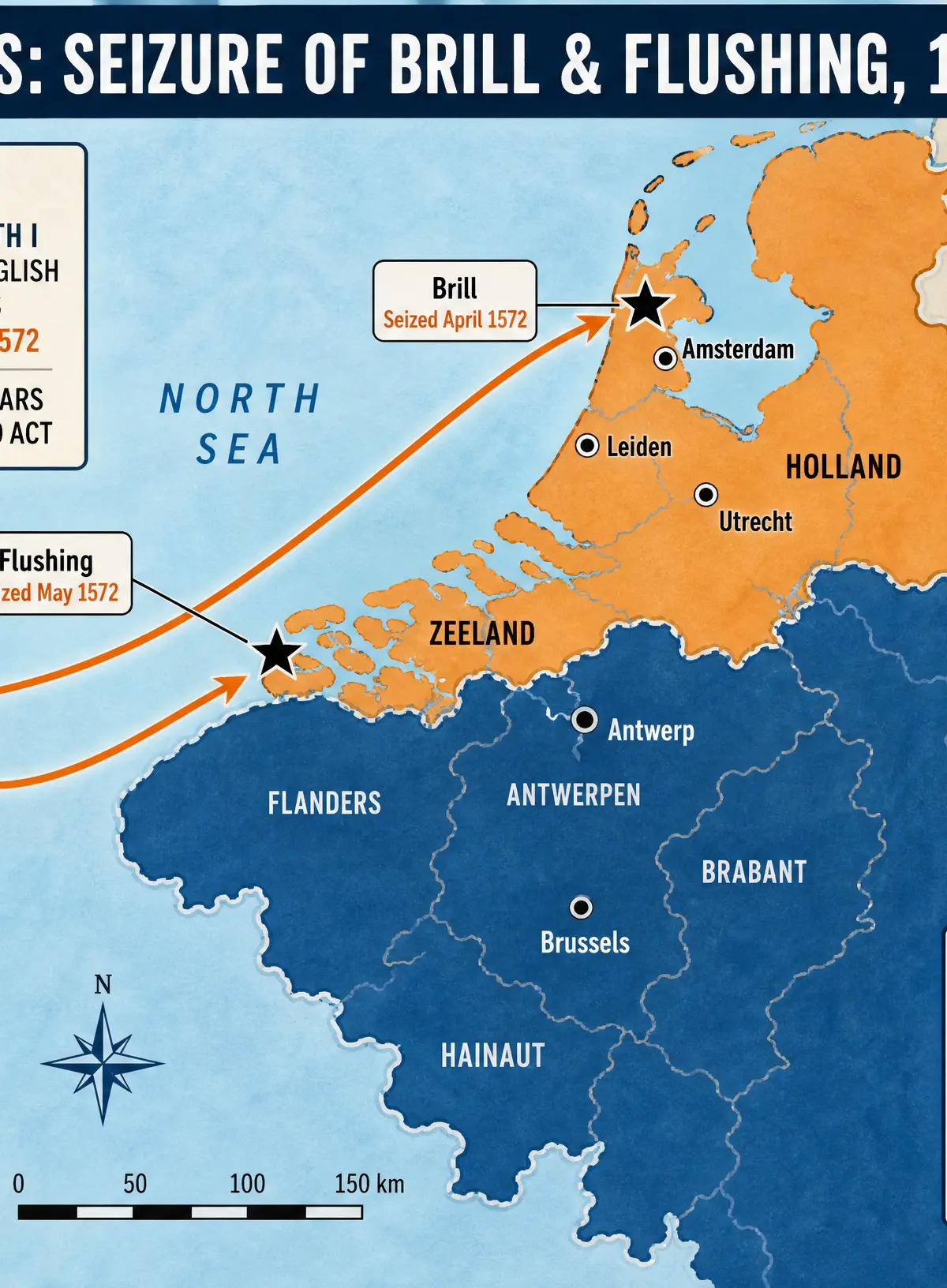
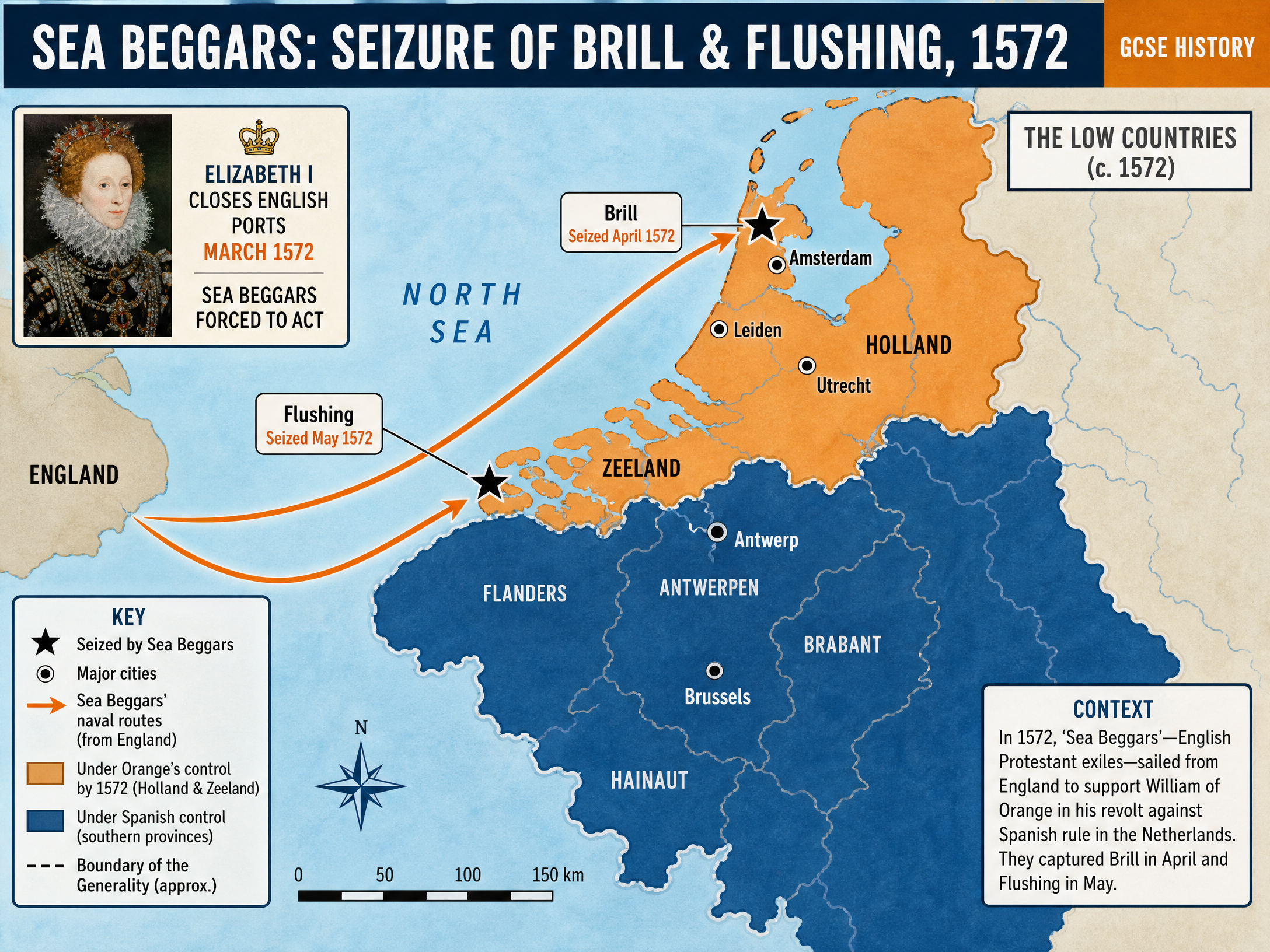
What happened: The Sea Beggars (privateers loyal to Orange) had been operating from English ports. In March 1572, Elizabeth I closed English ports to them to avoid war with Spain. Forced to sea, they attacked the Dutch coast and seized the port of Brill on 1 April 1572, followed by Flushing in May.
Why it matters: This was the trigger event for the general revolt. It provided the rebels with secure, strategic ports controlling the waterways of Holland and Zeeland, sparking uprisings in towns across the northern provinces.
Specific Knowledge: Elizabeth I closed ports (March 1572); seizure of Brill (1 April 1572); seizure of Flushing (May 1572).
Orange's Triumph in the North
Date(s): 1572–1573
What happened: Following the capture of Brill, William of Orange invaded again in July 1572. With popular support fueled by hatred of the Tenth Penny Tax, and with the Sea Beggars controlling the waters, Orange established firm control over the provinces of Holland and Zeeland. Alva failed to reconquer these water-defended northern areas.
Why it matters: This established the geographic and political foundation for the independent Dutch Republic. It marked the definitive failure of Alva's hardline policies.
Specific Knowledge: Control of Holland and Zeeland; Alva's failure to retake the north.
Key Individuals
The Duke of Alva
Role: Spanish Governor-General of the Netherlands (1567–1573)
Key Actions: Established the Council of Troubles; executed Egmont and Hoorn; imposed the Tenth Penny Tax; commanded the Spanish army against the rebels.
Impact: His uncompromising brutality and economic taxation inadvertently united the Dutch provinces against Spanish rule, turning a manageable political crisis into a full-scale war of independence.
William of Orange (William the Silent)
Role: Leading noble of the Netherlands and leader of the Dutch Revolt.
Key Actions: Fled Alva's regime in 1567; funded the failed 1568 invasions; issued letters of marque to the Sea Beggars; successfully invaded and took control of Holland and Zeeland in 1572.
Impact: Provided the political and military leadership necessary to coordinate the resistance, transforming scattered rebellions into a structured fight for independence.
Elizabeth I of England
Role: Queen of England
Key Actions: Allowed Sea Beggars to use English ports initially, then expelled them in March 1572 to avoid provoking Spain.
Impact: Her decision to expel the Sea Beggars accidentally triggered the seizure of Brill, serving as the catalyst for the successful 1572 revolt.
Second-Order Concepts
Causation
Long-term: Philip II's desire for centralisation and religious conformity (Catholicism).
Short-term: Alva's Council of Troubles and the execution of moderate nobles (Egmont and Hoorn).
Trigger: Elizabeth I's expulsion of the Sea Beggars, forcing them to seize Brill.
Catalyst: The Tenth Penny Tax, which provided the economic grievance that united the population.
Consequence
Immediate: The establishment of rebel control over Holland and Zeeland by the end of 1572.
Long-term: The permanent division of the Netherlands and the eventual creation of the independent Dutch Republic in the north.
Change & Continuity
Change: The shift from loyal subjects petitioning the King (pre-1567) to an armed, unified rebellion seeking self-governance (post-1572).
Continuity: The ongoing military superiority of the Spanish army in open land battles in the southern provinces.
Significance
This period is significant because it demonstrates the limits of imperial power. Alva's failure proved that military occupation and terror cannot suppress a population that is united by economic ruin and religious persecution.
Source Skills
When evaluating sources for this topic, consider the provenance carefully.
- Spanish/Catholic sources (e.g., letters from Alva to Philip II) will likely emphasize the heresy and treason of the rebels to justify harsh measures.
- Dutch/Protestant sources (e.g., pamphlets from William of Orange) will emphasize Spanish tyranny, the violation of traditional Dutch liberties, and the devastating impact of the Tenth Penny Tax to drum up support for the revolt.
- Always look for the purpose of the source: is it trying to justify actions, secure funding, or rally troops?
Revision Podcast
Listen to this 10-minute podcast covering the key events, exam tips, and a quick-fire recall quiz.
Worked Examples
3 worked examples — open one to explore the question and available guidance.
Practice Questions
Test your understanding — click to reveal model answers
Explain the significance of the Tenth Penny Tax in the development of the Dutch Revolt. (8 marks)
Hint: Don't just describe the tax. Explain WHO it affected and HOW it changed the nature of the rebellion.
Describe two features of the Council of Troubles. (4 marks)
Hint: Identify a feature, then add a specific supporting fact for each.
How far do you agree that the actions of the Sea Beggars were the main reason for the success of the Dutch Revolt in 1572? (16 marks + 4 SPaG)
Hint: You must evaluate the Sea Beggars against other factors, particularly Alva's policies (Tenth Penny Tax, Council of Troubles).
Explain why the Duke of Alva was sent to the Netherlands in 1567. (8 marks)
Hint: Think about what happened in 1566 and Philip II's overall goals.
Write an account of William of Orange's attempts to defeat the Spanish between 1568 and 1572. (8 marks)
Hint: Structure chronologically: start with the 1568 failure, mention his support for the Sea Beggars, and end with the 1572 success.
Test your understanding of The Dutch Revolt, c1563–1609
Active recall beats re-reading. Take an instant quiz now to test what you’ve learned and lock it into long-term memory.
7 days Premium · Then free forever · No card, no charge