Pearson Edexcel · A-Level · History
The making of modern China, 1860–1997
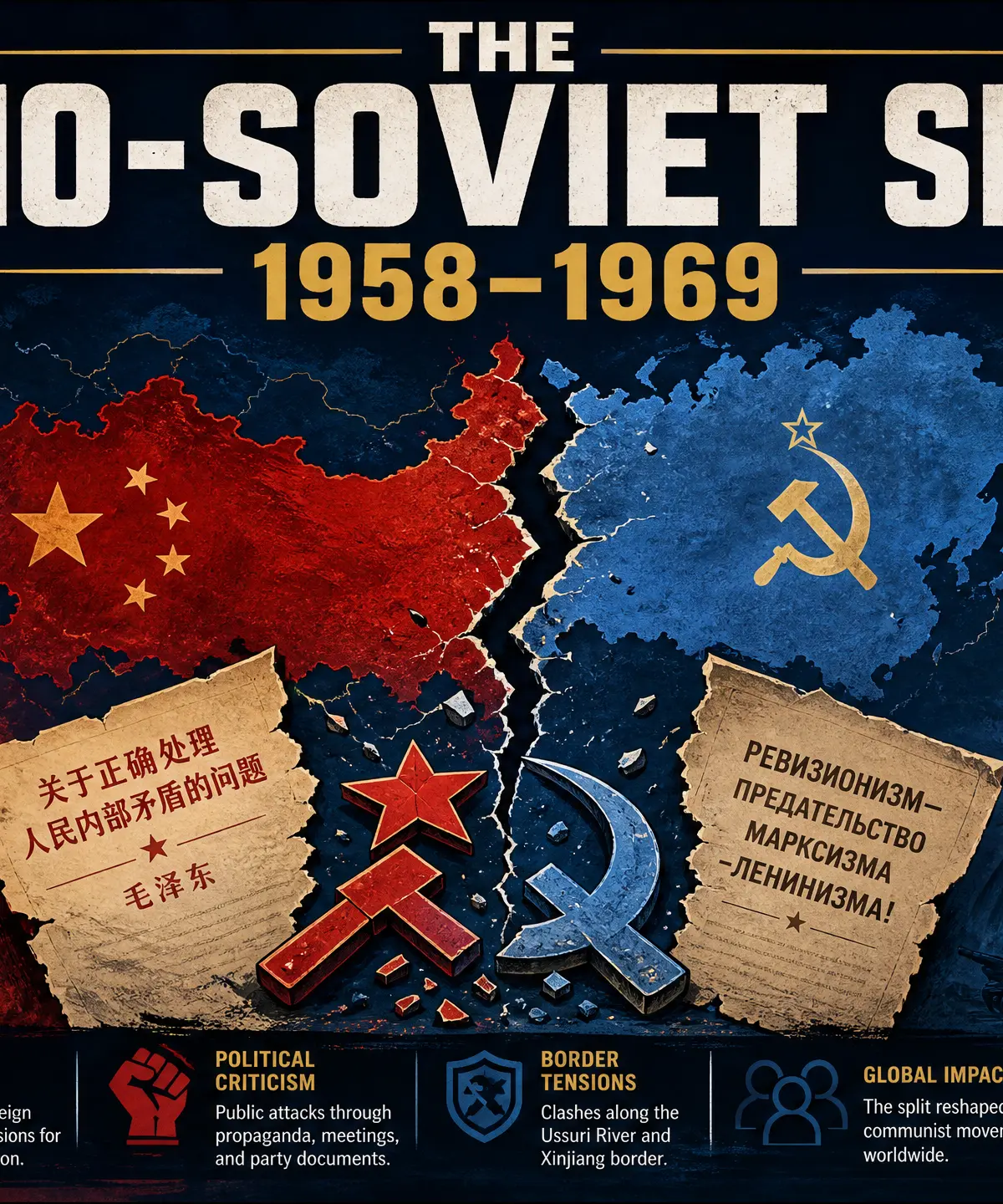
The Sino-Soviet Split (1958–69) was the dramatic breakdown of relations between the world's two largest communist powers. It transformed the Cold War landscape, turning former allies into bitter rivals and culminating in military clashes on their shared border.
- 7 min read
- 3 worked examples
- 5 practice questions
- 6 key terms
Study Notes
Overview
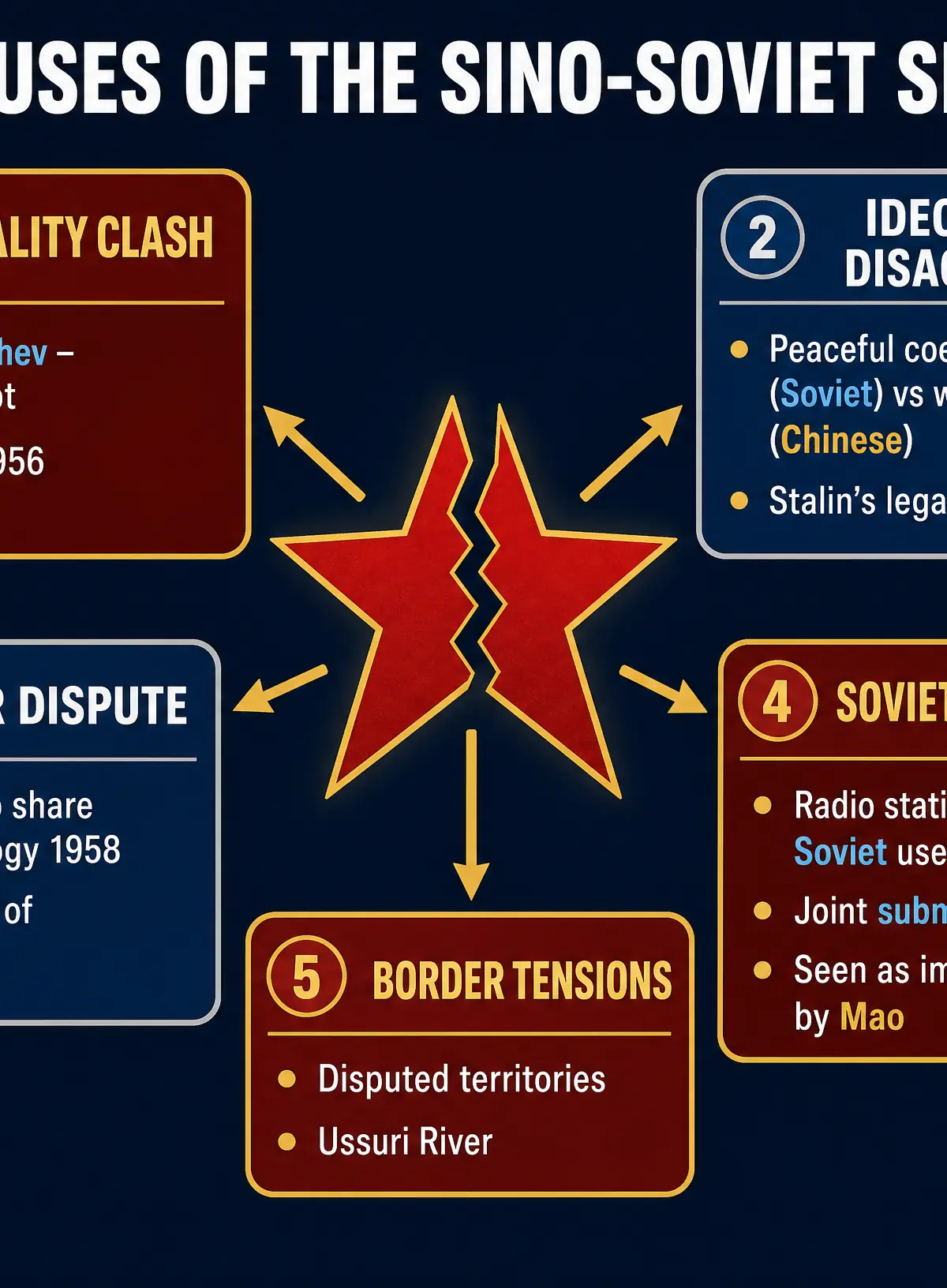
The Sino-Soviet Split represents a pivotal turning point in 20th-century history. Initially united by the 1950 Treaty of Friendship, Alliance and Mutual Assistance, the People's Republic of China and the Soviet Union appeared to form an unbreakable communist bloc. However, beneath the surface, profound ideological differences and a bitter personality clash between Mao Zedong and Nikita Khrushchev drove a wedge between the two nations. Examiners expect candidates to understand how this relationship deteriorated from ideological disagreements in the late 1950s to the withdrawal of Soviet advisers in 1960, and finally to armed conflict on the Ussuri River in 1969. You must be able to evaluate the relative importance of personal rivalries, ideological disputes, and strategic fears in causing this fracture.
Key Events & Developments
Khrushchev's Secret Speech
Date(s): February 1956
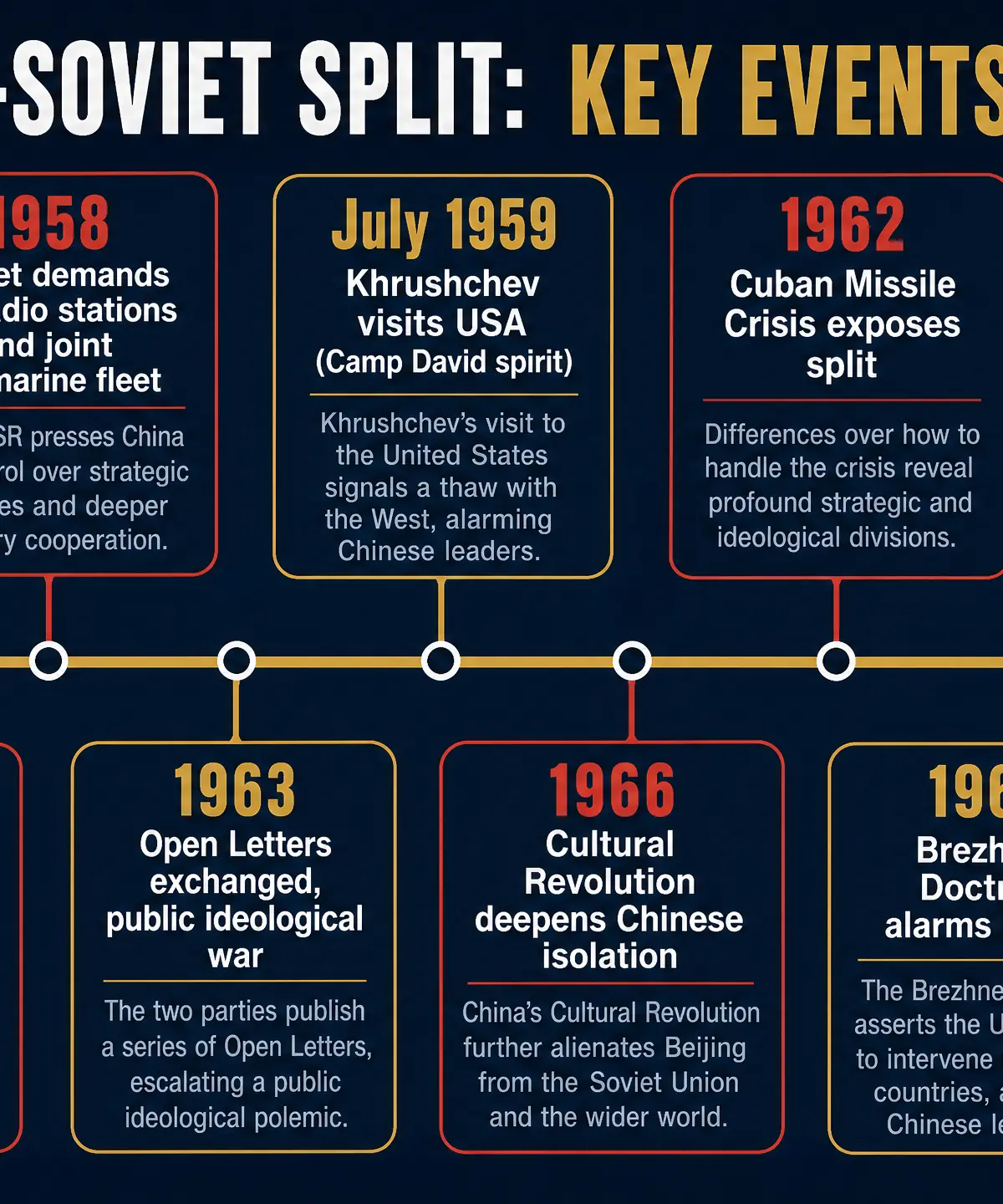
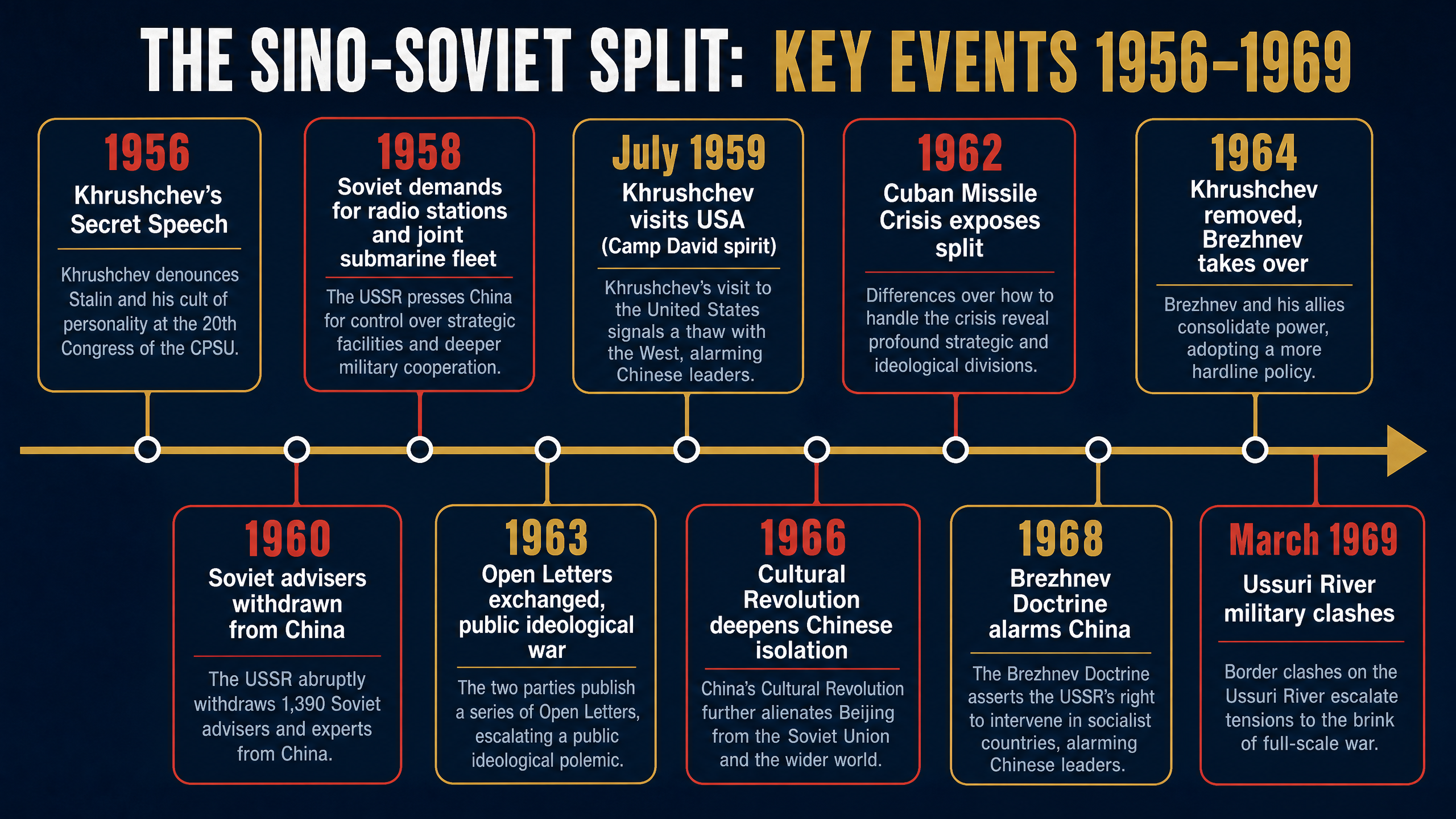
What happened: At the 20th Congress of the Communist Party of the Soviet Union, Nikita Khrushchev delivered a speech denouncing Joseph Stalin's 'cult of personality' and his crimes.
Why it matters: This triggered the split. Mao Zedong had modelled his own leadership on Stalin's and saw the attack on Stalin as an indirect attack on his own authority. It created immediate ideological friction.
Specific Knowledge: The speech was delivered at the 20th Congress; it shocked the communist world as it was the first official condemnation of Stalinism.
Soviet Demands on China
Date(s): 1958
What happened: The Soviet Union requested permission to build radio stations on Chinese soil to communicate with its submarines, and proposed a joint Sino-Soviet submarine fleet.
Why it matters: Mao interpreted these requests as Soviet imperialism, fearing the USSR was trying to control China's military and infringe on its sovereignty. He rejected the proposals furiously.
Specific Knowledge: Demands included a long-wave radio station and a joint naval fleet; Mao's rejection marked a clear refusal to be a subordinate partner.
Withdrawal of Soviet Advisers
Date(s): July-August 1960
What happened: In retaliation for Chinese ideological attacks, Khrushchev abruptly ordered the withdrawal of all Soviet technical and scientific advisers from China.
Why it matters: This caused immense economic damage to China, halting hundreds of industrial projects. It turned an ideological dispute into a tangible economic and diplomatic break.
Specific Knowledge: Exactly 1,390 Soviet experts were withdrawn, taking their blueprints with them and leaving numerous construction projects unfinished.
The Cuban Missile Crisis
Date(s): October 1962
What happened: The Soviet Union placed nuclear missiles in Cuba, then withdrew them under US pressure.
Why it matters: Mao publicly criticised Khrushchev for both 'adventurism' (placing the missiles) and 'capitulationism' (backing down). This highlighted the profound strategic divide between the two nations.
Specific Knowledge: The crisis exposed the ideological gap between Khrushchev's 'peaceful coexistence' and Mao's more aggressive revolutionary stance.
Ussuri River Border Clashes
Date(s): March 1969
What happened: Chinese and Soviet border troops engaged in armed conflict over a disputed island in the Ussuri River.
Why it matters: This was the climax of the split. It demonstrated that ideological differences had escalated into a real threat of war between two nuclear-armed communist states, fundamentally altering Cold War dynamics.
Specific Knowledge: The clashes occurred over Zhenbao Island (known as Damansky Island to the Soviets); dozens of soldiers were killed on both sides.
Key Individuals
Mao Zedong
Role: Chairman of the Chinese Communist Party
Key Actions: Resisted Soviet attempts to control Chinese policy, launched the Cultural Revolution, and steered China away from the Soviet orbit.
Impact: His personal pride, nationalist focus, and strict adherence to his interpretation of Marxism-Leninism were primary drivers of the split.
Nikita Khrushchev
Role: First Secretary of the Communist Party of the Soviet Union (1953-1964)
Key Actions: Denounced Stalin, pursued 'peaceful coexistence' with the West, and withdrew Soviet advisers from China.
Impact: His policies and his abrasive personal relationship with Mao alienated the Chinese leadership and fractured the communist bloc.
Leonid Brezhnev
Role: General Secretary of the Communist Party of the Soviet Union (from 1964)
Key Actions: Issued the Brezhnev Doctrine and oversaw the military build-up along the Sino-Soviet border.
Impact: His assertion of the right to intervene in socialist countries (the Brezhnev Doctrine) deeply alarmed Mao, leading directly to the 1969 border clashes.
Second-Order Concepts
Causation
Long-term causes included historical border disputes and differing interpretations of Marxist ideology. Short-term triggers included the 1956 Secret Speech and the 1958 Soviet military demands. The clash of personalities between Mao and Khrushchev acted as an accelerating factor throughout the period.
Consequence
Immediate consequences included the devastating withdrawal of Soviet economic aid to China in 1960. Long-term consequences included the permanent fracturing of the global communist movement and China's eventual rapprochement with the United States in the 1970s.
Change & Continuity
The period saw a dramatic change from the 'unbreakable friendship' of the 1950 Treaty to open warfare in 1969. However, continuity can be seen in China's persistent fear of foreign domination, a legacy of its 'century of humiliation'.
Significance
The split is historically significant because it destroyed the myth of a monolithic communist bloc, reshaped the bipolar Cold War into a tripolar conflict, and paved the way for Sino-American relations.
Source Skills
When evaluating sources on the Sino-Soviet Split, examiners expect you to scrutinise provenance closely. Soviet sources (e.g., Pravda articles) will often characterise Chinese actions as reckless or 'dogmatic', while Chinese sources (e.g., People's Daily editorials) will attack Soviet 'revisionism' and 'imperialism'. Both sides used state-controlled media for propaganda. Always ask: Is this source intended for a domestic audience to justify a policy, or for an international audience to win support in the global communist movement? Recognise that private communications (like the Open Letters of 1963) often reveal the genuine ideological venom that public statements sometimes veiled.
Visual Resources
2 diagrams and illustrations
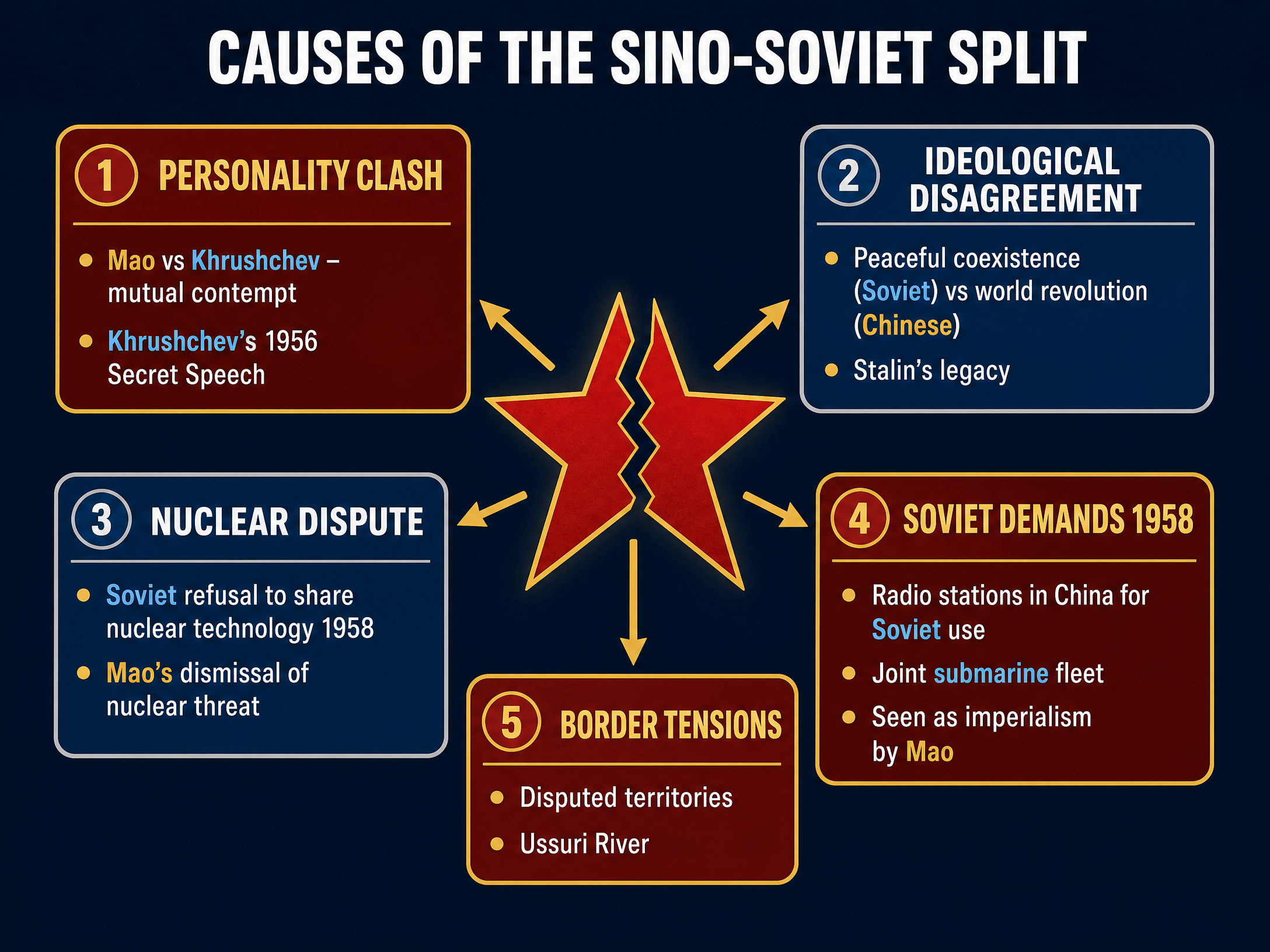
Interactive Diagrams
1 interactive diagram to visualise key concepts
Conceptual Flow Outline
The Escalation of the Sino-Soviet Split
Worked Examples
3 worked examples — open one to explore the question and available guidance.
Practice Questions
Test your understanding — click to reveal model answers
Explain the significance of the withdrawal of Soviet advisers from China in 1960. (8 marks)
Hint: Think about both the immediate economic impact and the long-term diplomatic significance.
'Ideological differences were the main reason for the Sino-Soviet Split.' How far do you agree? (16 marks)
Hint: You must evaluate ideology against other factors like national security fears (imperialism) and the personality clash between Mao and Khrushchev.
Describe two ways the Sino-Soviet Split affected international relations. (4 marks)
Hint: Think about how it changed the Cold War and China's relationship with the USA.
Explain why the Ussuri River clashes occurred in 1969. (8 marks)
Hint: Link the long-term deterioration of relations to the specific context of the late 1960s (Cultural Revolution, Brezhnev Doctrine).
Study Source C. Why was this source published in the Soviet Union in 1964? (8 marks)
Hint: Focus on the purpose of the source. What was happening in 1964, and what did the Soviet government want its people to believe about China?
Test your understanding of The making of modern China, 1860–1997
Active recall beats re-reading. Take an instant quiz now to test what you’ve learned and lock it into long-term memory.
7 days Premium · Then free forever · No card, no charge