Pearson Edexcel · A-Level · History
The making of modern Russia, 1855–1991
Dive into one of the most turbulent periods in human history: the collapse of the 300-year-old Romanov dynasty and the birth of the world's first communist state. This guide unpacks the chaos of 1917, helping you master the crucial differences between the February and October Revolutions to secure top marks.
- 7 min read
- 3 worked examples
- 5 practice questions
- 6 key terms
Study Notes
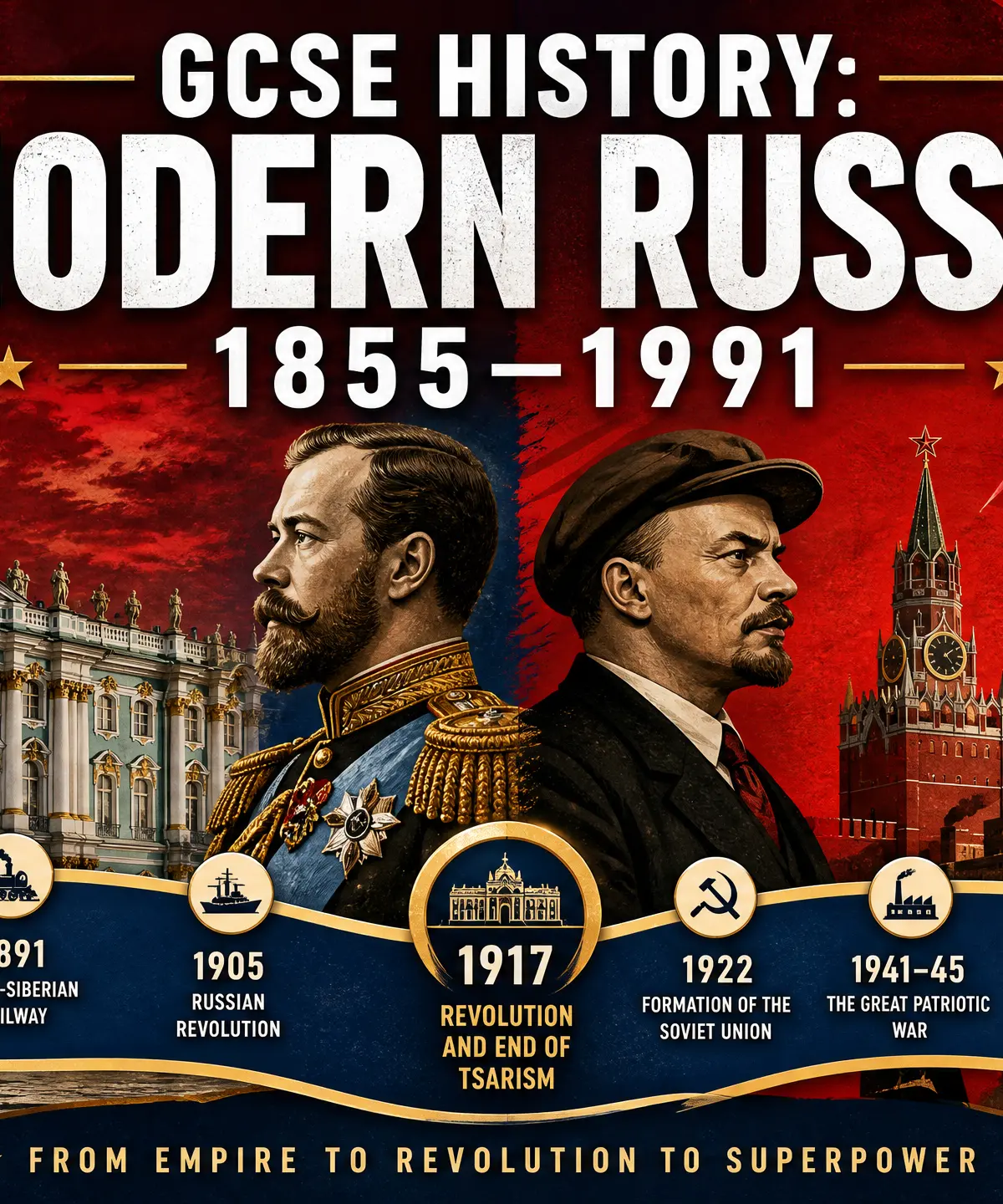
Overview
This study covers the monumental collapse of Tsarist Russia and the subsequent rise of the Bolsheviks between 1916 and 1918. It is a story of war, hunger, and radical political ideology. For GCSE History candidates, this topic is a goldmine for marks if you can accurately distinguish between the spontaneous February Revolution and the calculated October Revolution. Examiners consistently reward students who can explain the concept of 'Dual Power' and how the First World War acted as a catalyst for political breakdown. You will need to demonstrate specific knowledge of key individuals like Lenin, Kerensky, and Trotsky, and evaluate their significance against broader structural factors like military failure and economic collapse.
Podcast Episode: The Revolutions of 1917
Listen to this 5-minute revision podcast covering the core concepts, key events, and top exam tips for this topic.
Key Events & Developments
The Impact of the First World War
Date(s): 1914–1917
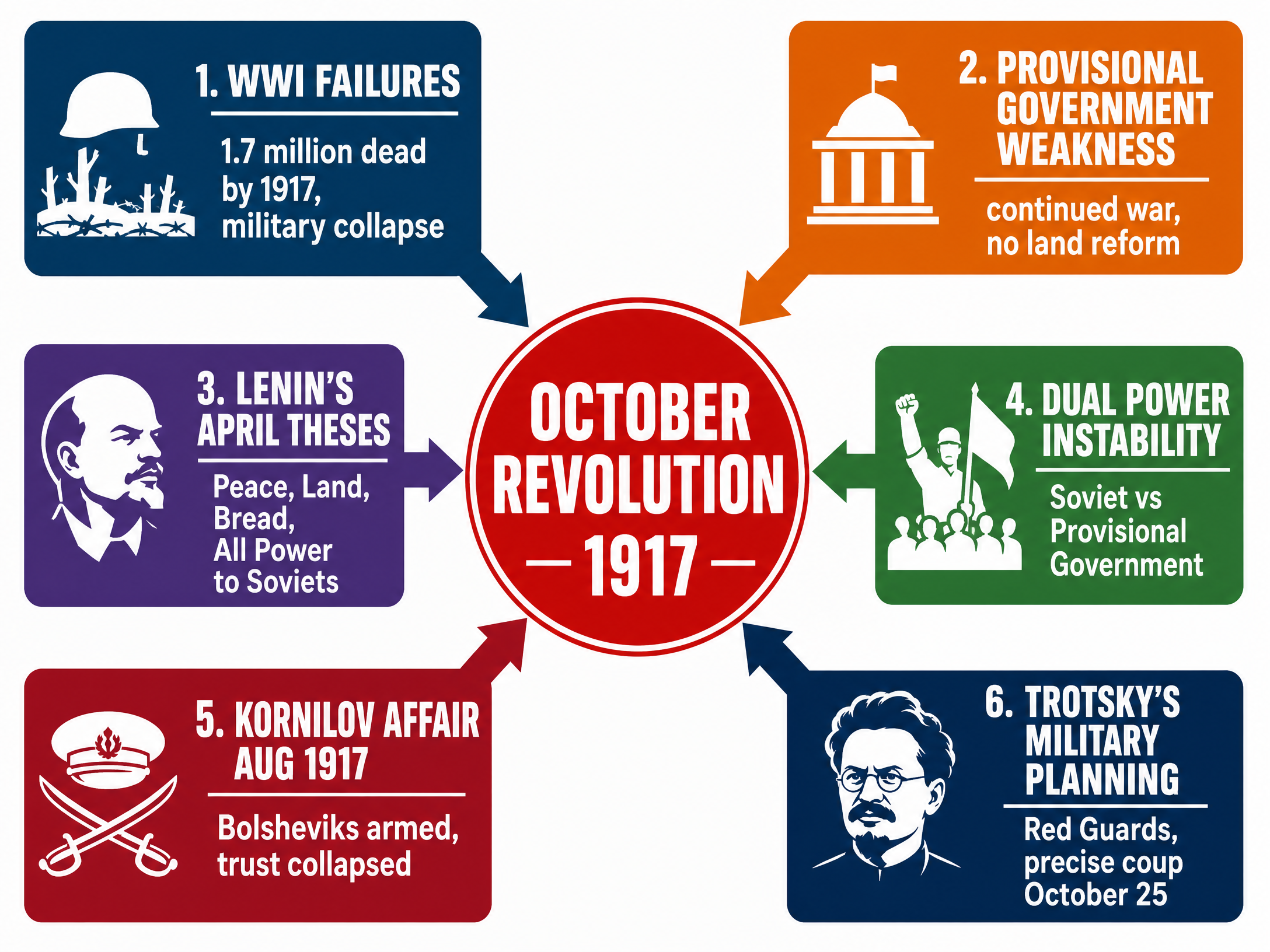
What happened: Russia suffered catastrophic military defeats (e.g., Tannenberg, Masurian Lakes). By 1917, 1.7 million soldiers were dead. The war effort collapsed the domestic economy, leading to severe bread shortages and inflation in Petrograd.
Why it matters: It destroyed the myth of the Tsar's divine authority, especially after Nicholas II took personal command of the army in 1915, making him personally responsible for defeats. It acted as the primary catalyst for the February Revolution.
Specific Knowledge: 1.7 million dead by 1917; Nicholas II takes command in August 1915; Tsarina Alexandra and Rasputin left in charge in Petrograd.
The February Revolution
Date(s): 23rd February – 2nd March 1917 (Julian Calendar)
What happened: Spontaneous strikes and bread riots in Petrograd escalated. Crucially, the army garrison mutinied and refused to fire on the crowds. Nicholas II abdicated on 2nd March, ending 300 years of Romanov rule.
Why it matters: It marked the end of Tsardom and created a power vacuum, leading to the unstable period of 'Dual Power'.
Specific Knowledge: International Women's Day protests (23rd Feb); Volynsky regiment mutiny; abdication of Nicholas II (2nd March).
The Period of Dual Power
Date(s): March – October 1917
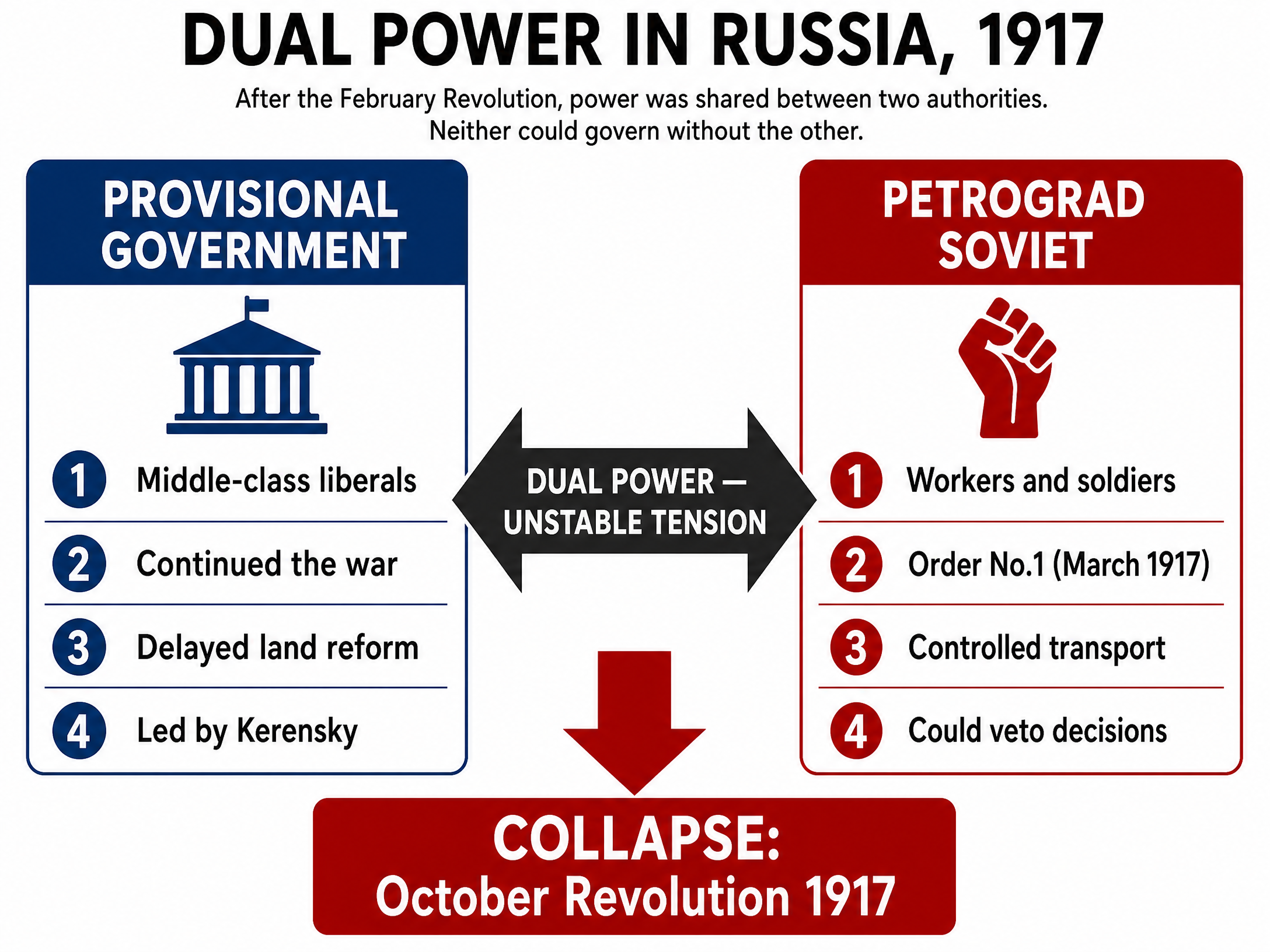
What happened: Power was shared uneasily between the unelected Provisional Government (middle-class liberals) and the Petrograd Soviet (workers' and soldiers' council).
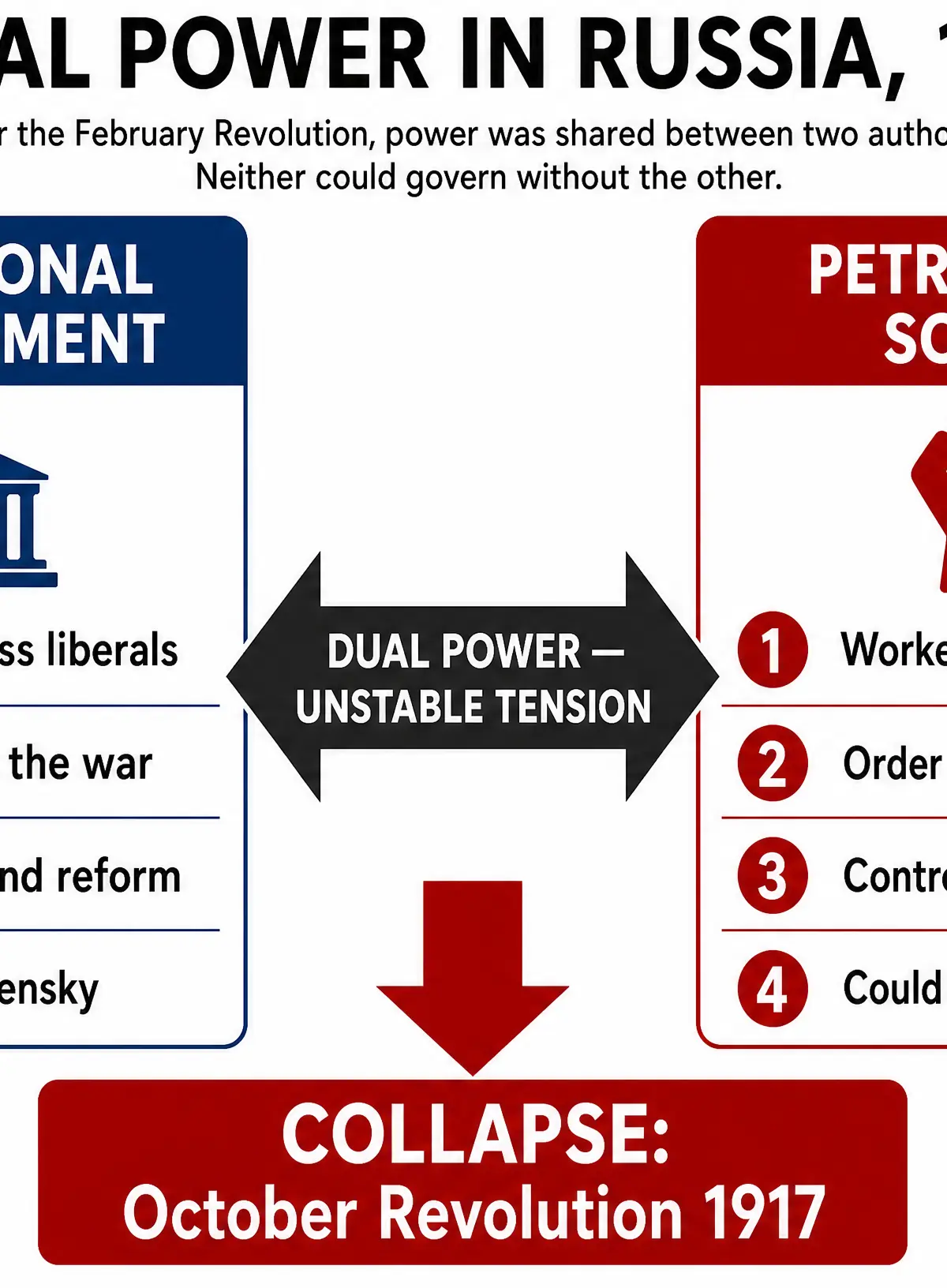
Why it matters: It created political paralysis. The Provisional Government had responsibility without true power, while the Soviet had power (through Order No. 1) without responsibility.
Specific Knowledge: Order No. 1 (March 1917) gave the Soviet control over the military; Alexander Kerensky became Prime Minister in July.
Lenin's Return and the April Theses
Date(s): 3rd April 1917
What happened: Lenin returned from exile in a sealed train provided by Germany. He published the April Theses, demanding an immediate end to the war, land for peasants, and "All Power to the Soviets".
Why it matters: It radically changed Bolshevik policy from cooperating with the Provisional Government to actively seeking its overthrow. It provided a popular, easily understood programme.
Specific Knowledge: Slogans: "Peace, Land, Bread" and "All Power to the Soviets"; Finland Station arrival.
The Kornilov Affair
Date(s): August 1917
What happened: General Kornilov marched on Petrograd, apparently to establish a military dictatorship. Kerensky panicked, armed the Bolshevik Red Guards, and released Bolshevik prisoners to defend the city.
Why it matters: It destroyed Kerensky's credibility, showed the Provisional Government was vulnerable to military threat, and armed the Bolsheviks, casting them as the saviours of Petrograd.
Specific Knowledge: General Lavr Kornilov; Kerensky's arming of the Red Guards.
The October Revolution
Date(s): 24th–25th October 1917 (Julian Calendar)
What happened: A planned, almost bloodless coup organised by Trotsky's Military Revolutionary Committee. Red Guards seized key infrastructure (bridges, telegraph offices) and stormed the Winter Palace, arresting the Provisional Government.
Why it matters: It brought the Bolsheviks to power, leading to the creation of the Soviet state and ultimately the Russian Civil War.
Specific Knowledge: Leon Trotsky; Military Revolutionary Committee (MRC); Winter Palace; cruiser Aurora.
Key Individuals
Tsar Nicholas II
Role: The last Emperor of Russia.
Key Actions: Took personal command of the army in 1915; ordered troops to fire on protesters in February 1917; abdicated in March 1917.
Impact: His autocratic inflexibility and military incompetence were primary long-term causes of the revolution.
Alexander Kerensky
Role: Leader of the Provisional Government (Prime Minister from July 1917).
Key Actions: Launched the disastrous June Offensive; armed the Bolsheviks during the Kornilov Affair; fled Petrograd in October.
Impact: His failure to end the war and address land reform doomed the Provisional Government.
Vladimir Lenin
Role: Leader of the Bolshevik Party.
Key Actions: Authored the April Theses; drove the party towards armed insurrection; established the Cheka and dissolved the Constituent Assembly.
Impact: The ideological mastermind of the October Revolution and the architect of the Soviet state.
Leon Trotsky
Role: Head of the Petrograd Soviet and the Military Revolutionary Committee (MRC).
Key Actions: Organised the tactical execution of the October coup; later built the Red Army.
Impact: The practical organiser who turned Lenin's vision of revolution into a successful military reality.
Second-Order Concepts
Causation
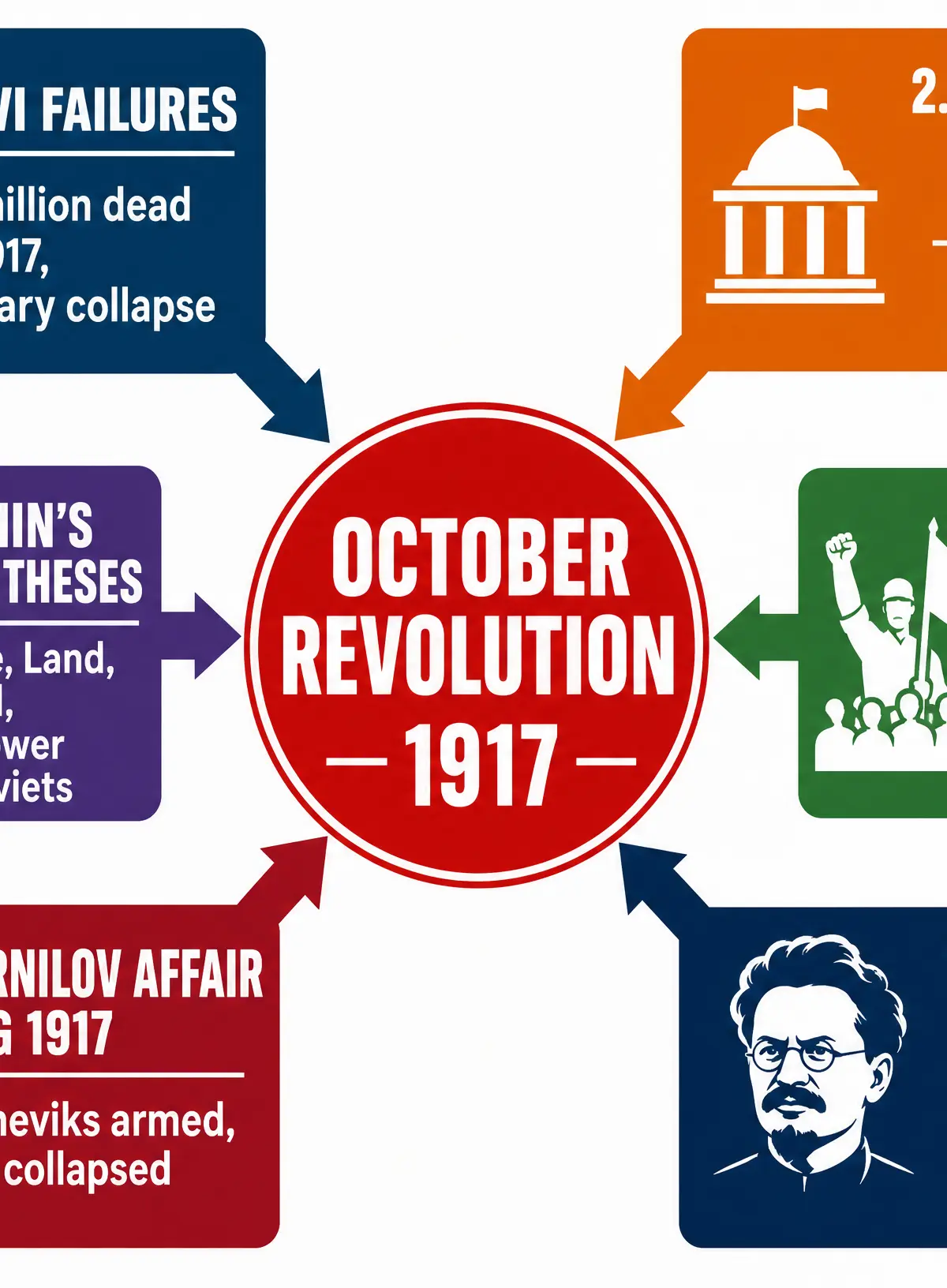
Examiners want to see you link causes. The long-term autocratic nature of Tsardom was exposed by the short-term trigger of WWI. The February Revolution was caused by spontaneous anger over bread and war, whereas the October Revolution was caused by the specific political failures of the Provisional Government combined with Bolshevik opportunism.
Consequence
The immediate consequence of the October Revolution was Bolshevik power, but the long-term consequence was the brutal Russian Civil War, as the Bolsheviks used the Cheka and the Red Army to enforce their minority rule against a vast array of opponents.
Change & Continuity
While the ruling personnel changed radically from Romanov autocrats to Bolshevik communists, there was significant continuity in the use of state terror. The Tsar's Okhrana was replaced by Lenin's Cheka; both used censorship, imprisonment, and execution to suppress political opposition.
Source Skills
When evaluating sources from 1917, always consider provenance. A Bolshevik poster from late 1917 will exaggerate the heroism of the October coup to legitimise their rule. A diary entry from a middle-class liberal in March 1917 will likely show optimism about the Provisional Government, which contrasts sharply with the reality of later months. Always look for what a source omits—for example, Bolshevik sources often minimize Trotsky's role after he fell out of favour with Stalin in the 1920s.
Worked Examples
3 worked examples — open one to explore the question and available guidance.
Practice Questions
Test your understanding — click to reveal model answers
Describe two features of the Petrograd Soviet in 1917. (4 marks)
Hint: Identify a feature, then add a sentence of specific supporting detail for each.
Explain why Tsar Nicholas II abdicated in March 1917. (12 marks)
Hint: Think about military failures, economic collapse at home, and the crucial loss of army loyalty.
Explain the significance of the April Theses for the Bolshevik party. (8 marks)
Hint: How did it change their strategy? How did it increase their popularity?
Explain why the Bolsheviks were able to consolidate their power between October 1917 and March 1918. (12 marks)
Hint: Think about how they dealt with political opposition, military threats, and the First World War.
‘The Provisional Government was doomed to fail from the start.’ How far do you agree? (16 marks)
Hint: Look at the inherent flaws (unelected, dual power) vs the mistakes they made later (June Offensive, Kornilov).
Test your understanding of The making of modern Russia, 1855–1991
Active recall beats re-reading. Take an instant quiz now to test what you’ve learned and lock it into long-term memory.
7 days Premium · Then free forever · No card, no charge