Pearson Edexcel · A-Level · History
The unification of Germany, c1840–71
This topic explores the dramatic transformation of central Europe from a loose confederation of 39 states into a unified German Empire dominated by Prussia. You will examine the economic rise of Prussia, the declining influence of Austria, and how Otto von Bismarck's ruthless 'Realpolitik' and military strategy forged a new nation through 'iron and blood'.
- 7 min read
- 3 worked examples
- 5 practice questions
- 6 key terms
Study Notes
Overview
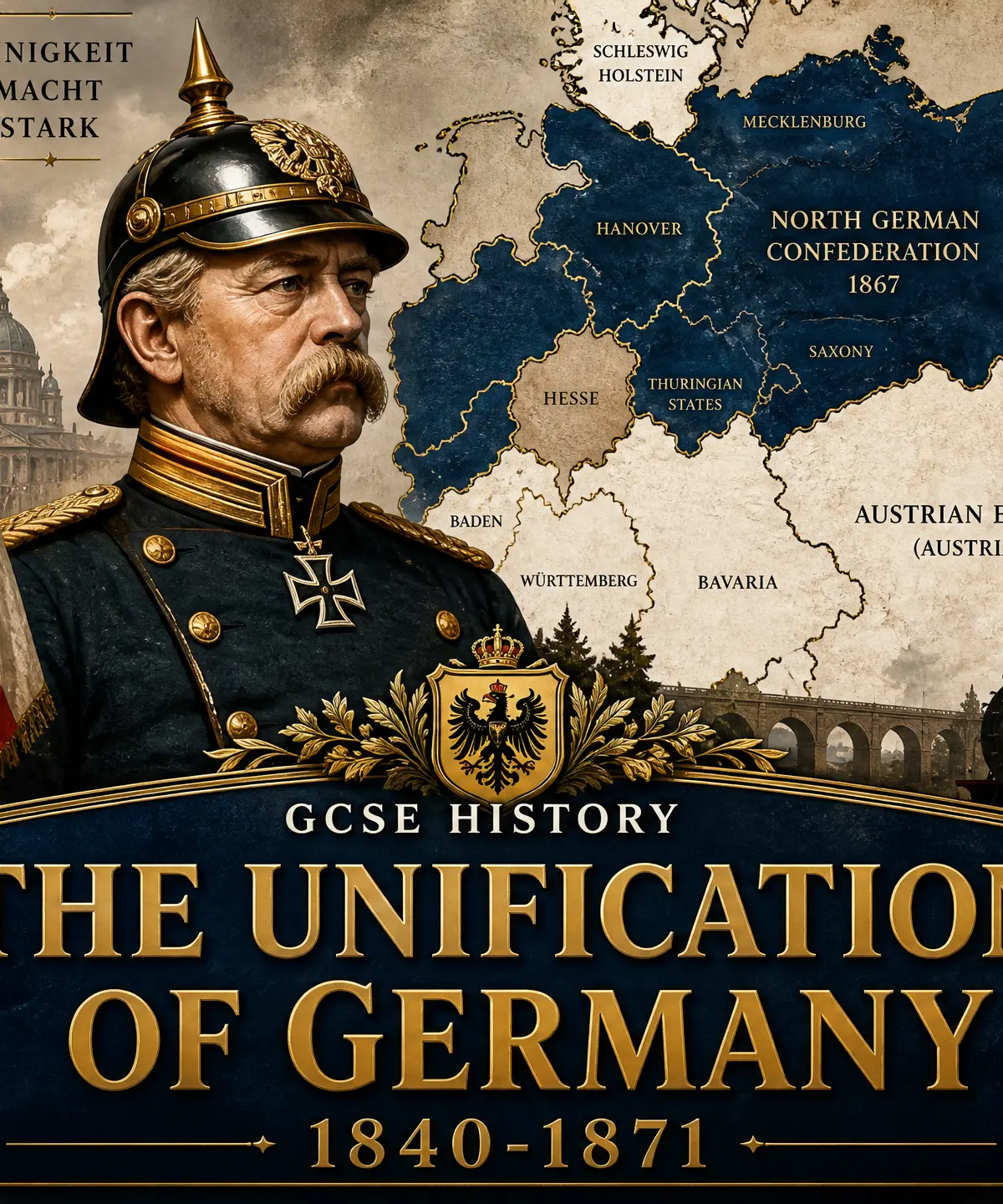
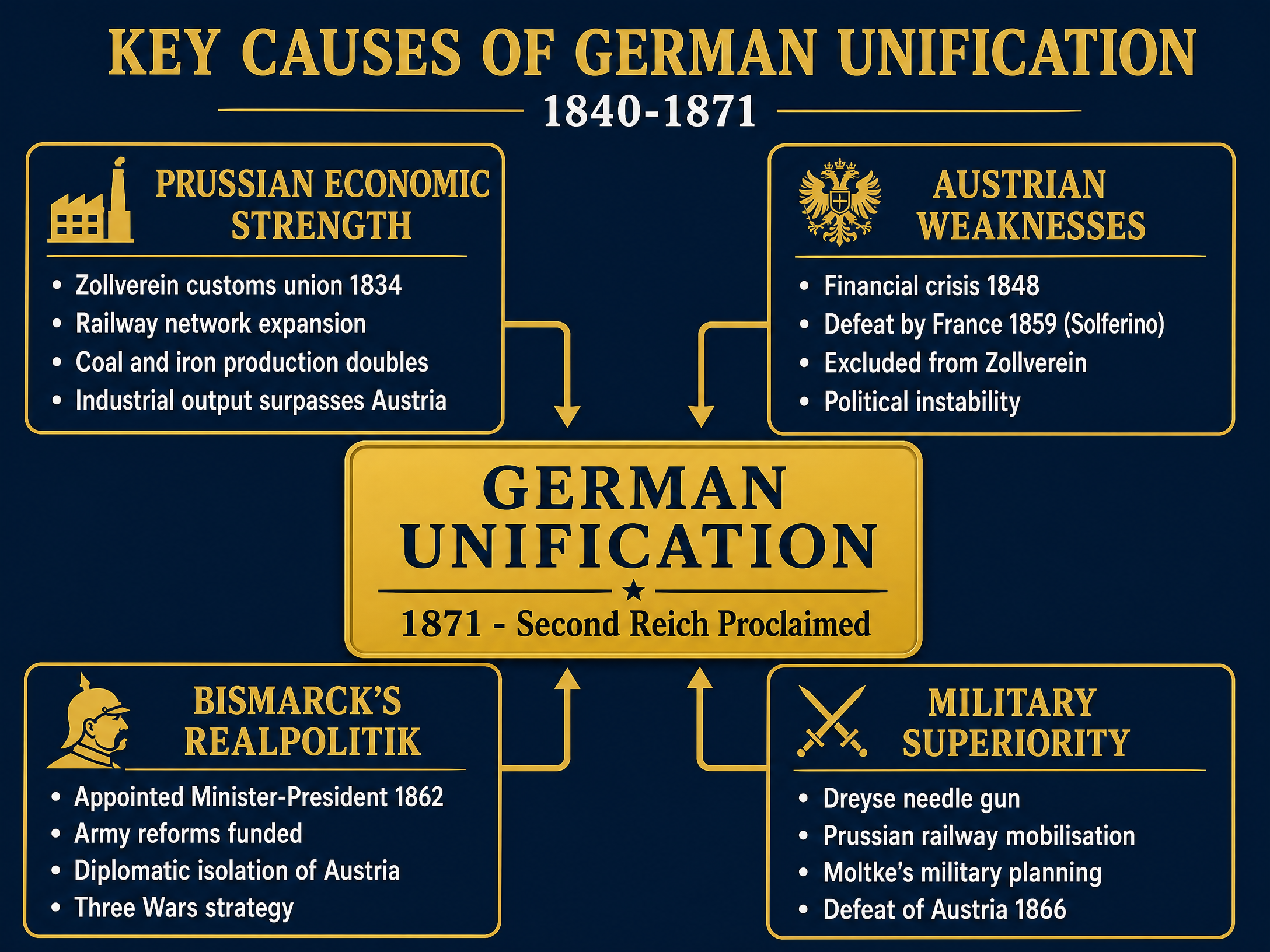
The unification of Germany between 1840 and 1871 is a core thematic study of shifting power dynamics in 19th-century Europe. During this period, the German Confederation—initially dominated by the Austrian Empire—was systematically dismantled and replaced by a unified German state under Prussian leadership. For your exam, examiners expect you to understand the complex interplay of economic, political, and military factors that drove this change. You must be able to evaluate the relative importance of Prussian economic growth (particularly the Zollverein), Austrian weaknesses, and the calculated diplomacy and wars orchestrated by Otto von Bismarck. A strong answer will move beyond a simple narrative of events to analyze how and why Prussia succeeded in excluding Austria and uniting the German states.
Key Events & Developments
The Zollverein (Customs Union)
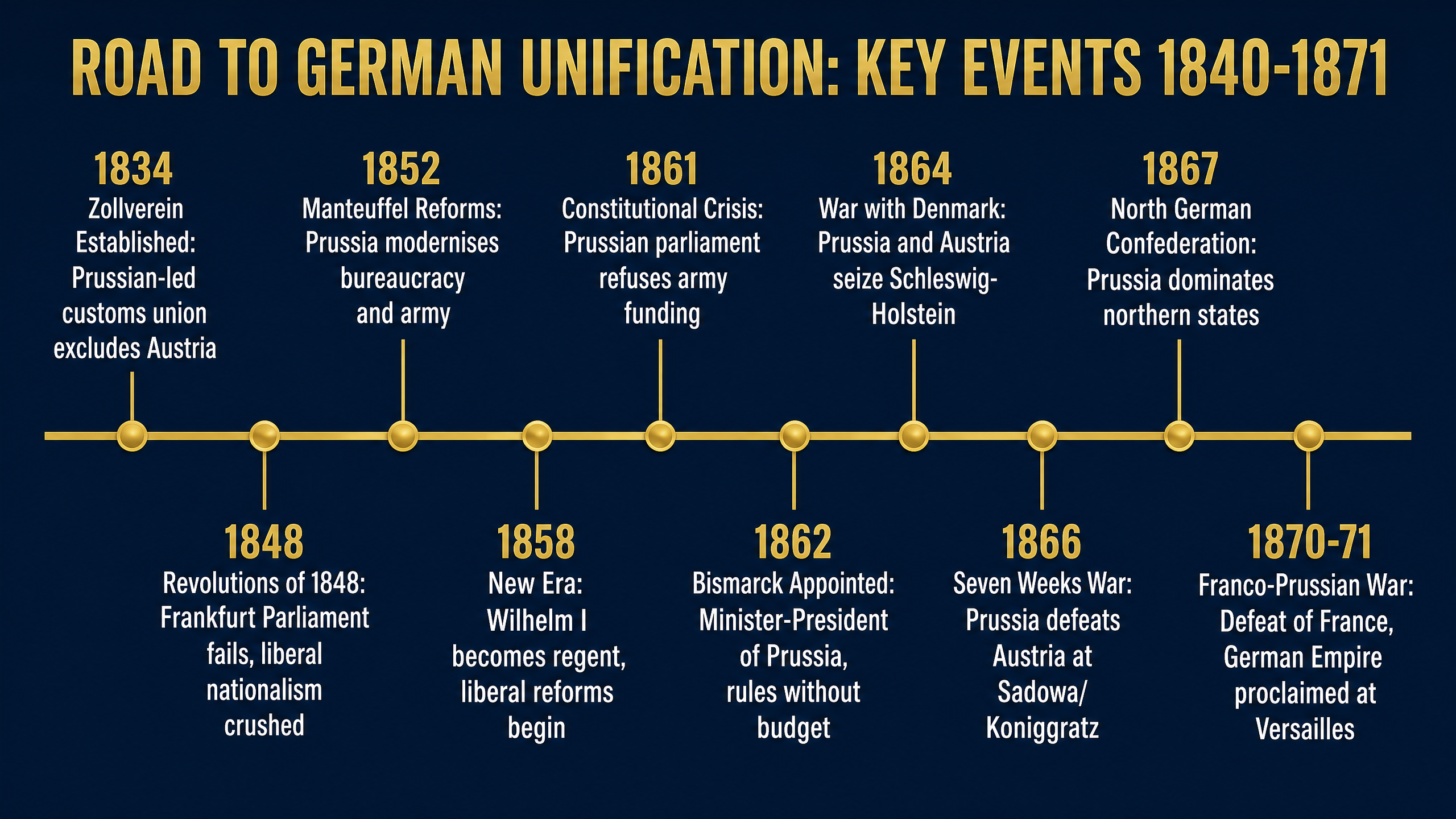
Date(s): Established 1834, expanded through the 1850s
What happened: A Prussian-led free trade area that abolished internal tariffs between most German states, while deliberately excluding Austria.
Why it matters: This is a crucial long-term economic cause of unification. It created a financially integrated Germany with Prussia at its center, isolating Austria economically before it was isolated militarily.
Specific Knowledge: By 1853, all major German states except Austria were members. It stimulated rapid industrialization; Prussian coal and iron production doubled between 1850 and 1860.
The Constitutional Crisis and Army Reforms
Date(s): 1860–1862
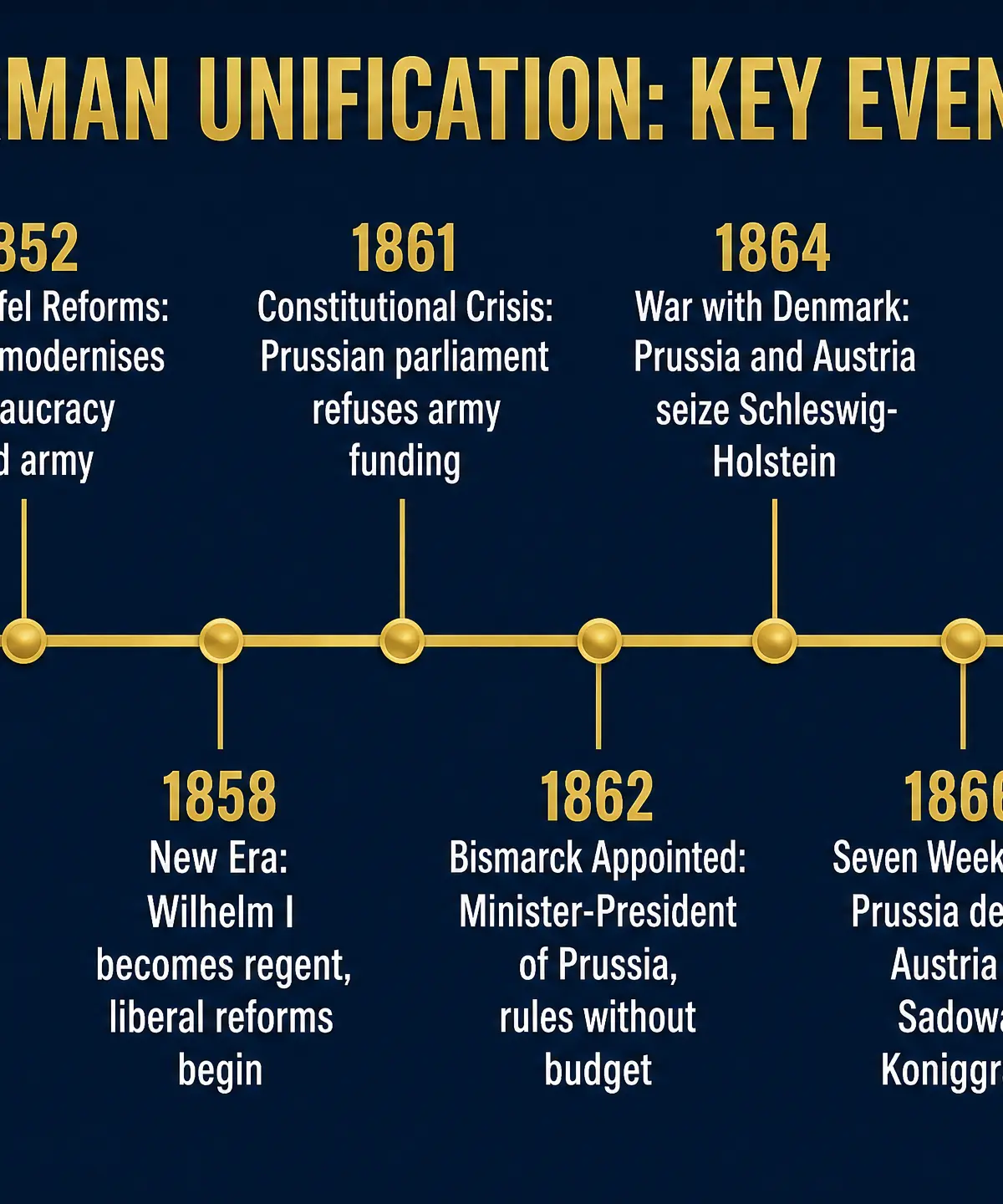
What happened: King Wilhelm I wanted to expand the Prussian army and extend military service from two to three years. The liberal Landtag (parliament) refused to pass the budget to fund this.
Why it matters: This crisis led directly to the appointment of Bismarck, who solved the deadlock by collecting taxes unconstitutionally, ensuring Prussia had the military strength needed for unification.
Specific Knowledge: Wilhelm I considered abdicating. Bismarck was appointed Minister-President in September 1862 and delivered his famous 'Blood and Iron' speech.
The War with Denmark
Date(s): 1864
What happened: Prussia and Austria formed an alliance to defeat Denmark and seize the disputed duchies of Schleswig and Holstein.
Why it matters: This was a manufactured conflict that allowed Bismarck to test the reformed Prussian army and, crucially, set a trap for Austria by creating a complex joint-administration agreement over the duchies that he could later exploit.
Specific Knowledge: Schleswig was administered by Prussia, Holstein by Austria (agreed at the Convention of Gastein, 1865).
The Seven Weeks War (Austro-Prussian War)
Date(s): June–August 1866
What happened: Following a dispute over Holstein, Prussia rapidly defeated Austria and its German allies.
Why it matters: This was the decisive turning point. It permanently excluded Austria from German affairs and led to the creation of the Prussian-dominated North German Confederation.
Specific Knowledge: The decisive Battle of Sadowa (Königgrätz) took place on 3 July 1866. Prussia's victory was aided by the rapid mobilization via railways and the superior rate of fire of the Dreyse needle gun. The Treaty of Prague ended the war.
Key Individuals
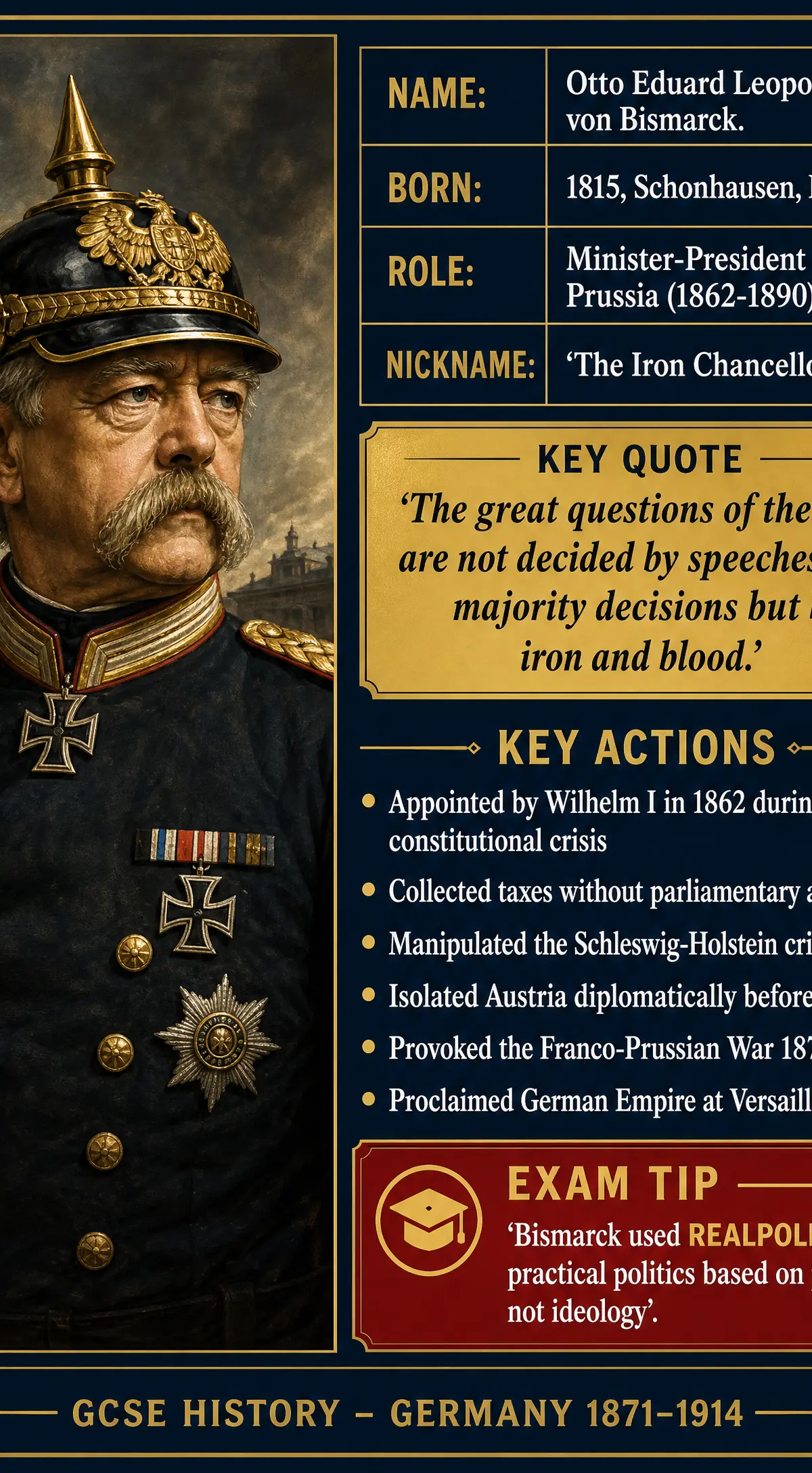
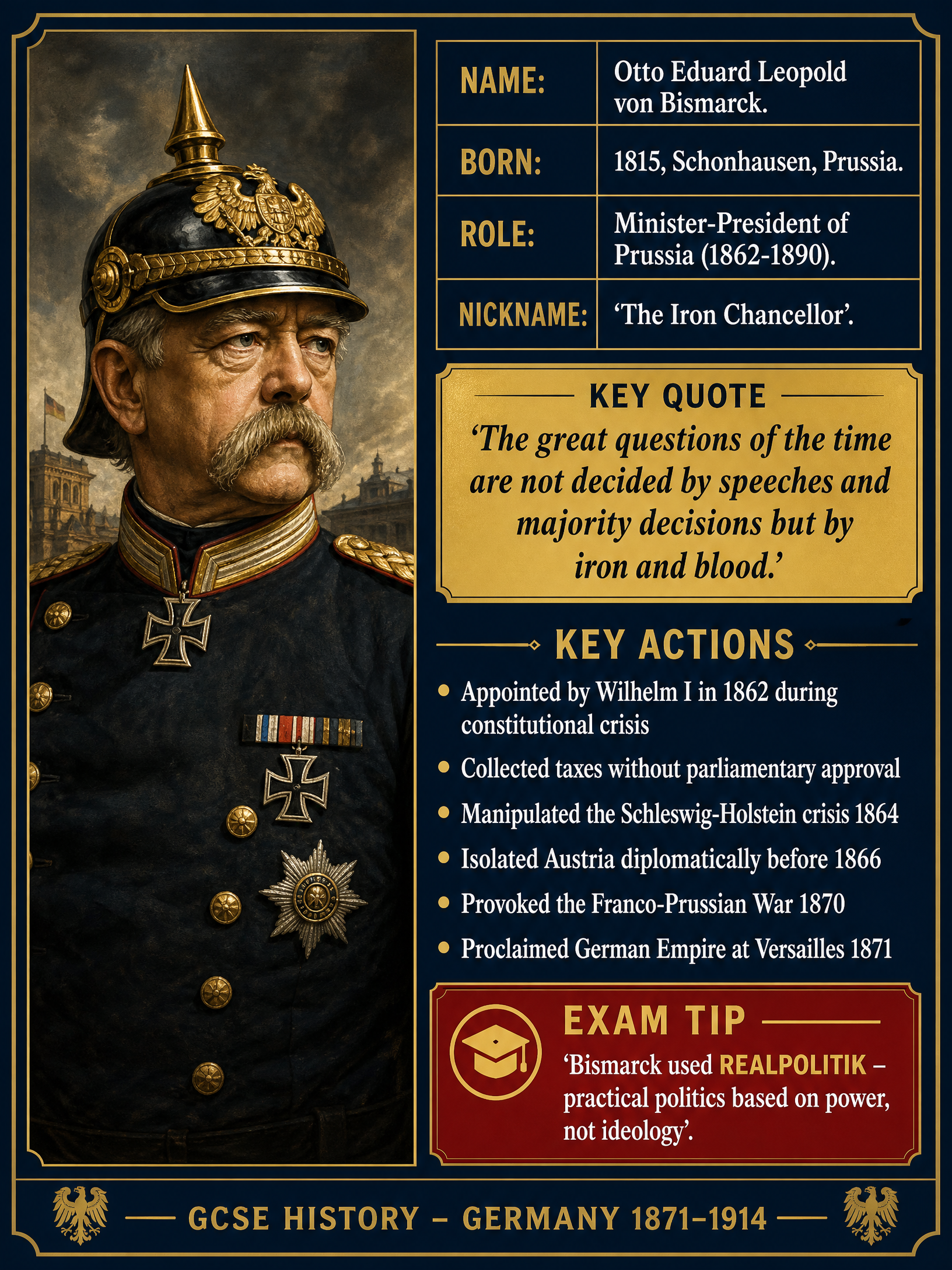
Otto von Bismarck
Role: Minister-President of Prussia (from 1862) and later Chancellor of the German Empire.
Key Actions: Resolved the constitutional crisis by bypassing parliament; modernized the army; isolated Austria diplomatically (securing Russian goodwill during the 1863 Polish Revolt and French neutrality before 1866); provoked the wars with Denmark and Austria.
Impact: The central architect of unification. He used 'Realpolitik'—practical politics based on power rather than ideology—to ensure Prussian dominance.
King Wilhelm I
Role: Regent of Prussia (1858–1861), King of Prussia (1861–1888), and first German Emperor (1871–1888).
Key Actions: Initiated the crucial army reforms; appointed Bismarck; allowed Bismarck to manage foreign policy despite occasional personal misgivings.
Impact: Provided the royal authority and backing that Bismarck needed to execute his strategies.
General Helmuth von Moltke
Role: Chief of the Prussian General Staff (1857–1888).
Key Actions: Revolutionized military strategy by utilizing railways for rapid mobilization and the telegraph for communication; commanded the victorious forces at Sadowa.
Impact: Ensured that Bismarck's diplomatic maneuvering was backed by unbeatable military execution.
Second-Order Concepts
Causation
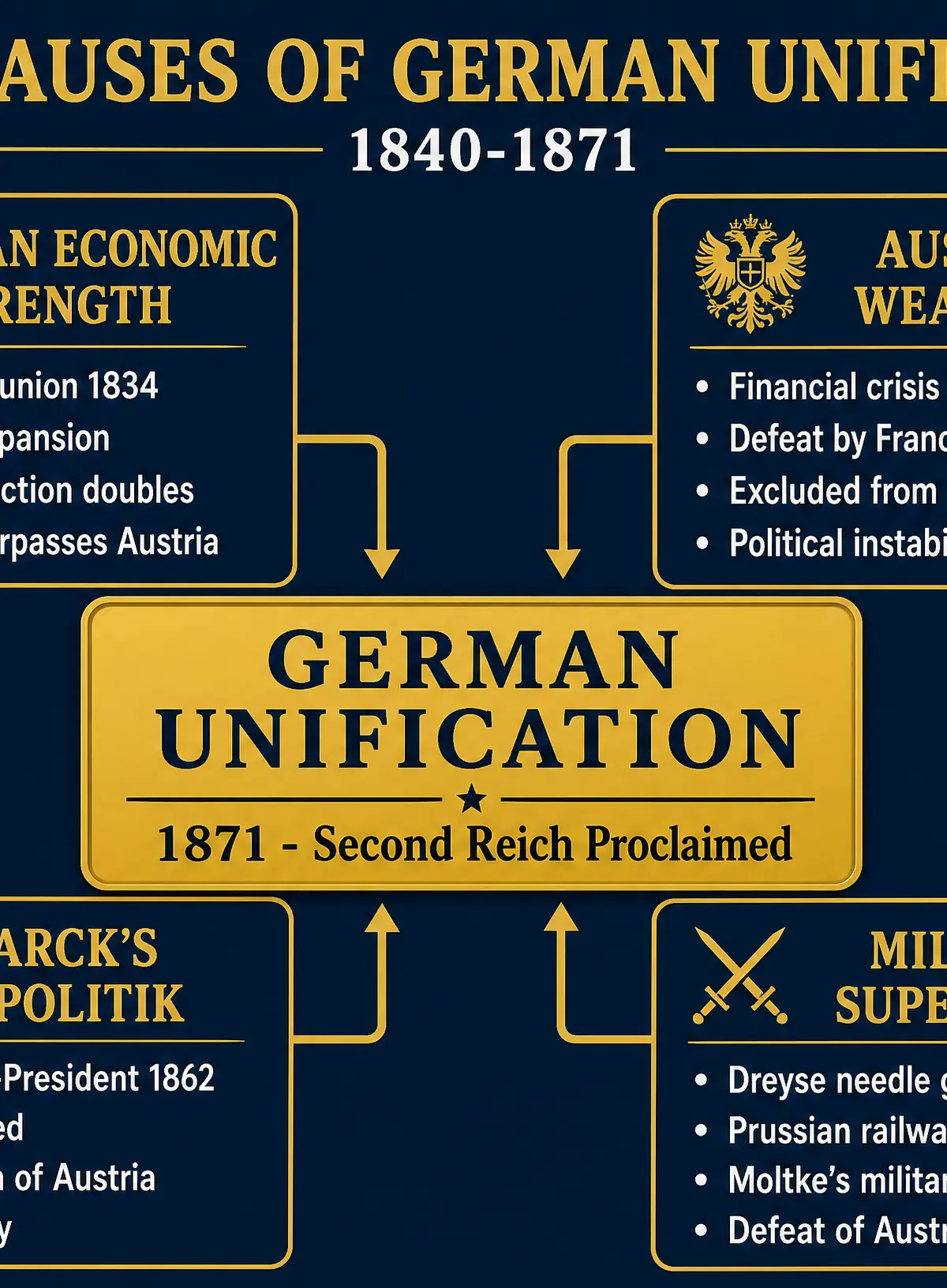
Unification was not caused by a single factor. Long-term economic factors (the Zollverein, industrialization) laid the groundwork. Medium-term political factors (army reforms, Bismarck's appointment) provided the means. Short-term triggers (the dispute over Schleswig-Holstein) provided the opportunity. Examiners reward answers that show how these causes interlinked.
Consequence
The immediate consequence of the 1866 war was the exclusion of Austria (Kleindeutschland or 'lesser Germany' solution) and the formation of the North German Confederation. The long-term consequence was a fundamental shift in the European balance of power, replacing a weak center with a military and industrial powerhouse.
Change & Continuity
While the political map of Germany changed dramatically between 1840 and 1871, the dominance of conservative, authoritarian elites (the Prussian Junkers) continued. Unification was achieved from 'above' by the military and the monarchy, not from 'below' by liberal revolutionaries (as had been attempted and failed in 1848).
Significance
The unification of Germany under Prussian leadership defined European history for the next century, setting the stage for the alliance systems and militarism that would eventually contribute to the outbreak of the First World War.
Source Skills
When evaluating sources for this topic, consider:
- Prussian official documents/speeches: Often emphasize the necessity of strong leadership and military readiness (e.g., Bismarck's speeches). Watch for justification of unconstitutional actions.
- Austrian sources: May highlight Prussian aggression or the betrayal of the German Confederation.
- Liberal German sources: Might show frustration with Bismarck's authoritarian methods, or later, a willingness to sacrifice liberal ideals for the achievement of national unity.
- Always check the date: A source from 1860 (during the crisis) will have a very different tone to one from 1867 (after the spectacular victory over Austria).
Audio Revision
Listen to this podcast episode for a comprehensive overview of the topic, including exam tips and a quick-fire recall quiz.
Visual Resources
3 diagrams and illustrations
Interactive Diagrams
1 interactive diagram to visualise key concepts
Conceptual Flow Outline
Interlinking causes of German Unification
Worked Examples
3 worked examples — open one to explore the question and available guidance.
Practice Questions
Test your understanding — click to reveal model answers
Describe two features of the Zollverein. (4 marks)
Hint: Think about who led it and who was left out.
Explain why the Prussian parliament clashed with King Wilhelm I in 1860. (8 marks)
Hint: Focus on the army reforms and the power struggle over the budget.
In what ways were the outcomes of the war with Denmark (1864) significant for German unification? (8 marks)
Hint: Think about how it set a trap for Austria.
Study Source C (A cartoon from a British magazine, 1866, showing Bismarck sweeping away Austrian soldiers). How useful is this source to a historian studying the Austro-Prussian War? (8 marks)
Hint: Apply the Content, Provenance, Limitations framework.
‘Prussian military strength was the main reason for the defeat of Austria in 1866.’ How far do you agree? (16 marks)
Hint: Agree by discussing weapons and tactics, but counter-argue with diplomacy and economics.
Test your understanding of The unification of Germany, c1840–71
Active recall beats re-reading. Take an instant quiz now to test what you’ve learned and lock it into long-term memory.
7 days Premium · Then free forever · No card, no charge