Pearson Edexcel · A-Level · History
The USA, 1955–92: conformity and challenge
This topic explores the explosive social changes in the USA between 1955 and 1992, focusing on the powerful protest movements that challenged inequality and the government's attempts to manage this upheaval. It is crucial for understanding how modern America was shaped by the tension between radical reform and conservative backlash.
- 10 min read
- 3 worked examples
- 5 practice questions
- 6 key terms
Study Notes
Overview
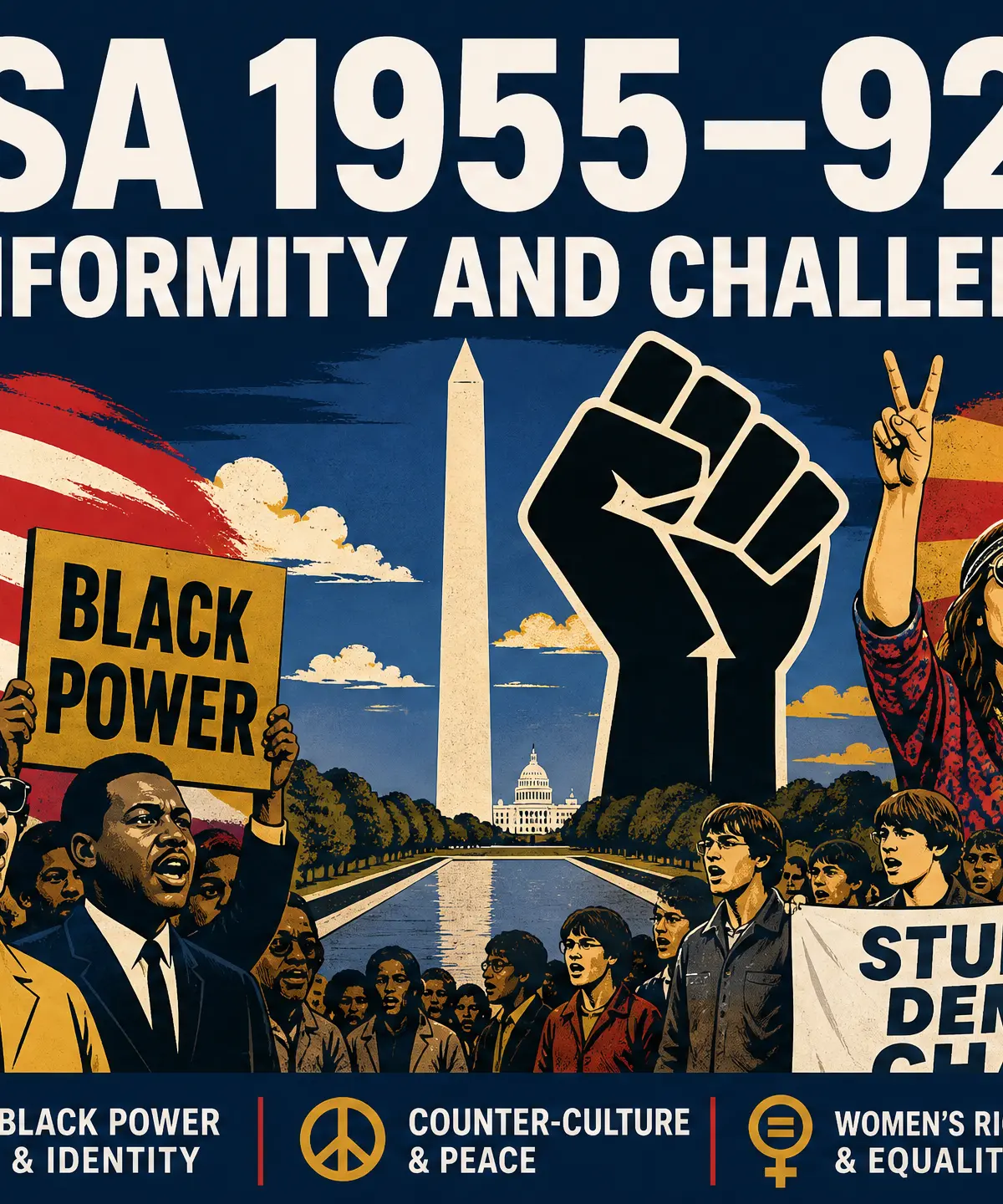
The period from 1955 to 1992 in the United States was defined by a profound struggle between conformity and challenge. Following World War Two, the USA projected an image of prosperity and freedom, but this masked deep inequalities. Marginalised groups—particularly Black Americans, women, and the LGBTQ+ community—began to forcefully challenge the status quo, demanding civil rights and social justice.
Examiners expect candidates to understand not just the narrative of these protests, but their causes, consequences, and significance. You must be able to analyse the differing methods of leaders like Martin Luther King Jr. and Malcolm X, and evaluate the effectiveness of government responses, from Lyndon B. Johnson's ambitious 'Great Society' to Richard Nixon's appeal to the 'silent majority'. High marks are awarded for linking these events together and deploying specific knowledge—dates, names, and statistics—to support your arguments.
Key Events & Developments
The March on Washington
Date(s): August 1963
What happened: Over 250,000 people gathered in Washington D.C. to demand civil and economic rights for African Americans. It was here that Martin Luther King Jr. delivered his iconic "I Have a Dream" speech.
Why it matters: This event demonstrated the massive public support for the civil rights movement and put immense pressure on the federal government to act, directly contributing to the passage of the Civil Rights Act the following year.
Specific Knowledge: 250,000 attendees; Martin Luther King Jr.; "I Have a Dream" speech; Lincoln Memorial.
The Civil Rights Act and Voting Rights Act
Date(s): 1964 and 1965
What happened: The Civil Rights Act (1964) outlawed discrimination based on race, colour, religion, sex, or national origin. The Voting Rights Act (1965) prohibited racial discrimination in voting, specifically targeting practices like literacy tests in the South.
Why it matters: These acts represent the legislative peak of the civil rights movement, legally dismantling the Jim Crow system of segregation. However, they did not immediately solve economic inequality or de facto segregation in the North.
Specific Knowledge: Signed by President Lyndon B. Johnson; followed the Birmingham campaign (1963) and Selma to Montgomery marches (1965).
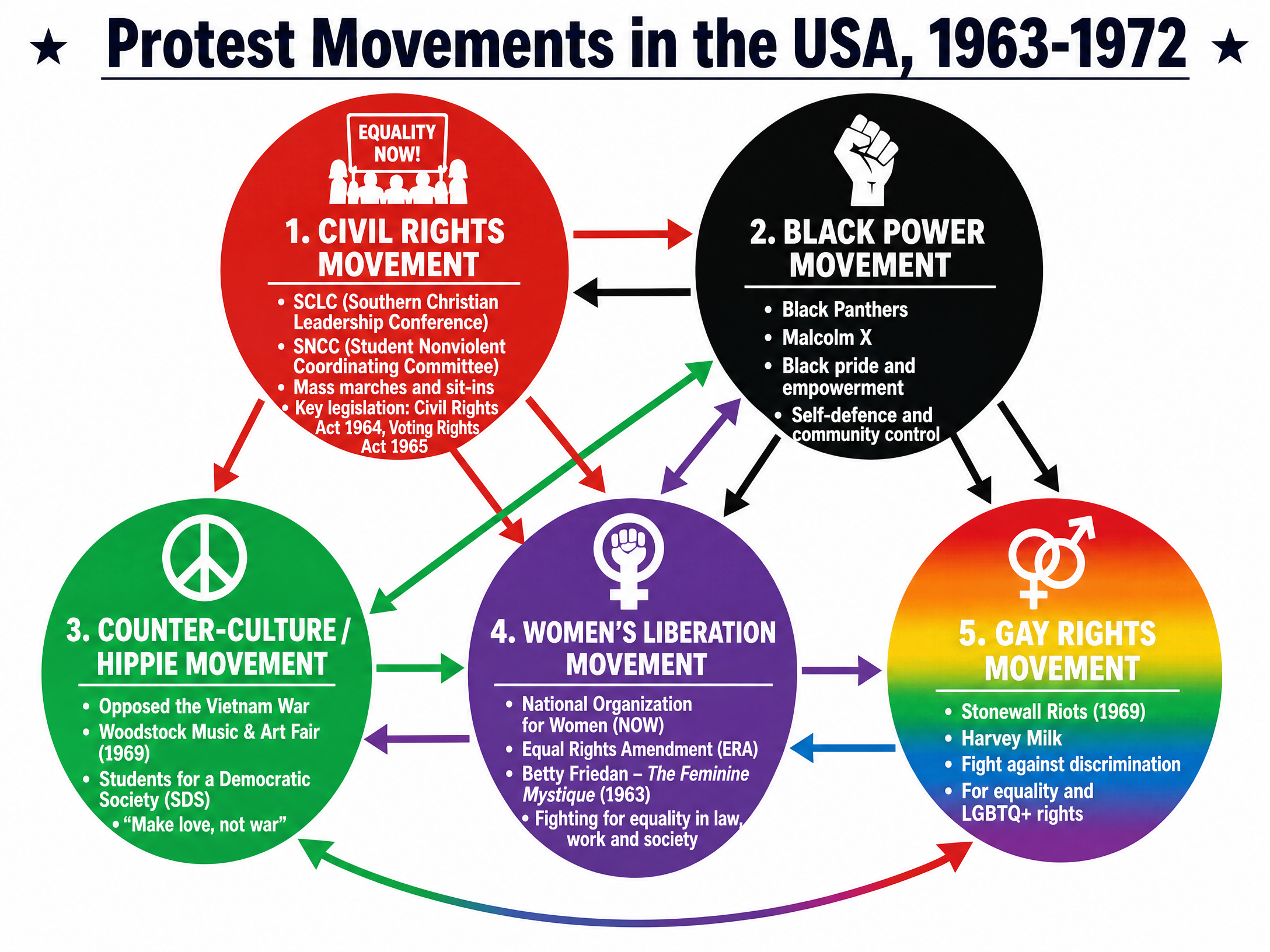
The Rise of Black Power
Date(s): Mid-1960s to early 1970s
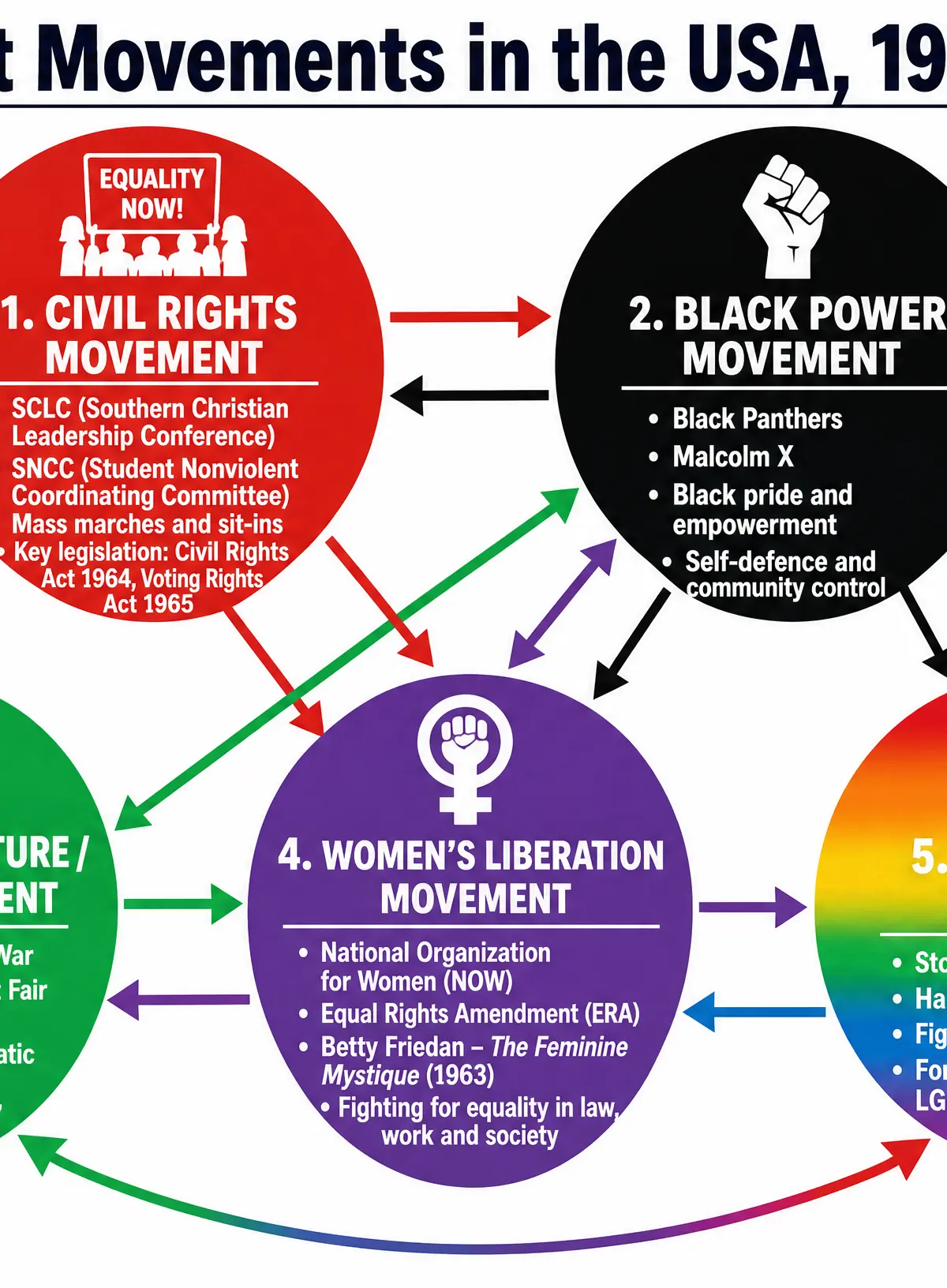
What happened: Frustrated by the slow pace of change and ongoing police brutality, many younger Black Americans turned away from King's non-violent approach towards a more militant stance advocating for Black pride, self-reliance, and armed self-defence.
Why it matters: It fundamentally shifted the tone of the civil rights struggle. It alarmed many white Americans, contributing to a conservative backlash, but also fostered a powerful sense of Black identity and community empowerment.
Specific Knowledge: Malcolm X (assassinated 1965); Black Panther Party founded by Huey Newton and Bobby Seale in Oakland (1966); 1968 Olympics Black Power salute by Tommie Smith and John Carlos.
The Counter-Culture and Anti-War Movement
Date(s): 1960s
What happened: A youth-led movement that rejected traditional American values, consumerism, and the Vietnam War. It encompassed everything from the hippie lifestyle to radical student politics.
Why it matters: The counter-culture deeply divided American society. The anti-war protests, particularly after the Tet Offensive in 1968, played a major role in turning public opinion against the Vietnam War and forcing Johnson not to seek re-election.
Specific Knowledge: Students for a Democratic Society (SDS) founded 1962; Woodstock festival (August 1969, 400,000 attendees); Kent State shootings (May 1970, 4 students killed).
The Women's Liberation Movement
Date(s): 1960s and 1970s
What happened: A renewed push for gender equality, challenging traditional domestic roles and demanding equal pay, reproductive rights, and an end to workplace discrimination.
Why it matters: It led to significant legislative changes (like Title IX and the Roe v. Wade Supreme Court decision in 1973) and fundamentally altered societal expectations of women, though the Equal Rights Amendment (ERA) ultimately failed to be ratified.
Specific Knowledge: Betty Friedan's The Feminine Mystique (1963); National Organization for Women (NOW) founded 1966.
The Origins of Gay Rights
Date(s): June 1969
What happened: The Stonewall Riots in New York City, where patrons of a gay bar fought back against a police raid, sparking days of protests.
Why it matters: Stonewall is widely considered the catalyst for the modern LGBTQ+ rights movement, leading to the formation of the Gay Liberation Front and the first Pride marches.
Specific Knowledge: Stonewall Inn, Greenwich Village, New York City; June 1969.
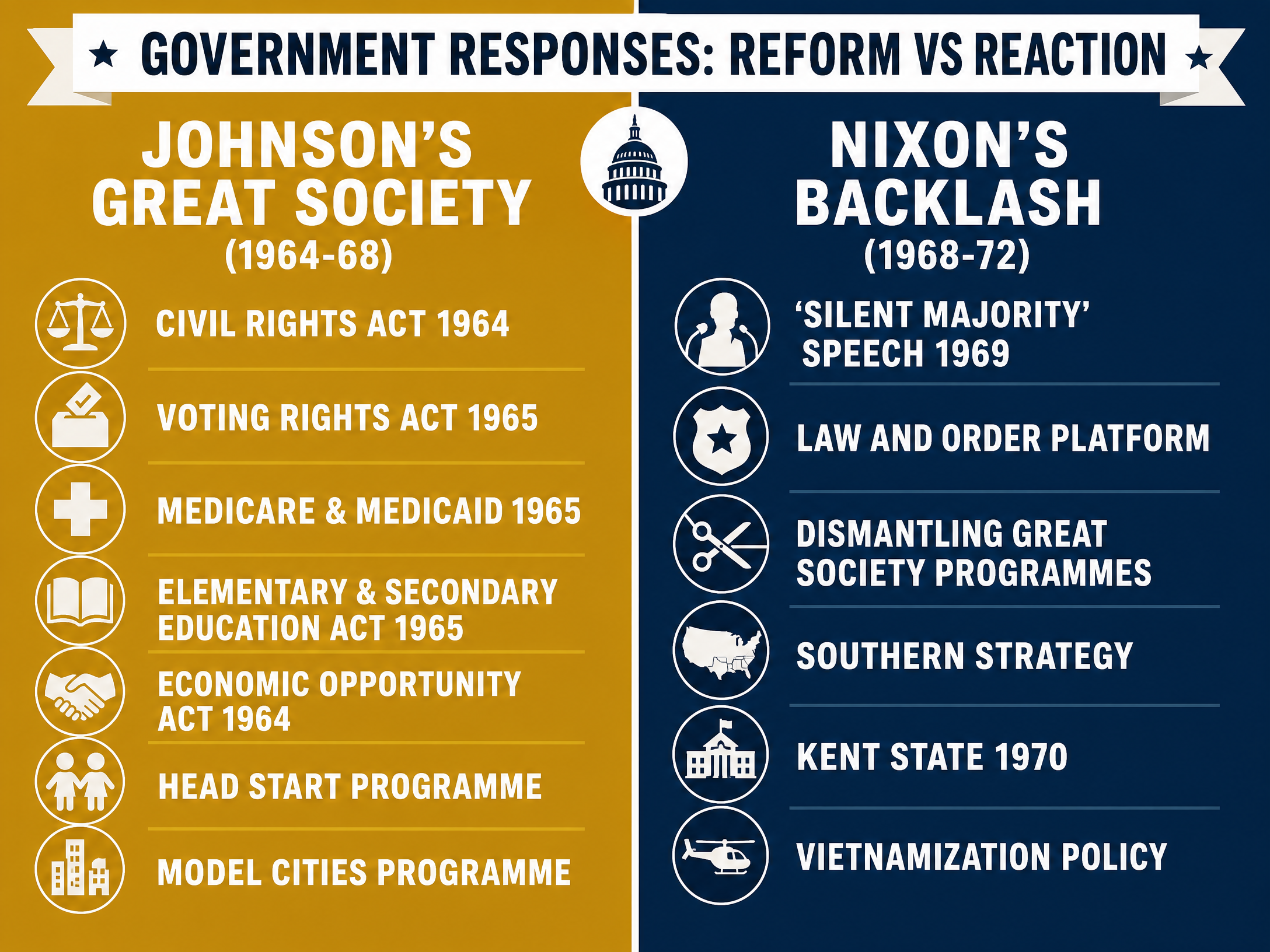
Johnson's Great Society vs. Nixon's Backlash
Date(s): 1964-1968 (Johnson) and 1968-1974 (Nixon)
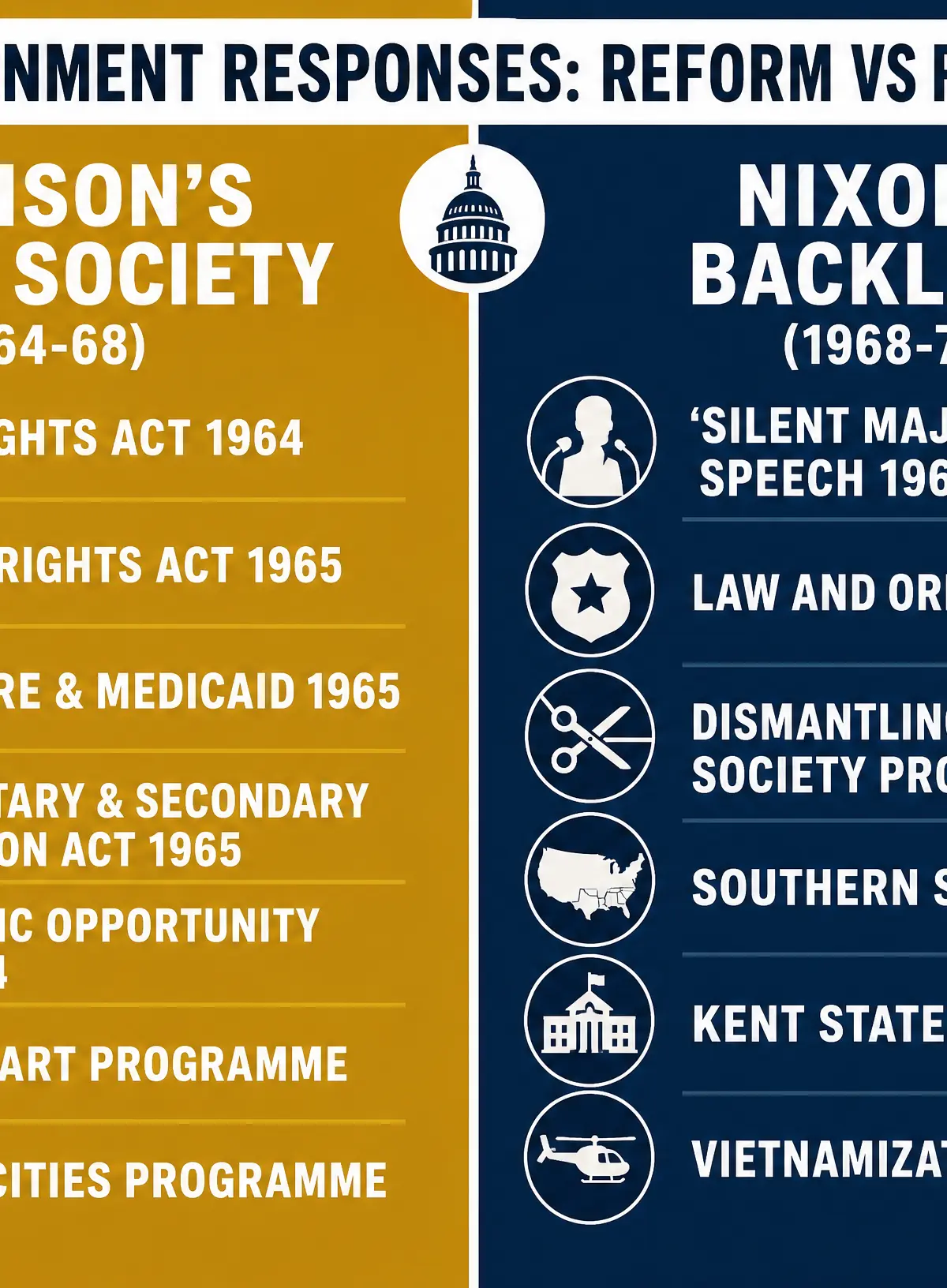
What happened: Johnson launched a massive suite of domestic programs aimed at eliminating poverty and racial injustice. Nixon, capitalising on white working-class fears of riots and protests, won the presidency by appealing to the 'silent majority' and promising a return to 'law and order'.
Why it matters: This demonstrates the cyclical nature of American politics—a period of intense progressive reform followed by a conservative reaction. The Great Society significantly expanded the welfare state, while Nixon's election marked the beginning of a rightward shift in American politics.
Specific Knowledge: Great Society: Medicare and Medicaid (1965), Head Start. Nixon: 'Silent majority' speech (November 1969), Southern Strategy.
Key Individuals
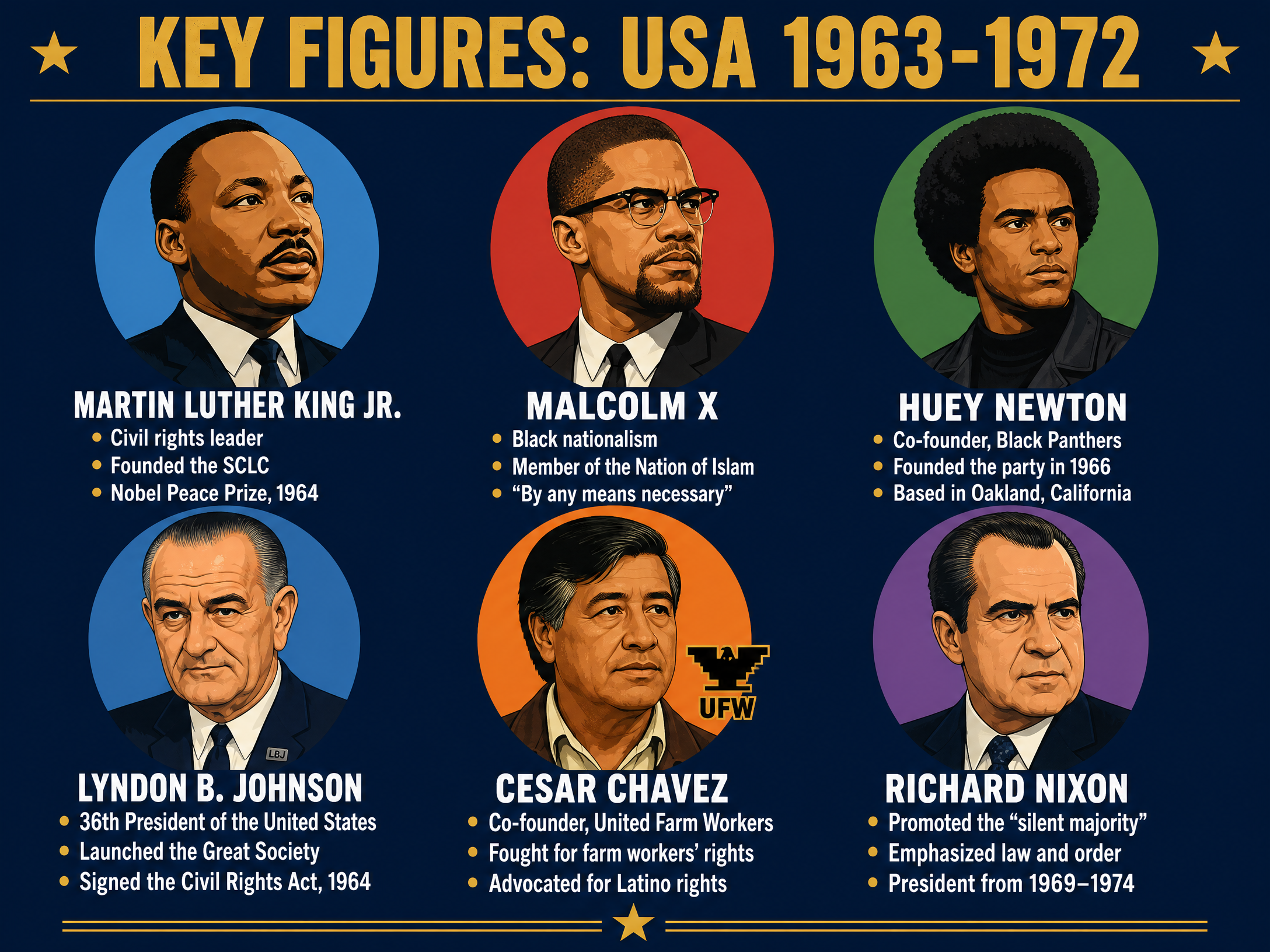
Martin Luther King Jr.
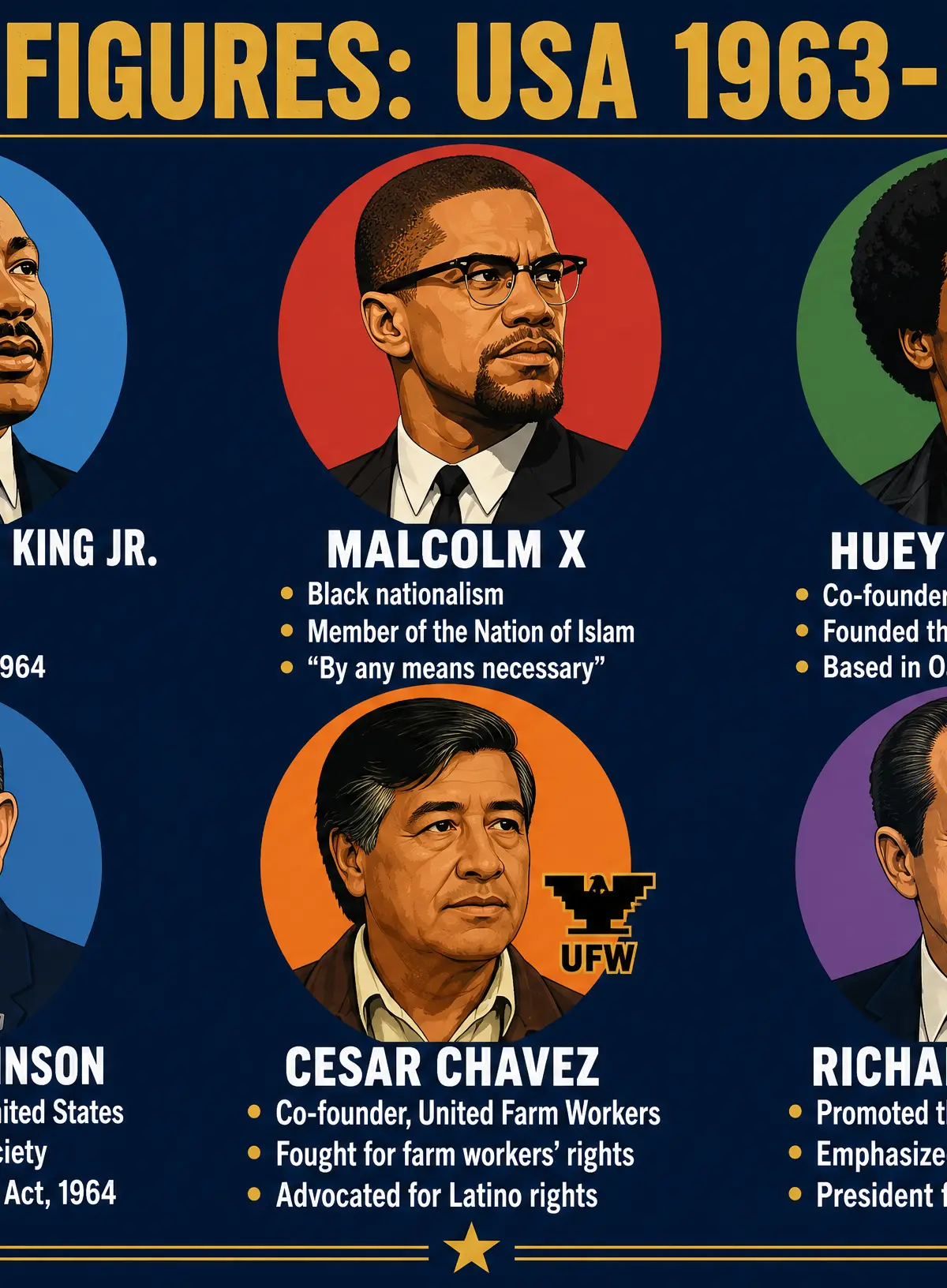
Role: Leader of the Southern Christian Leadership Conference (SCLC) and the most prominent figure of the mainstream civil rights movement.
Key Actions: Led the Montgomery Bus Boycott (1955), the Birmingham campaign (1963), the March on Washington (1963), and the Selma marches (1965). Advocated non-violent direct action.
Impact: His campaigns successfully highlighted the brutality of segregation, forcing federal intervention and the passage of landmark civil rights legislation.
Malcolm X
Role: Prominent figure in the Nation of Islam (until 1964) and a leading voice for Black nationalism.
Key Actions: Criticised King's non-violent approach, advocating for Black separatism and self-defence 'by any means necessary'.
Impact: He inspired the Black Power movement and articulated the deep frustrations of urban Black Americans in the North, shifting the discourse beyond just legal rights to economic and social empowerment.
Lyndon B. Johnson (LBJ)
Role: 36th President of the United States (1963-1969).
Key Actions: Pushed through the Civil Rights Act (1964) and Voting Rights Act (1965). Launched the 'Great Society' domestic agenda. Escalated US involvement in Vietnam.
Impact: His domestic policies represented the most significant expansion of the American welfare state since the New Deal, but his presidency was ultimately derailed by the deeply unpopular Vietnam War.
Richard Nixon
Role: 37th President of the United States (1969-1974).
Key Actions: Campaigned on a 'law and order' platform. Appealed to the 'silent majority' of Americans who opposed the counter-culture and anti-war protests. Employed the 'Southern Strategy' to win white voters in the South.
Impact: He successfully harnessed the conservative backlash against the 1960s protest movements, realigning American politics before his resignation over the Watergate scandal.
Cesar Chavez
Role: Mexican-American labour leader and civil rights activist.
Key Actions: Co-founded the United Farm Workers (UFW) union in 1962. Led the successful Delano grape strike and boycott (1965-1970).
Impact: He successfully fought for better wages and working conditions for Latino farm workers, demonstrating that civil rights struggles extended beyond Black Americans.
Second-Order Concepts
Causation
Examiners expect you to distinguish between long-term causes (e.g., decades of systemic racism and Jim Crow laws), short-term causes (e.g., the success of the Montgomery Bus Boycott), and triggers (e.g., the police violence in Birmingham or Selma broadcast on television). You must explain how one event led to another, rather than just listing them.
Consequence
The consequences of the protest movements were both legislative (the Civil Rights Acts) and social (changes in attitudes towards women, the LGBTQ+ community, and the government). However, a crucial consequence of the radicalism of the late 1960s was the conservative backlash that propelled Nixon to power.
Change & Continuity
While there was immense change in the legal status of minorities (the end of de jure segregation), there was significant continuity in economic inequality. De facto segregation (segregation in practice, often due to housing and economic disparity) continued to plague Northern cities, fueling the Black Power movement.
Significance
The significance of this period lies in its fundamental reshaping of American society. The protest movements of the 1960s established the framework for modern debates about race, gender, sexuality, and the role of government, making it a pivotal era in modern history.
Source Skills
When evaluating sources for this topic, consider:
- Provenance: Who wrote it? A speech by King will have a very different purpose to an FBI memo by J. Edgar Hoover. When was it written? A source from 1963 (optimism of the March on Washington) differs greatly from one in 1968 (year of assassinations and riots).
- Purpose: Is the source trying to persuade, inform, or justify an action? Nixon's 'silent majority' speech was explicitly designed to isolate protesters and consolidate his political base.
- Limitations: What does the source not tell us? A photograph of a peaceful protest does not show the systemic economic issues that caused it; a government report on crime may ignore police brutality.
Visual Resources
3 diagrams and illustrations
Interactive Diagrams
1 interactive diagram to visualise key concepts
Diagram could not be rendered
Chronological timeline of major events across different protest movements.
Worked Examples
3 worked examples — open one to explore the question and available guidance.
Practice Questions
Test your understanding — click to reveal model answers
Describe two features of the Black Panther Party. (4 marks)
Hint: Identify a feature, then add a specific detail to develop it.
Explain why the student protest movement grew in the 1960s. (12 marks)
Hint: Think about the Vietnam War, the influence of the civil rights movement, and changing cultural values.
‘The Vietnam War was the main reason why Johnson's Great Society failed to achieve its goals.’ How far do you agree? (16 marks)
Hint: Balance the impact of the war against other factors like conservative opposition or the sheer scale of the poverty problem.
Explain the significance of the Stonewall Riots (1969). (8 marks)
Hint: Focus on the change from hidden subculture to active, public political movement.
Describe two achievements of the Women's Liberation Movement in the 1960s and 1970s. (4 marks)
Hint: Think about legislation or shifts in public awareness.
Test your understanding of The USA, 1955–92: conformity and challenge
Active recall beats re-reading. Take an instant quiz now to test what you’ve learned and lock it into long-term memory.
7 days Premium · Then free forever · No card, no charge