Pearson Edexcel · A-Level · History
The USA, c1920–55: boom, bust and recovery
This study guide covers the dramatic transformation of the USA from the roaring twenties through the Great Depression to post-war prosperity. It is essential for understanding how economic policies, social changes, and the Cold War shaped modern America, providing crucial evidence for evaluation and causation questions.
- 8 min read
- 3 worked examples
- 5 practice questions
- 6 key terms
Study Notes
Overview
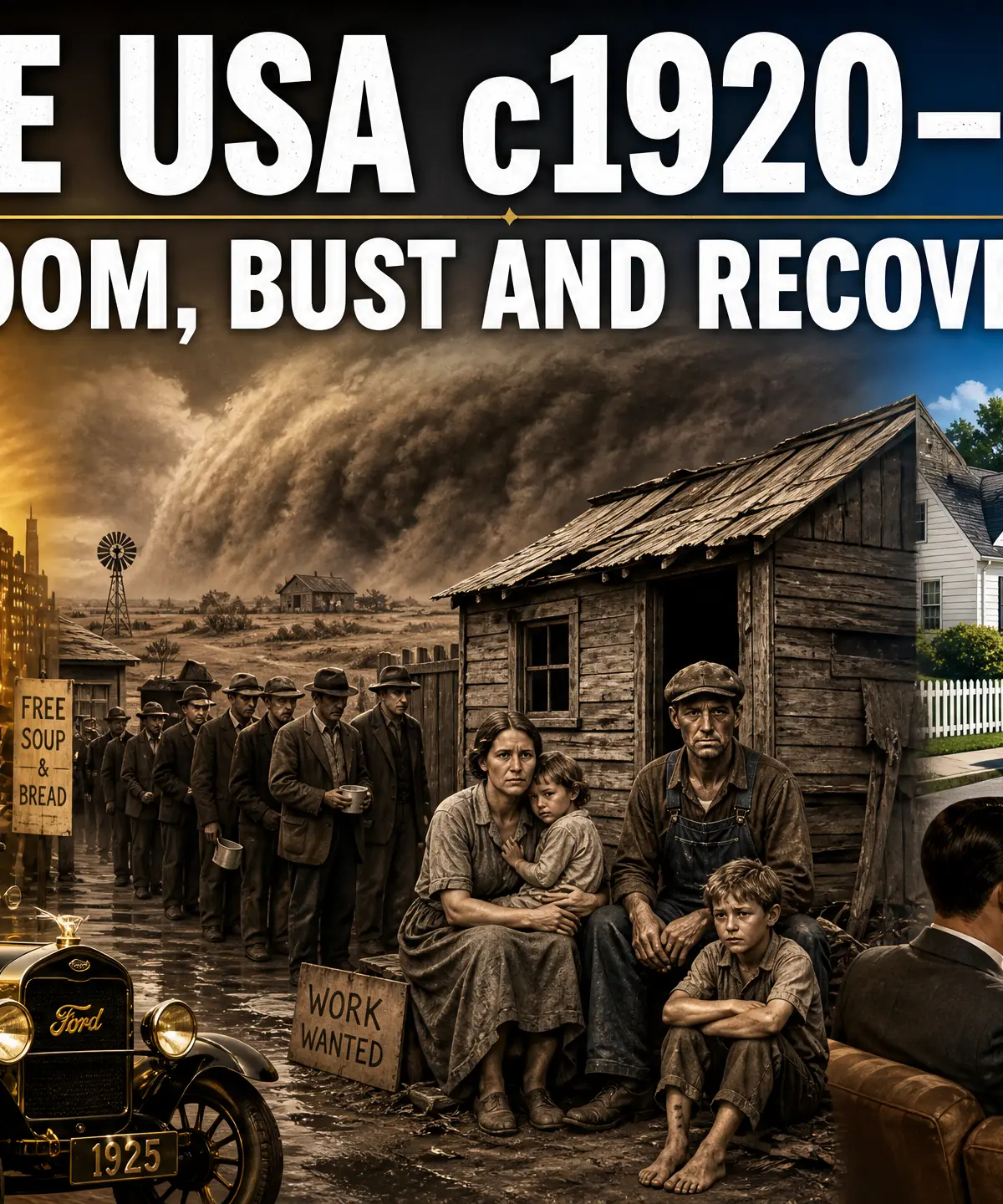
This study covers a pivotal 35-year period in American history, tracking the nation's journey from the unprecedented economic boom of the 1920s, through the devastating collapse of the Great Depression in the 1930s, to the remarkable post-war recovery and social transformation of 1945–55. Examiners expect candidates to demonstrate a deep understanding of causation (why the boom happened and why it ended), consequence (the impact of the Depression and the New Deal), and the extent of change (how much society truly transformed for different groups). You must be able to deploy specific knowledge—such as the impact of the GI Bill, the realities of McCarthyism, and the significance of the Brown v. Board of Education ruling—to evaluate historical interpretations and construct balanced arguments.
Listen to the companion podcast below for a comprehensive audio review of the entire topic, featuring exam tips and a quick-fire recall quiz:
Key Events & Developments
The Economic Boom of the 1920s
Date(s): 1920–1929
What happened: Following the First World War, the USA experienced rapid economic growth. This was driven by mass production techniques (pioneered by Henry Ford), the expansion of credit and hire purchase, and laissez-faire Republican government policies that kept taxes low and tariffs high to protect domestic industries.
Why it matters: This period established the modern consumer society. However, the uneven distribution of wealth and underlying structural weaknesses in agriculture and banking directly caused the subsequent economic collapse.
Specific Knowledge: By 1929, the USA produced 46% of the world's industrial output. Ford produced a Model T every 10 seconds. However, 60% of Americans still lived below the poverty line.
The Wall Street Crash and Great Depression
Date(s): October 1929 – 1939
What happened: Panic selling on the New York Stock Exchange led to a market collapse, wiping out billions in value. This triggered a severe economic depression characterised by mass unemployment, bank failures, and widespread poverty (symbolised by 'Hoovervilles').
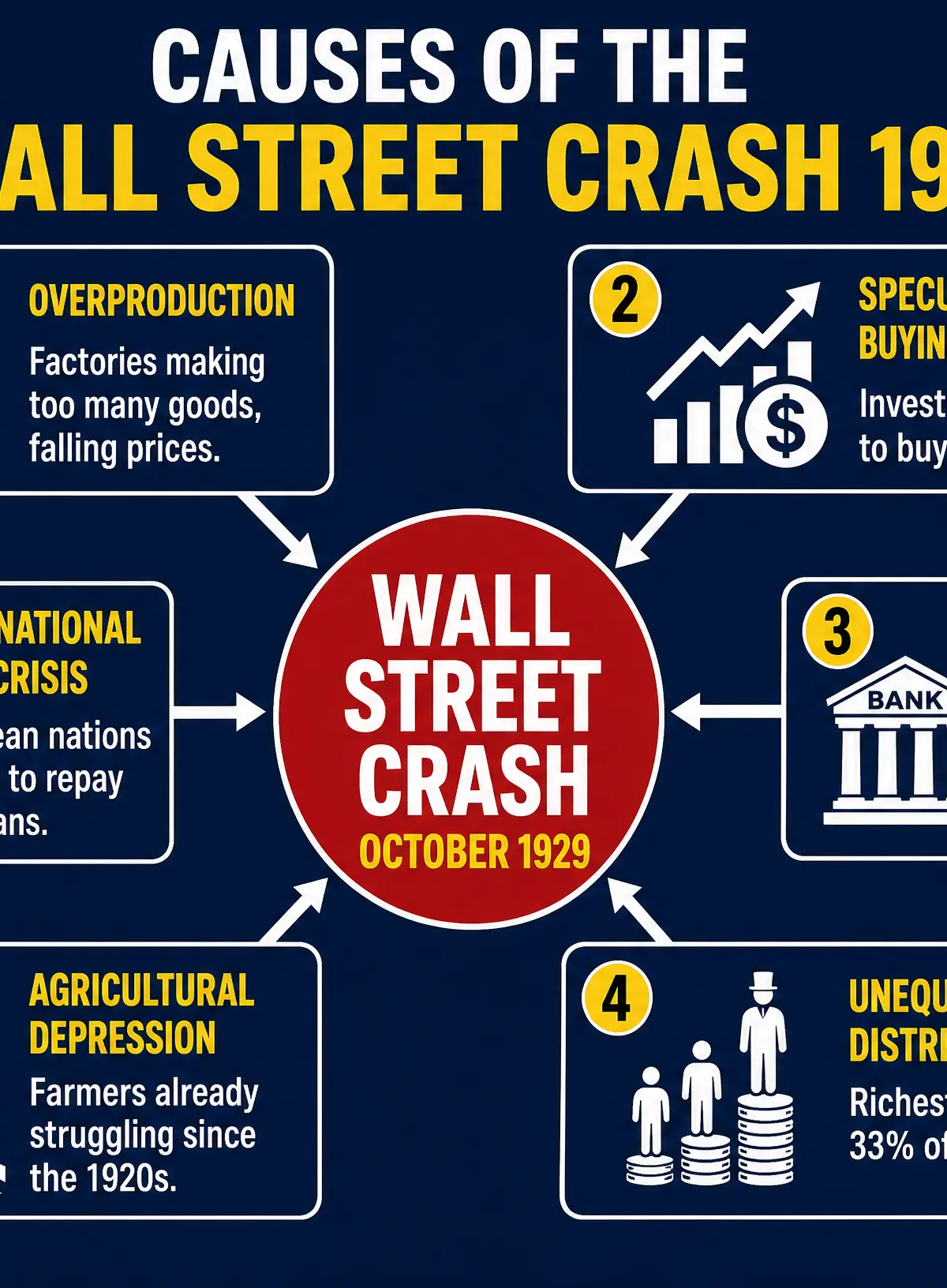
Why it matters: The Depression fundamentally changed the relationship between the American people and their government, ending the era of laissez-faire capitalism and ushering in federal intervention.
Specific Knowledge: Unemployment peaked at 25% (around 14 million people) in 1933. Approximately 5,000 banks collapsed between 1929 and 1933. Industrial production halved.
Roosevelt's New Deal
Date(s): 1933–1939
What happened: President Franklin D. Roosevelt introduced a series of federal programmes designed to provide Relief, Recovery, and Reform. This included massive public works projects, agricultural subsidies, and the introduction of social security.
Why it matters: The New Deal expanded the role of the federal government and provided crucial relief, though historians debate its ultimate economic success. It reshaped American politics, creating a new Democratic coalition.
Specific Knowledge: The Civilian Conservation Corps (CCC) employed 3 million young men. The Works Progress Administration (WPA) employed 8.5 million. The Social Security Act of 1935 introduced the first national system of pensions and unemployment insurance.
Post-War Prosperity and Suburbanisation
Date(s): 1945–1955
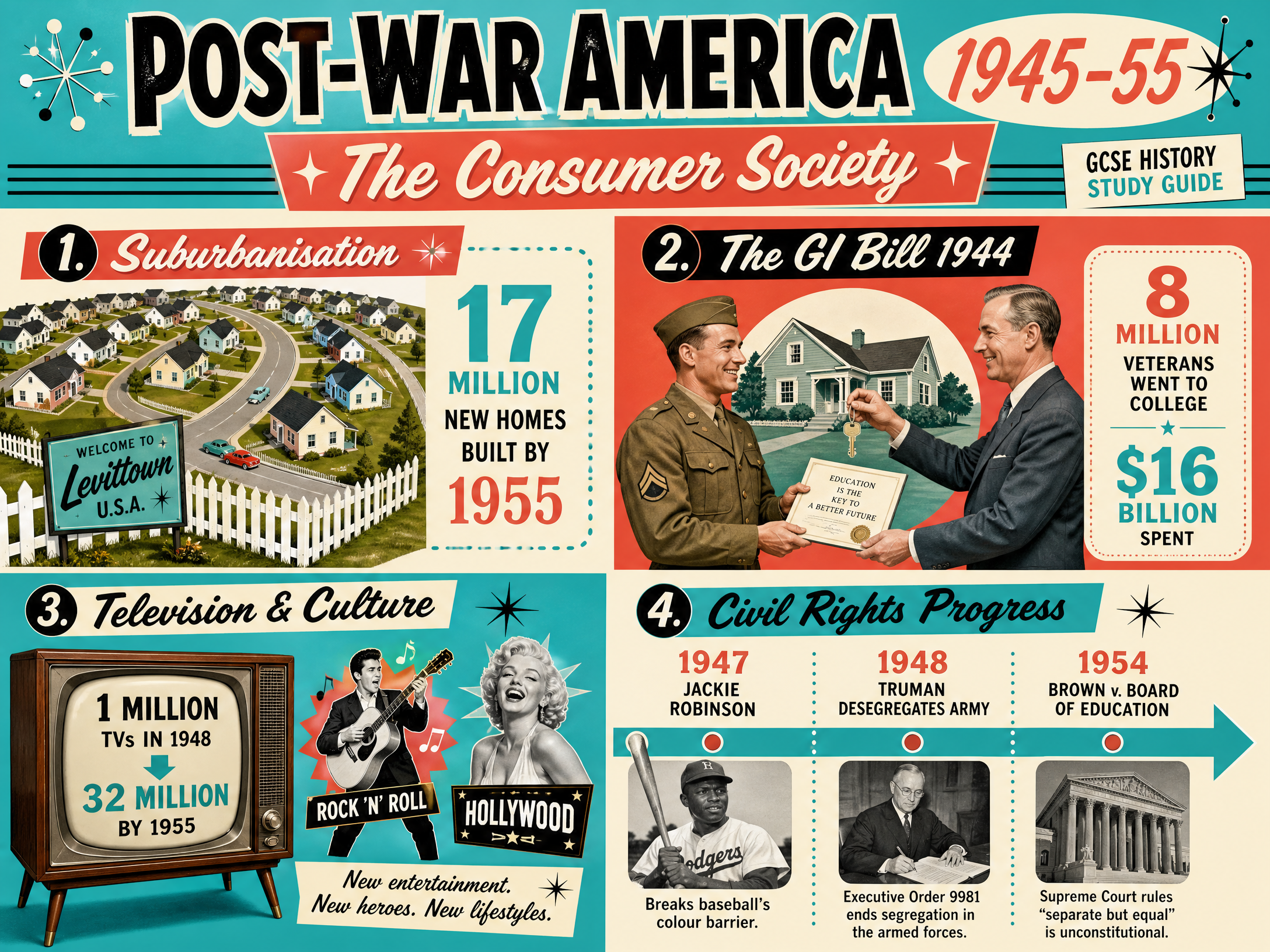
What happened: Following WWII, the USA experienced another massive economic boom. The GI Bill provided veterans with mortgages and education funding, leading to the rapid growth of suburbs (like Levittown) and a new, affluent middle class.
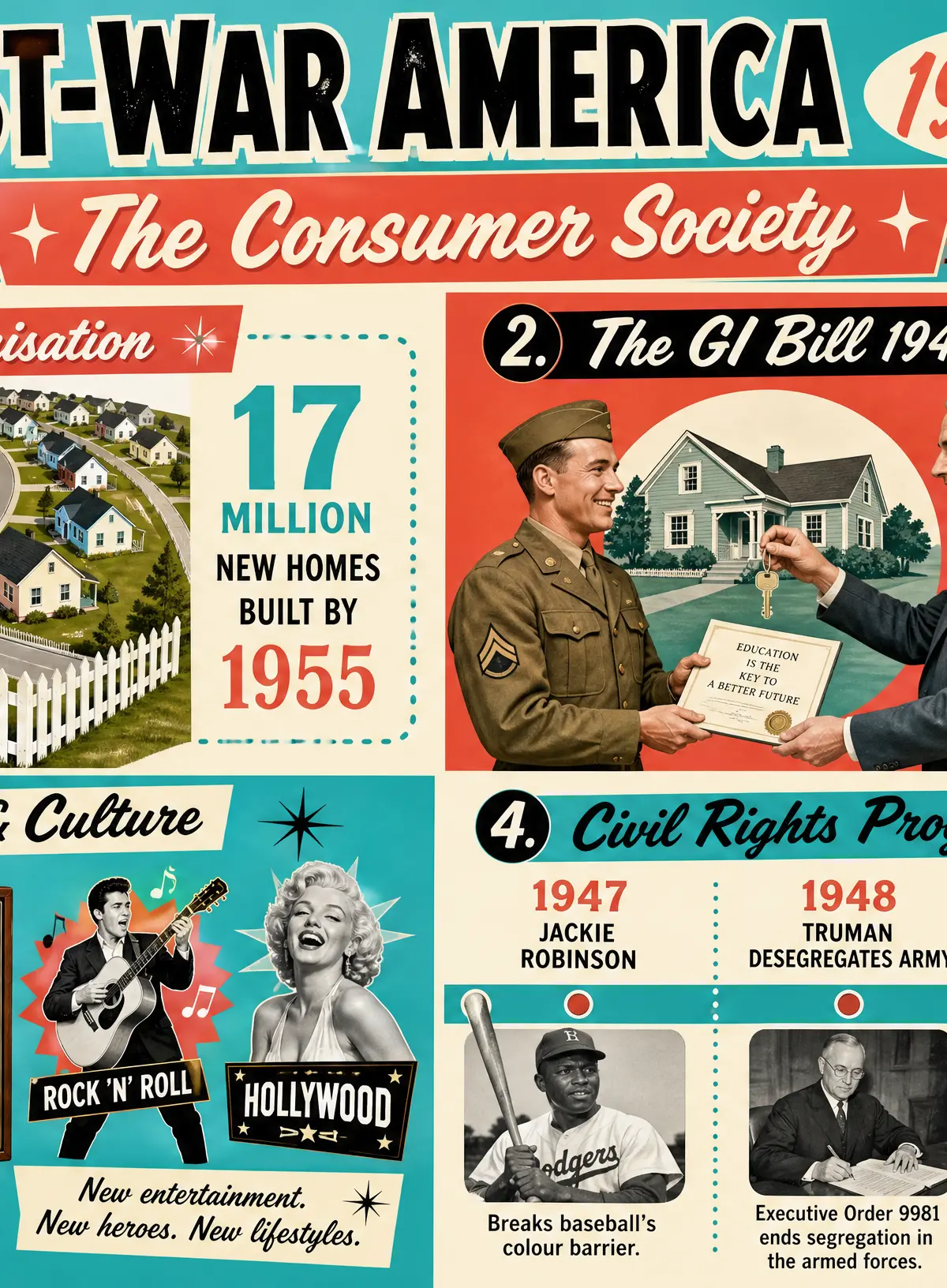
Why it matters: This era defined the 'American Dream' and modern consumer culture, but also highlighted persistent racial inequalities, as many Black Americans were excluded from suburban housing through redlining.
Specific Knowledge: The GI Bill (1944) spent $16 billion and sent 8 million veterans to college. By 1955, 17 million new homes had been built. Television ownership rose from 1 million in 1948 to 32 million in 1955.
McCarthyism and the Red Scare
Date(s): 1947–1954
What happened: Amidst Cold War tensions, a profound fear of communist infiltration gripped the USA. Senator Joseph McCarthy led aggressive, often baseless investigations into government employees, while HUAC targeted the entertainment industry.
Why it matters: McCarthyism demonstrates the severe domestic impact of the Cold War, showing how international tensions compromised civil liberties and created a climate of political conformity and fear.
Specific Knowledge: The Hollywood Ten were jailed in 1947 for refusing to testify before HUAC. Julius and Ethel Rosenberg were executed in 1953 for alleged espionage.
Early Civil Rights Progress
Date(s): 1945–1955
What happened: The post-war decade saw the beginnings of the modern civil rights movement. Key milestones included the desegregation of the armed forces and successful legal challenges to the 'separate but equal' doctrine by the NAACP.
Why it matters: These events laid the crucial legal and political groundwork for the mass protests of the 1960s, though examiners expect candidates to note that practical implementation of desegregation was fiercely resisted in the South.
Specific Knowledge: President Truman's Executive Order 9981 (1948) desegregated the military. The landmark Brown v. Board of Education Supreme Court ruling (1954) declared segregated public schools unconstitutional, overturning the 1896 Plessy v. Ferguson decision.
Key Individuals
Herbert Hoover
Role: 31st US President (1929–1933)
Key Actions: Responded to the Wall Street Crash with a philosophy of 'rugged individualism' and limited federal intervention. Eventually introduced the Reconstruction Finance Corporation, but it was seen as too little, too late.
Impact: Became the scapegoat for the Depression (hence 'Hoovervilles'). His failure to provide direct relief led to a landslide defeat in 1932.
Franklin D. Roosevelt (FDR)
Role: 32nd US President (1933–1945)
Key Actions: Implemented the New Deal, fundamentally changing the role of the federal government in the economy and society.
Impact: Restored public confidence (through 'fireside chats') and provided crucial relief, though his policies did not fully end the Depression until WWII.
Senator Joseph McCarthy
Role: Republican Senator from Wisconsin
Key Actions: Claimed to have lists of communists working in the State Department. Led aggressive Senate hearings to root out alleged subversives.
Impact: Created a climate of fear and paranoia that ruined thousands of careers. His eventual downfall in 1954 marked the decline of the Red Scare.
Chief Justice Earl Warren
Role: Chief Justice of the US Supreme Court (1953–1969)
Key Actions: Authored the unanimous decision in Brown v. Board of Education (1954).
Impact: His ruling that "separate educational facilities are inherently unequal" dismantled the legal basis for Jim Crow segregation.
Second-Order Concepts
Causation
Examiners frequently ask why the 1920s boom occurred or why the Wall Street Crash happened. Strong answers distinguish between long-term structural weaknesses (like agricultural depression and unequal wealth) and short-term triggers (like panic selling).
Consequence
The consequences of the Great Depression were both immediate (mass unemployment, homelessness) and long-term (the permanent expansion of federal power through the New Deal). Similarly, the GI Bill had the long-term consequence of creating the modern American middle class.
Change & Continuity
When evaluating the period 1945–55, you must balance change (economic prosperity, suburbanisation, legal victories for civil rights) with continuity (persistent poverty for minorities, de facto segregation in the South, the ongoing fear of communism).
Significance
The significance of events like Brown v. Board of Education lies not just in their immediate impact, but in how they shifted the legal landscape and empowered future activism.
Source Skills
When evaluating sources for this period, provenance is crucial. A source from a New Deal agency will likely exaggerate its successes, while a source from a Republican opponent will highlight its failures or costs. For McCarthyism, consider the climate of fear—was the author protecting themselves? Always analyze: Content (what it says), Provenance (who, when, why), and Limitations (what it omits or its inherent bias).
Worked Examples
3 worked examples — open one to explore the question and available guidance.
Practice Questions
Test your understanding — click to reveal model answers
Describe two features of the post-war American consumer society (1945–55). (4 marks)
Hint: Think about housing and entertainment.
Explain why there was a 'Red Scare' in the USA in the years after 1945. (12 marks)
Hint: Link international Cold War events to domestic politics and the actions of specific individuals.
'The New Deal successfully solved the problems of the Great Depression.' How far do you agree? (16 marks)
Hint: You must balance the successes (relief/reform) against the failures (unemployment remained high until WWII).
Explain the significance of the Brown v. Board of Education ruling (1954). (8 marks)
Hint: Explain what it changed legally, and what its limitations were in practice.
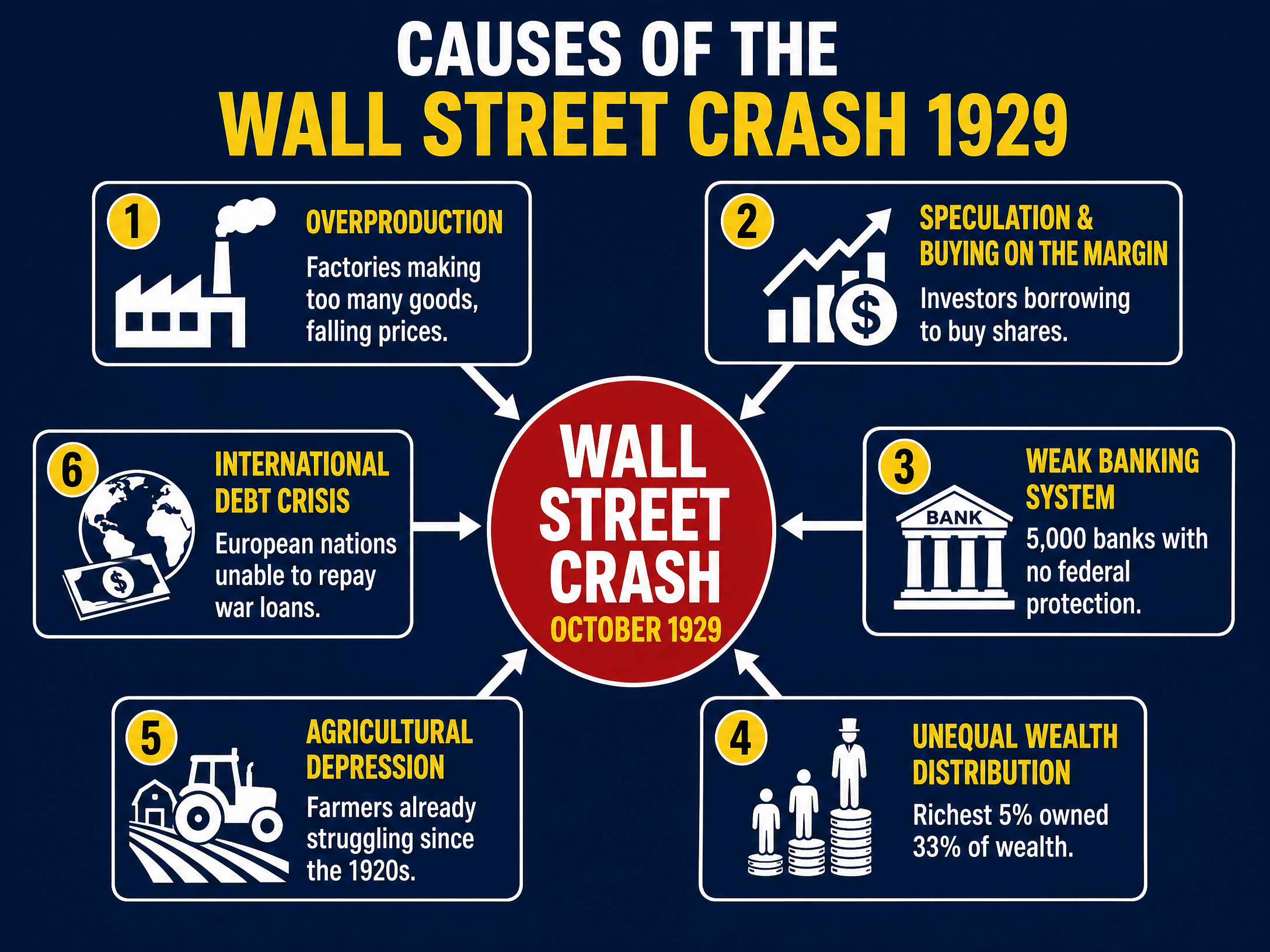
Describe two causes of the Wall Street Crash in 1929. (4 marks)
Hint: Look at the diagram in the study guide.
Test your understanding of The USA, c1920–55: boom, bust and recovery
Active recall beats re-reading. Take an instant quiz now to test what you’ve learned and lock it into long-term memory.
7 days Premium · Then free forever · No card, no charge