Pearson Edexcel · A-Level · History
The witch craze in Britain, Europe and North America, c1580–c1750
The East Anglian Witch Craze of 1645-1647 was the deadliest witch-hunt in English history, driven by the chaos of the English Civil War, economic hardship, and the ambition of 'Witchfinder General' Matthew Hopkins. Understanding how these causes combined is essential for scoring highly in causation questions.
- 7 min read
- 3 worked examples
- 5 practice questions
- 6 key terms
Study Notes
Overview
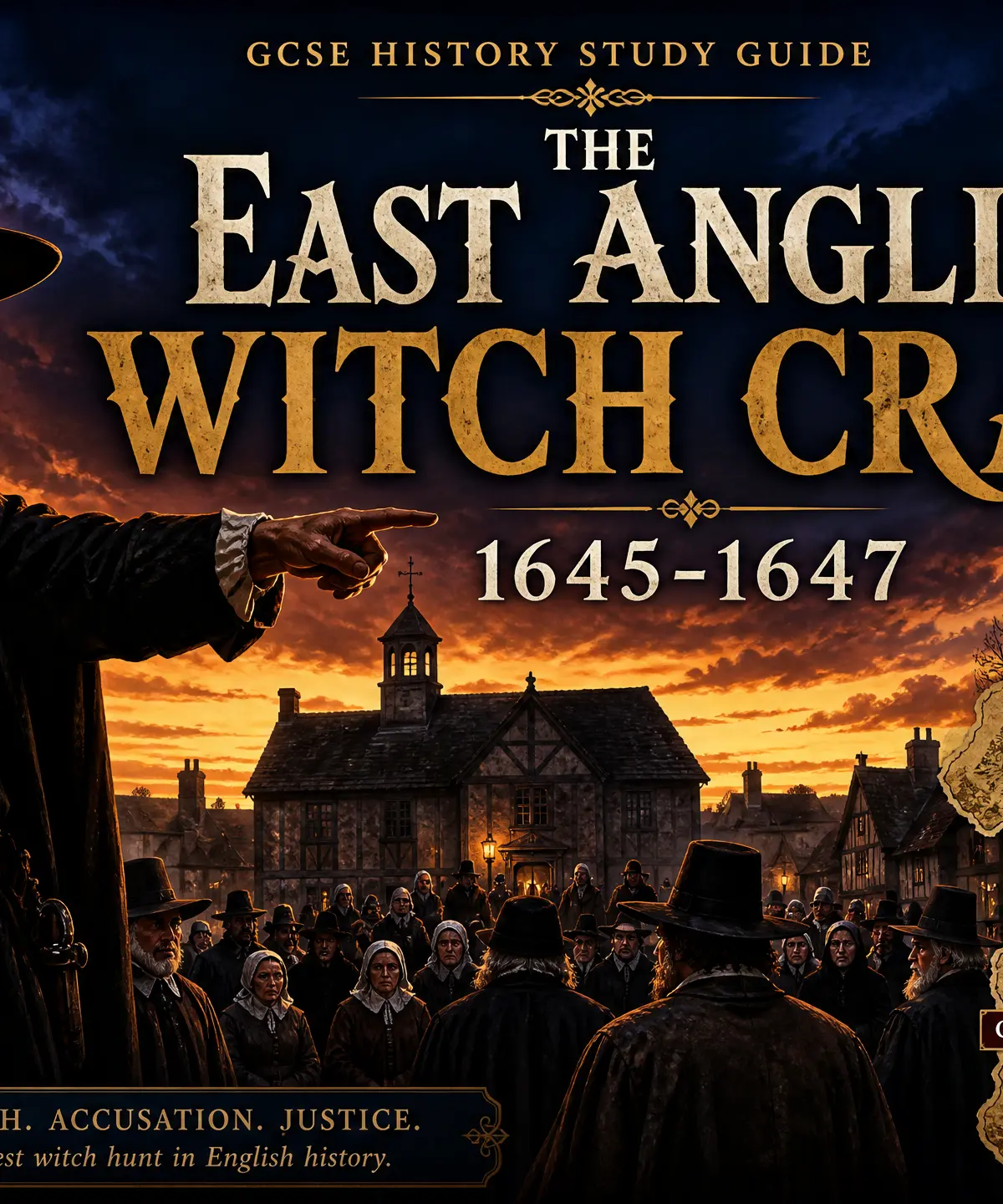
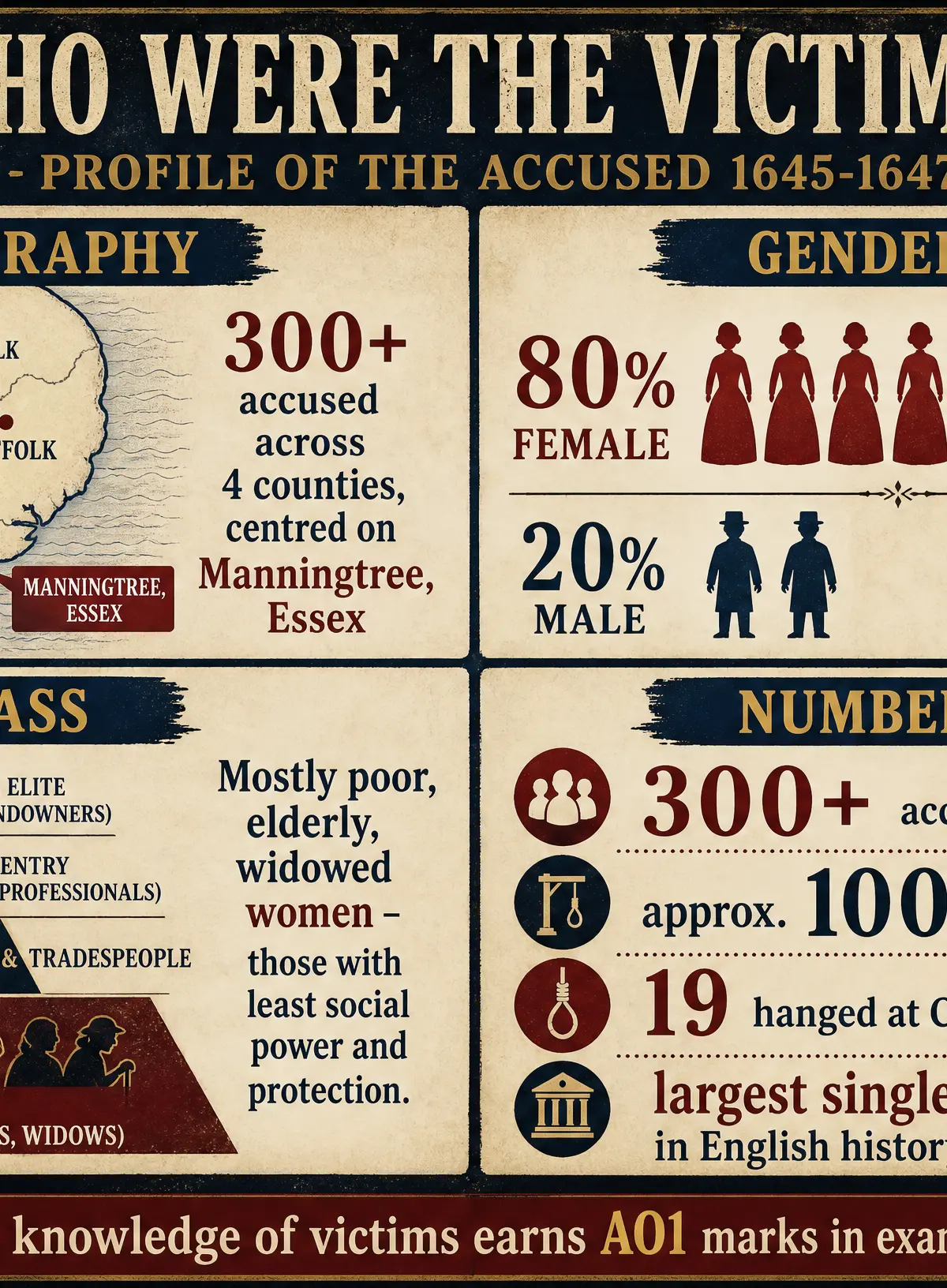
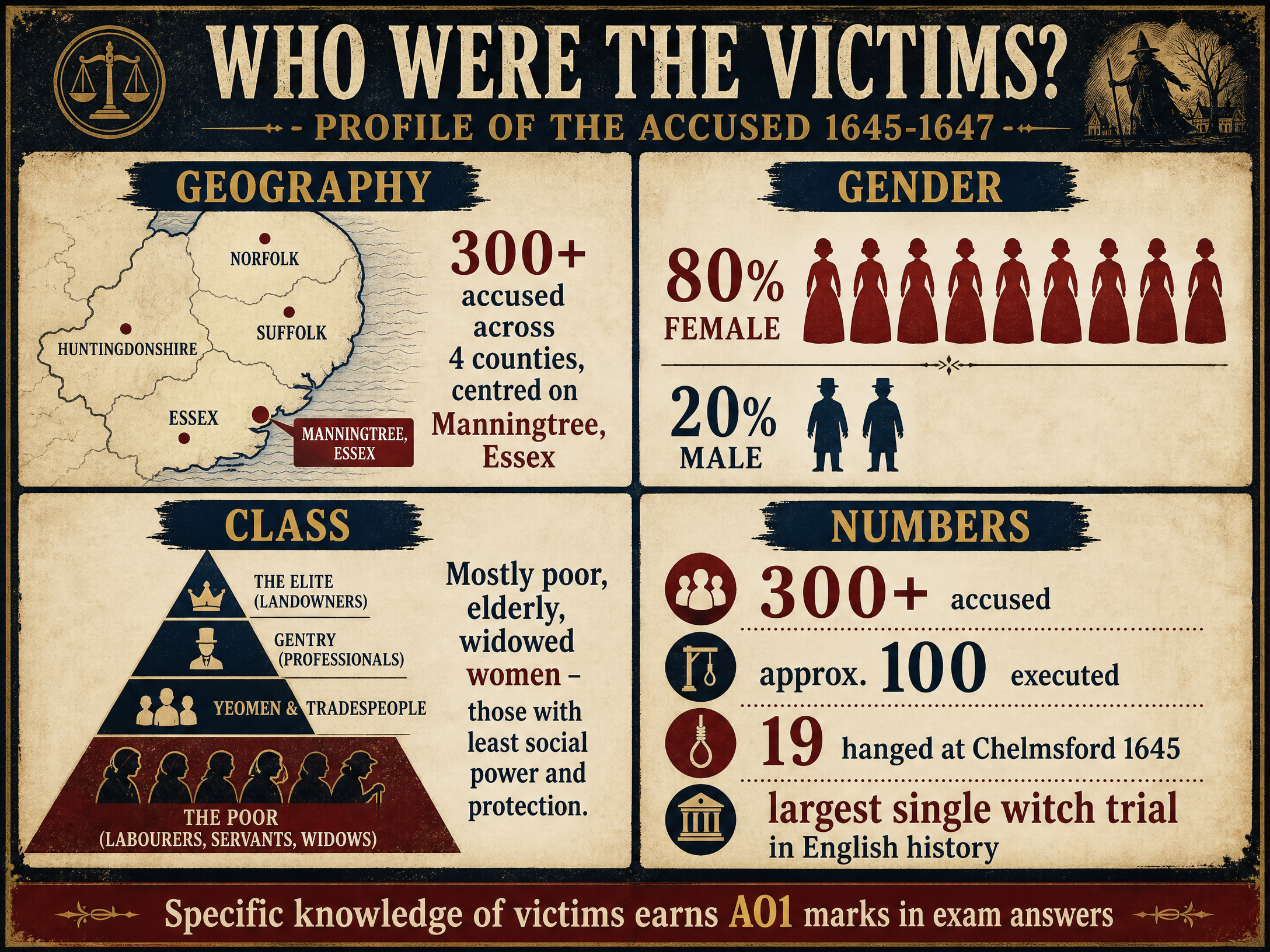
Between 1645 and 1647, East Anglia witnessed the most severe and concentrated witch-hunt in English history. Over 300 individuals, predominantly poor and elderly women, were accused of witchcraft, leading to approximately 100 executions. This episode is historically significant because it demonstrates what happens when traditional legal authority breaks down during a time of national crisis (the English Civil War) and is replaced by localized, fear-driven justice. For examiners, this topic is a classic study in causation—they expect candidates to explain how multiple factors (war, economics, religion, and ambitious individuals) combined to create the perfect storm for a witch craze.
Listen to the topic podcast here:
Key Events & Developments
The Outbreak in Manningtree
Date(s): March 1645
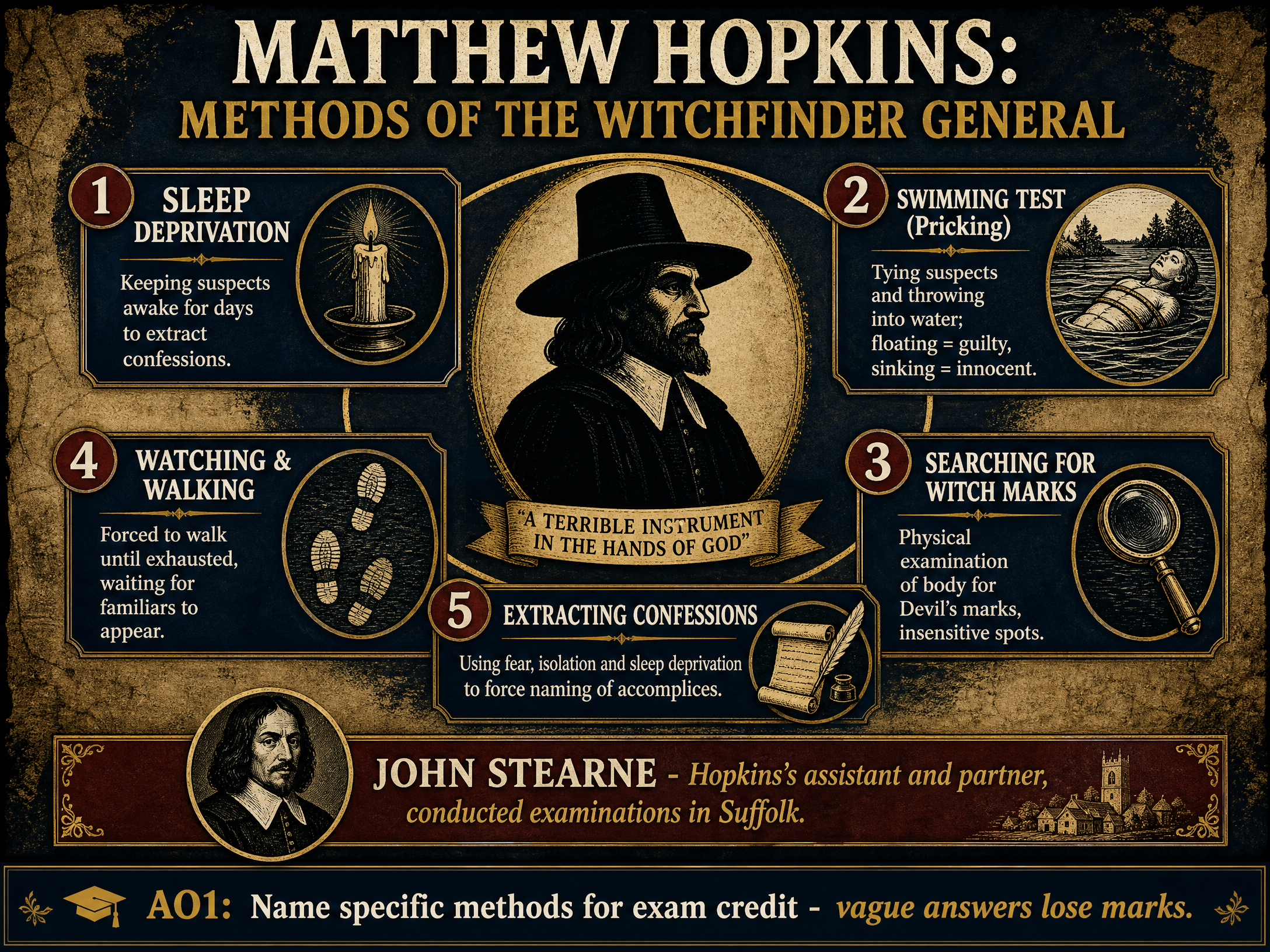
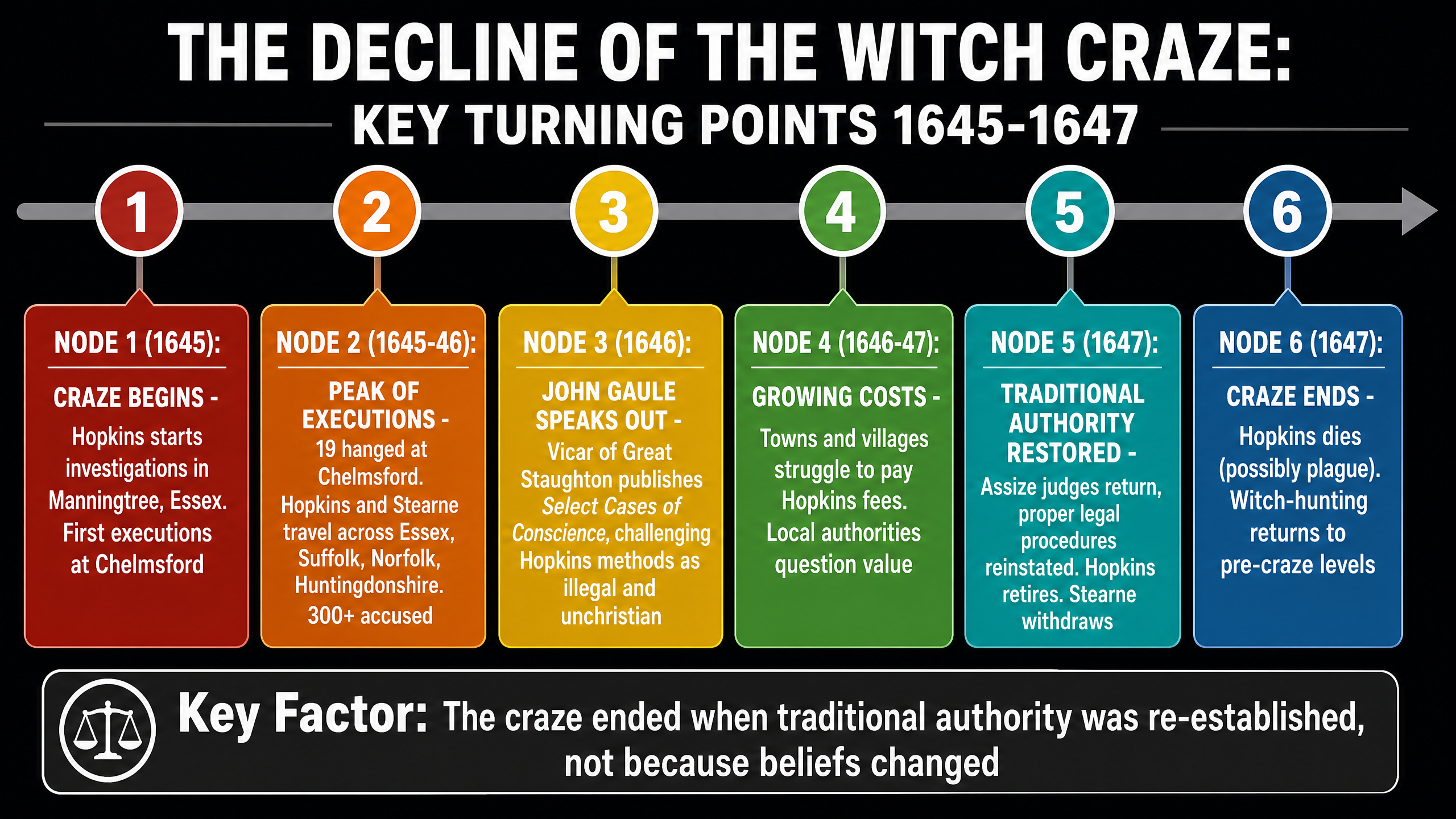
What happened: Matthew Hopkins and John Stearne began investigating local women in Manningtree, Essex. The first accused was Elizabeth Clarke, an elderly, one-legged widow. After being subjected to sleep deprivation, she confessed to having familiars (demonic animal companions) and named other local women as accomplices.
Why it matters: This triggered a chain reaction of accusations. The initial success gave Hopkins and Stearne the credibility to expand their operations across the region.
Specific Knowledge: Elizabeth Clarke, Manningtree, March 1645, use of sleep deprivation to extract confessions.
The Chelmsford Assizes
Date(s): July 1645
What happened: A major trial of Essex witches took place at Chelmsford. The trial was overseen by the Earl of Warwick rather than traditional Assize judges, due to the disruptions of the Civil War. 19 women were hanged.
Why it matters: This was the largest mass execution for witchcraft in English history. It provided official, legal validation for Hopkins's methods and allowed the craze to spread rapidly into Suffolk, Norfolk, and Huntingdonshire.
Specific Knowledge: 19 hanged, Chelmsford Assizes, July 1645, Earl of Warwick presiding.
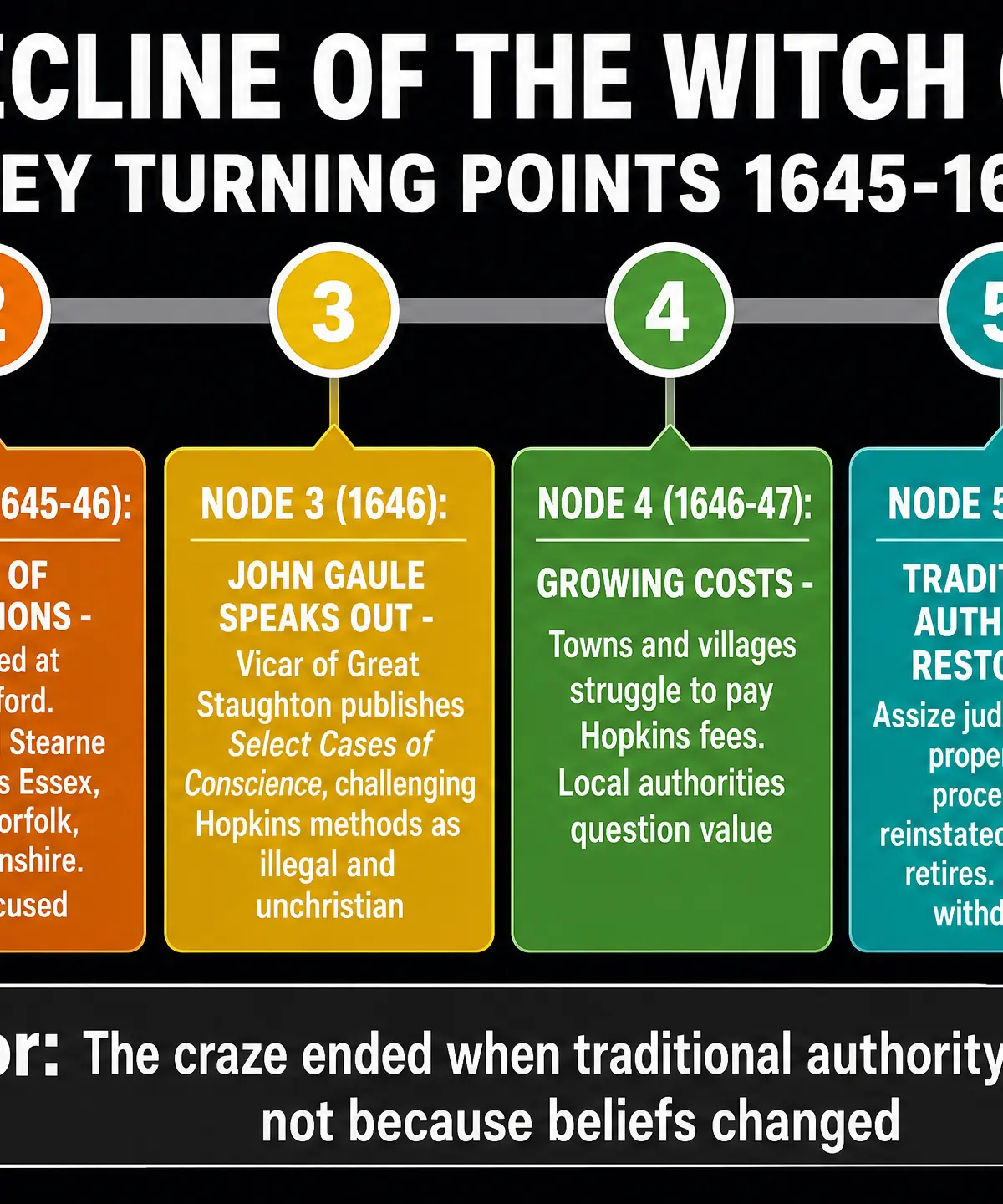
The Publication of 'Select Cases of Conscience'
Date(s): 1646
What happened: John Gaule, the Puritan Vicar of Great Staughton, published a pamphlet fiercely criticizing Hopkins's methods. He argued that the witchfinders were usurping God's authority and that their methods (like the swimming test) were illegal and unchristian.
Why it matters: Gaule's intervention was a major turning point. Because he was a respected Puritan minister, his criticisms could not be dismissed as atheism. It gave local magistrates the theological backing to reject the witchfinders.
Specific Knowledge: John Gaule, Vicar of Great Staughton, Select Cases of Conscience Touching Witches and Witchcraft (1646).
Key Individuals
Matthew Hopkins
Role: Self-appointed 'Witchfinder General'
Key Actions: Systematized the hunting of witches. He charged a fee (usually 20 shillings per town) to investigate accusations. He utilized controversial methods such as 'watching and walking' (sleep deprivation), searching for 'witch marks' (insensitive spots on the body), and the swimming test.
Impact: Hopkins was the catalyst that turned local neighbourly disputes into a regional craze. Without his organizational skills and ambition, the accusations would likely have remained isolated incidents.
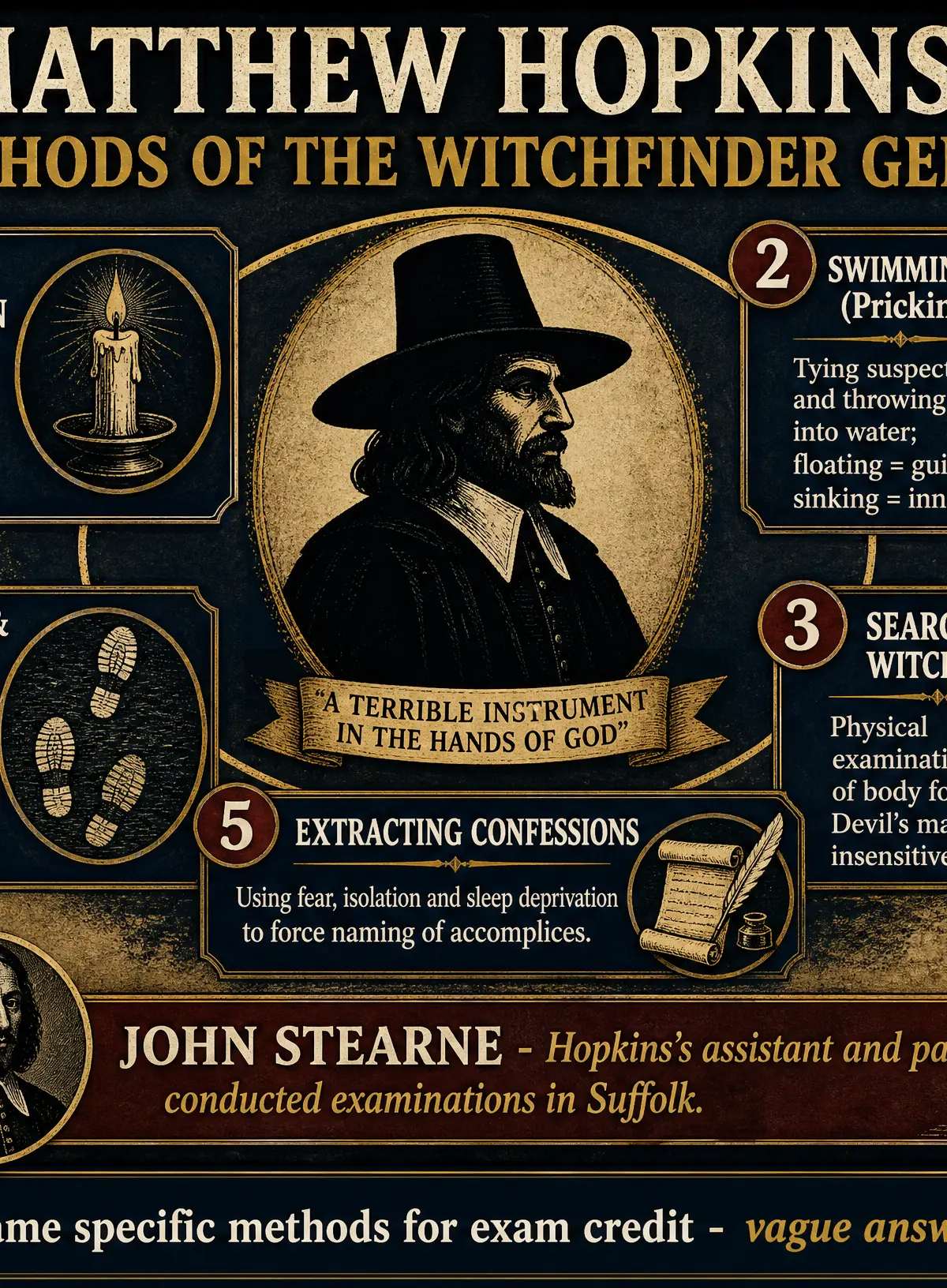
John Stearne
Role: Hopkins's associate and fellow witch-finder
Key Actions: Often worked independently of Hopkins, particularly in Suffolk. He was actually the first to receive a warrant to search suspected witches in Manningtree.
Impact: Stearne's involvement shows that this was a coordinated, professional operation rather than the work of a single fanatic.
John Gaule
Role: Vicar of Great Staughton and prominent critic
Key Actions: Preached against the witchfinders and published Select Cases of Conscience (1646), attacking their methods as unscriptural.
Impact: His opposition was crucial in turning public and official opinion against Hopkins, leading to the decline of the craze.
Second-Order Concepts
Causation
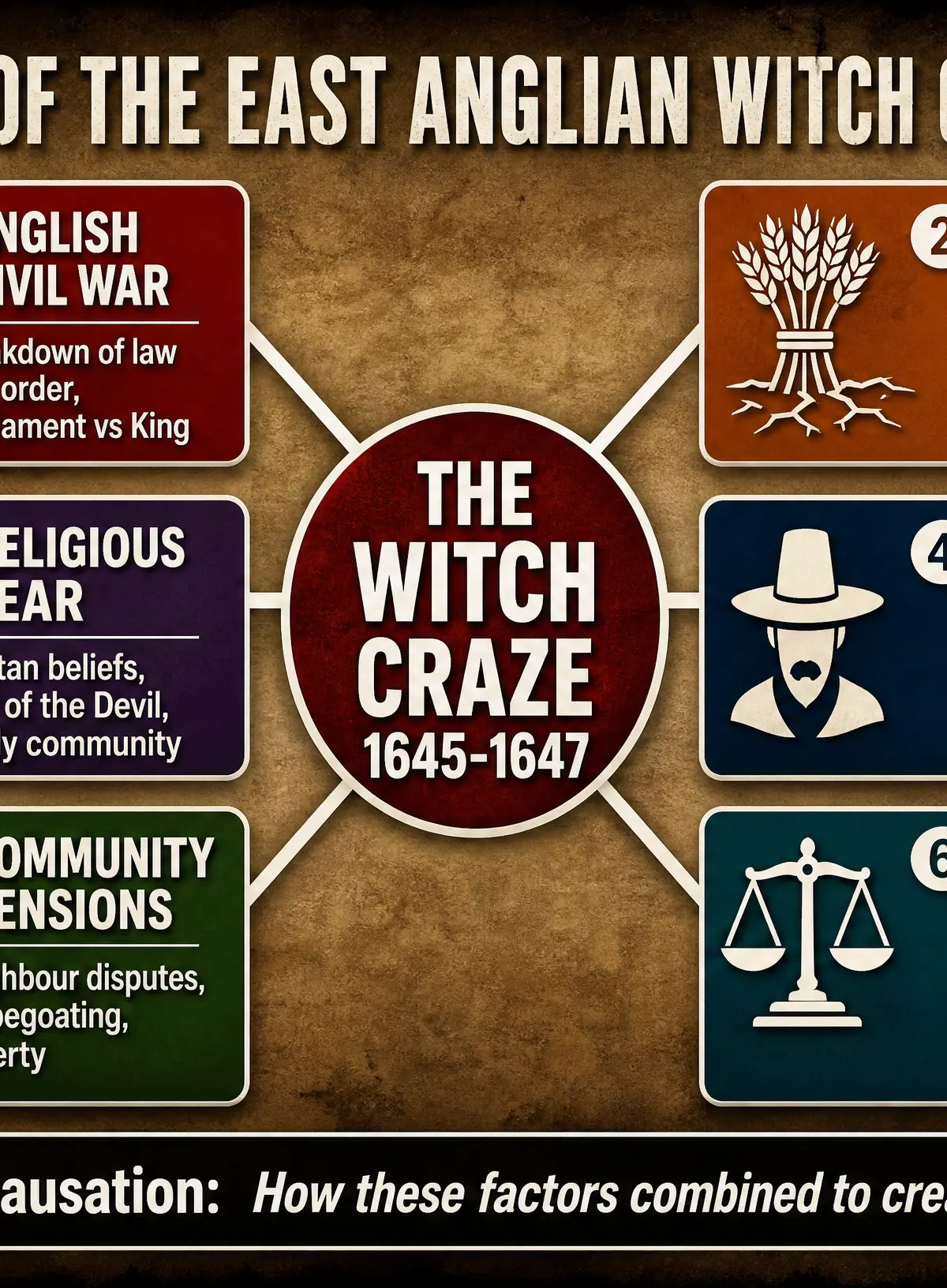
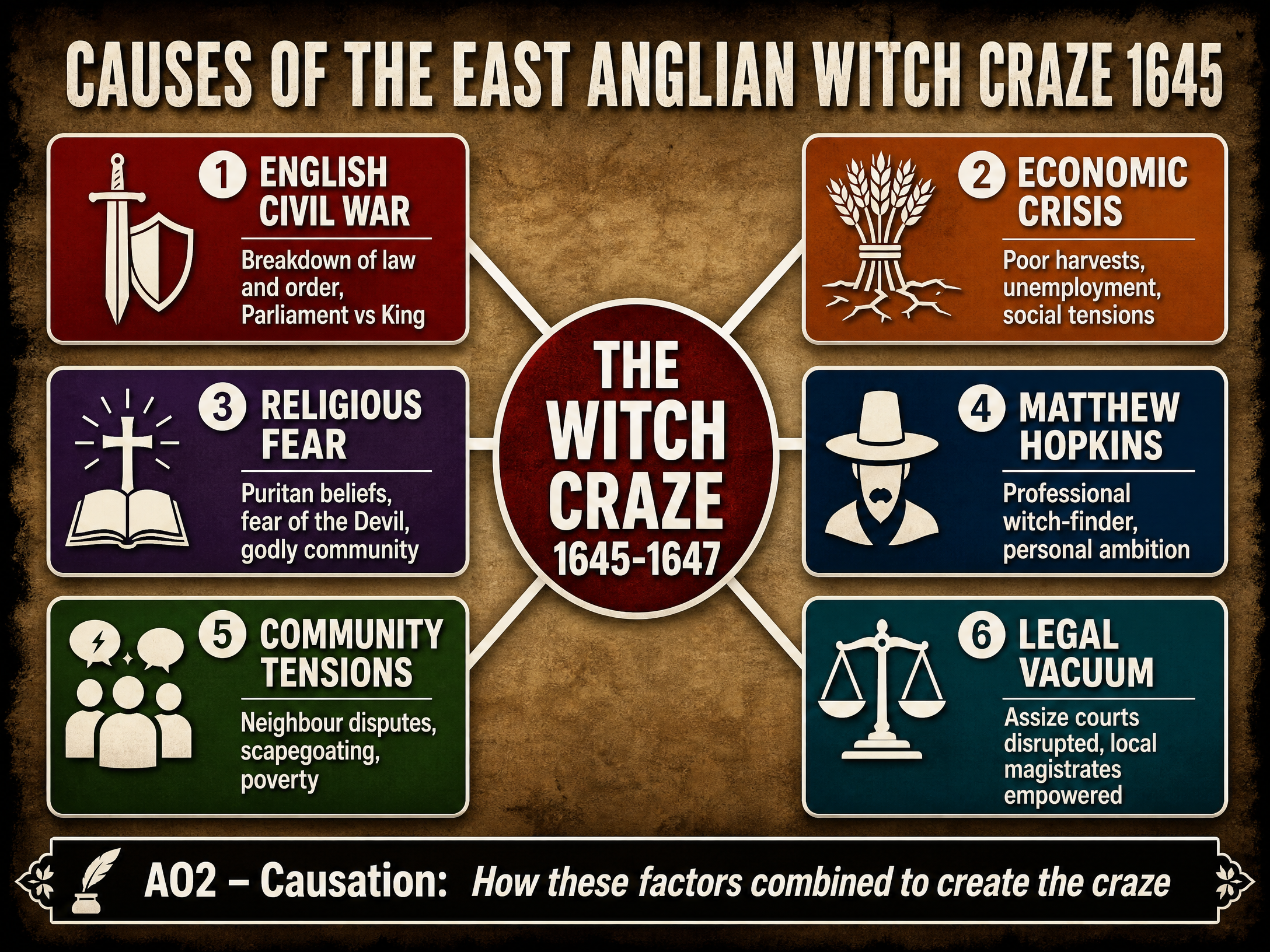
The East Anglian witch craze was caused by a combination of short-term triggers and long-term underlying conditions:
- The English Civil War (Context/Catalyst): The conflict between King and Parliament (started 1642) disrupted the traditional Assize courts. Power fell to local magistrates with less legal training, removing the checks and balances that normally prevented mass executions.
- Economic Hardship (Underlying Condition): The 1640s saw poor harvests, inflation, and the economic strain of the war (including new taxes). Poverty increased social tensions, making wealthier villagers less willing to give charity to the poor, leading to guilt, resentment, and scapegoating.
- Religious Fervour (Underlying Condition): East Anglia was a Puritan stronghold. Puritans believed in a literal, active Devil and sought to create a 'godly community' by rooting out sin.
- Matthew Hopkins (Trigger/Catalyst): The ambition and methods of Hopkins and Stearne provided the mechanism for these tensions to explode into a full-scale craze.
Consequence
The immediate consequence was the death of approximately 100 individuals and the devastation of local communities through fear and financial cost. A longer-term consequence was a growing skepticism among the educated elite regarding the methods used to identify witches, leading to stricter rules of evidence in later decades.
Change & Continuity
Change: The scale of the 1645-47 craze was unprecedented in England. The use of professional witchfinders who travelled from town to town charging fees was a significant change from the usual pattern of isolated, local accusations.
Continuity: The types of people accused (predominantly poor, elderly, marginalized women) and the types of accusations (maleficium—harming neighbours, livestock, or crops) remained consistent with earlier periods.
Significance
The craze is significant because it highlights the fragility of law and order. It demonstrates how quickly extreme measures can be adopted when central authority collapses and society is under intense economic and psychological stress.
Source Skills
When evaluating sources for this topic, examiners expect you to consider the provenance carefully:
- Pamphlets by Hopkins/Stearne (e.g., The Discovery of Witches, 1647): These are highly useful for understanding their methods and justifications, but they are heavily biased—written specifically to defend themselves against critics like Gaule and to justify their fees.
- Court Records/Confessions: Useful for identifying who was accused and the nature of the charges, but severely limited by the fact that confessions were routinely extracted through sleep deprivation and coercion. They reflect what the interrogators wanted to hear, not the truth.
- Criticisms (e.g., John Gaule): Useful for showing that even at the time, there was significant opposition to the witchfinders from within the Puritan establishment.
Visual Resources
4 diagrams and illustrations
Interactive Diagrams
1 interactive diagram to visualise key concepts
Conceptual Flow Outline
Flowchart showing the interconnected causes of the East Anglian Witch Craze.
Worked Examples
3 worked examples — open one to explore the question and available guidance.
Practice Questions
Test your understanding — click to reveal model answers
Describe two features of the methods used by Matthew Hopkins to identify witches. (4 marks)
Hint: Name a method, then give one sentence of detail explaining how it worked.
Explain the significance of John Gaule in the decline of the East Anglian witch craze. (8 marks)
Hint: Focus on his role, his publication, and why his specific position made his criticism so effective.
Explain why the Civil War was a major cause of the East Anglian witch craze. (8 marks)
Hint: Focus on the breakdown of law and order and the psychological impact of the war.
How useful are court records for an historian studying the East Anglian witch craze? (8 marks)
Hint: Consider what they tell us (names, charges) vs how the confessions were obtained.
'Matthew Hopkins was the main reason for the East Anglian witch craze.' How far do you agree? (16 marks)
Hint: Agree that he was the catalyst, but argue that he could only succeed because of the context (Civil War, economy, religion).
Test your understanding of The witch craze in Britain, Europe and North America, c1580–c1750
Active recall beats re-reading. Take an instant quiz now to test what you’ve learned and lock it into long-term memory.
7 days Premium · Then free forever · No card, no charge