Pearson Edexcel · GCSE · History
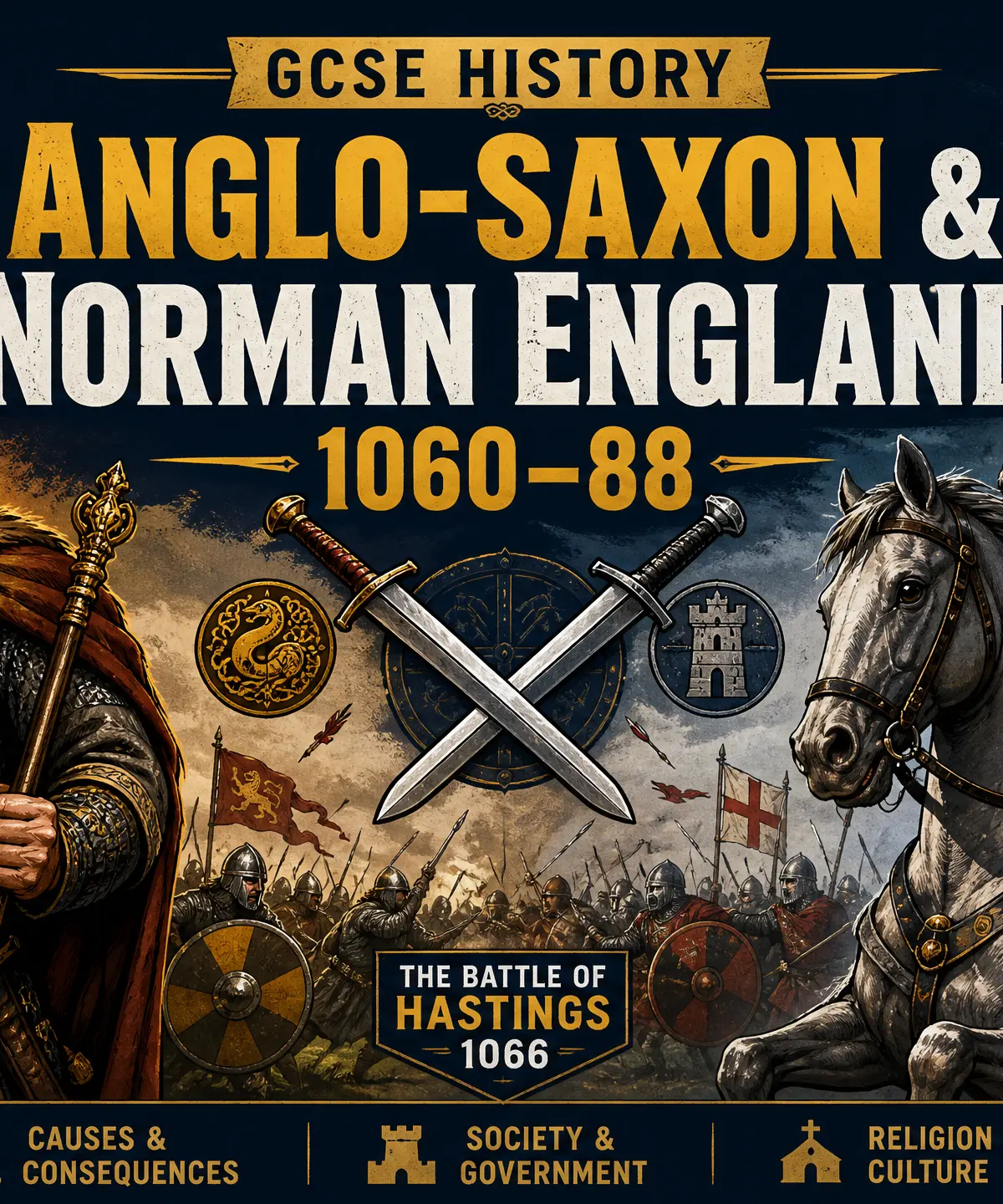
Anglo-Saxon and Norman England, c1060–88
Anglo-Saxon and Norman England c1060–88 is a dramatic story of invasion, succession, and profound transformation. You will explore how a well-organised Anglo-Saxon kingdom was conquered and reshaped by William of Normandy, fundamentally changing England's society, landscape, and language.
- 8 min read
- 3 worked examples
- 5 practice questions
- 6 key terms
Study Notes
Overview
This study covers one of the most turbulent and consequential periods in English history. Between 1060 and 1088, England transitioned from a wealthy, well-organised Anglo-Saxon state to a kingdom firmly under the control of a foreign Norman elite. You will examine the sophisticated nature of Anglo-Saxon society, the power of the Godwin family, and the succession crisis triggered by the death of Edward the Confessor in January 1066. The core of this topic focuses on the three rival claimants to the throne, the subsequent invasions, and the decisive Battle of Hastings where William of Normandy defeated Harold Godwinson. Furthermore, examiners expect you to understand not just the narrative of 1066, but the causes of the Norman victory and the consequences of the conquest, including how William secured control through castles, the feudal system, and the Domesday Book. You must move beyond storytelling to analyze historical concepts using specific dates, names, and events.
Key Events & Developments
The Death of Edward the Confessor and Succession Crisis
Date(s): 5 January 1066
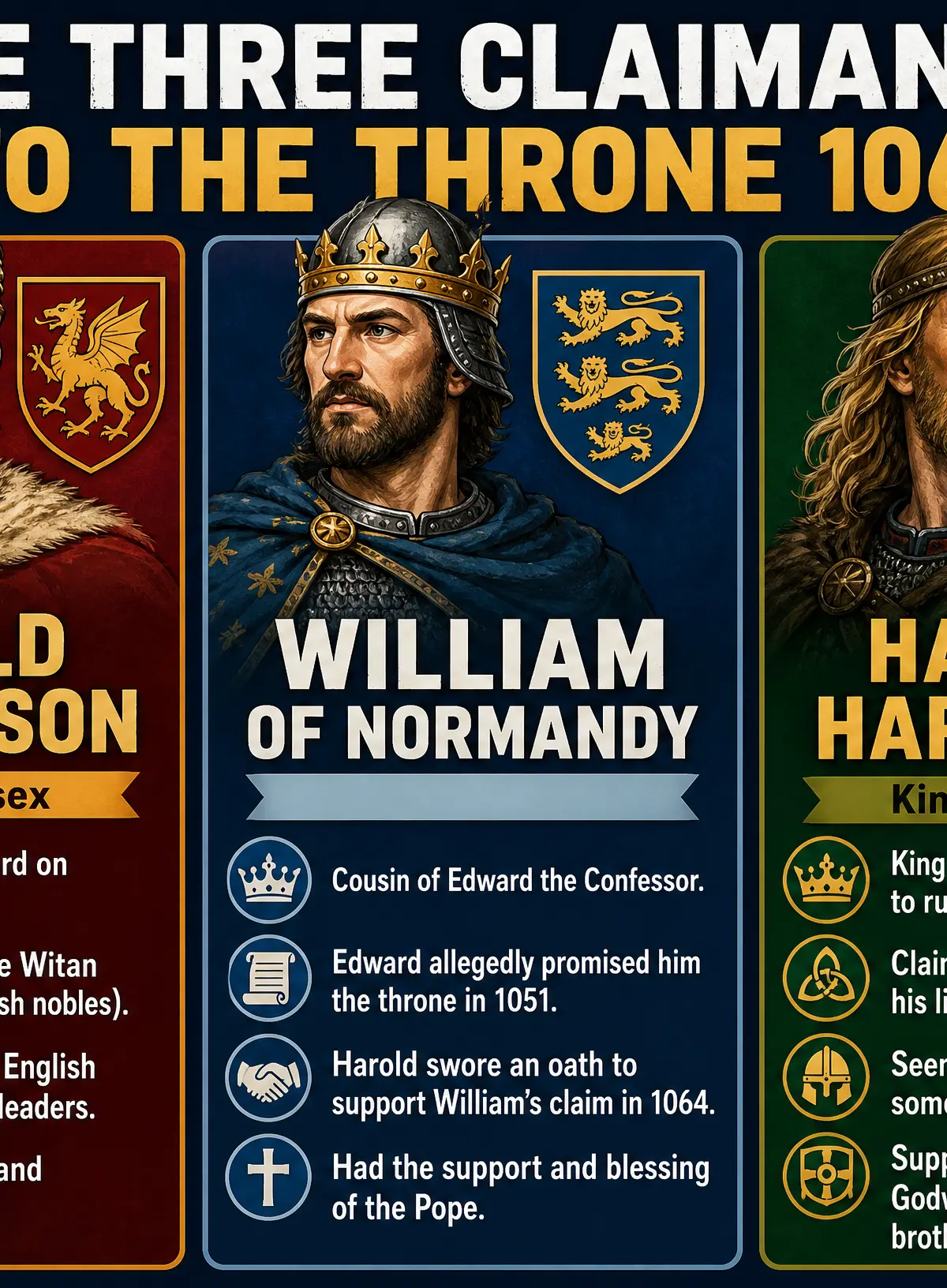
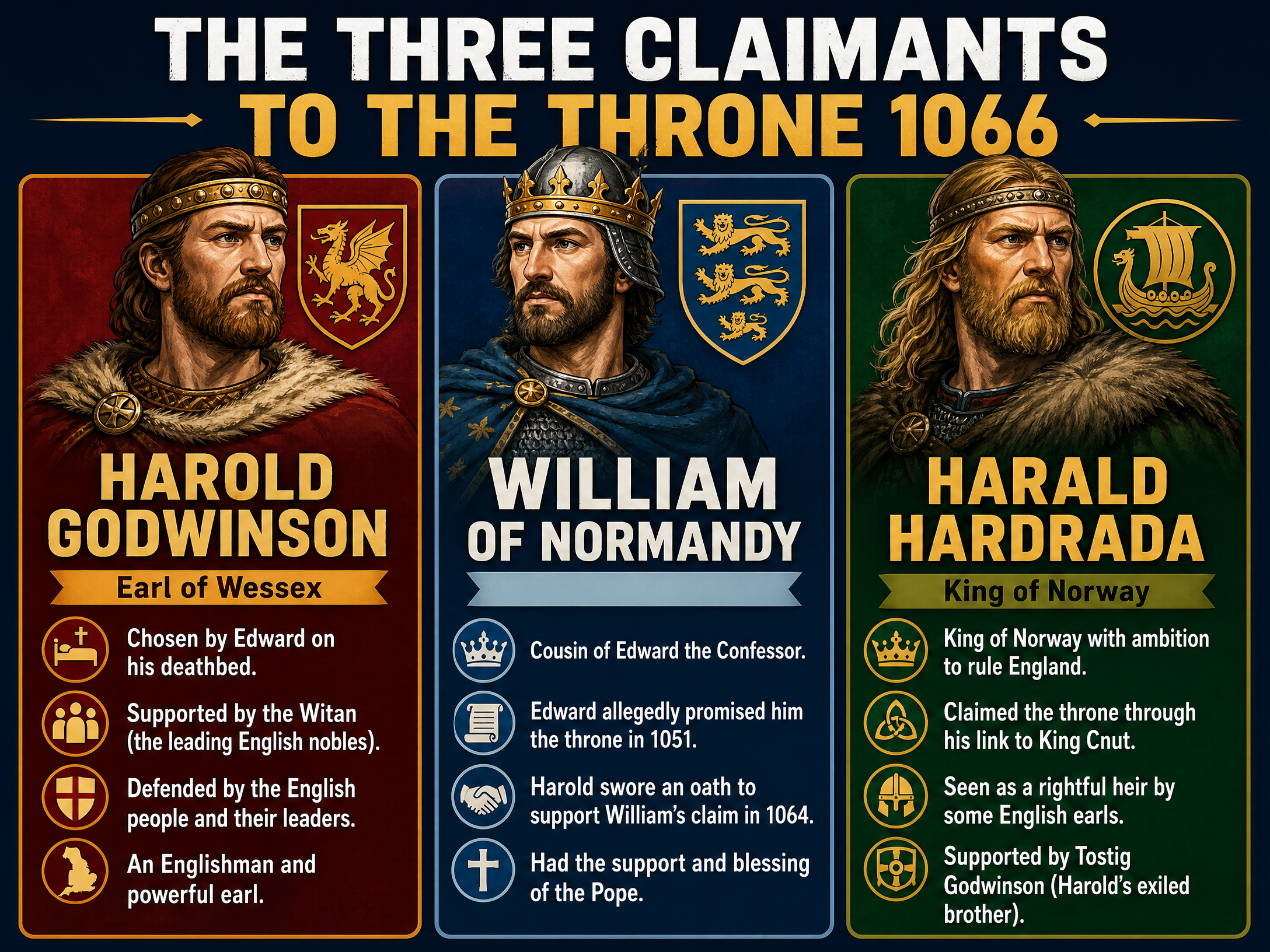
What happened: King Edward the Confessor died without a direct heir. On his deathbed, he allegedly named Harold Godwinson, the powerful Earl of Wessex, as his successor. The Witan (the king's council) quickly crowned Harold on 6 January. However, William of Normandy claimed Edward had promised him the throne in 1051, and Harald Hardrada of Norway also claimed the throne based on an old Viking treaty.
Why it matters: This triggered a massive succession crisis (causation) that directly led to the invasions of 1066. It highlights the importance of the Witan in Anglo-Saxon England and the vulnerability of a kingdom without a clear, undisputed heir.
Specific Knowledge: Edward died 5 Jan 1066; Harold crowned 6 Jan; three claimants: Harold Godwinson, William of Normandy, Harald Hardrada.
The Battles of Gate Fulford and Stamford Bridge
Date(s): 20 September & 25 September 1066
What happened: Harald Hardrada and Tostig Godwinson (Harold's exiled brother) invaded the north of England. They defeated the northern earls Edwin and Morcar at Gate Fulford on 20 September. King Harold marched his army north at incredible speed (185 miles in 4 days) and launched a surprise attack at Stamford Bridge on 25 September, decisively defeating the Norwegians and killing both Hardrada and Tostig.
Why it matters: While a great victory for Harold, it had disastrous consequences. It exhausted his army and drew him away from the south just as William of Normandy was preparing to invade. This is a crucial short-term cause of Harold's eventual defeat at Hastings.
Specific Knowledge: Earls Edwin and Morcar; 185 miles in 4 days; deaths of Hardrada and Tostig.
The Battle of Hastings
Date(s): 14 October 1066
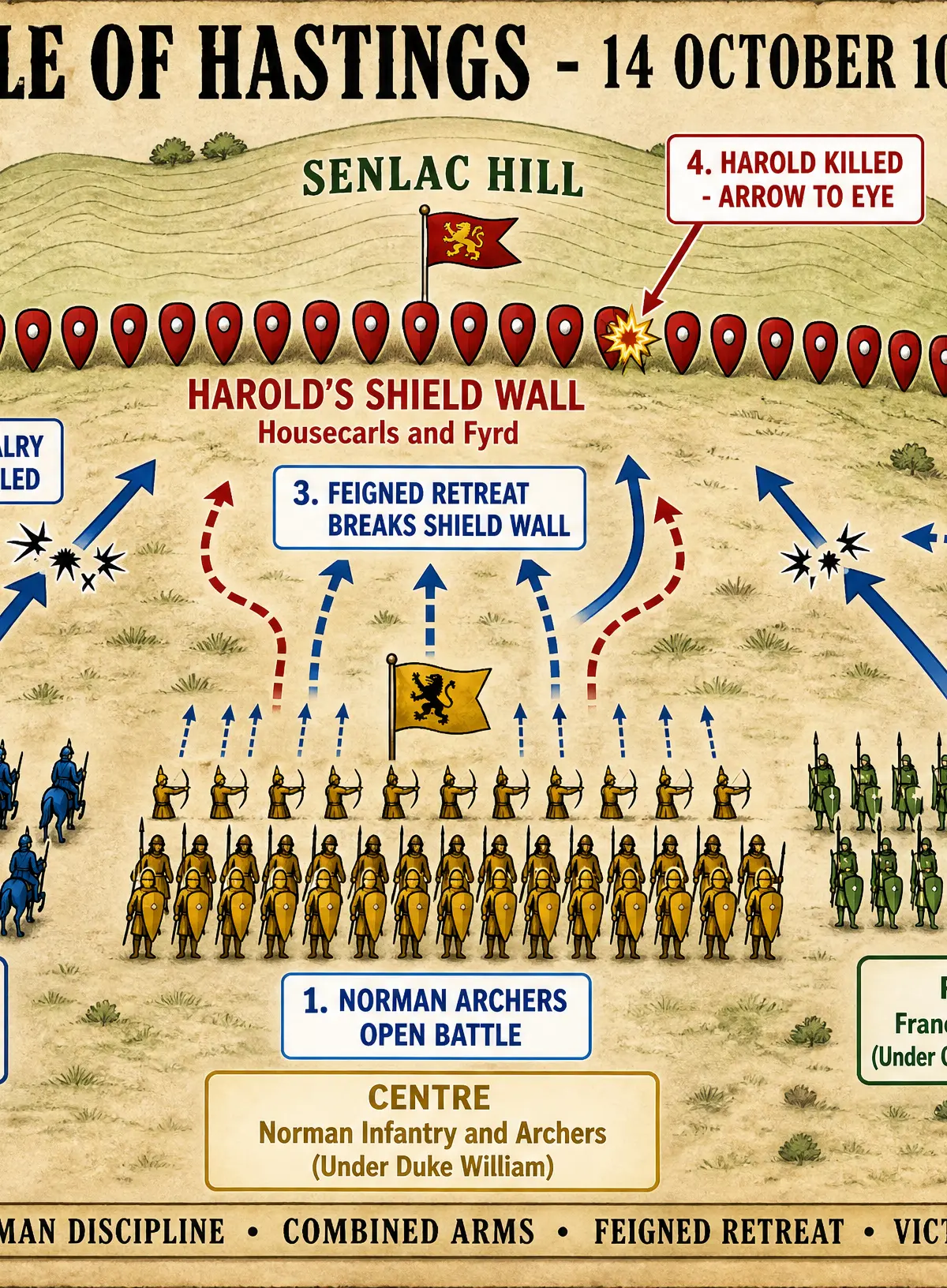
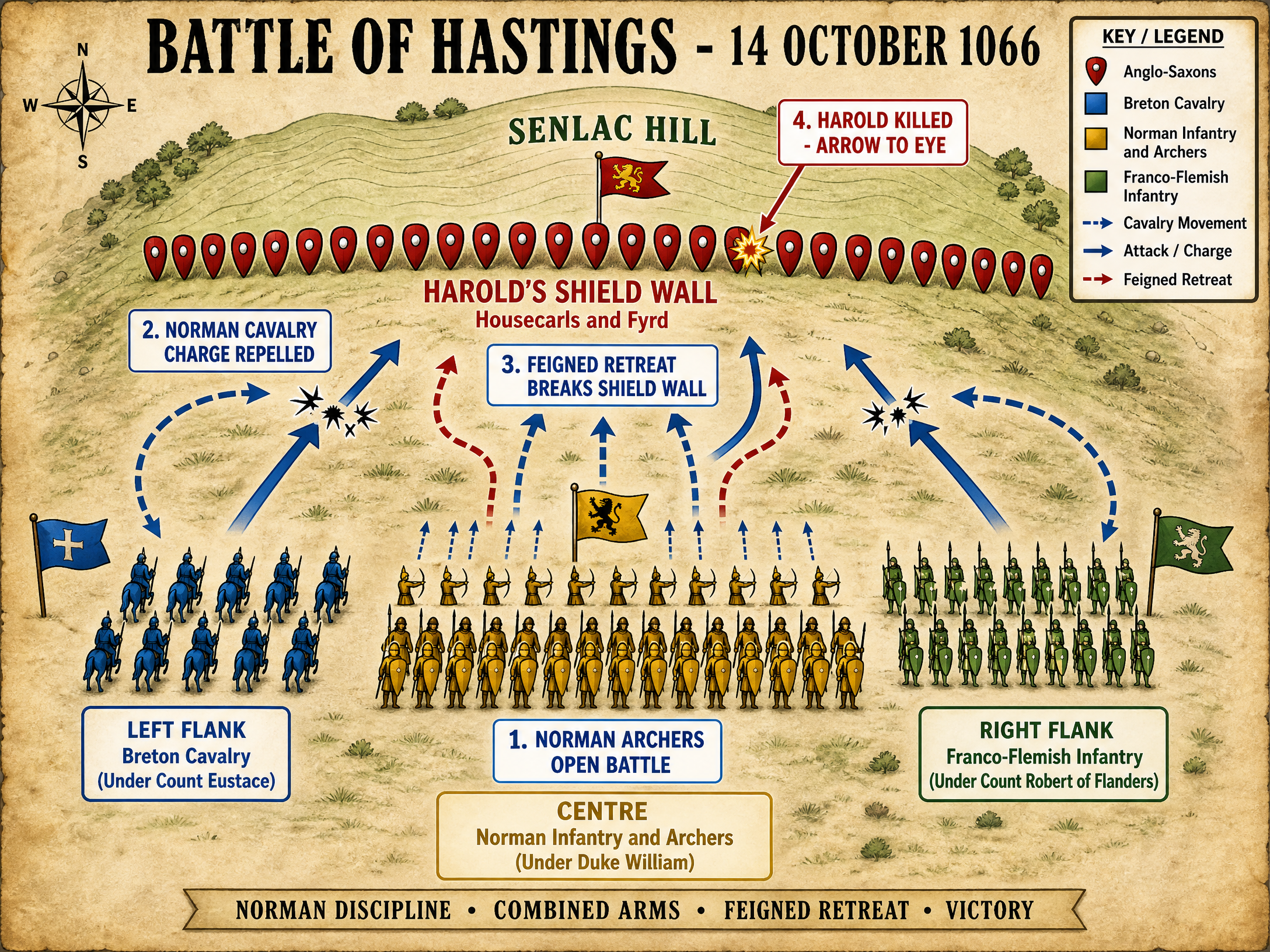
What happened: William landed at Pevensey on 28 September. Harold rushed south, meeting William at Senlac Hill near Hastings. Harold took a strong defensive position with a shield wall. William used combined arms (archers, infantry, cavalry) and the 'feigned retreat' tactic to break the shield wall. Harold was killed, and the English army collapsed.
Why it matters: This is the turning point of English history. The Norman victory led to the complete destruction of the Anglo-Saxon ruling class and the imposition of Norman rule. Examiners expect you to explain why William won, weighing factors like William's leadership, Harold's exhaustion, and the feigned retreat.
Specific Knowledge: Pevensey landing (28 Sept); Senlac Hill; shield wall; housecarls and fyrd; feigned retreat; combined arms.
The Harrying of the North
Date(s): 1069–1070
What happened: Following rebellions in the north of England (supported by the Danes), William responded with brutal devastation. His troops destroyed crops, slaughtered livestock, and burned villages across Yorkshire and surrounding areas to prevent future rebellions.
Why it matters: This demonstrates the extreme measures William used to secure control (consequence). It caused widespread famine, killing an estimated 100,000 people, and left the north economically devastated for decades, as later recorded in the Domesday Book.
Specific Knowledge: 1069-70; estimated 100,000 deaths; salt in the earth; prevention of Danish support.
Key Individuals
Harold Godwinson
Role: Earl of Wessex, then King of England (Jan-Oct 1066).
Key Actions: Consolidated Godwin power; allegedly swore an oath to William in 1064; claimed the throne in Jan 1066; defeated Hardrada at Stamford Bridge; died at Hastings.
Impact: His ambition and rapid military movements defined the events of 1066. His death marked the end of Anglo-Saxon rule.
William, Duke of Normandy (William the Conqueror)
Role: Duke of Normandy, then King of England.
Key Actions: Claimed Edward promised him the throne; secured Papal backing (a papal banner); organized a massive invasion fleet; won at Hastings; brutally suppressed rebellions (Harrying of the North); built castles.
Impact: Fundamentally changed England's ruling elite, language, architecture (castles), and social structure (feudal system).
Earl Godwin of Wessex
Role: The most powerful Anglo-Saxon earl under Edward the Confessor.
Key Actions: Built immense wealth and landholdings; frequently challenged King Edward's authority; secured the earldom of Wessex for his son Harold.
Impact: His power demonstrates the weakness of the Anglo-Saxon monarchy relative to the great earls, setting the stage for his son's claim to the throne.
Second-Order Concepts
Causation
Why did William win the Battle of Hastings?
- Short-term triggers: Harold's exhaustion after Stamford Bridge and the rapid march south.
- Tactical factors: William's use of combined arms (archers, infantry, cavalry) versus Harold's reliance on the infantry shield wall; William's successful 'feigned retreat' which broke the English discipline.
- Long-term factors: William's meticulous preparation and securing of the Papal banner, which boosted Norman morale.
Consequence
What were the impacts of the Norman Conquest?
- Immediate: The destruction of the Anglo-Saxon nobility (many died at Hastings or were later dispossessed of their land).
- Long-term: The introduction of the feudal system, the building of motte and bailey castles to control the population, and the Domesday Book (1086) which recorded all land and wealth for taxation.
Change & Continuity
- Change: The ruling elite changed entirely from Anglo-Saxon to Norman. Language at court changed to Norman French. Architecture changed with the introduction of stone castles and Norman cathedrals.
- Continuity: William kept the Anglo-Saxon system of shires and hundreds, the use of sheriffs, and the geld (tax) system, because they were highly efficient.
Significance
The year 1066 is arguably the most significant date in English history because it permanently reoriented England away from Scandinavia and towards continental Europe, completely restructuring its society and governance.
Source Skills
When evaluating sources for this topic (like the Bayeux Tapestry or the Anglo-Saxon Chronicle), you must consider:
- Content: What does the source actually show or say? Use specific details from the source.
- Provenance: Who made it? (e.g., Bishop Odo commissioned the Bayeux Tapestry). When? (1070s). Why? (To justify the Norman Conquest).
- Limitations: Does it show a one-sided view? The Bayeux Tapestry is Norman propaganda; the Anglo-Saxon Chronicle reflects English despair.
Podcast Revision
Listen to this 10-minute revision podcast covering the key events and exam techniques for 1066:
Worked Examples
3 worked examples — open one to explore the question and available guidance.
Practice Questions
Test your understanding — click to reveal model answers
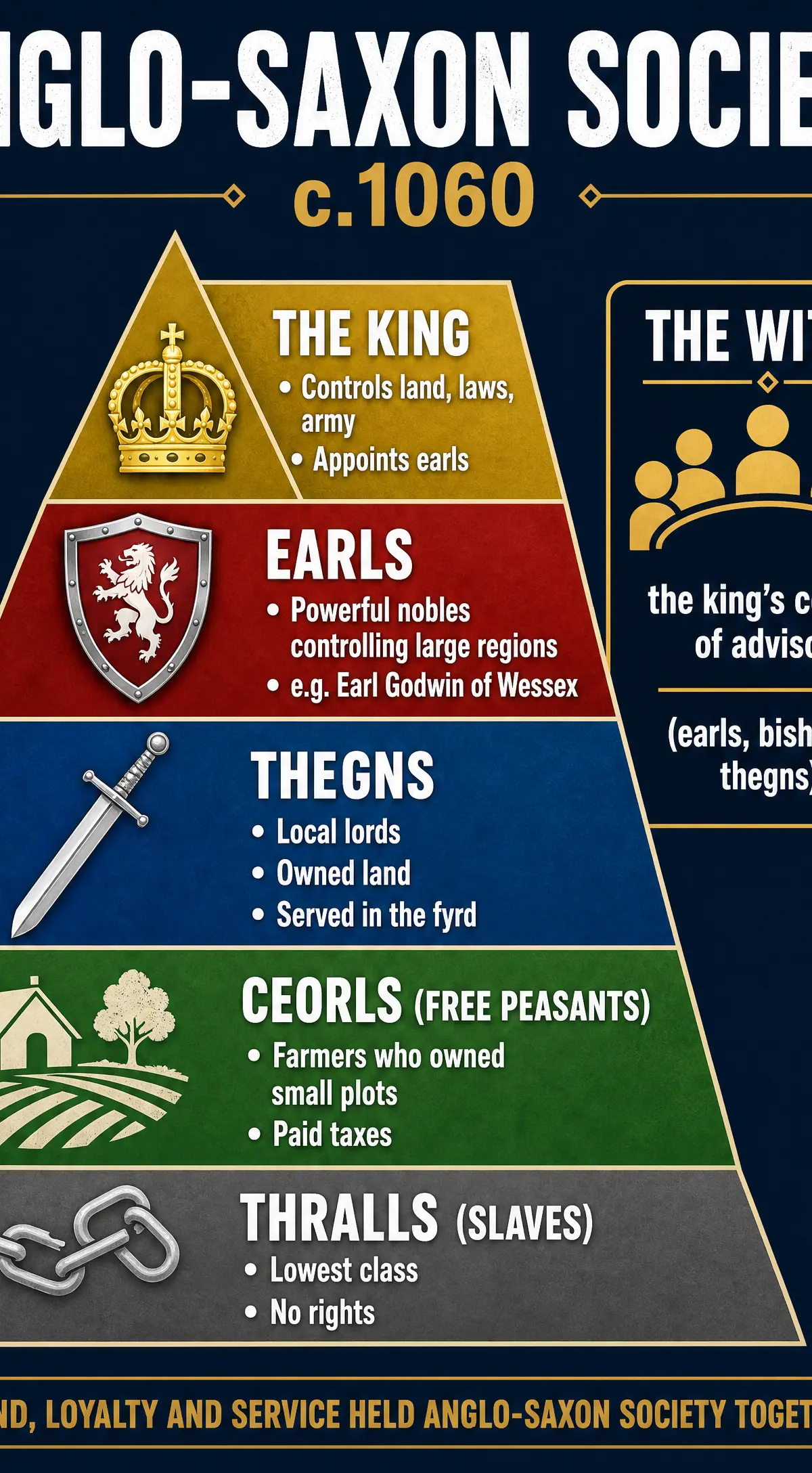
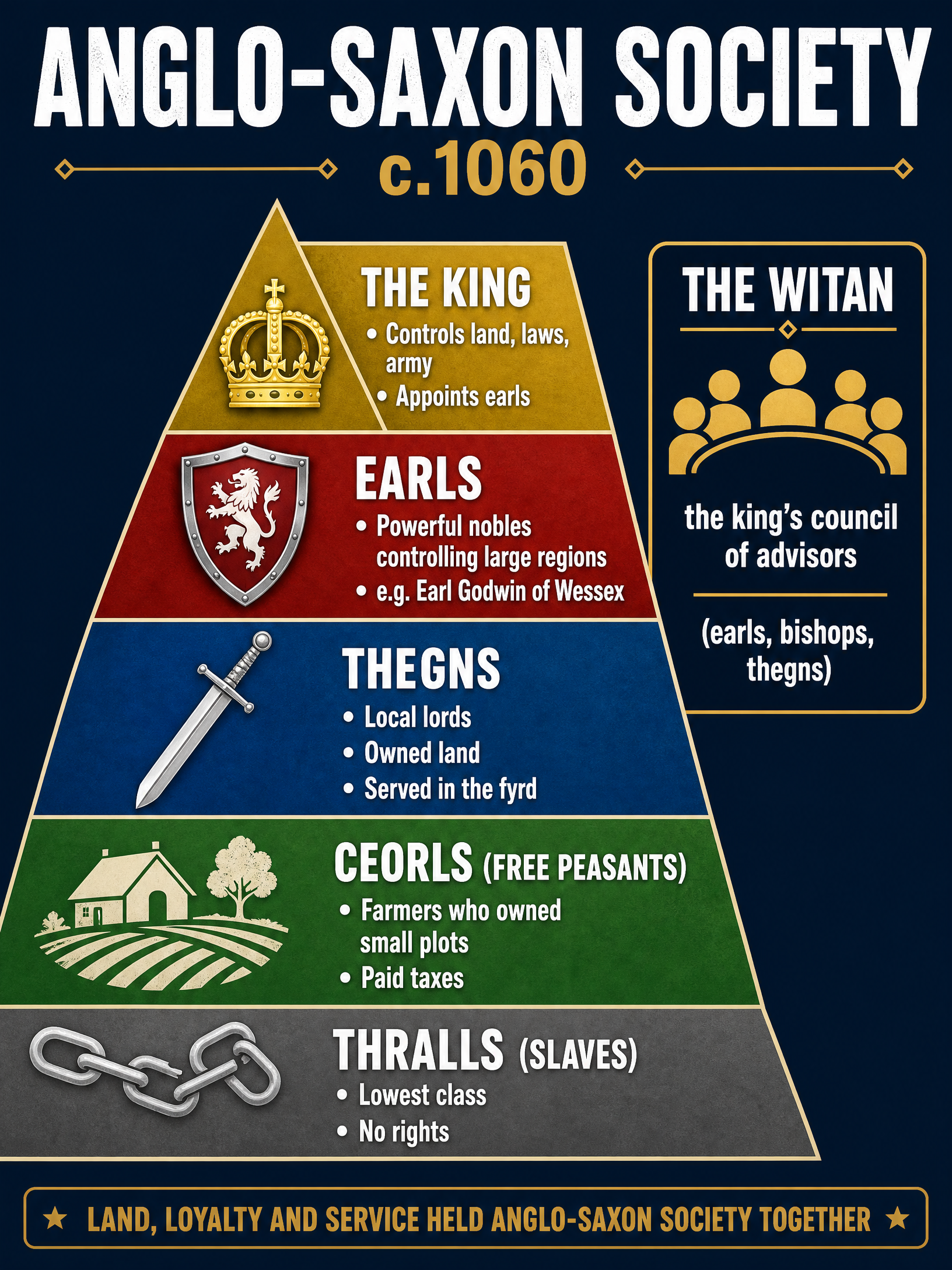
Describe two features of the Anglo-Saxon social system. (4 marks)
Hint: Identify a feature (e.g., Earls) and provide a specific supporting detail (e.g., they advised the king in the Witan).
Explain why there was a succession crisis in January 1066. (12 marks)
Hint: Think about the lack of an heir, the deathbed promise, and the rival claims from overseas.
'The feigned retreat was the main reason for William's victory at Hastings.' How far do you agree? (16 marks)
Hint: Evaluate the feigned retreat, but also consider Harold's exhaustion and William's preparation. Reach a conclusion.
Explain why William implemented the Harrying of the North. (12 marks)
Hint: Consider rebellions, the Danish threat, and the need to establish absolute control.
How useful is the Anglo-Saxon Chronicle for an enquiry into the Harrying of the North? (8 marks)
Hint: Assess the content (what it says about destruction), provenance (written by English monks), and limitations.
Test your understanding of Anglo-Saxon and Norman England, c1060–88
Active recall beats re-reading. Take an instant quiz now to test what you’ve learned and lock it into long-term memory.
7 days Premium · Then free forever · No card, no charge