Pearson Edexcel · GCSE · History
British America, 1713–83: empire and revolution
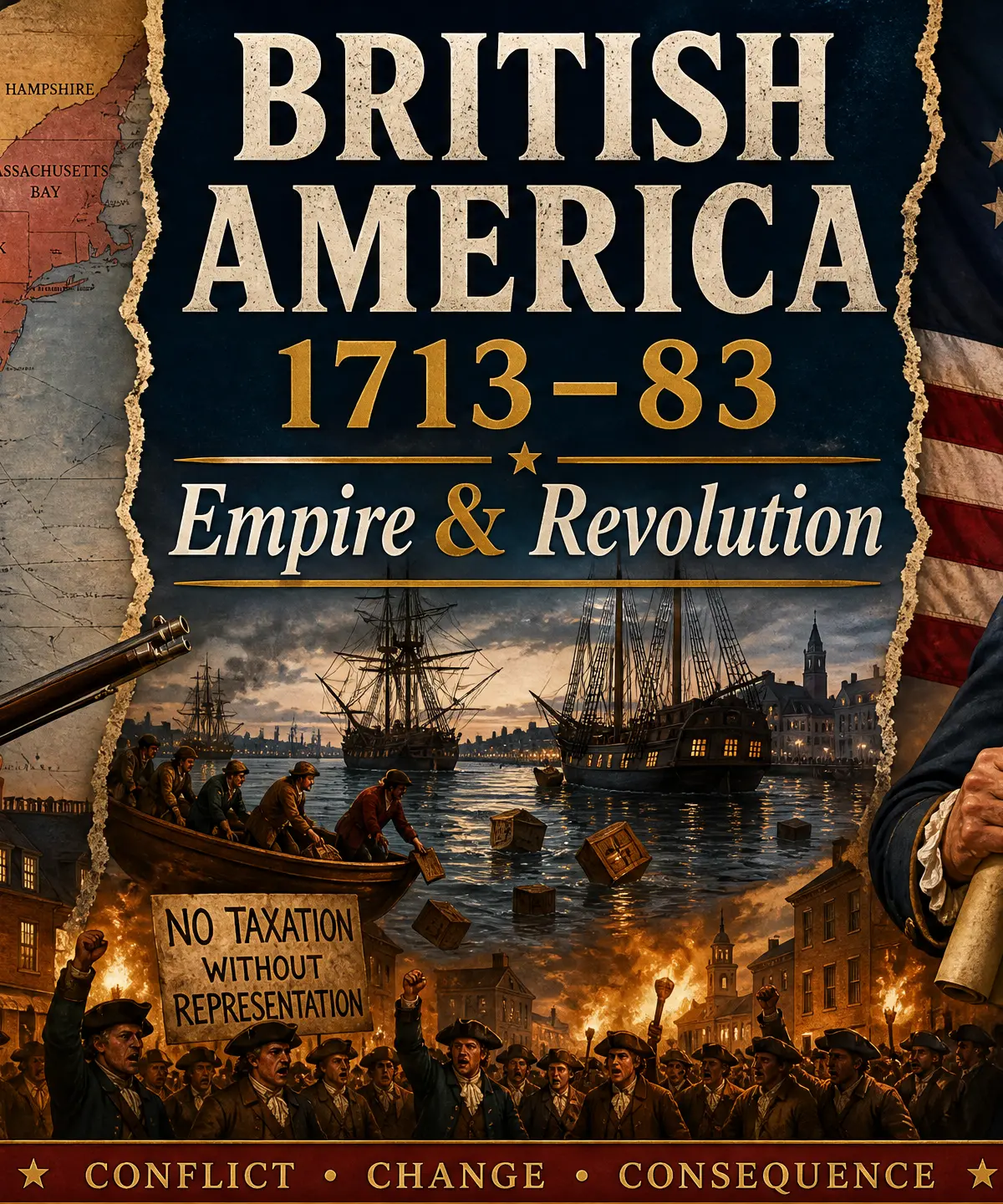
This study guide covers the dramatic transformation of thirteen British colonies into the independent United States of America. It explores the causes of the revolution, key turning points in the war, and the profound consequences for colonists, Indigenous peoples, and enslaved individuals, ensuring you are fully prepared for your GCSE History exam.
- 9 min read
- 3 worked examples
- 5 practice questions
- 6 key terms
Study Notes
Overview
This study guide covers the period from 1713 to 1783, focusing on the escalating tensions between the British government and its American colonies, the outbreak of the War of Independence, and the far-reaching consequences of the conflict. Examiners expect you to demonstrate a strong understanding of causation (why the colonies rebelled) and consequence (the impact of the war). You must be able to analyse key events like the Stamp Act and the Boston Tea Party, evaluate the significance of turning points like the Battle of Saratoga, and assess the role of key individuals such as George Washington and Thomas Jefferson. Furthermore, you will need to evaluate primary sources and historical interpretations, understanding how and why perspectives on the revolution differ.
Listen to our comprehensive revision podcast to solidify your understanding:
Key Events & Developments
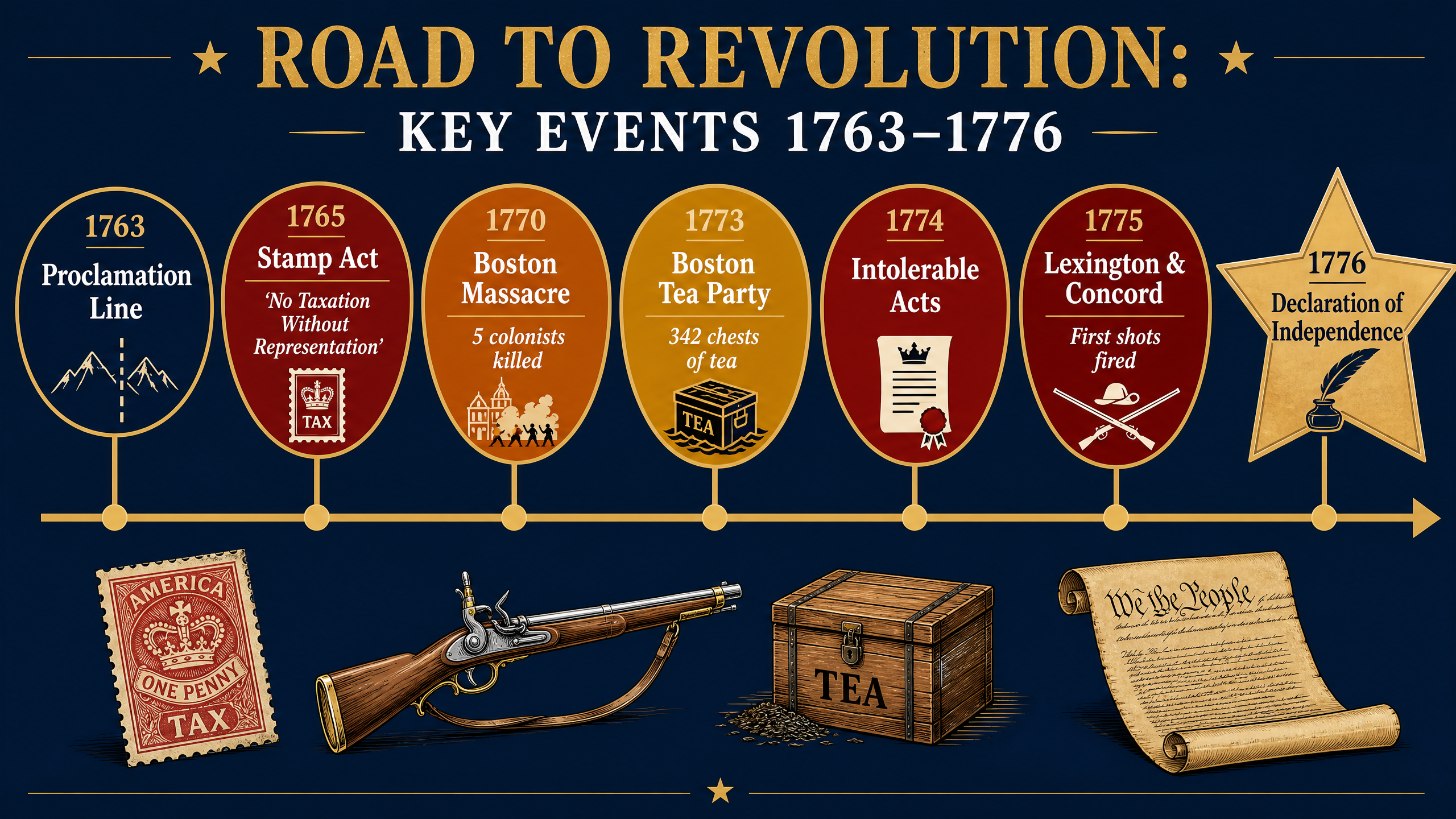
The Stamp Act Crisis
Date(s): March 1765
What happened: Following the costly Seven Years' War, British Prime Minister George Grenville introduced the Stamp Act, a direct tax on all printed materials in the colonies, including legal documents, newspapers, and playing cards.
Why it matters: This act sparked widespread outrage because it was a direct tax levied by a Parliament in which the colonists had no elected representatives, leading to the rallying cry of 'no taxation without representation'. It united the colonies in opposition and led to the formation of the Stamp Act Congress.
Specific Knowledge: Passed in March 1765; Stamp Act Congress met in October 1765 with delegates from 9 colonies; repealed in 1766.
The Boston Massacre
Date(s): 5 March 1770
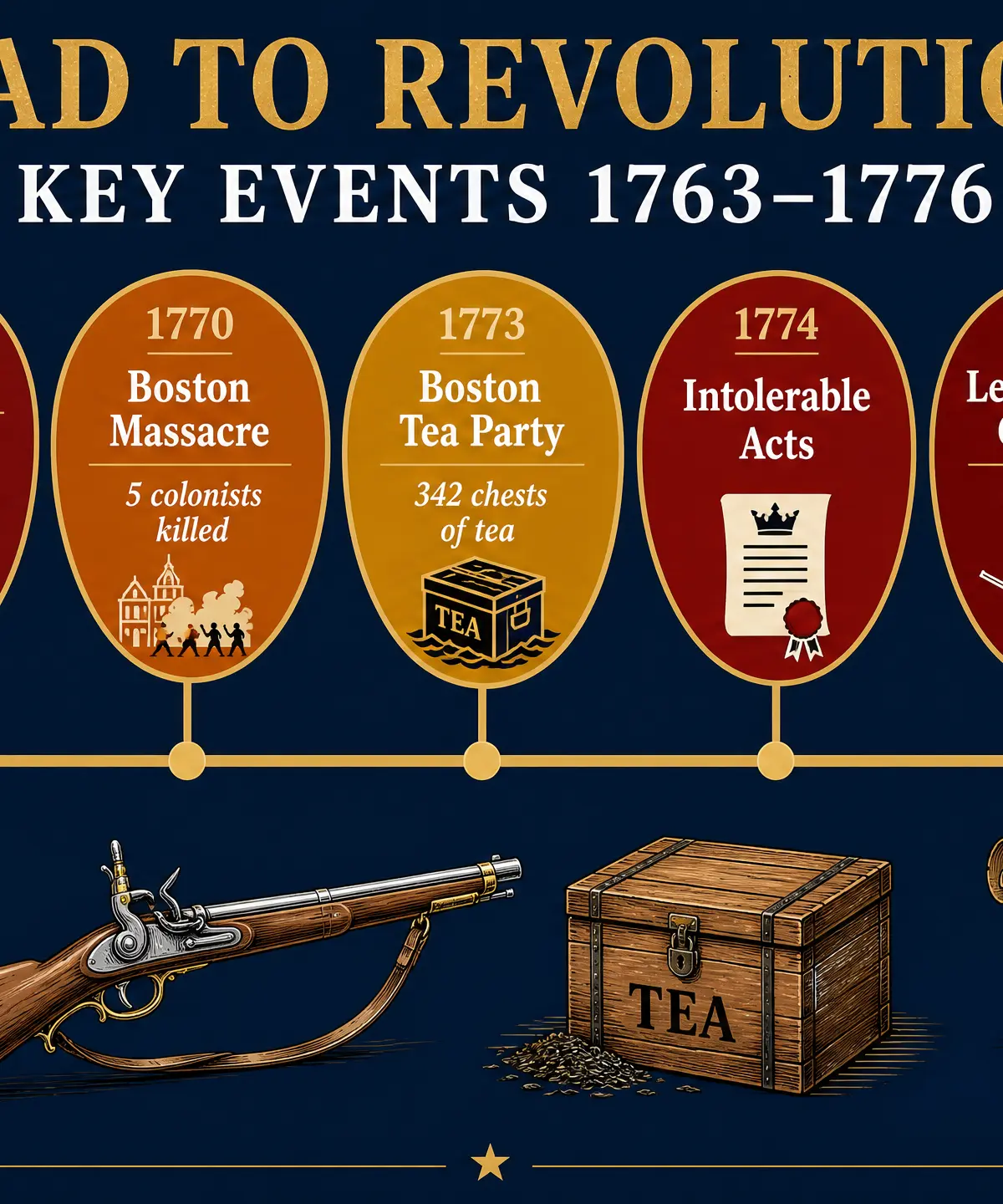
What happened: Tensions over the presence of British troops (stationed under the Quartering Act) boiled over when a mob confronted soldiers guarding the Custom House. The soldiers fired into the crowd, killing five colonists.
Why it matters: The event was heavily propagandised by colonial leaders like Paul Revere, who produced an engraving depicting it as a deliberate slaughter. It significantly increased anti-British sentiment and is a crucial event for source analysis questions.
Specific Knowledge: 5 colonists killed, including Crispus Attucks; Paul Revere's engraving was key propaganda.
The Boston Tea Party
Date(s): 16 December 1773
What happened: In protest against the Tea Act (which gave the British East India Company a monopoly), the Sons of Liberty, some disguised as Mohawk Native Americans, boarded three ships in Boston Harbour and destroyed their cargo of tea.
Why it matters: This was a direct, destructive challenge to British authority. It provoked a harsh response from Britain (the Coercive/Intolerable Acts), which in turn pushed the colonies closer to outright rebellion.
Specific Knowledge: 342 chests of tea destroyed; valued at approximately £10,000.
The First and Second Continental Congresses
Date(s): September 1774 (First) and May 1775 (Second)
What happened: The First Congress met in response to the Intolerable Acts, petitioning the King for redress. When the King refused and fighting broke out, the Second Congress convened, acting as a de facto national government, creating the Continental Army, and eventually drafting the Declaration of Independence.
Why it matters: These congresses represent the critical shift from isolated colonial protests to unified, coordinated political and military action against Britain.
Specific Knowledge: First Congress had delegates from 12 colonies (Georgia absent); Second Congress appointed George Washington as Commander-in-Chief.
The Declaration of Independence
Date(s): 4 July 1776
What happened: The Second Continental Congress formally adopted a document, primarily drafted by Thomas Jefferson, declaring the thirteen colonies as independent states, no longer subject to British rule.
Why it matters: It provided the ideological foundation for the new nation, based on Enlightenment ideas of natural rights ('life, liberty, and the pursuit of happiness'). It transformed the conflict from a rebellion within the empire into a war for a new, independent nation.
Specific Knowledge: Drafted by Jefferson; listed 27 specific grievances against King George III; heavily influenced by John Locke.
The Battle of Saratoga
Date(s): September - October 1777
What happened: American forces under General Horatio Gates defeated a British army led by General John Burgoyne in upstate New York.
Why it matters: This is widely considered the turning point of the war. The decisive American victory convinced France that the Americans could win, leading to a formal Franco-American alliance in 1778, which provided crucial military and financial support.
Specific Knowledge: Burgoyne surrendered approximately 6,000 troops; led to French alliance in February 1778.
The Battle of Yorktown
Date(s): September - October 1781
What happened: A combined American and French force under Washington and Rochambeau besieged British General Cornwallis at Yorktown, Virginia, while the French navy blocked his escape by sea.
Why it matters: Cornwallis's surrender effectively ended major combat operations in North America, making American independence inevitable and leading directly to peace negotiations.
Specific Knowledge: Cornwallis surrendered around 8,000 men on 19 October 1781; French naval support (Admiral de Grasse) was decisive.
Key Individuals
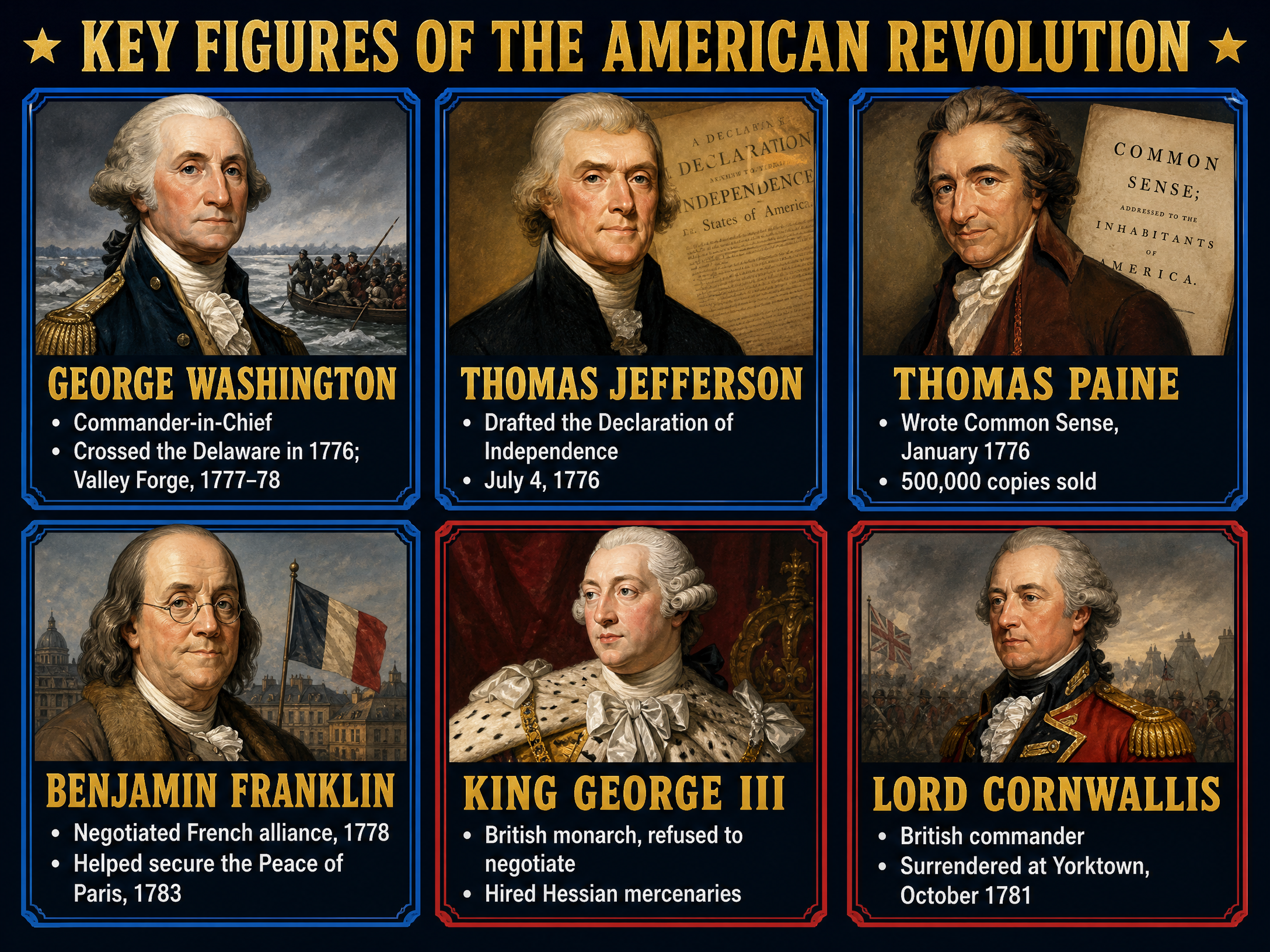
George Washington
Role: Commander-in-Chief of the Continental Army
Key Actions: Led American forces through difficult periods (e.g., Valley Forge), orchestrated the surprise attack at Trenton, and commanded the decisive victory at Yorktown.
Impact: His leadership, strategic patience, and ability to hold the army together were essential to the American victory.
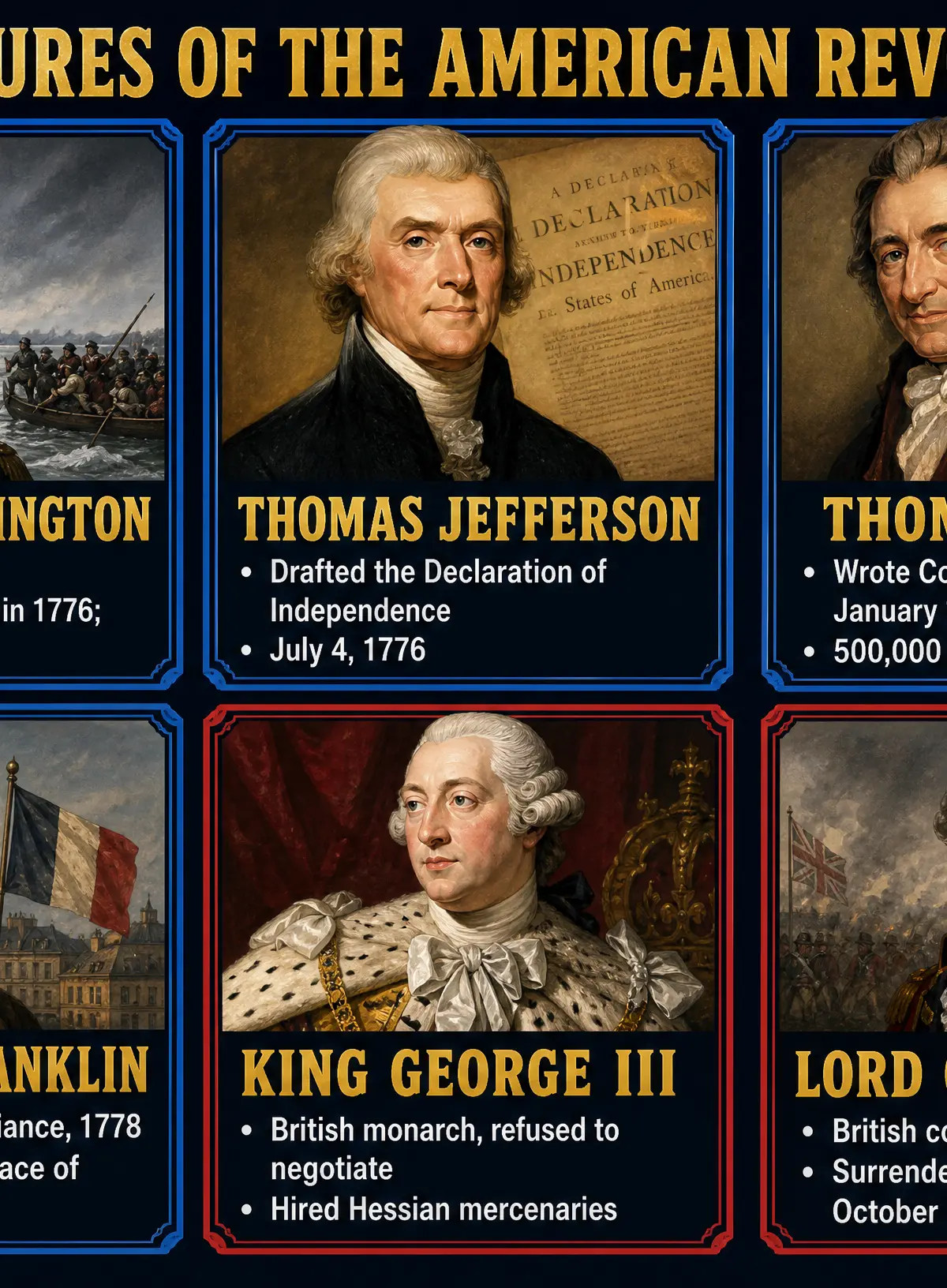
Thomas Jefferson
Role: Delegate to the Continental Congress and primary author of the Declaration of Independence
Key Actions: Drafted the Declaration, articulating the Enlightenment ideals that justified the rebellion.
Impact: Provided the intellectual and moral framework for the United States, though his status as a slave owner highlights the contradictions of the era.
Thomas Paine
Role: Political activist and author
Key Actions: Published the highly influential pamphlet Common Sense in January 1776.
Impact: He translated complex political arguments into accessible language, shifting public opinion decisively in favour of independence from the British monarchy.
Benjamin Franklin
Role: Diplomat and statesman
Key Actions: Served as the American ambassador to France, securing the crucial 1778 alliance, and later helped negotiate the Peace of Paris (1783).
Impact: His diplomatic skills were vital in securing the international support that made American victory possible.
Second-Order Concepts
Causation
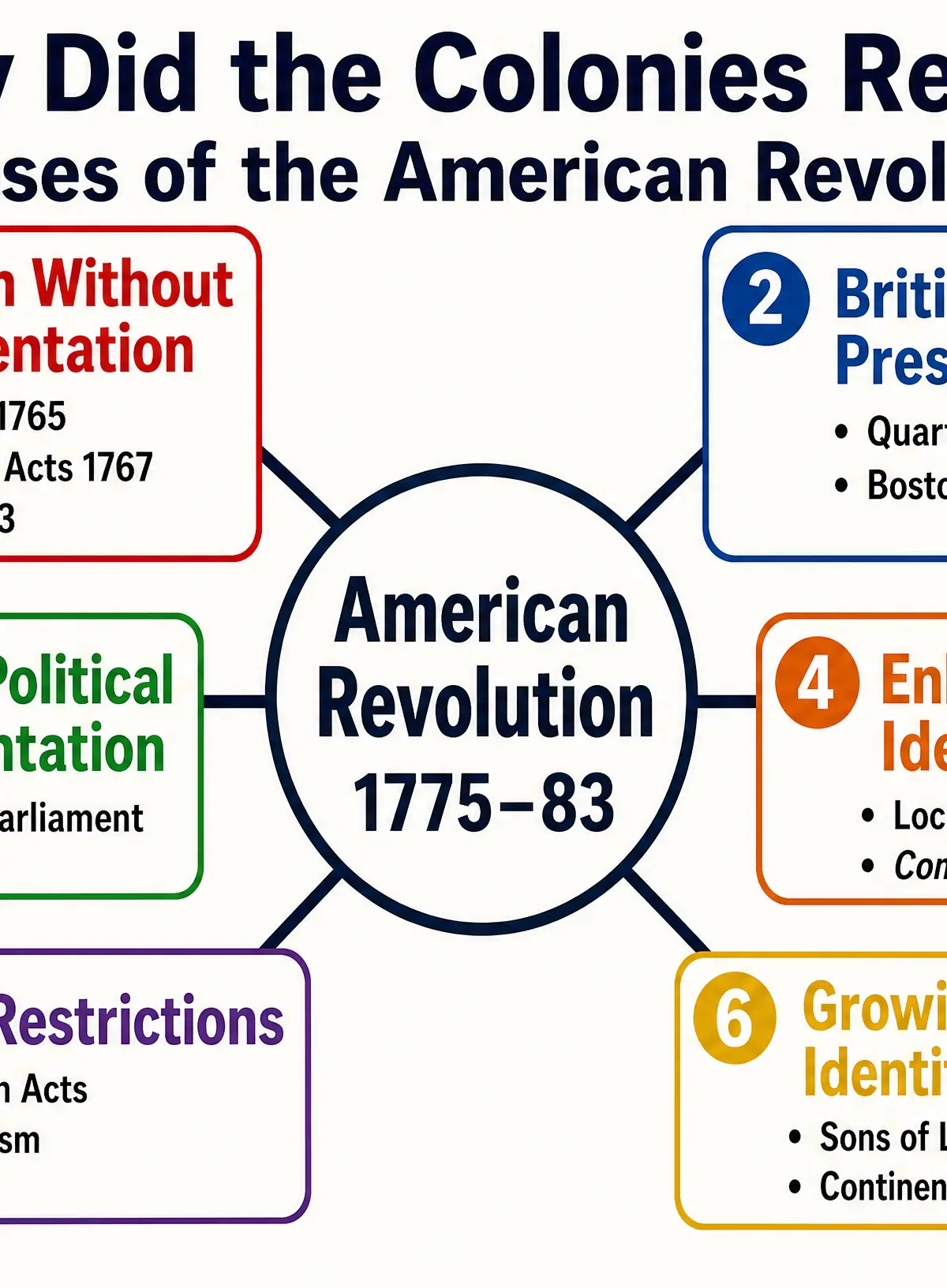
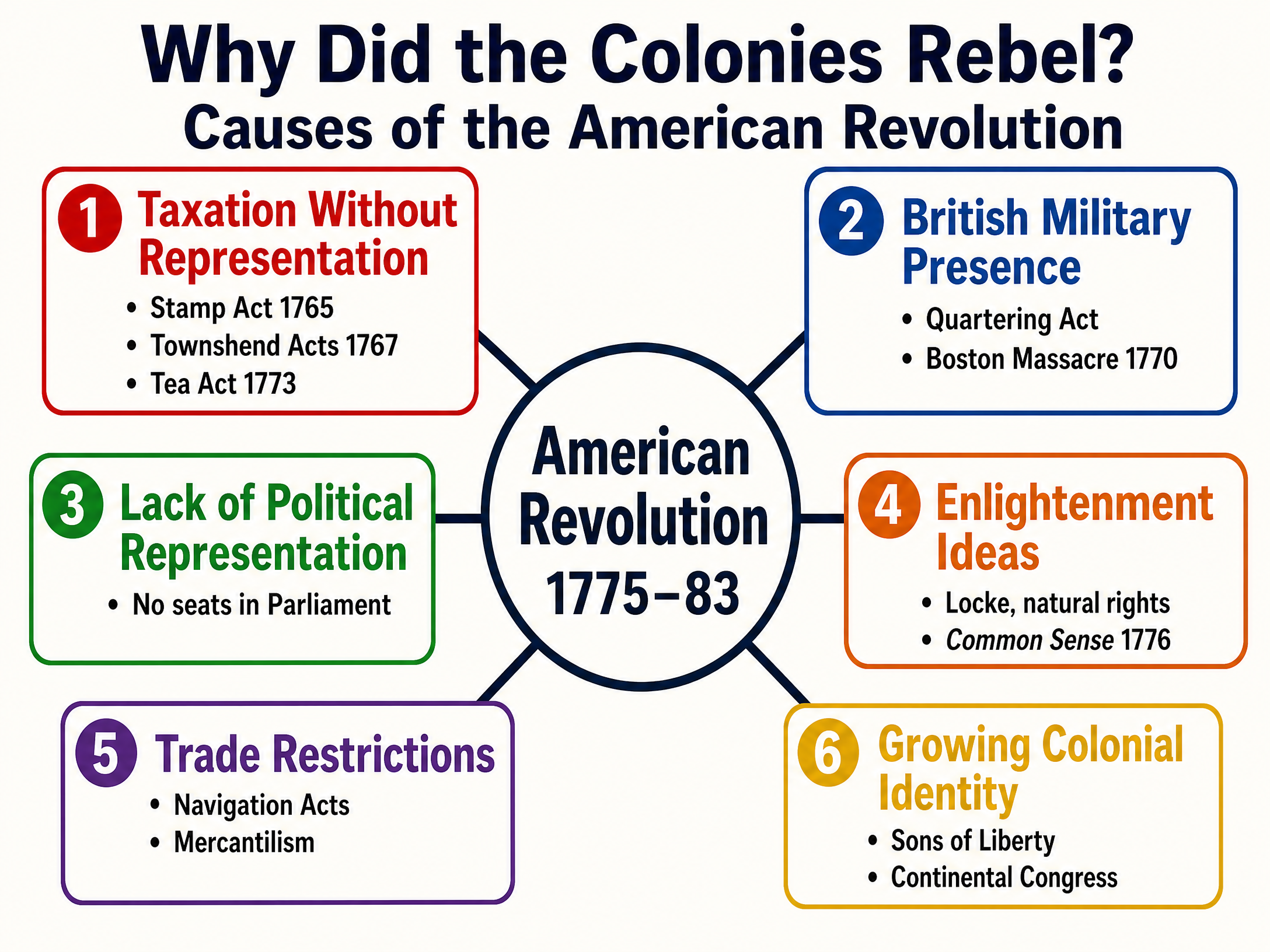
The American Revolution was driven by a combination of factors:
- Economic (Long-term): Mercantilist policies like the Navigation Acts restricted colonial trade.
- Political (Trigger): The end of 'salutary neglect' after 1763 led to new taxes (Stamp Act, Townshend Acts) imposed without colonial representation in Parliament.
- Ideological: Enlightenment ideas regarding natural rights and the social contract (popularised by Paine's Common Sense) provided the justification for rebellion.
- Escalation: British military responses (Boston Massacre, Intolerable Acts) radicalised colonists and closed off avenues for compromise.
Consequence
The impact of the revolution varied significantly depending on the group:
- For Colonists: Achieved political independence and established a republic, though political power remained concentrated among white, male property owners.
- For Indigenous Peoples: Disastrous. The Proclamation Line of 1763 was nullified, opening western lands to aggressive American expansion without British protection.
- For Loyalists: Approximately 60,000 faced persecution, confiscation of property, and forced exile, many relocating to Canada (Nova Scotia, Niagara).
- For Enslaved People: While some gained freedom by fighting (often for the British), the institution of slavery was maintained and codified in the new republic.
Change & Continuity
- Change: The transition from a monarchical empire to an independent republic; the severing of formal economic ties with Britain; the displacement of Loyalists.
- Continuity: The social hierarchy remained largely intact (wealthy elites retained power); the institution of slavery continued; patriarchal structures restricting women's rights persisted.
Significance
The revolution is historically significant because it successfully challenged the world's most powerful empire, established a new nation based on Enlightenment principles, and inspired subsequent revolutionary movements globally (e.g., in France and Latin America).
Source Skills
When tackling source questions (AO3) on this topic, consider:
- Provenance: Who produced the source? (A British official, a radical Patriot, a Loyalist?) When? (Before or after fighting began?) Why? (To inform, to persuade, to inflame tensions?)
- Content: What specific events or attitudes does the source describe? How does it align with your contextual knowledge?
- Utility: How useful is this source for a specific enquiry? (e.g., Paul Revere's engraving is highly useful for understanding Patriot propaganda, but less useful for establishing the exact facts of the Boston Massacre).
Visual Resources
3 diagrams and illustrations
Interactive Diagrams
1 interactive diagram to visualise key concepts
Conceptual Flow Outline
Flowchart showing the escalation of conflict from 1763 to 1775
Worked Examples
3 worked examples — open one to explore the question and available guidance.
Practice Questions
Test your understanding — click to reveal model answers
Describe two consequences of the American War of Independence for Indigenous peoples. (4 marks)
Hint: Think about land protection and the treaties made at the end of the war.
Explain why the British lost the American War of Independence. (12 marks)
Hint: Consider British logistical problems, American leadership, and foreign intervention.
How useful is Thomas Paine's pamphlet 'Common Sense' to a historian studying the causes of the American Revolution? (8 marks)
Hint: Evaluate its content (what it argued) and its provenance (purpose and impact on the public).
'The Stamp Act was the most significant cause of the American Revolution.' How far do you agree? (16 marks)
Hint: Compare the Stamp Act with other causes like the Intolerable Acts or Enlightenment ideas.
Describe two features of the Boston Tea Party. (4 marks)
Hint: Think about who was involved and what exactly they did.
Test your understanding of British America, 1713–83: empire and revolution
Active recall beats re-reading. Take an instant quiz now to test what you’ve learned and lock it into long-term memory.
7 days Premium · Then free forever · No card, no charge