Pearson Edexcel · GCSE · History
Conflict in the Middle East, 1945–95
This study guide covers the intense diplomatic efforts and ongoing conflicts in the Middle East from 1945 to 1995. It is crucial for understanding how modern diplomacy works, the role of superpowers, and the deep-rooted complexities of the Arab-Israeli conflict that continue to shape global politics today.
- 9 min read
- 3 worked examples
- 5 practice questions
- 6 key terms
Study Notes
Overview
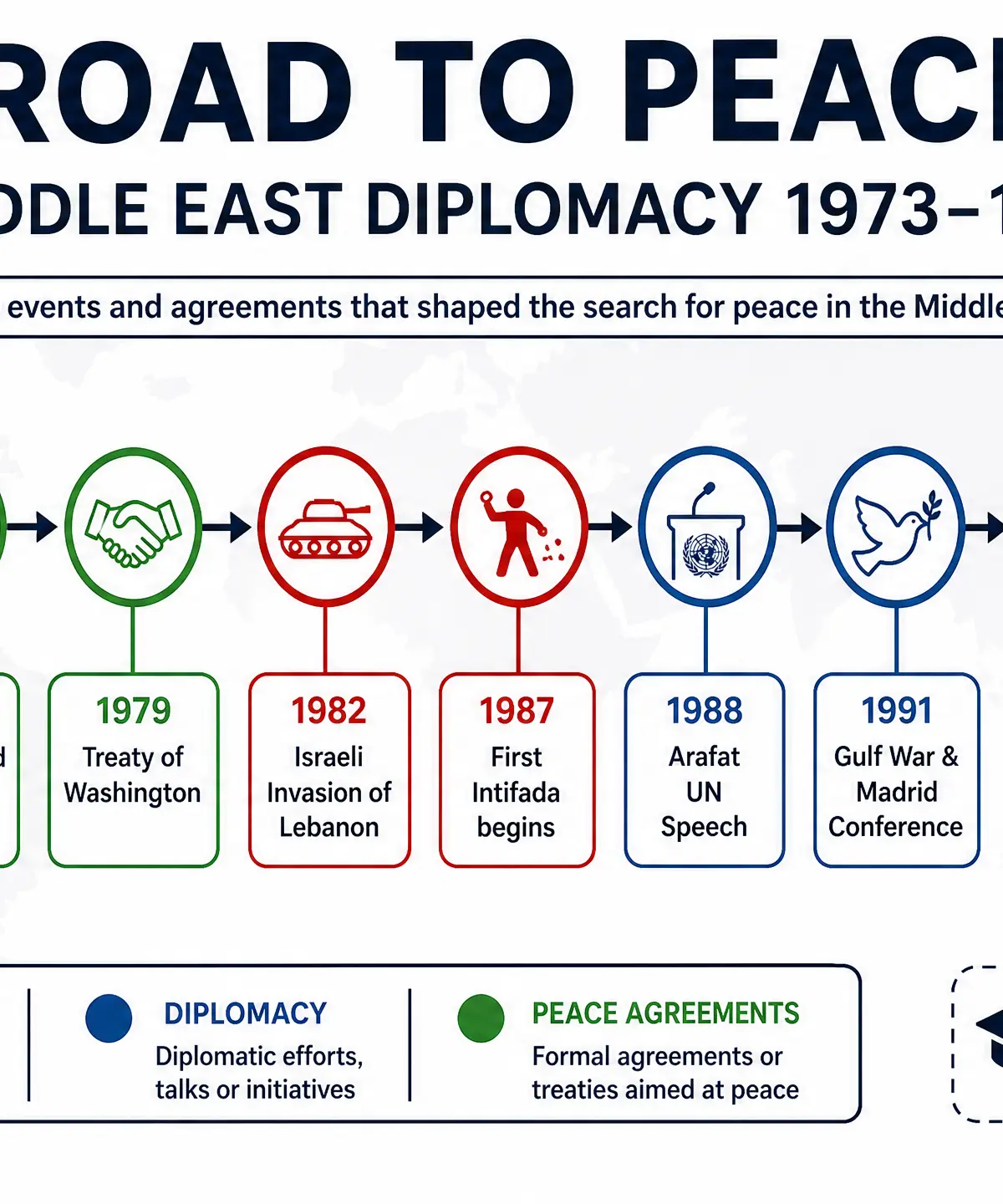
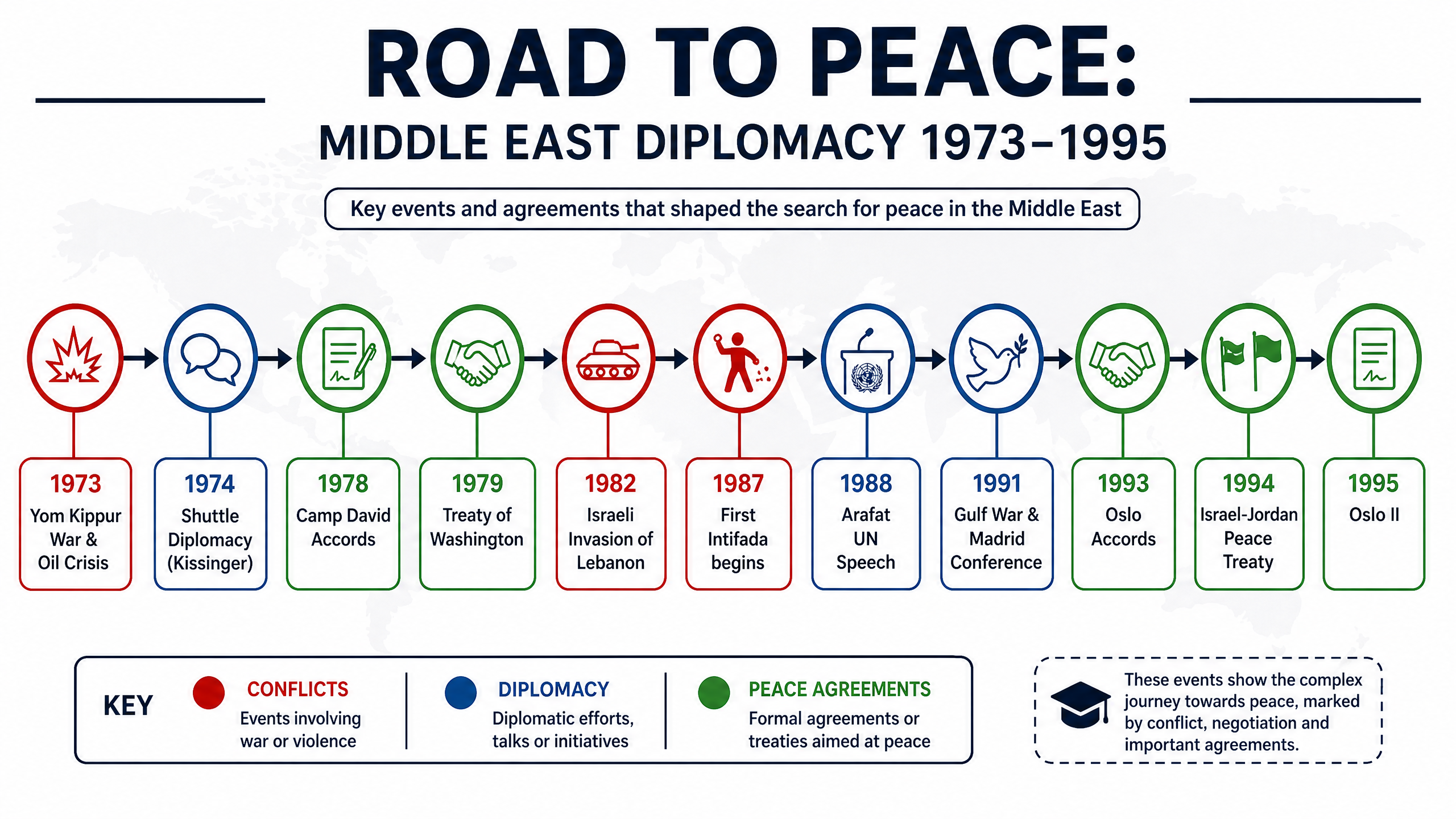
The period from 1945 to 1995 in the Middle East is defined by a cycle of intense conflict followed by complex, often fragile, diplomatic efforts to secure peace. At the heart of this era is the Arab-Israeli conflict, a struggle over land, national identity, and security that drew in global superpowers and influenced international economies, most notably through the oil crisis. For GCSE History candidates, this topic requires an understanding of the shift from military confrontation to diplomatic negotiation. Examiners expect you to trace the evolution of peace efforts—from Henry Kissinger's bilateral 'shuttle diplomacy' to the multilateral framework of the Oslo Accords. You must be able to explain the causes and consequences of key events like the 1973 Yom Kippur War, the 1982 invasion of Lebanon, and the First Intifada, linking these regional crises to wider global shifts such as the end of the Cold War.
Listen to the companion podcast episode for a deep dive into the topic:
Key Events & Developments
The Yom Kippur War & Oil Crisis
Date(s): October 1973
What happened: Egypt and Syria launched a surprise attack on Israel on the Jewish holy day of Yom Kippur to reclaim territory lost in 1967. While initially successful, Israel, backed by the USA, eventually repelled the attack. In response to US support for Israel, Arab members of OPEC imposed an oil embargo.
Why it matters: The conflict demonstrated that Israel was not invincible, restoring Arab pride and making diplomacy possible. The resulting oil crisis quadrupled global oil prices, proving that Arab states could use economic leverage as a powerful political weapon.
Specific Knowledge: Egypt led by Anwar Sadat; Sinai Peninsula; OPEC oil embargo; prices quadrupled.
Shuttle Diplomacy
Date(s): 1974–1975
What happened: US Secretary of State Henry Kissinger flew between Middle Eastern capitals (Jerusalem, Cairo, Damascus) to negotiate disengagement agreements bilaterally, avoiding the impossible task of getting all hostile parties around a single table.
Why it matters: It successfully de-escalated immediate post-war tensions and led to the reopening of the Suez Canal in 1975, laying the groundwork for future peace talks.
Specific Knowledge: Henry Kissinger; bilateral negotiations; Suez Canal reopened in 1975.
Camp David Accords & Treaty of Washington
Date(s): September 1978 (Accords) & March 1979 (Treaty)
What happened: US President Jimmy Carter mediated 13 days of secret talks between Egypt's Sadat and Israel's Begin at Camp David. This resulted in the 1979 Treaty of Washington, where Egypt recognised Israel, and Israel returned the Sinai Peninsula.
Why it matters: It was the first peace treaty between Israel and an Arab state. However, it isolated Egypt in the Arab world (leading to Sadat's assassination in 1981) and failed to resolve the Palestinian issue.
Specific Knowledge: Jimmy Carter, Anwar Sadat, Menachem Begin; Sinai Peninsula returned; Egypt expelled from Arab League.
Israeli Invasion of Lebanon
Date(s): June 1982
What happened: Israel invaded Lebanon to destroy the PLO's military infrastructure, advancing to Beirut. The invasion was marred by the Sabra and Shatila massacres carried out by Lebanese Christian militias while Israeli forces stood by.
Why it matters: It severely damaged Israel's international reputation, forced the PLO to relocate to Tunis, and inadvertently led to the creation of Hezbollah, a radical Iran-backed militant group.
Specific Knowledge: Menachem Begin; PLO relocation to Tunis; Sabra and Shatila massacres; rise of Hezbollah.
The First Intifada
Date(s): December 1987 – 1993
What happened: A spontaneous Palestinian uprising against Israeli occupation in the West Bank and Gaza Strip, characterised by stone-throwing, strikes, and civil disobedience.
Why it matters: It shifted international sympathy towards the Palestinians and pressured both Israel and the PLO (whose leadership in Tunis was losing control to local factions) to seek a negotiated settlement, directly catalysing the Oslo peace process.
Specific Knowledge: Began in Gaza Strip; 'Intifada' means 'shaking off'; emergence of Hamas.
Arafat's UN Speech
Date(s): November 1988
What happened: Yasser Arafat addressed the UN General Assembly in Geneva, declaring a Palestinian state, renouncing terrorism, and recognising Israel's right to exist.
Why it matters: This marked a fundamental shift in PLO policy, accepting a two-state solution and prompting the USA to open direct dialogue with the PLO.
Specific Knowledge: UN General Assembly in Geneva; renunciation of terrorism; acceptance of two-state solution.
The Oslo Accords (Oslo I)
Date(s): September 1993
What happened: Following secret negotiations in Norway, Israel and the PLO signed a Declaration of Principles in Washington. Israel recognised the PLO, the PLO recognised Israel, and a Palestinian National Authority was established to govern Jericho and Gaza.
Why it matters: It was a historic breakthrough providing a framework for peace, but it deliberately delayed resolving the hardest 'final status' issues (Jerusalem, refugees, borders), which remained a critical weakness.
Specific Knowledge: Yitzhak Rabin, Yasser Arafat, Bill Clinton; secret Norwegian mediation; Palestinian National Authority.
Key Individuals
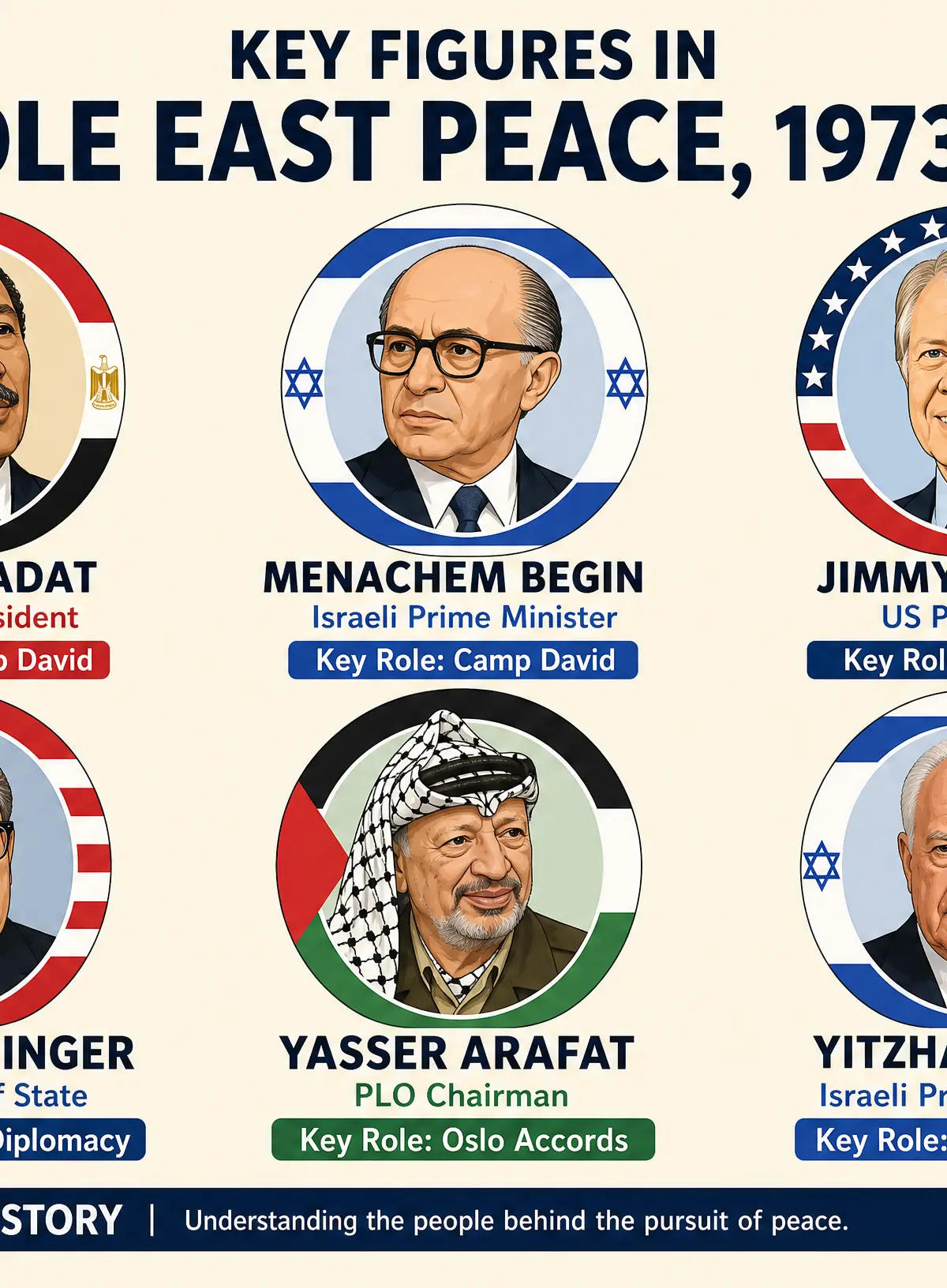
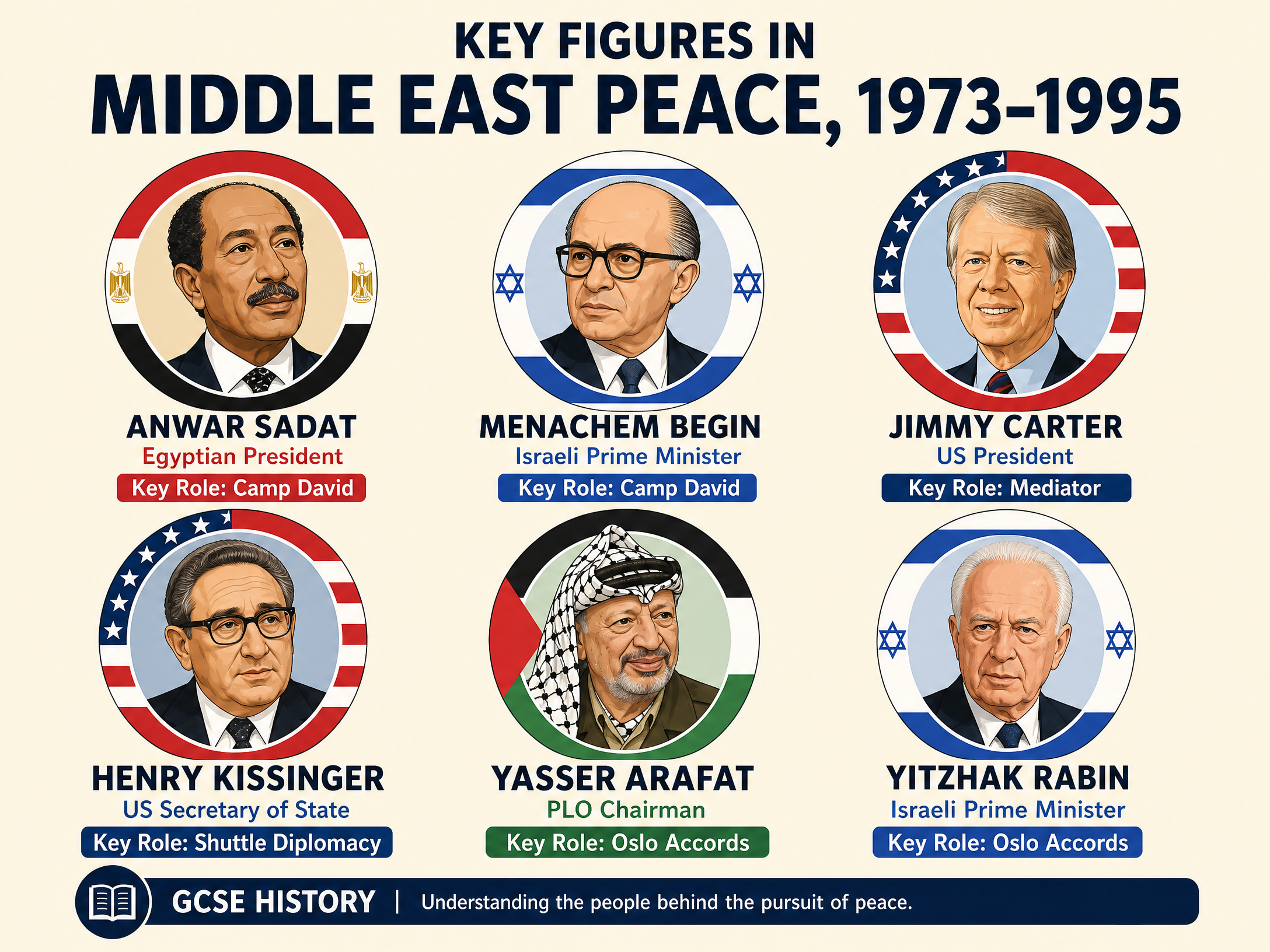
Anwar Sadat
Role: President of Egypt
Key Actions: Launched the 1973 Yom Kippur War, later travelled to Jerusalem in 1977, and signed the Camp David Accords in 1978.
Impact: Broke the diplomatic deadlock by becoming the first Arab leader to recognise Israel, though it cost him his life in 1981.
Menachem Begin
Role: Prime Minister of Israel
Key Actions: Signed the Camp David Accords returning the Sinai to Egypt, but also launched the controversial 1982 invasion of Lebanon.
Impact: Demonstrated that right-wing Israeli leaders could make territorial concessions for peace, while maintaining a hard line on the PLO.
Henry Kissinger
Role: US Secretary of State
Key Actions: Conducted 'shuttle diplomacy' in 1974-75.
Impact: Pioneered bilateral, step-by-step negotiations that successfully de-escalated tensions after the 1973 war.
Yasser Arafat
Role: Chairman of the PLO
Key Actions: Led the PLO in Lebanon, renounced terrorism at the UN in 1988, and signed the Oslo Accords in 1993.
Impact: Transitioned the Palestinian movement from armed struggle to diplomatic negotiation, securing international recognition for the Palestinian cause.
Yitzhak Rabin
Role: Prime Minister of Israel
Key Actions: Signed the Oslo Accords with the PLO in 1993 and the peace treaty with Jordan in 1994.
Impact: Pushed forward the peace process by formally recognising the PLO, a move that led to his assassination by an Israeli extremist in 1995.
Second-Order Concepts
Causation
Events in the Middle East were driven by a mix of long-term territorial disputes and short-term triggers. For example, the Oslo Accords were caused by long-term exhaustion with conflict, but triggered by short-term shifts: the First Intifada pressuring both sides, the PLO's weakness after backing Iraq in the 1991 Gulf War, and the end of the Cold War removing Soviet backing for Arab states, leaving the US as the sole mediator.
Consequence
The consequences of peace agreements were often mixed. Camp David successfully ended the Egypt-Israel conflict but consequently isolated Egypt and enraged Palestinian groups. The 1982 Lebanon invasion aimed to destroy the PLO but consequently birthed Hezbollah, creating a new, more formidable enemy for Israel.
Change & Continuity
Between 1973 and 1995, there was significant change in diplomatic methods—moving from military confrontation to bilateral treaties (Camp David), and eventually to multilateral frameworks (Oslo). However, continuity remained in the unresolved core issues: the status of Jerusalem, Palestinian refugees, and Israeli settlements, which persisted throughout the period.
Significance
The period is highly significant because it established the modern framework for the Middle East peace process. The recognition of Israel by Egypt and Jordan, and the mutual recognition between Israel and the PLO, fundamentally altered the geopolitical landscape, even if a final, lasting peace remained elusive.
Source Skills
When evaluating sources on this topic, candidates must look closely at provenance. A source from an Israeli politician in 1982 will justify the Lebanon invasion as a security necessity against terrorism. A Palestinian source from 1988 will likely focus on the grassroots nature of the Intifada and the heavy-handed Israeli military response. Always consider the audience and purpose: is a speech meant for domestic political survival, or international diplomatic appeal (like Arafat at the UN)? Use your contextual knowledge to explain why the author holds their view.
Worked Examples
3 worked examples — open one to explore the question and available guidance.
Practice Questions
Test your understanding — click to reveal model answers
Explain the significance of the 1973 Oil Crisis. (8 marks)
Hint: Think about both the economic impact on the West and how it changed the political dynamics of the Arab-Israeli conflict.
Describe two features of the Oslo Accords (1993). (4 marks)
Hint: Identify a feature and then add a sentence of specific factual detail to develop it.
Explain why the PLO's international standing changed between 1982 and 1988. (8 marks)
Hint: Contrast their position in Lebanon in 1982 with Arafat's UN speech in 1988.
'The First Intifada was the main reason for the Oslo Accords.' How far do you agree? (16 marks)
Hint: Agree using the Intifada; disagree by discussing the Cold War and Gulf War.
Explain why the 1982 Israeli invasion of Lebanon was controversial. (8 marks)
Hint: Focus on the humanitarian consequences and the Sabra and Shatila massacres.
Test your understanding of Conflict in the Middle East, 1945–95
Active recall beats re-reading. Take an instant quiz now to test what you’ve learned and lock it into long-term memory.
7 days Premium · Then free forever · No card, no charge