Pearson Edexcel · GCSE · History
Early Elizabethan England, 1558–88
Master the initial challenges of Elizabeth I's reign, from her precarious accession in 1558 to the looming Catholic threat of Mary, Queen of Scots. This study guide unpacks the 1559 Religious Settlement and the ensuing political tightrope Elizabeth walked, providing you with the specific knowledge and analytical frameworks examiners reward.
- 8 min read
- 3 worked examples
- 5 practice questions
- 6 key terms
Study Notes
Overview
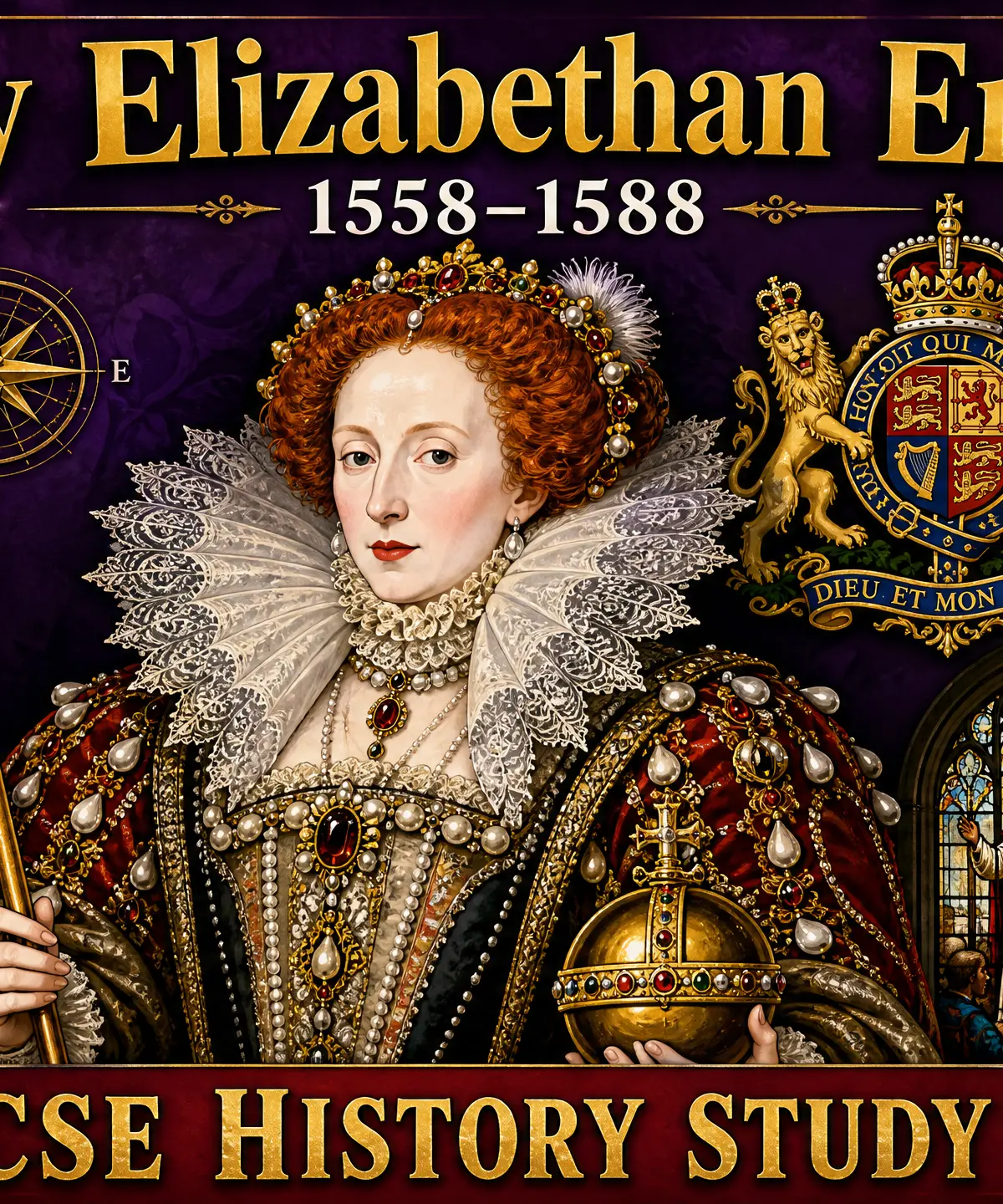
When Elizabeth I ascended to the throne in November 1558, she inherited a kingdom fraught with peril. This topic covers the first thirty years of her reign, a period defined by her efforts to establish authority, navigate deep religious divisions, and neutralize threats from both domestic rebels and foreign powers. For GCSE History examiners, this period is crucial for demonstrating your understanding of causation (why Elizabeth faced challenges) and consequence (the impact of her policies, like the Religious Settlement). You must move beyond simply telling the story of Elizabeth and Mary, Queen of Scots, and instead analyse the nature of the threat Mary posed. Strong candidates will use specific terminology—like 'legitimacy', 'Supreme Governor', and 'papal bull'—and provide precise dates and names to support their arguments.
Audio Lesson
Listen to our expert tutor explain the core concepts of Early Elizabethan England:
Key Events & Developments
The Accession of Elizabeth I
Date(s): 17 November 1558
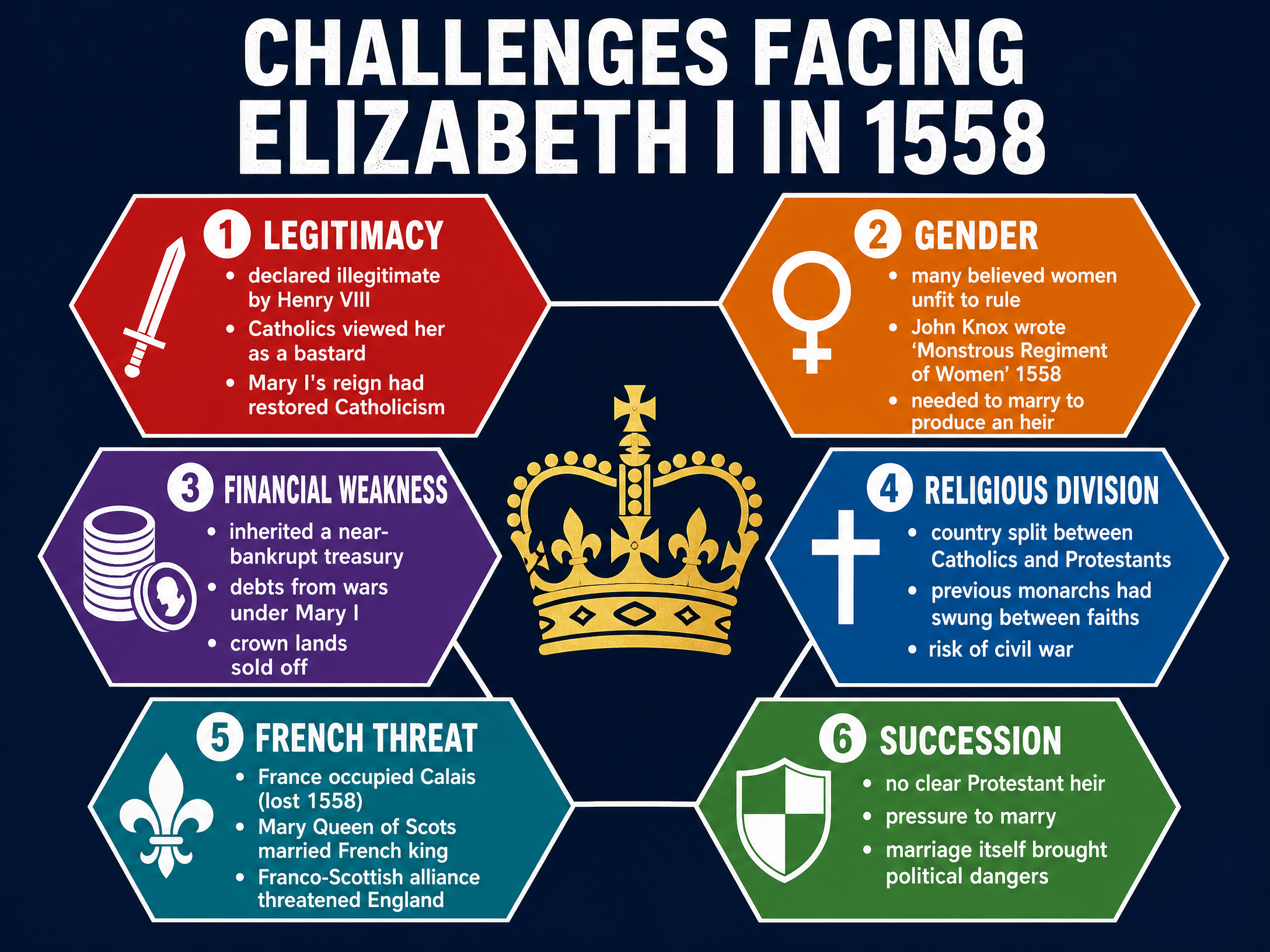
What happened: Elizabeth inherited the throne following the death of her Catholic half-sister, Mary I. She faced immediate challenges regarding her legitimacy, gender, the country's finances, religious division, and the lack of a clear successor.
Why it matters: These initial challenges shaped her entire reign. Her need to establish authority as a female ruler in a patriarchal society, and her status as illegitimate in the eyes of the Catholic Church, made her vulnerable to plots from the outset.
Specific Knowledge:
- Legitimacy: Declared illegitimate in 1536 after Anne Boleyn's execution.
- Finance: The Crown was £300,000 in debt.
- Foreign Threat: England had lost Calais to France in 1558, and France and Scotland were allied against England (the 'Auld Alliance').
The Religious Settlement
Date(s): 1559
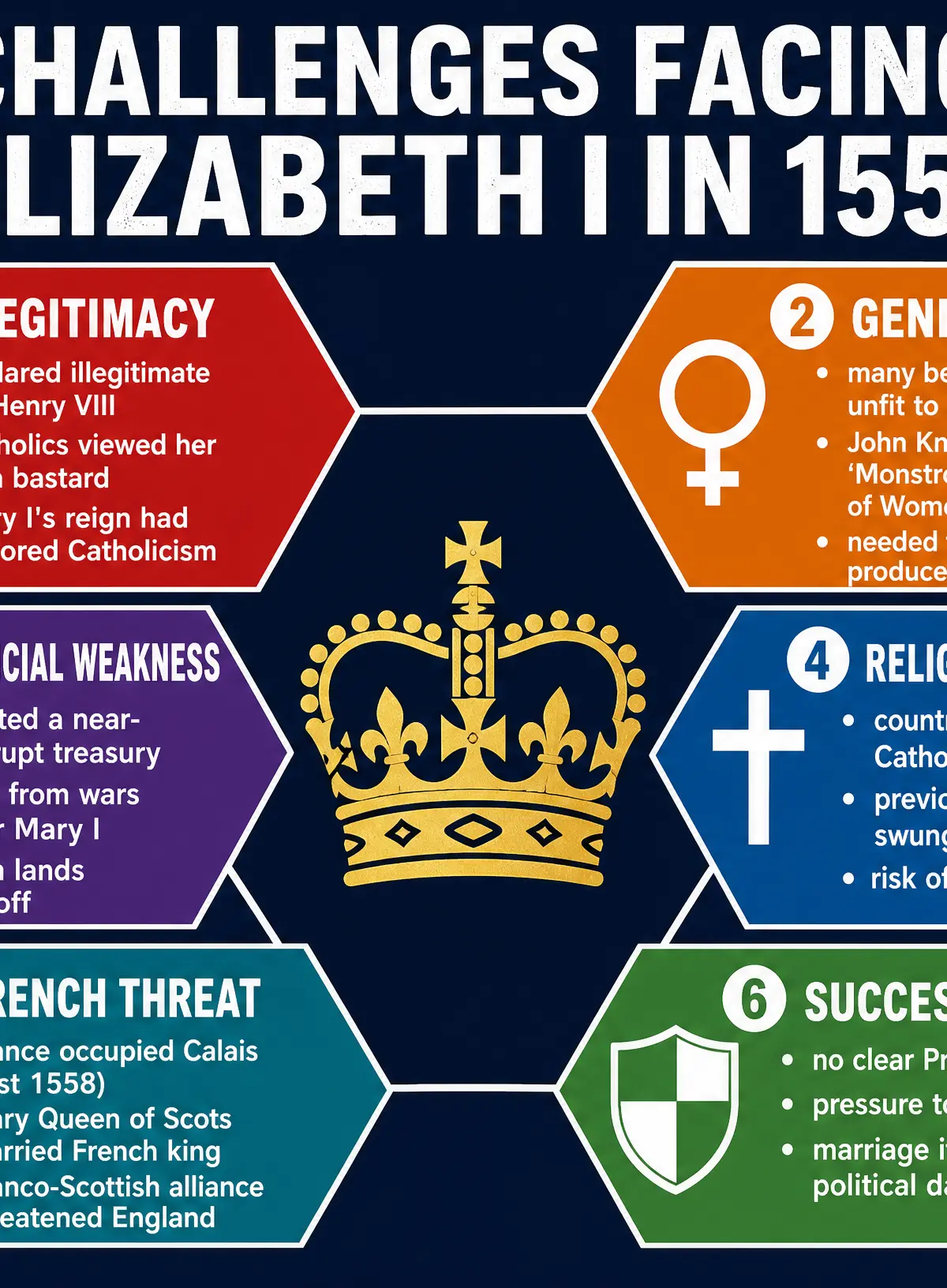
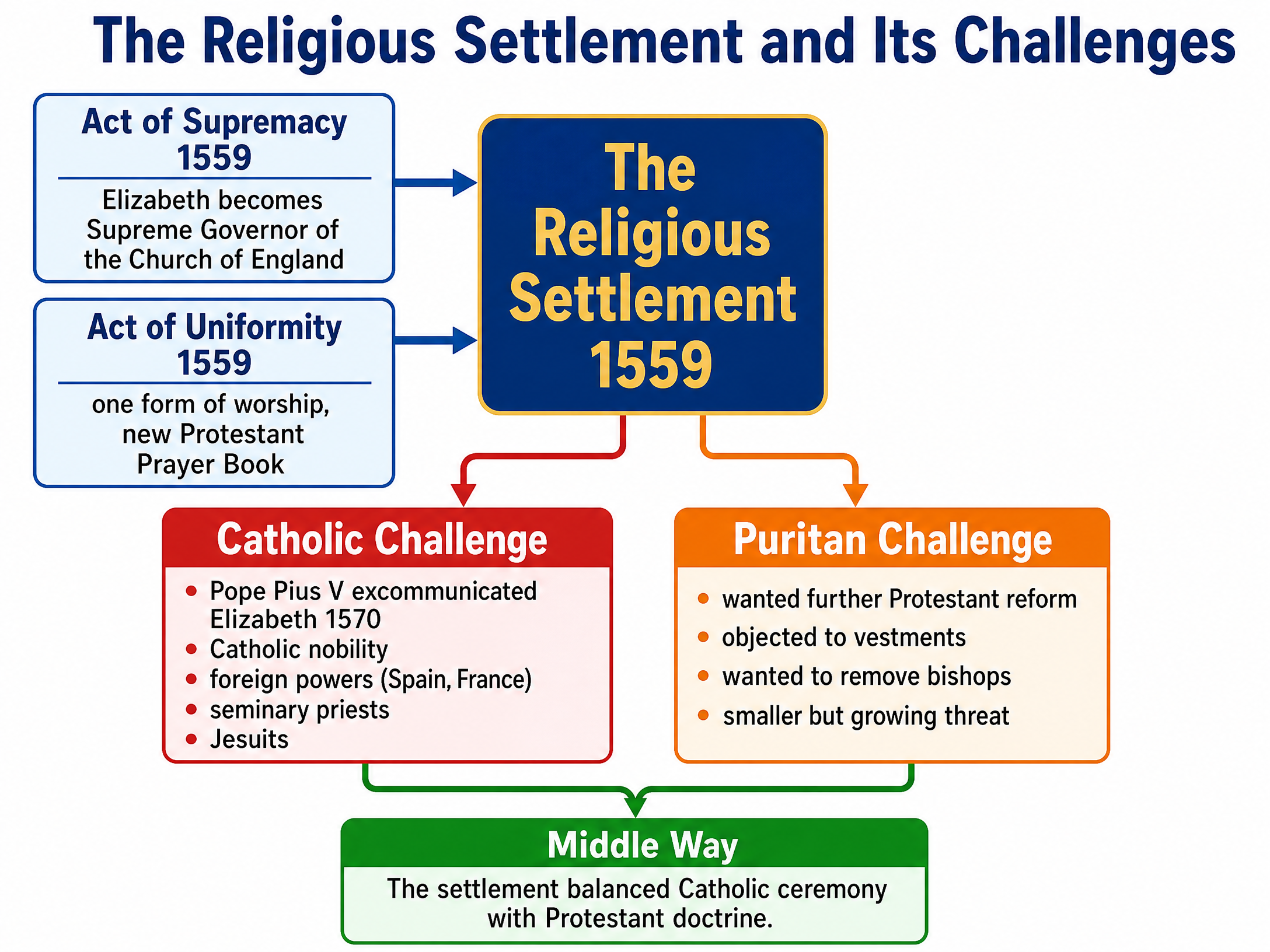
What happened: Elizabeth established a 'Middle Way' between Catholicism and Protestantism to heal the religious divisions caused by the previous three reigns. It consisted of two main acts: the Act of Supremacy and the Act of Uniformity, alongside the Royal Injunctions.
Why it matters: This was the foundation of the Church of England. While it largely succeeded in bringing stability for the first decade of her reign, its compromises ultimately angered both Puritans (who wanted more radical reform) and Catholics (who refused to accept Elizabeth as head of the Church).
Specific Knowledge:
- Act of Supremacy: Made Elizabeth 'Supreme Governor' (not Head) of the Church.
- Act of Uniformity: Imposed a single Protestant Book of Common Prayer, but kept wording vague enough to allow Catholic interpretation of communion.
- Royal Injunctions: Ordered clergy to wear vestments and allowed some church decoration.
The Papal Excommunication
Date(s): 1570
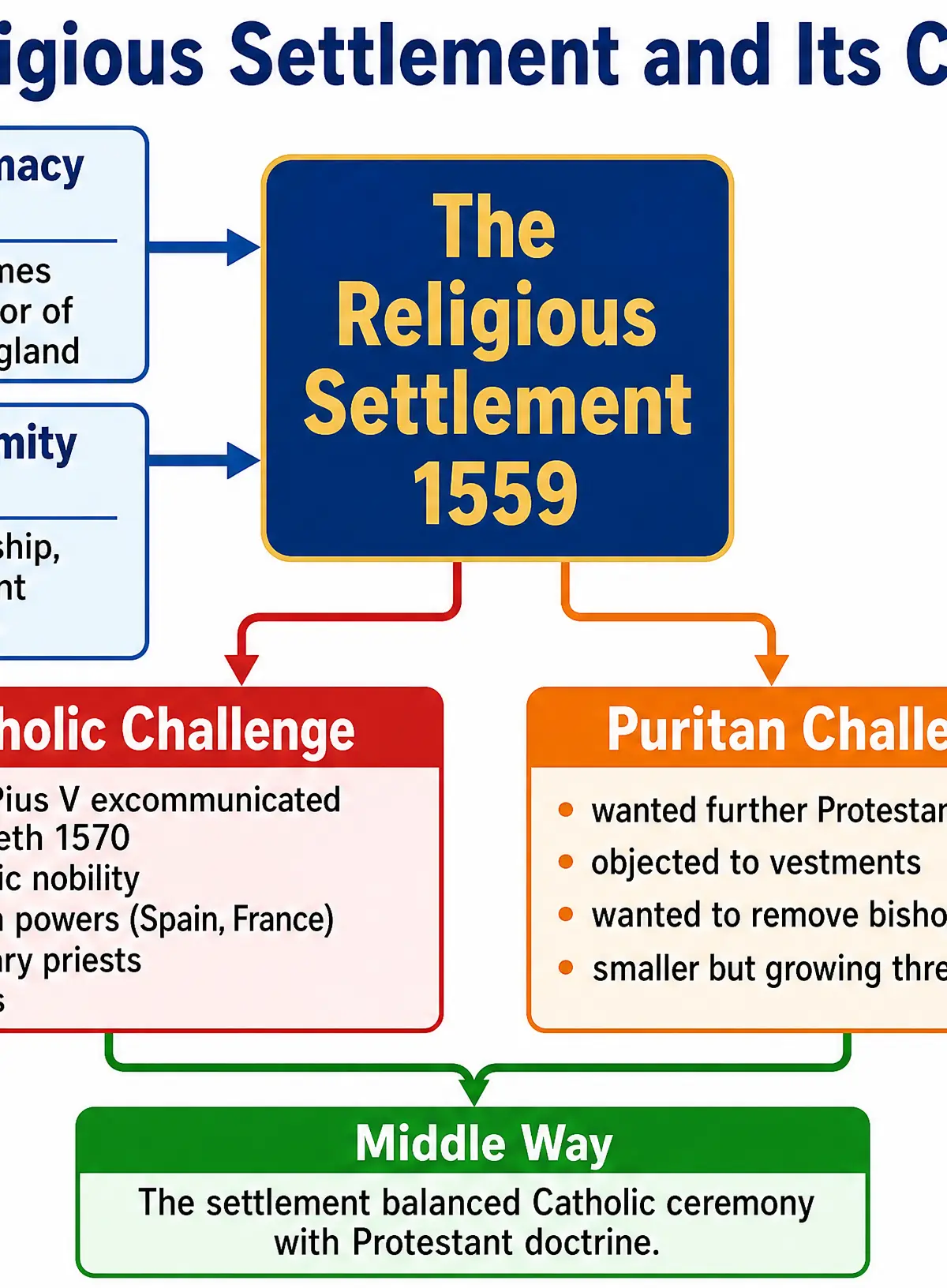
What happened: Pope Pius V issued a papal bull (Regnans in Excelsis) excommunicating Elizabeth I from the Catholic Church.
Why it matters: This was a turning point in the Catholic challenge. It released English Catholics from their oath of allegiance to Elizabeth and effectively encouraged them to overthrow her. It transformed English Catholics from a religious minority into potential traitors in the eyes of the government.
Specific Knowledge:
- The bull was issued after the Northern Rebellion had been crushed, limiting its immediate impact, but it provided the justification for all subsequent Catholic plots (Ridolfi, Throckmorton, Babington).
The Arrival of Mary, Queen of Scots
Date(s): 1568
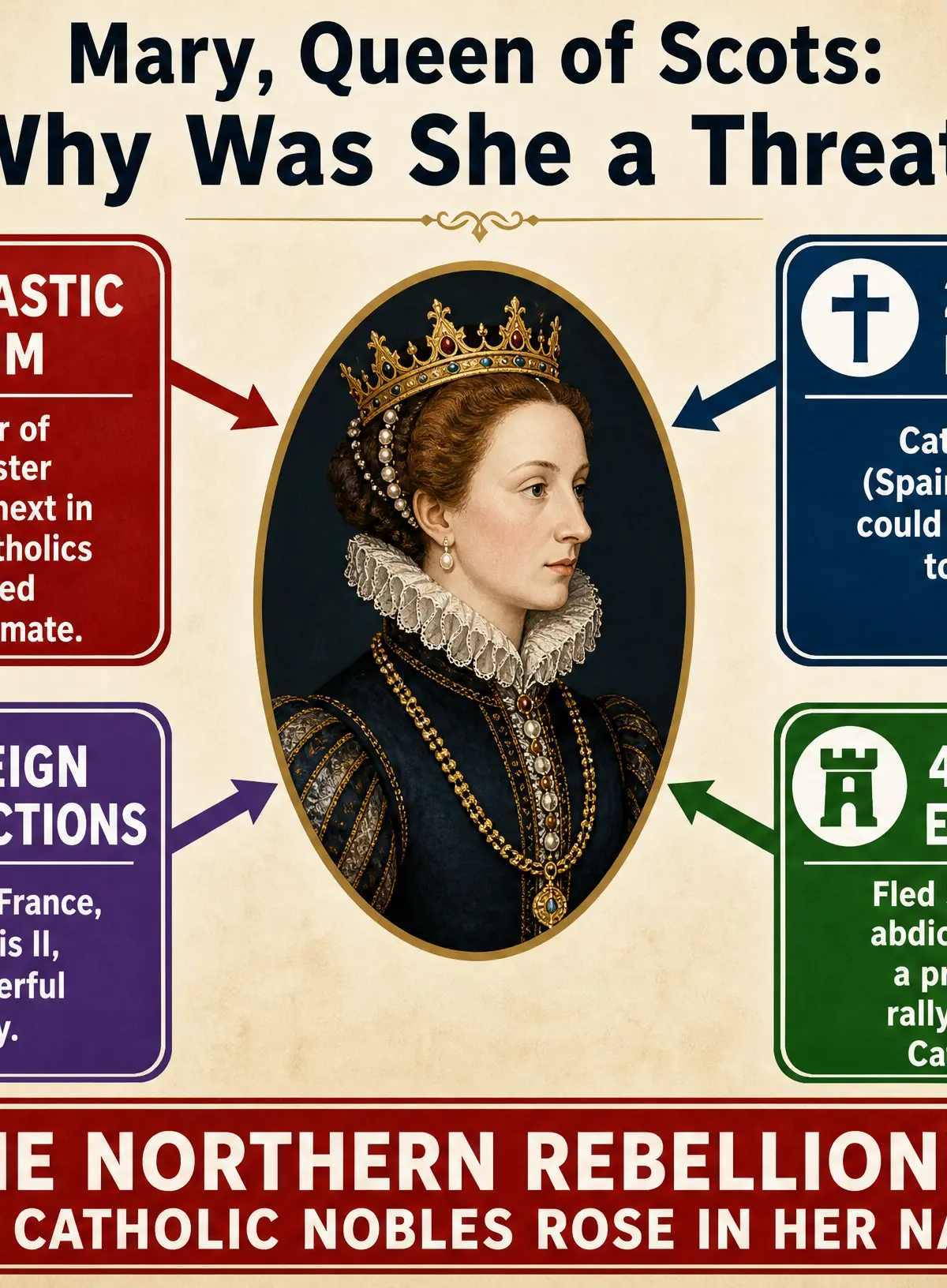
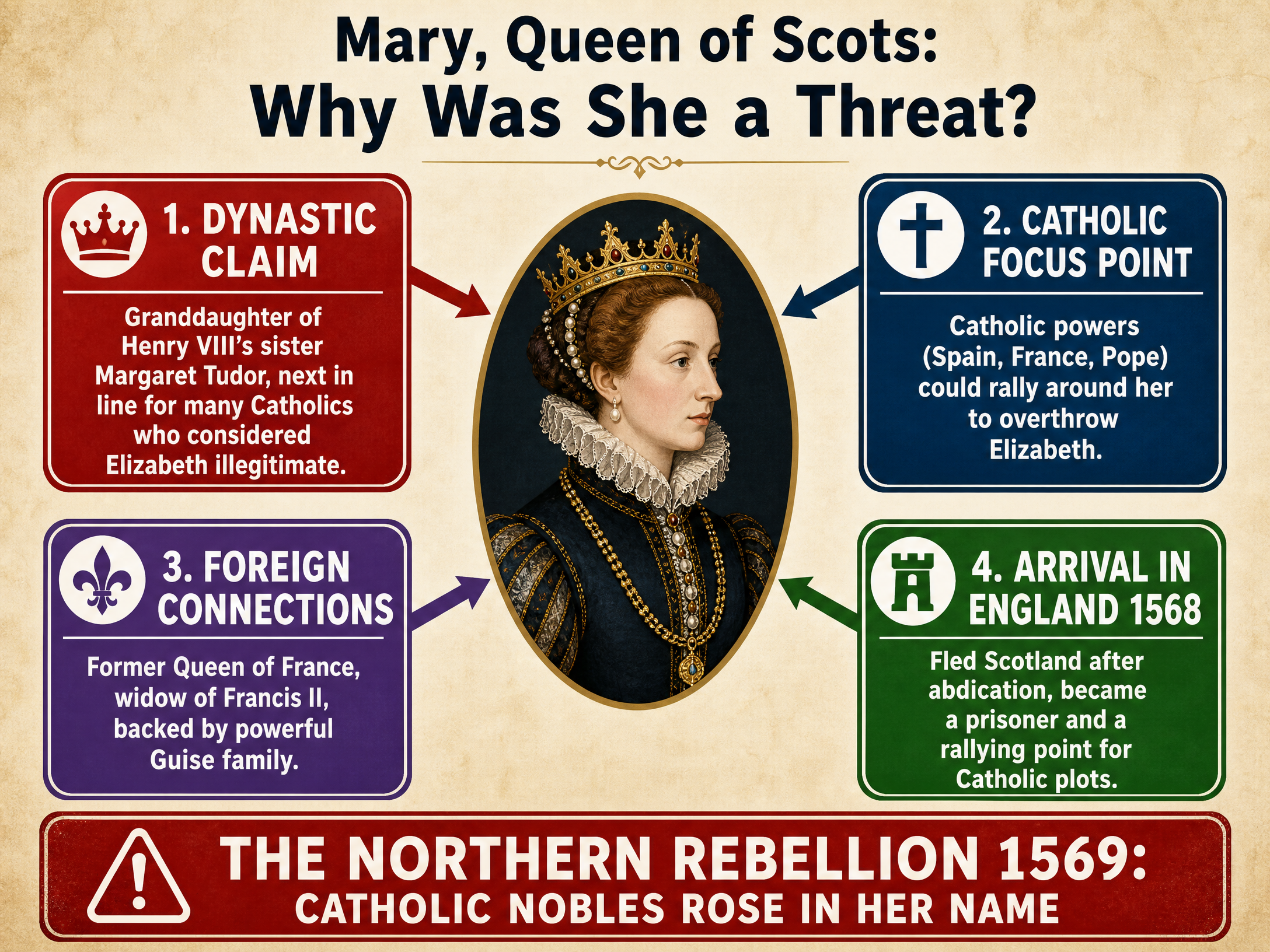
What happened: Following a scandal involving the murder of her husband (Lord Darnley) and her subsequent marriage to the chief suspect (the Earl of Bothwell), Mary was forced to abdicate the Scottish throne. She fled to England seeking Elizabeth's help.
Why it matters: Mary's arrival provided English Catholics with a figurehead. As a Catholic with a strong dynastic claim to the English throne, she became the focus of numerous plots to replace Elizabeth.
Specific Knowledge:
- Mary was Elizabeth's cousin (granddaughter of Margaret Tudor).
- Elizabeth placed Mary under house arrest for 19 years rather than executing her or returning her to Scotland.
The Revolt of the Northern Earls (The Northern Rebellion)
Date(s): 1569
What happened: The Catholic Earls of Northumberland and Westmorland led a rebellion in northern England. They took Durham Cathedral, celebrated Catholic Mass, and aimed to free Mary, Queen of Scots, and marry her to the Duke of Norfolk.
Why it matters: This was the first major Catholic challenge to Elizabeth's rule. Although it failed, it demonstrated the reality of the Catholic threat and led to harsher treason laws and a crackdown on Catholics.
Specific Knowledge:
- The rebels raised an army of around 6,000 men.
- Elizabeth's response was brutal: around 800 rebels were executed to serve as a warning.
Key Individuals
Elizabeth I
Role: Queen of England (1558–1603)
Key Actions: Implemented the 1559 Religious Settlement; navigated the threat of Mary, Queen of Scots; used her unmarried status as a diplomatic tool.
Impact: Established a relatively stable Protestant regime despite significant domestic and foreign threats. Her cautious approach ('Middle Way') prevented immediate civil war.
Mary, Queen of Scots
Role: Former Queen of Scotland, Catholic claimant to the English throne.
Key Actions: Fled to England in 1568; became the focus of the Northern Rebellion (1569) and subsequent Catholic plots.
Impact: Her presence in England was the single greatest threat to Elizabeth's security during this period, forcing the English government to adopt increasingly anti-Catholic policies.
William Cecil (Lord Burghley)
Role: Elizabeth's Secretary of State and most trusted advisor.
Key Actions: Managed the day-to-day running of the government; played a key role in drafting the Religious Settlement; oversaw the intelligence network that monitored Catholic threats.
Impact: Provided stability and experienced counsel, helping Elizabeth navigate the precarious early years of her reign.
Second-Order Concepts
Causation
Examiners often ask why Elizabeth faced challenges in 1558, or why the Catholic threat increased.
- Short-term triggers: The arrival of Mary, Queen of Scots in 1568 triggered the Northern Rebellion in 1569.
- Long-term causes: The fundamental cause of the Catholic threat was Henry VIII's break with Rome and the subsequent religious see-sawing under Edward VI and Mary I.
Consequence
The consequence of the 1559 Religious Settlement was initial stability, but long-term division. The consequence of the 1570 Papal Excommunication was a shift in government policy from relative tolerance of Catholics to active persecution.
Change & Continuity
- Change: England officially returned to Protestantism after Mary I's Catholic reign.
- Continuity: The 1559 Settlement deliberately retained continuity with some Catholic traditions (vestments, bishops) to ease the transition.
Significance
Mary, Queen of Scots is significant not just because she was a queen, but because she embodied the intersection of dynastic politics (she had a claim to the throne) and religious conflict (she was Catholic). She was the catalyst that turned religious discontent into active treason.
Source Skills
When evaluating sources for this period, pay close attention to provenance:
- Catholic sources (e.g., from seminary priests or the Pope) will heavily criticize the Religious Settlement and portray Elizabeth as a heretic.
- Puritan sources (e.g., pamphlets) will criticize the Settlement for being 'too Catholic' and failing to purify the Church.
- Government sources (e.g., Cecil's letters, Acts of Parliament) will emphasize the need for stability, obedience, and the 'Middle Way'.
Always consider the purpose of the source: is it trying to justify rebellion, enforce conformity, or persuade the Queen?
Visual Resources
3 diagrams and illustrations
Interactive Diagrams
1 interactive diagram to visualise key concepts
Diagram could not be rendered
Timeline showing how the Catholic threat escalated in the first decade of Elizabeth's reign.
Worked Examples
3 worked examples — open one to explore the question and available guidance.
Practice Questions
Test your understanding — click to reveal model answers
Describe two features of the Elizabethan Religious Settlement (1559). (4 marks)
Hint: Provide a feature, then add a specific supporting detail for each.
Explain why the Catholic threat to Elizabeth increased between 1568 and 1570. (12 marks)
Hint: Think about the sequence of events: Mary's arrival, the Northern Rebellion, and the Pope's actions.
'The main problem Elizabeth faced in 1558 was the threat from foreign powers.' How far do you agree? (16 marks + 4 SPaG)
Hint: Argue for foreign powers (France/Scotland), but contrast this with domestic issues (religion, finance, legitimacy).
Explain why the Puritans challenged the Religious Settlement. (8 marks)
Hint: Focus on what the Puritans wanted versus what the 'Middle Way' actually delivered.
Describe two features of the Catholic threat to Elizabeth I between 1569 and 1570. (4 marks)
Hint: Think about the Northern Rebellion and the Pope's actions.
Test your understanding of Early Elizabethan England, 1558–88
Active recall beats re-reading. Take an instant quiz now to test what you’ve learned and lock it into long-term memory.
7 days Premium · Then free forever · No card, no charge