Pearson Edexcel · GCSE · History
Henry VIII and his ministers, 1509–40
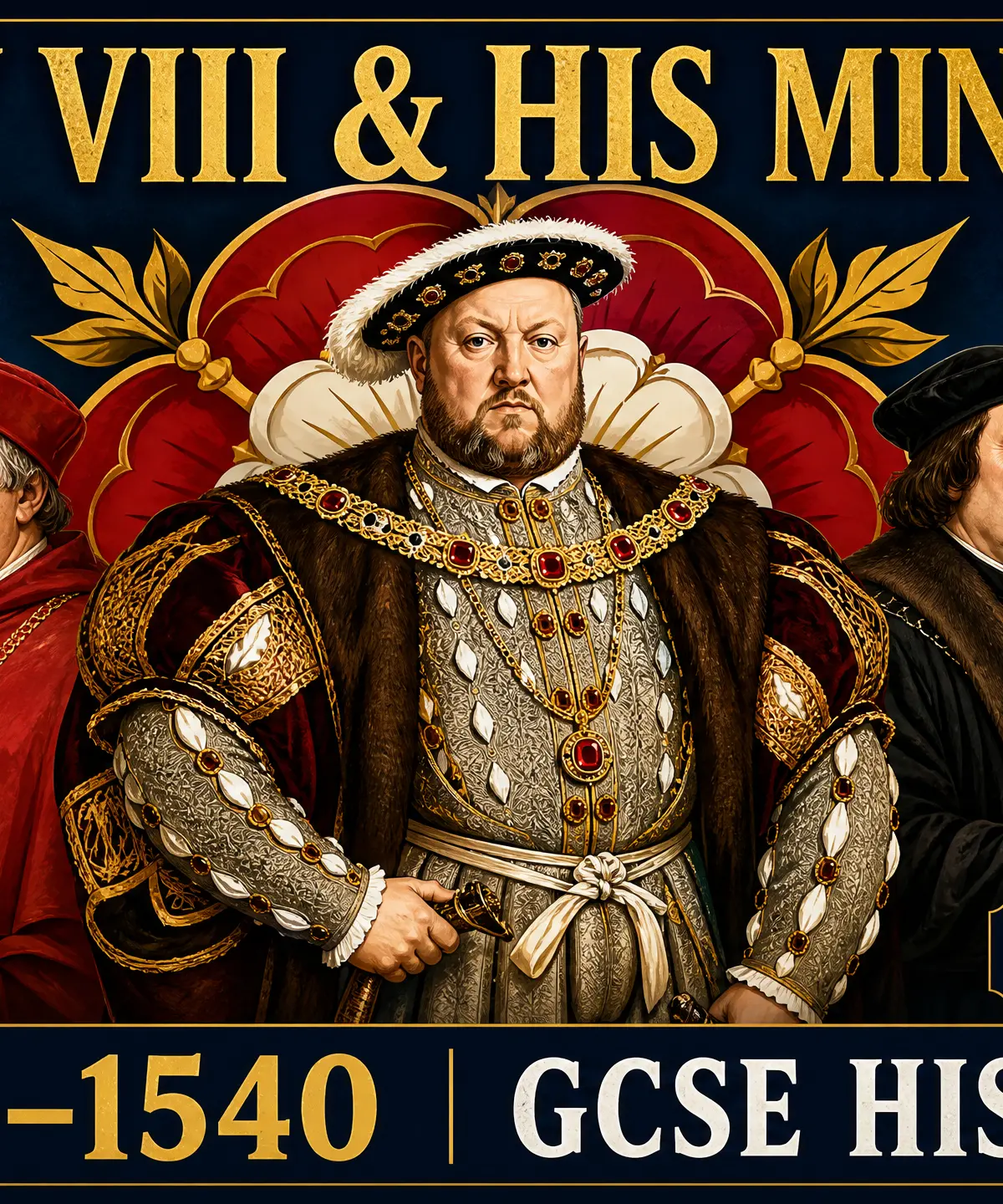
Master the dramatic era of Henry VIII and his most powerful minister, Cardinal Wolsey. This guide unpacks the politics, power struggles, and foreign policy that shaped Tudor England, providing you with the specific knowledge and examiner insights needed for top marks.
- 9 min read
- 3 worked examples
- 5 practice questions
- 6 key terms
Study Notes
Overview
This study guide covers the first half of Henry VIII's reign (1509–1540), focusing specifically on his character, his style of government, and the extraordinary rise and fall of his chief minister, Cardinal Thomas Wolsey. This period is historically significant because it marks the transition of England from a medieval kingdom to an early modern state, dominated by the tension between royal sovereignty and papal authority. For the exam, candidates must demonstrate a clear understanding of why Wolsey rose to power, the specific mechanisms of his domestic and foreign policies, and how his inability to solve the 'Great Matter' (Henry's annulment) led to his spectacular downfall. Examiners consistently reward answers that link Wolsey's foreign policy maneuvers directly to his failure to secure the annulment from Catherine of Aragon.
🎧 Listen to the Podcast
Key Events & Developments
Henry VIII's Accession and Character
Date(s): 1509
What happened: Henry VIII became king at age 17 following the death of his father, Henry VII. He was viewed as a 'Renaissance Prince'—athletic, highly educated (speaking Latin, French, and Spanish), and interested in the arts. Crucially, he possessed a firm belief in his divine right to rule and his own sovereignty.
Why it matters: His ambition to be a 'warrior king' and his distaste for the tedious paperwork of government created the perfect vacuum for a capable minister like Wolsey to fill. His belief in royal sovereignty meant he would not tolerate failure or opposition, setting the stage for his later break with Rome.
Specific Knowledge: Henry VIII was 17 upon accession; he married Catherine of Aragon shortly after; he executed his father's unpopular ministers Empson and Dudley to gain immediate popularity.
Wolsey's Rise to Power
Date(s): 1514–1515
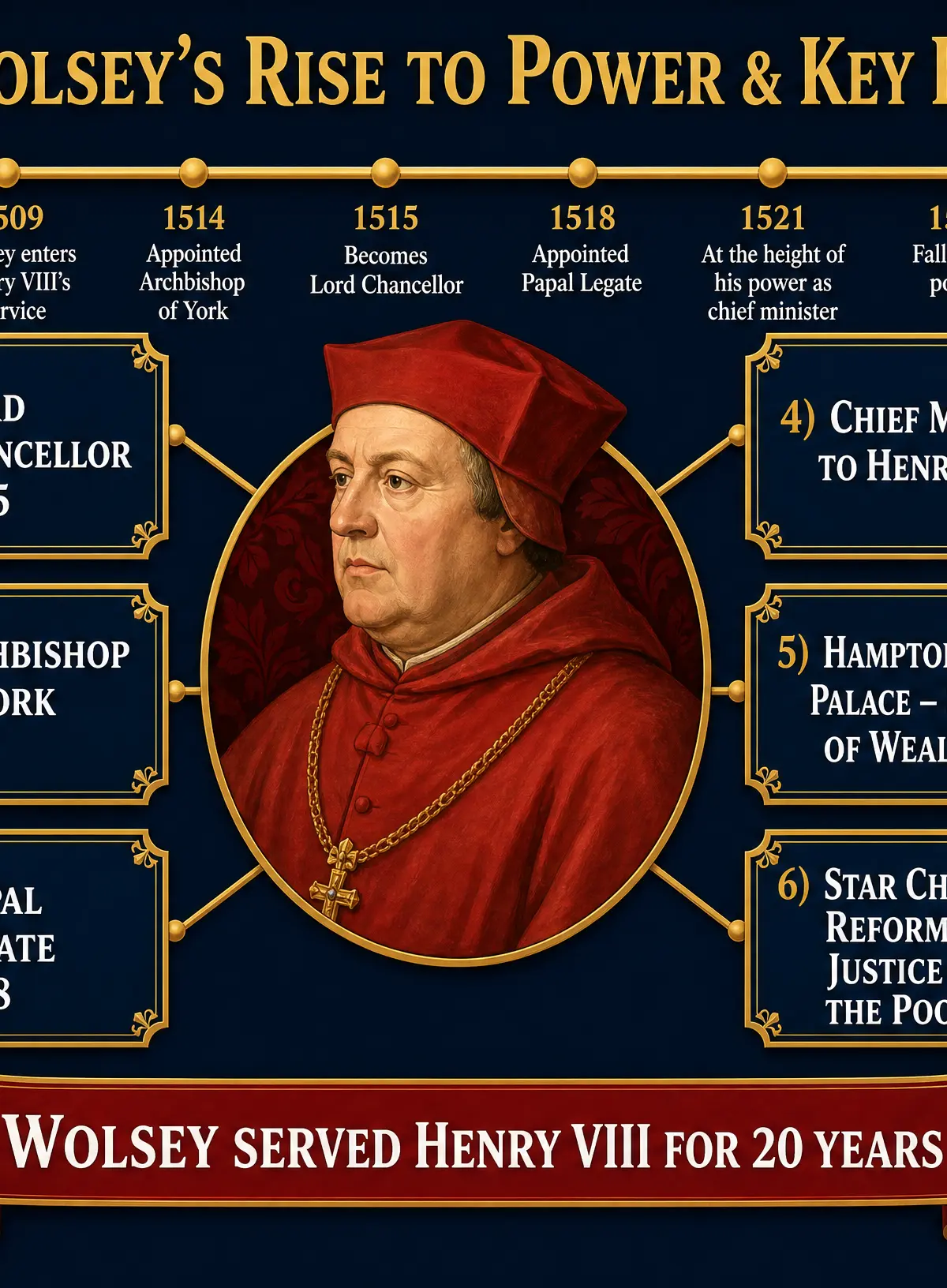
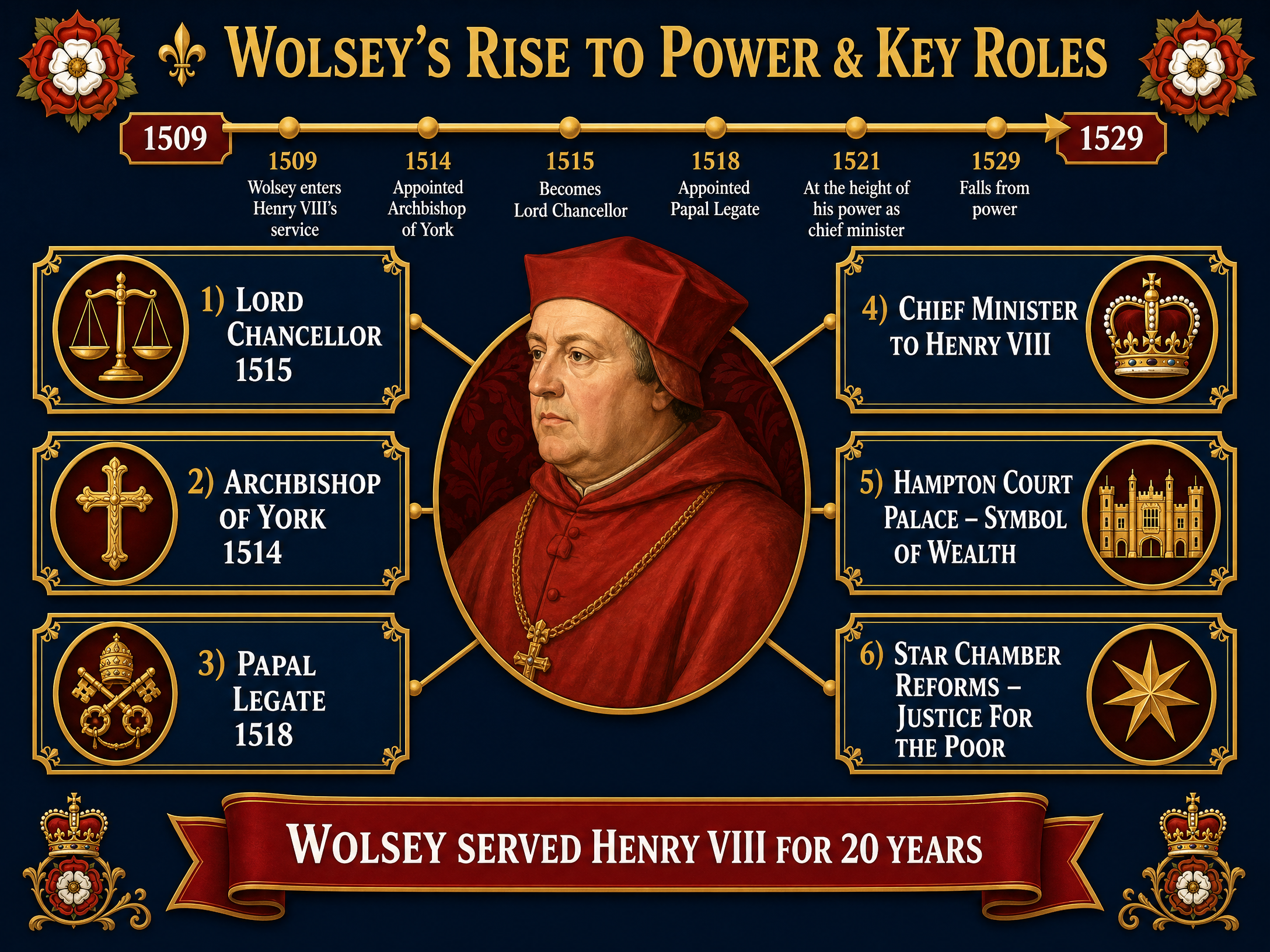
What happened: Thomas Wolsey, the son of an Ipswich butcher, rose rapidly through the Church and royal administration. By 1514 he was Archbishop of York, and in 1515 Henry appointed him Lord Chancellor.
Why it matters: Wolsey's rise demonstrates Henry's preference for promoting men of low birth who relied entirely on royal favour, rather than powerful nobles with independent power bases. Wolsey's dominance centralised power and administration.
Specific Knowledge: Appointed Royal Almoner (1509), Archbishop of York (1514), Lord Chancellor and Cardinal (1515), Papal Legate (1518).
Domestic Reforms: Justice and Finance
Date(s): 1515–1529
What happened: Wolsey expanded the Court of Star Chamber to dispense accessible justice, often against the nobility. In finance, he replaced the outdated 'fifteenths and tenths' tax with the 'Subsidy', a more accurate and progressive tax based on property and income.
Why it matters: These reforms increased royal authority and revenue, but they also made Wolsey deeply unpopular with the nobility and wealthy classes, who felt targeted by his policies.
Specific Knowledge: Star Chamber cases rose from roughly 12 per year under Henry VII to 120 per year under Wolsey. The Subsidy raised over £300,000 between 1513 and 1523.
The Amicable Grant
Date(s): 1525
What happened: To fund Henry's desired invasion of France, Wolsey demanded a non-parliamentary tax called the Amicable Grant. It provoked widespread resistance, particularly a rebellion of 10,000 men in Lavenham, Suffolk. Henry was forced to abandon the tax and pardon the rebels, while Wolsey took the blame.
Why it matters: It demonstrated the limits of royal power—even a king as formidable as Henry could not tax without Parliament's consent. It was Wolsey's first major failure and damaged his relationship with the King.
Specific Knowledge: Demanded 1/6th of income from the laity and 1/3rd from the clergy. 10,000 men rebelled in Suffolk.
Foreign Policy: The Balance of Power
Date(s): 1518–1521
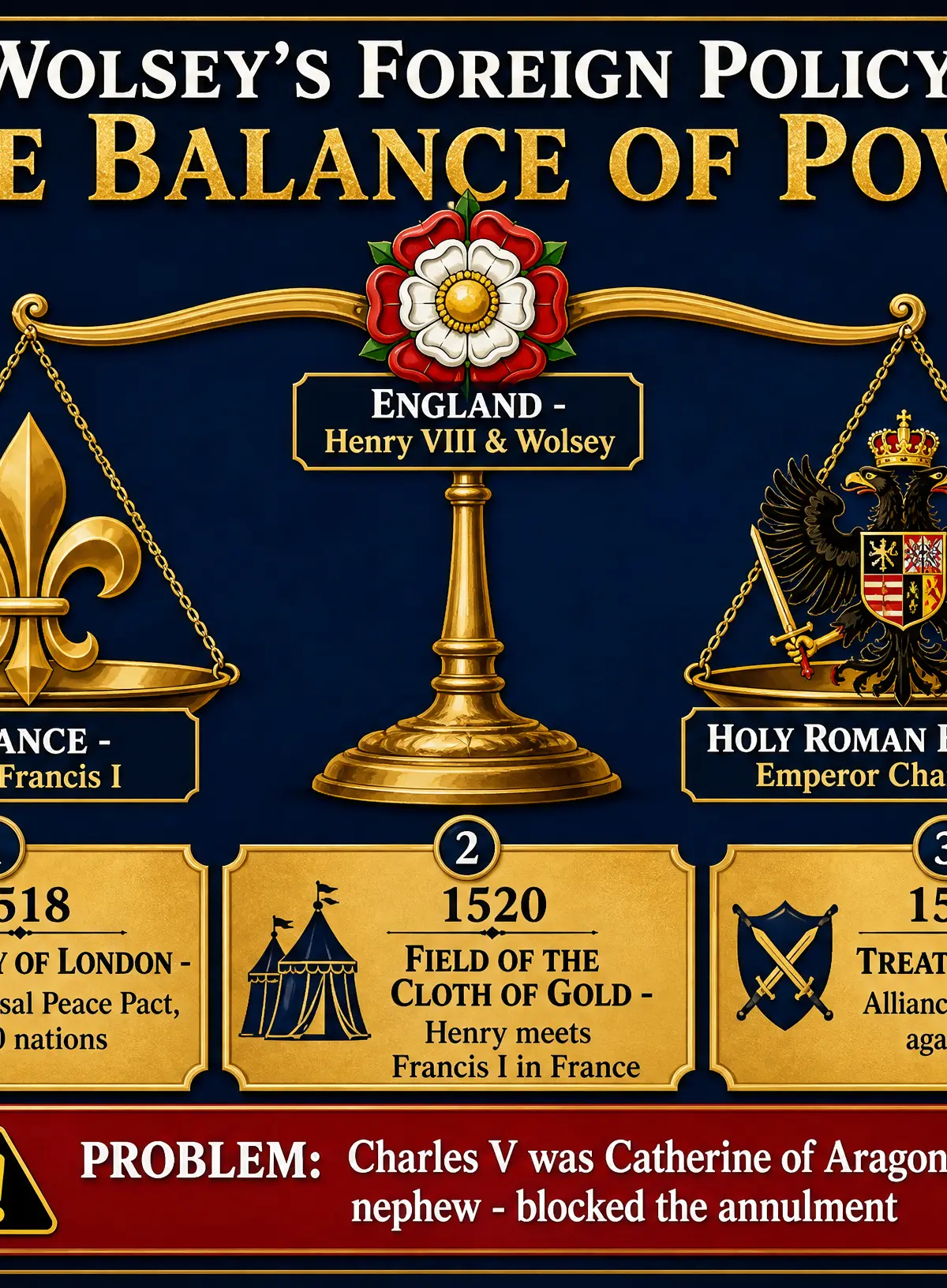
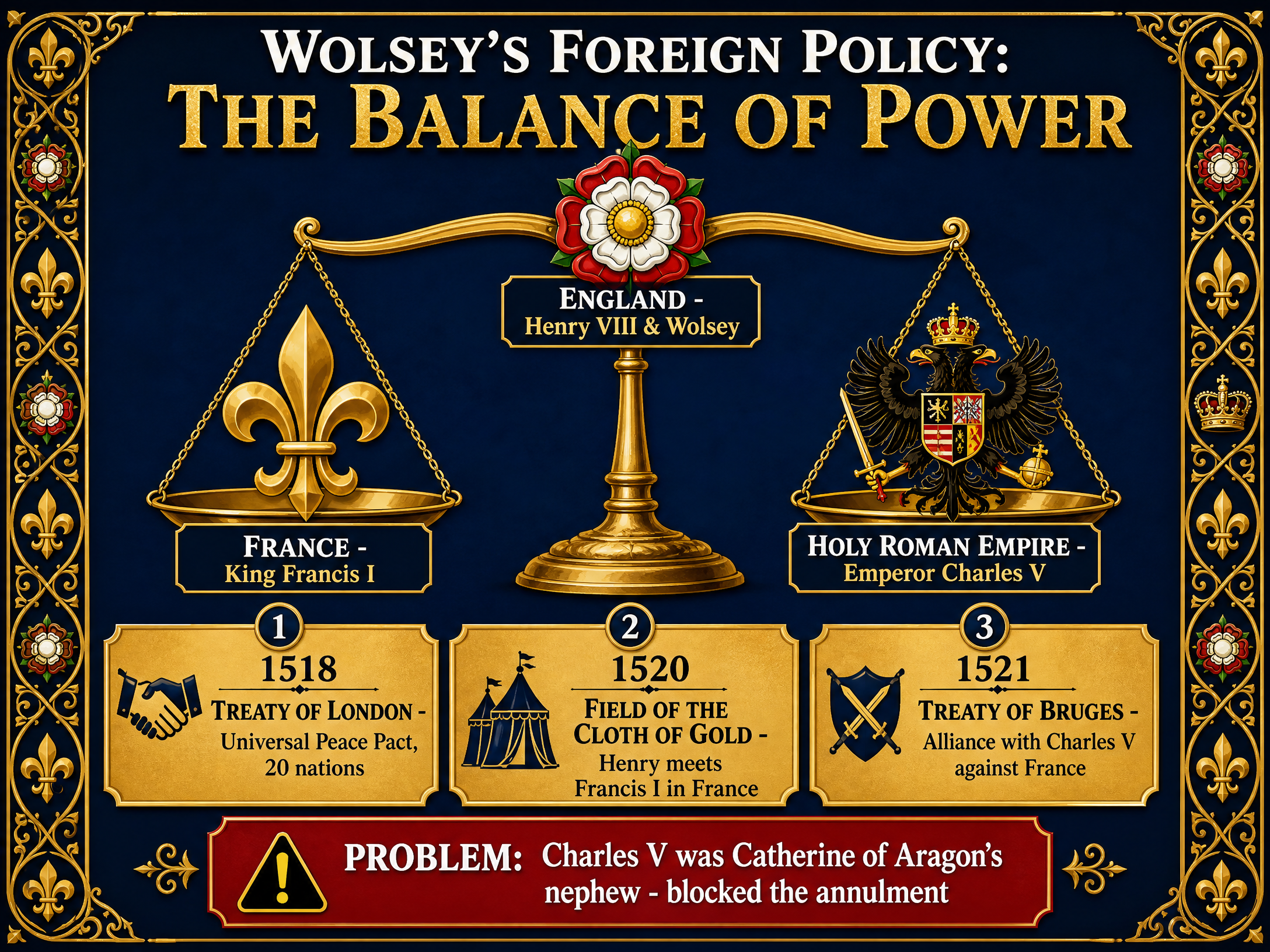
What happened: Wolsey sought to make England the peacemaker of Europe. He orchestrated the Treaty of London (1518) and the spectacular Field of the Cloth of Gold (1520). However, by 1521, England allied with Emperor Charles V against France in the Treaty of Bruges.
Why it matters: Wolsey successfully placed England at the centre of European diplomacy despite its lack of wealth and military might compared to France and the Holy Roman Empire. However, aligning with Charles V proved disastrous when Henry later needed the Pope (controlled by Charles) to grant his annulment.
Specific Knowledge: Treaty of London (1518) signed by 20 nations. Field of the Cloth of Gold (1520) cost roughly £15,000. Treaty of Bruges (1521).
The 'Great Matter' and Wolsey's Fall
Date(s): 1527–1529
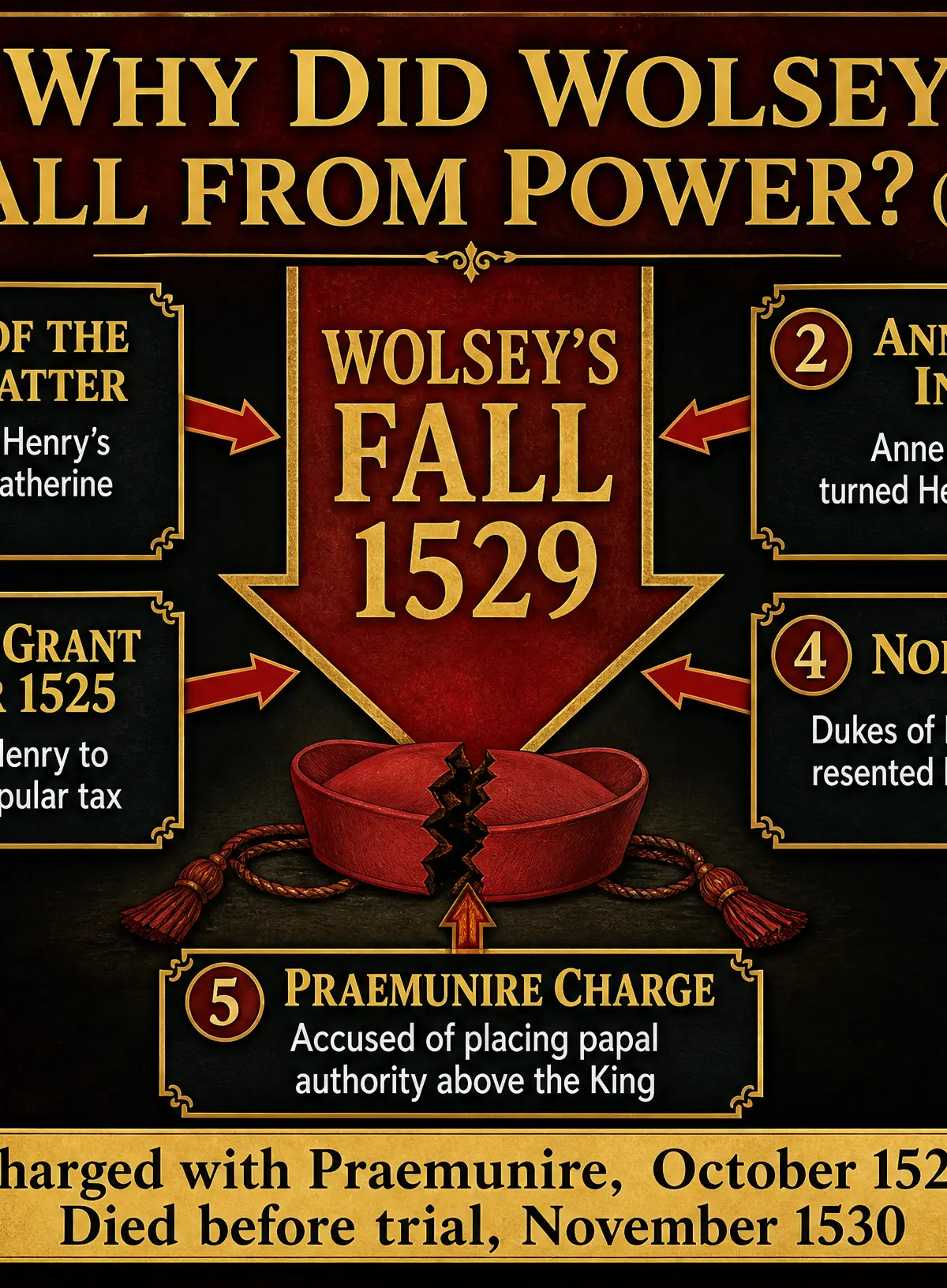
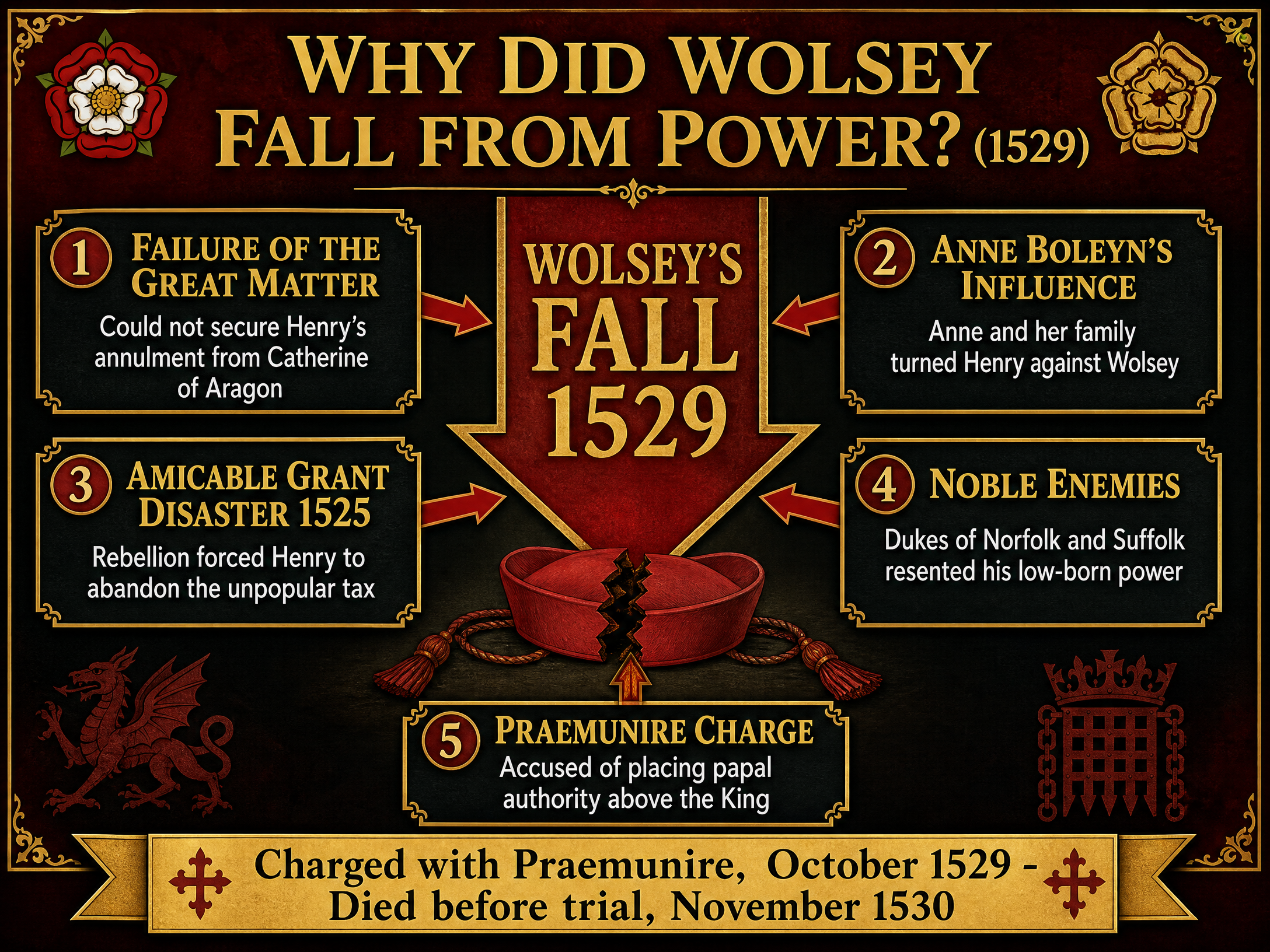
What happened: Henry sought an annulment from Catherine of Aragon to marry Anne Boleyn and secure a male heir. Wolsey failed to secure papal approval because Pope Clement VII was controlled by Charles V (Catherine's nephew). After the failed Legatine Court at Blackfriars (1529), Wolsey was dismissed, charged with praemunire, and died before standing trial.
Why it matters: The failure of the Great Matter was the direct trigger for Wolsey's fall. It highlights how Wolsey's power depended entirely on satisfying Henry's desires. His fall paved the way for Thomas Cromwell and the eventual Break with Rome.
Specific Knowledge: Sack of Rome by Charles V's troops (1527). Legatine Court at Blackfriars (1529). Wolsey charged with Praemunire (October 1529), died at Leicester Abbey (November 1530).
Key Individuals
Henry VIII
Role: King of England (1509–1547)
Key Actions: Delegated day-to-day government to Wolsey; sought an annulment from Catherine of Aragon; abandoned the Amicable Grant when faced with rebellion.
Impact: His absolute belief in his own sovereignty and his desperation for a male heir drove the major political and religious changes of the era.
Cardinal Thomas Wolsey
Role: Lord Chancellor, Papal Legate, and Chief Minister (1515–1529)
Key Actions: Centralised the justice system via Star Chamber; introduced the Subsidy tax; orchestrated the Treaty of London; failed to secure Henry's annulment.
Impact: He was the architect of Henry's early government, taking on the administrative burden the King disliked. His eventual failure demonstrated that ministers, no matter how powerful, were entirely disposable if they failed the King.
Catherine of Aragon
Role: Queen of England, Henry's first wife
Key Actions: Failed to provide a surviving male heir; fiercely resisted the annulment; made a dramatic personal appeal at the Blackfriars court in 1529.
Impact: Her refusal to go quietly to a nunnery, combined with her powerful family connections (Emperor Charles V), made the annulment impossible for Wolsey to achieve through traditional diplomatic channels.
Anne Boleyn
Role: Henry's love interest and eventual second wife
Key Actions: Refused to be Henry's mistress; allied with her family (the Duke of Norfolk) to turn Henry against Wolsey when the annulment stalled.
Impact: She was the catalyst for the Great Matter. Her faction at court actively worked to bring about Wolsey's downfall.
Second-Order Concepts
Causation
Wolsey's fall was caused by a combination of short-term triggers and long-term vulnerabilities. The immediate trigger was his failure to secure the annulment (the Great Matter) by 1529. However, this was compounded by long-term factors: his unpopularity with the nobility (who resented his low birth and his use of the Star Chamber), the lingering damage of the Amicable Grant failure (1525), and the active plotting of the Boleyn faction at court.
Consequence
The consequence of Wolsey's dominance was a highly centralised, efficient administration that alienated the traditional nobility. The consequence of his fall was profound: it left a power vacuum that was eventually filled by Thomas Cromwell, who realized that if the Pope would not grant the annulment, Henry would have to break with Rome entirely, changing English history forever.
Change & Continuity
Change: Wolsey changed the taxation system (from fifteenths and tenths to the Subsidy) and altered the justice system to make it more accessible to the poor (Star Chamber). Continuity: Despite Wolsey's immense power, the ultimate source of authority remained unchanged—the King. When Wolsey lost Henry's favour, he lost everything instantly.
Significance
Wolsey is significant because he represents the pinnacle of the 'alter rex' (other king) phenomenon—a low-born minister wielding almost monarchical power. His career demonstrates the mechanisms of Tudor government and the fatal intersection of domestic desires (an heir) with international politics (the power of Charles V).
Source Skills
When evaluating sources for this topic, consider provenance carefully:
- Wolsey's own writings/letters: Useful for his intentions and diplomatic skill, but limited by his need to present himself as indispensable to Henry.
- Polydore Vergil or George Cavendish: Cavendish was Wolsey's gentleman usher (loyal, sympathetic, wrote after Wolsey's death). Vergil was a rival who hated Wolsey (highly critical, biased).
- Imperial Ambassador (Chapuys): Excellent for insights into court factions and Catherine's position, but heavily biased against Anne Boleyn and Wolsey.
Always evaluate Utility by combining Content (what it tells us) with Provenance (who wrote it and why).
Worked Examples
3 worked examples — open one to explore the question and available guidance.
Practice Questions
Test your understanding — click to reveal model answers
Describe two features of Wolsey's justice system. (4 marks)
Hint: Think about the specific courts he used and who he targeted.
Explain why Wolsey's foreign policy failed in the late 1520s. (12 marks)
Hint: Connect his alliance with Charles V to the problem of the 'Great Matter'.
'Wolsey's most significant achievement was his reform of the justice system.' How far do you agree? (16 marks + 4 SPaG)
Hint: Evaluate justice, then compare it to finance (Subsidy) and foreign policy (Treaty of London).
Explain why the Amicable Grant of 1525 caused a rebellion. (12 marks)
Hint: Think about the economic burden, the lack of Parliament's consent, and the timing.
Describe two reasons why Wolsey rose to power so quickly. (4 marks)
Hint: Think about what Henry disliked doing, and Wolsey's background.
Test your understanding of Henry VIII and his ministers, 1509–40
Active recall beats re-reading. Take an instant quiz now to test what you’ve learned and lock it into long-term memory.
7 days Premium · Then free forever · No card, no charge