Pearson Edexcel · GCSE · History
Medicine in Britain, c1250–present and The British sector of the Western Front, 1914–18: injuries, treatment and the trenches
This study guide covers the fascinating evolution of medicine in Britain from the medieval reliance on the Four Humours to the groundbreaking discoveries of the Industrial Revolution, and the extraordinary medical innovations forged in the mud of the Western Front. It is essential for understanding how scientific evidence slowly replaced supernatural belief, shaping the modern world and saving millions of lives.
- 8 min read
- 3 worked examples
- 5 practice questions
- 6 key terms
Study Notes
Overview

This comprehensive study covers two deeply interconnected historical narratives: the long, slow development of medicine in Britain from c1250 to the present day, and the intense, rapid period of medical innovation on the British sector of the Western Front (1914–18). Examiners expect you to understand the overarching themes of change and continuity over a massive 800-year sweep, while also demonstrating highly specific knowledge of key individuals, discoveries, and the impact of the First World War. You will need to explain why changes happened (causation) and evaluate the significance of breakthroughs like Germ Theory or the Thomas Splint. Remember: history is not just a story; it is an analysis of factors such as science, technology, government, and individual genius.
Listen to the comprehensive revision podcast below to reinforce your understanding:
Key Events & Developments
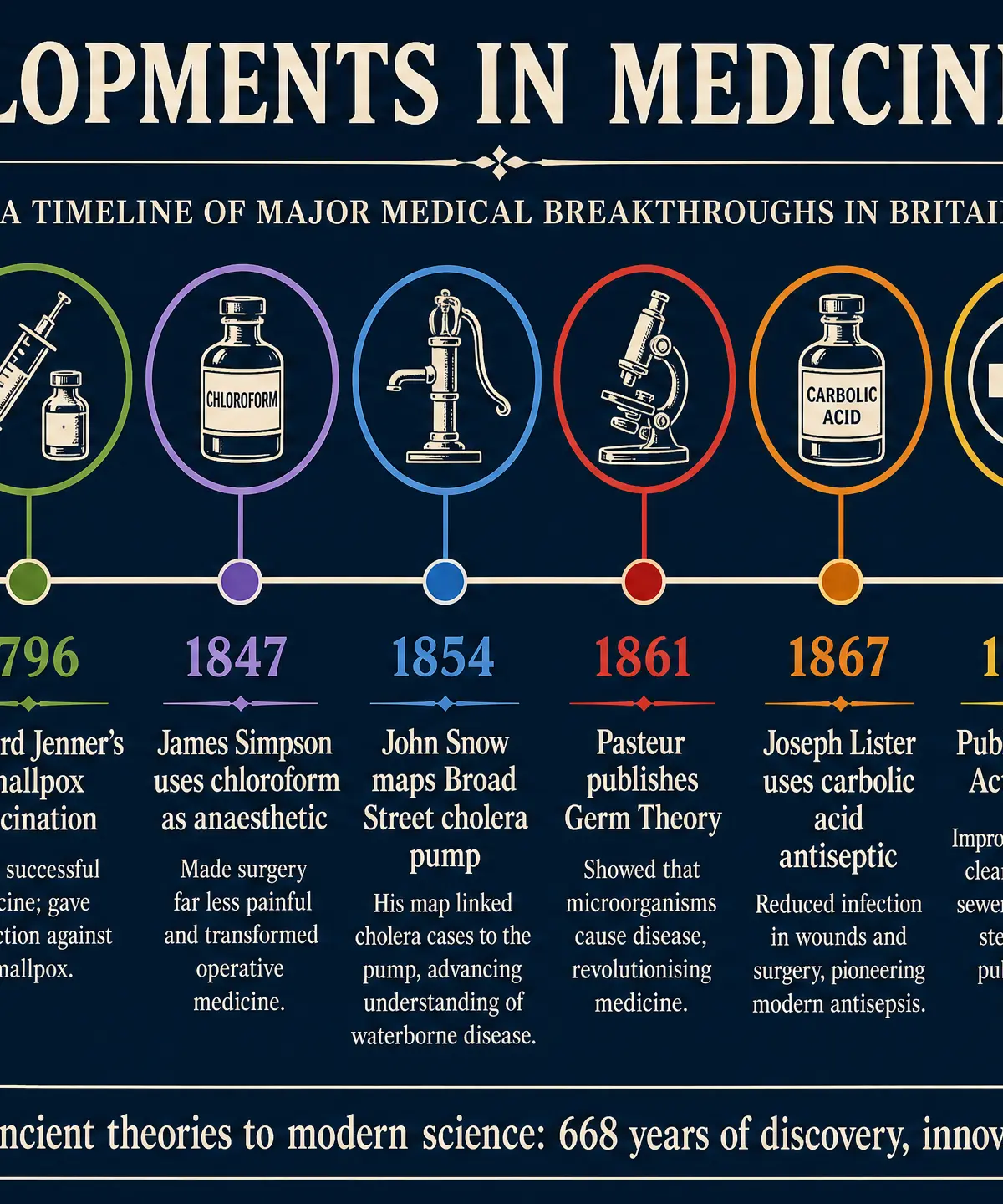
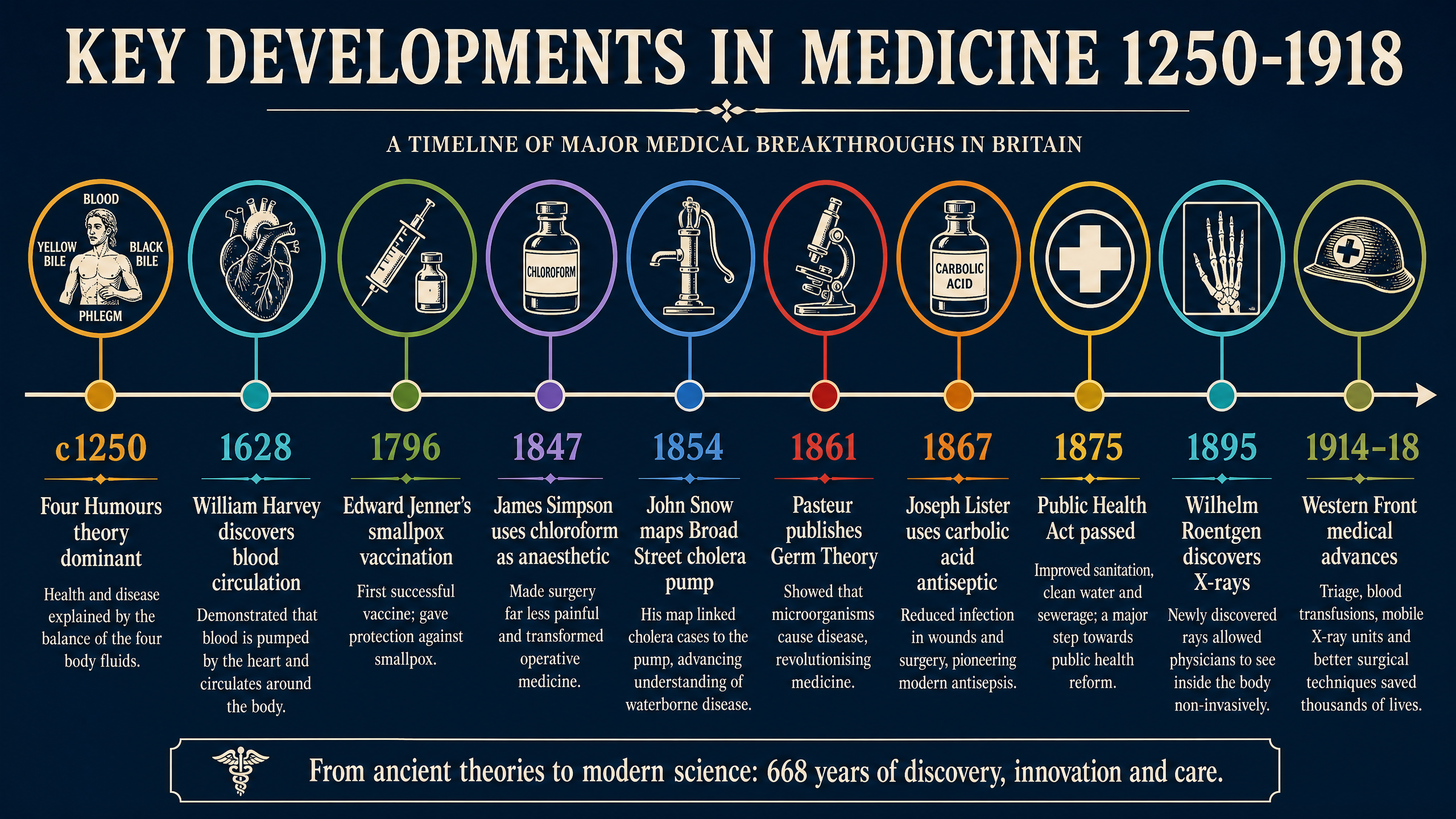
The Medieval Period (c1250–1500)
Date(s): c1250–1500
What happened: Medicine was dominated by the Theory of the Four Humours (blood, phlegm, yellow bile, black bile) and religious explanations. The Church controlled education and hospitals, which focused on care rather than cure.
Why it matters: This period represents extraordinary continuity. For centuries, medical progress was stifled because challenging the ancient texts of Hippocrates and Galen was discouraged. Examiners often use this period as a baseline to measure later changes against.
Specific Knowledge: Hippocrates (Four Humours), Galen (Theory of Opposites), the Black Death (1348) killing roughly one-third of England's population.
The Renaissance & Early Modern Medicine
Date(s): 16th and 17th Centuries
What happened: The Renaissance encouraged scientific observation and the challenging of old ideas. The printing press allowed new ideas to spread rapidly.
Why it matters: While it didn't immediately improve treatments, it laid the foundation for future discoveries by establishing a scientific method based on observation and dissection rather than blindly following ancient texts.
Specific Knowledge: William Harvey published his book on the circulation of the blood in 1628, proving Galen wrong. Thomas Sydenham encouraged doctors to observe symptoms rather than rely on books.
The Industrial Revolution: Prevention & Public Health
Date(s): c1700–1900
What happened: Rapid urbanisation led to horrific living conditions and cholera epidemics. This eventually forced the government to abandon its 'laissez-faire' (leave alone) attitude and intervene in public health.
Why it matters: This era saw the most significant shift in government attitudes towards health, moving from inaction to taking responsibility for the population's wellbeing.
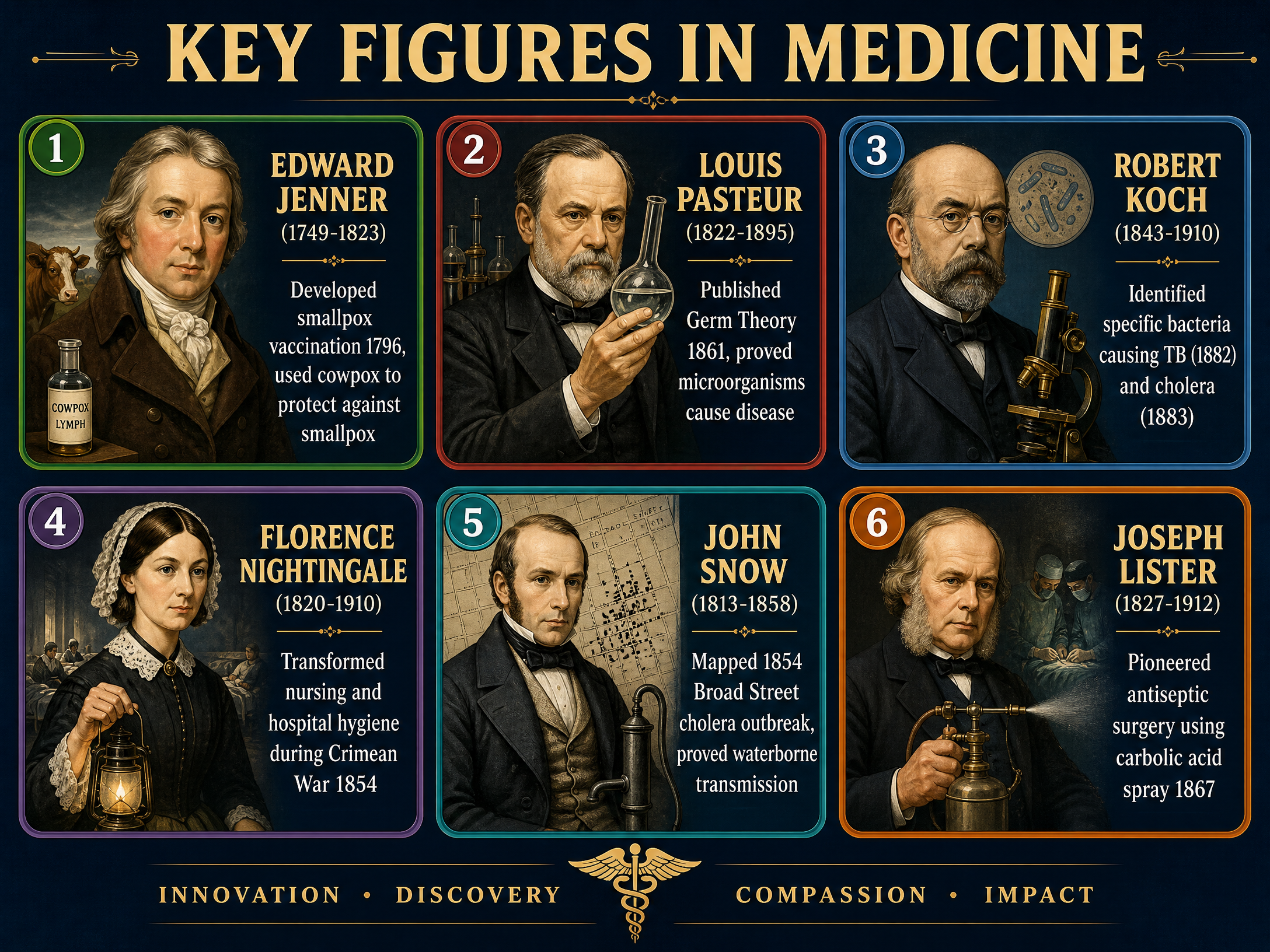
Specific Knowledge: Edward Jenner's smallpox vaccination (1796); John Snow mapping the Broad Street cholera pump (1854); The Public Health Act (1875) which made it compulsory for local councils to provide clean water and sewers.
The Bacteriological Revolution
Date(s): Late 19th Century
What happened: The discovery that microorganisms cause disease, overturning the miasma theory.
Why it matters: This is arguably the most significant turning point in the history of medicine. It provided a scientific explanation for disease, allowing for the development of targeted vaccines, antiseptic surgery, and eventually antibiotics.
Specific Knowledge: Louis Pasteur published Germ Theory in 1861. Robert Koch identified the specific bacteria causing tuberculosis (1882) and cholera (1883).
The Western Front (1914–18)
Date(s): 1914–1918
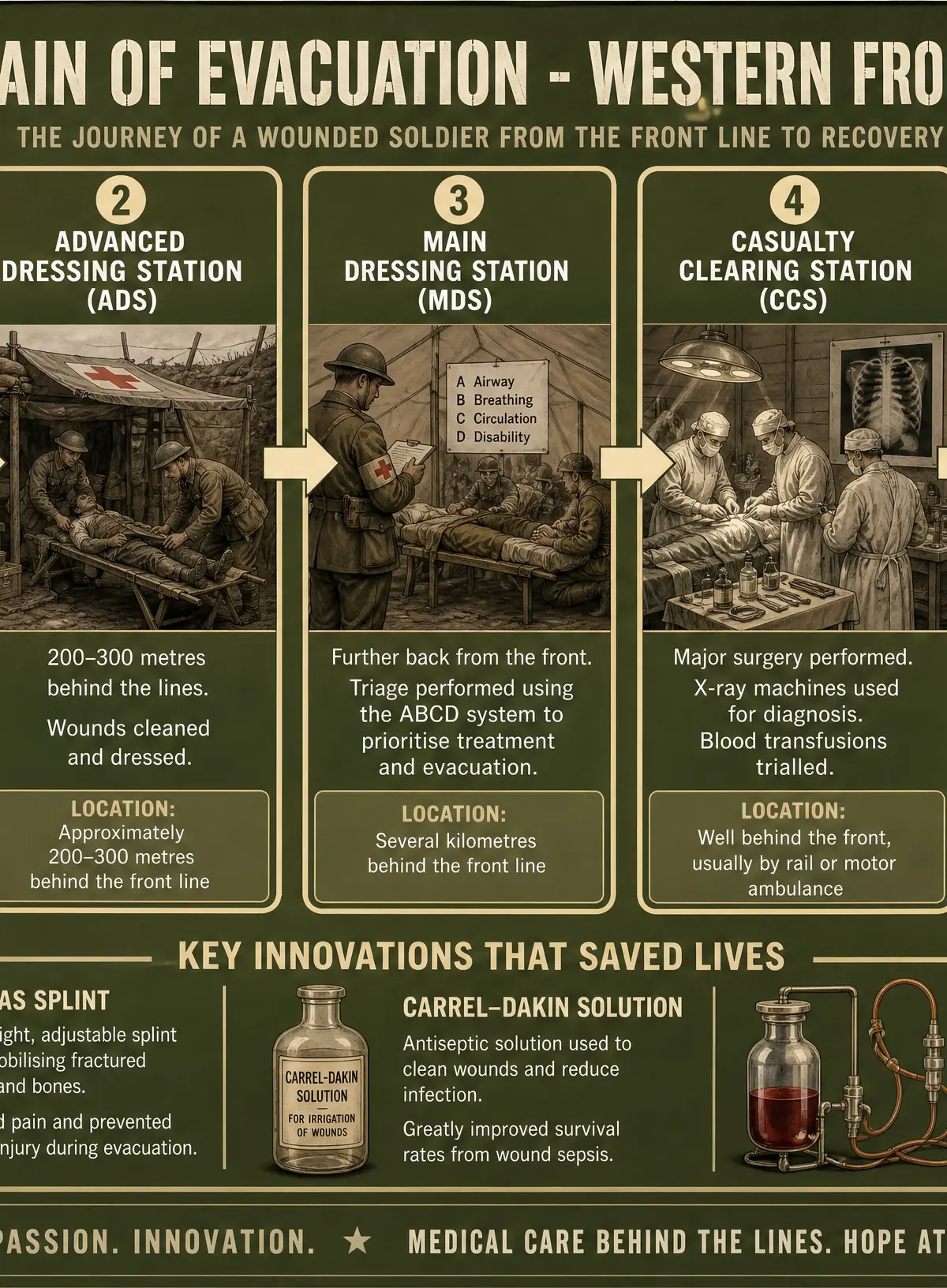
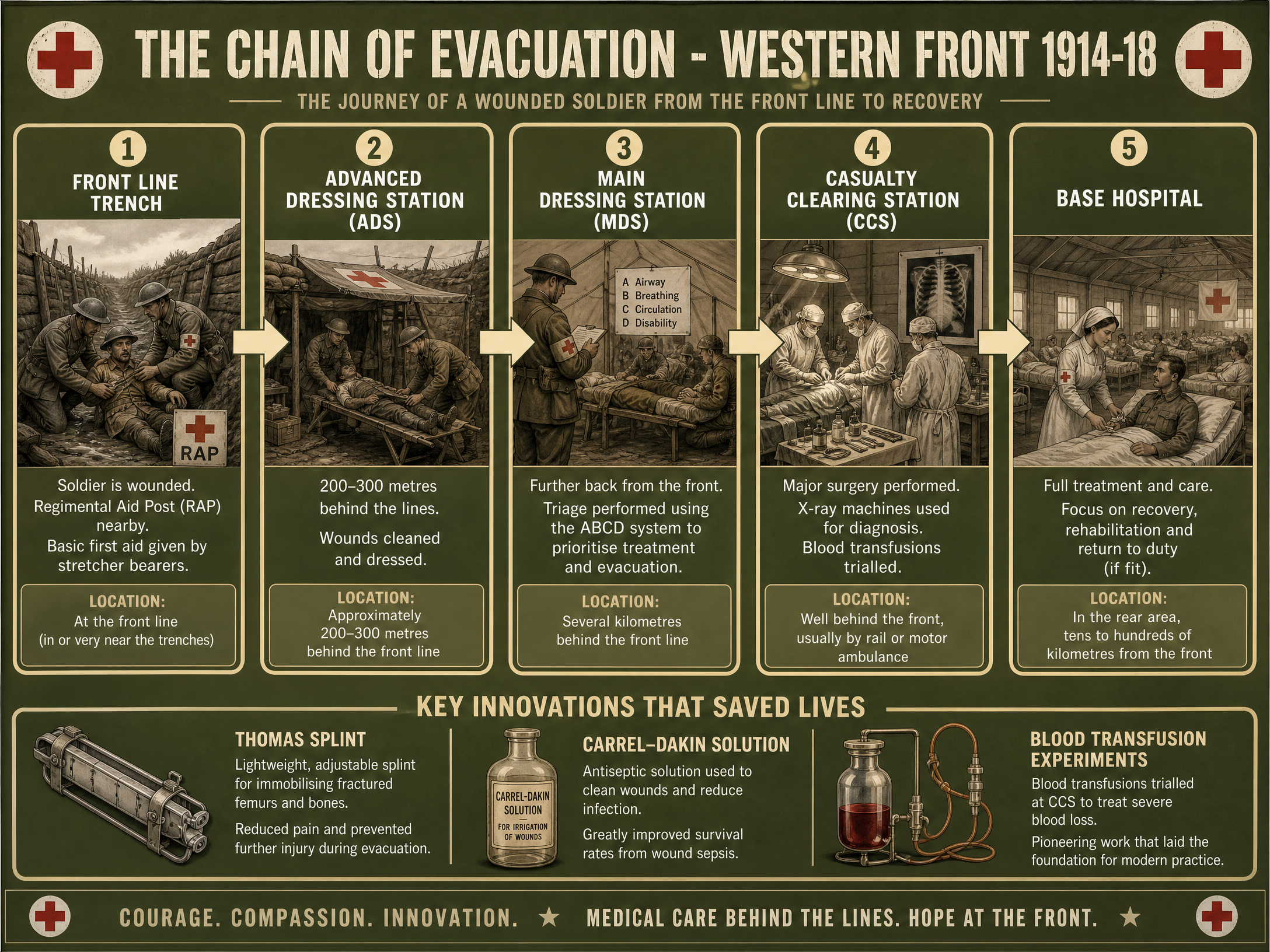
What happened: The unprecedented scale and nature of casualties in trench warfare forced rapid medical innovation. The British Army developed a complex 'chain of evacuation' to move wounded soldiers from the front line to Base Hospitals.
Why it matters: War acts as a catalyst for medical advancement. Innovations developed on the Western Front transformed civilian medicine after the war.
Specific Knowledge: The Thomas Splint (1916) reduced the death rate from femur fractures from 80% to 20%. The Carrel-Dakin method for treating infected wounds. The first use of mobile X-ray units (developed by Marie Curie) and blood banks (Battle of Cambrai, 1917).
Key Individuals
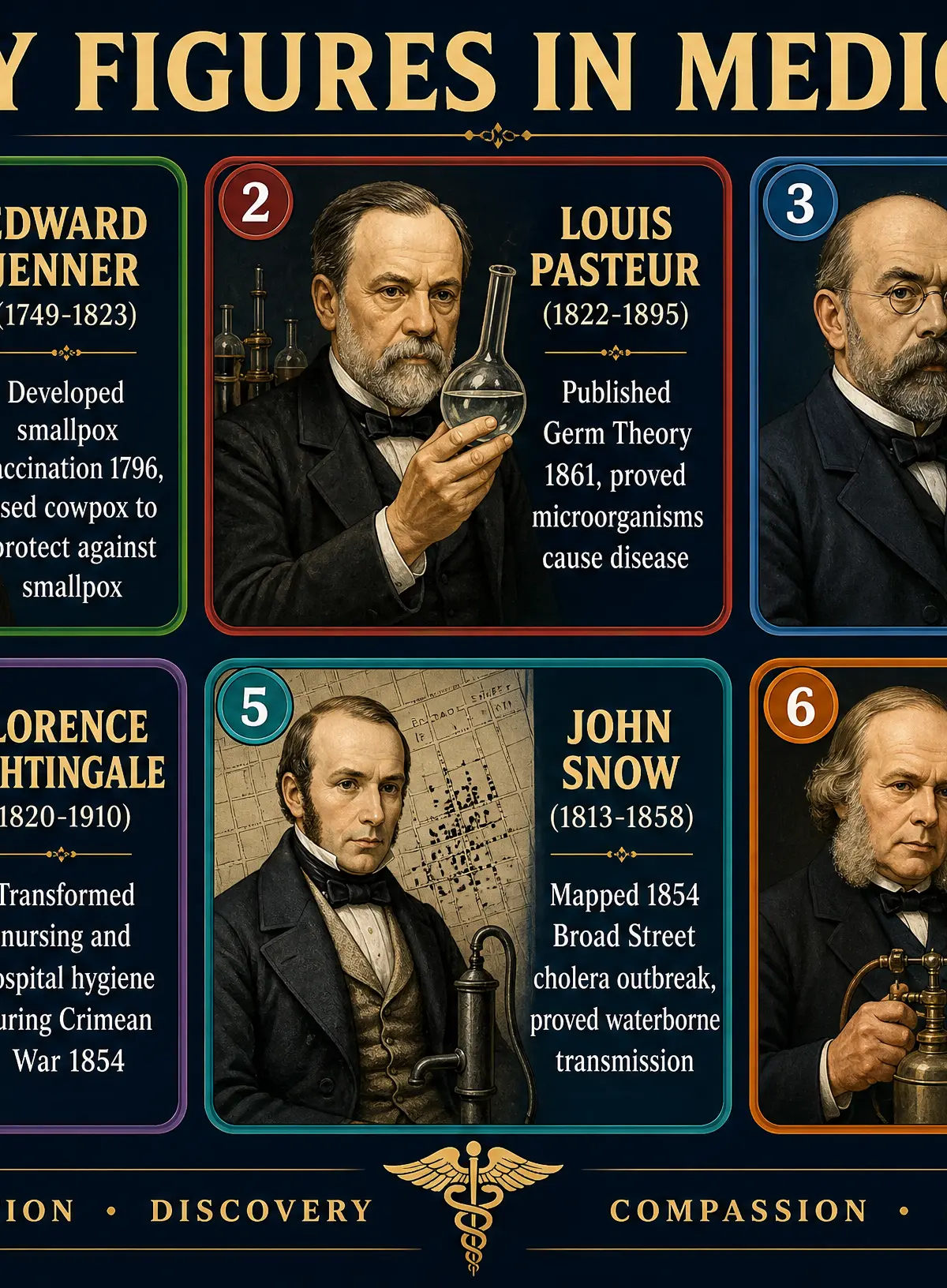
Edward Jenner
Role: Country doctor in Gloucestershire.
Key Actions: Observed that milkmaids who caught cowpox didn't get smallpox. In 1796, he infected James Phipps with cowpox, then exposed him to smallpox. Phipps survived. He called this 'vaccination'.
Impact: His discovery eventually led to the global eradication of smallpox (1980). However, he faced massive opposition initially because he couldn't explain why it worked (Germ Theory didn't exist yet).
John Snow
Role: London surgeon and pioneer in epidemiology.
Key Actions: During the 1854 cholera outbreak in Soho, he mapped the deaths and proved they clustered around the Broad Street water pump. He removed the handle, stopping the outbreak.
Impact: Proved cholera was waterborne, not caused by miasma. His work helped persuade the government to invest in a new sewer system (designed by Joseph Bazalgette).
Louis Pasteur
Role: French chemist.
Key Actions: Published Germ Theory in 1861, proving that microbes in the air cause decay and disease.
Impact: Completely revolutionised medicine. His theory provided the scientific basis for Lister's antiseptic surgery and Koch's bacteriology.
Joseph Lister
Role: British surgeon.
Key Actions: Read Pasteur's Germ Theory and applied it to surgery. In 1867, he began using carbolic acid to clean wounds, instruments, and the operating theatre.
Impact: Dramatically reduced death rates from surgical infection, making complex, invasive surgery possible for the first time.
Florence Nightingale
Role: British nurse and social reformer.
Key Actions: Went to the Crimean War in 1854. Appalled by the conditions, she enforced strict hygiene, cleaning, and ventilation in the hospitals. She later established the first professional nursing school at St Thomas' Hospital.
Impact: Transformed nursing into a respected profession and fundamentally changed hospital design to prioritise cleanliness and ventilation (the 'pavilion plan').
Second-Order Concepts
Causation
Why did medical knowledge change so rapidly in the 19th century? It was a combination of individuals (Pasteur, Koch), technology (improved microscopes), government action (Public Health Acts), and changing attitudes (the decline of religious explanations and the rise of scientific enquiry).
Consequence
The consequence of Germ Theory was massive: it led to antiseptic surgery, targeted vaccinations, and eventually the discovery of penicillin by Alexander Fleming in 1928. The consequence of the Western Front was the rapid advancement of trauma surgery, blood transfusions, and the recognition of PTSD (shell shock).
Change & Continuity
Examiners love questions about what stayed the same. For example, while Harvey discovered blood circulation in 1628 (change), doctors continued to use bleeding as a treatment for centuries afterwards (continuity). The miasma theory persisted well into the late 19th century, even after Germ Theory was published.
Significance
When evaluating significance, consider: How many people were affected? How long did the impact last? Did it change how people thought? Jenner's vaccination is highly significant because it eradicated a global killer, but Pasteur's Germ Theory is arguably more significant because it changed the fundamental understanding of all diseases.
Source Skills
For the Western Front section, you will face a source utility question. You must analyse:
- Content: What specific information does the source give you about the enquiry?
- Provenance: Who wrote it, when, and why? A diary entry from a stretcher bearer in 1916 gives a highly reliable, firsthand account of the horrific conditions, but it is limited to one person's perspective. An official army medical report might be broader, but could be censored or downplay failures.
- Limitations: What does the source not tell you? Does the author have a bias or limited viewpoint?
Visual Resources
3 diagrams and illustrations
Interactive Diagrams
1 interactive diagram to visualise key concepts
Conceptual Flow Outline
The Chain of Evacuation on the Western Front
Worked Examples
3 worked examples — open one to explore the question and available guidance.
Practice Questions
Test your understanding — click to reveal model answers
Describe two features of the Thomas Splint. (4 marks)
Hint: Identify a feature, then add a specific detail about how it worked or its impact.
Explain one way in which ideas about the cause of disease were similar in the 14th and 17th centuries. (4 marks)
Hint: Focus on continuity. What incorrect theory persisted across both centuries?
Explain why there was opposition to Edward Jenner's smallpox vaccination. (12 marks)
Hint: Think about the role of the Church, the medical establishment, and the fact that Jenner couldn't explain the science behind his discovery.
How useful is a diary entry from a stretcher bearer at the Battle of the Somme (1916) for an enquiry into the challenges of evacuating the wounded? (8 marks)
Hint: Evaluate the content (what a stretcher bearer actually did) and the provenance (eyewitness, but limited perspective).
'The development of antiseptic surgery was the most significant medical breakthrough of the 19th century.' How far do you agree? (16 marks)
Hint: Argue for antiseptics (Lister), but you MUST provide strong counter-arguments (Pasteur's Germ Theory, Snow/Public Health, or Simpson's anaesthetics).
Test your understanding of Medicine in Britain, c1250–present and The British sector of the Western Front, 1914–18: injuries, treatment and the trenches
Active recall beats re-reading. Take an instant quiz now to test what you’ve learned and lock it into long-term memory.
7 days Premium · Then free forever · No card, no charge