Pearson Edexcel · GCSE · History
Migrants in Britain, c800–present and Notting Hill, c1948–c1970
This study guide explores the profound impact of migration on Britain from c800 to the present, focusing deeply on early modern migrations and the post-war Caribbean experience in Notting Hill. Mastering this topic requires understanding the complex push and pull factors that drove migration and evaluating the significant cultural, economic, and social changes migrants brought to British society.
- 7 min read
- 3 worked examples
- 5 practice questions
- 6 key terms
Study Notes
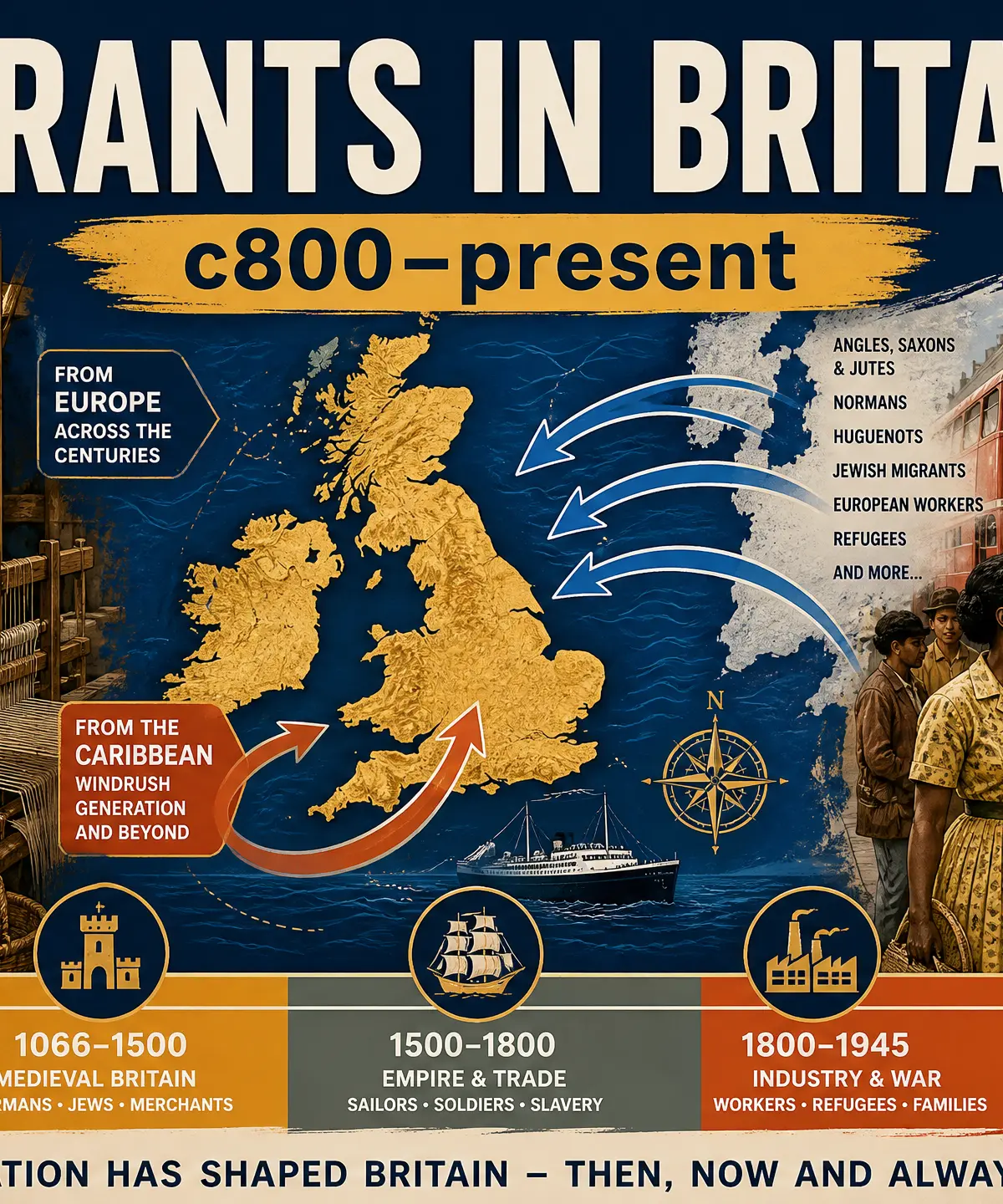
Overview
Migration is not a modern phenomenon; it is the thread that weaves together the story of Britain. This thematic study covers over a thousand years of history, requiring candidates to trace patterns of change and continuity from the early medieval period to the present day. Examiners reward students who can move beyond simple narrative to analyze the complex 'push' and 'pull' factors driving migration, and who can evaluate the profound impact migrants have had on English culture, trade, industry, and agriculture.
In this guide, we focus on two crucial areas: the early modern period (c1500–c1700), exploring the arrival of Flemish, Walloon, and Huguenot migrants; and the historic environment study of Notting Hill (c1948–c1970), focusing on the experiences of the Caribbean Windrush generation. To achieve top marks, you must deploy specific knowledge—names, dates, and statistics—and confidently use second-order historical concepts like causation, consequence, and significance.
Listen to the Revision Podcast
A comprehensive 13-minute audio guide covering the core concepts, case studies, and exam techniques for this topic.
Key Events & Developments
Early Modern Migration: The Flemish and Walloons
Date(s): 1560s onwards
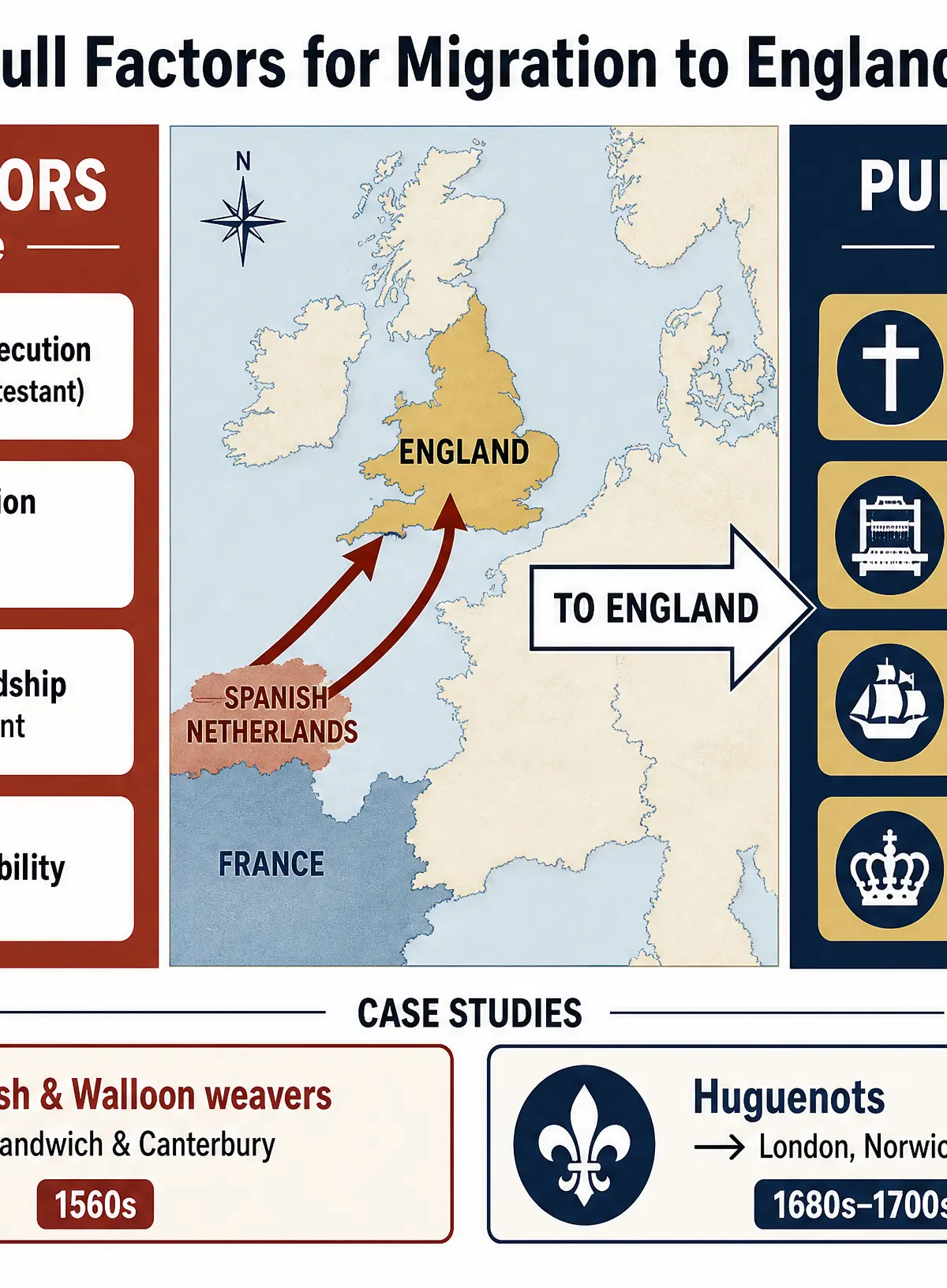
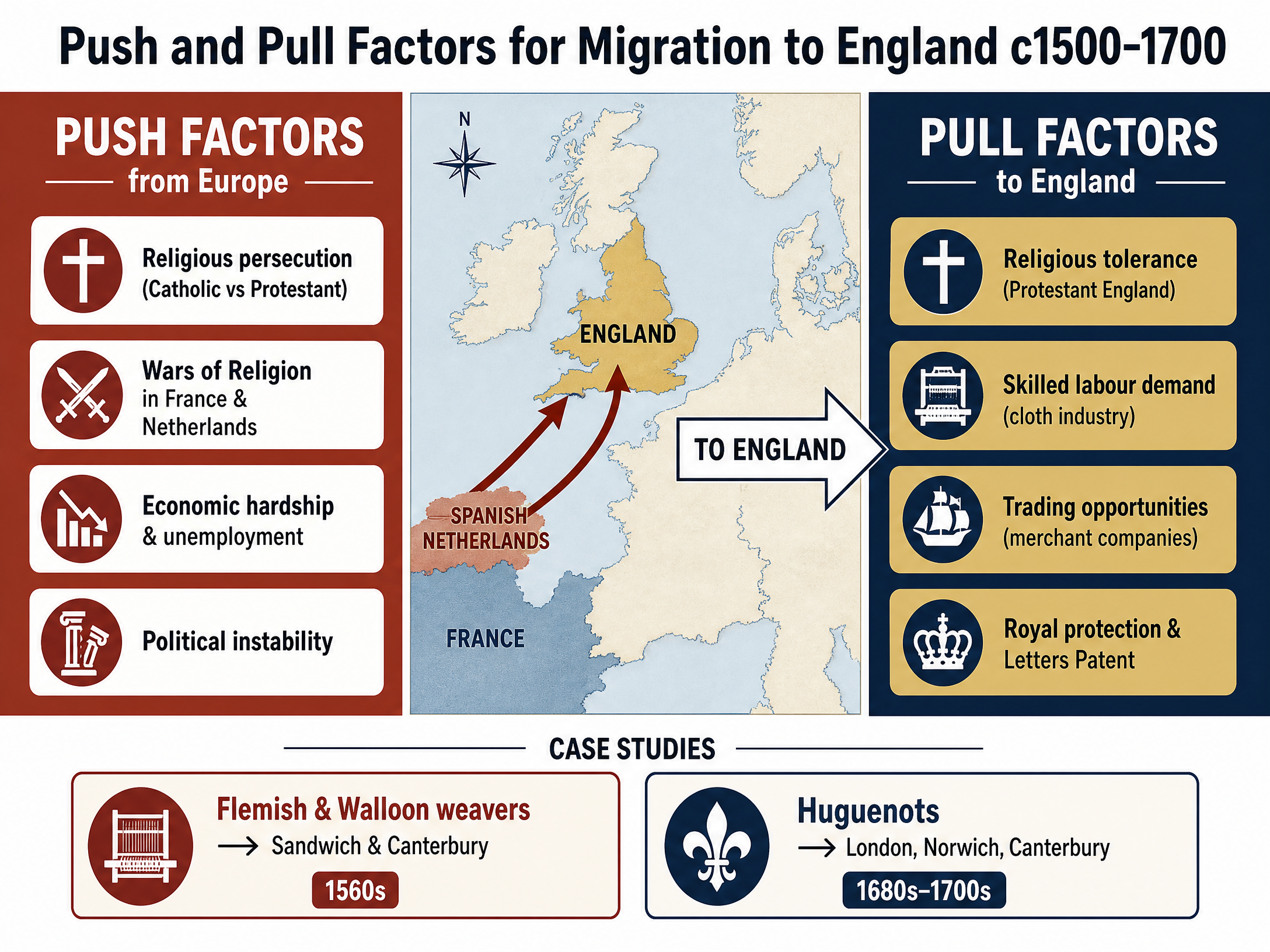
What happened: Fleeing religious persecution by Catholic Spanish rulers in the Spanish Netherlands (push factor), thousands of skilled Protestant Flemish and Walloon weavers migrated to England. They were welcomed by Elizabeth I (pull factor) who issued Letters Patent allowing them to settle in towns like Sandwich and Canterbury to boost the English cloth industry.
Why it matters: This demonstrates the powerful combination of religious and economic factors driving migration. It highlights the positive economic impact (introducing new 'New Draperies' weaving techniques) while also showing the continuity of social tension, as local English workers sometimes resented the competition.
Specific Knowledge: By 1561, approximately 2,500 migrants had settled in Sandwich (population ~4,000). They were granted the use of St Peter's Church in Canterbury.
Early Modern Migration: The Huguenots
Date(s): 1685 onwards
What happened: Following the revocation of the Edict of Nantes (Edict of Fontainebleau) in 1685 by King Louis XIV, French Protestants (Huguenots) faced severe persecution. Around 50,000 fled to England, settling heavily in London (Spitalfields), Norwich, and Canterbury.
Why it matters: The Huguenots represent a massive demographic and economic injection into England. They brought highly specialized skills in silk weaving, silversmithing, and finance, significantly boosting England's economy. Their relatively successful integration highlights the importance of shared Protestant religion as a unifying factor in early modern England.
Specific Knowledge: 50,000 migrants; key industries included silk weaving in Spitalfields; notable families include Courtauld (textiles) and Dollond (optics); tensions culminated in the 1675 Spitalfields riots.
Post-War Migration: The Windrush Generation and Notting Hill
Date(s): 1948–1970
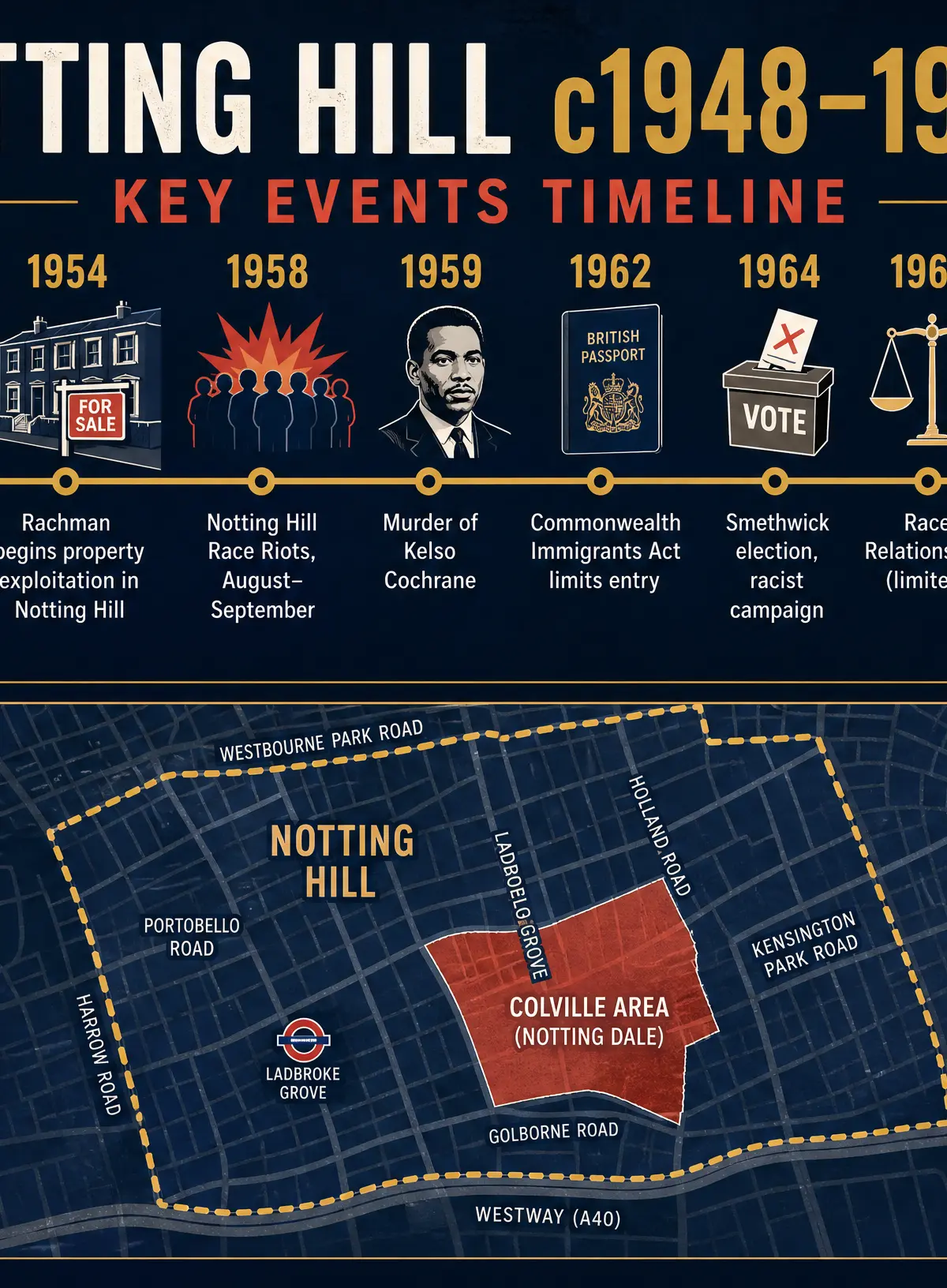
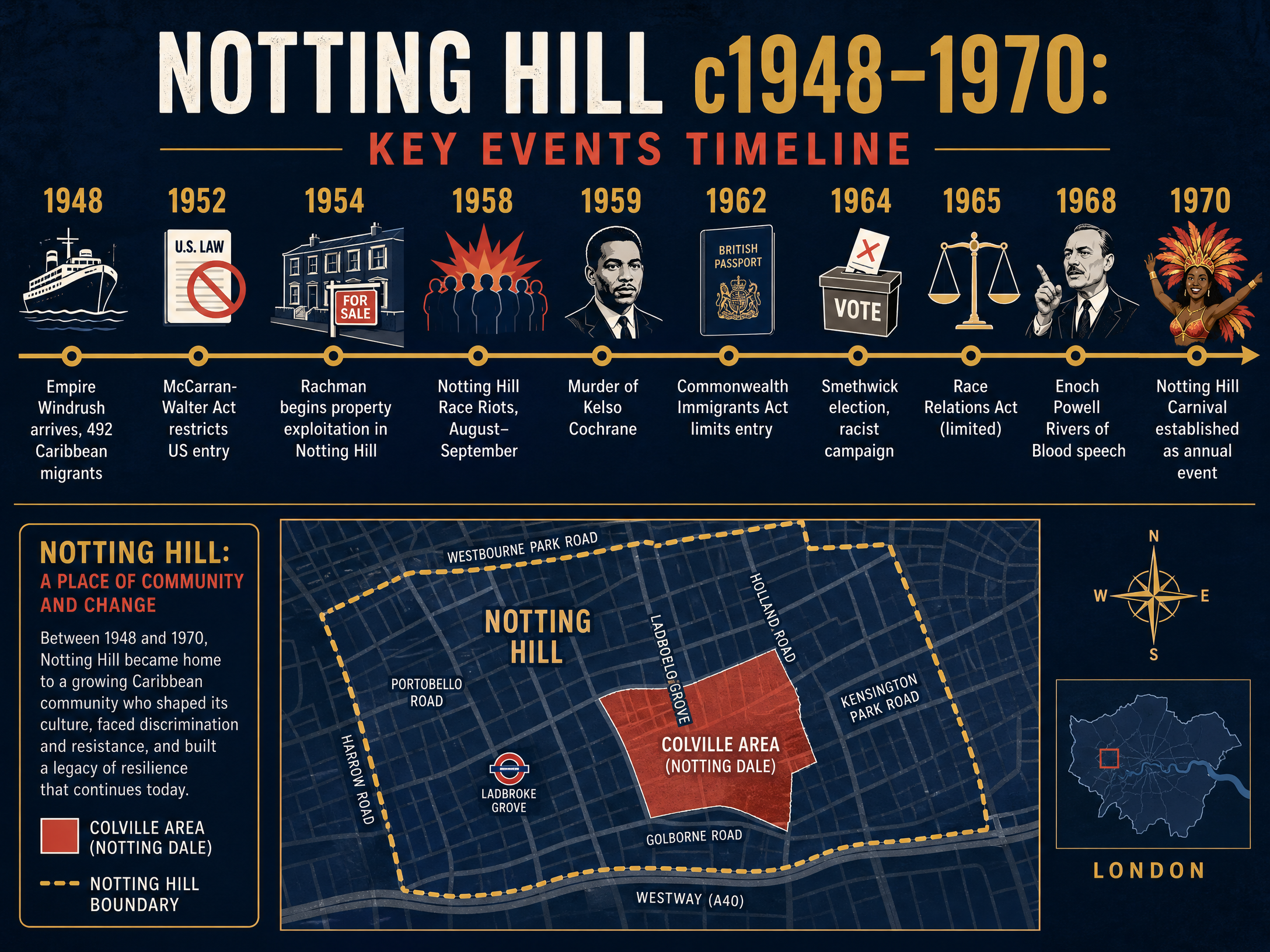
What happened: Facing severe post-war labour shortages, the British government encouraged Commonwealth migration (1948 British Nationality Act). Caribbean migrants settled in areas like Notting Hill, where they faced severe housing exploitation (Rachmanism), systemic discrimination, and racial violence, culminating in the 1958 Race Riots and the 1959 murder of Kelso Cochrane.
Why it matters: This period highlights the stark contrast between the economic need for migrant labour and the social reality of racial hostility in Britain. It also demonstrates community resilience and resistance, leading to the establishment of the Notting Hill Carnival and early, albeit limited, Race Relations Acts.
Specific Knowledge: Empire Windrush arrived June 1948 with 492 migrants; 1958 Notting Hill Riots; 1959 Kelso Cochrane murder; 1962 Commonwealth Immigrants Act.
Key Individuals
Peter Rachman
Role: Exploitative landlord in Notting Hill during the 1950s and 60s.
Key Actions: Rachman bought up run-down properties in the Colville area and subdivided them into overcrowded, substandard flats. He exploited Caribbean migrants who were barred from renting elsewhere due to the "colour bar", charging them extortionate rents.
Impact: The term "Rachmanism" entered the dictionary as a synonym for the exploitation and intimidation of tenants. His actions highlight the severe housing discrimination faced by the Windrush generation.
Kelso Cochrane
Role: Antiguan carpenter living in Notting Hill.
Key Actions: Cochrane was murdered by a gang of white youths in Notting Hill in May 1959. No one was ever convicted of the crime.
Impact: His murder became a turning point. It galvanised the Caribbean community, led to widespread protests against police inaction, and highlighted the severe racial tensions in the area. His funeral was attended by over 1,200 people of all races.
Claudia Jones
Role: Trinidadian-born journalist and activist.
Key Actions: Founded the West Indian Gazette in 1958, Britain's first major Black newspaper. In response to the 1958 riots, she organised an indoor Caribbean carnival at St Pancras Town Hall in 1959.
Impact: Jones was instrumental in uniting the Caribbean community and using culture as a form of resistance. Her indoor carnival laid the foundational ideas for what would eventually become the outdoor Notting Hill Carnival.
Second-Order Concepts
Causation
Migration is rarely driven by a single factor. Examiners expect you to analyze the interplay between push factors (e.g., religious persecution of Huguenots in France, poverty in the post-war Caribbean) and pull factors (e.g., Protestant tolerance in Elizabethan England, the 1948 British Nationality Act, recruitment drives by London Transport). You must prioritize these causes: was the economic pull stronger than the religious push?
Consequence
The consequences of migration must be evaluated across multiple spheres: Economic (introducing new weaving techniques, filling post-war labour shortages), Cultural (silk weaving, Notting Hill Carnival), and Social (integration vs. tension, e.g., Spitalfields riots, 1958 Notting Hill riots).
Change & Continuity
While the reasons for migration changed (from religious asylum in the 16th century to economic rebuilding in the 20th), the experience of migrants shows striking continuity. Both the Flemish weavers in the 1560s and Caribbean migrants in the 1950s faced hostility and economic resentment from sections of the existing population, yet both profoundly enriched British society.
Source Skills
For the Historic Environment (Notting Hill), you will face source utility questions.
- Content: What specific details does the source reveal about the migrant experience?
- Provenance: Who wrote it? A police report on the 1958 riots will differ vastly from an article in the West Indian Gazette.
- Context: Use your specific knowledge to verify or challenge the source.
- Limitations: What is omitted? A source showing a vibrant Carnival might obscure the ongoing struggle against police discrimination.
Worked Examples
3 worked examples — open one to explore the question and available guidance.
Practice Questions
Test your understanding — click to reveal model answers
Describe two features of the experience of Caribbean migrants in Notting Hill in the 1950s. (4 marks)
Hint: Identify a feature (e.g., housing, racism) and provide a specific supporting detail for each.
Explain the impact of Huguenot migration on England in the seventeenth century. (12 marks)
Hint: Think about economic impacts (skills, industries) and social impacts (integration, tensions).
‘The Notting Hill Carnival was the most significant consequence of the racial tensions in Notting Hill between 1958 and 1959.’ How far do you agree? (16 marks)
Hint: Evaluate the Carnival against other consequences, such as the 1962 Immigration Act or the politicization of the community.
Explain one way in which the experience of migrants in Notting Hill in the 1950s was similar to the experience of Flemish migrants in the 1560s. (4 marks)
Hint: Focus on the reaction of the local population to economic competition.
Explain the significance of the 1948 British Nationality Act for migration to Britain. (8 marks)
Hint: What did the Act legally allow, and what was the demographic result?
Test your understanding of Migrants in Britain, c800–present and Notting Hill, c1948–c1970
Active recall beats re-reading. Take an instant quiz now to test what you’ve learned and lock it into long-term memory.
7 days Premium · Then free forever · No card, no charge