Pearson Edexcel · GCSE · History
Russia and the Soviet Union, 1917–41
This study guide covers the dramatic collapse of Tsarist Russia and the rise of the Soviet Union from 1917 to 1941. It explores the causes of the two 1917 revolutions, the fatal weaknesses of the Provisional Government, and how the Bolsheviks successfully seized and consolidated power.
- 7 min read
- 3 worked examples
- 1 practice question
- 6 key terms
Study Notes
Overview
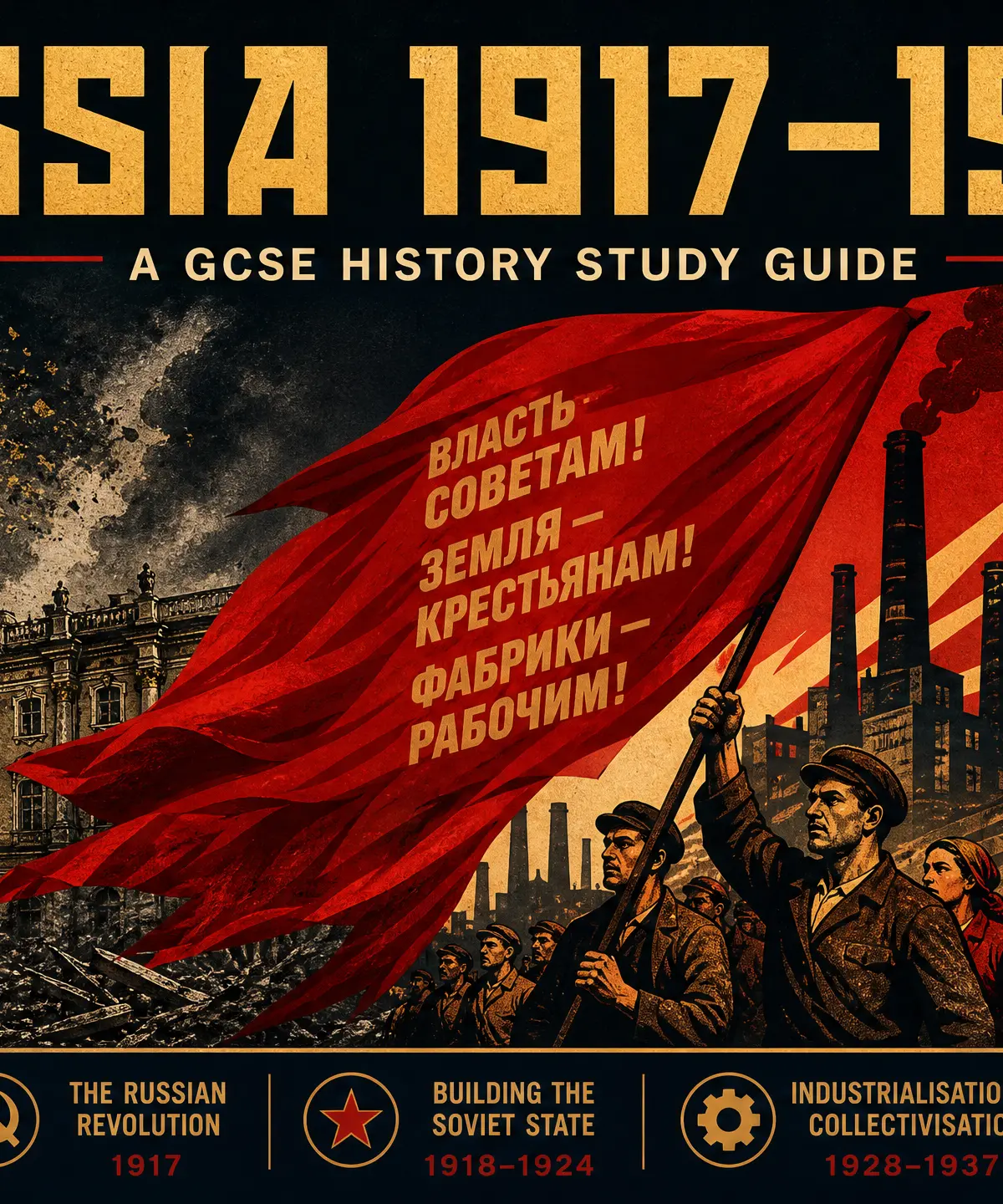
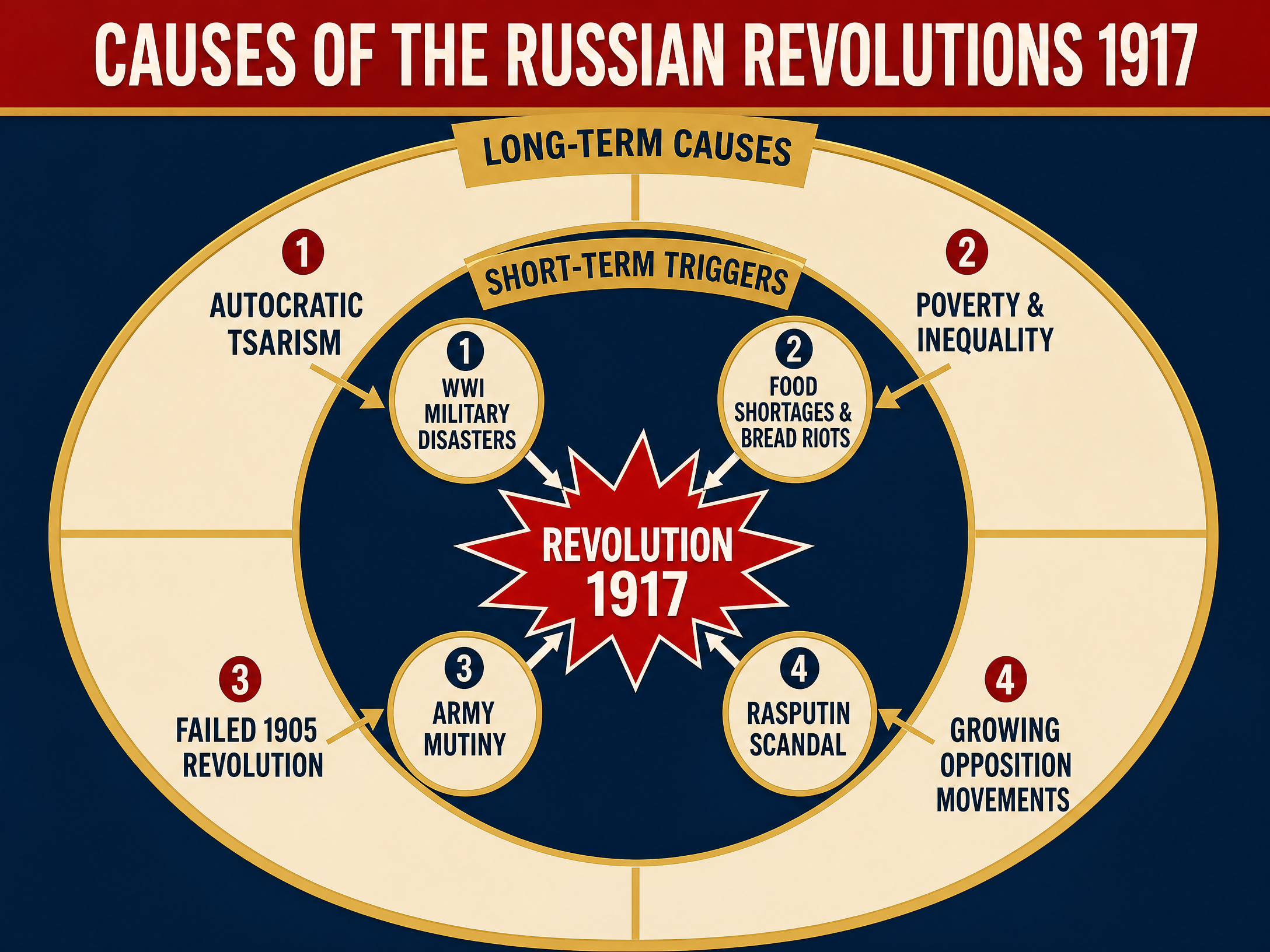
This period study focuses on one of the most turbulent eras in modern history: the collapse of the 300-year-old Romanov dynasty and the establishment of the world's first communist state. Examiners expect candidates to understand not just the narrative of events, but the complex causation behind them. You must be able to explain how long-term structural problems in Tsarist Russia combined with the short-term catastrophic impact of the First World War to trigger the February Revolution. Furthermore, you must understand the concept of 'Dual Control' and how the fatal errors of the Provisional Government created the power vacuum that Lenin, Trotsky, and the Bolsheviks ruthlessly exploited in October 1917. Specific knowledge of dates, names, and key terms is essential for reaching the highest mark bands.
Listen to the Topic Podcast
Key Events & Developments
The February Revolution
Date(s): 23 February - 2 March 1917
What happened: Spontaneous strikes and bread riots broke out in Petrograd. When ordered to fire on the crowds, the army mutinied and joined the protesters. The Duma refused to dissolve, and Tsar Nicholas II was forced to abdicate.
Why it matters: This ended autocratic Tsarism in Russia. However, it did not solve the underlying problems (war and poverty), instead creating an unstable power vacuum filled by the Provisional Government and the Petrograd Soviet.
Specific Knowledge: Began on International Women's Day (23 Feb); 250,000 workers on strike by 25 Feb; Nicholas II abdicated on 2 March.
The Establishment of Dual Control
Date(s): March - October 1917
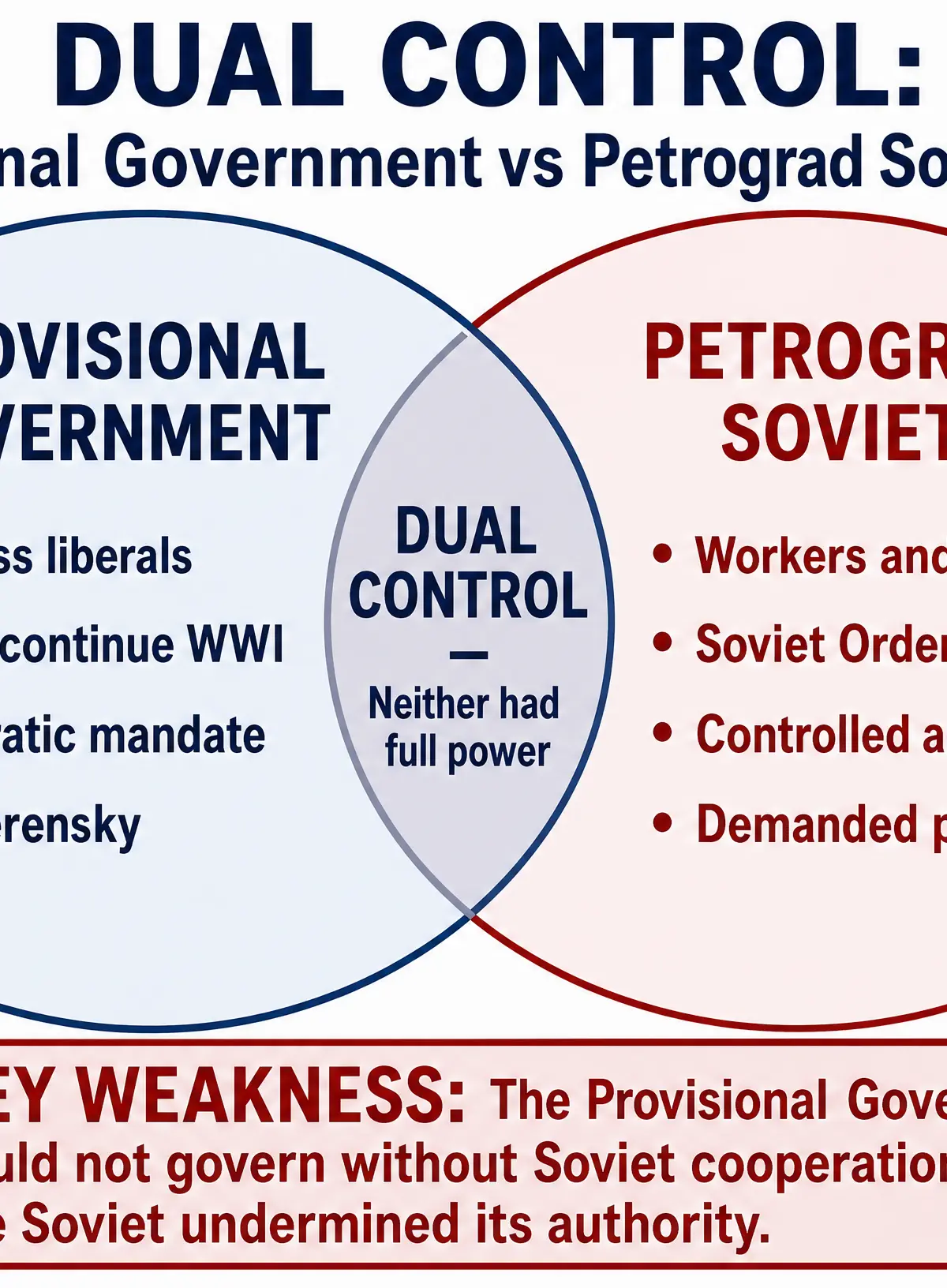
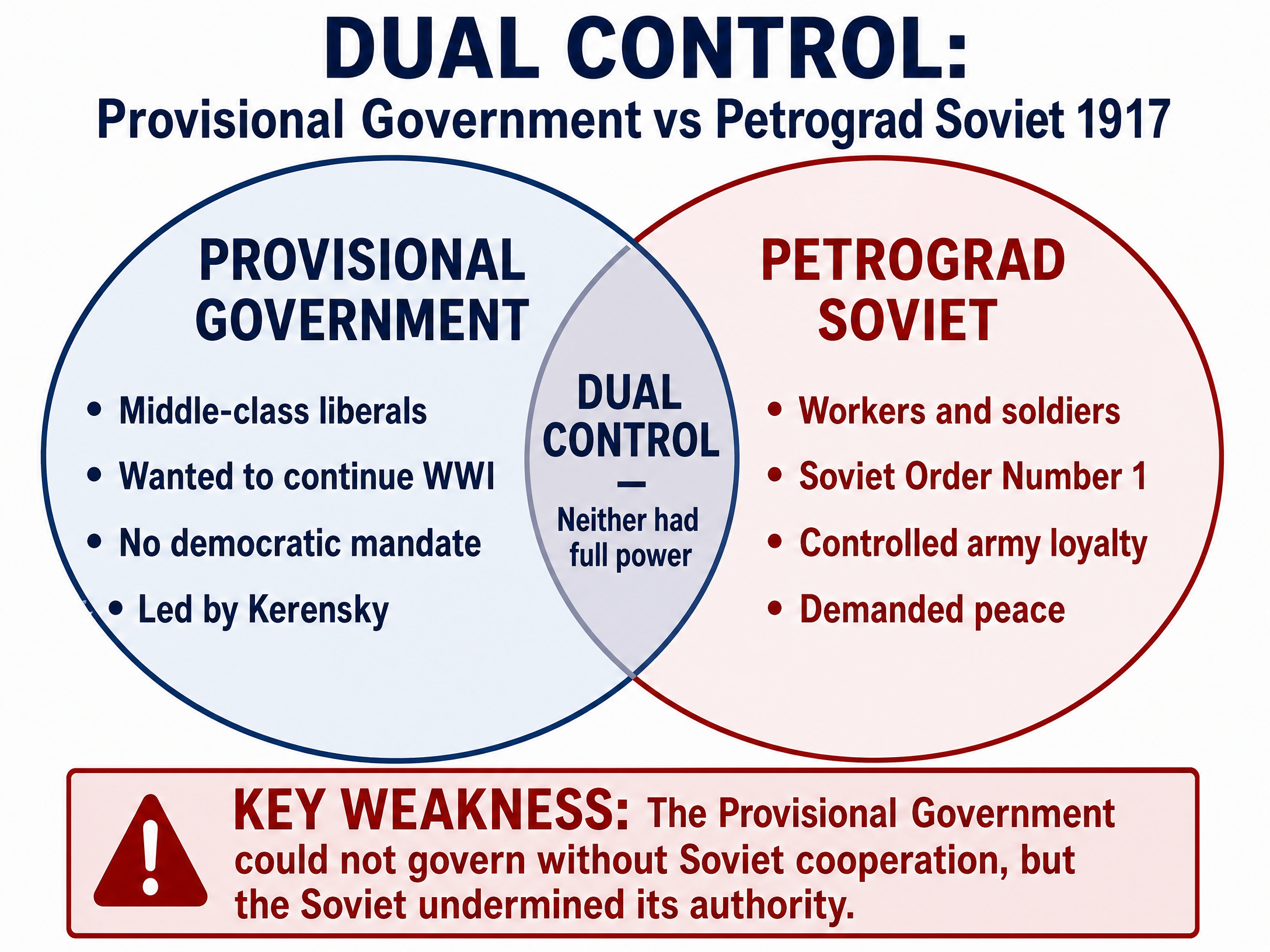
What happened: Power was shared uneasily between the unelected Provisional Government (mostly middle-class liberals) and the Petrograd Soviet (representing workers and soldiers).
Why it matters: This arrangement paralyzed Russia. The Provisional Government had official authority but lacked military control, while the Soviet had the loyalty of the troops but refused to take official responsibility.
Specific Knowledge: Soviet Order Number 1 (March 1917) stated that military orders from the Provisional Government were only to be obeyed if they did not contradict the Soviet.
Lenin's Return and the April Theses
Date(s): 3 April 1917
What happened: Lenin returned from exile in Switzerland (via a sealed train provided by Germany) and immediately issued a radical manifesto demanding an end to the war, no support for the Provisional Government, and all power to the Soviets.
Why it matters: This transformed the Bolshevik party from a marginal group into a radical alternative to the failing Provisional Government. It provided a clear, popular message that resonated with the masses.
Specific Knowledge: Arrived at Finland Station; slogan was 'Peace, Land, Bread'.
The Kornilov Revolt
Date(s): August 1917
What happened: General Kornilov marched troops towards Petrograd in an apparent military coup. Prime Minister Kerensky panicked, released imprisoned Bolsheviks, and armed their militia (the Red Guards) to defend the city. The coup collapsed.
Why it matters: It completely destroyed Kerensky's credibility and the authority of the Provisional Government. The Bolsheviks emerged as the armed heroes who had 'saved' the revolution, leading to a surge in their support.
Specific Knowledge: By September 1917, Bolshevik membership had reached 200,000, and they gained majorities in the Petrograd and Moscow Soviets.
The October Revolution
Date(s): 24-25 October 1917
What happened: The Bolsheviks, organised by Trotsky's Military Revolutionary Committee, systematically seized control of key infrastructure in Petrograd (bridges, telegraph offices, railway stations). They then stormed the Winter Palace and arrested the Provisional Government.
Why it matters: This marked the successful Bolshevik seizure of power, establishing a communist government that would rule Russia for over 70 years.
Specific Knowledge: The cruiser Aurora fired a blank shot to signal the assault on the Winter Palace; the takeover was almost bloodless in Petrograd.
Key Individuals
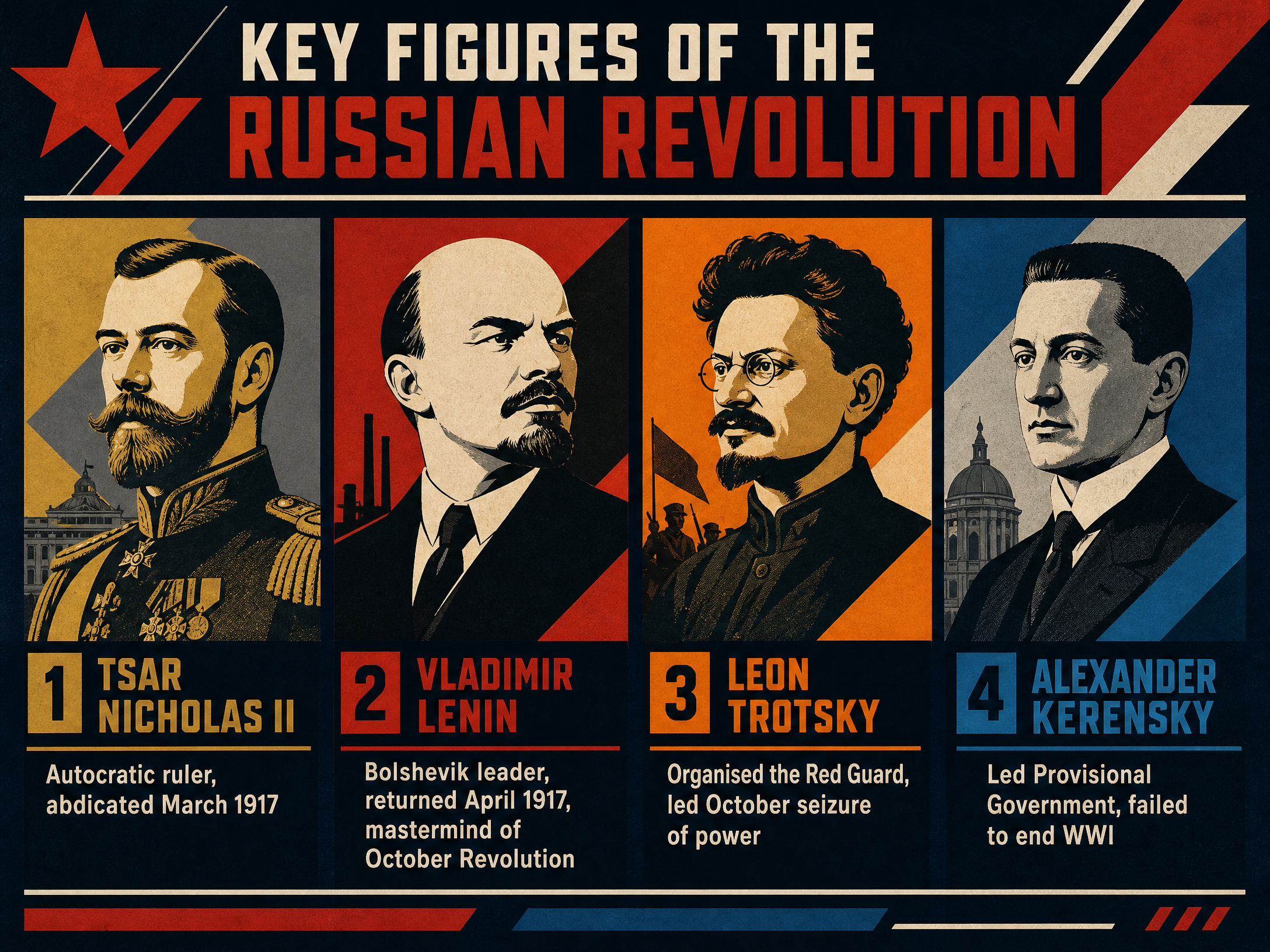
Tsar Nicholas II
Role: The last Emperor of Russia (ruled 1894-1917).
Key Actions: Took personal command of the army in 1915; refused to share power with the Duma; ordered troops to fire on protesters in February 1917.
Impact: His stubborn commitment to autocracy and disastrous military leadership made revolution inevitable.
Vladimir Lenin
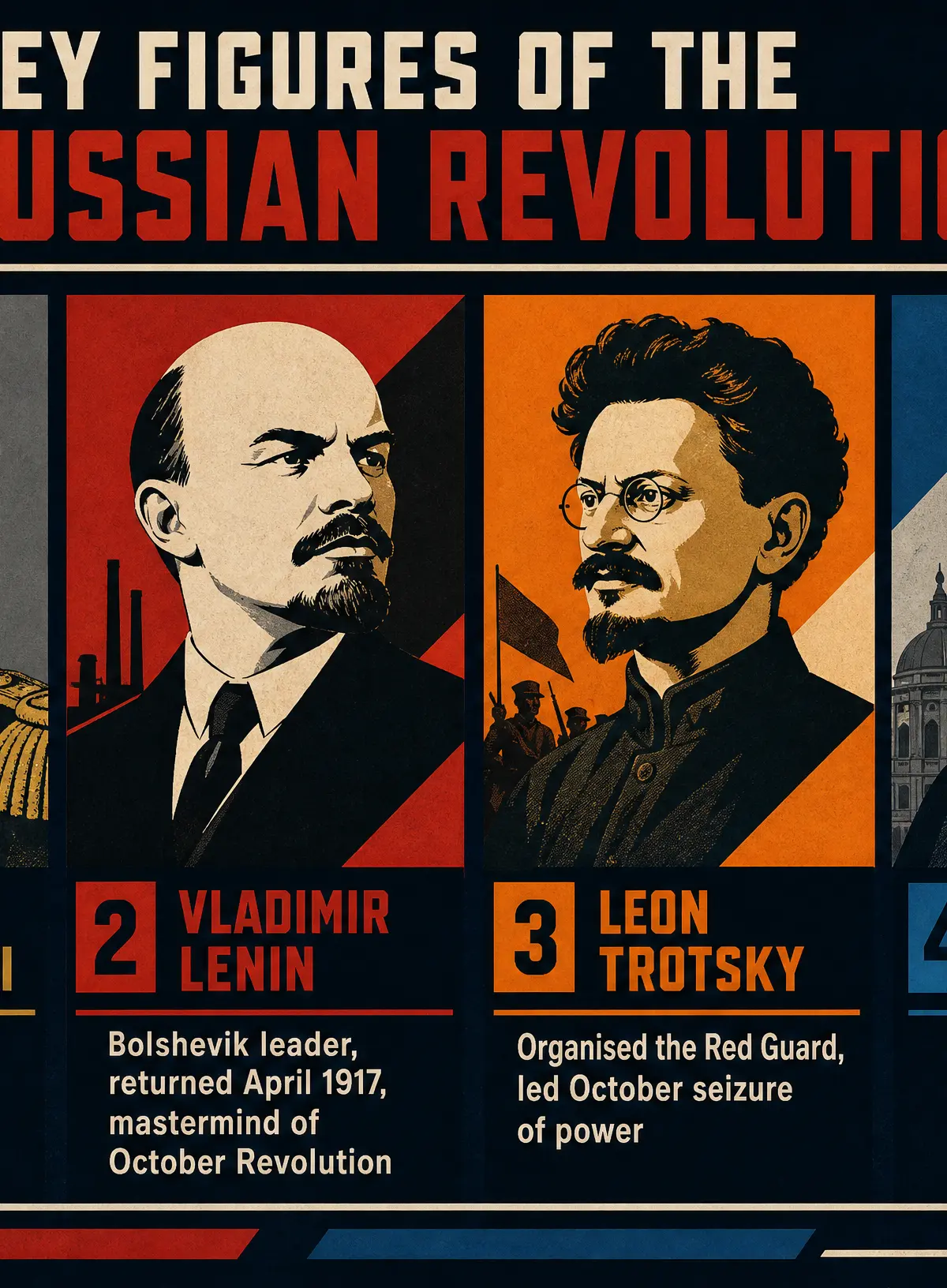
Role: Leader of the Bolshevik Party.
Key Actions: Issued the April Theses; relentlessly pushed the Bolshevik Central Committee to seize power in October 1917.
Impact: Provided the ideological vision and ruthless political determination required for the Bolsheviks to succeed.
Leon Trotsky
Role: Key Bolshevik leader and military strategist.
Key Actions: Chairman of the Petrograd Soviet; formed and led the Military Revolutionary Committee (MRC); planned the logistics of the October Revolution.
Impact: While Lenin provided the vision, Trotsky provided the practical organisation that made the October seizure of power successful.
Alexander Kerensky
Role: Key figure in the Provisional Government, becoming Prime Minister in July 1917.
Key Actions: Ordered the disastrous June Offensive in WWI; armed the Bolsheviks during the Kornilov Revolt.
Impact: His failure to end the war and his miscalculation during the Kornilov affair doomed the Provisional Government.
Second-Order Concepts
Causation
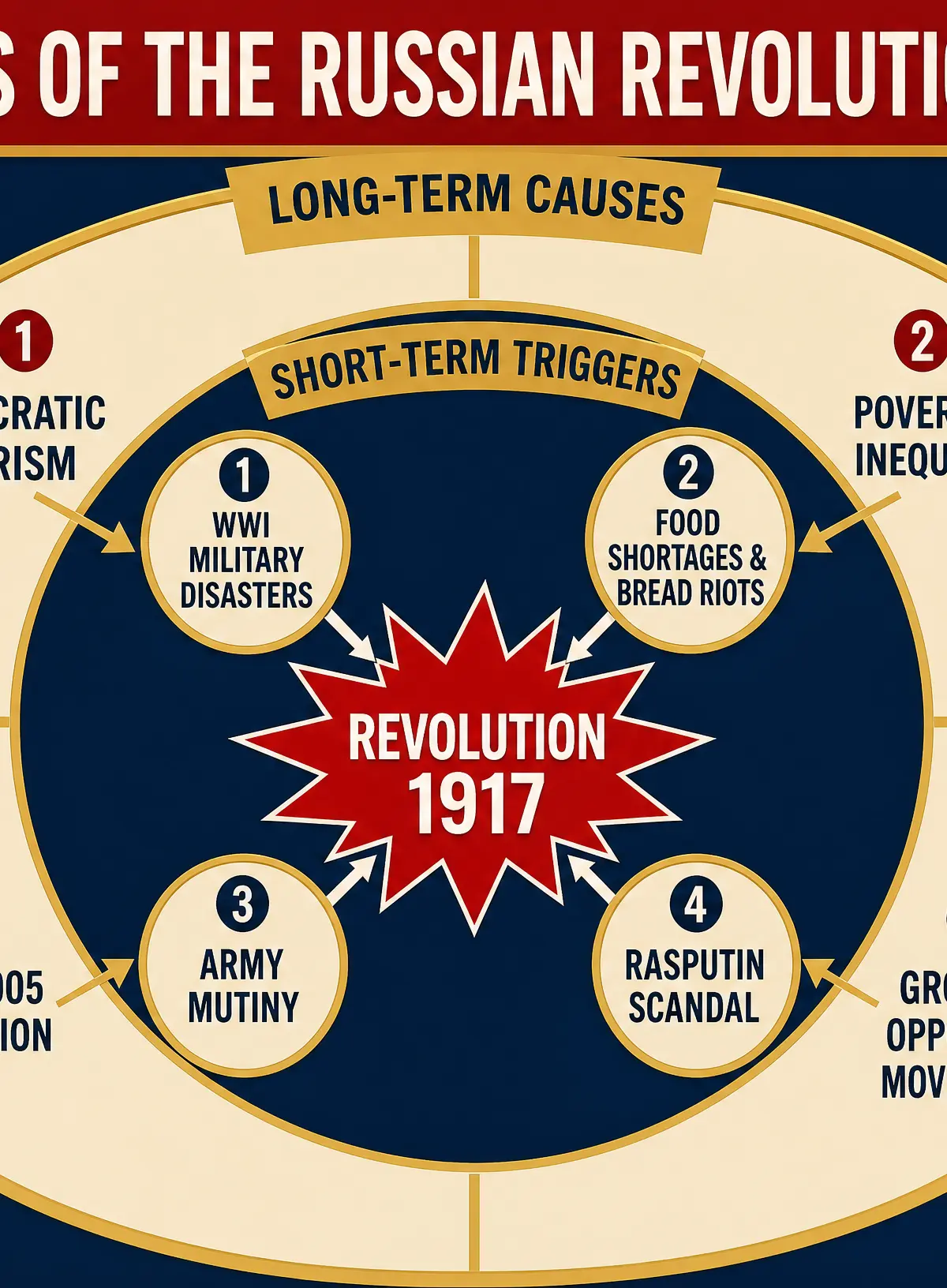
Examiners expect you to distinguish between long-term causes (autocracy, peasant poverty, industrial exploitation) and short-term triggers (WWI military defeats, food shortages, Rasputin's influence). Strong answers explain how these factors interacted—for example, how the war exacerbated existing economic inequalities to the breaking point.
Consequence
The immediate consequence of the February Revolution was the abdication of the Tsar, but the more significant structural consequence was the creation of 'Dual Control'. This inherently unstable system directly paved the way for the October Revolution.
Change & Continuity
While the February Revolution brought a massive political change (the end of Tsarism), there was significant continuity in the lived experience of ordinary Russians: the war continued, food shortages persisted, and land was not redistributed. This continuity of suffering is why the Provisional Government failed.
Significance
The October Revolution is globally significant as it established the first communist state, fundamentally altering 20th-century geopolitics and setting the stage for the Cold War.
Source Skills
When evaluating sources for this topic, always consider provenance:
- Bolshevik sources (post-October 1917) will often exaggerate the scale of the October Revolution, portraying it as a massive popular uprising rather than a strategic coup, to legitimize their rule.
- Provisional Government sources may emphasize the chaos of the Soviets or downplay their own lack of democratic mandate.
- Tsarist sources (pre-1917) often demonstrate a profound disconnect from the reality of peasant and worker suffering.
Worked Examples
3 worked examples — open one to explore the question and available guidance.
Practice Questions
Test your understanding — click to reveal model answers
Explain why the Tsar was forced to abdicate in March 1917. (12 marks)
Hint: Think about long-term discontent, the specific impact of WWI, and the immediate trigger of the Petrograd strikes.
Test your understanding of Russia and the Soviet Union, 1917–41
Active recall beats re-reading. Take an instant quiz now to test what you’ve learned and lock it into long-term memory.
7 days Premium · Then free forever · No card, no charge