Pearson Edexcel · GCSE · History
Superpower relations and the Cold War, 1941–91
This study covers the dramatic final chapter of the Cold War from 1970 to 1991, tracing the journey from the fragile peace of Détente through the tense 'Second Cold War' to the ultimate collapse of the Soviet Union. Understanding this period is crucial for explaining how half a century of superpower rivalry abruptly ended, reshaping the modern world.
- 10 min read
- 3 worked examples
- 5 practice questions
- 6 key terms
Study Notes
Overview
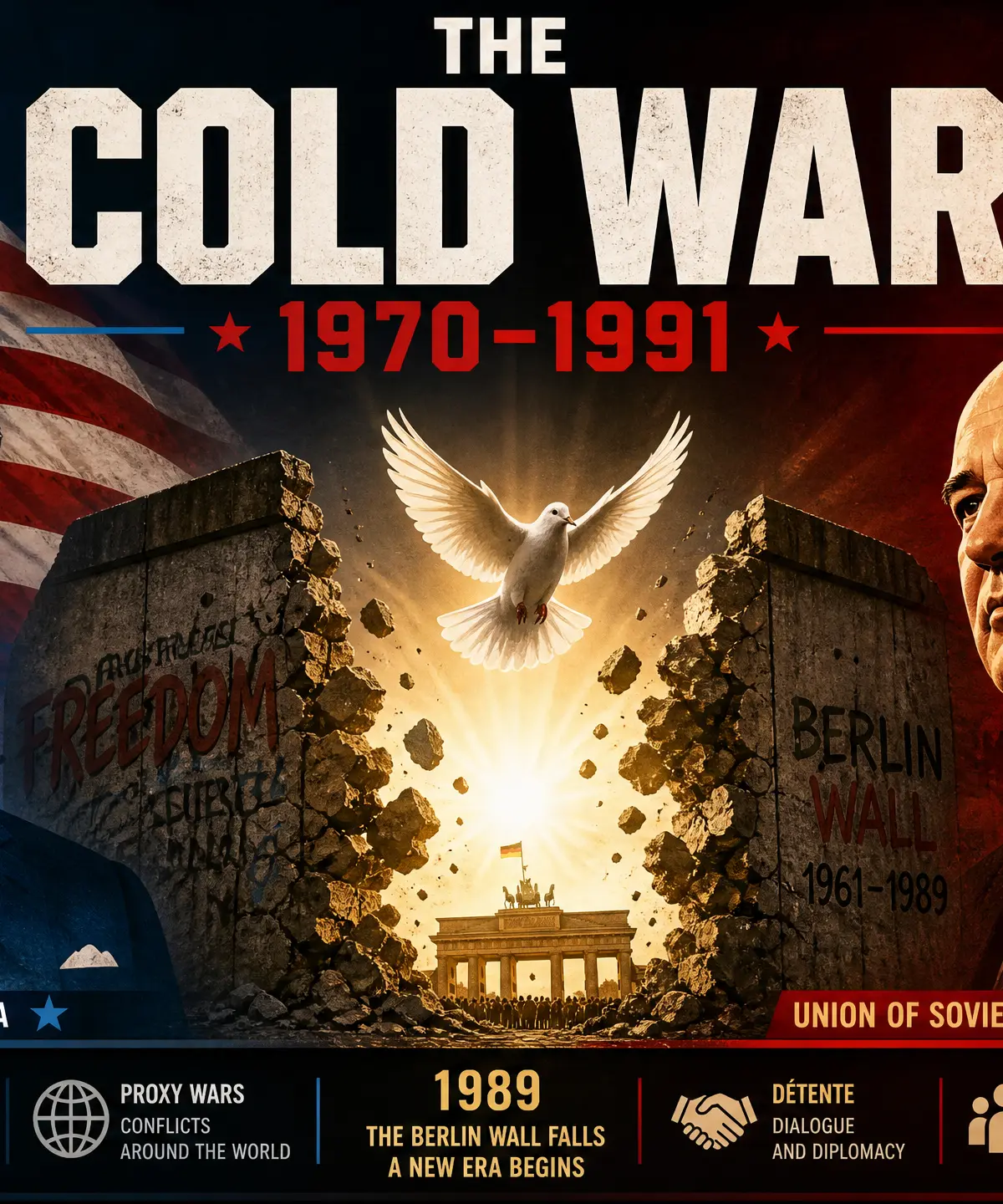
This study guide covers the final phase of the Cold War (1970–1991), a period characterised by dramatic shifts in superpower relations. It begins with Détente in the 1970s, a deliberate attempt to relax tensions and limit nuclear arms following the exhaustion of the 1960s arms race. However, this fragile peace was shattered in 1979 by the Soviet invasion of Afghanistan, launching the 'Second Cold War' under US President Ronald Reagan, who escalated military spending and rhetoric.
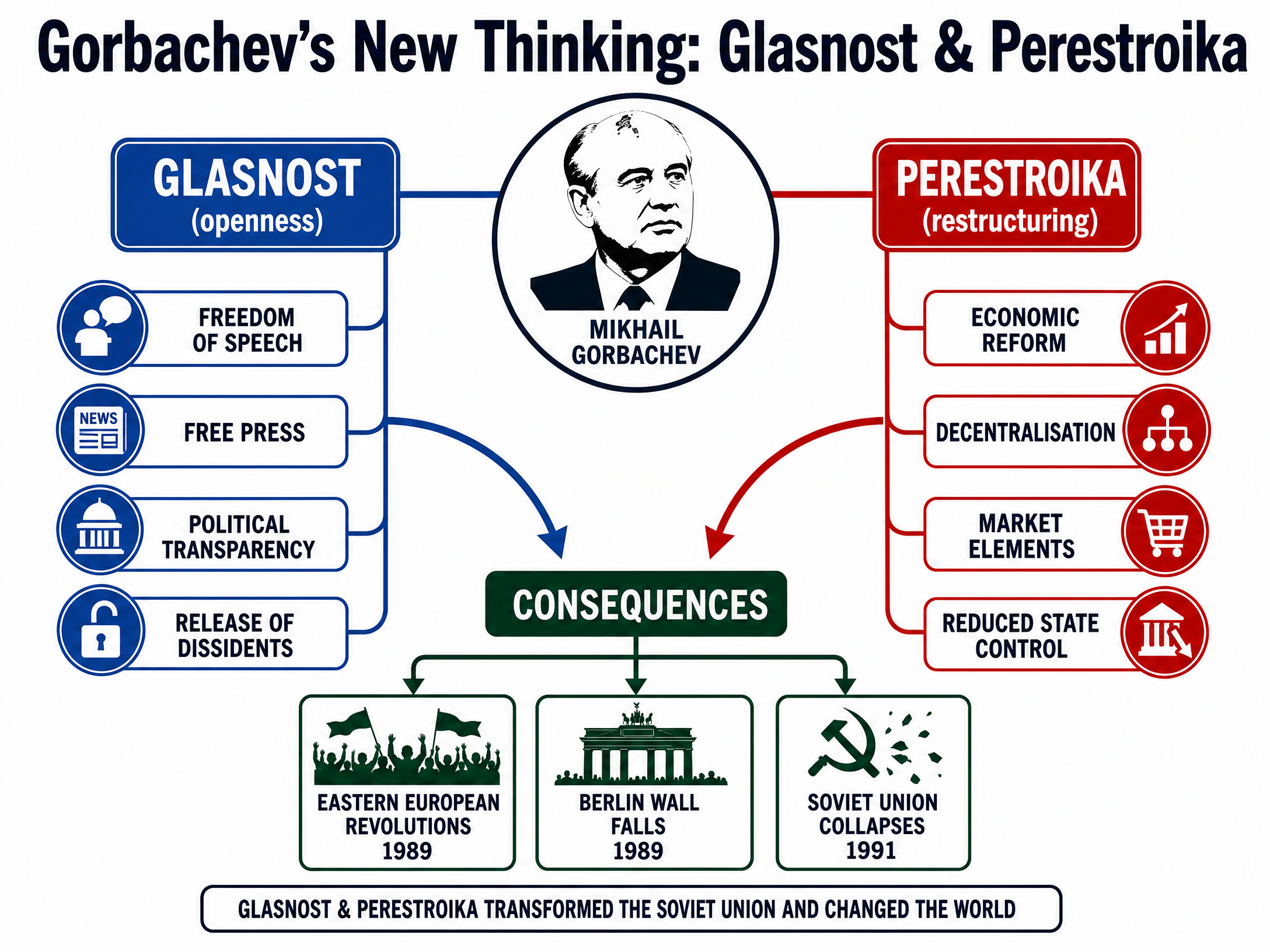
The narrative then shifts to the internal crisis of the Soviet Union and the emergence of Mikhail Gorbachev in 1985. His revolutionary policies of glasnost (openness) and perestroika (restructuring), combined with his abandonment of the Brezhnev Doctrine, inadvertently triggered a wave of revolutions across Eastern Europe in 1989. The symbolic fall of the Berlin Wall was followed by the total collapse of the Soviet Union itself in 1991. Examiners expect candidates to clearly distinguish between these phases, understand the causal links between economic pressure and political collapse, and evaluate the relative significance of Reagan and Gorbachev in ending the conflict.
Key Events & Developments
Détente and the SALT Agreements
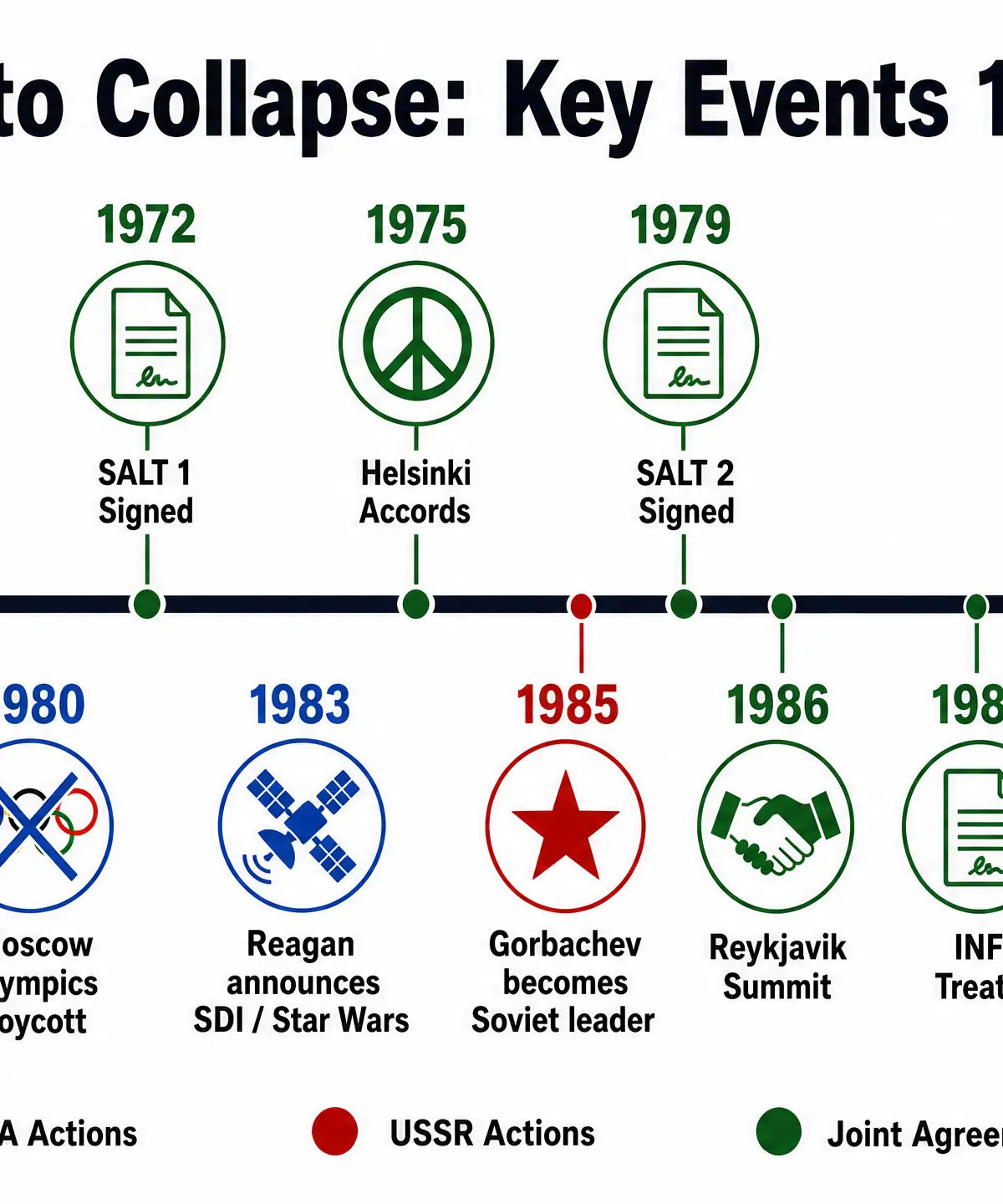
Date(s): 1970s (SALT 1 in 1972, Helsinki Accords in 1975, SALT 2 in 1979)
What happened: A period of relaxed tension where the USA and USSR actively sought to limit the arms race and improve relations through diplomacy and treaties. Nixon visited Moscow in 1972, leading to the Strategic Arms Limitation Treaty (SALT 1), which froze the number of strategic ballistic missile launchers. The 1975 Helsinki Accords recognised European borders and included human rights commitments. SALT 2 (1979) aimed to limit nuclear delivery vehicles but was never ratified by the US Senate.
Why it matters: Détente represented a significant shift from the brinkmanship of the 1960s (like the Cuban Missile Crisis) to diplomatic management of the conflict. The Helsinki Accords, while initially seen as a Soviet diplomatic victory regarding borders, provided dissidents within the Soviet bloc a legal framework to demand human rights, laying long-term groundwork for opposition.
Specific Knowledge: SALT 1 (1972) limited ICBMs and ABMs; Helsinki Accords (1975) signed by 35 nations; SALT 2 (1979) withdrawn by Carter.
The Soviet Invasion of Afghanistan and the 'Second Cold War'
Date(s): December 1979 – late 1980s
What happened: Fearing the collapse of a pro-Soviet communist government in Afghanistan, Soviet leader Leonid Brezhnev sent 80,000 troops to support it against the Mujahideen (Islamic resistance fighters). The USA, under President Carter and later Reagan, responded furiously, viewing this as aggressive Soviet expansionism.
Why it matters: This event definitively ended Détente. It triggered the Carter Doctrine (US commitment to defend the Persian Gulf), the US withdrawal from SALT 2, and the US-led boycott of the 1980 Moscow Olympics (65 nations boycotted). It also became a disastrous, costly 'Vietnam' for the Soviet Union, draining its economy and morale throughout the 1980s.
Specific Knowledge: 80,000 Soviet troops deployed; Carter Doctrine announced January 1980; 65 nations boycotted the 1980 Moscow Olympics; USSR retaliated by boycotting the 1984 Los Angeles Olympics.
The Strategic Defence Initiative (SDI)
Date(s): Announced March 1983
What happened: US President Ronald Reagan announced plans for a space-based anti-missile system (nicknamed 'Star Wars') designed to shoot down Soviet ICBMs using lasers before they could reach the USA.
Why it matters: SDI fundamentally threatened the concept of Mutually Assured Destruction (MAD) that had maintained the Cold War balance. Although the technology was years away from reality, Soviet leadership believed the USA could achieve it. Knowing their struggling economy could not fund a comparable system, it placed immense pressure on the USSR, forcing them to reconsider the arms race and eventually seek arms reduction treaties under Gorbachev.
Specific Knowledge: Announced 1983; violated the spirit of the 1972 Anti-Ballistic Missile (ABM) Treaty; forced Soviet military spending to unsustainable levels (consuming roughly 25% of GDP).
Gorbachev's 'New Thinking' and Eastern European Revolutions
Date(s): 1985–1989
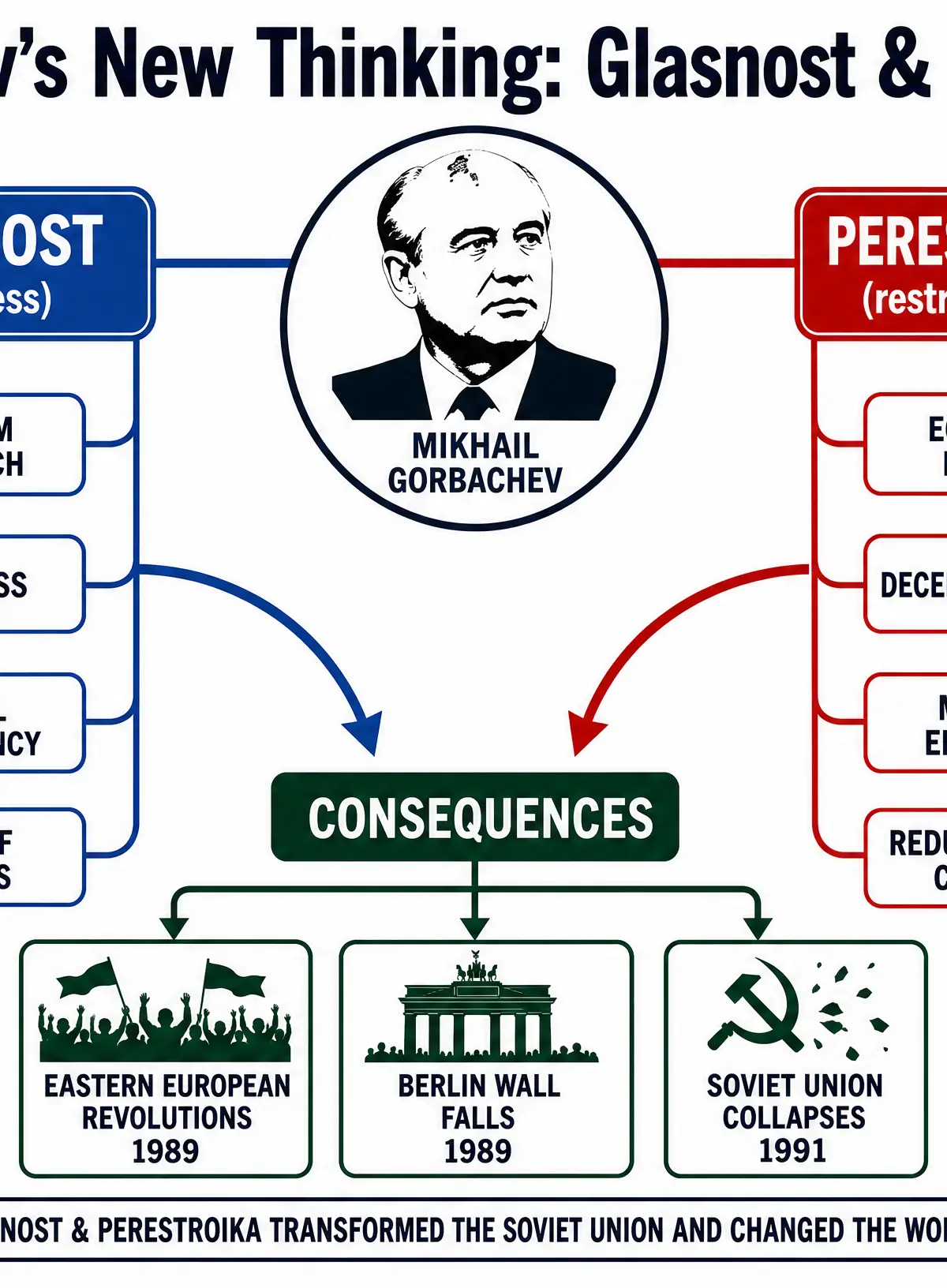
What happened: Mikhail Gorbachev introduced glasnost (openness) and perestroika (economic restructuring) to save the failing Soviet system. Crucially, he abandoned the Brezhnev Doctrine, telling Eastern European satellite states the USSR would no longer use military force to prop up their communist governments.
Why it matters: Without the threat of the Red Army, opposition movements across Eastern Europe rapidly gained momentum. In 1989, a wave of largely peaceful revolutions swept the Warsaw Pact. Poland held free elections, Hungary opened its borders, and the East German regime collapsed, culminating in the fall of the Berlin Wall.
Specific Knowledge: Gorbachev became General Secretary in March 1985; Solidarity won Polish elections in June 1989; Hungary opened borders in May 1989; Berlin Wall fell 9 November 1989.
The Collapse of the Soviet Union
Date(s): 1990–1991
What happened: The loss of the Eastern European empire and the internal destabilisation caused by glasnost led to nationalist movements within the Soviet republics themselves (e.g., the Baltic states). Following a failed hardline communist coup against Gorbachev in August 1991, the Soviet republics declared independence.
Why it matters: This marked the definitive end of the Cold War. The bipolar world order that had defined international relations since 1945 ceased to exist, leaving the USA as the sole global superpower. The Warsaw Pact was formally dissolved, and the Soviet Union fractured into 15 independent nations.
Specific Knowledge: August 1991 coup attempt; Gorbachev resigned 25 December 1991; USSR officially dissolved 26 December 1991.
Key Individuals
Ronald Reagan
Role: US President (1981–1989)
Key Actions: Initially adopted a hardline anti-communist stance, labelling the USSR an 'evil empire'. He drastically increased US military spending and launched the SDI programme. In his second term, he engaged in intensive diplomacy with Gorbachev, signing the INF Treaty in 1987.
Impact: His early aggressive stance and the SDI placed unbearable economic pressure on the Soviet Union, arguably forcing them to the negotiating table. His later willingness to negotiate with Gorbachev was crucial in ending the arms race.
Mikhail Gorbachev
Role: General Secretary of the Communist Party of the Soviet Union (1985–1991)
Key Actions: Introduced domestic reforms (glasnost and perestroika) to modernise the USSR. Abandoned the Brezhnev Doctrine. Signed major arms reduction treaties (INF Treaty) with the USA.
Impact: His policies unintentionally caused the collapse of Soviet control in Eastern Europe and the disintegration of the USSR itself. Most historians view his decision not to use force to maintain the Soviet empire as the decisive factor in ending the Cold War peacefully.
Leonid Brezhnev
Role: Soviet Leader (1964–1982)
Key Actions: Pursued Détente in the 1970s, signing SALT 1 and the Helsinki Accords. However, he also formulated the Brezhnev Doctrine (justifying Soviet intervention in socialist states) and ordered the disastrous invasion of Afghanistan in 1979.
Impact: His era saw both the peak of diplomatic cooperation (Détente) and the trigger for renewed hostility (Afghanistan). His leadership left the USSR with a stagnant economy and an unwinnable war, problems inherited by Gorbachev.
Second-Order Concepts
Causation
The end of the Cold War was driven by a combination of long-term and short-term causes. Long-term causes included the inherent structural weaknesses of the Soviet command economy, which could not sustain the arms race while providing consumer goods. Short-term causes included the economic shock of the Afghan war and the technological challenge posed by Reagan's SDI. The trigger was Gorbachev's 'new thinking'—specifically the abandonment of the Brezhnev Doctrine—which removed the barrier of fear and allowed Eastern European revolutions to succeed.
Consequence
The immediate consequence of Gorbachev's policies was the loss of the Soviet satellite empire in Eastern Europe (1989). The long-term consequence was the total collapse of the Soviet Union itself (1991), the end of the global bipolar power structure, the reunification of Germany (1990), and the transition of Eastern European states towards democracy and capitalism.
Change & Continuity
The 1970s (Détente) represented a change from the high tension of the 1960s, but continuity in the underlying ideological rivalry. The 1980s saw a sharp reversion to high tension (Second Cold War), followed by an unprecedented change in the late 1980s when the Soviet Union actively dismantled its own control mechanisms, breaking the continuity of Soviet imperialism that had existed since 1945.
Significance
This period is historically significant because it marks the peaceful resolution of a conflict that threatened global nuclear annihilation. The collapse of the Soviet Union fundamentally redrew the map of Europe and Asia and discredited Soviet-style communism as a viable global alternative to democratic capitalism.
Source Skills
When evaluating sources for this topic, consider the intense propaganda used by both sides.
- US political speeches (e.g., Reagan's 'Evil Empire' speech) are useful for understanding US public posture but may exaggerate Soviet threats to justify military spending.
- Soviet official documents pre-1985 are heavily censored and reflect party lines rather than reality.
- Post-1985 Soviet sources (during glasnost) become much more useful as censorship was lifted, revealing the true depth of economic crisis and public dissatisfaction.
- Political cartoons from the West often mock Soviet economic failures or aging leadership, useful for showing Western attitudes but limited as objective records of Soviet policy.
Listen to the podcast below for a comprehensive audio review of this topic:
Interactive Diagrams
1 interactive diagram to visualise key concepts
Conceptual Flow Outline
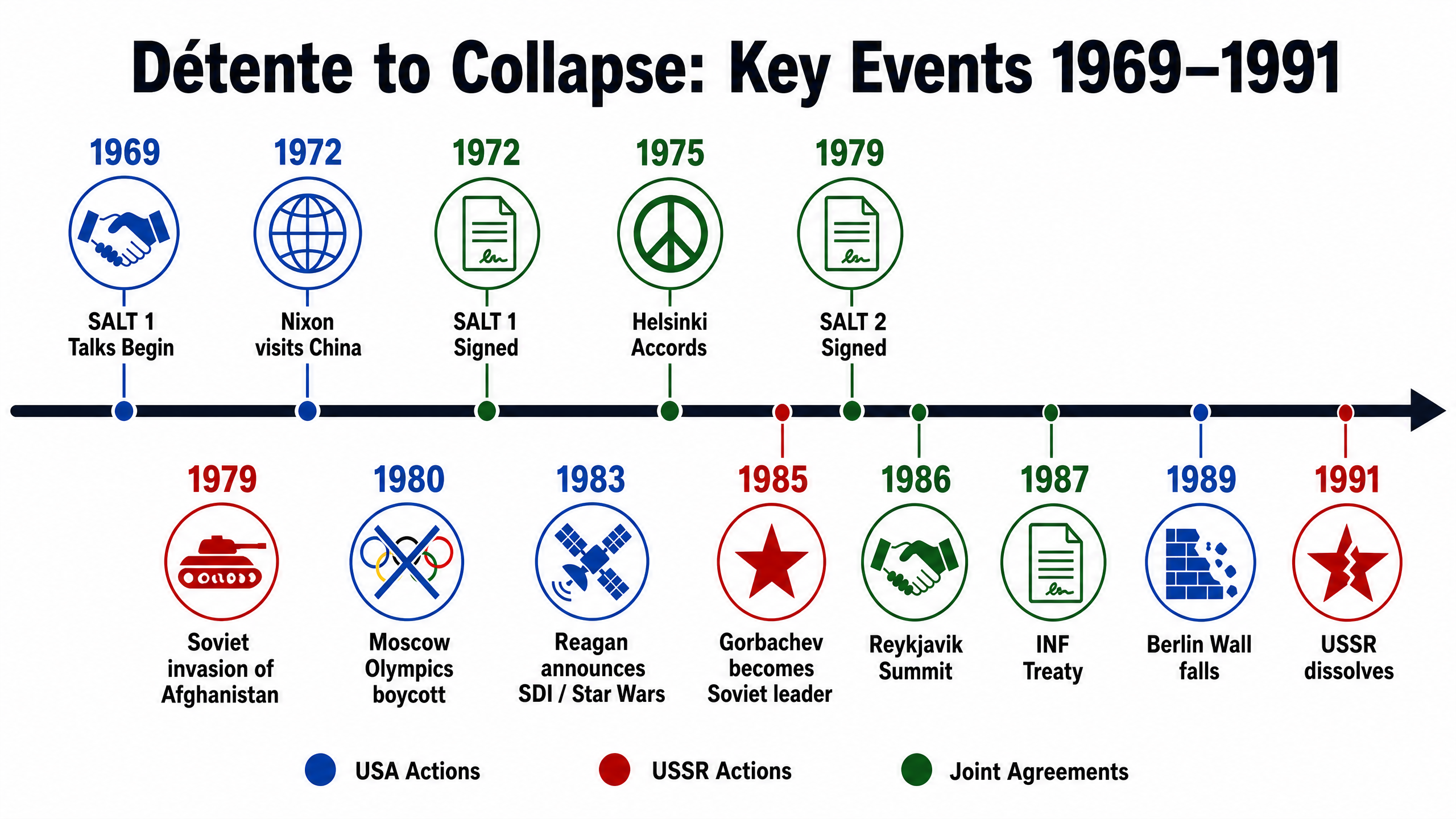
Causal map: How economic pressure and Gorbachev's reforms led to the end of the Cold War
Worked Examples
3 worked examples — open one to explore the question and available guidance.
Practice Questions
Test your understanding — click to reveal model answers
Explain two consequences of the Soviet invasion of Afghanistan. (8 marks)
Hint: Think about the impact on superpower relations (Détente) and the impact on the Soviet economy.
Write a narrative account analysing the key events of Détente in the 1970s. (8 marks)
Hint: Structure your answer chronologically: SALT 1 -> Helsinki -> SALT 2. Show how one event led to the next.
Explain the importance of the fall of the Berlin Wall (1989) for the end of the Cold War. (8 marks)
Hint: Focus on its symbolic importance and its practical impact on Soviet control in Europe.
Explain why relations between the USA and USSR worsened in the years 1979–1983. (12 marks)
Hint: You need three factors. Start with Afghanistan, then Olympic boycotts, then Reagan's policies (SDI).
How far do you agree that Gorbachev's policies were a failure? Explain your answer. (16 marks)
Hint: Define 'failure'. Did they fail to save the USSR? Yes. Did they succeed in ending the Cold War peacefully? Yes.
Test your understanding of Superpower relations and the Cold War, 1941–91
Active recall beats re-reading. Take an instant quiz now to test what you’ve learned and lock it into long-term memory.
7 days Premium · Then free forever · No card, no charge