Pearson Edexcel · GCSE · History
The American West, c1835–c1895
The American West (c1835–c1895) is a dramatic study of transformation, conflict, and the clash of cultures. This topic explores the rise and fall of the cattle industry, the relentless push of settlement, the violent nature of frontier justice, and the tragic destruction of Indigenous ways of life, providing essential context for understanding modern America.
- 8 min read
- 3 worked examples
- 5 practice questions
- 6 key terms
Study Notes
Overview
This study of The American West, c1835–c1895, covers one of the most rapid and profound periods of transformation in modern history. Within a few decades, the vast Great Plains changed from the ancestral homeland of Indigenous peoples to a landscape dominated by ranches, railways, and homesteads. Examiners expect candidates to understand not just the narrative of these events, but the complex interactions between different groups—settlers, cattle barons, lawmen, outlaws, and Native Americans. You must be able to analyse the causes and consequences of key developments, such as the end of the open range and the destruction of the traditional Indigenous way of life. Specific knowledge of dates, individuals, and legislation (like the Dawes Act) is crucial for achieving high marks. This topic is heavily thematic, requiring you to draw connections between environmental factors, economic changes, and government policies.
Listen to our 10-minute audio guide for a comprehensive overview of this topic!
Key Events & Developments
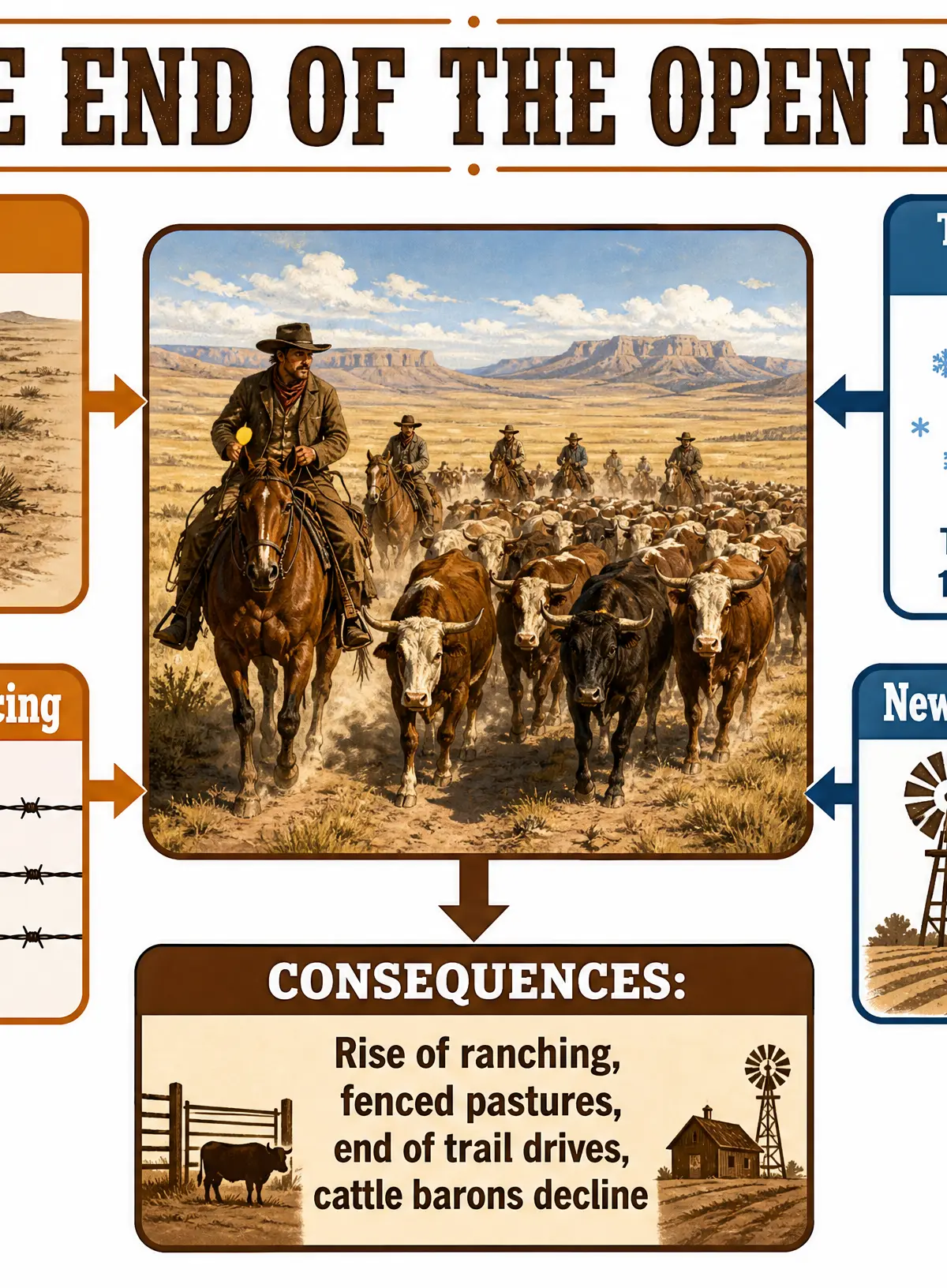
The End of the Open Range
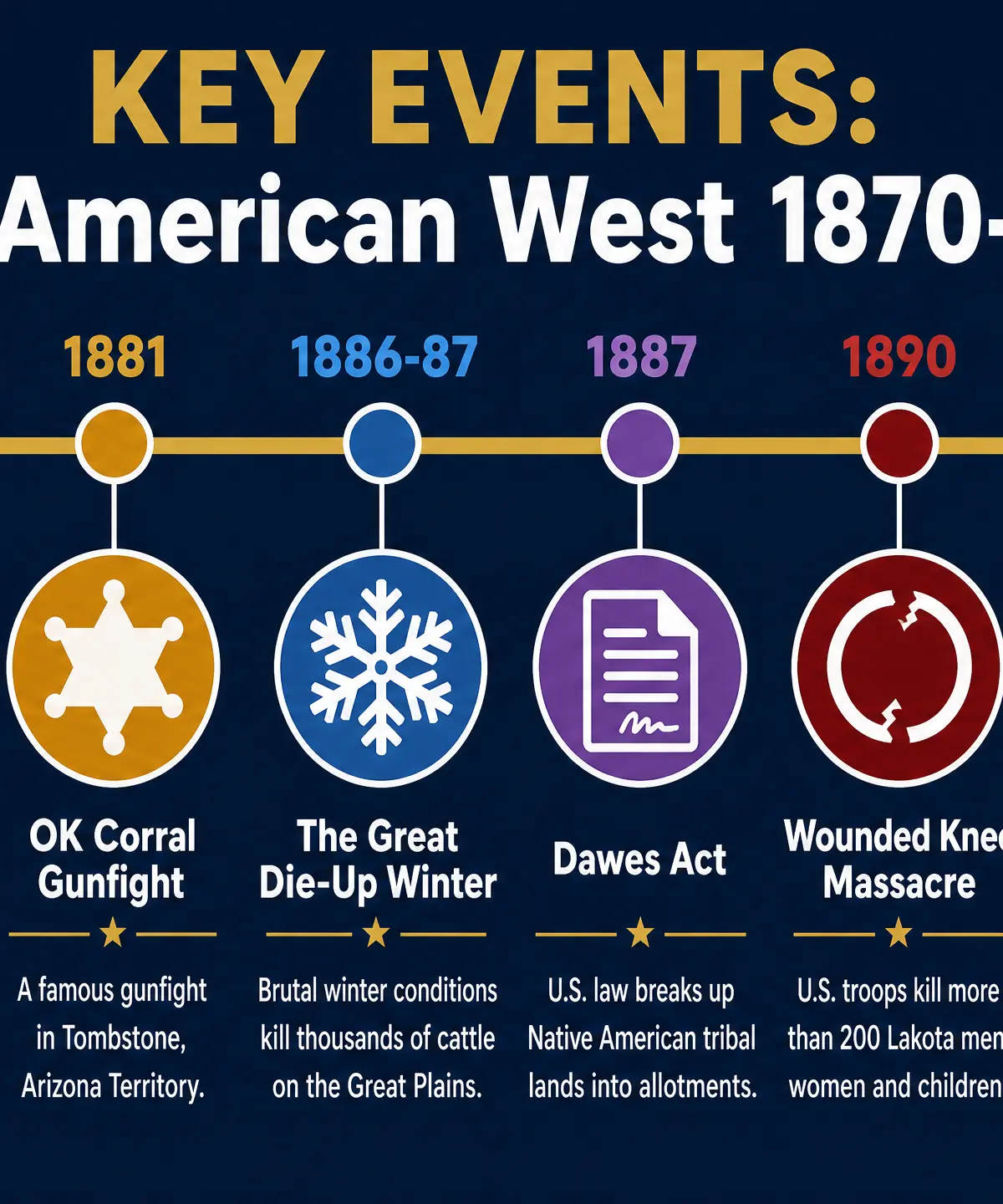
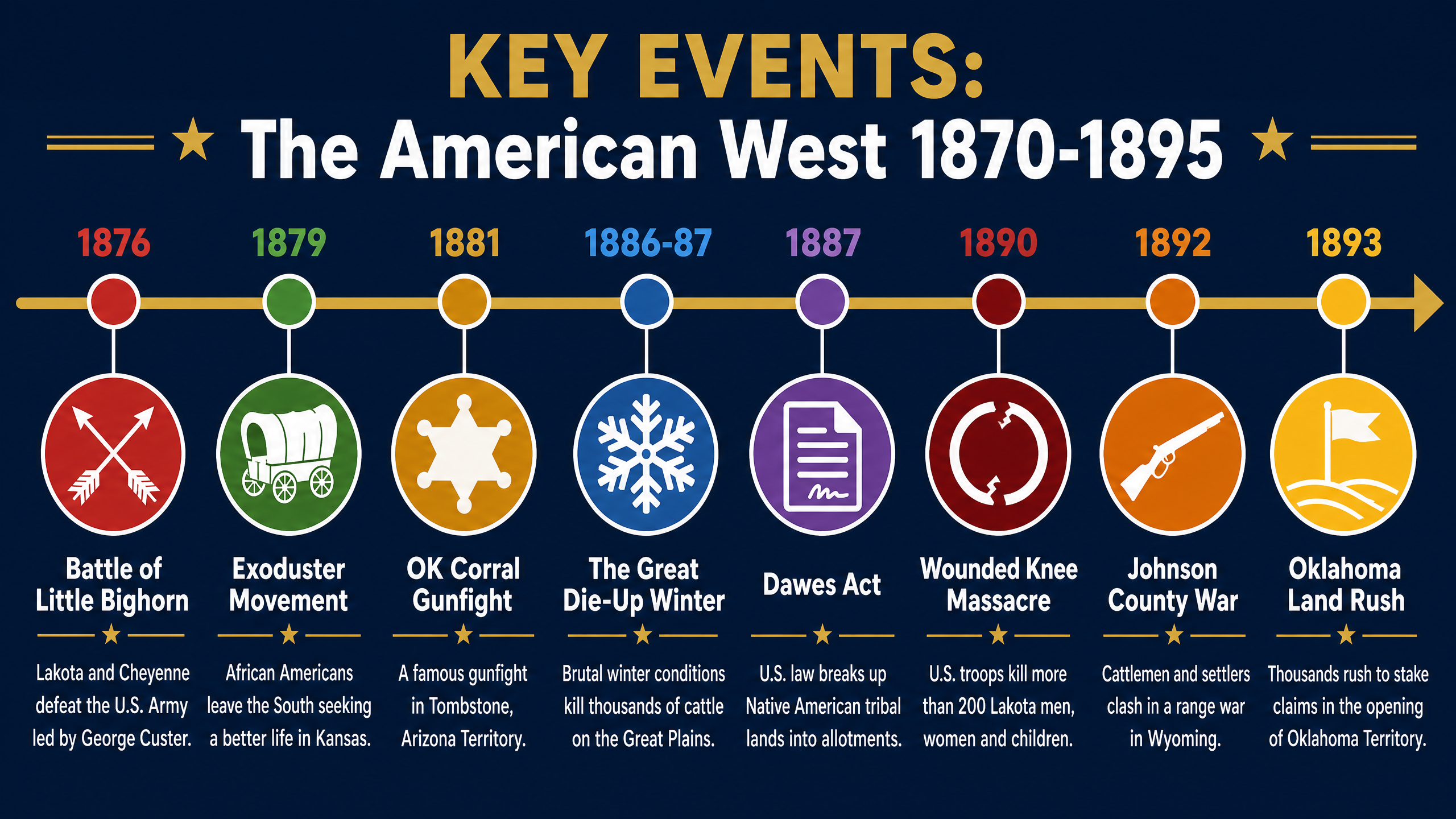
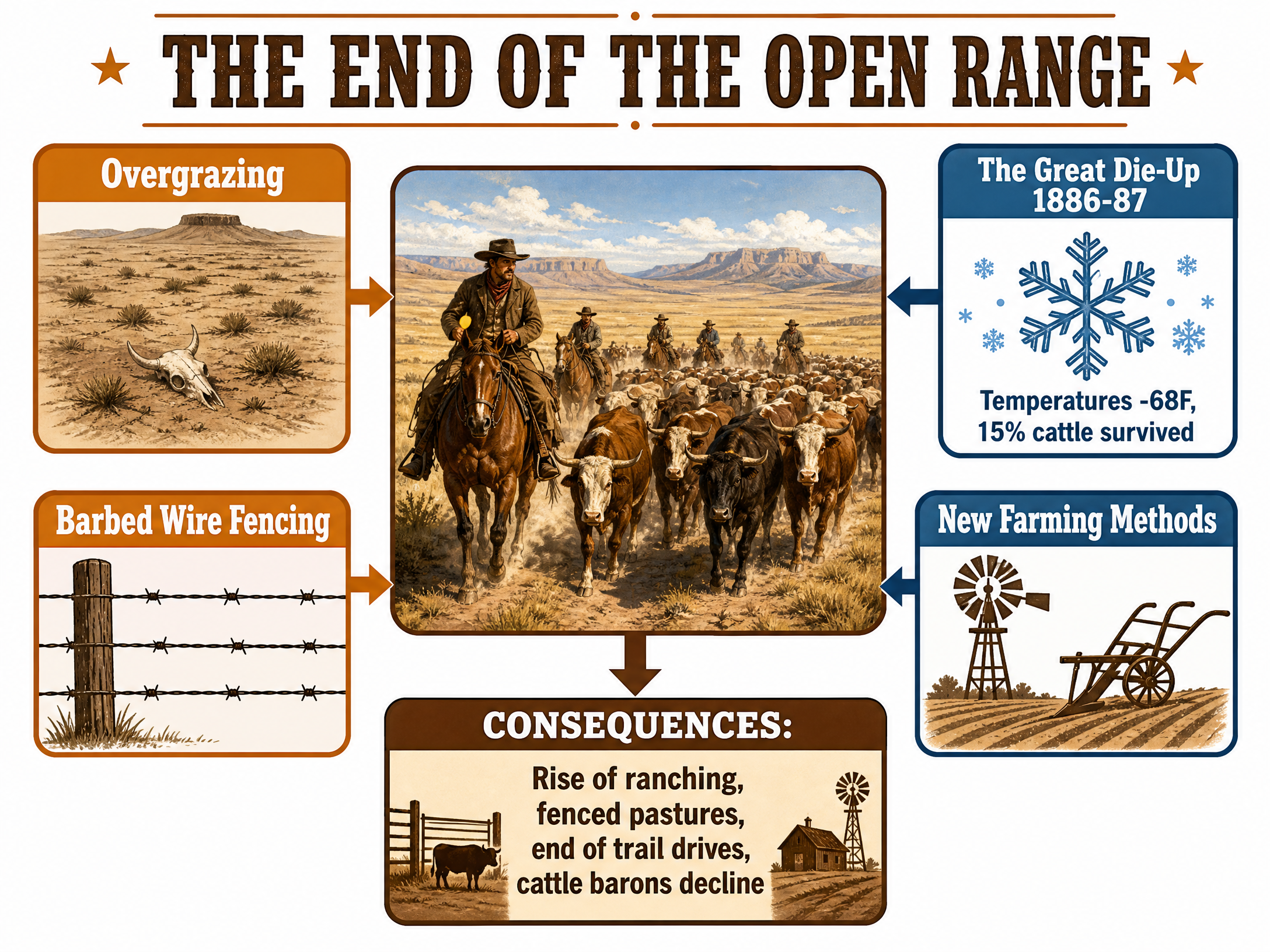
Date(s): 1886–1887 (The Great Die-Up)
What happened: The open range cattle industry, which relied on unfenced grasslands, collapsed. Overgrazing and the introduction of barbed wire (1874) had already weakened the system. The catastrophic winter of 1886–1887 brought temperatures of -68°F, killing up to 90% of cattle on the plains.
Why it matters: This is a classic example of multiple causation. The winter was the trigger, but structural economic and environmental factors were the underlying causes. It led to the rise of smaller, fenced ranches and the decline of the powerful cattle barons.
Specific Knowledge: Winter of 1886-87 ('Great Die-Up'), Joseph Glidden (invented barbed wire, 1874), temperatures of -68°F, 15% survival rate in some herds.
The Exoduster Movement
Date(s): 1879
What happened: Following the end of Reconstruction in the South, around 40,000 African Americans migrated to Kansas seeking land, freedom, and an escape from racial violence and poverty.
Why it matters: This demonstrates that western settlement was diverse and not solely driven by white European immigrants. It highlights the push factors of Southern oppression and the pull factors of available land.
Specific Knowledge: 1879, Benjamin Singleton (leader), 40,000 migrants, destination: Kansas.
The Oklahoma Land Rush
Date(s): 16 September 1893
What happened: The US government opened up 6 million acres of the Cherokee Outlet for settlement. At noon, a pistol shot started a race of around 100,000 people to stake land claims.
Why it matters: This event symbolically marks the closure of the 'Indian Frontier'. It represents the final, aggressive push of white settlement into the last remaining large tracts of Indigenous territory.
Specific Knowledge: 16 Sept 1893, 6 million acres, Cherokee Outlet, 100,000 participants ('Boomers' and 'Sooners').
The Battle of the Little Bighorn
Date(s): 25 June 1876
What happened: Lieutenant Colonel George Custer and the 7th Cavalry attacked a large encampment of Lakota Sioux and Cheyenne. Custer's force was overwhelmed and completely destroyed.
Why it matters: While a great military victory for Indigenous peoples, its consequence was disastrous. It provoked a furious response from the US government, which flooded the Plains with troops, ultimately accelerating the defeat of the Plains Indians.
Specific Knowledge: 25 June 1876, George Custer, Sitting Bull, Crazy Horse, 7th Cavalry, 268 US soldiers killed.
The Dawes Act (General Allotment Act)
Date(s): 1887
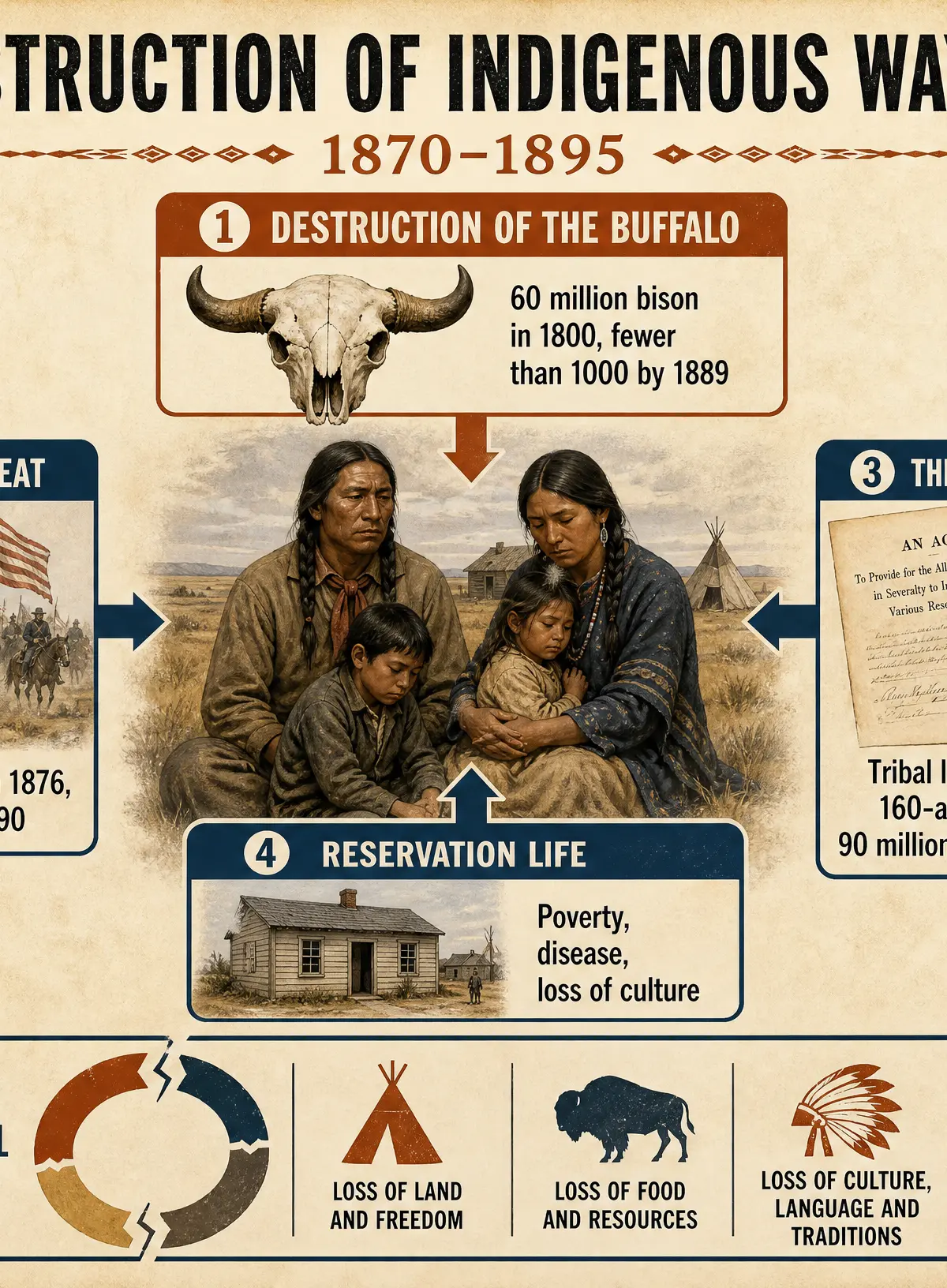
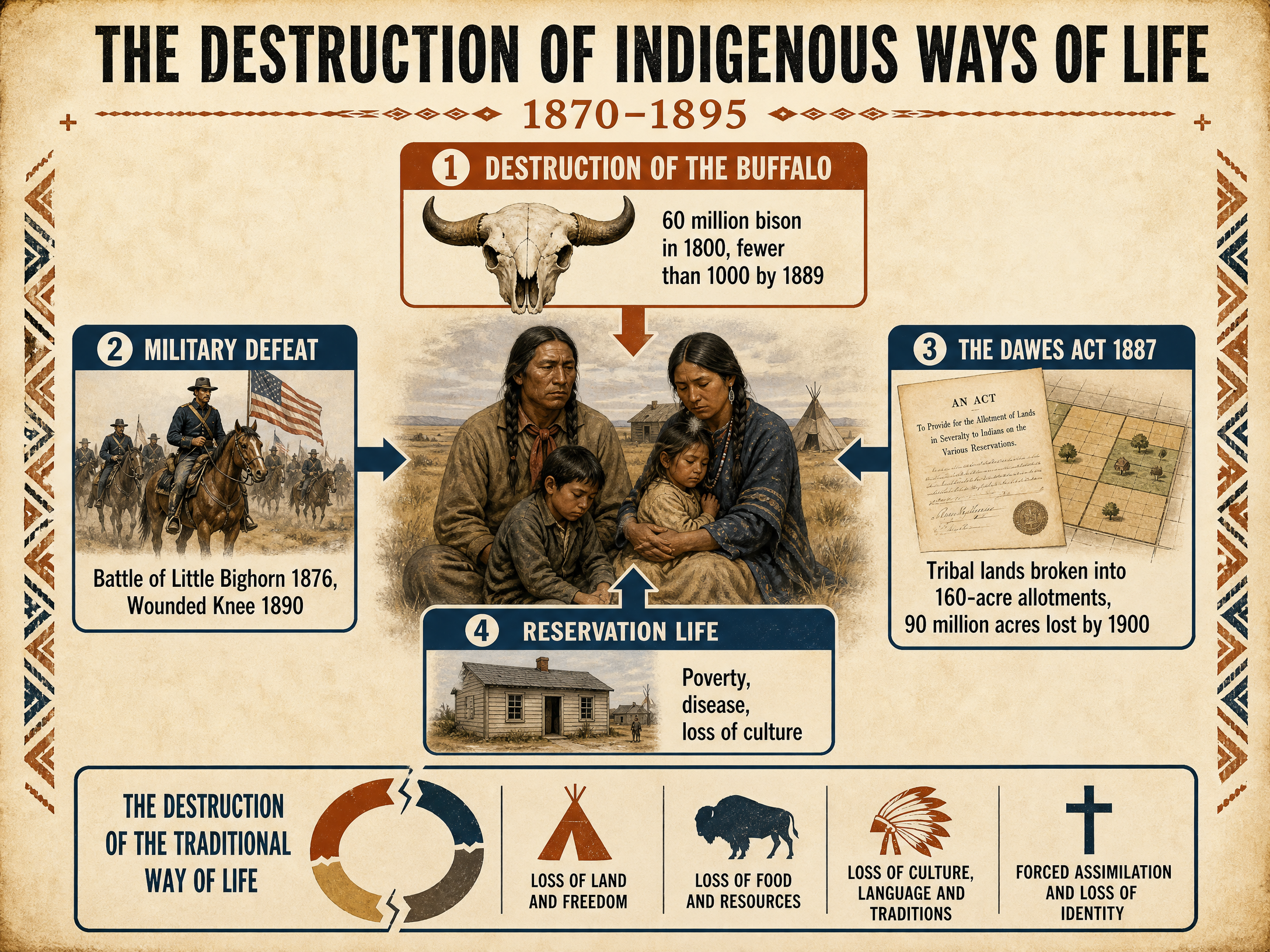
What happened: This legislation broke up communally held reservation land into individual 160-acre plots for Native American families. 'Surplus' land was sold to white settlers.
Why it matters: Examiners frequently test this. It was not a humanitarian policy, but a tool of forced assimilation designed to destroy tribal structures and culture, whilst simultaneously acquiring millions of acres of land for white settlement.
Specific Knowledge: 1887, 160-acre allotments, 90 million acres lost by Indigenous peoples by 1900.
The Wounded Knee Massacre
Date(s): 29 December 1890
What happened: US troops opened fire on a band of Lakota Sioux who were being disarmed, killing between 250 and 300 men, women, and children.
Why it matters: This marks the definitive end of armed Indigenous resistance on the Great Plains and the final closure of the Indian Wars.
Specific Knowledge: 29 Dec 1890, Pine Ridge Reservation, 7th Cavalry, 250-300 Lakota killed.
Key Individuals
George Custer
Role: Lieutenant Colonel in the US 7th Cavalry.
Key Actions: Led the disastrous attack at the Battle of the Little Bighorn in 1876.
Impact: His defeat and death shocked the American public and gave the US government the justification needed to launch a massive, final military campaign against the Plains Indians.
Sitting Bull & Crazy Horse
Role: Leaders of the Lakota Sioux.
Key Actions: United various tribes and led the resistance against US forces, culminating in the victory at Little Bighorn.
Impact: They represent the peak of Indigenous military resistance. Their eventual surrender (Crazy Horse in 1877, Sitting Bull in 1881) symbolised the overwhelming power of the US military.
Billy the Kid (William Bonney)
Role: Outlaw and gunfighter.
Key Actions: Participated in the Lincoln County War; killed several men before being shot by Sheriff Pat Garrett in 1881.
Impact: He exemplifies the lawlessness of the frontier and how the line between law enforcement and criminality was frequently blurred.
Wyatt Earp
Role: Lawman in Tombstone, Arizona.
Key Actions: Involved in the Gunfight at the OK Corral in 1881 against the Clanton-McLaury gang.
Impact: Demonstrates that frontier justice was often personal, violent, and rooted in local economic and political rivalries rather than impartial application of the law.
Second-Order Concepts
Causation
Examiners expect you to distinguish between long-term causes and short-term triggers. For example, the end of the open range was caused long-term by overgrazing and the invention of barbed wire, but the short-term trigger was the devastating winter of 1886-87.
Consequence
Always look for unintended consequences. The Battle of the Little Bighorn was an Indigenous victory, but its consequence was the total mobilisation of the US Army and the rapid end of Indigenous freedom.
Change & Continuity
The period 1835-1895 is defined by rapid change (from open plains to fenced farms, from Indigenous control to US government control). However, continuity can be seen in the persistent belief in 'Manifest Destiny'—the idea that white Americans had a God-given right to settle the entire continent.
Significance
Assess significance by looking at impact. The Dawes Act is highly significant because it fundamentally altered land ownership and deliberately attacked the core of Indigenous culture, having a devastating impact that lasted for generations.
Source Skills
When evaluating sources for this topic, always consider provenance. A report from a US Indian Agent in 1888 will likely justify government policy and portray assimilation positively. A photograph of the Oklahoma Land Rush might capture the excitement but ignore the displacement of Indigenous people. Always apply the framework: Content (what it shows) → Provenance (who/when/why) → Usefulness (what we learn) → Limitations (what it misses or distorts).
Visual Resources
3 diagrams and illustrations
Interactive Diagrams
1 interactive diagram to visualise key concepts
Conceptual Flow Outline
Causes and Consequences of the End of the Open Range
Worked Examples
3 worked examples — open one to explore the question and available guidance.
Practice Questions
Test your understanding — click to reveal model answers
Explain the importance of the Dawes Act (1887) for the way of life of the Plains Indians. (8 marks)
Hint: Focus on 'importance' - what changed because of this act? Mention land loss and cultural destruction.
Write a narrative account analysing the events of the Johnson County War (1892). (8 marks)
Hint: A narrative account must be in chronological order and show how one event led to the next.
Explain two consequences of the Exoduster movement (1879). (8 marks)
Hint: Identify two distinct results and explain them fully with evidence.
How far do you agree that the destruction of the buffalo was the main reason for the defeat of the Plains Indians? (16 marks)
Hint: You need to evaluate the buffalo against other factors like military defeat and government policy.
Explain why lawlessness was a major problem in the American West in the years 1870-1890. (12 marks)
Hint: Think about geography, resources, and the types of people living in the West.
Test your understanding of The American West, c1835–c1895
Active recall beats re-reading. Take an instant quiz now to test what you’ve learned and lock it into long-term memory.
7 days Premium · Then free forever · No card, no charge