Pearson Edexcel · GCSE · History
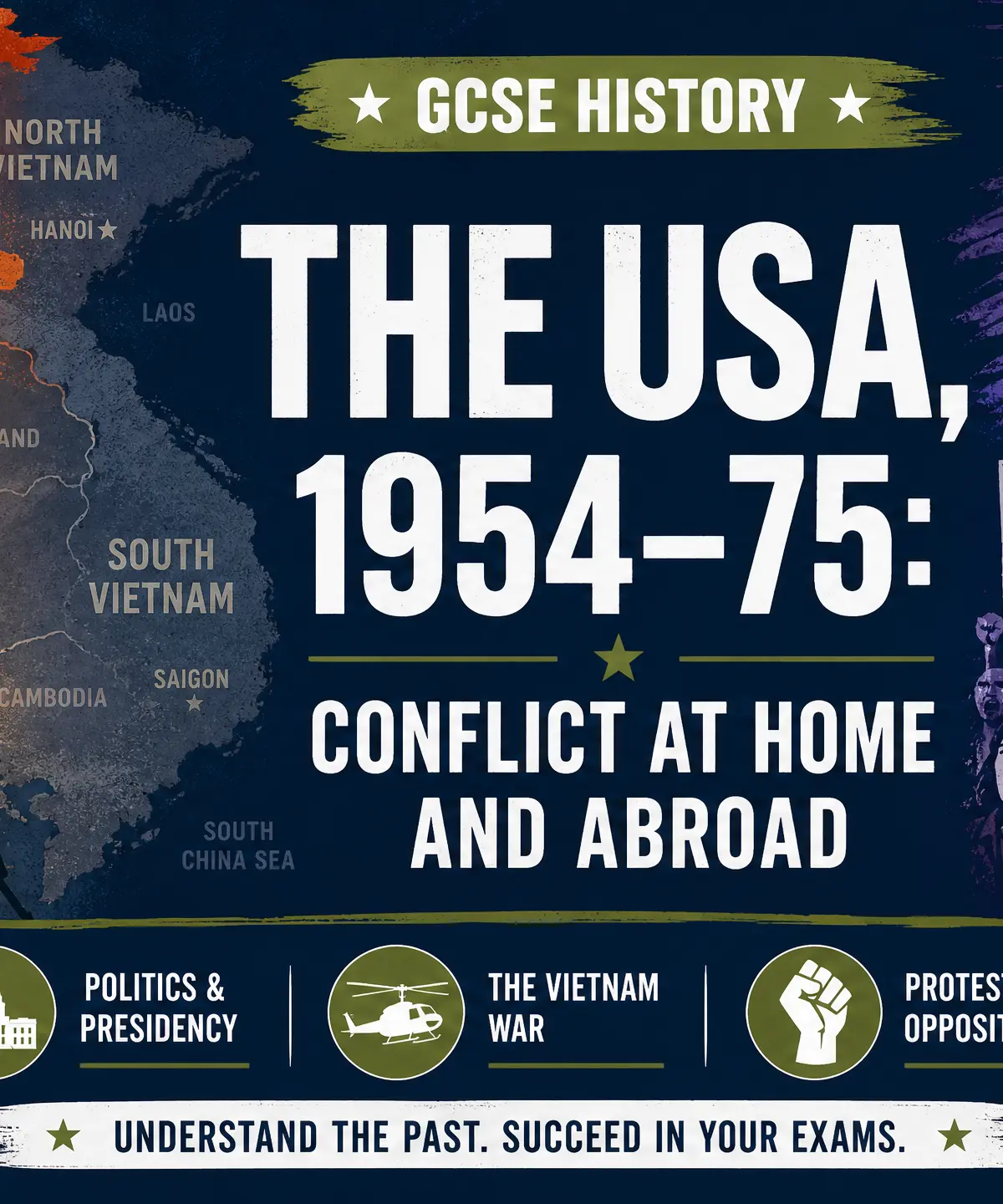
The USA, 1954–75: conflict at home and abroad
This study examines the defining conflict of the Cold War era, where the world's greatest superpower was defeated by a guerrilla army. Understanding the Vietnam War is crucial for examiners because it tests your ability to link military tactics with political decisions and the explosive growth of domestic opposition.
- 9 min read
- 3 worked examples
- 5 practice questions
- 6 key terms
Study Notes
Overview
This topic covers the USA's involvement in Vietnam from 1954 to 1975, a period that fundamentally changed American society and global politics. Examiners expect candidates to understand the chronological escalation under four key presidents (Eisenhower, Kennedy, Johnson, and Nixon) and the contrasting military tactics employed by the US forces and the Vietcong. Crucially, this is a thematic study that requires you to link events abroad with the growing anti-war movement at home. You must be able to evaluate the reasons for ultimate US failure, balancing military, political, and social factors. High-level answers will deploy specific knowledge, such as dates, statistics, and named operations, to support analytical judgements.
Listen to the revision podcast below for a comprehensive overview of the topic:
Key Events & Developments
Escalation under Eisenhower and Kennedy
Date(s): 1954–1963
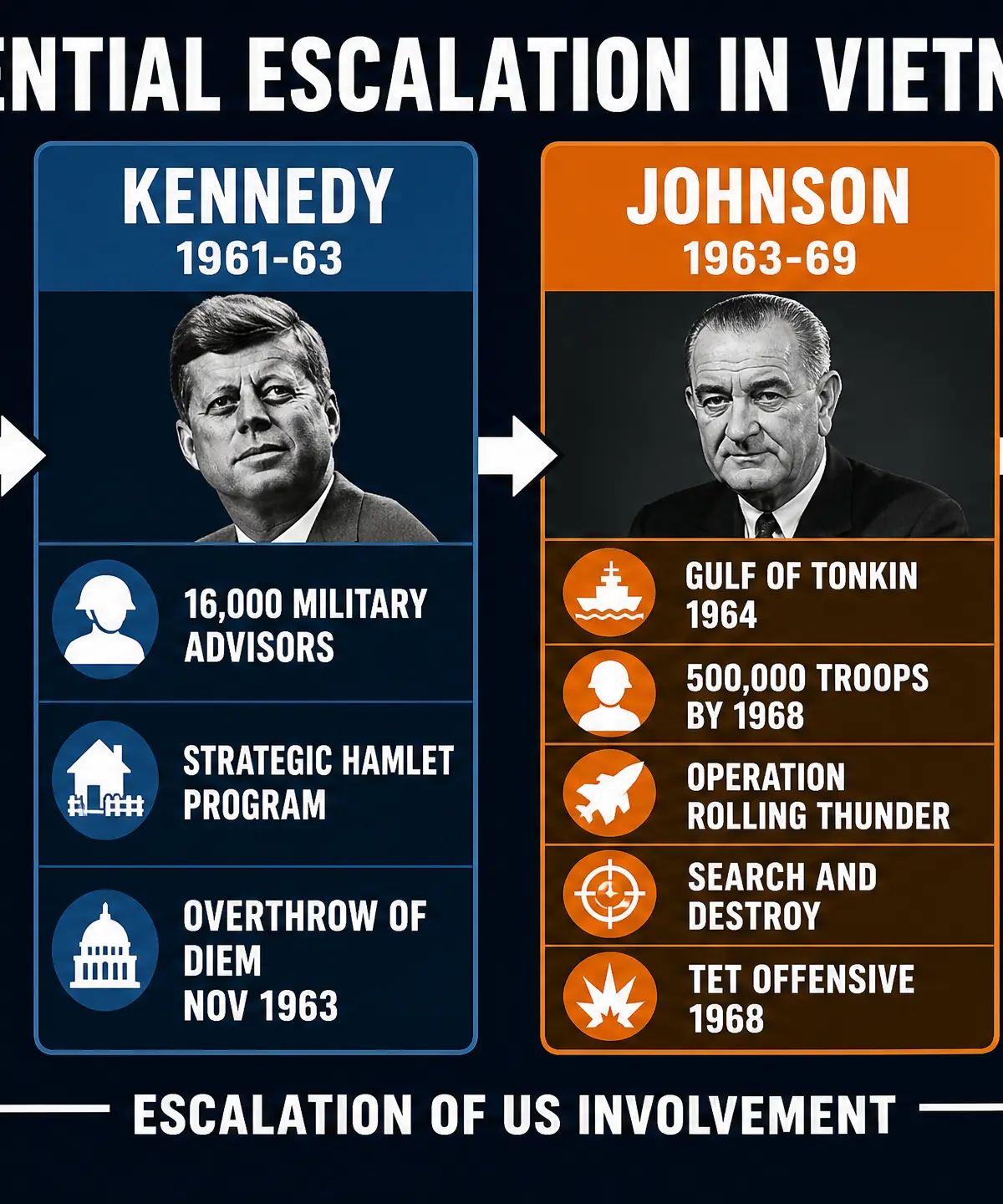
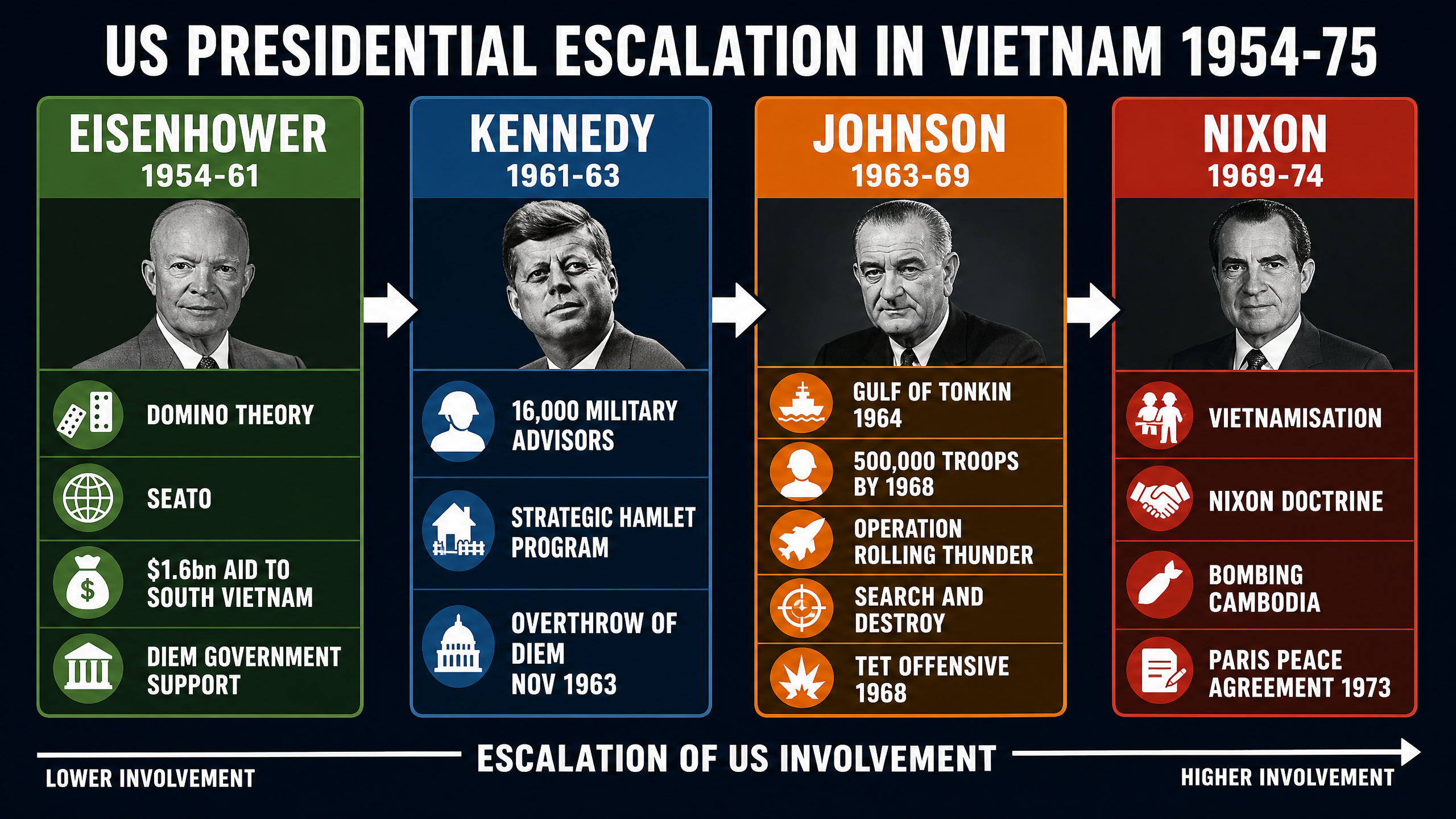
What happened: Following the French defeat at Dien Bien Phu in 1954, Vietnam was divided. President Eisenhower, driven by the Domino Theory, sent $1.6bn in aid and military advisors to support the capitalist South Vietnamese government led by Ngo Dinh Diem. President Kennedy escalated this by increasing advisors to 16,000 and introducing the Strategic Hamlet Program (1962), which forcibly relocated peasants to fortified villages.
Why it matters: This established the foundation of US commitment. The failure of the Strategic Hamlet Program and Diem's corrupt regime alienated the South Vietnamese peasantry, driving them to support the communist Vietcong.
Specific Knowledge: Domino Theory, $1.6bn aid, 16,000 advisors, Strategic Hamlet Program (1962), overthrow of Diem (Nov 1963).
The Gulf of Tonkin and Escalation under Johnson
Date(s): August 1964 – 1968
What happened: Following an alleged attack on the USS Maddox in August 1964, Congress passed the Gulf of Tonkin Resolution, granting President Johnson sweeping powers to escalate the war without a formal declaration. Johnson launched Operation Rolling Thunder (a massive bombing campaign) and committed ground troops, reaching over 500,000 by 1968.
Why it matters: This was the critical turning point from advisory support to full-scale American war. It demonstrated the US reliance on overwhelming firepower, which ultimately proved ineffective against guerrilla tactics.
Specific Knowledge: USS Maddox, Gulf of Tonkin Resolution (1964), Operation Rolling Thunder (1965-68), 500,000 troops by 1968.
US vs Vietcong Tactics
Date(s): 1965–1973
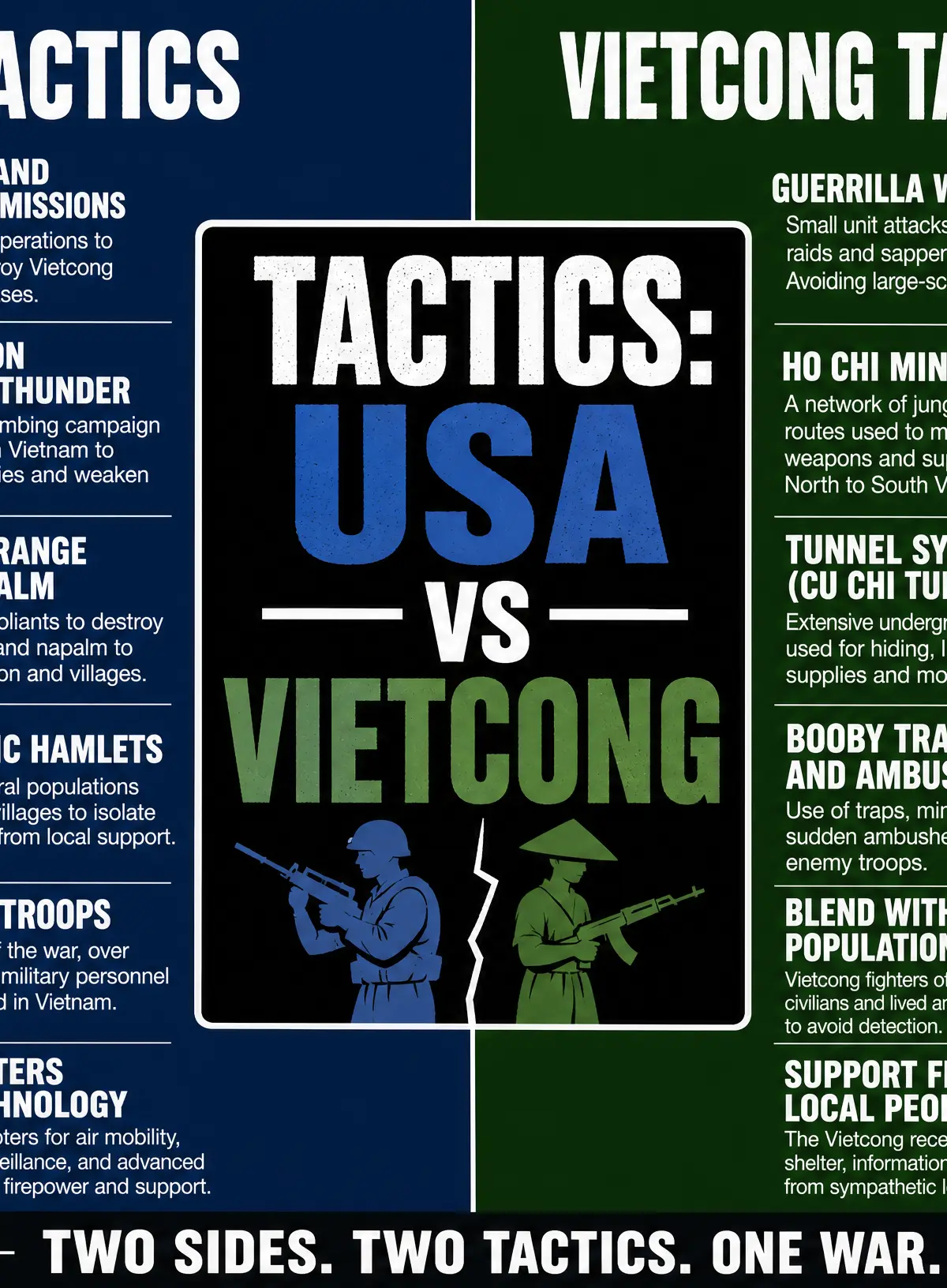
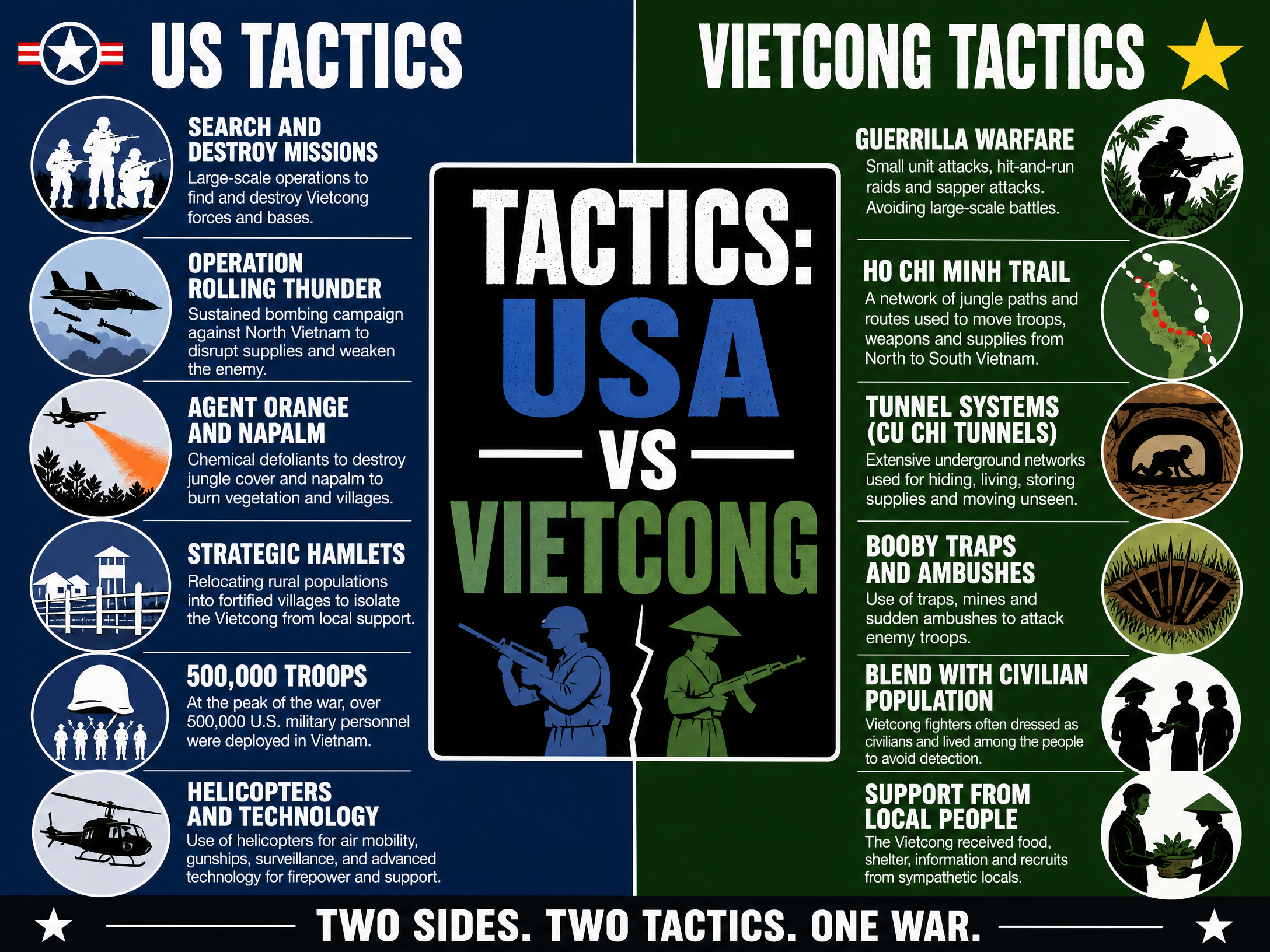
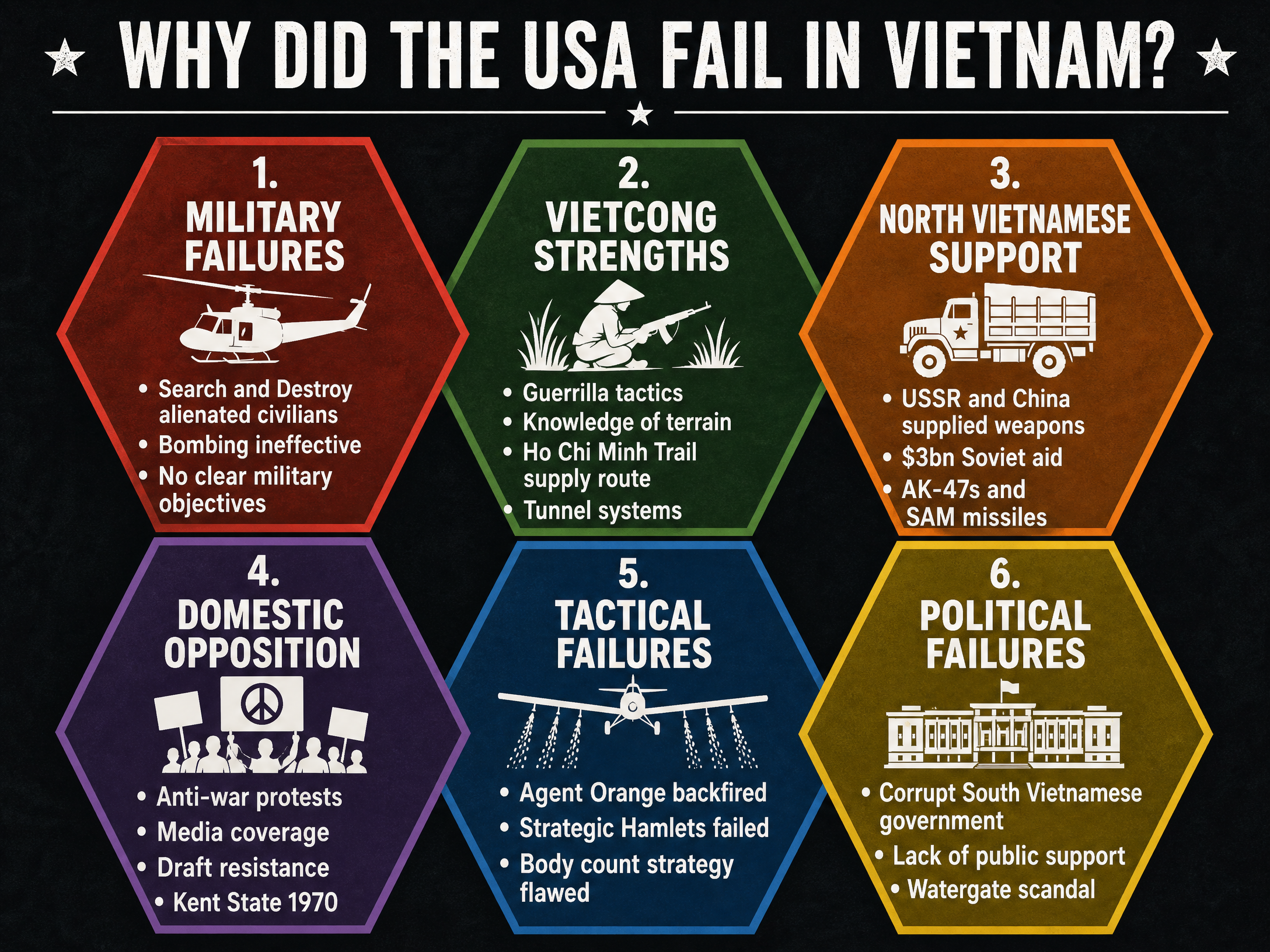
What happened: The USA relied on high-tech warfare: Search and Destroy missions, helicopters, and chemical weapons like Agent Orange and Napalm. In contrast, the Vietcong used guerrilla warfare: blending in with civilians, using the Ho Chi Minh Trail for supplies, building extensive tunnel networks (e.g., Cu Chi tunnels), and deploying booby traps.
Why it matters: The mismatch in tactics explains why the USA failed. US methods alienated the civilian population they were supposed to be protecting, while Vietcong tactics neutralized America's technological advantage.
Specific Knowledge: Search and Destroy, Agent Orange (82 million litres dropped), Napalm, Ho Chi Minh Trail, Cu Chi tunnels.
The Tet Offensive
Date(s): January 1968
What happened: During the Vietnamese New Year (Tet), the Vietcong and North Vietnamese Army launched surprise attacks on over 100 cities and military targets in South Vietnam, including the US Embassy in Saigon.
Why it matters: Although a military defeat for the Vietcong (who suffered heavy losses), it was a massive psychological defeat for the USA. It proved the government had been lying about imminent victory, destroying public trust and leading to Johnson's decision not to seek re-election.
Specific Knowledge: January 1968, 100+ cities attacked, US Embassy breached, Walter Cronkite's critical broadcast.
The Growth of Domestic Opposition
Date(s): 1968–1973
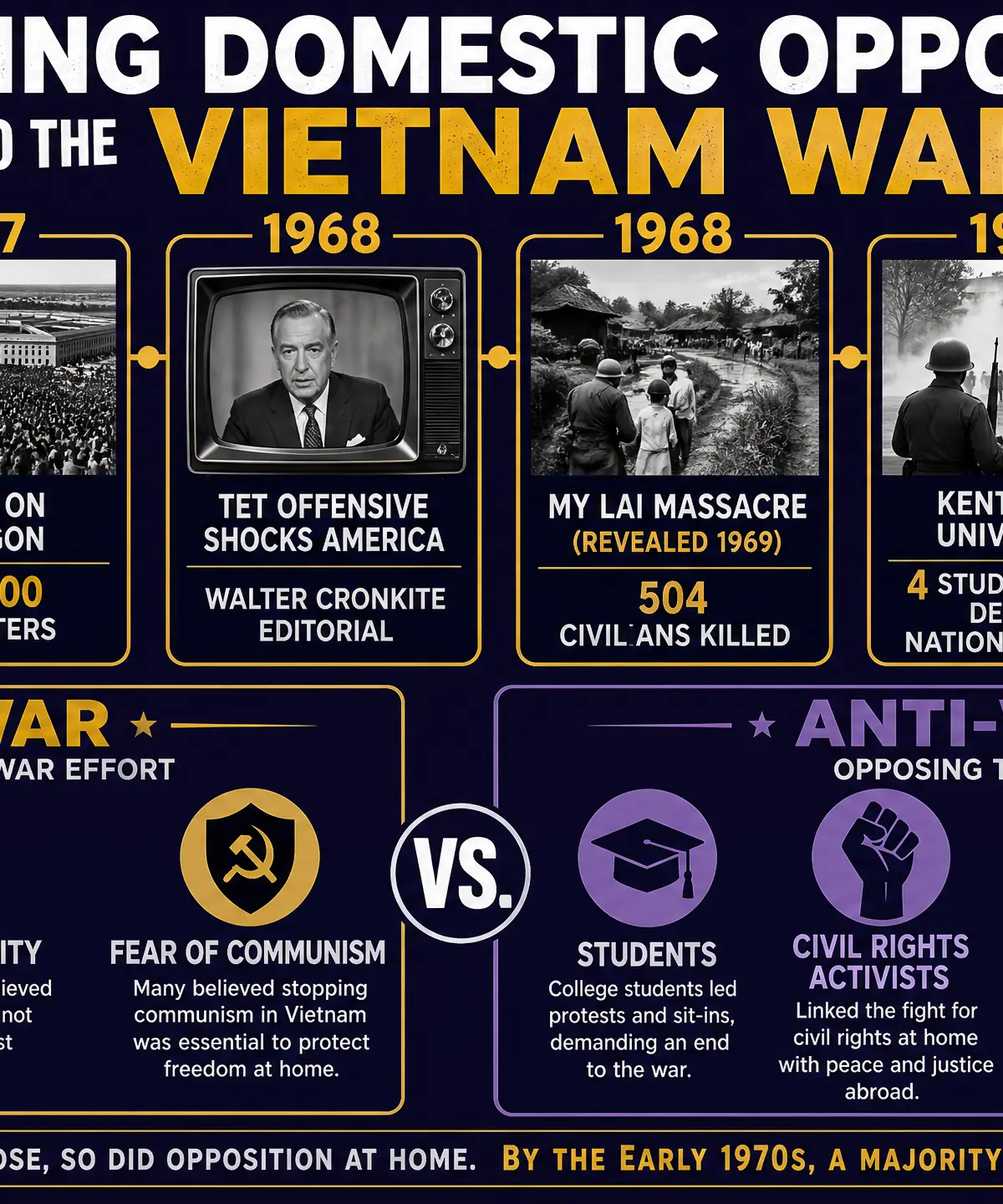
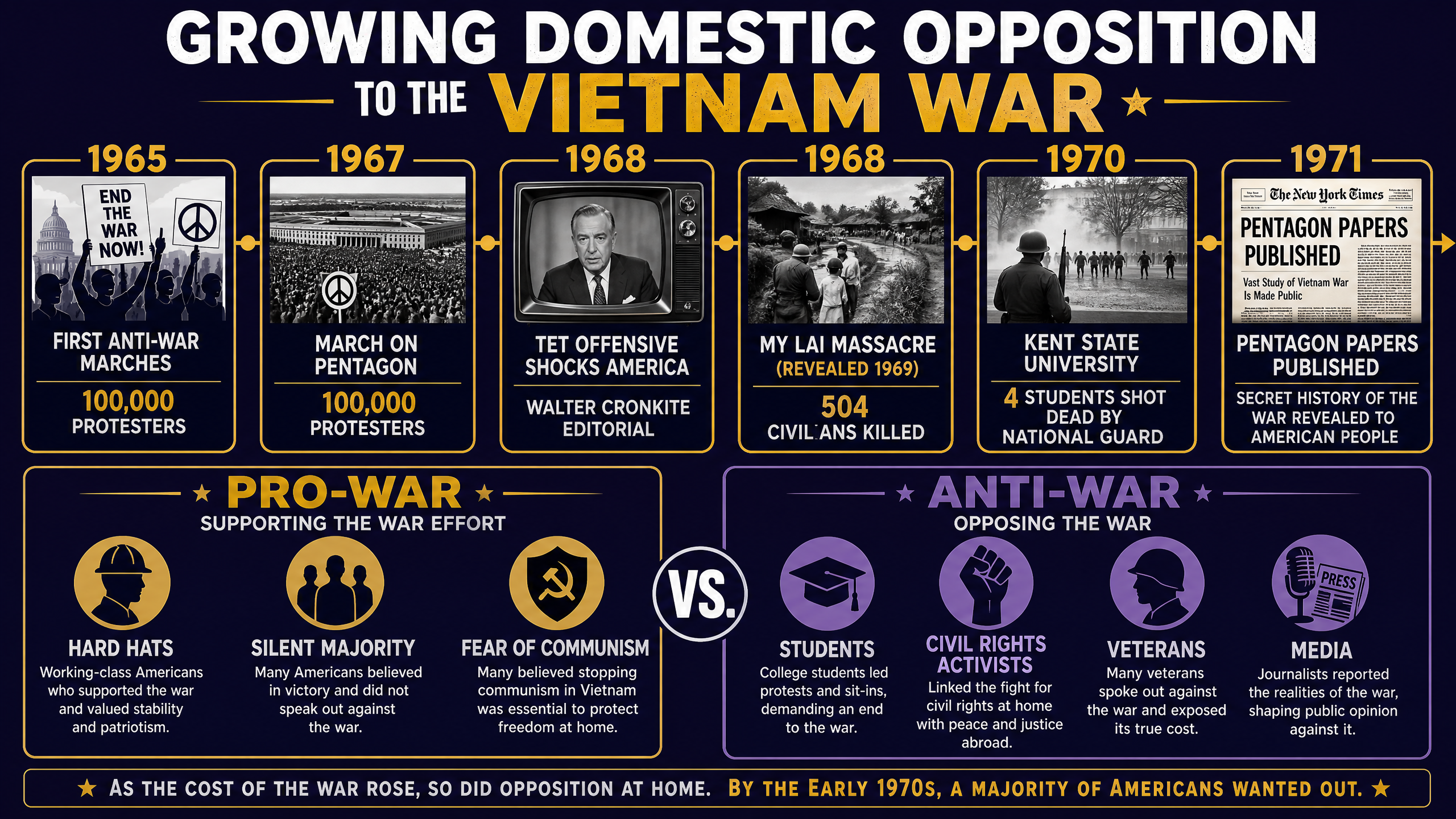
What happened: The war became deeply unpopular at home. Key triggers included the Tet Offensive, the revelation of the My Lai Massacre (where US troops killed 347-504 civilians), the draft system (which disproportionately affected the poor and minorities), and the Kent State University shootings (where National Guardsmen killed 4 student protesters).
Why it matters: Domestic opposition placed unbearable political pressure on the US government to withdraw, proving that wars cannot be won without public support.
Specific Knowledge: My Lai Massacre (March 1968, revealed 1969), Draft burning, Kent State University shootings (May 1970), Pentagon Papers (1971).
Vietnamisation and Withdrawal
Date(s): 1969–1975
What happened: President Nixon introduced 'Vietnamisation' — withdrawing US troops while training the South Vietnamese Army (ARVN) to take over. Concurrently, he secretly bombed Cambodia and Laos to disrupt the Ho Chi Minh Trail. The Paris Peace Agreement was signed in January 1973, leading to US withdrawal. In April 1975, Saigon fell to the communists.
Why it matters: It marked the admission of US failure and the end of the conflict. The fall of Saigon demonstrated that the South Vietnamese government could not survive without US military backing.
Specific Knowledge: Vietnamisation, Nixon Doctrine, Bombing of Cambodia (1970), Paris Peace Agreement (Jan 1973), Fall of Saigon (April 1975).
Key Individuals
Dwight D. Eisenhower
Role: US President (1953-1961)
Key Actions: Coined the 'Domino Theory', provided $1.6bn in financial backing to the French and then to Diem's South Vietnamese government.
Impact: Established the ideological justification for US intervention in Southeast Asia.
John F. Kennedy
Role: US President (1961-1963)
Key Actions: Increased military advisors to 16,000, backed the Strategic Hamlet Program, and tacitly supported the coup against Diem.
Impact: Escalated US involvement from financial aid to active advisory combat roles.
Lyndon B. Johnson
Role: US President (1963-1969)
Key Actions: Used the Gulf of Tonkin incident to secure war powers, launched Operation Rolling Thunder, and deployed 500,000 ground troops.
Impact: Responsible for the massive Americanization of the war, but his presidency was destroyed by the Tet Offensive.
Richard Nixon
Role: US President (1969-1974)
Key Actions: Implemented 'Vietnamisation', secretly bombed Cambodia, and eventually signed the Paris Peace Agreement.
Impact: Ended US involvement in the war, though his expansion into Cambodia triggered massive domestic protests.
Ho Chi Minh
Role: Communist leader of North Vietnam
Key Actions: Led the Vietminh against the French and the Vietcong against the USA. Inspired his followers with a powerful nationalist and communist vision.
Impact: His leadership provided the ideological strength that sustained the North Vietnamese through decades of war.
Second-Order Concepts
Causation
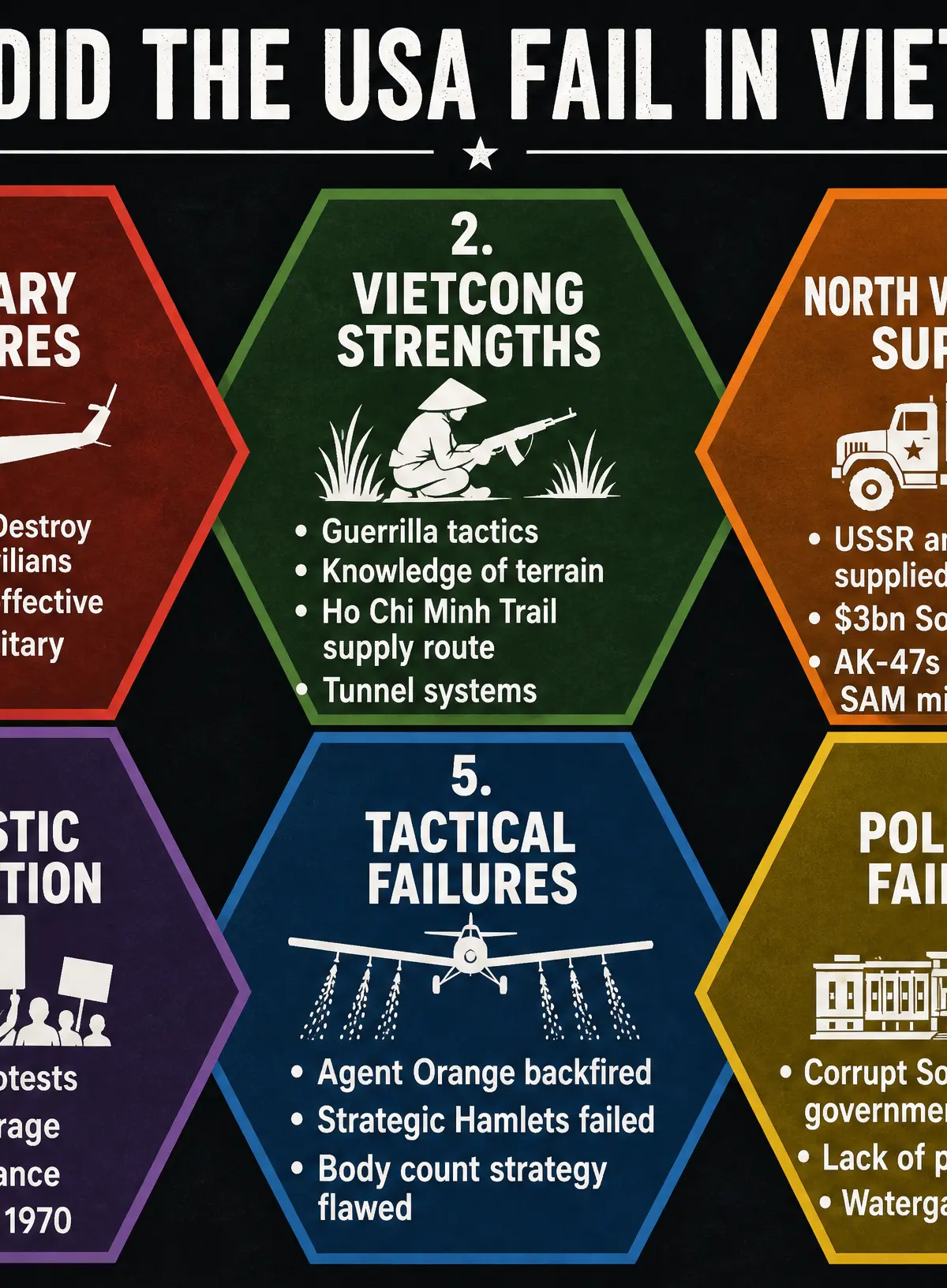
Why did the USA get involved? The long-term cause was the Cold War context and the fear of communism spreading (Domino Theory). The short-term trigger for full-scale war was the Gulf of Tonkin incident. Examiners want to see you link these — ideological fears made the USA overreact to the Tonkin incident.
Consequence
The consequences of the war were devastating. In Vietnam: over 2 million civilian deaths, widespread environmental destruction from Agent Orange, and a reunified communist country. In the USA: 58,000 military deaths, a deeply divided society, a loss of trust in government (exacerbated by the Pentagon Papers and Watergate), and a reluctance to commit troops abroad for decades (the 'Vietnam Syndrome').
Change & Continuity
Notice the change in US tactics over time: from financial aid (Eisenhower), to advisors (Kennedy), to full-scale ground war and bombing (Johnson), to withdrawal and Vietnamisation (Nixon). The continuity was the consistent underestimation of the Vietcong's resolve and the overestimation of US technological superiority.
Significance
The Vietnam War is historically significant because it was the first major defeat for the USA, the first 'televised war' where media played a crucial role in shaping public opinion, and a clear demonstration that military might alone cannot defeat a guerrilla insurgency supported by the local population.
Source Skills
For this topic, you will frequently encounter sources related to domestic opposition (e.g., protest posters, newspaper editorials, photographs like the Napalm Girl or Kent State) and military tactics (e.g., soldiers' letters, government memos).
When evaluating usefulness:
- Content: What does the source show about the reality of the war or public opinion?
- Provenance: A photo by a critical journalist will highlight US failures; a government report may downplay them to maintain morale.
- Context: Use your specific knowledge (e.g., the Tet Offensive) to explain why the source was created at that specific time.
Worked Examples
3 worked examples — open one to explore the question and available guidance.
Practice Questions
Test your understanding — click to reveal model answers
'The main reason for the growth of opposition to the Vietnam War in the USA was the Tet Offensive.' How far do you agree? (16 marks + 4 SPaG)
Hint: You must discuss the Tet Offensive, but also bring in other factors like media coverage, the draft, and specific events like My Lai or Kent State to provide a balanced argument.
Explain the significance of the Gulf of Tonkin incident. (8 marks)
Hint: Focus on how it changed the nature of US involvement from advisory to active combat.
Describe two features of the Vietcong's guerrilla tactics. (4 marks)
Hint: Identify a feature and add a supporting detail for each.
Explain why the Strategic Hamlet Program failed. (8 marks)
Hint: Think about how it affected the South Vietnamese peasants and how the Vietcong exploited it.
How useful is a photograph of the My Lai Massacre for an historian studying US military tactics in Vietnam? (8 marks)
Hint: It's useful for showing the reality of Search and Destroy, but limited because it shows an extreme atrocity rather than everyday combat.
Test your understanding of The USA, 1954–75: conflict at home and abroad
Active recall beats re-reading. Take an instant quiz now to test what you’ve learned and lock it into long-term memory.
7 days Premium · Then free forever · No card, no charge