Pearson Edexcel · GCSE · History
Warfare and British society, c1250–present and London and the Second World War, 1939–45
This thematic study traces the profound impact of warfare on British society from the medieval period to the modern day. By examining pivotal battles like Falkirk and Agincourt alongside the civilian trauma of the London Blitz, candidates will explore how technology, tactics, and social structure evolved in tandem.
- 8 min read
- 3 worked examples
- 5 practice questions
- 6 key terms
Study Notes
Overview
This GCSE History thematic study covers Warfare and British Society from c1250 to the present day, with a special depth study on London and the Second World War (1939–45). The course requires candidates to understand the 'big picture' of how warfare evolved over seven centuries, focusing on the interplay between military technology, tactical developments, and the social fabric of Britain.
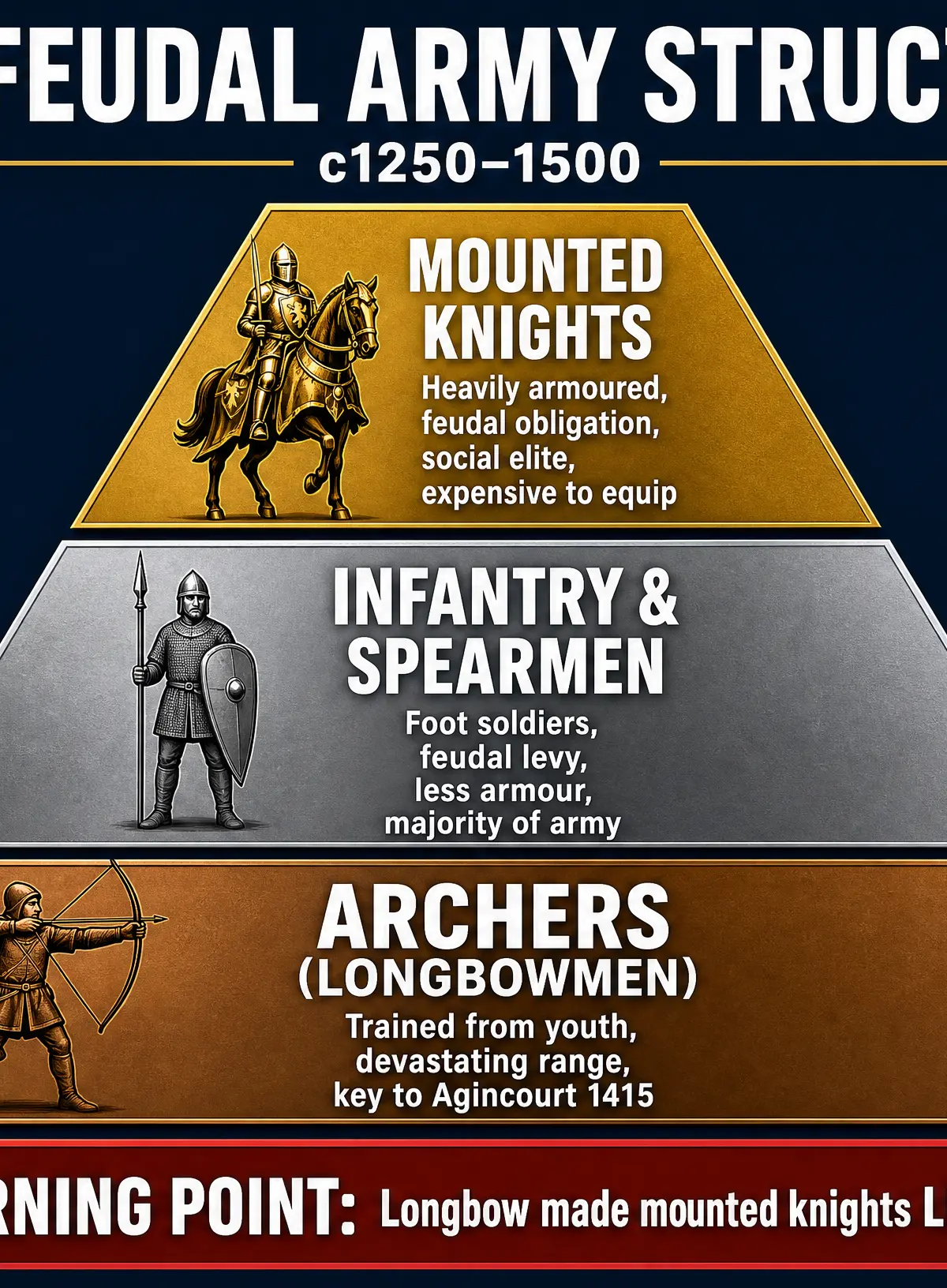
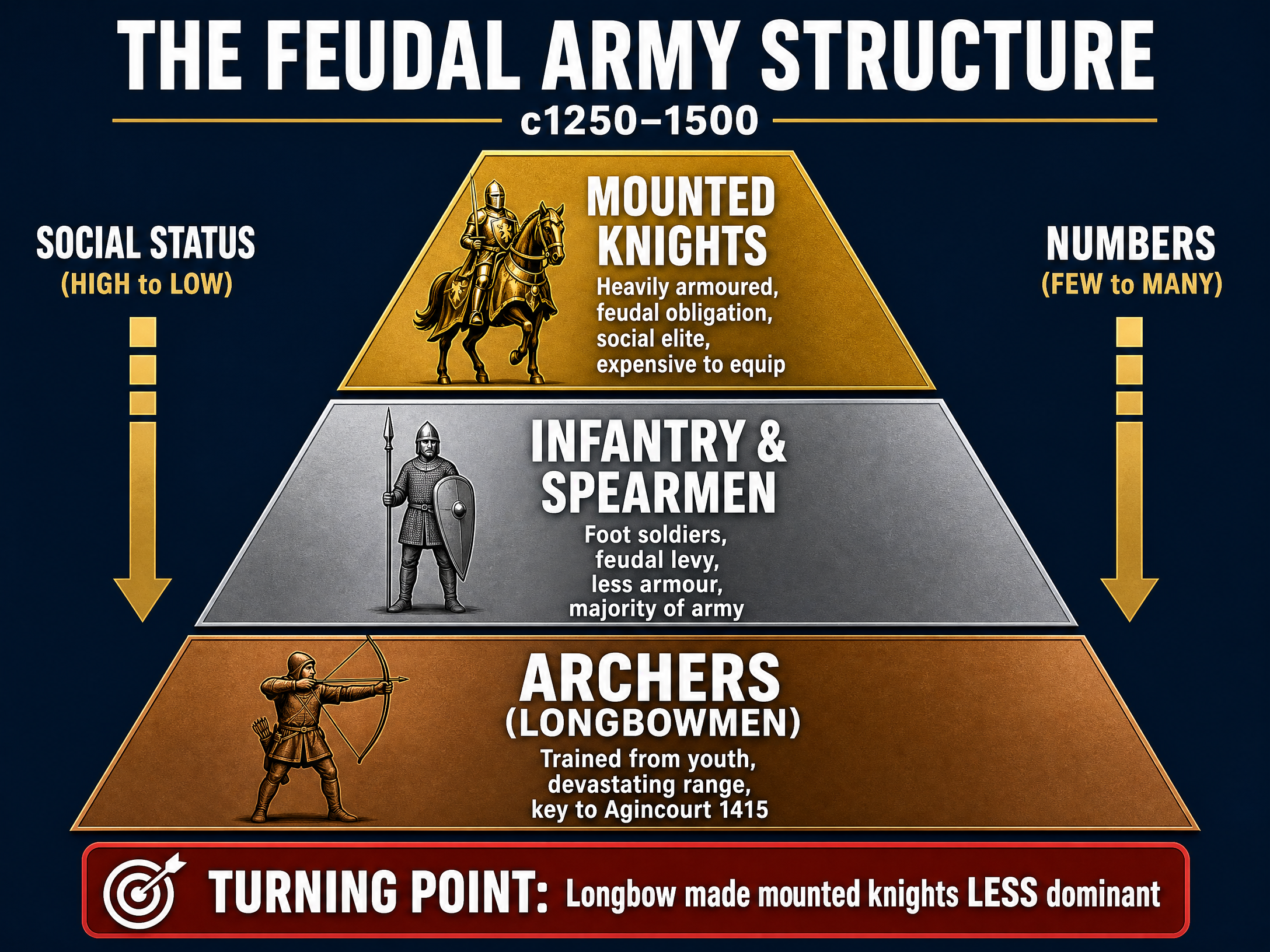
Examiners are not simply looking for narrative accounts of battles; they reward the ability to analyse change and continuity across time. You must be able to explain how the feudal system dictated the composition of medieval armies, how innovations like the longbow challenged the social dominance of the mounted knight, and how the civilian experience of war shifted from the localized impacts of medieval campaigning to the total war and mass destruction of the London Blitz.
This guide provides the core knowledge, specific named examples, and analytical frameworks needed to achieve top marks in both the thematic overview and the depth study.
Key Events & Developments
The Battle of Falkirk
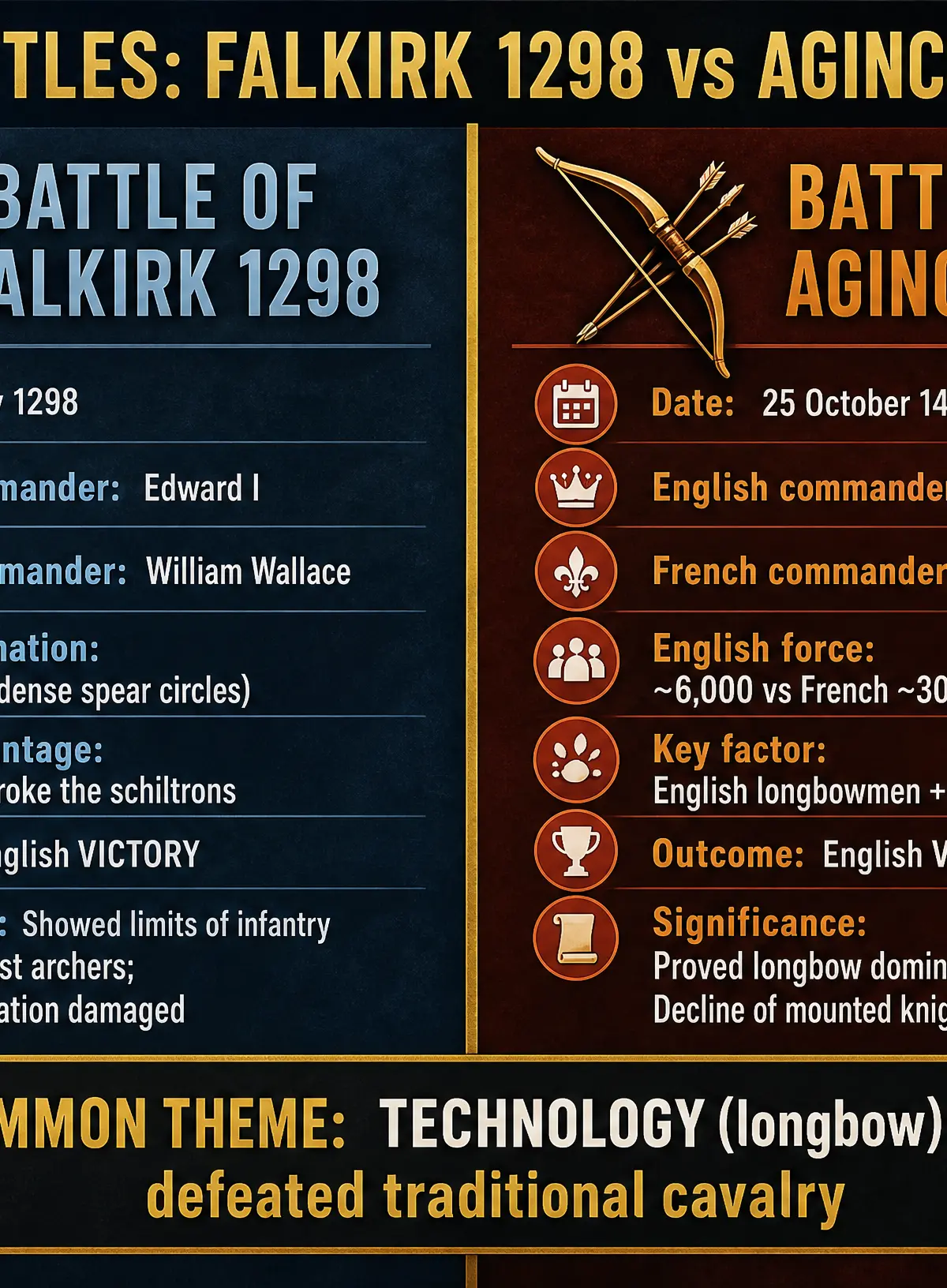
Date(s): 22 July 1298
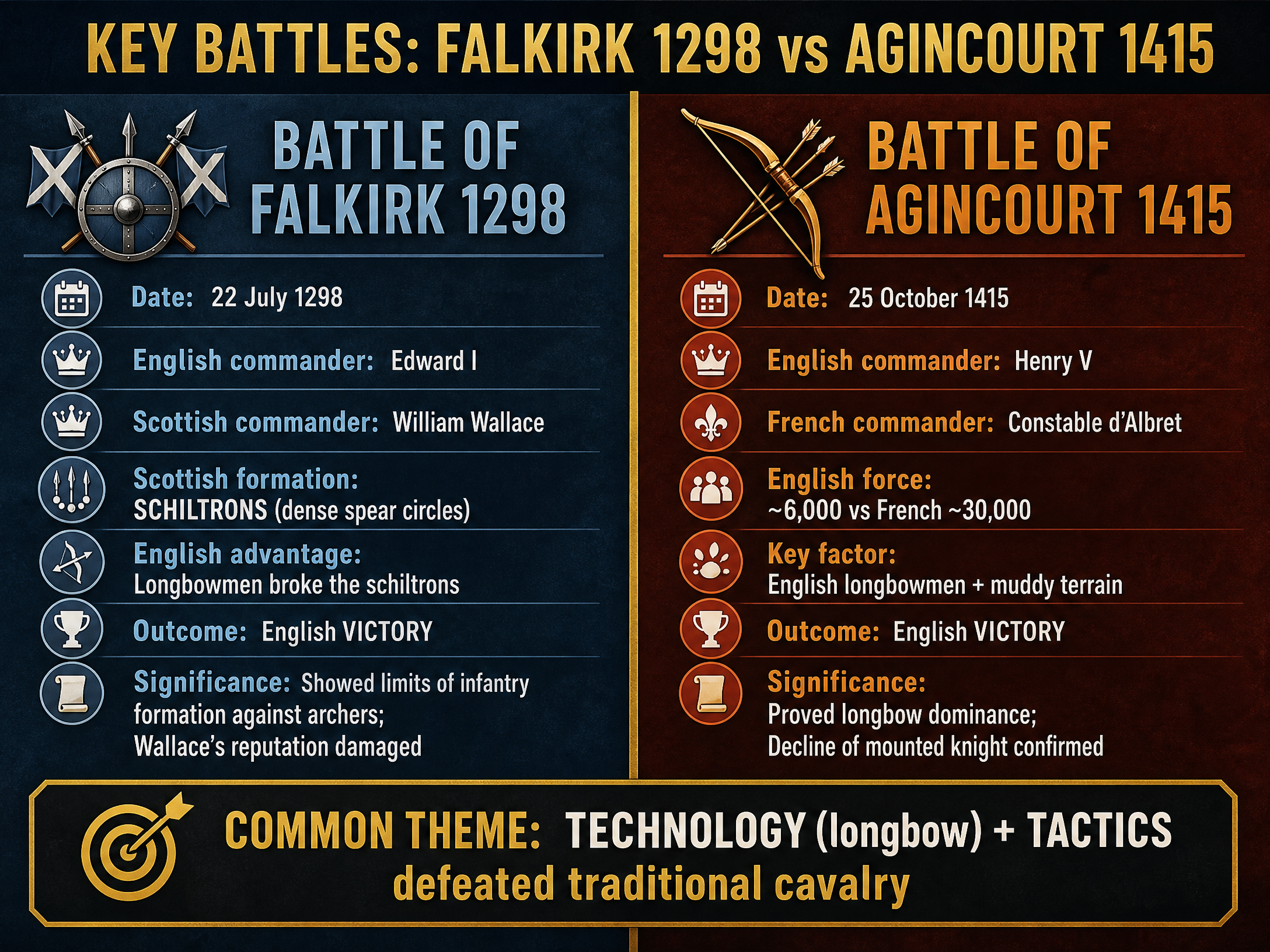
What happened: King Edward I of England defeated the Scottish forces led by William Wallace. The Scottish infantry formed defensive circles called schiltrons (spearmen tightly packed together), which successfully repelled the English cavalry. However, Edward deployed his Welsh and English longbowmen, whose sustained arrow fire broke the schiltrons, allowing the English cavalry to charge and secure a decisive victory.
Why it matters: Falkirk is a crucial example of change in military tactics. It demonstrated that disciplined infantry formations could stop heavy cavalry, but more importantly, it proved the devastating power of the longbow when used in a coordinated tactical manner. It marked the beginning of the decline of the mounted knight's absolute dominance.
Specific Knowledge: Edward I (commander), William Wallace (Scottish commander), Schiltrons (spear formations), Longbowmen.
The Battle of Agincourt
Date(s): 25 October 1415
What happened: During the Hundred Years' War, a small, exhausted English army (~6,000 men) commanded by Henry V decisively defeated a much larger French force (~30,000 men). Henry chose a narrow battlefield flanked by woods, funneling the French advance. Heavy rain had turned the ground to thick mud. The French cavalry charge bogged down, and the English longbowmen, positioned on the flanks, fired at close range into the tightly packed French ranks, causing massive casualties.
Why it matters: Agincourt is the ultimate proof of the longbow's superiority and the vulnerability of the heavily armoured mounted knight. It highlights the importance of terrain and tactics over sheer numbers, and serves as a key turning point in the thematic study of medieval warfare.
Specific Knowledge: Henry V, Constable d'Albret (French commander), ~6,000 English vs ~30,000 French, mud/terrain, flanking archers.
The London Blitz
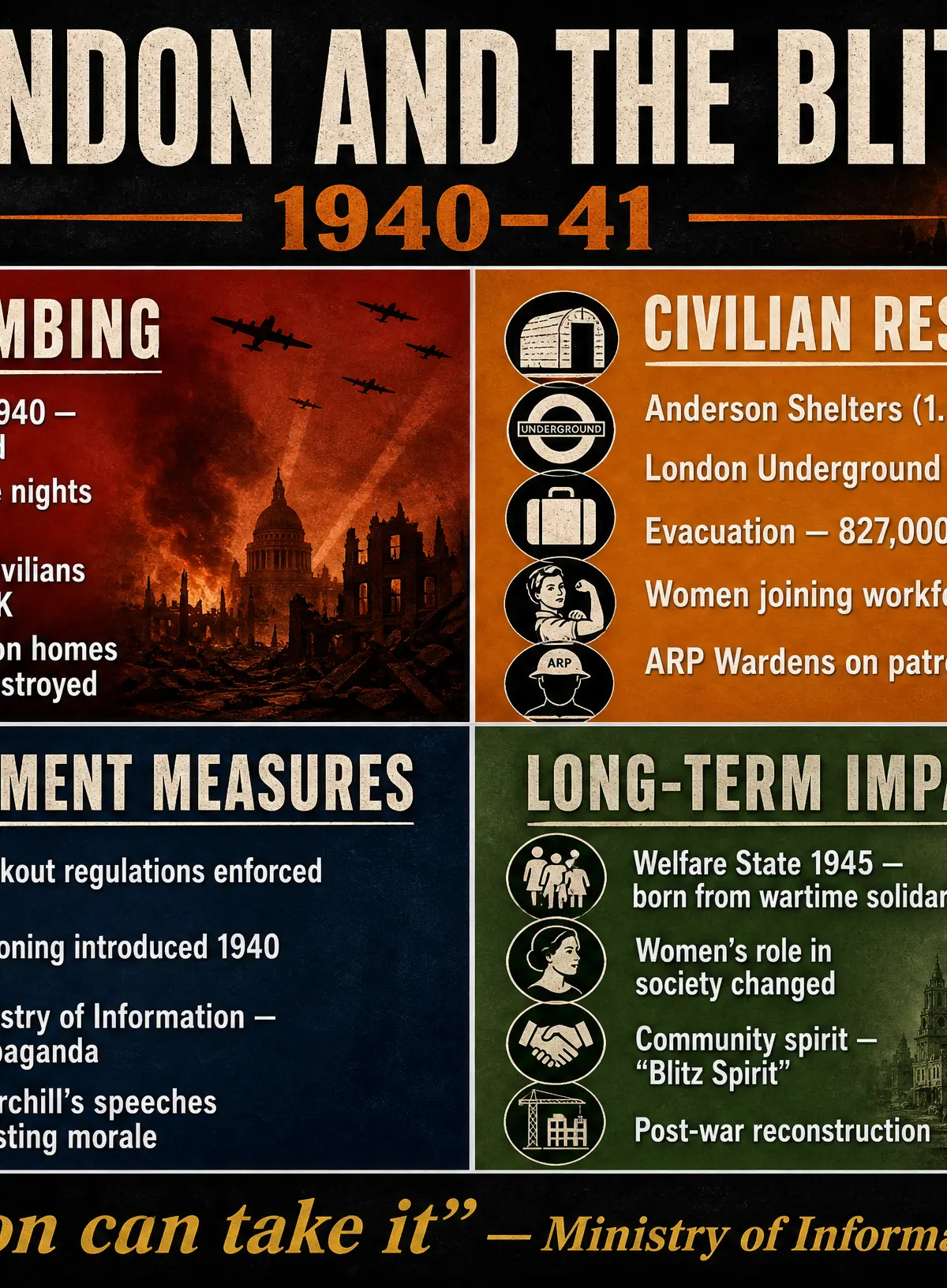
Date(s): 7 September 1940 – 11 May 1941
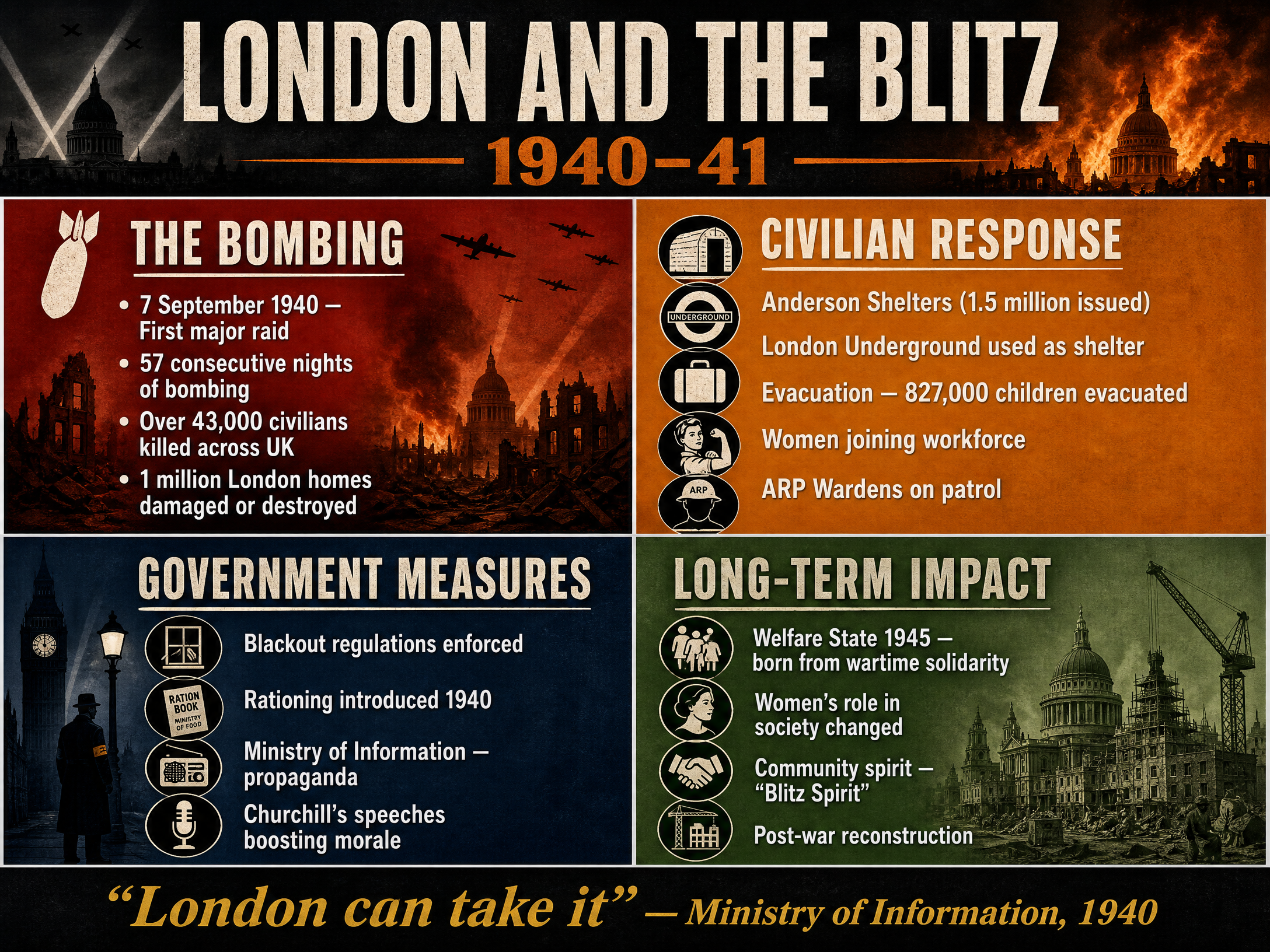
What happened: Following the Battle of Britain, the German Luftwaffe shifted its strategy to the strategic bombing of British cities, primarily London. The Blitz began with 57 consecutive nights of bombing. The aim was to destroy industry, terrorize the civilian population, and force a British surrender.
Why it matters: The Blitz represents the terrifying reality of total war, where civilians became the primary target. It is significant for its profound social impact: rather than breaking morale, it fostered the 'Blitz Spirit', led to massive government intervention in civilian life (evacuation, rationing, shelters), and laid the psychological groundwork for the post-war Welfare State.
Specific Knowledge: 57 consecutive nights, over 43,000 civilian deaths across the UK, 1 million London homes damaged/destroyed, Anderson shelters (1.5 million issued), 827,000 children evacuated.
Key Individuals
King Edward I ('Longshanks')
Role: King of England (1272–1307) and military commander.
Key Actions: Led the English army at the Battle of Falkirk (1298). He successfully integrated longbowmen with cavalry to break the Scottish schiltrons.
Impact: Demonstrated the tactical necessity of combined arms (archers and cavalry working together) and proved the devastating potential of the longbow.
King Henry V
Role: King of England (1413–1422) and military commander.
Key Actions: Commanded the English forces at Agincourt (1415). He expertly utilized terrain (a narrow muddy field) and deployed his longbowmen to devastating effect against a numerically superior French force.
Impact: Secured one of England's most famous military victories, cementing the tactical dominance of the longbow and the decline of the traditional mounted knight.
Winston Churchill
Role: Prime Minister of the United Kingdom (1940–1945).
Key Actions: Led Britain during the Second World War and the Blitz. Delivered powerful, morale-boosting speeches and frequently visited bombed areas of London.
Impact: Crucial in maintaining civilian morale and the 'Blitz Spirit'. His leadership style and use of rhetoric are key examples of government action to sustain the war effort on the home front.
Second-Order Concepts
Causation
Examiners expect candidates to explain why military changes occurred. For example, the decline of the mounted knight was caused by multiple factors: the tactical vulnerability exposed by the longbow (Falkirk, Agincourt), the increasing cost of armour and horses, and later, the introduction of gunpowder weapons. The Blitz was caused by the Luftwaffe's failure to destroy the RAF during the Battle of Britain, leading to a shift toward terror bombing.
Consequence
The consequences of warfare extend far beyond the battlefield. The medieval feudal levy system meant that agricultural production suffered when peasants were called to fight. The consequence of the Blitz was a massive shift in government policy: the state took unprecedented control over civilian lives (rationing, evacuation, conscription of women), which ultimately led to the creation of the Welfare State in 1945.
Change & Continuity
This is the core of the thematic study.
- Change: The shift from feudal armies based on social obligation to professional standing armies; the evolution of weaponry from swords/bows to gunpowder, and eventually to aerial bombardment and drones.
- Continuity: The enduring importance of logistics (supplying an army), the role of terrain in deciding battles, and the fact that war always brings suffering and disruption to civilian populations.
Significance
Significance is about why an event matters historically. Agincourt is significant because it shattered the myth of knightly invincibility. The Blitz is significant because it redefined the relationship between the British government and its citizens, proving that civilian morale was as crucial as military strength in modern 'total war'.
Source Skills
For the depth study on London and WW2, you will face source analysis questions (AO3). You must evaluate sources using the following framework:
- Content: What does the source actually say or show? Use specific quotes or visual details.
- Provenance: Who created it? When? Why? (Purpose). A Ministry of Information poster from 1940 has the purpose of boosting morale, making it useful for understanding government propaganda, but limited for understanding the true terror of the bombing.
- Context: Apply your specific knowledge. If a source shows smiling people in an Underground shelter, use your knowledge to explain that while the 'Blitz Spirit' existed, the reality was often cold, damp, and terrifying.
- Judgement: Conclude on the overall usefulness of the source for the specific enquiry in the question.
Podcast Revision Episode
Listen to the comprehensive 13-minute revision podcast covering the core concepts of this study guide, including the feudal army, key battles, the London Blitz, and essential exam technique.
Worked Examples
3 worked examples — open one to explore the question and available guidance.
Practice Questions
Test your understanding — click to reveal model answers
Explain the significance of the longbow in medieval warfare. (8 marks)
Hint: Don't just describe what a longbow is. Explain *why it mattered*—how did it change tactics, and how did it affect the social status of knights?
How far do you agree that the London Blitz was a period of unbroken 'Blitz Spirit' and high civilian morale? (16 marks)
Hint: You must provide a balanced argument. Discuss evidence of resilience, but also discuss the reality of fear, exhaustion, and government censorship.
Explain why Edward I won the Battle of Falkirk in 1298. (12 marks)
Hint: Discuss multiple factors: English tactics (longbows), Scottish vulnerabilities (static schiltrons), and Edward's leadership.
Describe two features of the Anderson shelter. (4 marks)
Hint: Identify a feature, then add a specific detail to 'develop' it.
Explain the impact of the Blitz on the role of women in British society. (8 marks)
Hint: Think about employment, the armed forces (auxiliary roles), and changing social expectations.
Test your understanding of Warfare and British society, c1250–present and London and the Second World War, 1939–45
Active recall beats re-reading. Take an instant quiz now to test what you’ve learned and lock it into long-term memory.
7 days Premium · Then free forever · No card, no charge