Pearson Edexcel · GCSE · History
Weimar and Nazi Germany, 1918–39
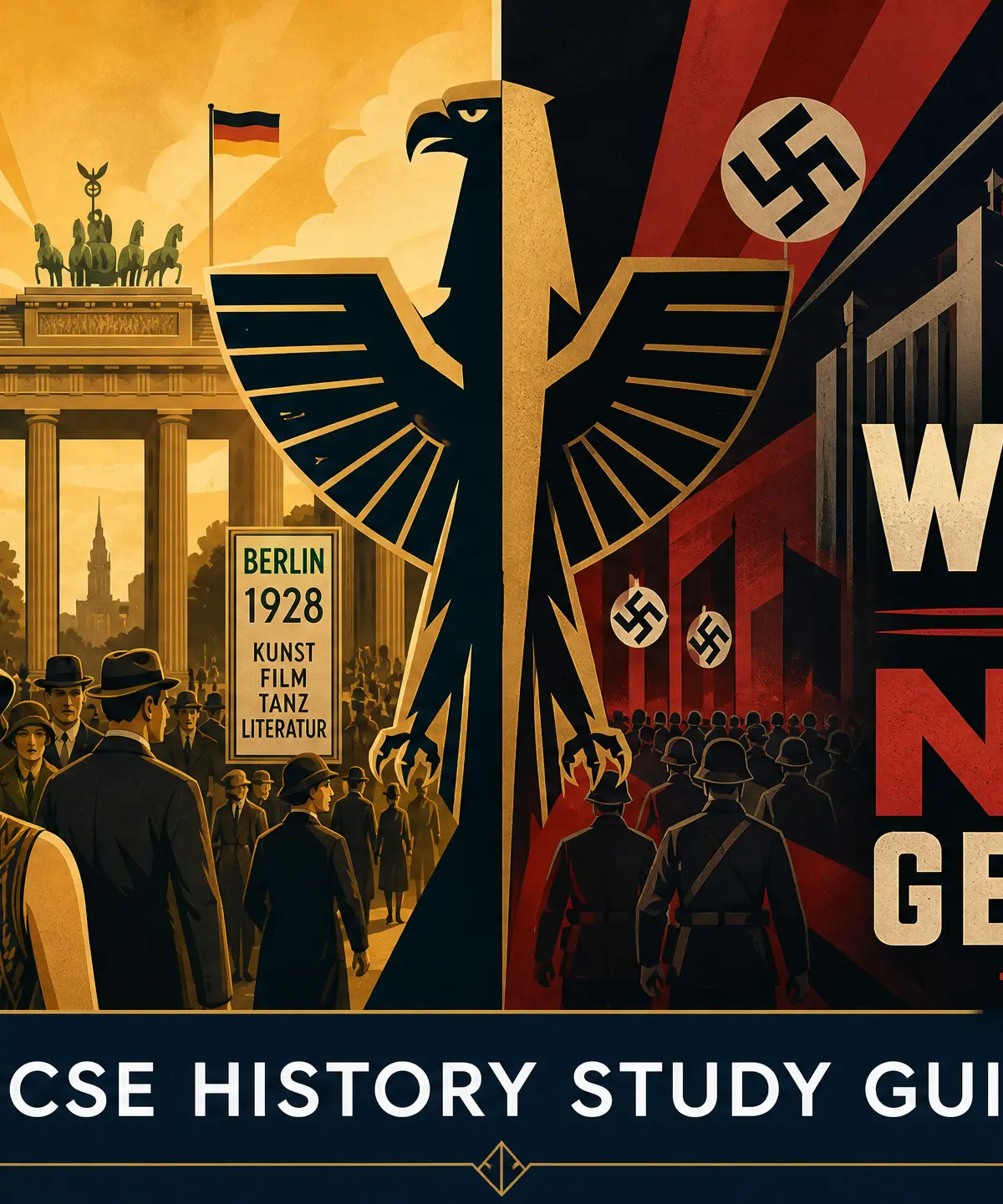
Master the origins, crises, and golden years of the Weimar Republic (1918–1929) with this comprehensive study guide. Designed for GCSE History, this guide unpacks the political, economic, and social forces that shaped interwar Germany and set the stage for the rise of extremism.
- 7 min read
- 3 worked examples
- 5 practice questions
- 6 key terms
Study Notes
Overview
The period from 1918 to 1929 was a defining era for Germany, marked by the traumatic end of the First World War and the birth of its first democracy: the Weimar Republic. This topic is essential for GCSE History candidates as it requires you to understand how a nation transitions from an empire to a democracy under immense pressure. Examiners expect you to trace the cause-and-effect relationship between economic crises (like the 1923 hyperinflation) and political instability (such as the Spartacist Revolt and the Munich Putsch). You must also evaluate the 'Golden Years' under Stresemann, balancing the cultural and economic achievements against the underlying structural weaknesses of the Republic. Precise knowledge of dates, key figures, and specific constitutional features (like Article 48 and proportional representation) is critical for securing top marks.
Key Events & Developments
The Birth of the Republic and the Armistice
Date(s): 9–11 November 1918
What happened: Facing military defeat and domestic revolution, Kaiser Wilhelm II abdicated on 9 November 1918. A new provisional government, led by Friedrich Ebert, was formed. On 11 November, this government signed the armistice, ending the First World War.
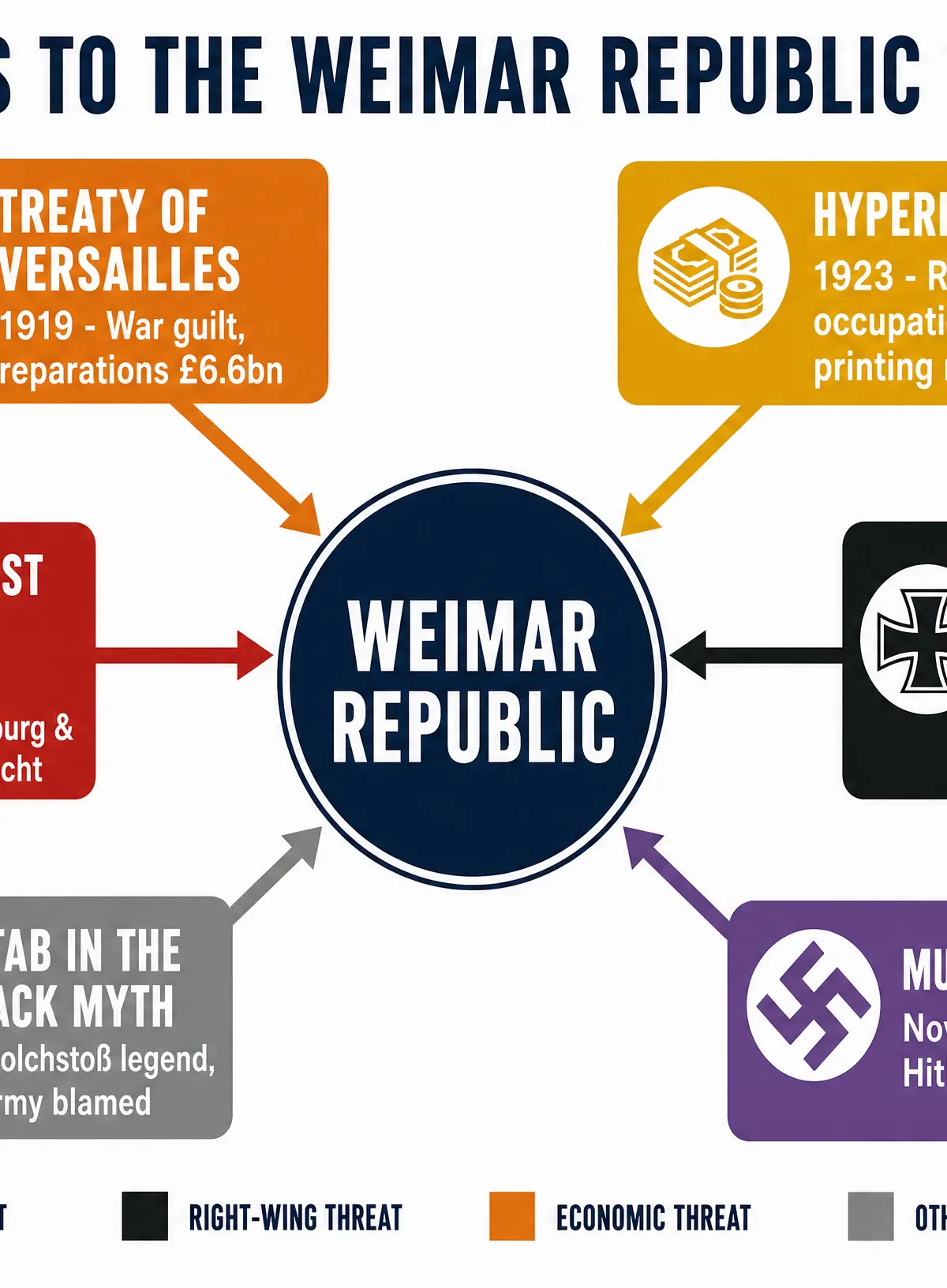
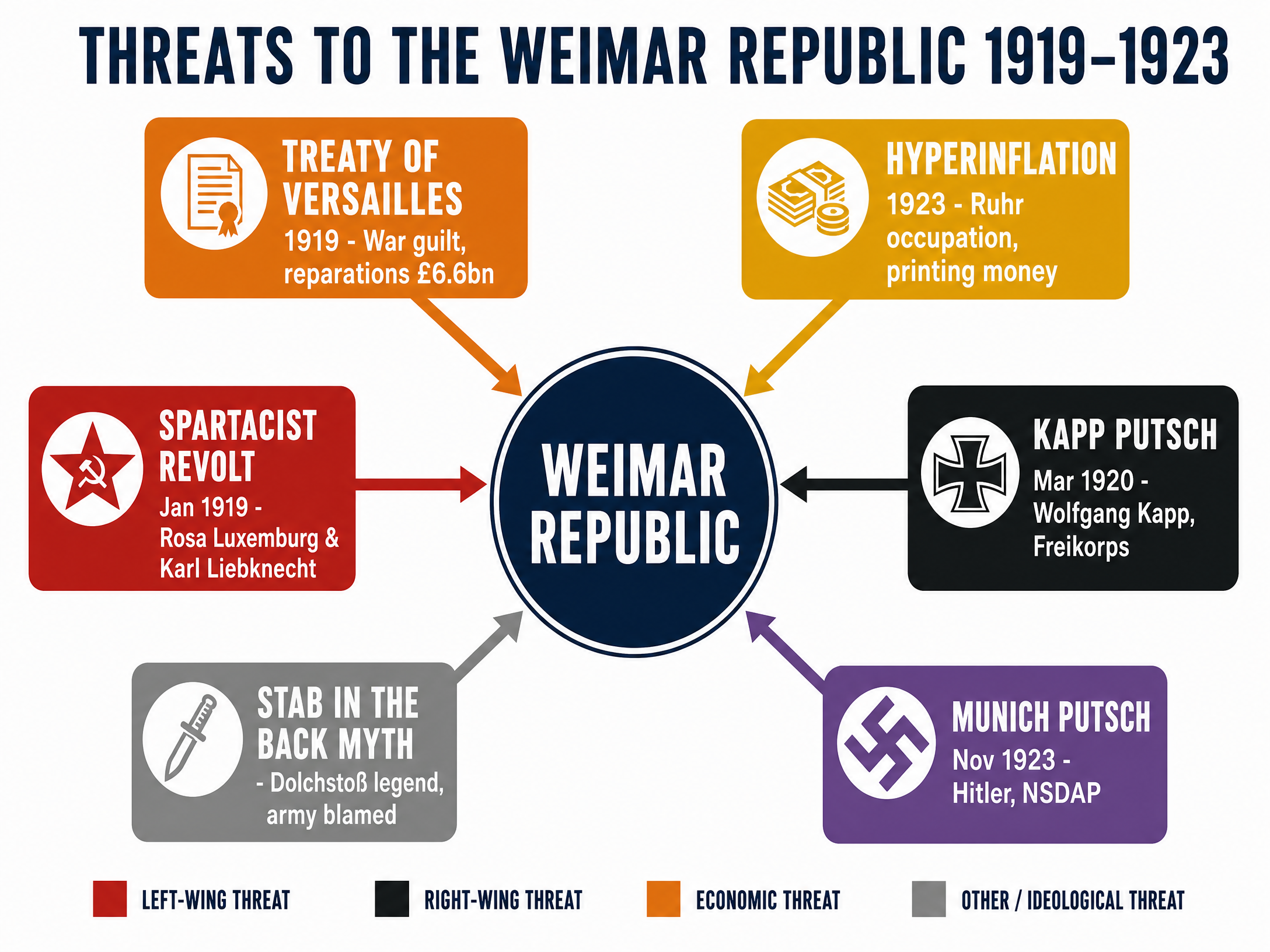
Why it matters: The new democratic government was immediately associated with defeat and surrender. This gave rise to the Dolchstoßlegende (stab-in-the-back myth), which right-wing nationalists used to undermine the Republic's legitimacy from day one.
Specific Knowledge: Kaiser Wilhelm II, Friedrich Ebert, 11 November 1918 (Armistice), Dolchstoßlegende.
The Treaty of Versailles
Date(s): 28 June 1919
What happened: Germany was forced to sign a punitive peace treaty by the Allied powers. The terms were non-negotiable (a Diktat).
Why it matters: The treaty devastated Germany economically and territorially, and caused deep national humiliation. It became a unifying grievance for extremist parties, particularly the Nazis, who promised to tear it up.
Specific Knowledge: Article 231 (War Guilt Clause), £6.6 billion (132 billion gold marks) in reparations, loss of 13% of territory (e.g., Alsace-Lorraine, Polish Corridor), army limited to 100,000 men.
Early Political Challenges: Left and Right
Date(s): January 1919 (Spartacist Revolt) and March 1920 (Kapp Putsch)
What happened: The Republic faced armed uprisings. From the left, the Spartacists (communists) attempted a revolution in Berlin, which was crushed by the Freikorps (right-wing paramilitaries). From the right, Wolfgang Kapp and the Freikorps attempted a coup, which was only defeated by a workers' general strike.
Why it matters: These events demonstrated the extreme fragility of the new government, which had to rely on unreliable paramilitaries to survive, highlighting the deep political divisions in German society.
Specific Knowledge: Rosa Luxemburg and Karl Liebknecht (Spartacist leaders), Wolfgang Kapp, Freikorps, Reichswehr (regular army).
The Crisis of 1923: Ruhr Occupation and Hyperinflation
Date(s): January–November 1923
What happened: When Germany defaulted on reparations, French and Belgian troops occupied the industrial Ruhr region. The German government ordered 'passive resistance' (strikes) and printed money to pay the workers, leading to hyperinflation.
Why it matters: The currency became worthless, wiping out middle-class savings and destroying trust in the Weimar government. It created the chaotic environment in which Hitler launched the Munich Putsch.
Specific Knowledge: Passive resistance, hyperinflation (a loaf of bread cost 200 billion marks by Nov 1923).
The Golden Years and Stresemann's Recovery
Date(s): 1924–1929
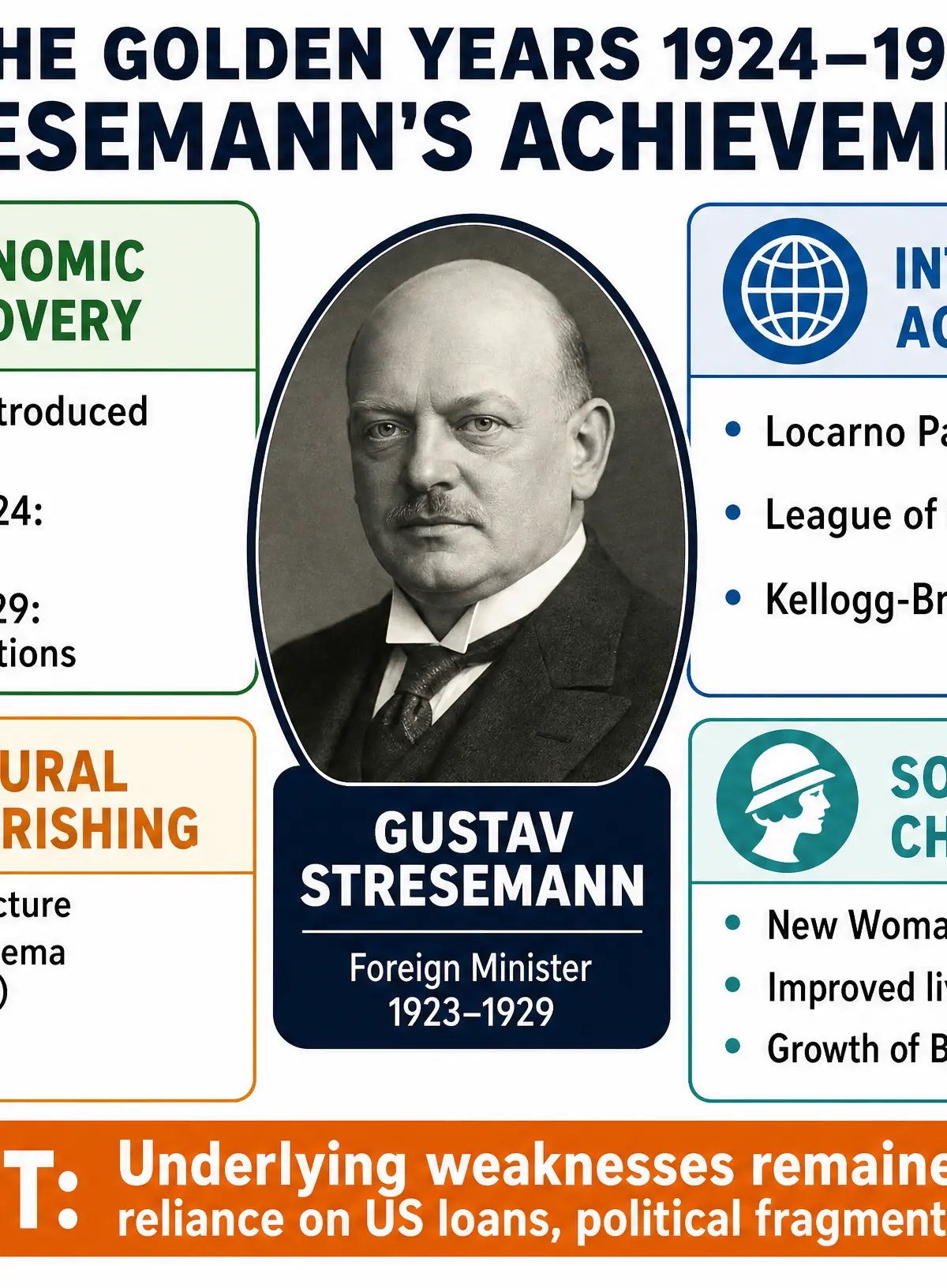
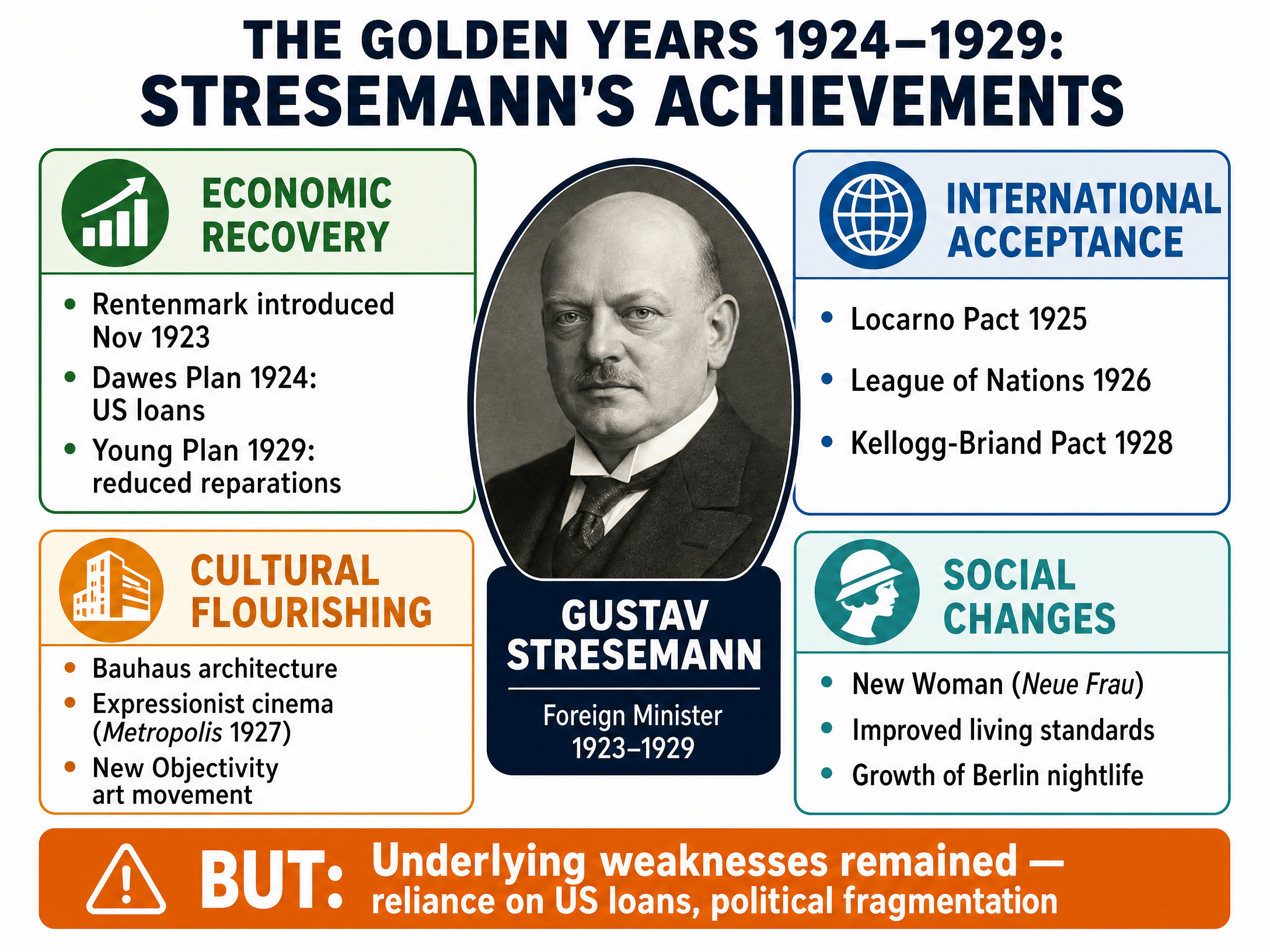
What happened: Gustav Stresemann stabilised the economy with a new currency (the Rentenmark) and secured US loans through the Dawes Plan (1924). Germany re-entered the international community (Locarno Pact 1925, League of Nations 1926).
Why it matters: This period saw significant economic recovery, political stabilization, and a cultural renaissance in Berlin. However, the recovery was dangerously dependent on short-term US loans.
Specific Knowledge: Gustav Stresemann, Rentenmark, Dawes Plan (1924), Young Plan (1929), Locarno Pact (1925), League of Nations (1926).
Key Individuals
Friedrich Ebert
Role: First President of the Weimar Republic (1919–1925).
Key Actions: Led the provisional government, signed the armistice, and used the Freikorps to crush the Spartacist Revolt.
Impact: Established the Republic but alienated the political left by using right-wing forces against them.
Gustav Stresemann
Role: Chancellor (briefly in 1923) and Foreign Minister (1923–1929).
Key Actions: Ended passive resistance, introduced the Rentenmark, negotiated the Dawes and Young Plans, and signed the Locarno Pact.
Impact: He was the architect of Weimar's 'Golden Years', restoring Germany's economic stability and international standing.
Rosa Luxemburg & Karl Liebknecht
Role: Leaders of the Spartacist League (German Communist Party).
Key Actions: Led the January 1919 uprising in Berlin to establish a Soviet-style state.
Impact: Their murder by the Freikorps created a permanent, bitter divide between the moderate socialists (SPD) and the communists (KPD), weakening the left against the later rise of fascism.
Second-Order Concepts
Causation
Examiners want to see you link long-term causes (like the flawed constitution) with short-term triggers (like the French occupation of the Ruhr). For example, hyperinflation wasn't just caused by printing money; it was rooted in the massive reparations burden of the Treaty of Versailles.
Consequence
The consequences of the 1923 crisis were profound. While Stresemann fixed the immediate economic issue, the psychological consequence—the middle class losing their life savings—permanently damaged their trust in democratic government, making them susceptible to extremist appeals later on.
Change & Continuity
Between 1918 and 1929, Germany changed from an authoritarian empire to a progressive democracy with a vibrant culture (the Neue Frau, Bauhaus architecture). However, continuity existed in the form of the traditional elites (judges, army officers, civil servants) who remained in power and remained deeply hostile to the Republic.
Significance
The Weimar Constitution is highly significant because its progressive features (proportional representation) inadvertently created systemic instability (weak coalitions), while Article 48 provided a legal mechanism that would eventually be used to dismantle the democracy entirely.
Source Skills
When evaluating sources for this period, always consider the provenance. A source from a right-wing nationalist in 1920 will likely reflect the 'stab-in-the-back' myth, making it useful for showing right-wing attitudes but limited as an objective account of why Germany lost the war. Always use the formula: Content (what it says) + Provenance (who/when/why) + Limitations (what it misses or its bias) = Judgement on usefulness.
Podcast Episode
Listen to our comprehensive audio guide covering all the key events, exam tips, and a quick-fire recall quiz to test your knowledge.
Worked Examples
3 worked examples — open one to explore the question and available guidance.
Practice Questions
Test your understanding — click to reveal model answers
Describe two features of the Weimar Constitution. (4 marks)
Hint: Identify a feature, then add a sentence of specific detail explaining how it worked.
Explain why there was hyperinflation in Germany in 1923. (12 marks)
Hint: Link the long-term cause (reparations) to the trigger event (Ruhr occupation) and the government's response (printing money).
How useful is a 1920 poster produced by the Nazi Party for an enquiry into the challenges facing the Weimar Republic? (8 marks)
Hint: Remember that a biased source is still useful for showing the attitudes of the people who made it.
‘The Treaty of Versailles was the main reason for the unpopularity of the Weimar Republic between 1919 and 1923.’ How far do you agree? (16 marks)
Hint: You must discuss the Treaty, but you must also evaluate other factors like the 'stab-in-the-back' myth and economic crises.
Describe two effects of Stresemann's foreign policy on Germany. (4 marks)
Hint: Think about international relations and economic impacts.
Test your understanding of Weimar and Nazi Germany, 1918–39
Active recall beats re-reading. Take an instant quiz now to test what you’ve learned and lock it into long-term memory.
7 days Premium · Then free forever · No card, no charge