OCR · GCSE · History
Britain in peace and war, 1900-1918
From the sweeping welfare legislation of the Liberal Reforms to the militant campaigns of the suffragettes and the total mobilisation of the Home Front during the First World War, Britain between 1900 and 1918 was transformed beyond recognition. This study sits at the heart of OCR GCSE History, demanding that candidates demonstrate precise factual knowledge, analytical explanation of causation and consequence, and sophisticated evaluation of primary sources. Master this period and you will have the skills — and the marks — to succeed across the entire paper.
- 11 min read
- 3 worked examples
- 5 practice questions
- 9 key terms
Study Notes
Overview
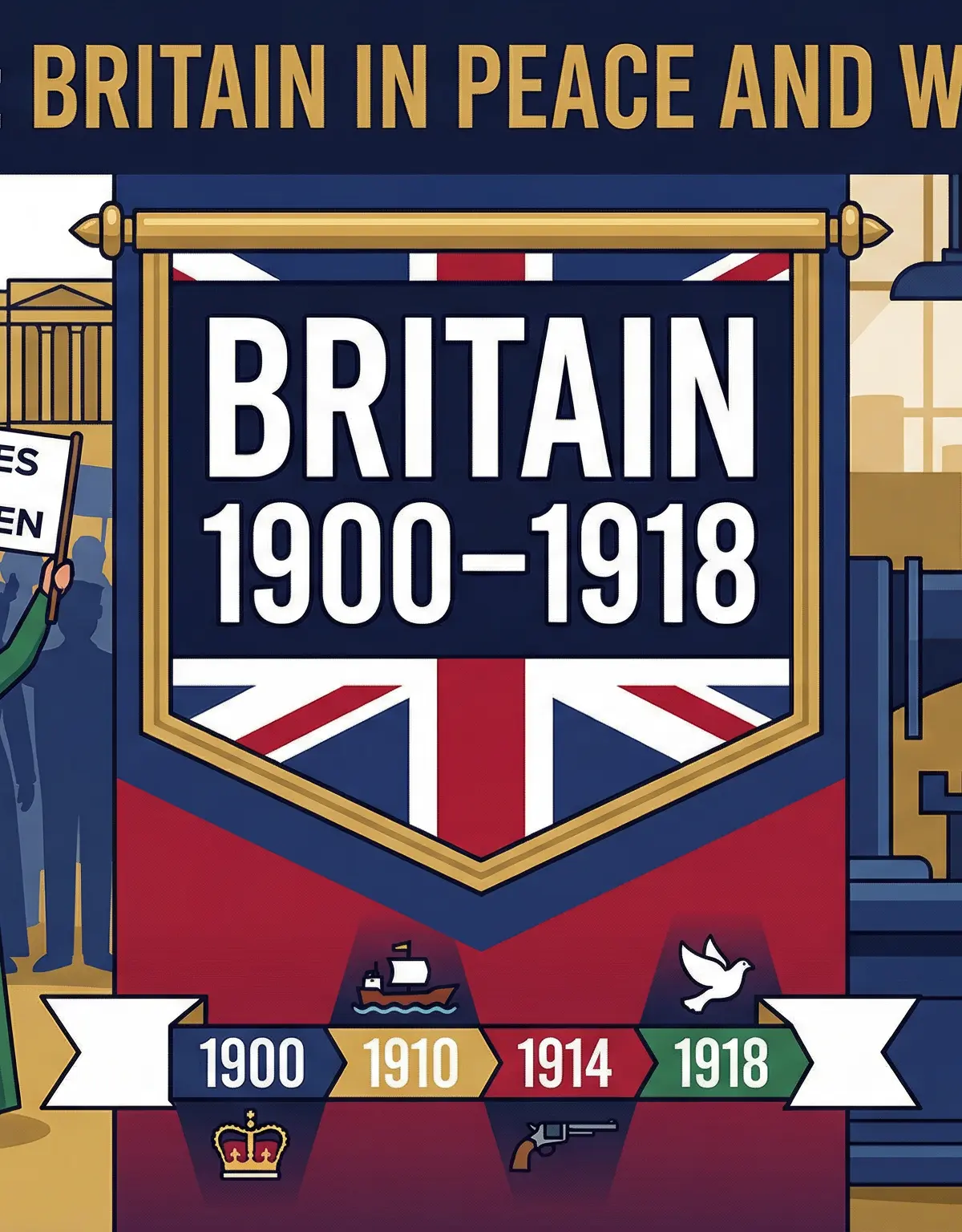
Britain in Peace and War, 1900–1918 covers three interlocking themes: the Liberal Reforms (1906–1914), the campaign for women's suffrage, and the civilian experience of the First World War. Together, these themes chart Britain's transformation from a society in which poverty was regarded as a personal failing and women were excluded from political life, into a modern welfare state engaged in total war. OCR examiners expect candidates to demonstrate AO1 knowledge (specific dates, names, and statistics), AO2 analytical explanation (causation, consequence, significance), AO3 source evaluation (content, provenance, utility, limitations), and AO4 historical interpretation. The Assessment Objective weightings are: AO1 35%, AO2 35%, AO3 15%, AO4 15%. This guide provides everything you need to reach the highest levels.
Key Events and Developments
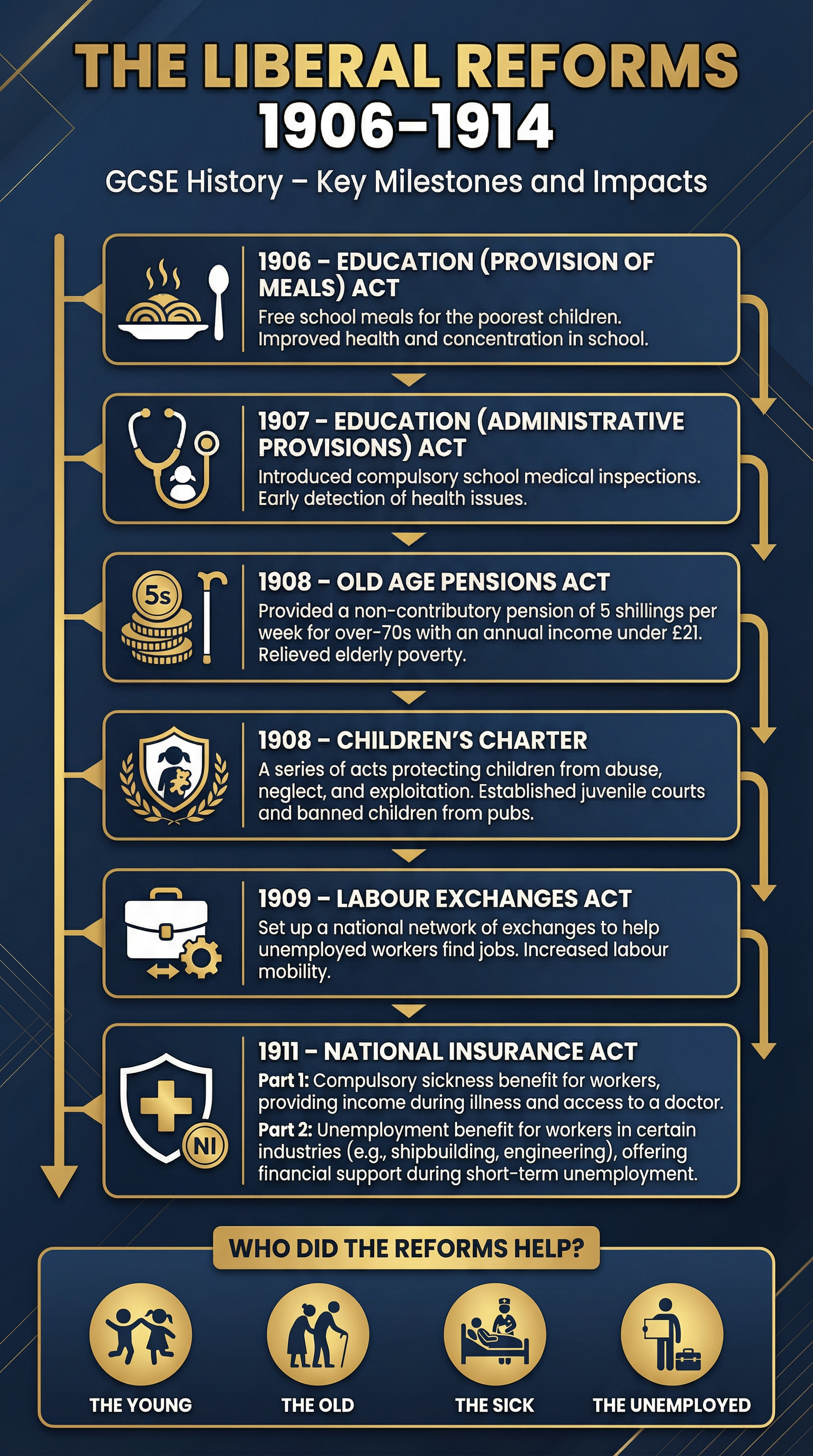
The Liberal Reforms, 1906–1914
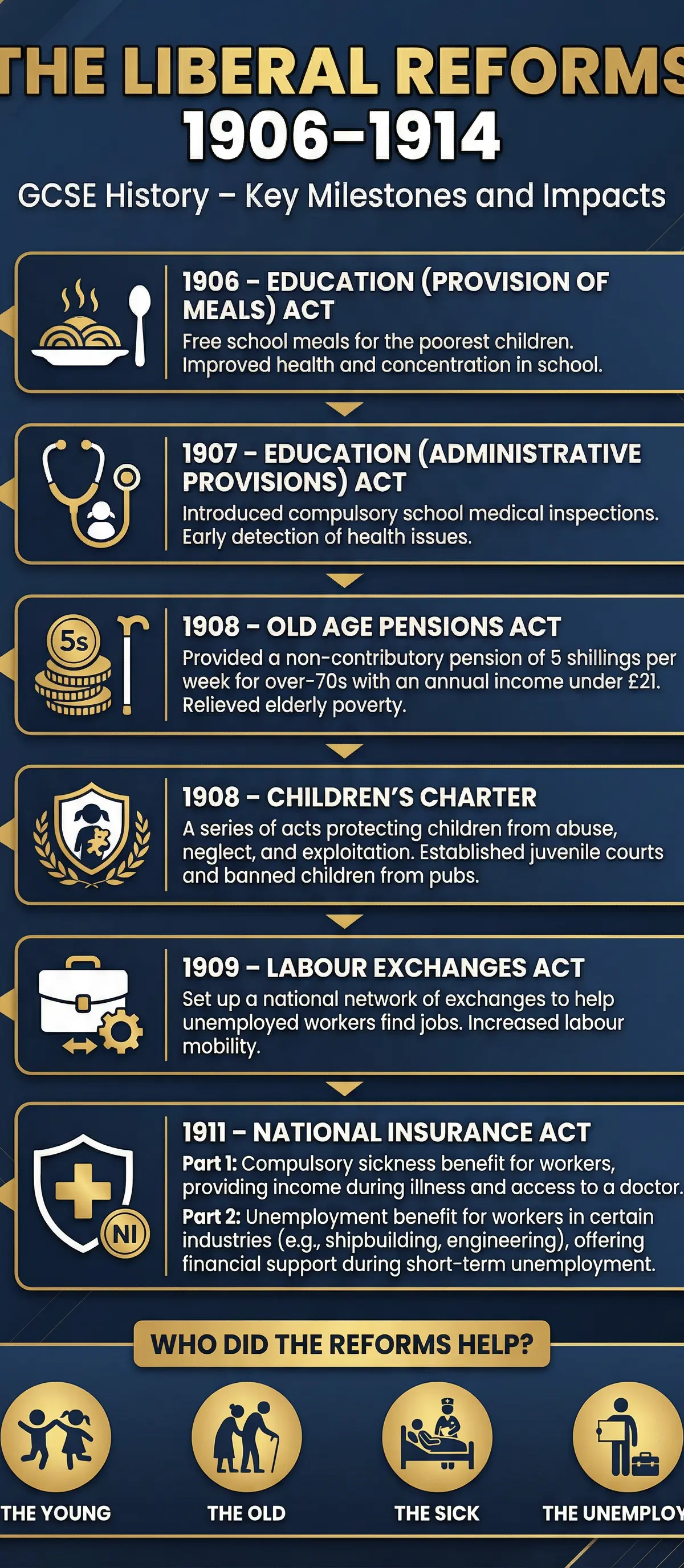
Date(s): 1906–1914
What happened: Following their landslide general election victory in 1906, the Liberal government under Herbert Asquith (Prime Minister from 1908) and key ministers David Lloyd George and Winston Churchill introduced a series of welfare reforms targeting the young, the old, the sick, and the unemployed. The reforms were driven by the findings of social investigators Charles Booth (London, 1889) and Seebohm Rowntree (York, 1901), who demonstrated that approximately 28–30% of the urban population lived in primary poverty — a figure that shocked the political establishment. The Boer War (1899–1902) had also revealed that 40% of army recruits were physically unfit, raising national efficiency concerns.
Why it matters: The Liberal Reforms represent a fundamental shift in political philosophy — from laissez-faire individualism (the belief that poverty was the individual's own fault) to collectivism (the belief that the state had a duty to protect citizens from poverty beyond their control). Examiners credit candidates who explain the impact of reforms rather than merely listing them. For example, the 1908 Old Age Pensions Act did not merely provide 5 shillings a week — it meant that for the first time, the elderly poor were not forced into the workhouse.
Specific Knowledge: 1906 — Education (Provision of Meals) Act: free school meals for poorest children; 1907 — school medical inspections introduced; 1908 — Old Age Pensions Act (5 shillings/week for over-70s earning under £21/year); 1908 — Children's Charter (juvenile courts, ban on children in pubs, protection from abuse); 1909 — Labour Exchanges Act (national network of job centres); 1911 — National Insurance Act Part 1 (sickness: 4d worker, 3d employer, 2d state) and Part 2 (unemployment in shipbuilding, engineering, construction).
The Suffrage Movement, 1897–1918
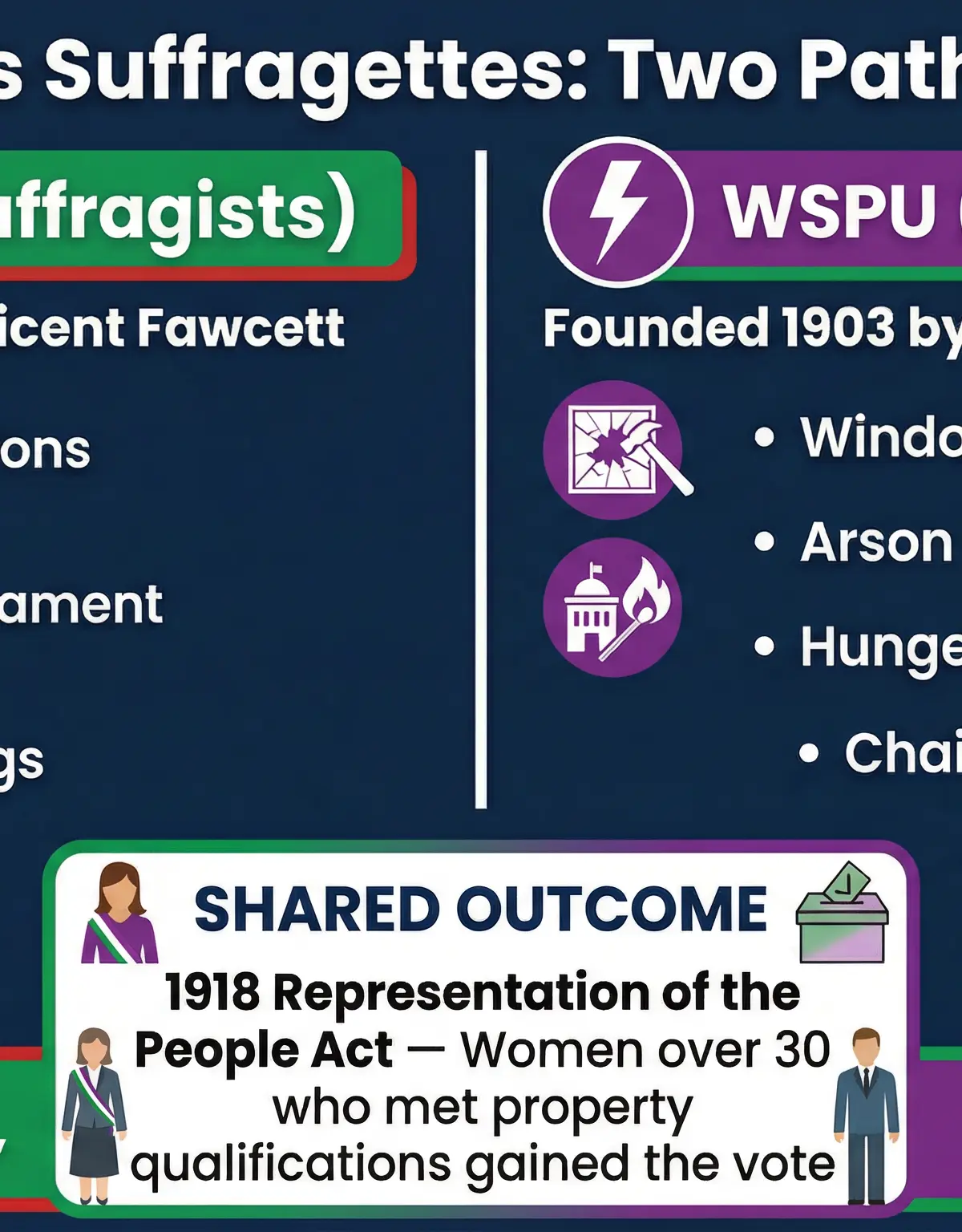
Date(s): 1897–1918
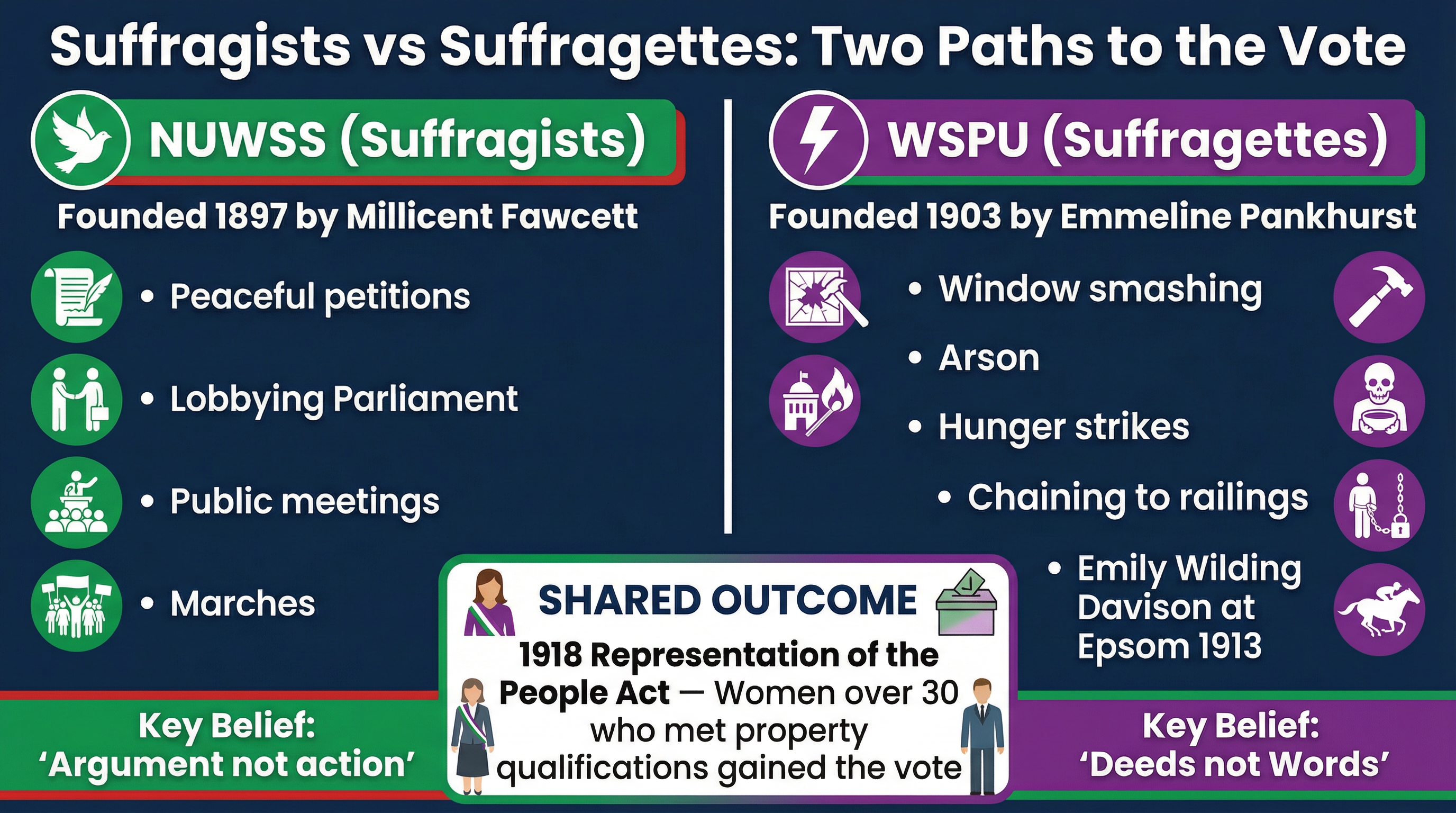
What happened: Two organisations led the campaign for women's votes. The NUWSS (National Union of Women's Suffrage Societies), founded in 1897 by Millicent Fawcett, used constitutional methods: petitions, lobbying MPs, public meetings, and marches. By 1914 it had approximately 100,000 members. The WSPU (Women's Social and Political Union), founded in 1903 by Emmeline Pankhurst, adopted the motto 'Deeds not Words' and escalated to militant tactics from 1905 onwards: heckling politicians, chaining to railings, window smashing (March 1912, causing £500,000 of damage in London's West End), arson attacks, and hunger strikes in prison. The government responded with the 'Cat and Mouse Act' (Prisoners' Temporary Discharge for Ill-Health Act, 1913), which allowed hunger strikers to be released and re-arrested when recovered. In June 1913, Emily Wilding Davison ran onto the track at the Epsom Derby and was struck by the King's horse Anmer; she died four days later. When war broke out in August 1914, both organisations suspended their campaigns. The 1918 Representation of the People Act granted the vote to women over 30 who met property qualifications — approximately 8.4 million women.
Why it matters: Examiners specifically credit candidates who distinguish between NUWSS and WSPU methods. High-level responses also address the debate about whether militancy helped or hindered the cause, and avoid the common error of attributing the 1918 Act solely to war work.
Specific Knowledge: NUWSS founded 1897 by Millicent Fawcett; WSPU founded 1903 by Emmeline Pankhurst; 'Cat and Mouse Act' 1913; Emily Wilding Davison, Epsom Derby, June 1913; 1918 Representation of the People Act — women over 30 with property qualifications; full equal suffrage not until Equal Franchise Act 1928.
The Home Front and DORA, 1914–1918
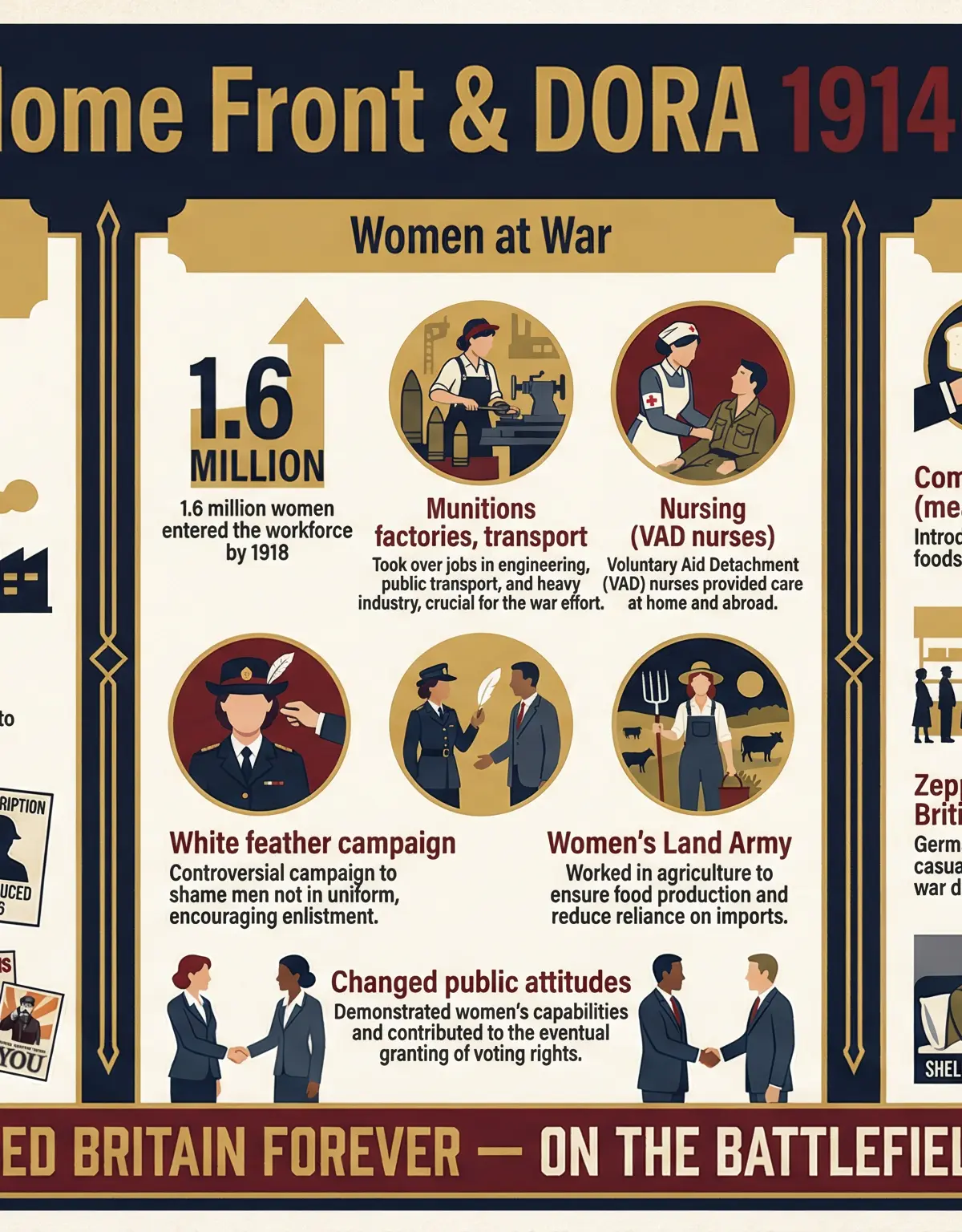
Date(s): 1914–1918
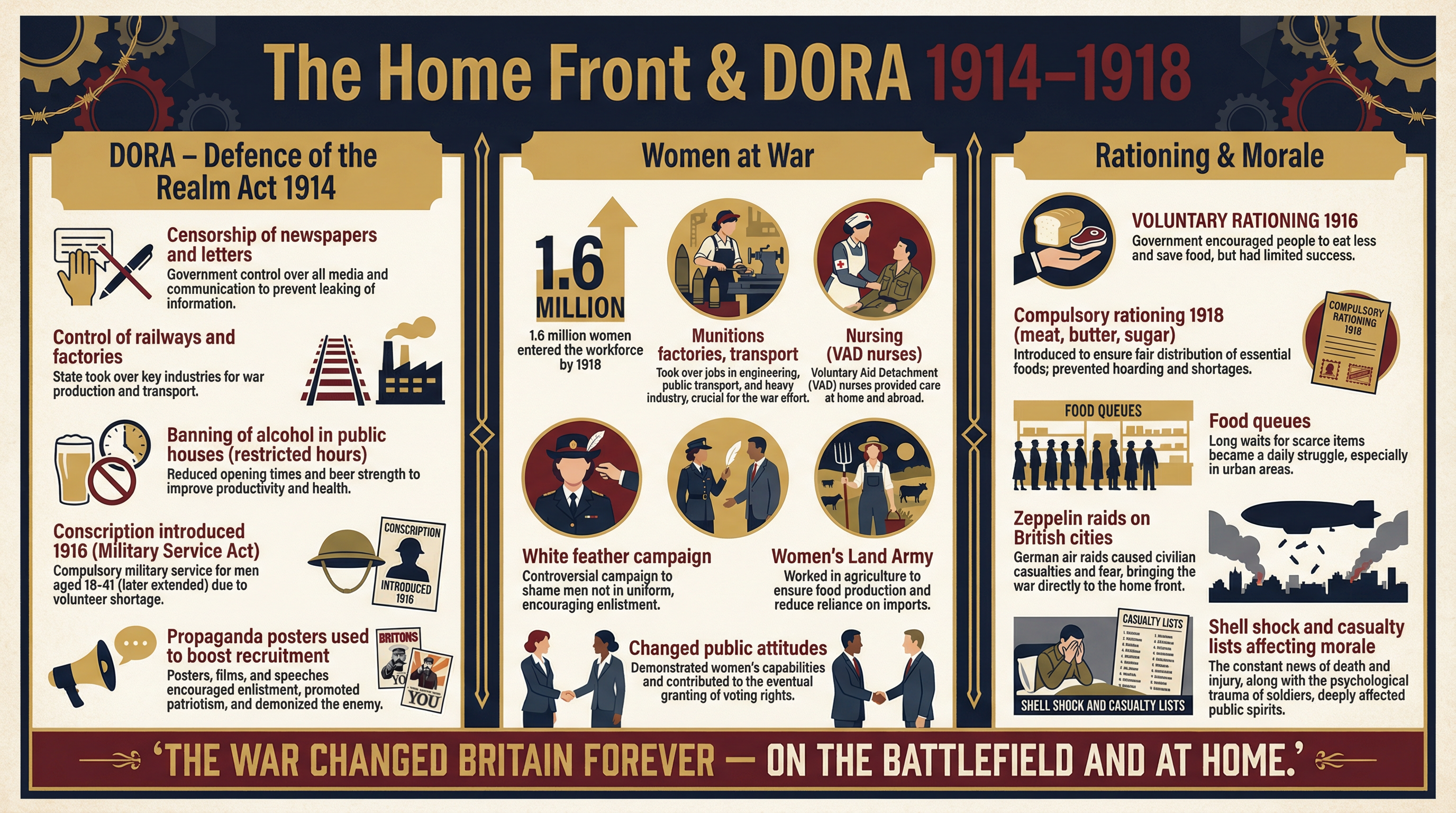
What happened: The Defence of the Realm Act (DORA) was passed in August 1914, giving the government sweeping powers over civilian life: censorship of newspapers and letters, control of railways and factories, restrictions on pub opening hours and alcohol strength, and the use of propaganda. Voluntary recruitment initially succeeded — over 750,000 men enlisted in the first two months — but by 1916 the Military Service Act introduced conscription for single men aged 18–41 (later extended to married men). Women filled the gaps in the workforce: by 1918, approximately 1.6 million women were employed in roles previously held by men, including munitions factories, transport, and nursing (VAD nurses). Voluntary rationing was introduced in 1916; compulsory rationing of meat, butter, and sugar followed in 1918. Zeppelin raids on British cities brought the war to the Home Front directly.
Why it matters: Source questions on this topic frequently use propaganda posters, government notices, or personal accounts. Candidates must evaluate these using provenance (Nature, Origin, Purpose) and must not dismiss biased sources as 'useless' — the bias itself reveals government aims and public sentiment.
Specific Knowledge: DORA passed August 1914; Military Service Act January 1916 (conscription); 1.6 million women in workforce by 1918; compulsory rationing 1918; Women's Land Army; VAD (Voluntary Aid Detachment) nurses; white feather campaign; Zeppelin raids 1915–1918.
Key Individuals
David Lloyd George
Role: Chancellor of the Exchequer (1908–1915); later Minister of Munitions and Prime Minister (1916–1922)
Key Actions: Introduced the 1909 'People's Budget' to fund the Liberal Reforms through progressive taxation on the wealthy; co-authored the 1911 National Insurance Act; as Minister of Munitions from 1915, dramatically increased shell production; introduced compulsory rationing.
Impact: Lloyd George is central to both the Liberal Reforms and the wartime Home Front. His famous quote that Britain was fighting 'Germany, Austria, and drink' illustrates DORA's restrictions on alcohol. Candidates should use him to demonstrate how one individual shaped both pre-war welfare policy and wartime government control.
Emmeline Pankhurst
Role: Founder and leader of the WSPU (Women's Social and Political Union), 1903
Key Actions: Led the militant suffragette campaign; organised window-smashing raids; supported the war effort from 1914, redirecting WSPU energy into recruitment campaigns.
Impact: Pankhurst represents the tension between militancy and effectiveness. Her decision to support the war in 1914 is significant — it demonstrated patriotism and helped shift public attitudes towards women's suffrage, but it also divided the WSPU (her daughter Sylvia opposed the war).
Millicent Fawcett
Role: Founder and leader of the NUWSS (National Union of Women's Suffrage Societies), 1897
Key Actions: Led the constitutional suffragist campaign for over 20 years; lobbied MPs; organised peaceful marches including the 1913 Pilgrimage.
Impact: Fawcett's patient, constitutional approach is often contrasted with Pankhurst's militancy. Some historians argue the NUWSS's steady accumulation of political support was ultimately more effective than WSPU militancy in securing the 1918 Act.
Seebohm Rowntree
Role: Social investigator and businessman
Key Actions: Published 'Poverty: A Study of Town Life' (1901), documenting poverty in York.
Impact: Rowntree's finding that 28% of York's population lived in primary poverty provided the statistical evidence that justified the Liberal Reforms. Candidates should use him as a named example when explaining the causes of the reforms.
Second-Order Concepts
Causation
The Liberal Reforms had multiple causes operating at different levels. Long-term causes include the findings of Booth and Rowntree exposing mass poverty, and the growth of the Labour Party threatening Liberal electoral support from working-class voters. Medium-term causes include the Boer War's revelation that 40% of recruits were physically unfit, raising national efficiency concerns. Short-term causes include the Liberal landslide of 1906, which gave the party both the mandate and the parliamentary majority to legislate. Examiners credit responses that explain how these causes combined and interacted, rather than treating them as separate items on a list.
Consequence
The immediate consequences of the Liberal Reforms included reduced poverty among specific groups: free school meals improved children's health and concentration; the Old Age Pension reduced elderly destitution; the National Insurance Act provided a safety net for sick and unemployed workers. The long-term consequence was the establishment of the principle of state responsibility for welfare — the ideological foundation upon which the post-1945 welfare state would be built. For the suffrage movement, the consequence of the 1918 Act was partial enfranchisement, with full equality delayed until 1928 — a reminder that historical change is rarely complete or immediate.
Change and Continuity
The period 1900–1918 represents dramatic change in the role of the state, the status of women, and the experience of civilian life. However, continuity is also evident: the 1918 Act did not give all women the vote; class distinctions remained deeply embedded in British society; and the Liberal Reforms, while significant, did not eliminate poverty. Examiners reward candidates who can identify both what changed and what remained the same.
Significance
This period is significant because it established the foundations of the modern British state. The Liberal Reforms created the precedent for state welfare; the suffrage movement began the long process of political equality; and the First World War demonstrated that total war required total national mobilisation, including women. These developments collectively shaped the Britain that emerged from the war in 1918.
Source Skills
OCR source questions for this topic most commonly use: government propaganda posters (recruitment, rationing, DORA); newspaper articles (censored or uncensored accounts of the war); personal letters and diaries (soldiers and civilians); political speeches (Lloyd George, Pankhurst); and official reports (Rowntree, Booth).
For every source, apply the NOP framework: Nature (what type of source is it?), Origin (who created it, when, in what context?), Purpose (why was it created — to inform, persuade, entertain, record?). Then evaluate: what does the content tell us? How does the provenance affect usefulness? What are the limitations? Never write 'this source is biased therefore useless' — instead, explain how the bias itself is historically informative.
Visual Resources
3 diagrams and illustrations
Interactive Diagrams
3 interactive diagrams to visualise key concepts
Diagram could not be rendered
Timeline of key events: Britain in Peace and War, 1900–1918
Conceptual Flow Outline
Causation diagram: Why did the Liberals introduce welfare reforms?
Conceptual Flow Outline
Causation diagram: Why did women gain the vote in 1918?
Worked Examples
3 worked examples — open one to explore the question and available guidance.
Practice Questions
Test your understanding — click to reveal model answers
Describe two features of the Liberal Reforms introduced between 1906 and 1914. (4 marks)
Hint: Choose two different reforms and provide specific detail about each — what it did and who it helped. Do not just name the reform; describe what it actually involved.
Explain why women had not gained the right to vote by 1914. (12 marks)
Hint: Consider at least three reasons: political opposition, the impact of militant tactics, and social attitudes. Use specific evidence for each and link your causes together.
How useful is Source A for an enquiry into the methods used by the government to control civilian life during the First World War? Explain your answer using Source A and your own knowledge. (8 marks)
Hint: Apply the NOP framework: Nature (what type of source?), Origin (who made it, when?), Purpose (why was it made?). Then evaluate content, usefulness, and limitations for the specific enquiry stated.
How far do you agree that the Liberal Reforms of 1906–1914 successfully tackled poverty in Britain? (16 marks)
Hint: Balance evidence that the reforms helped specific groups (elderly, children, sick, unemployed) against evidence of their limitations (means testing, exclusions, inadequate amounts). Reach a clear, substantiated judgement.
Explain why the Defence of the Realm Act (DORA) was important for the British government during the First World War. (12 marks)
Hint: Consider at least three reasons: controlling information, mobilising the economy, and managing civilian morale. Use specific examples of DORA's powers and their effects.
Test your understanding of Britain in peace and war, 1900-1918
Active recall beats re-reading. Take an instant quiz now to test what you’ve learned and lock it into long-term memory.
7 days Premium · Then free forever · No card, no charge