OCR · GCSE · History
The Mughal Empire, 1526-1707
This comprehensive study guide for OCR GCSE History delves into the Mughal Empire (1526-1707), a pivotal World Depth Study. It is designed to equip candidates with the precise knowledge and analytical skills needed to deconstruct exam questions, evaluate historical change, and secure top marks by focusing on key individuals, administrative systems, and cultural achievements.
- 9 min read
- 3 worked examples
- 5 practice questions
- 6 key terms
Study Notes
Overview
This study covers the rise, consolidation, and cultural zenith of the Mughal Empire, one of the most powerful early modern empires in world history. For the OCR GCSE History B (SHP) specification, candidates are required to analyse the period from Babur's founding victory in 1526 to the death of Aurangzeb in 1707. Examiners expect a deep understanding of the administrative machinery, particularly the Mansabdari system, and the contrasting religious policies of emperors like Akbar and Aurangzeb. Credit is awarded for moving beyond narrative description to analytical explanation, evaluating the causes of expansion, the nature of the 'Golden Age', and the seeds of decline. Success in this paper hinges on using specific terminology correctly (e.g., Jizya, Jagir) and assessing the significance of key events and individuals in shaping the empire's trajectory. This guide provides the detailed knowledge and exam technique required to meet these demands.
Key Events & Developments
The First Battle of Panipat
Date(s): 21 April 1526
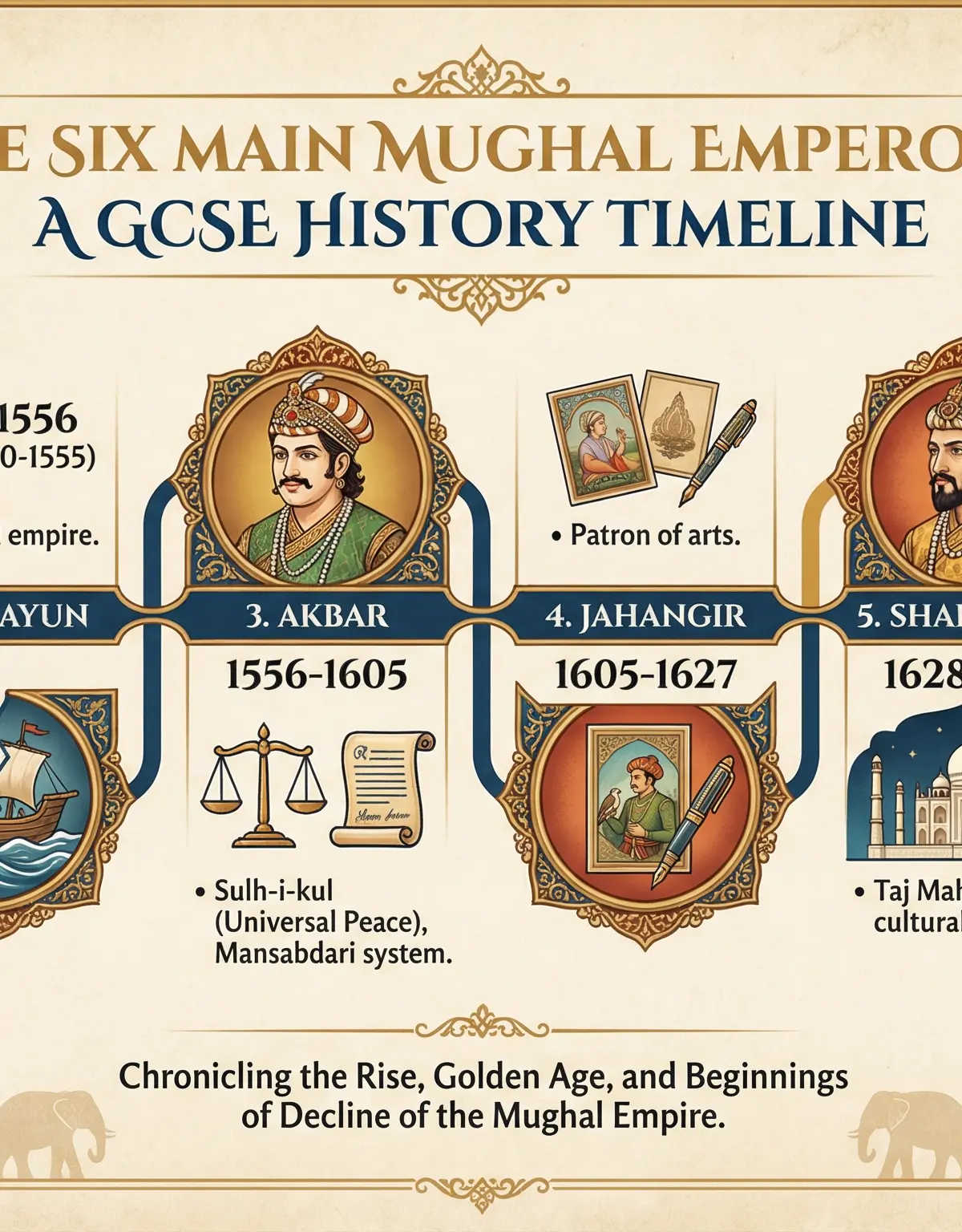
What happened: Babur's small force of around 12,000 men defeated Sultan Ibrahim Lodi of Delhi's army of over 100,000. Babur's victory was due to his tactical genius, disciplined army, and, crucially, the use of gunpowder firearms and field artillery, which were new to warfare in the Indian subcontinent.
Why it matters: This decisive battle marked the end of the Delhi Sultanate and the beginning of the Mughal Empire in India. It is a classic example of how technological and tactical superiority can overcome numerical disadvantage, a key theme in military history.
Specific Knowledge: Babur, Ibrahim Lodi, use of cannons and matchlock muskets.
Humayun's Exile and Return
Date(s): Exile (1540-1555), Return (1555-1556)
What happened: Babur's son, Humayun, was defeated by the Afghan leader Sher Shah Suri and forced into a 15-year exile in the Safavid court of Persia. He eventually reclaimed his throne in 1555 with Persian aid but died shortly after.
Why it matters: Humayun's time in Persia had a profound and lasting impact on Mughal culture. He brought back Persian artists, architects, and administrators, leading to a fusion of Persian and Indian styles that defined Mughal art, architecture, and courtly life. This is a crucial point for understanding the empire's cultural development.
Specific Knowledge: Humayun, Sher Shah Suri, Safavid Empire (Persia).
The Reign of Akbar the Great
Date(s): 1556-1605
What happened: Akbar succeeded his father Humayun at the age of 13 and went on to become the most significant Mughal emperor. He consolidated and expanded the empire, reformed its administration through the Mansabdari system, and pursued a policy of religious tolerance known as Sulh-i-kul ('universal peace').
Why it matters: Akbar's reign is considered the foundation of the empire's 'Golden Age'. His policies created a stable, prosperous, and inclusive state. Examiners frequently ask questions about the effectiveness of his administrative and religious policies as a tool for consolidating power.
Specific Knowledge: Sulh-i-kul, Jizya (abolished 1564), Ibadat Khana (House of Worship), Fatehpur Sikri, Mansabdari system, Todar Mal (finance minister).
The Cultural Zenith under Shah Jahan
Date(s): 1628-1658
What happened: Shah Jahan's reign is renowned for its architectural masterpieces, most famously the Taj Mahal, built as a mausoleum for his wife Mumtaz Mahal. He also constructed the Red Fort and Jama Masjid in Delhi, the new imperial capital.
Why it matters: This period represents the peak of Mughal cultural achievement and wealth. The architectural projects were not just beautiful buildings; they were powerful statements of imperial authority, wealth, and divine grandeur. However, the immense cost of these projects placed a significant strain on the imperial treasury.
Specific Knowledge: Taj Mahal (1632-1653), Mumtaz Mahal, Red Fort (Delhi), Jama Masjid.
Aurangzeb's Reign and the Seeds of Decline
Date(s): 1658-1707
What happened: Aurangzeb, a devout and orthodox Muslim, reversed many of Akbar's policies of religious tolerance. He re-imposed the Jizya tax on non-Muslims in 1679, destroyed Hindu temples, and alienated powerful groups like the Rajputs and Marathas. He spent the last 25 years of his reign in a costly and draining war in the Deccan.
Why it matters: Aurangzeb's policies and military over-extension are seen as major causes of the Mughal Empire's decline. His reign provides a critical point of comparison with Akbar's, allowing for analysis of change and continuity. 'How far' questions often focus on whether Aurangzeb alone was responsible for the empire's decline.
Specific Knowledge: Aurangzeb, Jizya (reinstated 1679), Maratha Confederacy (Shivaji), Deccan Wars.
Key Individuals
Babur (r. 1526-1530)
Role: Founder of the Mughal Empire.
Key Actions: Defeated Ibrahim Lodi at the First Battle of Panipat (1526) using gunpowder and advanced tactics. Wrote the Baburnama, his memoirs.
Impact: Established the Mughal dynasty in India, laying the groundwork for one of the world's great empires.
Akbar (r. 1556-1605)
Role: The third and greatest Mughal Emperor.
Key Actions: Implemented the Mansabdari system to organize the nobility and military. Promoted religious tolerance through Sulh-i-kul and abolished the Jizya. Commissioned the city of Fatehpur Sikri.
Impact: Consolidated the empire, created a powerful centralized administration, and fostered a unique Indo-Persian culture. His reign is the benchmark against which other rulers are judged.
Shah Jahan (r. 1628-1658)
Role: The fifth Mughal Emperor, the great builder.
Key Actions: Commissioned the Taj Mahal, the Red Fort, and the Jama Masjid. Moved the capital from Agra to Delhi.
Impact: His reign marked the zenith of Mughal architectural and cultural achievement, but his extravagant spending weakened the imperial treasury.
Aurangzeb (r. 1658-1707)
Role: The sixth and last of the great Mughal Emperors.
Key Actions: Seized power from his father, Shah Jahan. Reinstated the Jizya tax. Expanded the empire to its greatest territorial extent but at a huge financial and political cost. Fought a long, unsuccessful war in the Deccan.
Impact: His policies of religious orthodoxy and military over-extension alienated key allies and drained the treasury, sowing the seeds for the empire's eventual decline.
Second-Order Concepts
Causation
Key causal questions revolve around the empire's rise and decline. Rise: Long-term causes include the political fragmentation of the Delhi Sultanate. Short-term triggers include Babur's military genius and use of gunpowder. Decline: Long-term causes include structural weaknesses in the Mansabdari and Jagirdari systems. Short-term causes include Aurangzeb's divisive religious policies and his costly Deccan campaigns. Examiners look for a multi-causal explanation.
Consequence
The consequences of Mughal rule were immense. Political: Creation of a large, centralized Indian empire that unified much of the subcontinent. Economic: Development of a sophisticated, monetized economy with extensive trade networks. Cultural: A unique fusion of Persian, Islamic, and Hindu traditions in art, architecture, and literature. Religious: A complex legacy of both tolerance (Akbar) and intolerance (Aurangzeb) that shaped later Hindu-Muslim relations.
Change & Continuity
Change: The most significant change was in religious policy, from Akbar's Sulh-i-kul to Aurangzeb's orthodoxy. The capital also changed, from Agra to Fatehpur Sikri, back to Agra, and finally to Delhi. Continuity: The Mansabdari system, though modified, remained the core administrative structure throughout the period. The reliance on land revenue as the primary source of state income was also a constant.
Significance
The Mughal Empire is significant for its role in shaping early modern India. It created a lasting administrative and cultural legacy. Its architectural wonders, like the Taj Mahal, are global icons. For the exam, its significance lies in providing a case study of empire-building, multi-ethnic governance, and the complex interplay of politics, religion, and culture.
Source Skills
For this topic, you might encounter sources like extracts from official court chronicles (e.g., the Akbarnama), memoirs (e.g., the Baburnama), or accounts from European travellers (e.g., François Bernier). When evaluating them, always apply the Content-Provenance-Limitations-Judgement framework. Content: What does the source say about Mughal power or policy? Provenance: Who wrote it and why? A court chronicle is official propaganda, designed to glorify the emperor. A European traveller might be biased by their own cultural assumptions. Limitations: What does the source not tell you? An official chronicle will omit failures and dissent. A traveller might not understand the nuances of the court. Judgement: How useful is it for a specific enquiry? A biased source can still be very useful for understanding the attitudes and ideology of its author.
Visual Resources
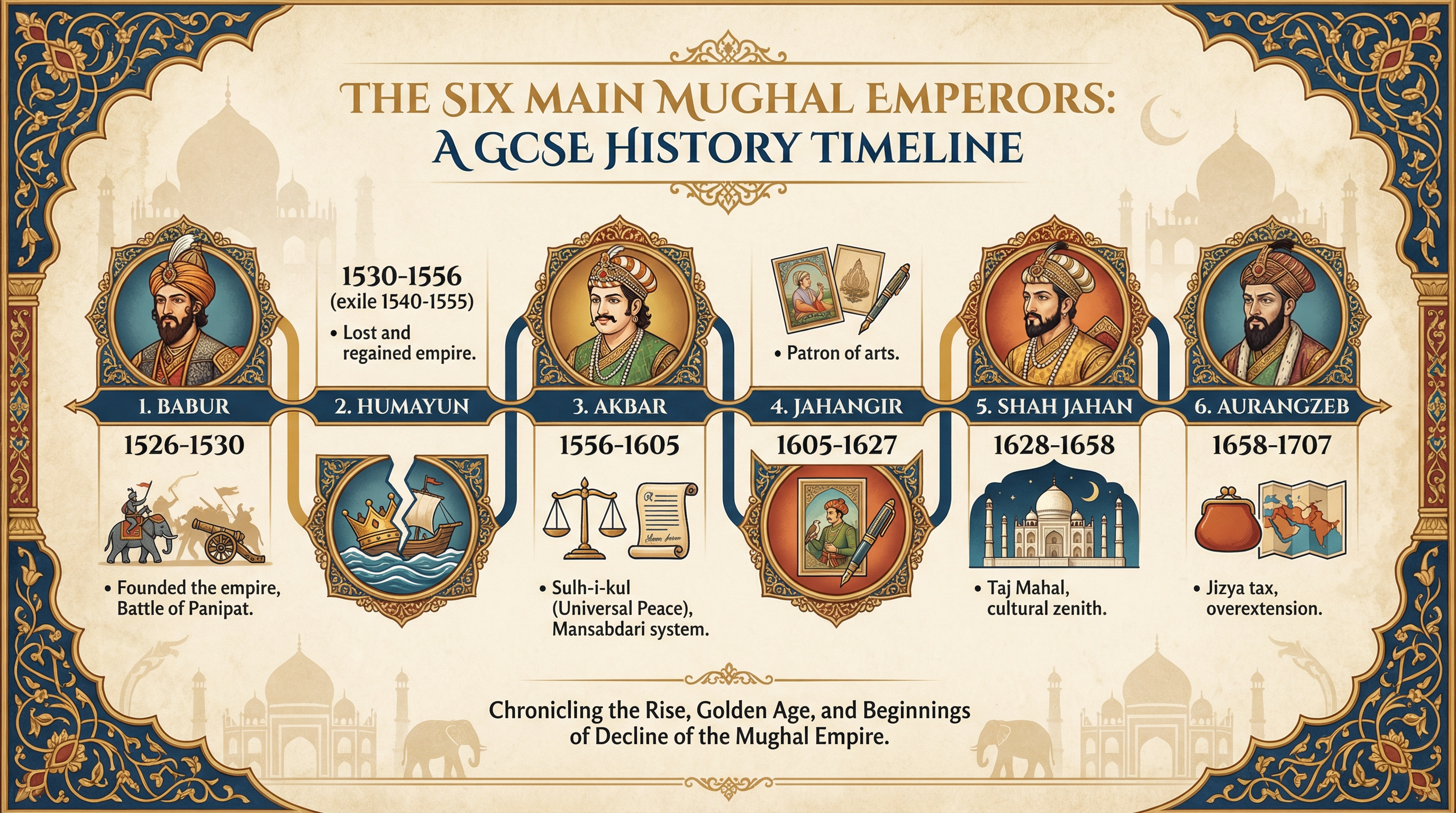
2 diagrams and illustrations
Interactive Diagrams
1 interactive diagram to visualise key concepts
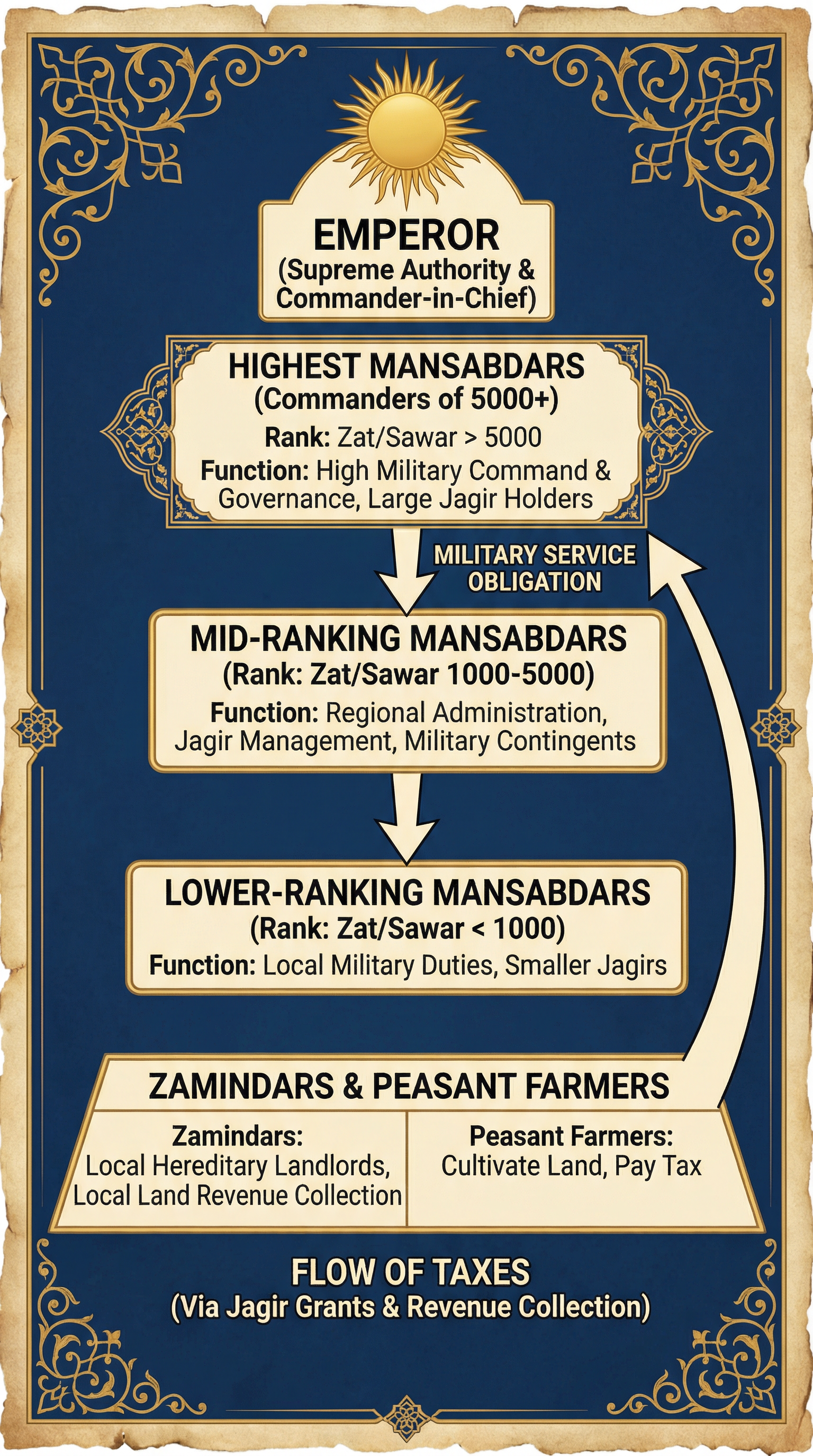
Conceptual Flow Outline
Simplified diagram showing the flow of authority and revenue in the Mughal system.
Worked Examples
3 worked examples — open one to explore the question and available guidance.
Practice Questions
Test your understanding — click to reveal model answers
Describe two features of the Mansabdari system. (4 marks)
Hint: Think about what the ranks meant and how Mansabdars were paid.
Explain why the city of Fatehpur Sikri was significant. (12 marks)
Hint: Consider its political, religious, and architectural importance.
How far was the First Battle of Panipat in 1526 the most important turning point in the establishment of the Mughal Empire? (16 marks)
Hint: Agree that it was important, but then introduce other key turning points (like Humayun's return or Akbar's consolidation) to create a balanced argument.
Explain the economic and military consequences of Shah Jahan's building projects. (8 marks)
Hint: Think about the cost of the buildings and what they represented.
How did the role of a Zamindar differ from the role of a Mansabdar? (6 marks)
Hint: Focus on three key differences: appointment, heredity, and relationship to the state.
Test your understanding of The Mughal Empire, 1526-1707
Active recall beats re-reading. Take an instant quiz now to test what you’ve learned and lock it into long-term memory.
7 days Premium · Then free forever · No card, no charge