OCR · GCSE · History
Course version: J410 · Version from Mar 2026
The People and the State (J410/01) - China during the Cultural Revolution…
Full specification wording
China 1950–1981: The People and the State (J410/01) - China during the Cultural Revolution 1966–1976: Reasons for the Cultural Revolution; impact of the Cultural Revolution on the people, including intellectuals and students; the role of the Red Guards; impact of Communism in Tibet; the nature of Communist propaganda and its impact, including Mao’s personality cult; Dazhai community as a case study of Communist Party repression.
This topic asks you to explain why Mao launched the Cultural Revolution in 1966 and to trace its consequences for different groups up to 1976.
Checked against the OCR J410 specification (opens in a new tab) on .
- 4 key terms
Study notes
From the checked teaching notes for this specification point.
The idea
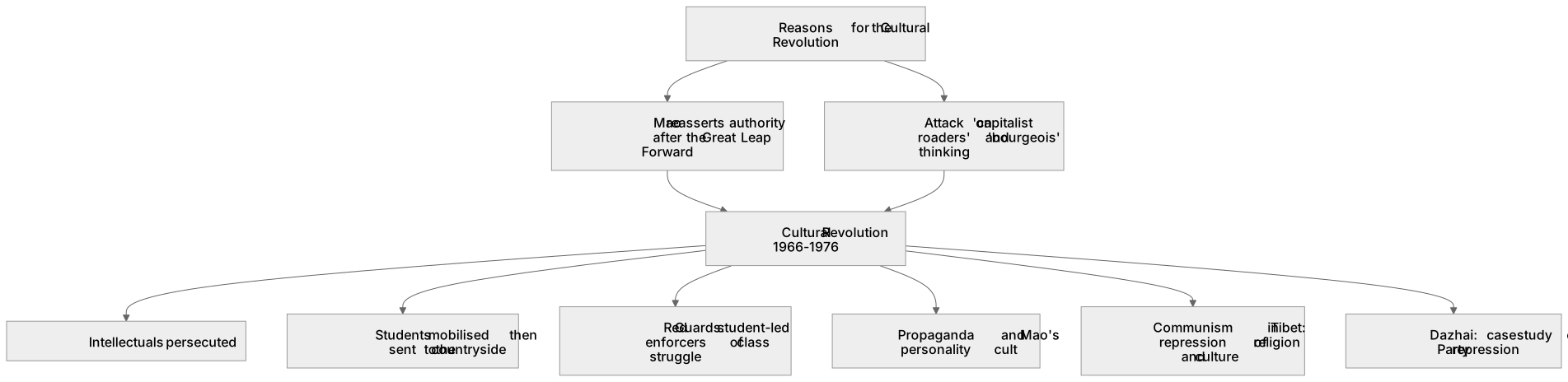
This topic asks you to explain why Mao launched the Cultural Revolution in 1966 and to trace its consequences for different groups up to 1976. Reasons include Mao's wish to reassert his authority after the failures of the Great Leap Forward and to attack 'capitalist roaders' and 'bourgeois' thinking in the Party and society. Consider the impact on intellectuals, who faced persecution, and on students, who were mobilised and then sent to the countryside. Explain the Red Guards' role as Mao's youthful enforcers of class struggle. Cover how Communism changed Tibet after 1950, including repression of Tibetan religion and culture. Analyse propaganda, including Mao's personality cult, and treat Dazhai as a case study of Party repression. Multiple-choice questions test precise recall, so link each cause and consequence to the correct group and date.
What earns the marks
- Identifies Mao's desire to reassert authority after the Great Leap Forward as a reason for the Cultural Revolution.
- Explains that intellectuals were targeted as bearers of 'bourgeois' or 'old' thinking and suffered persecution.
- Describes the Red Guards as student-led enforcers of Maoist class struggle who attacked 'the Four Olds'.
- States that Communist rule in Tibet brought repression of Tibetan religion and culture.
- Recognises propaganda and Mao's personality cult as tools that built loyalty and silenced criticism.
- Uses Dazhai as a case study showing Communist Party repression of a community.
Common mistakes and how to put them right
Confuses the Cultural Revolution with the Great Leap Forward.
Put it right: Keep the two campaigns distinct in date and purpose.
Treats the Red Guards as an official army.
Put it right: Describe them as a mass student movement mobilised by Mao.
Assumes Tibet was unaffected by Communist policy.
Put it right: Note the repression of religion and culture.
Dates the Cultural Revolution outside 1966–1976.
Put it right: Keep all examples inside that period.
Exam tips
- Read the whole stem before choosing, because options often differ by one group or date.
- Match each option to a specific group such as intellectuals, students or Tibetans.
- Eliminate options that fall outside the 1966–1976 window.
- Check whether the question asks for a reason or an impact before selecting.
Try the lesson
The start of the China 1950–1981: The People and the State (J410/01) - China during the Cultural Revolution 1966–1976: Reasons for the Cultural Revolution; impact of the Cultural Revolution on the people, including intellectuals and students; the role of the Red Guards; impact of Communism in Tibet; the nature of Communist propaganda and its impact, including Mao’s personality cult; Dazhai community as a case study of Communist Party repression. lesson, made from checked teaching notes for this specification point.
Have a go first
During the Cultural Revolution, what did the Red Guards mean by the 'Four Olds' that they were told to destroy?
Listen
This topic asks you to explain why Mao launched the Cultural Revolution in 1966 and to trace its consequences for different groups up to 1976. Reasons include Mao's wish to reassert his authority after the failures of the Great Leap Forward and to attack 'capitalist roaders' and 'bourgeois' thinking in the Party and society. Consider the impact on intellectuals, who faced persecution, and on students, who were mobilised and then sent to the countryside. Explain the Red Guards' role as Mao's youthful enforcers of class struggle. Cover how Communism changed Tibet after 1950, including repression of Tibetan religion and culture. Analyse propaganda, including Mao's personality cult, and treat Dazhai as a case study of Party repression. Multiple-choice questions test precise recall, so link each cause and consequence to the correct group and date. A strong answer earns marks for these points. Identifies Mao's desire to reassert authority after the Great Leap Forward as a reason for the Cultural Revolution. Explains that intellectuals were targeted as bearers of 'bourgeois' or 'old' thinking and suffered persecution. Describes the Red Guards as student-led enforcers of Maoist class struggle who attacked 'the Four Olds'. States that Communist rule in Tibet brought repression of Tibetan religion and culture. Exam tip: Read the whole stem before choosing, because options often differ by one group or date.
See it
Put the events in order
Put these events in the order they happened, earliest first.
- 1. Communism began to change Tibet, repressing Tibetan religion and culture
- 2. The Cultural Revolution came to an end
- 3. Mao launched the Cultural Revolution to reassert his authority
Key words
Say what each word means before you turn the card.
Causes of the Cultural Revolution
Try answering aloud or in your head before turning the card.
Impact on intellectuals and students
Try answering aloud or in your head before turning the card.
Role of the Red Guards
Try answering aloud or in your head before turning the card.
Propaganda and Mao's personality cult
Try answering aloud or in your head before turning the card.
See every definition
- Causes of the Cultural Revolution
- Mao's wish to reassert his authority after the failures of the Great Leap Forward and to attack 'capitalist roaders' and 'bourgeois' thinking in the Party and society.
- Impact on intellectuals and students
- Intellectuals faced persecution, while students were mobilised and then sent to the countryside.
- Role of the Red Guards
- Mao's youthful enforcers of class struggle, described as a mass student movement mobilised by Mao.
- Propaganda and Mao's personality cult
- Tools that built loyalty and silenced criticism.
Label the diagram
Some boxes have lost their names. Pick the right name for each number.
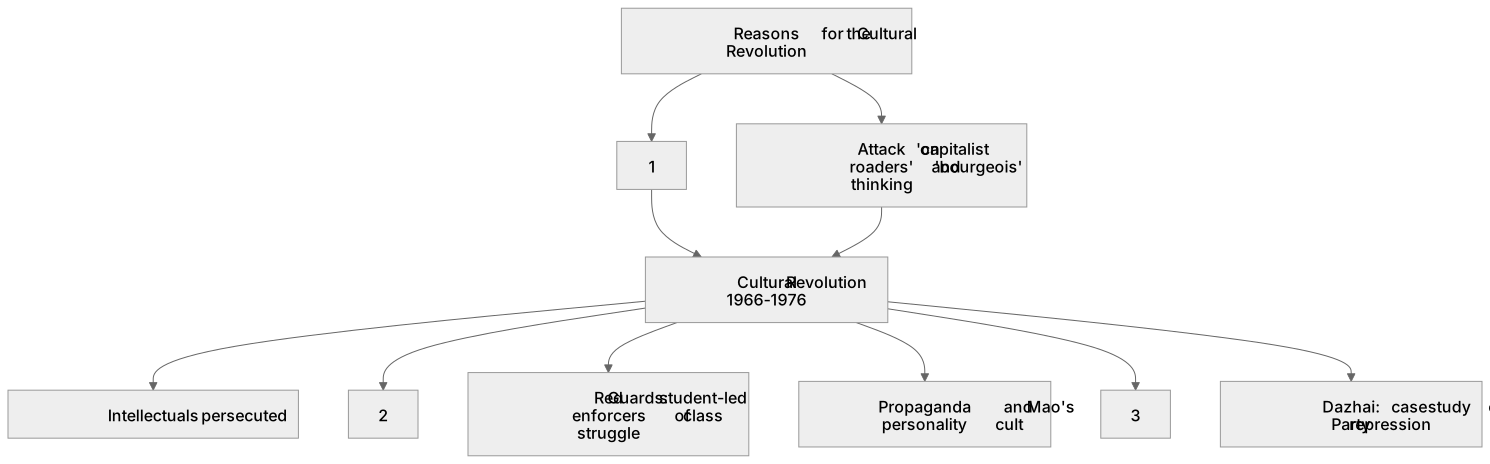
1Box 1
2Box 2
3Box 3
There is more to this lesson
The full lesson goes on to check your understanding and help you earn the marks. Create a free account to carry on, with your progress saved.
A week of Premium from your first lesson · Then the free plan continues · No card, no charge
Test your understanding of China 1950–1981: The People and the State (J410/01) - China during the Cultural Revolution 1966–1976: Reasons for the Cultural Revolution; impact of the Cultural Revolution on the people, including intellectuals and students; the role of the Red Guards; impact of Communism in Tibet; the nature of Communist propaganda and its impact, including Mao’s personality cult; Dazhai community as a case study of Communist Party repression.
Active recall beats re-reading. Take an instant quiz now to test what you’ve learned and lock it into long-term memory.
A week of Premium from your first lesson · Then the free plan continues · No card, no charge