OCR · GCSE · History
Course version: J410 · Version from Mar 2026
The People and the State (J410/01) - Communism in China after the death of…
Full specification wording
China 1950–1981: The People and the State (J410/01) - Communism in China after the death of Mao 1976–1981: Attitudes to opposition and its repression after 1976, including the Gang of Four and the ‘democracy wall’; changes in economic policy under Deng and its impact, including the Four Modernisations; the nature of Communist propaganda and its impact; social changes under Deng and its impact, including the role of women, changes in education and the One Child policy.
This topic covers China after Mao's death in 1976 up to 1981.
Checked against the OCR J410 specification (opens in a new tab) on .
- 4 key terms
Study notes
From the checked teaching notes for this specification point.
The idea
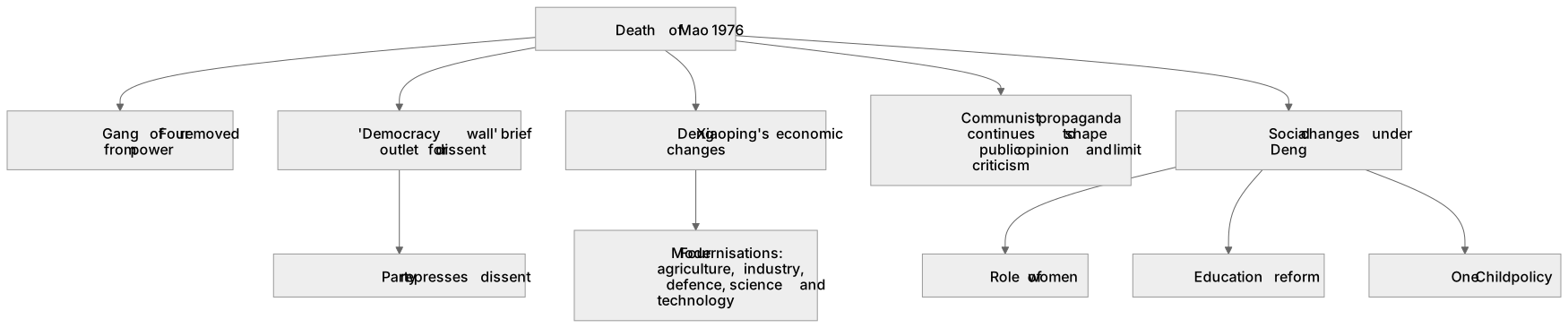
This topic covers China after Mao's death in 1976 up to 1981. You need to explain how the Party treated opposition, including the fall of the Gang of Four and the brief 'democracy wall' movement, and how dissent was repressed. Explain Deng Xiaoping's economic changes, especially the Four Modernisations in agriculture, industry, defence and science and technology, and their impact. Analyse the continuing role of Communist propaganda and its effect on public opinion. Cover social change under Deng, including the changing role of women, reforms in education and the introduction of the One Child policy. Multiple-choice questions reward precise knowledge of who did what and when, so link each policy to its author and its consequence.
What earns the marks
- Identifies the Gang of Four as a radical faction removed from power after Mao's death.
- Describes the 'democracy wall' as a brief outlet for dissent that the Party then repressed.
- Explains that Deng's Four Modernisations targeted agriculture, industry, defence and science and technology.
- States that propaganda continued under Deng to shape public opinion and limit criticism.
- Describes social changes under Deng, including the role of women, education reform and the One Child policy.
Common mistakes and how to put them right
Attributes the Four Modernisations to Mao.
Put it right: Credit Deng Xiaoping as their author.
Treats the 'democracy wall' as tolerated permanently.
Put it right: Note that the Party repressed it.
Assumes propaganda ended with Mao.
Put it right: Recognise its continued use after 1976.
Dates Deng's reforms before 1976.
Put it right: Keep them inside the 1976–1981 period.
Exam tips
- Link each policy to the correct leader before choosing an option.
- Check the date range 1976–1981 and reject options set outside it.
- Distinguish economic from social change when the stem asks for one.
- Watch for options that name the wrong modernisation sector.
Try the lesson
The start of the China 1950–1981: The People and the State (J410/01) - Communism in China after the death of Mao 1976–1981: Attitudes to opposition and its repression after 1976, including the Gang of Four and the ‘democracy wall’; changes in economic policy under Deng and its impact, including the Four Modernisations; the nature of Communist propaganda and its impact; social changes under Deng and its impact, including the role of women, changes in education and the One Child policy. lesson, made from checked teaching notes for this specification point.
Have a go first
After Mao's death in 1976, which group was blamed for the worst excesses of the Cultural Revolution and arrested?
Listen
This topic covers China after Mao's death in 1976 up to 1981. You need to explain how the Party treated opposition, including the fall of the Gang of Four and the brief 'democracy wall' movement, and how dissent was repressed. Explain Deng Xiaoping's economic changes, especially the Four Modernisations in agriculture, industry, defence and science and technology, and their impact. Analyse the continuing role of Communist propaganda and its effect on public opinion. Cover social change under Deng, including the changing role of women, reforms in education and the introduction of the One Child policy. Multiple-choice questions reward precise knowledge of who did what and when, so link each policy to its author and its consequence. A strong answer earns marks for these points. Identifies the Gang of Four as a radical faction removed from power after Mao's death. Describes the 'democracy wall' as a brief outlet for dissent that the Party then repressed. Explains that Deng's Four Modernisations targeted agriculture, industry, defence and science and technology. States that propaganda continued under Deng to shape public opinion and limit criticism. Exam tip: Link each policy to the correct leader before choosing an option.
See it
Key words
Say what each word means before you turn the card.
Gang of Four
Try answering aloud or in your head before turning the card.
'democracy wall'
Try answering aloud or in your head before turning the card.
Four Modernisations
Try answering aloud or in your head before turning the card.
One Child policy
Try answering aloud or in your head before turning the card.
See every definition
- Gang of Four
- A radical faction removed from power after Mao's death.
- 'democracy wall'
- A brief outlet for dissent that the Party then repressed.
- Four Modernisations
- Deng's changes targeting agriculture, industry, defence and science and technology.
- One Child policy
- A social change under Deng, alongside the role of women and education reform.
Label the diagram
Some boxes have lost their names. Pick the right name for each number.
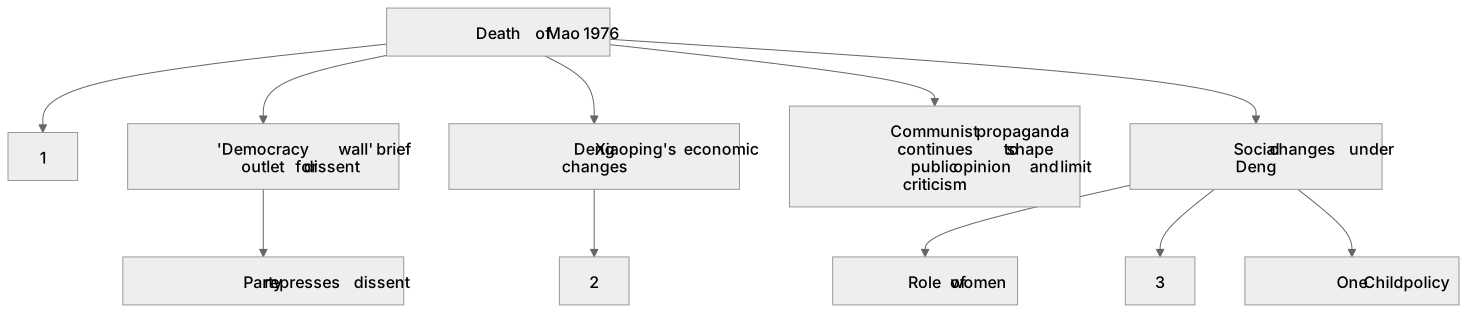
1Box 1
2Box 2
3Box 3
There is more to this lesson
The full lesson goes on to check your understanding and help you earn the marks. Create a free account to carry on, with your progress saved.
A week of Premium from your first lesson · Then the free plan continues · No card, no charge
Test your understanding of China 1950–1981: The People and the State (J410/01) - Communism in China after the death of Mao 1976–1981: Attitudes to opposition and its repression after 1976, including the Gang of Four and the ‘democracy wall’; changes in economic policy under Deng and its impact, including the Four Modernisations; the nature of Communist propaganda and its impact; social changes under Deng and its impact, including the role of women, changes in education and the One Child policy.
Active recall beats re-reading. Take an instant quiz now to test what you’ve learned and lock it into long-term memory.
A week of Premium from your first lesson · Then the free plan continues · No card, no charge