OCR · GCSE · History
Course version: J410 · Version from Mar 2026
The People and the State (J410/01) - Establishing Communism in China…
Full specification wording
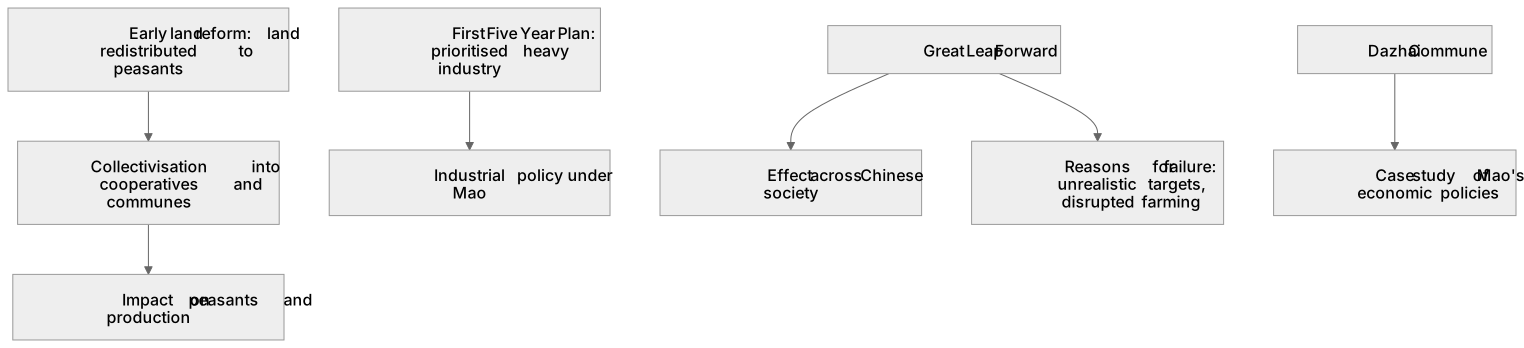
China 1950–1981: The People and the State (J410/01) - Establishing Communism in China 1950–1965: Early purges against opposition in the 1950s in the cities, countryside and regions; intentions and impact of the Hundred Flowers campaign; Communist social policies under Mao and how these differed from Chinese traditionalism; policies towards women, young people and education; agricultural policies, including early land reform, collectivisation and its impact; industrial policy, including the First Five Year Plan; the Great Leap Forward, its effect across Chinese society and reasons for failure; Dazhai Commune as a case study of Mao’s economic policies.
This content covers how the Chinese Communist Party under Mao consolidated and reshaped China between 1950 and 1965.
Checked against the OCR J410 specification (opens in a new tab) on .
- 4 key terms
Study notes
From the checked teaching notes for this specification point.
The idea
This content covers how the Chinese Communist Party under Mao consolidated and reshaped China between 1950 and 1965. You need to know the early purges against opposition across cities, countryside and regions, and how the Hundred Flowers campaign invited criticism before being turned against critics, with consequences for trust and dissent. Learn the social policies that broke with Chinese traditionalism — for example campaigns against Confucian customs and arranged marriage — and the specific policies towards women, young people and education, such as the 1950 Marriage Law and expanded schooling. On the economy, trace early land reform that redistributed land to peasants, then collectivisation into cooperatives and communes and its effects.
What earns the marks
- Identifies the early purges against opposition in the 1950s as occurring across cities, the countryside and regions, not in one location only.
- Explains that the Hundred Flowers campaign invited criticism and that its impact included a later backlash against those who spoke out.
- Distinguishes Communist social policies under Mao from Chinese traditionalism, citing a specific change such as the 1950 Marriage Law or campaigns against old customs.
- Describes agricultural policy in sequence, moving from early land reform to collectivisation and its impact on peasants and production.
- Explains that the First Five Year Plan prioritised heavy industry and links this to industrial policy under Mao.
- Explains the Great Leap Forward's effect across Chinese society and gives a reason for its failure, such as unrealistic targets or disrupted farming.
- Uses Dazhai Commune as a case study to illustrate Mao's economic policies rather than as an isolated fact.
Common mistakes and how to put them right
Places the early purges in a single city only.
Put it right: They reached cities, the countryside and regions.
Treats the Hundred Flowers campaign as simply an invitation to free speech.
Put it right: Include its intentions and the impact on those who criticised the Party.
Confuses land reform with collectivisation.
Put it right: Keep the sequence of redistributing land first, then pooling it into cooperatives and communes.
Describes the Great Leap Forward without explaining why it failed.
Put it right: Link failure to specific causes such as inflated targets and rural disruption.
Exam tips
- Learn the chronology of economic policy in order — land reform, collectivisation, First Five Year Plan, Great Leap Forward — so sequence questions are secure.
- Attach one concrete detail to each policy, such as the 1950 Marriage Law for social change or Dazhai for economic case study.
- When a question asks for impact, name who was affected — peasants, women, young people or industrial workers — rather than describing policy alone.
Try the lesson
The start of the China 1950–1981: The People and the State (J410/01) - Establishing Communism in China 1950–1965: Early purges against opposition in the 1950s in the cities, countryside and regions; intentions and impact of the Hundred Flowers campaign; Communist social policies under Mao and how these differed from Chinese traditionalism; policies towards women, young people and education; agricultural policies, including early land reform, collectivisation and its impact; industrial policy, including the First Five Year Plan; the Great Leap Forward, its effect across Chinese society and reasons for failure; Dazhai Commune as a case study of Mao’s economic policies. lesson, made from checked teaching notes for this specification point.
Have a go first
What did the First Five Year Plan of 1953–57 concentrate on developing?
Listen
This content covers how the Chinese Communist Party under Mao consolidated and reshaped China between 1950 and 1965. You need to know the early purges against opposition across cities, countryside and regions, and how the Hundred Flowers campaign invited criticism before being turned against critics, with consequences for trust and dissent. Learn the social policies that broke with Chinese traditionalism — for example campaigns against Confucian customs and arranged marriage — and the specific policies towards women, young people and education, such as the 1950 Marriage Law and expanded schooling. On the economy, trace early land reform that redistributed land to peasants, then collectivisation into cooperatives and communes and its effects. A strong answer earns marks for these points. Identifies the early purges against opposition in the 1950s as occurring across cities, the countryside and regions, not in one location only. Explains that the Hundred Flowers campaign invited criticism and that its impact included a later backlash against those who spoke out. Distinguishes Communist social policies under Mao from Chinese traditionalism, citing a specific change such as the 1950 Marriage Law or campaigns against old customs. Describes agricultural policy in sequence, moving from early land reform to collectivisation and its impact on peasants and production. Exam tip: Learn the chronology of economic policy in order — land reform, collectivisation, First Five Year Plan, Great Leap Forward — so sequence questions are secure.
See it
Key words
Say what each word means before you turn the card.
Hundred Flowers campaign
Try answering aloud or in your head before turning the card.
Collectivisation
Try answering aloud or in your head before turning the card.
First Five Year Plan
Try answering aloud or in your head before turning the card.
Dazhai Commune
Try answering aloud or in your head before turning the card.
See every definition
- Hundred Flowers campaign
- A campaign that invited criticism, with intentions and impact including a later backlash against those who spoke out.
- Collectivisation
- Pooling land into cooperatives and communes, following early land reform that redistributed land to peasants, with effects on peasants and production.
- First Five Year Plan
- An industrial policy that prioritised heavy industry under Mao.
- Dazhai Commune
- A case study used to illustrate Mao's economic policies rather than as an isolated fact.
Label the diagram
Some boxes have lost their names. Pick the right name for each number.
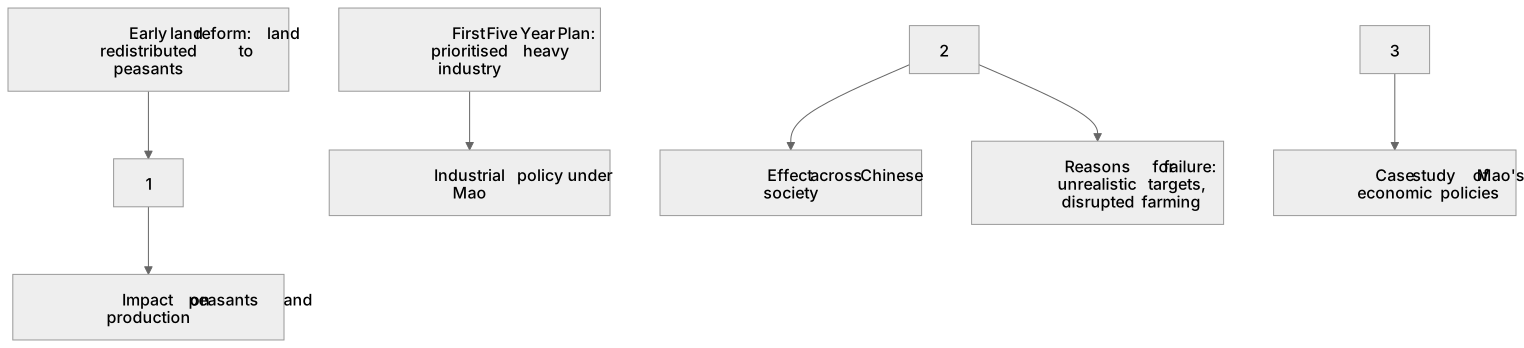
1Box 1
2Box 2
3Box 3
There is more to this lesson
The full lesson goes on to check your understanding and help you earn the marks. Create a free account to carry on, with your progress saved.
A week of Premium from your first lesson · Then the free plan continues · No card, no charge
Test your understanding of China 1950–1981: The People and the State (J410/01) - Establishing Communism in China 1950–1965: Early purges against opposition in the 1950s in the cities, countryside and regions; intentions and impact of the Hundred Flowers campaign; Communist social policies under Mao and how these differed from Chinese traditionalism; policies towards women, young people and education; agricultural policies, including early land reform, collectivisation and its impact; industrial policy, including the First Five Year Plan; the Great Leap Forward, its effect across Chinese society and reasons for failure; Dazhai Commune as a case study of Mao’s economic policies.
Active recall beats re-reading. Take an instant quiz now to test what you’ve learned and lock it into long-term memory.
A week of Premium from your first lesson · Then the free plan continues · No card, no charge