OCR · GCSE · History
Course version: J410 · Version from Mar 2026
The People and the State (J410/02) - The rise and consolidation of the…
Full specification wording
Germany 1925–1955: The People and the State (J410/02) - The rise and consolidation of the Nazi regime 1925–1934: Strengths and weaknesses of the Weimar Republic 1925–1928, including Nazi policies in the 1920s and the position of the party in 1928; the impact of the Depression on different groups in Germany; the political, social and economic crisis of 1929–1933; rising support for Nazis 1929–1933; the Nazi consolidation of power 1933–1934, including the Reichstag Fire, the suspension of the Weimar constitution and the Enabling Act, the elections of March 1933, the takeover of/or collaboration with key institutions (particularly the army), and the elimination of opposition (including trade unions, opposition parties and the SA).
This topic traces Germany from the stabilised mid-1920s to Hitler's consolidation of power by 1934.
Checked against the OCR J410 specification (opens in a new tab) on .
- 4 key terms
Study notes
From the checked teaching notes for this specification point.
The idea
This topic traces Germany from the stabilised mid-1920s to Hitler's consolidation of power by 1934. Learn the strengths of the Weimar Republic 1925–1928 (economic recovery, foreign policy successes, cultural life) alongside its weaknesses (fragile coalition governments, dependence on foreign loans, lingering hostility to democracy). Note that Nazi policies in the 1920s gained little traction and the party was weak in 1928. Then follow the Depression's uneven impact on different groups, the political, social and economic crisis of 1929–1933, and the resulting rise in Nazi support. Finally, sequence the consolidation of 1933–1934: the Reichstag Fire, the suspension of the Weimar constitution, the March 1933 elections, the Enabling Act, the takeover of or collaboration with key institutions such as the army, and the elimination of opposition including trade unions, other parties and the SA.
What earns the marks
- Identifies a strength of the Weimar Republic 1925–1928, such as economic recovery or a foreign policy success.
- Identifies a weakness of the Weimar Republic 1925–1928, such as unstable coalition government or reliance on foreign loans.
- States that Nazi policies in the 1920s attracted limited support and the party was weak in 1928.
- Explains how the Depression affected different groups in Germany in different ways.
- Links the political, social and economic crisis of 1929–1933 to rising Nazi support.
- Sequences the Reichstag Fire, the suspension of the Weimar constitution and the Enabling Act correctly.
- Identifies the March 1933 elections as part of the consolidation of power.
- Explains the takeover of or collaboration with key institutions, particularly the army.
- Identifies the elimination of opposition, including trade unions, opposition parties and the SA.
Common mistakes and how to put them right
Treats the Weimar Republic as uniformly stable across 1925–1928.
Put it right: Note both its strengths and its underlying weaknesses.
Assumes the Nazis were already a mass party in 1928.
Put it right: Recognise their weak position before the Depression.
Treats the Depression as affecting all Germans equally.
Put it right: Distinguish its uneven impact on different groups.
Places the Enabling Act before the Reichstag Fire.
Put it right: Keep the sequence of 1933–1934 events in order.
Confuses the elimination of the SA in 1934 with the elimination of trade unions and parties.
Put it right: Keep these separate.
Assumes the army was simply crushed.
Put it right: Recognise takeover of or collaboration with key institutions.
Exam tips
- Learn a short list of Weimar strengths and weaknesses so you can match each option to the correct period.
- Memorise the order of the 1933–1934 consolidation events, since sequence questions reward accurate chronology.
- Distinguish causes (Depression, crisis) from consequences (rising Nazi support) when choosing an answer.
- Read every option fully; a plausible statement may belong to the wrong year or the wrong group.
Try the lesson
The start of the Germany 1925–1955: The People and the State (J410/02) - The rise and consolidation of the Nazi regime 1925–1934: Strengths and weaknesses of the Weimar Republic 1925–1928, including Nazi policies in the 1920s and the position of the party in 1928; the impact of the Depression on different groups in Germany; the political, social and economic crisis of 1929–1933; rising support for Nazis 1929–1933; the Nazi consolidation of power 1933–1934, including the Reichstag Fire, the suspension of the Weimar constitution and the Enabling Act, the elections of March 1933, the takeover of/or collaboration with key institutions (particularly the army), and the elimination of opposition (including trade unions, opposition parties and the SA). lesson, made from checked teaching notes for this specification point.
Have a go first
Which group in Germany was especially badly affected by the fall in world trade after 1929, helping to explain the growth of Nazi support?
Listen
This topic traces Germany from the stabilised mid-1920s to Hitler's consolidation of power by 1934. Learn the strengths of the Weimar Republic 1925–1928 (economic recovery, foreign policy successes, cultural life) alongside its weaknesses (fragile coalition governments, dependence on foreign loans, lingering hostility to democracy). Note that Nazi policies in the 1920s gained little traction and the party was weak in 1928. Then follow the Depression's uneven impact on different groups, the political, social and economic crisis of 1929–1933, and the resulting rise in Nazi support. Finally, sequence the consolidation of 1933–1934: the Reichstag Fire, the suspension of the Weimar constitution, the March 1933 elections, the Enabling Act, the takeover of or collaboration with key institutions such as the army, and the elimination of opposition including trade unions, other parties and the SA. A strong answer earns marks for these points. Identifies a strength of the Weimar Republic 1925–1928, such as economic recovery or a foreign policy success. Identifies a weakness of the Weimar Republic 1925–1928, such as unstable coalition government or reliance on foreign loans. States that Nazi policies in the 1920s attracted limited support and the party was weak in 1928. Explains how the Depression affected different groups in Germany in different ways. Exam tip: Learn a short list of Weimar strengths and weaknesses so you can match each option to the correct period.
See it
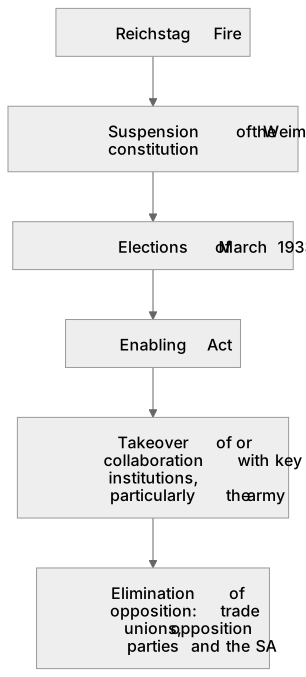
Put it in order
Put these steps in the order they happen.
- 1. Elections of March 1933
- 2. Suspension of the Weimar constitution
- 3. Reichstag Fire
- 4. Elimination of opposition: trade unions, opposition parties and the SA
- 5. Takeover of or collaboration with key institutions, particularly the army
- 6. Enabling Act
Put the events in order
Put these events in the order they happened, earliest first.
- 1. Elimination of the SA
- 2. Nazi party was weak
- 3. Reichstag Fire and suspension of Weimar constitution
- 4. Depression and crisis raised Nazi support
Key words
Say what each word means before you turn the card.
Weimar stability and fragility 1925–1928
Try answering aloud or in your head before turning the card.
Nazi weakness in the 1920s
Try answering aloud or in your head before turning the card.
Impact of the Depression
Try answering aloud or in your head before turning the card.
Crisis and rising Nazi support 1929–1933
Try answering aloud or in your head before turning the card.
See every definition
- Weimar stability and fragility 1925–1928
- The period had strengths such as economic recovery, foreign policy successes and cultural life, alongside weaknesses such as fragile coalition governments, dependence on foreign loans and lingering hostility to democracy.
- Nazi weakness in the 1920s
- Nazi policies in the 1920s gained little traction and the party was weak in 1928.
- Impact of the Depression
- The Depression had an uneven impact on different groups in Germany.
- Crisis and rising Nazi support 1929–1933
- The political, social and economic crisis of 1929–1933 resulted in rising support for the Nazis.
Label the diagram
Some boxes have lost their names. Pick the right name for each number.
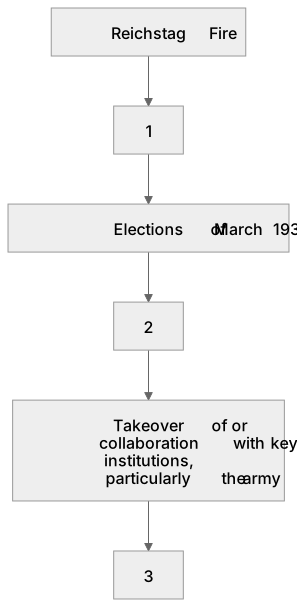
1Box 1
2Box 2
3Box 3
There is more to this lesson
The full lesson goes on to check your understanding and help you earn the marks. Create a free account to carry on, with your progress saved.
A week of Premium from your first lesson · Then the free plan continues · No card, no charge
Test your understanding of Germany 1925–1955: The People and the State (J410/02) - The rise and consolidation of the Nazi regime 1925–1934: Strengths and weaknesses of the Weimar Republic 1925–1928, including Nazi policies in the 1920s and the position of the party in 1928; the impact of the Depression on different groups in Germany; the political, social and economic crisis of 1929–1933; rising support for Nazis 1929–1933; the Nazi consolidation of power 1933–1934, including the Reichstag Fire, the suspension of the Weimar constitution and the Enabling Act, the elections of March 1933, the takeover of/or collaboration with key institutions (particularly the army), and the elimination of opposition (including trade unions, opposition parties and the SA).
Active recall beats re-reading. Take an instant quiz now to test what you’ve learned and lock it into long-term memory.
A week of Premium from your first lesson · Then the free plan continues · No card, no charge