OCR · GCSE · History
Course version: J410 · Version from Mar 2026
The changing international order 1918–1975 - Cold War confrontations and…
Full specification wording
International Relations: the changing international order 1918–1975 - Cold War confrontations and conflict 1954–1975: Developing Cold War tensions and conflicts
This topic covers how Cold War tensions turned into open conflict between 1954 and 1975.
Checked against the OCR J410 specification (opens in a new tab) on .
- Point 1 of 6
- 4 key terms
Study notes
From the checked teaching notes for this specification point.
The idea
This topic covers how Cold War tensions turned into open conflict between 1954 and 1975. Learn the main confrontations and their causes and consequences. Key examples include the division of Vietnam after 1954 and the growing involvement of the superpowers, the Cuban Missile Crisis of 1962, and the Vietnam War, which drew in the United States and ended with its withdrawal in 1973 and the reunification of Vietnam in 1975. For each conflict, know who was involved, why tensions rose, and what the outcome was. Link each event to the wider superpower rivalry between the United States and the Soviet Union, and explain how each confrontation increased or eased tension.
What earns the marks
- Identifies a specific Cold War confrontation within the period 1954–1975, such as the Cuban Missile Crisis or the Vietnam War.
- Explains a cause of rising tension, such as superpower rivalry or the spread of communist and capitalist influence.
- Describes a consequence of a conflict, such as the US withdrawal from Vietnam in 1973.
- Explains how a confrontation increased or eased Cold War tensions between the superpowers.
Common mistakes and how to put them right
Places conflicts outside the stated period, such as the Berlin Blockade of 1948–1949.
Put it right: Keep examples within 1954–1975.
Describes a conflict without naming the countries or leaders involved.
Put it right: Identify the agents.
Treats each conflict as separate from the superpower rivalry.
Put it right: Link it to US–Soviet tension.
Exam tips
- Learn the dates and outcomes of at least two conflicts in the period 1954–1975.
- For each conflict, prepare a cause, a key event and a consequence.
- Practise explaining how a conflict affected wider US–Soviet relations.
Try the lesson
The start of the International Relations: the changing international order 1918–1975 - Cold War confrontations and conflict 1954–1975: Developing Cold War tensions and conflicts lesson, made from checked teaching notes for this specification point.
Have a go first
In which country did the United States become heavily involved in a war during the 1960s as part of Cold War containment?
Listen
This topic covers how Cold War tensions turned into open conflict between 1954 and 1975. Learn the main confrontations and their causes and consequences. Key examples include the division of Vietnam after 1954 and the growing involvement of the superpowers, the Cuban Missile Crisis of 1962, and the Vietnam War, which drew in the United States and ended with its withdrawal in 1973 and the reunification of Vietnam in 1975. For each conflict, know who was involved, why tensions rose, and what the outcome was. Link each event to the wider superpower rivalry between the United States and the Soviet Union, and explain how each confrontation increased or eased tension. A strong answer earns marks for these points. Identifies a specific Cold War confrontation within the period 1954–1975, such as the Cuban Missile Crisis or the Vietnam War. Explains a cause of rising tension, such as superpower rivalry or the spread of communist and capitalist influence. Describes a consequence of a conflict, such as the US withdrawal from Vietnam in 1973. Explains how a confrontation increased or eased Cold War tensions between the superpowers. Exam tip: Learn the dates and outcomes of at least two conflicts in the period 1954–1975.
See it
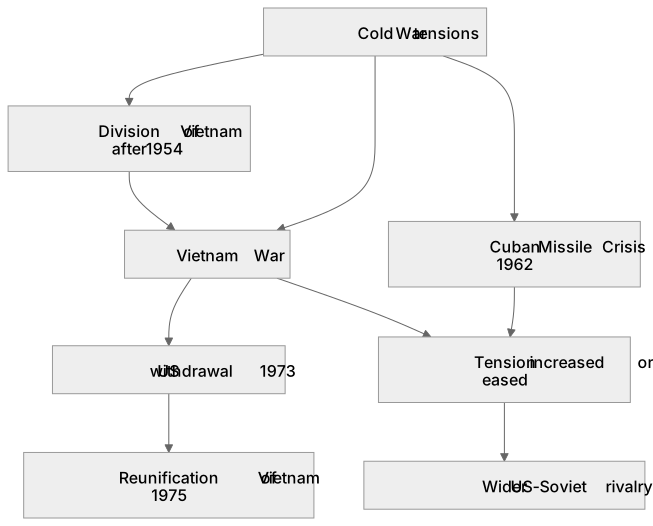
Put the events in order
Put these events in the order they happened, earliest first.
- 1. Reunification of Vietnam
- 2. Division of Vietnam after the conflict
- 3. US withdrawal from Vietnam
- 4. Cuban Missile Crisis
Key words
Say what each word means before you turn the card.
Superpower rivalry and the spread of influence
Try answering aloud or in your head before turning the card.
The Cuban Missile Crisis
Try answering aloud or in your head before turning the card.
The Vietnam War and US involvement
Try answering aloud or in your head before turning the card.
Consequences of conflict for international relations
Try answering aloud or in your head before turning the card.
See every definition
- Superpower rivalry and the spread of influence
- Rivalry between the United States and the Soviet Union, and the spread of communist and capitalist influence, which was a cause of rising tension.
- The Cuban Missile Crisis
- A Cold War confrontation of 1962 within the period 1954–1975, named as an example of a confrontation between the superpowers.
- The Vietnam War and US involvement
- A confrontation that drew in the United States and ended with its withdrawal in 1973 and the reunification of Vietnam in 1975.
- Consequences of conflict for international relations
- Outcomes such as the US withdrawal from Vietnam in 1973, and how a confrontation increased or eased Cold War tensions between the superpowers.
Label the diagram
Some boxes have lost their names. Pick the right name for each number.
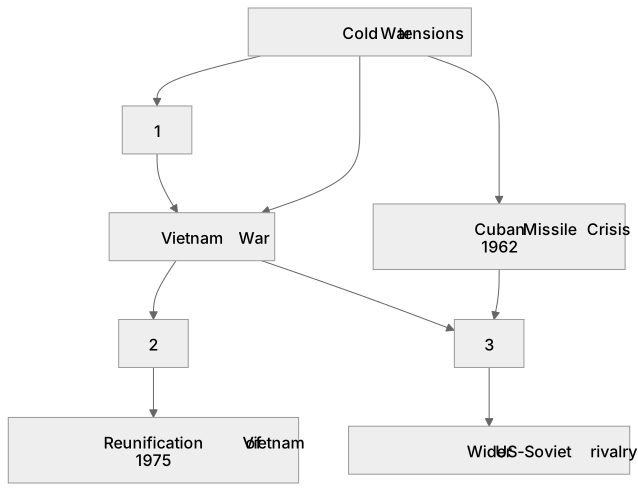
1Box 1
2Box 2
3Box 3
There is more to this lesson
The full lesson goes on to check your understanding and help you earn the marks. Create a free account to carry on, with your progress saved.
A week of Premium from your first lesson · Then the free plan continues · No card, no charge
Test your understanding of International Relations: the changing international order 1918–1975 - Cold War confrontations and conflict 1954–1975: Developing Cold War tensions and conflicts
Active recall beats re-reading. Take an instant quiz now to test what you’ve learned and lock it into long-term memory.
A week of Premium from your first lesson · Then the free plan continues · No card, no charge