OCR · GCSE · History
Course version: J410 · Version from Mar 2026
The changing international order 1918–1975 - Cold War confrontations and…
Full specification wording
International Relations: the changing international order 1918–1975 - Cold War confrontations and conflict 1954–1975: The end of the war and its impact on international relations.
This bullet sits in the Vietnam War strand of the Cold War confrontations section, so 'the war' means the Vietnam War and 'the end' means its closing phase.
Checked against the OCR J410 specification (opens in a new tab) on .
- Point 6 of 6
- 4 key terms
Study notes
From the checked teaching notes for this specification point.
The idea
This bullet sits in the Vietnam War strand of the Cold War confrontations section, so 'the war' means the Vietnam War and 'the end' means its closing phase. Teach learners to trace the sequence with named agents: Nixon's administration pursued 'Vietnamisation' and widened bombing into Cambodia; the Paris Peace Accords of January 1973 were signed by the United States, North Vietnam, South Vietnam and the Viet Cong, after which US combat forces withdrew; North Vietnamese forces took Saigon in April 1975 and South Vietnam fell. Then assess impact on international relations: détente between the superpowers continued alongside the collapse of a US-backed state, Congress limited further US military action, and regional neighbours in South-East Asia faced a changed balance of power.
What earns the marks
- Identifies the war as the Vietnam War and places its ending in the 1954–1975 period of the section.
- Names the January 1973 Paris Peace Accords and the withdrawal of US combat forces that followed them.
- States that North Vietnamese forces captured Saigon in 1975 and that South Vietnam fell.
- Explains an impact on international relations, such as the effect on US credibility, on détente or on the regional balance in South-East Asia.
Common mistakes and how to put them right
Treats 'the war' as an unnamed generic conflict.
Put it right: Name the Vietnam War and its closing events.
Dates the US withdrawal and the fall of Saigon as the same event.
Put it right: Separate the 1973 accords and withdrawal from the 1975 fall of Saigon.
Describes only events inside Vietnam and ignores the impact on international relations.
Put it right: Add a consequence for superpower or regional relations.
Exam tips
- Read the stem for the date range 1954–1975 and reject options set outside it.
- Link each option to a named agent, such as Nixon's administration or North Vietnamese forces, to test whether it is accurate.
- When two options both sound plausible, choose the one that addresses impact on international relations rather than only military detail.
Try the lesson
The start of the International Relations: the changing international order 1918–1975 - Cold War confrontations and conflict 1954–1975: The end of the war and its impact on international relations. lesson, made from checked teaching notes for this specification point.
Have a go first
What was the name of the American programme that gave economic aid to help rebuild Western Europe after 1945?
Listen
This bullet sits in the Vietnam War strand of the Cold War confrontations section, so 'the war' means the Vietnam War and 'the end' means its closing phase. Teach learners to trace the sequence with named agents: Nixon's administration pursued 'Vietnamisation' and widened bombing into Cambodia; the Paris Peace Accords of January 1973 were signed by the United States, North Vietnam, South Vietnam and the Viet Cong, after which US combat forces withdrew; North Vietnamese forces took Saigon in April 1975 and South Vietnam fell. Then assess impact on international relations: détente between the superpowers continued alongside the collapse of a US-backed state, Congress limited further US military action, and regional neighbours in South-East Asia faced a changed balance of power. A strong answer earns marks for these points. Identifies the war as the Vietnam War and places its ending in the 1954–1975 period of the section. Names the January 1973 Paris Peace Accords and the withdrawal of US combat forces that followed them. States that North Vietnamese forces captured Saigon in 1975 and that South Vietnam fell. Explains an impact on international relations, such as the effect on US credibility, on détente or on the regional balance in South-East Asia. Exam tip: Read the stem for the date range 1954–1975 and reject options set outside it.
See it
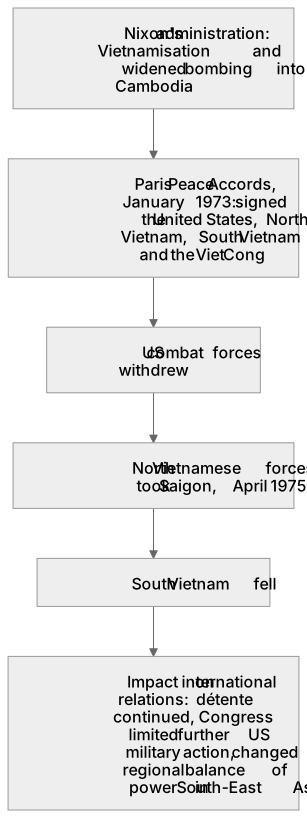
Put it in order
Put these steps in the order they happen.
- 1. US combat forces withdrew
- 2. Paris Peace Accords, January 1973: signed by the United States, North Vietnam, South Vietnam and the Viet Cong
- 3. Nixon's administration: Vietnamisation and widened bombing into Cambodia
- 4. Impact on international relations: détente continued, Congress limited further US military action, changed regional balance of power in South-East Asia
- 5. South Vietnam fell
- 6. North Vietnamese forces took Saigon, April 1975
Key words
Say what each word means before you turn the card.
Ending of the Vietnam War
Try answering aloud or in your head before turning the card.
Paris Peace Accords 1973
Try answering aloud or in your head before turning the card.
Fall of Saigon 1975
Try answering aloud or in your head before turning the card.
Impact on superpower and regional relations
Try answering aloud or in your head before turning the card.
See every definition
- Ending of the Vietnam War
- The closing phase of the Vietnam War, in which US combat forces withdrew after the Paris Peace Accords and North Vietnamese forces took Saigon.
- Paris Peace Accords 1973
- Agreement of January 1973 signed by the United States, North Vietnam, South Vietnam and the Viet Cong, after which US combat forces withdrew.
- Fall of Saigon 1975
- North Vietnamese forces took Saigon in April 1975 and South Vietnam fell.
- Impact on superpower and regional relations
- Détente between the superpowers continued alongside the collapse of a US-backed state, Congress limited further US military action, and regional neighbours in South-East Asia faced a changed balance of power.
Label the diagram
Some boxes have lost their names. Pick the right name for each number.
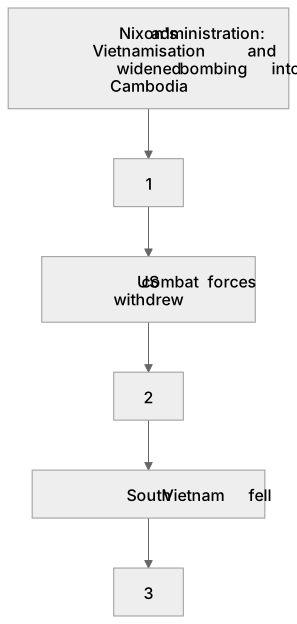
1Box 1
2Box 2
3Box 3
There is more to this lesson
The full lesson goes on to check your understanding and help you earn the marks. Create a free account to carry on, with your progress saved.
A week of Premium from your first lesson · Then the free plan continues · No card, no charge
Test your understanding of International Relations: the changing international order 1918–1975 - Cold War confrontations and conflict 1954–1975: The end of the war and its impact on international relations.
Active recall beats re-reading. Take an instant quiz now to test what you’ve learned and lock it into long-term memory.
A week of Premium from your first lesson · Then the free plan continues · No card, no charge