OCR · GCSE · History
Course version: J410 · Version from Mar 2026
The changing international order 1918–1975 - Conflict and co-operation…
Full specification wording
International Relations: the changing international order 1918–1975 - Conflict and co-operation 1918–1939: The Versailles Peace Settlement; the League of Nations in the 1920s; international agreements in the 1920s (Dawes Plan 1924, Locarno 1925, Kellogg-Briand 1928, Young Plan 1929); attempts at disarmament.
This topic covers the Versailles Peace Settlement, the League of Nations in the 1920s, the international agreements of that decade and attempts at disarmament.
Checked against the OCR J410 specification (opens in a new tab) on .
- Point 2 of 4
- 4 key terms
Study notes
From the checked teaching notes for this specification point.
The idea
This topic covers the Versailles Peace Settlement, the League of Nations in the 1920s, the international agreements of that decade and attempts at disarmament. Learn what Versailles imposed on Germany and why it caused resentment. Learn how the League handled disputes and its membership. Learn each agreement with its year: the Dawes Plan 1924 rescheduled German reparations, Locarno 1925 improved relations, Kellogg-Briand 1928 renounced war, and the Young Plan 1929 further revised reparations. Learn the disarmament attempts, including the Washington Naval Conference 1921–1922 and the failure of the World Disarmament Conference in the early 1930s. Match each term to its date and purpose.
What earns the marks
- Identifies a key term of the Versailles Peace Settlement, such as reparations, territorial loss or military limits on Germany.
- Describes the role of the League of Nations in the 1920s, including settling some disputes and its membership limits.
- Matches each international agreement to its year and purpose: Dawes Plan 1924, Locarno 1925, Kellogg-Briand 1928 and Young Plan 1929.
- Explains an attempt at disarmament and whether it succeeded or failed, such as the Washington Naval Conference or the World Disarmament Conference.
Common mistakes and how to put them right
Mixes up the years of the agreements.
Put it right: Attach Dawes to 1924, Locarno to 1925, Kellogg-Briand to 1928 and Young to 1929.
Treats the League of Nations as able to enforce decisions with its own army.
Put it right: Recognise that it relied on member co-operation.
Confuses the Washington Naval Conference with the World Disarmament Conference.
Put it right: Keep each attempt and its outcome distinct.
Assumes Versailles alone caused later conflict.
Put it right: Weigh it alongside the League and the agreements of the 1920s.
Exam tips
- Check the date in each option against the agreement named before choosing.
- Link each term to its purpose, not just its year, to rule out close distractors.
- Use the wording of the question to decide whether it asks about Versailles, the League, an agreement or disarmament.
Try the lesson
The start of the International Relations: the changing international order 1918–1975 - Conflict and co-operation 1918–1939: The Versailles Peace Settlement; the League of Nations in the 1920s; international agreements in the 1920s (Dawes Plan 1924, Locarno 1925, Kellogg-Briand 1928, Young Plan 1929); attempts at disarmament. lesson, made from checked teaching notes for this specification point.
Have a go first
Under the Treaty of Versailles of 1919, which territory was returned to France?
Listen
This topic covers the Versailles Peace Settlement, the League of Nations in the 1920s, the international agreements of that decade and attempts at disarmament. Learn what Versailles imposed on Germany and why it caused resentment. Learn how the League handled disputes and its membership. Learn each agreement with its year: the Dawes Plan 1924 rescheduled German reparations, Locarno 1925 improved relations, Kellogg-Briand 1928 renounced war, and the Young Plan 1929 further revised reparations. Learn the disarmament attempts, including the Washington Naval Conference 1921–1922 and the failure of the World Disarmament Conference in the early 1930s. Match each term to its date and purpose. A strong answer earns marks for these points. Identifies a key term of the Versailles Peace Settlement, such as reparations, territorial loss or military limits on Germany. Describes the role of the League of Nations in the 1920s, including settling some disputes and its membership limits. Matches each international agreement to its year and purpose: Dawes Plan 1924, Locarno 1925, Kellogg-Briand 1928 and Young Plan 1929. Explains an attempt at disarmament and whether it succeeded or failed, such as the Washington Naval Conference or the World Disarmament Conference. Exam tip: Check the date in each option against the agreement named before choosing.
See it
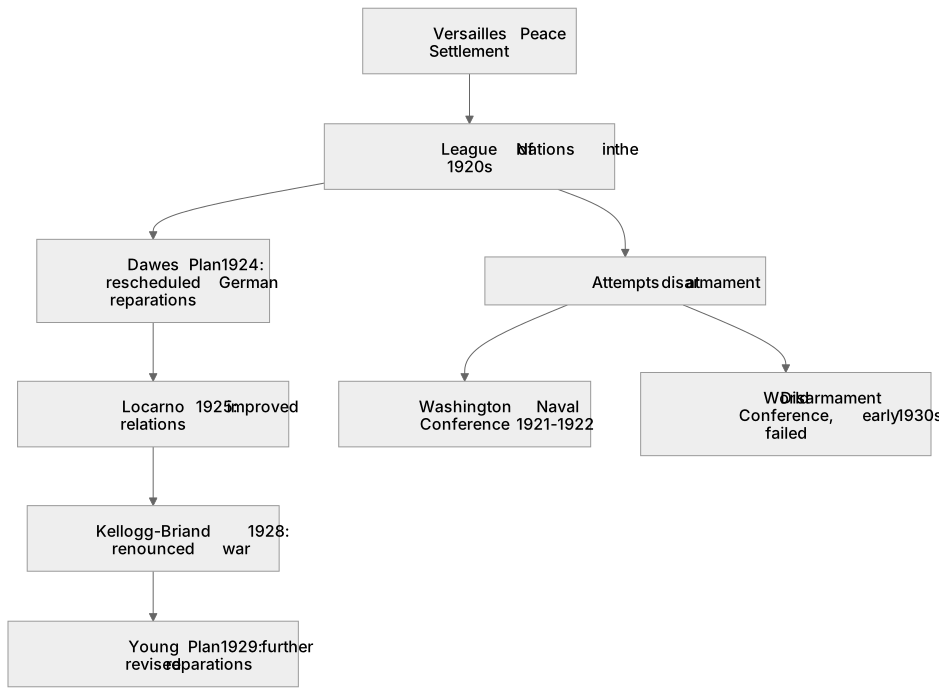
Put the events in order
Put these events in the order they happened, earliest first.
- 1. Dawes Plan rescheduled German reparations
- 2. Washington Naval Conference begins as a disarmament attempt
- 3. Young Plan further revised reparations
- 4. Locarno improved relations
- 5. Kellogg-Briand renounced war
Key words
Say what each word means before you turn the card.
The Versailles Peace Settlement
Try answering aloud or in your head before turning the card.
The League of Nations in the 1920s
Try answering aloud or in your head before turning the card.
International agreements of the 1920s
Try answering aloud or in your head before turning the card.
Attempts at disarmament
Try answering aloud or in your head before turning the card.
See every definition
- The Versailles Peace Settlement
- Imposed reparations, territorial loss and military limits on Germany, and caused resentment.
- The League of Nations in the 1920s
- Settled some disputes and had membership limits, relying on member co-operation rather than its own army.
- International agreements of the 1920s
- The Dawes Plan 1924 rescheduled German reparations, Locarno 1925 improved relations, Kellogg-Briand 1928 renounced war and the Young Plan 1929 further revised reparations.
- Attempts at disarmament
- Included the Washington Naval Conference 1921–1922 and the failure of the World Disarmament Conference in the early 1930s.
Label the diagram
Some boxes have lost their names. Pick the right name for each number.
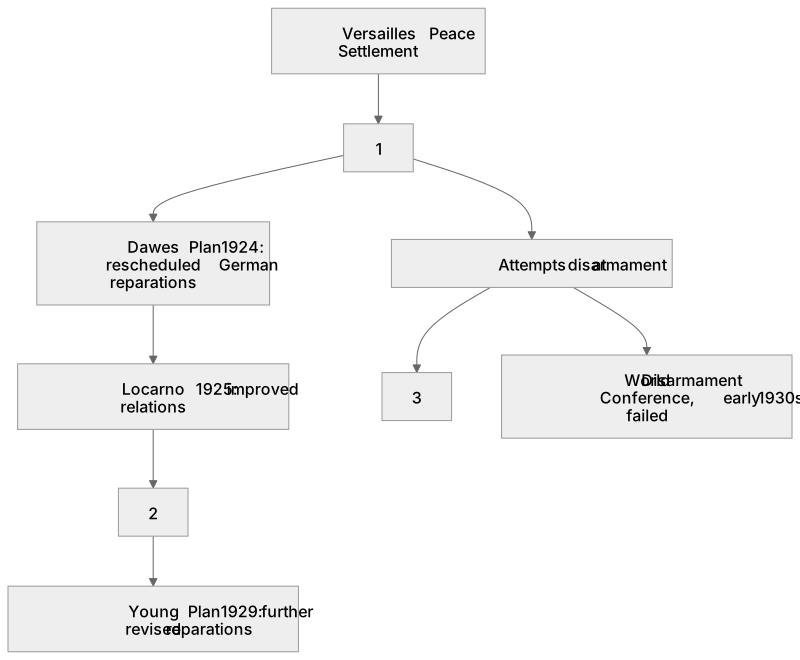
1Box 1
2Box 2
3Box 3
There is more to this lesson
The full lesson goes on to check your understanding and help you earn the marks. Create a free account to carry on, with your progress saved.
A week of Premium from your first lesson · Then the free plan continues · No card, no charge
Test your understanding of International Relations: the changing international order 1918–1975 - Conflict and co-operation 1918–1939: The Versailles Peace Settlement; the League of Nations in the 1920s; international agreements in the 1920s (Dawes Plan 1924, Locarno 1925, Kellogg-Briand 1928, Young Plan 1929); attempts at disarmament.
Active recall beats re-reading. Take an instant quiz now to test what you’ve learned and lock it into long-term memory.
A week of Premium from your first lesson · Then the free plan continues · No card, no charge