OCR · GCSE · History
Course version: J410 · Version from Mar 2026
The continued growth of diverse port communities in the early twentieth…
Full specification wording
Migration to Britain c.1000 to c.2010 (J410/08) - 1900–c.2010: The continued growth of diverse port communities in the early twentieth century.
Port cities such as Liverpool, Cardiff, London and South Shields kept growing as diverse communities in the early twentieth century because shipping needed labour and migrants settled near docks…
Checked against the OCR J410 specification (opens in a new tab) on .
- Point 1 of 4
- 4 key terms
Study notes
From the checked teaching notes for this specification point.
The idea
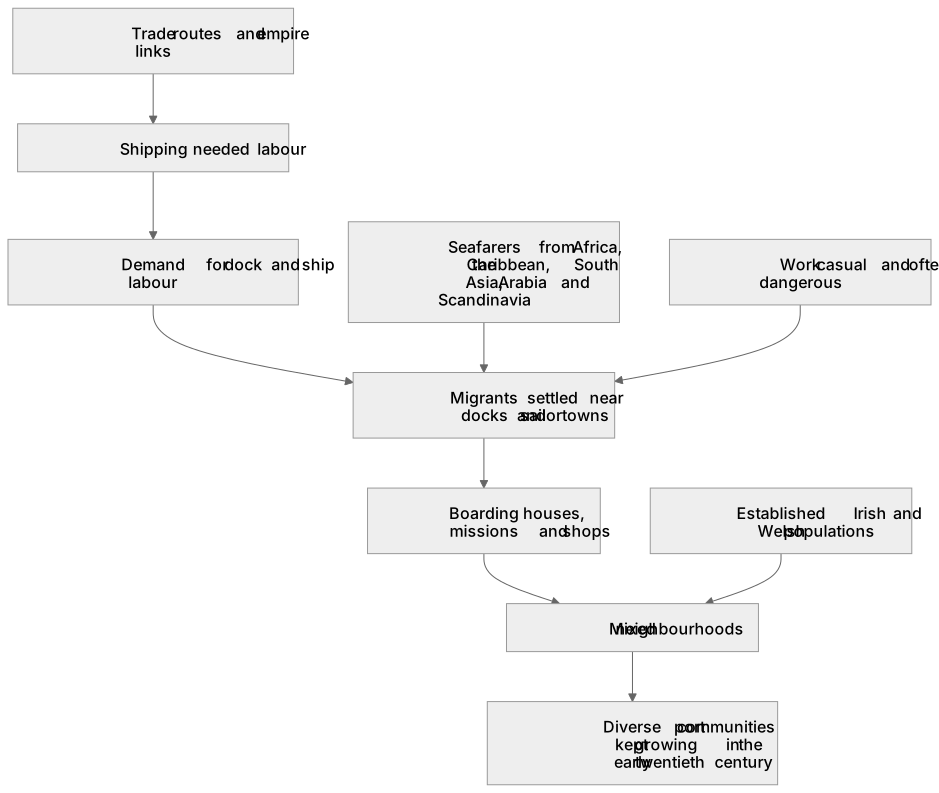
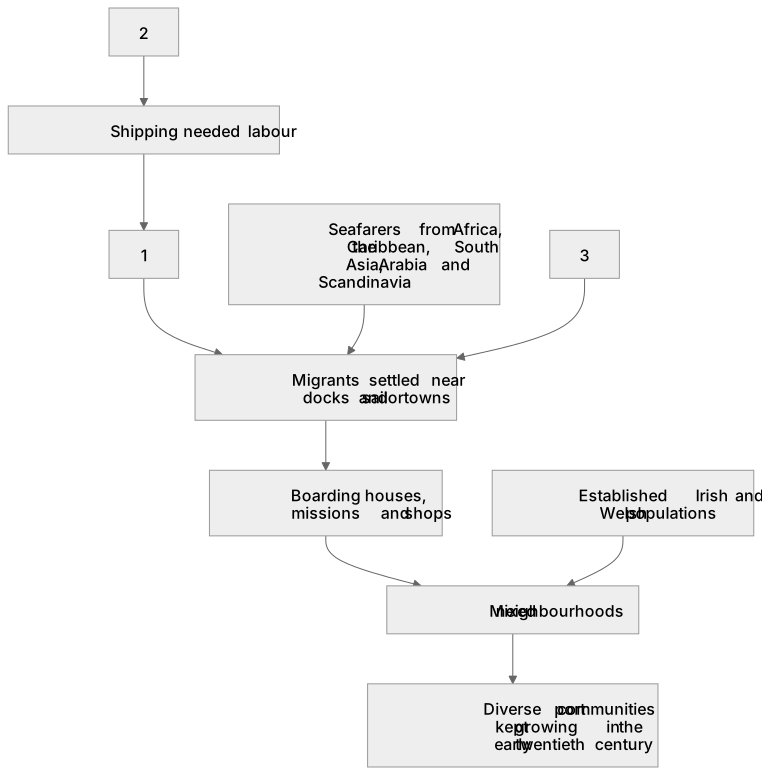
Port cities such as Liverpool, Cardiff, London and South Shields kept growing as diverse communities in the early twentieth century because shipping needed labour and migrants settled near docks and sailortowns. Seafarers from Africa, the Caribbean, South Asia, Arabia and Scandinavia joined established Irish and Welsh populations, forming mixed neighbourhoods with boarding houses, missions and shops. Work was casual and often dangerous, so communities clustered where hiring happened. Learners should connect this growth to trade routes, empire links and the demand for dock and ship labour, and recognise that diversity was long-standing rather than new after 1945. A good answer identifies a port, a migrant group and a reason for settlement there.
What earns the marks
- Identifies a named British port such as Liverpool, Cardiff or London's East End as a site of diverse settlement.
- Explains that demand for dock, shipping and boarding-house labour drew migrants to port neighbourhoods.
- Links diversity to empire and trade routes that connected British ports to Africa, the Caribbean and South Asia.
- Recognises that port communities were already diverse before 1945 rather than only after the Second World War.
Common mistakes and how to put them right
Assumes diverse port communities began only with post-1945 Commonwealth migration.
Put it right: Place the growth in the early twentieth century.
Treats all migrants in ports as a single group.
Put it right: Distinguish seafarers, settlers and their families by origin.
Ignores the economic cause of settlement.
Put it right: Connect communities to dock and shipping work.
Exam tips
- Name a specific port and one migrant group to make the point concrete.
- Give the economic reason for settlement, not just the fact of diversity.
- Keep the answer inside the 1900–c.2010 period and avoid drifting into earlier centuries.
Try the lesson
The start of the Migration to Britain c.1000 to c.2010 (J410/08) - 1900–c.2010: The continued growth of diverse port communities in the early twentieth century. lesson, made from checked teaching notes for this specification point.
Have a go first
In which type of neighbourhood did many migrant seamen settle in early twentieth-century port cities?
Listen
Port cities such as Liverpool, Cardiff, London and South Shields kept growing as diverse communities in the early twentieth century because shipping needed labour and migrants settled near docks and sailortowns. Seafarers from Africa, the Caribbean, South Asia, Arabia and Scandinavia joined established Irish and Welsh populations, forming mixed neighbourhoods with boarding houses, missions and shops. Work was casual and often dangerous, so communities clustered where hiring happened. Learners should connect this growth to trade routes, empire links and the demand for dock and ship labour, and recognise that diversity was long-standing rather than new after 1945. A good answer identifies a port, a migrant group and a reason for settlement there. A strong answer earns marks for these points. Identifies a named British port such as Liverpool, Cardiff or London's East End as a site of diverse settlement. Explains that demand for dock, shipping and boarding-house labour drew migrants to port neighbourhoods. Links diversity to empire and trade routes that connected British ports to Africa, the Caribbean and South Asia. Recognises that port communities were already diverse before 1945 rather than only after the Second World War. Exam tip: Name a specific port and one migrant group to make the point concrete.
See it
Key words
Say what each word means before you turn the card.
Port cities and sailortowns
Try answering aloud or in your head before turning the card.
Labour and casual dock work
Try answering aloud or in your head before turning the card.
Empire and trade routes
Try answering aloud or in your head before turning the card.
Long-standing diversity before 1945
Try answering aloud or in your head before turning the card.
See every definition
- Port cities and sailortowns
- Places such as Liverpool, Cardiff, London and South Shields that kept growing as diverse communities in the early twentieth century, with migrants settling near docks and sailortowns.
- Labour and casual dock work
- Work that was casual and often dangerous, so communities clustered where hiring happened.
- Empire and trade routes
- Links that connected British ports to Africa, the Caribbean and South Asia, to which the growth of diverse port communities should be connected.
- Long-standing diversity before 1945
- The recognition that port communities were already diverse before 1945 rather than only after the Second World War.
Label the diagram
Some boxes have lost their names. Pick the right name for each number.
1Box 1
2Box 2
3Box 3
There is more to this lesson
The full lesson goes on to check your understanding and help you earn the marks. Create a free account to carry on, with your progress saved.
A week of Premium from your first lesson · Then the free plan continues · No card, no charge
Test your understanding of Migration to Britain c.1000 to c.2010 (J410/08) - 1900–c.2010: The continued growth of diverse port communities in the early twentieth century.
Active recall beats re-reading. Take an instant quiz now to test what you’ve learned and lock it into long-term memory.
A week of Premium from your first lesson · Then the free plan continues · No card, no charge