OCR · GCSE · History
Course version: J410 · Version from Mar 2026
The process of naturalisation and denization: government legislation on…
Full specification wording
Migration to Britain c.1000 to c.2010 (J410/08) - c.1500–1900: The process of naturalisation and denization: government legislation on immigration and nationality, including the Naturalisation Act of 1870.
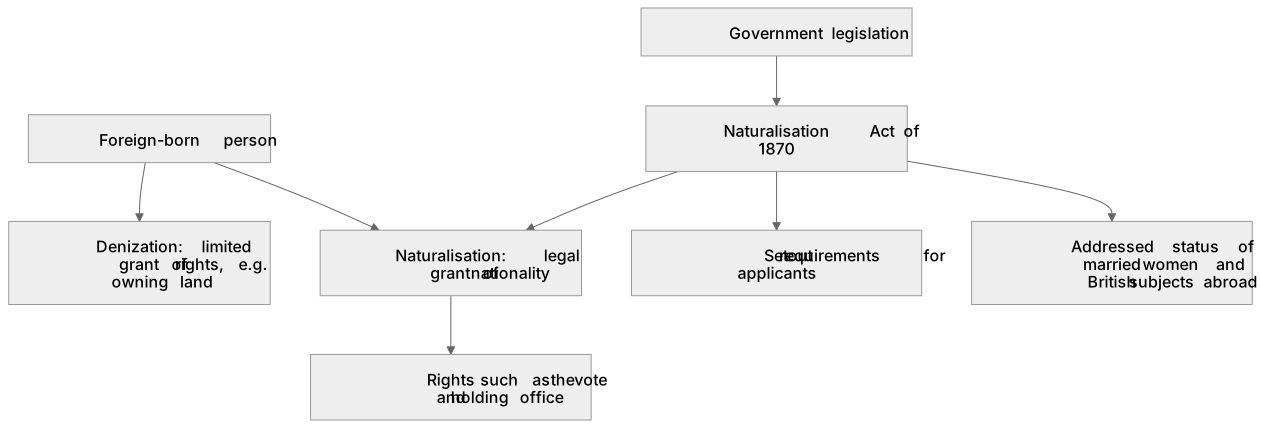
Naturalisation is the legal process by which a foreign-born person acquires the nationality of a state, gaining rights such as the vote and the ability to hold office.
Checked against the OCR J410 specification (opens in a new tab) on .
- Point 5 of 5
- 4 key terms
Study notes
From the checked teaching notes for this specification point.
The idea
Naturalisation is the legal process by which a foreign-born person acquires the nationality of a state, gaining rights such as the vote and the ability to hold office. Denization was an older, more limited grant that gave a foreigner some rights, such as owning land, without full citizenship. Government legislation shaped who could become British and on what terms. The Naturalisation Act of 1870 reformed the law, allowing aliens to apply for naturalisation and setting out requirements, while also addressing the status of married women and British subjects abroad. Understanding the difference between the two processes and the role of statute helps explain how the state controlled membership of the nation.
What earns the marks
- Defines naturalisation as the legal grant of nationality to a foreign-born person with associated rights.
- Distinguishes denization as a more limited grant of rights falling short of full nationality.
- Identifies the Naturalisation Act of 1870 as government legislation reforming nationality law.
- Explains that legislation determined who could become British and under what conditions.
- Recognises that naturalisation conferred rights such as voting or holding office that denization did not fully provide.
Common mistakes and how to put them right
Treats naturalisation and denization as identical.
Put it right: Distinguish full nationality from a limited grant of rights.
Assumes anyone could naturalise freely without legal conditions.
Put it right: Note that statute set requirements.
Places the Naturalisation Act outside the stated period.
Put it right: Keep it within c.1500–1900.
Confuses naturalisation with simple entry to the country.
Put it right: Recognise it as a legal status change.
Exam tips
- Check whether an option describes naturalisation or denization before selecting it.
- Look for the option that correctly links the 1870 Act to nationality legislation.
- Eliminate options that describe rights denization did not grant.
- Confirm any date in an option sits within the c.1500–1900 period.
Try the lesson
The start of the Migration to Britain c.1000 to c.2010 (J410/08) - c.1500–1900: The process of naturalisation and denization: government legislation on immigration and nationality, including the Naturalisation Act of 1870. lesson, made from checked teaching notes for this specification point.
Have a go first
Before the Naturalisation Act of 1870, what was the key legal difference between a person who was naturalised and a person who was only denizened?
Listen
Naturalisation is the legal process by which a foreign-born person acquires the nationality of a state, gaining rights such as the vote and the ability to hold office. Denization was an older, more limited grant that gave a foreigner some rights, such as owning land, without full citizenship. Government legislation shaped who could become British and on what terms. The Naturalisation Act of 1870 reformed the law, allowing aliens to apply for naturalisation and setting out requirements, while also addressing the status of married women and British subjects abroad. Understanding the difference between the two processes and the role of statute helps explain how the state controlled membership of the nation. A strong answer earns marks for these points. Defines naturalisation as the legal grant of nationality to a foreign-born person with associated rights. Distinguishes denization as a more limited grant of rights falling short of full nationality. Identifies the Naturalisation Act of 1870 as government legislation reforming nationality law. Explains that legislation determined who could become British and under what conditions. Exam tip: Check whether an option describes naturalisation or denization before selecting it.
See it
Key words
Say what each word means before you turn the card.
Naturalisation
Try answering aloud or in your head before turning the card.
Denization
Try answering aloud or in your head before turning the card.
Government legislation on nationality
Try answering aloud or in your head before turning the card.
The Naturalisation Act of 1870
Try answering aloud or in your head before turning the card.
See every definition
- Naturalisation
- The legal process by which a foreign-born person acquires the nationality of a state, gaining rights such as the vote and the ability to hold office.
- Denization
- An older, more limited grant that gave a foreigner some rights, such as owning land, without full citizenship.
- Government legislation on nationality
- Legislation that shaped who could become British and on what terms, determining membership of the nation.
- The Naturalisation Act of 1870
- Government legislation that reformed the law, allowing aliens to apply for naturalisation and setting out requirements.
Label the diagram
Some boxes have lost their names. Pick the right name for each number.
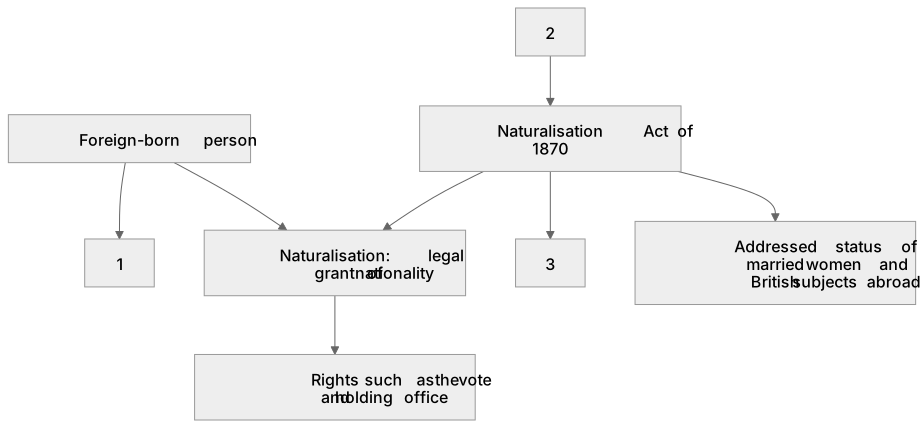
1Box 1
2Box 2
3Box 3
There is more to this lesson
The full lesson goes on to check your understanding and help you earn the marks. Create a free account to carry on, with your progress saved.
A week of Premium from your first lesson · Then the free plan continues · No card, no charge
Test your understanding of Migration to Britain c.1000 to c.2010 (J410/08) - c.1500–1900: The process of naturalisation and denization: government legislation on immigration and nationality, including the Naturalisation Act of 1870.
Active recall beats re-reading. Take an instant quiz now to test what you’ve learned and lock it into long-term memory.
A week of Premium from your first lesson · Then the free plan continues · No card, no charge